
- Technology explained – machines and equipment
Sorters: sliding shoe, cross-belt, tilt tray – how they distribute parcels
By Tobias Schott · 5-minute read · Updated November 2026
A sorter automatically distributes conveyed goods to destinations – and how it takes the item off the conveyor decides what it can sort, how gently it handles items and where it wears.
You encounter sorters in parcel hubs, distribution warehouses, baggage handling systems at airports and in retail logistics. Names such as sliding shoe sorter, cross-belt sorter or tilt tray sorter come up in conversation. For operators and maintenance the design is more than a name: it determines spare parts, maintenance effort and downtime risk.
This article explains how a sorter is built and how the designs sort. How to maintain a sorting system in continuous operation is covered in the guide Sorting system maintenance.
What is a sorter?
A sorter is a conveyor system that identifies conveyed goods and automatically discharges them to the destination assigned by the control. In German it is called Sorter, Sortieranlage or Sortiersystem; in English “sorter” or “sortation system”.
Every sorter has four areas. In the induction the item is singulated, aligned and placed on the sorter. In the identification a scanner reads the barcode or label, and the item is often weighed and measured too. On the sorting line the item runs to its destination. At the discharge it leaves the sorter onto a chute, a conveyor or into a container.
Key facts
- Purpose: Automatically distribute conveyed goods by destination, route or order.
- Types: Sliding shoe, cross-belt, tilt tray, pop-up and pocket sorters, plus simple diverters and pushers.
- Format: Linear with discharges along a line or as a closed loop that lets the item circulate.
- Drive: Usually electric motors with gearbox, on loop sorters often linear motors or chain drive; diverters and discharge units electric or pneumatic.
- Typical applications: Parcel and express hubs, distribution warehouses, baggage handling systems, returns processing.
- Standard: EN 619 for the safety of continuous handling equipment for unit loads.
- Common misconception: A sorter is a conveyor with diverters – in fact it is a finely tuned system of mechanics, sensors and control.
How the designs sort
The designs differ in how the item leaves the sorting line.
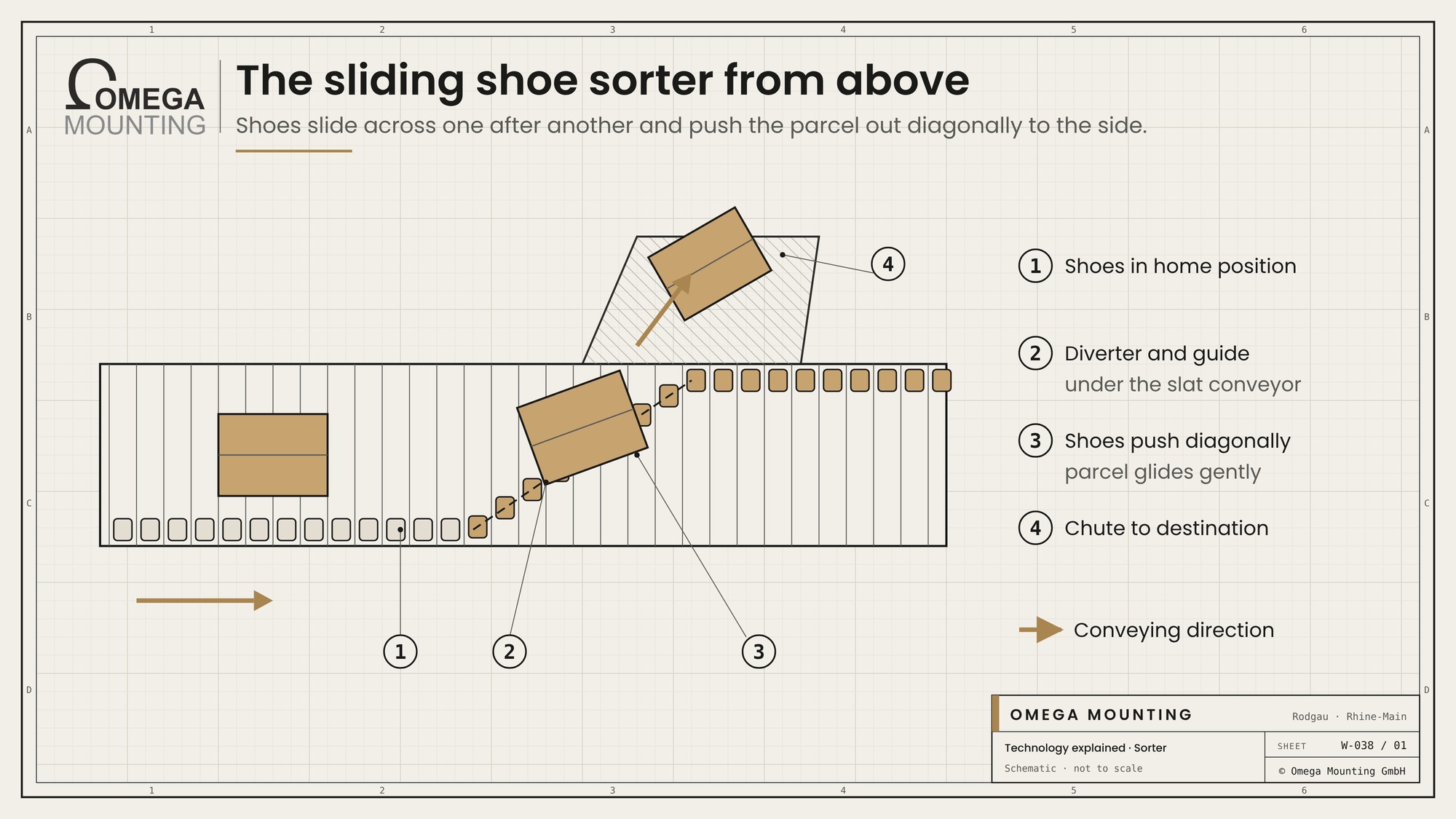
Sliding shoe sorter. It consists of a slat conveyor on which transversely movable shoes sit. Under the conveyor a diverter guides the shoes into a diagonal track. The shoes slide across one after another and push the parcel gently and diagonally out to the side. It works linearly, sorts to both sides and is suitable for cartons and parcels with a firm base.
Cross-belt sorter. On a circulating train of carriers, each carrier has a small conveyor belt running across the direction of travel. At the destination this belt starts and conveys the item off to the side. It sorts very precisely and gently, including small and soft goods, and is usually built as a loop.
Tilt tray sorter. Each carrier holds a tray that tilts to the side at the destination. The item slides out. It is simple in principle and handles many goods, but discharges sensitive or round items less controllably.

Pop-up sorter. In a roller or belt conveyor, angled rollers or wheels rise at the discharge and divert the item sideways. It is compact and suitable for cartons and totes.
Pocket sorter. The item hangs in pockets on an overhead rail and is dropped over the destination. It buffers and sorts at the same time, typical for small items in e-commerce.

The designs compared

Which design fits depends on the goods, the space and the required precision – each has its own wear points.
| Type | Principle | Suitable goods | Limit | Typical wear point |
|---|---|---|---|---|
| Sliding shoe. | Shoes slide across and push out diagonally. | Cartons, parcels with a firm base. | Soft bags and very small items. | Shoes, guides, diverters, slat conveyor. |
| Cross-belt. | Cross-belt on each carrier conveys off to the side. | Parcels, small items, soft goods. | Complex mechanics and power transmission. | Cross-belts, rollers, current collectors. |
| Tilt tray. | Tray tilts to the side. | Many conveyed goods, baggage. | Sensitive and rolling goods. | Tilt mechanism, rollers, chain. |
| Pop-up. | Rising wheels divert. | Cartons, totes. | Soft and very flat goods. | Wheels, lifting cylinders, belts. |
| Pocket. | Hanging pockets drop the item. | Small, light items. | Heavy and bulky goods. | Pockets, trolleys, opening mechanism. |
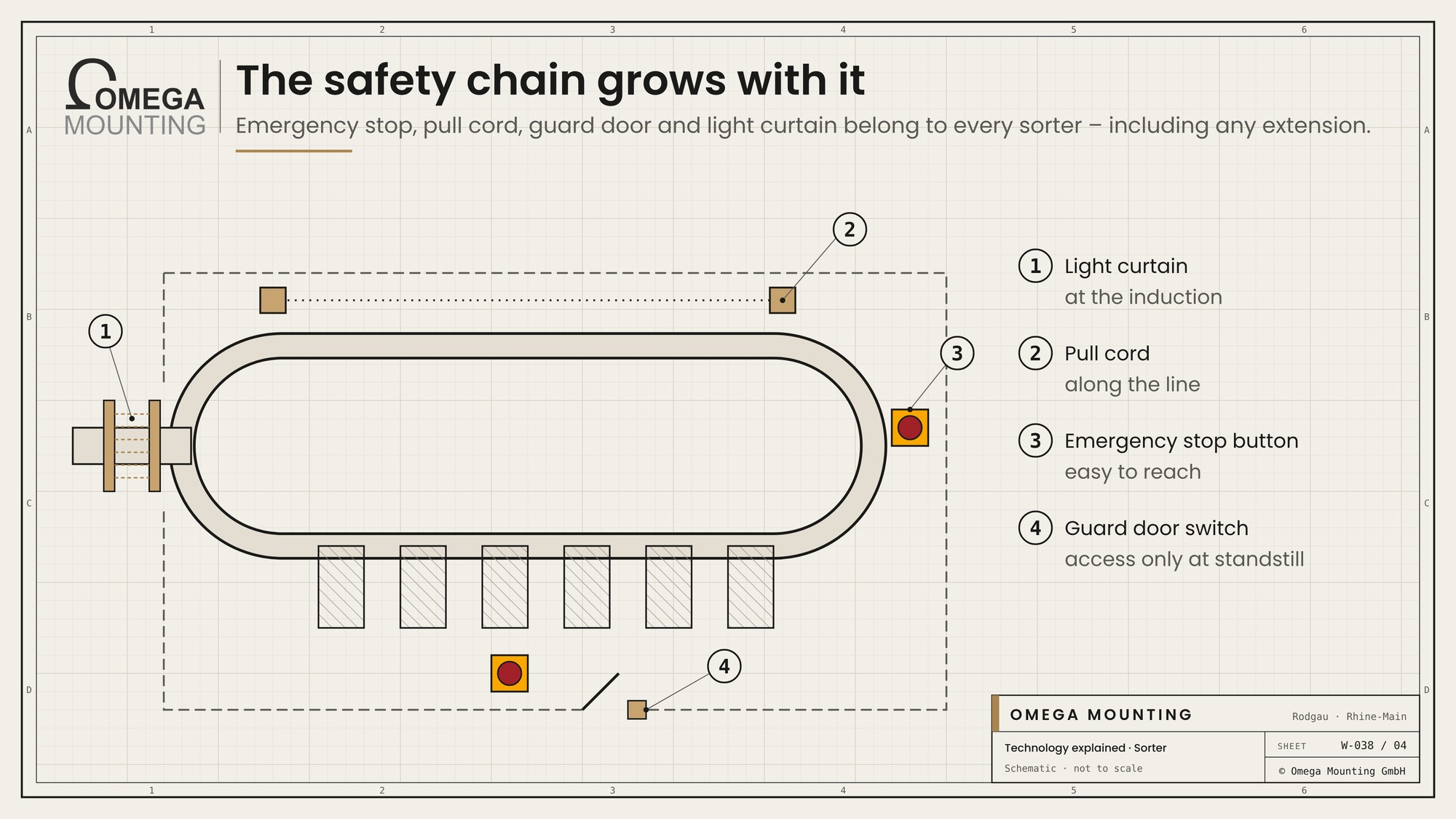
Common to all are drives, sensors and the safety chain. Emergency stop buttons, pull cords, guard door switches and safety sensors belong to every sorting system – and must grow with every extension.
Maintenance and wear on a sorter
In many distribution centres a sorter runs almost around the clock. Planned maintenance is correspondingly important. The wear points depend on the design:
- Shoes and guides: The shoes slide across the slats with every diversion. Guides, sliding pieces and the switches of the shoe track wear and are replaced in batches.
- Cross belts: Each carrier has its own small belt with a drive. Belts, rollers and motors are checked carrier by carrier so that a weak carrier does not divert wrongly.
- Tilt trays: Joints, tilting mechanism and return work with every discharge. Play in the mechanism shows first as untidy tilting.
- Traction and drive: A chain or linear drive pulls the carriers round the loop. Chain elongation, running rollers and power transmission belong in every inspection.
- Scanners and sensors: Read tunnels, light barriers and encoders decide whether a parcel reaches the right destination. Dirt leads to missorts.
- Destinations: Chutes, bags and take-away conveyors are hit by parcels and get dented. Edges where parcels get caught soon become obvious.
Because the sorter rarely stands still, work is placed in fixed maintenance windows, often at night or at the weekend. Laying out the parts beforehand and splitting the work into sections gets much more done in one window.
The same applies to extensions: new destinations or a longer loop are prepared while the system is running and only connected during the shutdown.
What we pay attention to
On a sorter every hour in the shutdown window counts – that is why we prepare whatever can be prepared.
- We clarify beforehand which design, which sections and which time window are available.
- We prepare brackets, plates and assemblies in the workshop so that only installation is left on site.
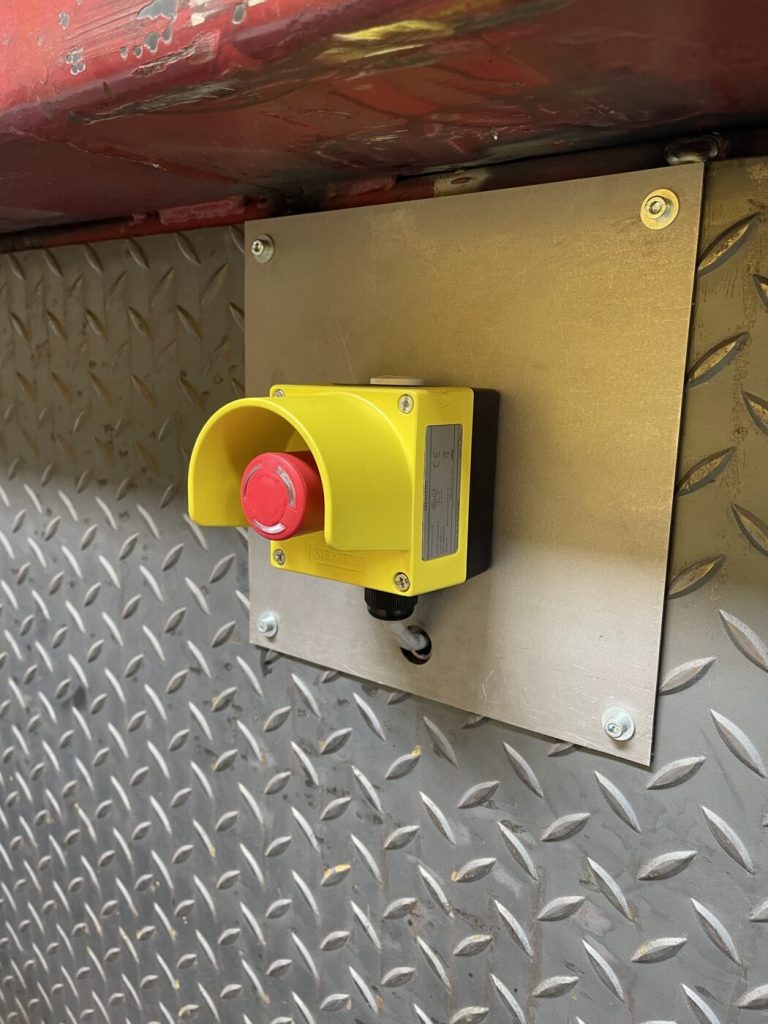
- We treat the safety chain as part of every job: emergency stop buttons at grip height, properly fixed, integrated and tested.
- We replace wear parts such as shoes, rollers and belts based on findings and make sure the design is the same throughout the section.
- After every job we check discharge and sensors in a test run before the system goes back into production.
- Control and sorting logic remain with the manufacturer or control system builder.
Where we use it
We extend and maintain sorting systems, above all in logistics and at the airport. During the extension of a parcel sorting system at Frankfurt Airport two fitters installed and aligned 32 emergency stop buttons and numerous sensors in two working days and integrated them electrically into the existing safety chain. The bracket plates were pre-assembled to suit the installation situation; work was carried out during the day in the system’s downtimes. Such jobs are part of our work in Logistics.
More technology explained
Technology explained
the sensors that release every diverter and every discharge.
Technology explained
how the sorter sees the item on the line.
Guide
the guide to maintenance plan and wear.
Do you need this machine together with a team on site?
Do you need a team that extends or repairs your sorting system in the shutdown window? We prepare, install, integrate and test. Request a callback – we will get back to you.
Free, no-obligation callback

About the author
Tobias Schott
Managing director of Omega Mounting GmbH, Rodgau · more than 20 years of hands-on experience in installation and maintenance
A trained mechatronics technician, working in maintenance, servicing and industrial installation since 2004 – first alongside his father, and with Omega Mounting since 2012: from overhead conveyors in Frankfurt to the crane system in a new-build hall. He plans and leads lifting operations as an appointed person (AP) in data centers and on industrial sites in the Rhine-Main region, trains and examines operators of cranes, mobile elevating work platforms and telehandlers, and is a qualified occupational safety specialist. On jobs abroad he is known as the “German Troubleshooter” – the person you call when a site gets stuck. He learned what quality means from his father, not from a manual: Made in Germany as a standard for his own work, not a label. That is why quality comes first at Omega Mounting – ahead of speed and price. The Technology explained articles cover the equipment and techniques his team uses every day: what counts on site is in them – what only appears in the brochure is not.
 English
 German