
- Technology explained – equipment and protection
Compressed air service unit: filter, regulator, lubricator – what they do
By Tobias Schott · 5-minute read · Updated November 2026
The air preparation unit treats the compressed air directly in front of the machine – it filters, drains, regulates the pressure and shuts off the air, and its condition determines how long cylinders and valves last.
You encounter the air preparation unit on almost every pneumatic machine, on conveyor systems, fixtures and workbenches: a row of blocks with sight glass, pressure gauge and knob at the point where the compressed air line enters the machine. It is also called an FRL unit, after „filter, regulator, lubricator“; in German it is called „Wartungseinheit“.
This article explains the modules, what the compressed air classes mean and which faults damage valves and cylinders. How to maintain the compressor station and compressed air network is described in the guide Maintaining the compressor station and compressed air network.
What is an air preparation unit?
An air preparation unit is a combination of compressed air modules that cleans the air in front of a machine, sets it to the required pressure and adds oil if needed. It sits at the transition from the compressed air network to the machine and protects everything that comes after it.
The network supplies air at the compressor’s pressure and with whatever collects along the way: water from condensate, rust and dirt from old pipes, sometimes oil from the compressor. The air preparation unit catches this before it reaches the sensitive valves.
Key facts
- Purpose: Filter, drain, bring to the right pressure and shut off compressed air in front of the machine.
- Modules: Shut-off valve, filter with water separator, pressure regulator with gauge, lubricator, manifold, often a pressure switch.
- Combinations: Filter regulator as one module; fine filter or activated carbon filter for higher requirements.
- Characteristics: Filter rating in micrometres, flow rate, regulator setting range, connection thread.
- Maintenance points: Condensate, filter element, regulator pressure, oil level in the lubricator.
- Standard: ISO 8573-1 for the purity classes of compressed air.
- Common misconception: A cylinder is weak, so it is defective – often the air preparation unit supplies too little pressure or flow.
The modules and what they do
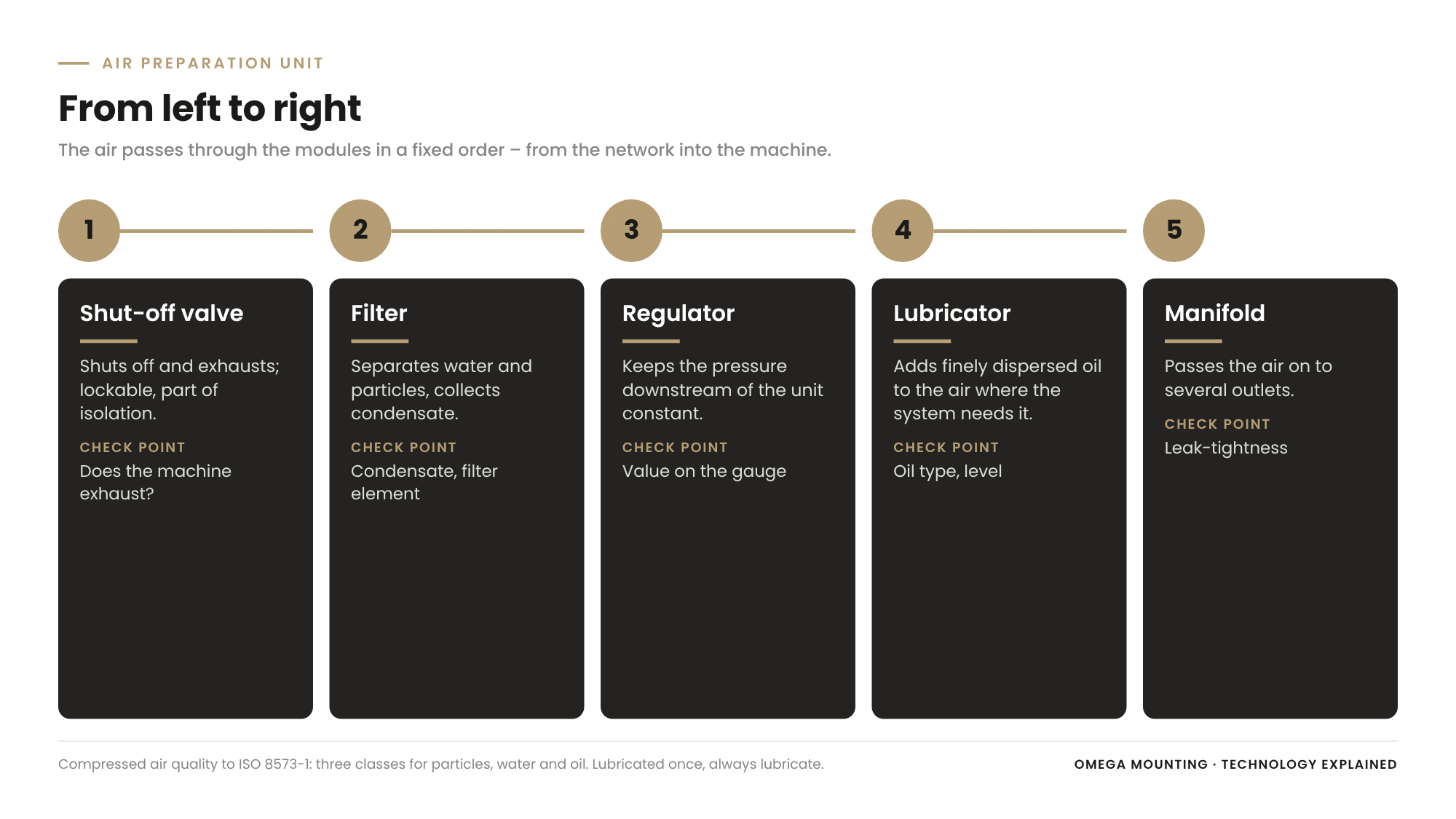
The modules sit in a fixed order so that each one gets the air the way it needs it.
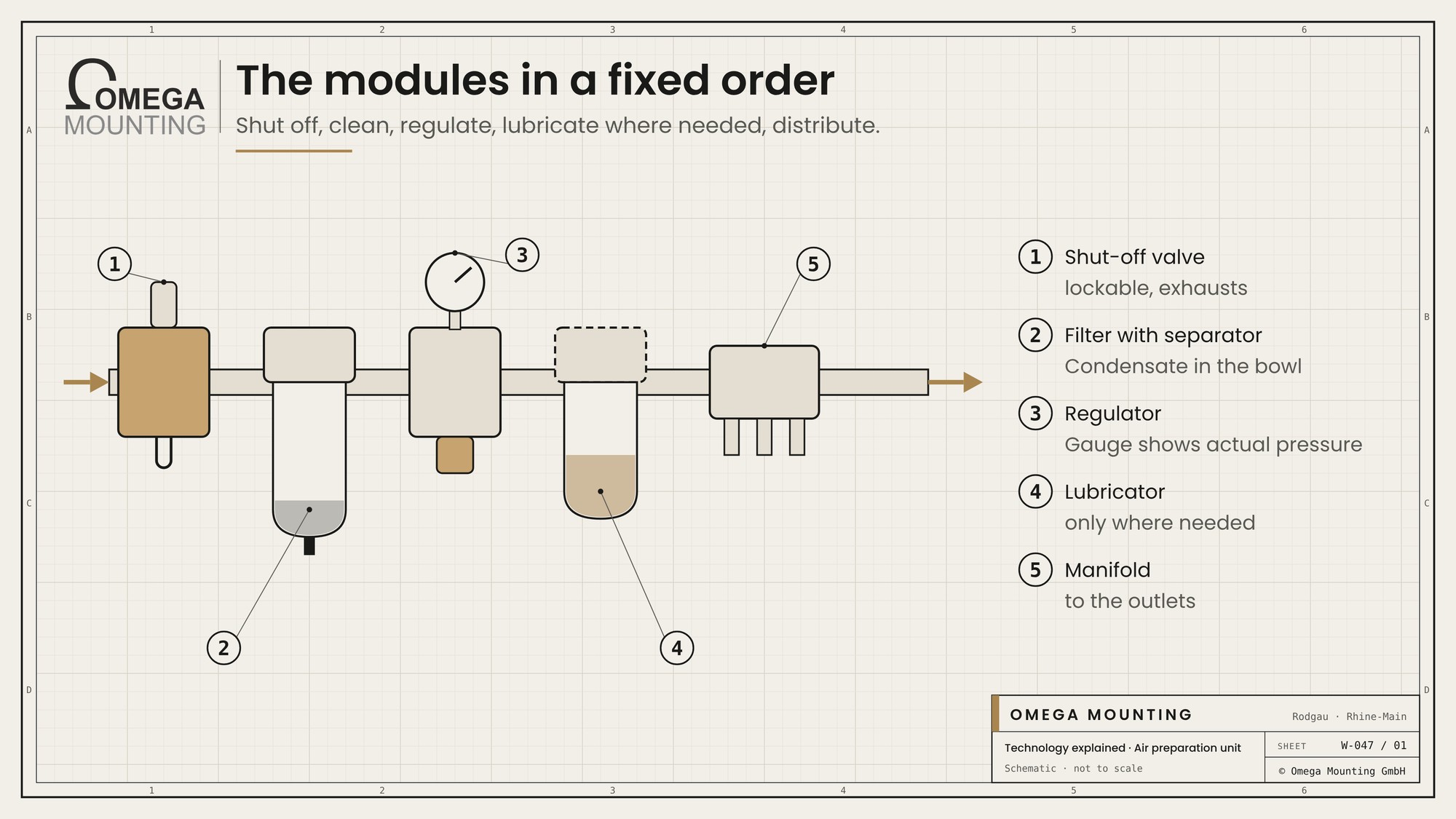
- Shut-off valve. It shuts off the air and exhausts the machine. In a lockable version it is part of isolation: closed, exhausted, lock on. A soft-start valve lets the pressure rise slowly after switching on so that cylinders do not strike out uncontrolled.
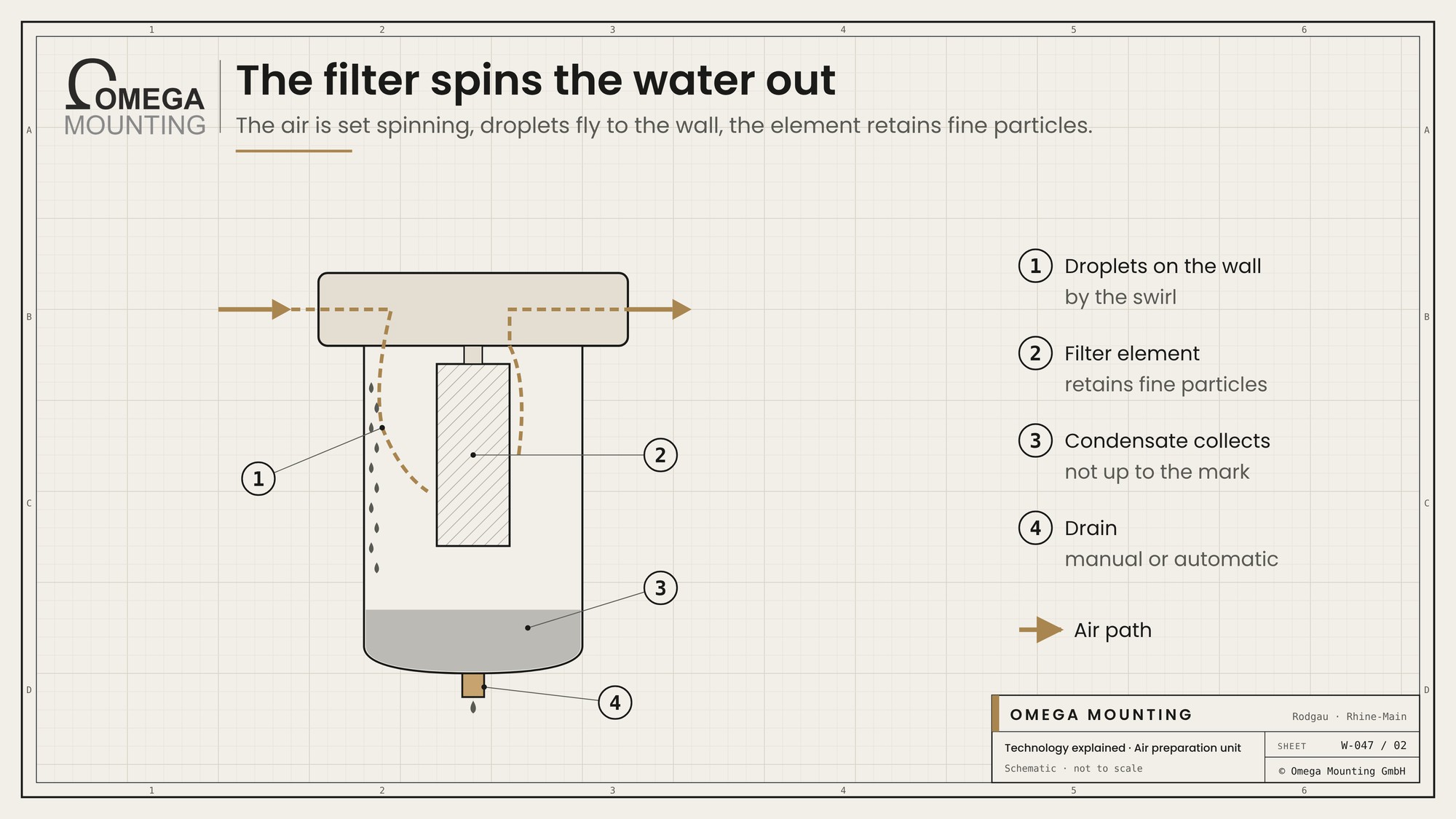
- Filter with water separator. The air is set spinning, water droplets and coarse particles are flung against the wall and collect in the bowl. A filter element retains finer particles. The condensate is drained manually, semi-automatically or automatically.
- Pressure regulator. It keeps the pressure downstream of the unit constant, even if the network pressure fluctuates. The gauge shows what the machine really gets.
- Lubricator. It adds finely dispersed oil to the air where old cylinders and tools need it. Many modern components are built for oil-free air and do not need a lubricator.
- Manifold. It passes the air on to several outlets.
Compressed air classes: what 1:4:1 means
How clean compressed air must be is described by ISO 8573-1 with three numbers – for solid particles, water and oil.
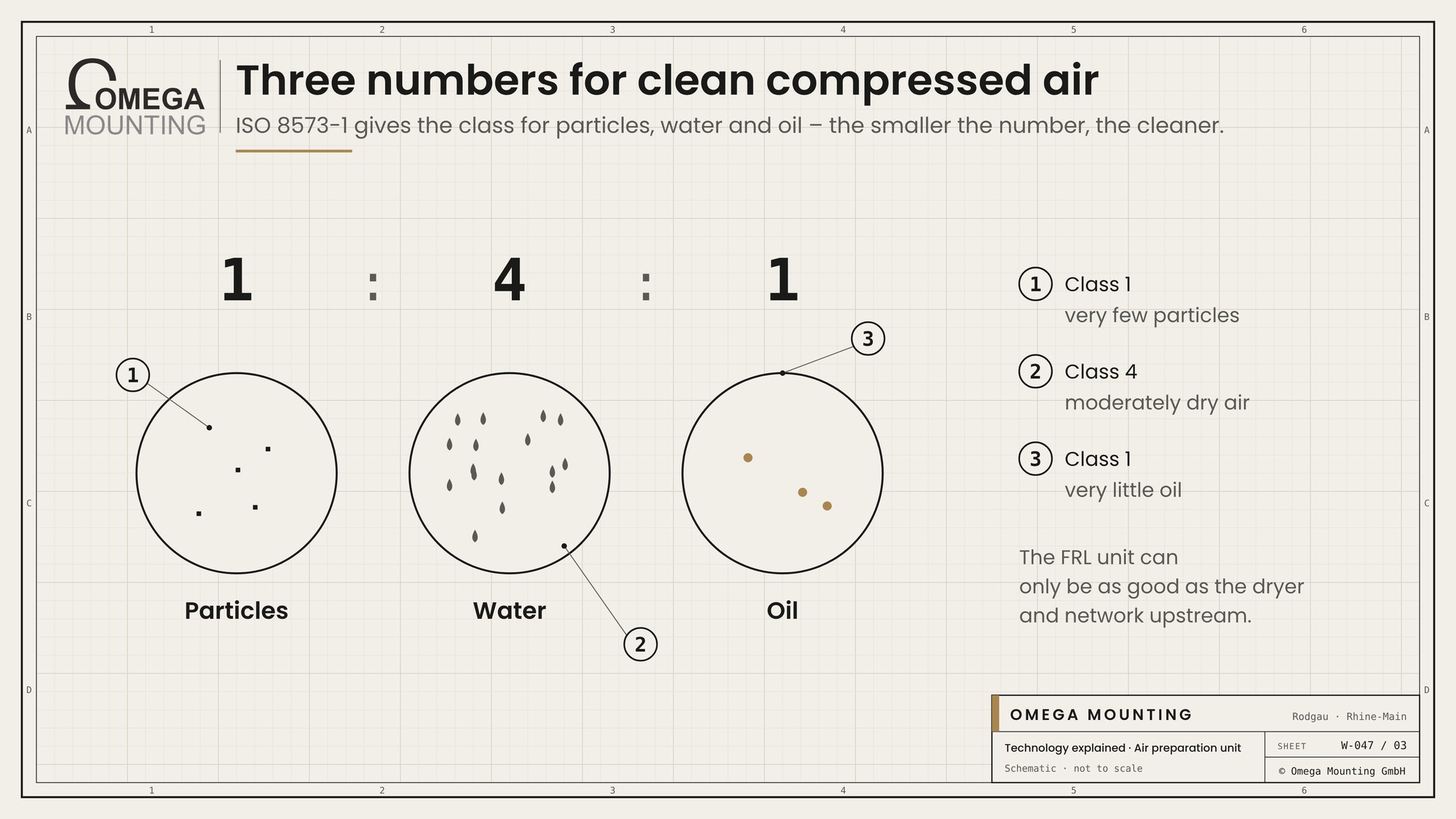
Each number is a class: the smaller the number, the cleaner the air. A specification such as „1:4:1“ therefore means very few particles, moderately dry air and very little oil. Medium classes are usually sufficient for simple pneumatics; low classes are required for food, painting or measuring technology.
| Parameter | What it describes | What influences it | Typical problem |
|---|---|---|---|
| Particles. | Solid particles such as dust, rust, wear debris. | Intake filter, network, filter in the air preparation unit. | Sticking valves, wear on seals. |
| Water | Moisture and condensate, specified via the pressure dew point. | Dryer at the station, water separator in front of the machine. | Corrosion, washed-out lubrication, ice in cold conditions. |
| Oil. | Oil aerosols and oil vapour. | Compressor type, oil and activated carbon filters, lubricator. | Gummed-up valves, contaminated products. |
The air preparation unit can only make the air as good as the dryer and network allow. Water already standing in the network runs into the machine at the next pressure peak.
Lubricated once, always lubricate
Anyone who has once given oil to a pneumatic system has to stick with it – otherwise the change does more harm than good.
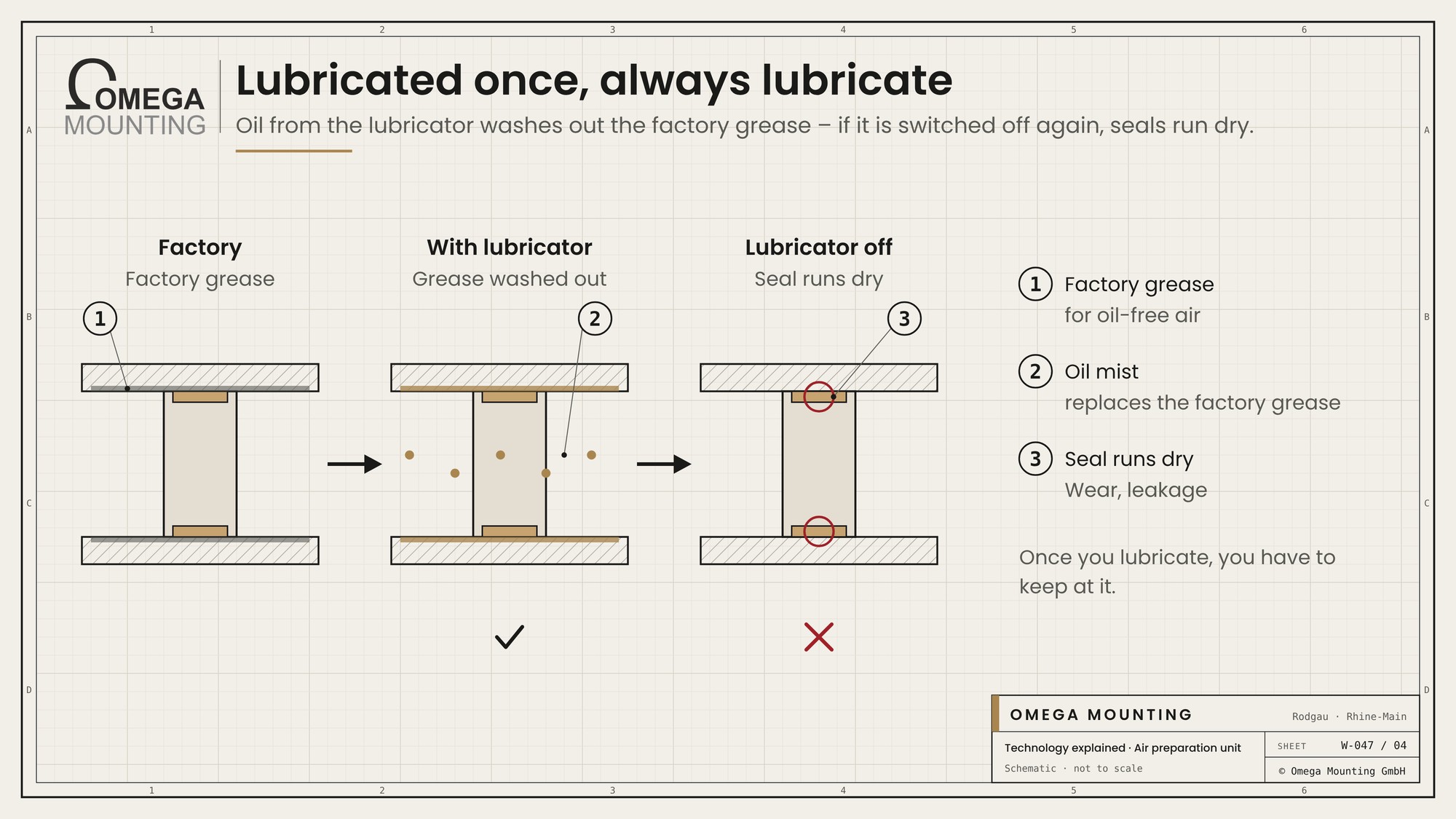
Valves and cylinders are supplied from the factory with a basic lubrication intended for operation with oil-free air. If oil from a lubricator is added, it washes out this basic lubrication over time. If the lubricator is then removed or runs empty, the seals run dry and wear quickly. That is why: an oil-free system stays oil-free, a lubricated system stays lubricated, and the lubricator is topped up regularly – with the approved oil, not with whatever is to hand.
Looking after the service unit
The service unit protects the whole pneumatic system behind it – but only if it is looked after itself:
- Drain condensate: Filter bowls without an automatic drain are emptied regularly, otherwise water runs into the system.
- Change filters: A clogged filter costs pressure. A gauge before and after the filter shows when it is due.
- Set the pressure: The regulator is set to the pressure the machine needs – no higher.
- Check the lubricator: If a lubricator is fitted, the oil level is checked and topped up with the specified oil.
- Check the bowls: Plastic bowls age. Cracks or clouding are a reason for replacement.
Before any work on the service unit, the system is depressurised. Including the care points in a fixed round means noticing early when unusually much water or oil arrives in the compressed air – often a sign of a problem at the compressor or dryer.
What we pay attention to
We check the air preparation unit whenever we work on the pneumatics, because many faults start here.
- We drain condensate and check whether the automatic drain works.
- We replace clogged filter elements before they restrict the flow.
- We check the pressure at the gauge and set it as specified, not by feel.
- We check the lubricator: correct oil type, level, drip rate – or no lubricator where the system runs oil-free.
- We use the lockable shut-off valve for isolation and check that the machine is really exhausted.
- If there is water in the unit, we look for the cause at the dryer and in the network.
Where we use it
We check and maintain air preparation units wherever we repair pneumatics: on roller conveyors with accumulation control, on sorting systems, fixtures and machines. A cylinder that moves slowly or a valve that sticks almost always leads us to the air preparation unit too – and the solution often already lies there. Such work is part of our Maintenance and servicing.
More technology explained
Technology explained
the consumer that the air preparation unit protects.
Technology explained
the components that stick first with poor air.
Technology explained
how leaks in the network are found.
Do you have questions about how this works on your site?
Do you have questions about how this works on your site – for example, why there is always water in your air preparation unit? We check, maintain and find the cause in the network. Request a callback – we will get back to you.
Free, no-obligation callback

About the author
Tobias Schott
Managing director of Omega Mounting GmbH, Rodgau · more than 20 years of hands-on experience in installation and maintenance
A trained mechatronics technician, working in maintenance, servicing and industrial installation since 2004 – first alongside his father, and with Omega Mounting since 2012: from overhead conveyors in Frankfurt to the crane system in a new-build hall. He plans and leads lifting operations as an appointed person (AP) in data centers and on industrial sites in the Rhine-Main region, trains and examines operators of cranes, mobile elevating work platforms and telehandlers, and is a qualified occupational safety specialist. On jobs abroad he is known as the “German Troubleshooter” – the person you call when a site gets stuck. He learned what quality means from his father, not from a manual: Made in Germany as a standard for his own work, not a label. That is why quality comes first at Omega Mounting – ahead of speed and price. The Technology explained articles cover the equipment and techniques his team uses every day: what counts on site is in them – what only appears in the brochure is not.
 English
 German