
- Technology explained – equipment and protection
The pallet safety gate: handing over pallets without going to the fall edge
By Tobias Schott · 6-minute read · Updated November 2026
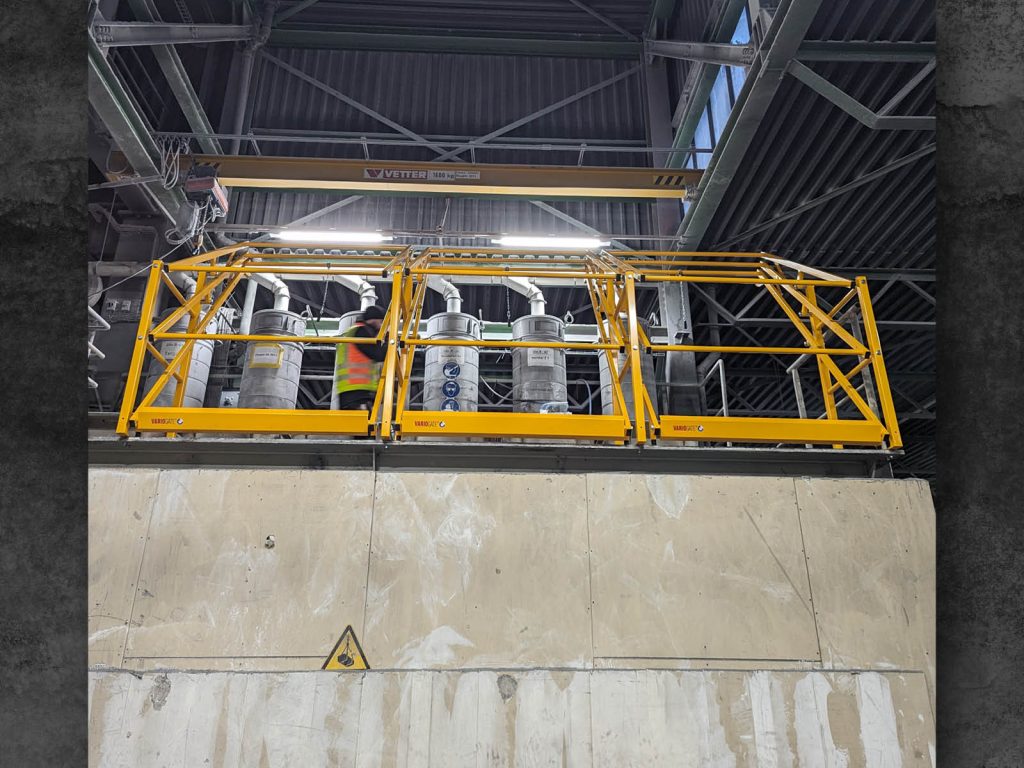
A pallet safety gate is a gate in the guardrail of a platform that only ever opens one side – so the pallet reaches the edge, but people never do.
You will find pallet safety gates wherever goods arrive at or leave a mezzanine, a steel platform or a rack-supported platform. Picking happens above, the forklift waits below. In between is an edge where an open guardrail is life-threatening.
Many companies still solve this with a chain, a swing bar or a roller door. That works as long as nobody forgets to close it. The pallet safety gate takes that decision out of people's hands: it is built so that the edge is never open while someone is working in front of it.
What is a pallet safety gate?
A pallet safety gate is a fall protection with a transfer bay through which pallets pass between a raised working area and the forklift, without the platform side and the edge being open at the same time. Other names are pallet transfer gate, pallet gate or – after the most common type – tilting gate. In German it is called Palettenschleuse.
Legally it is part of the edge protection. Under the German workplace rule ASR A2.1 there is a fall risk from a height of more than 1.0 m, and guardrails must be at least 1.00 m high. A gap in the guardrail for handing over pallets is therefore no solution – a safety gate is.
Key facts
- Purpose: Handing over pallets at a fall edge without staff stepping up to the open edge.
- Types: Tilting gate and vertical-lift gate, single or as a multi-bay gate in a row.
- Location: Edges of mezzanines, steel platforms, rack-supported platforms and ramps, connected to the existing guardrail.
- Fixing: Base plates with heavy-duty anchors in concrete or bolted to the platform structure.
- Operation: By hand via handle or lever, depending on the type assisted by a gas spring or counterweight.
- Capacity: The permitted pallet load is on the rating plate; it applies to the bay, not to the guardrail next to it.
- Inspection: As work equipment under the German Industrial Safety Ordinance (BetrSichV) at the intervals set in the risk assessment, plus a visual check in daily use.
How does a pallet safety gate work?
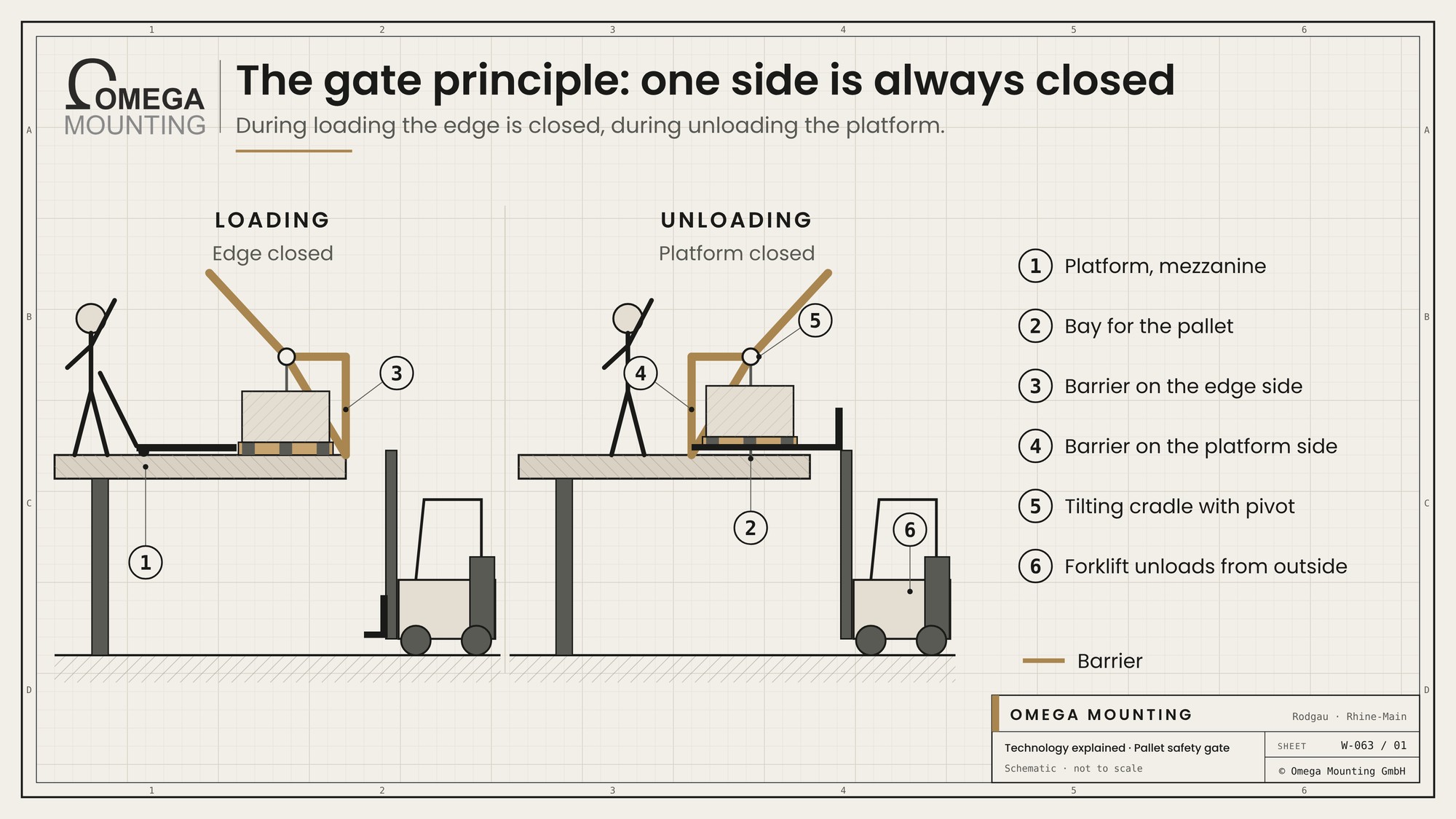
A pallet safety gate works like a lock on a river: there are two gates, and never more than one is open. The barrier switches between two positions.
In the first position the edge is closed. The platform side is open, and the worker moves the pallet into the bay with a pallet truck or loads it there. He stands in front of a closed barrier, not in front of the edge.
In the second position the platform side is closed. The worker has switched the gate over by hand and stands behind the barrier. Now the bay is open towards the edge, and the forklift takes the pallet from outside.
The benefit goes beyond fall protection. People and forklifts do not come close to each other at the handover, because the gate separates them. The forklift driver does not have to wait for a hand signal – he can see from the position of the gate whether he may unload.
Which types are there?
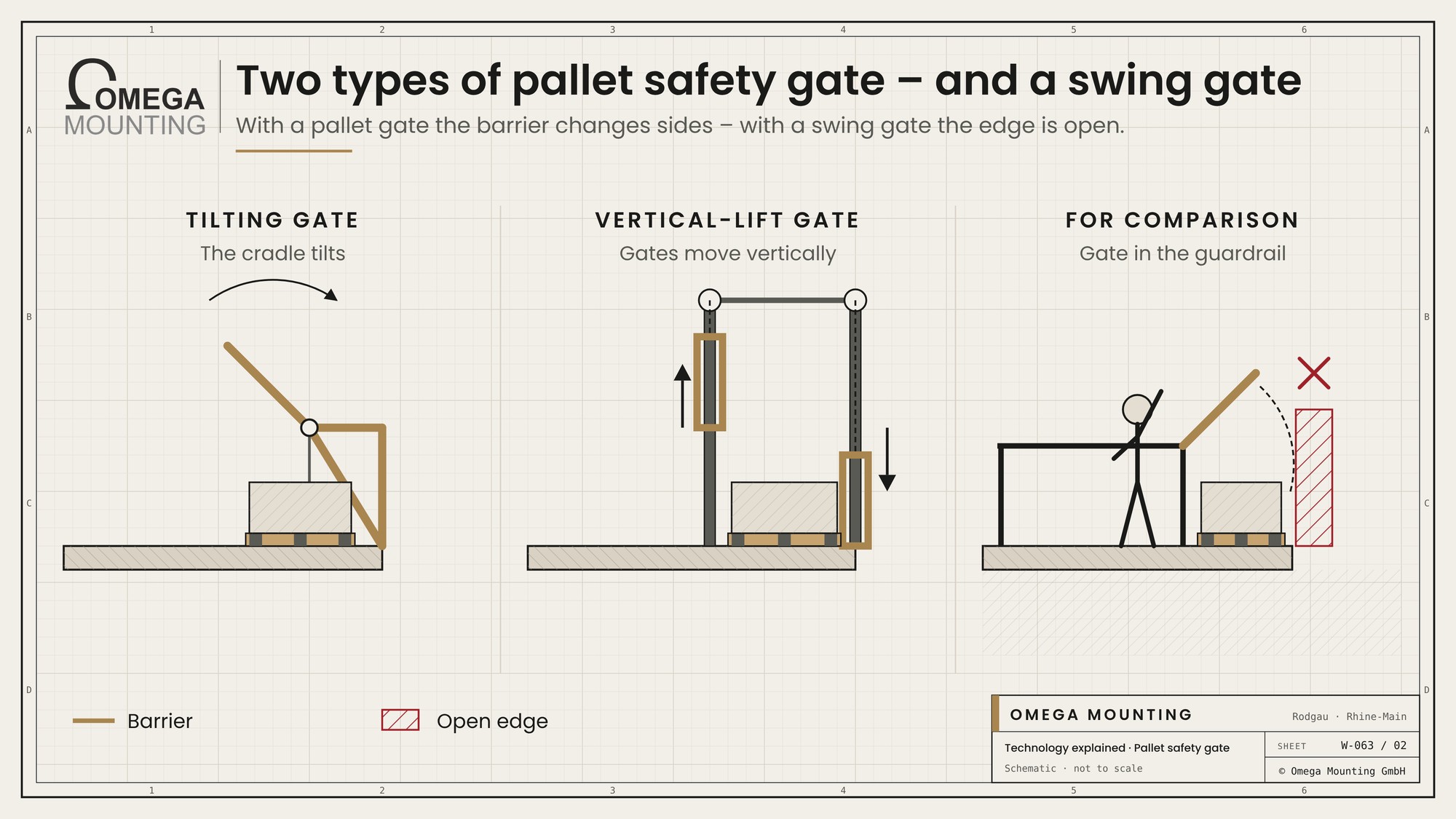
The two common types differ in how the barrier changes sides: on the tilting gate it tilts, on the vertical-lift gate it moves vertically. A gate in the guardrail looks similar, but it is not a safety gate.
| Type | How the barrier changes sides | Strengths | Limits |
|---|---|---|---|
| Installing a triple pallet safety gate at a mezzanine edge | Two barriers sit on a common axle; when the rocker tilts, one rises and the other drops. | Robust, simple mechanics, quick to operate. | Needs space above the bay for the swinging barrier. |
| Vertical-lift gate | Two barriers move vertically, coupled by a rope or chain. | Little space needed in front of and behind the bay. | More moving parts, needs clear height above the bay. |
| Gate or chain in the guardrail | Opened by hand; the edge is open during the handover. | Quick to retrofit. | Not a safety gate – safety depends on someone closing it. |
Which gate fits is usually decided by space: the clear height under the hall roof or the next level, and the room on the platform in front of the bay. The tilting gate is the most common because it needs little mechanics.
Single or in a row: the multi-bay gate
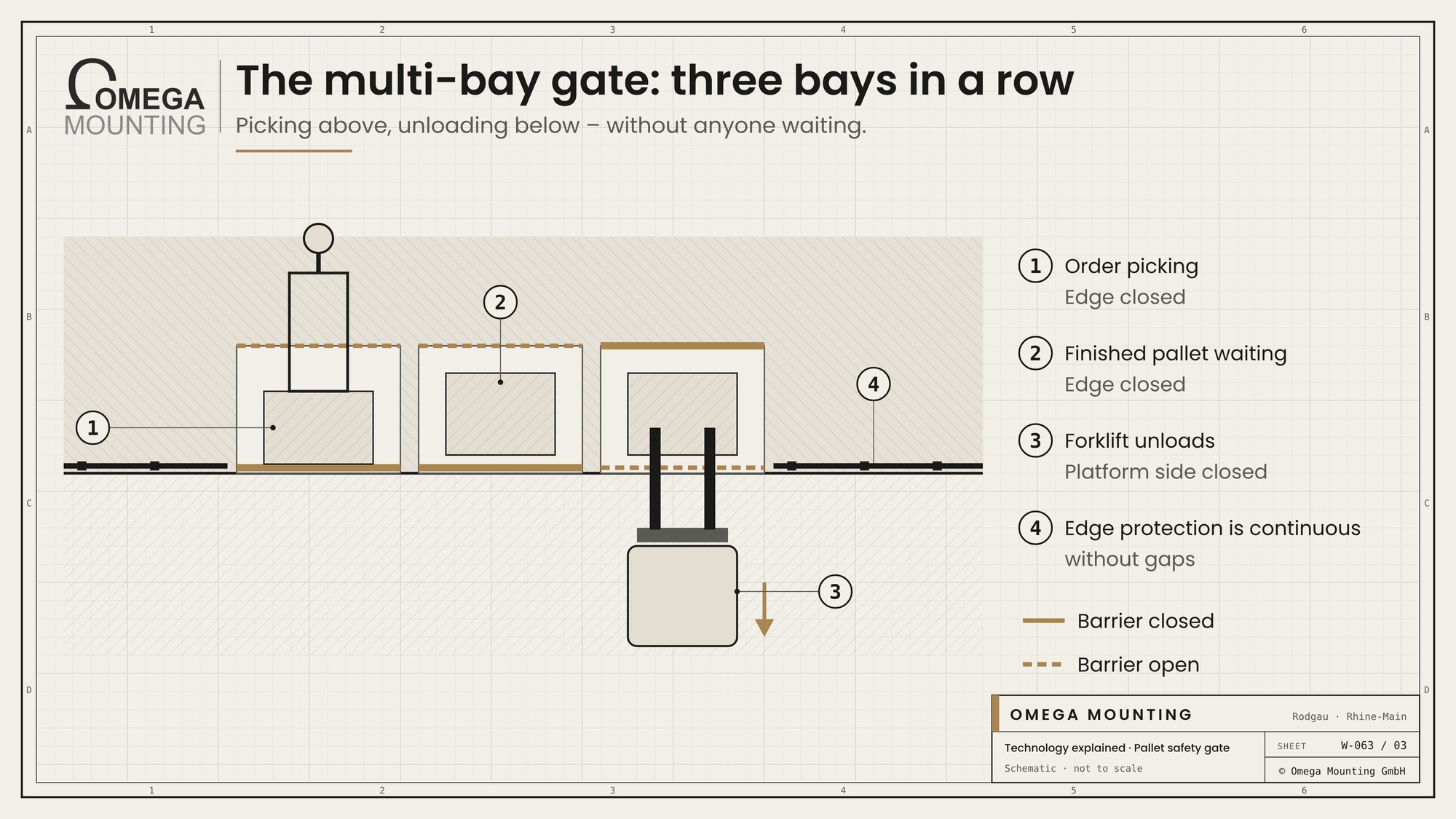
A single gate sets the pace of the handover: only once the forklift has unloaded can the next pallet go in above. Where a lot of goods pass over the edge, several gates are therefore placed side by side.
With a triple gate, picking can happen in one bay, the finished pallet waits in the second, and the forklift unloads from the third at the same time. Above and below work independently. The process becomes calmer because nobody has to wait for anyone else.
A multi-bay gate often replaces a whole transfer opening. A roller door that used to secure the edge then becomes unnecessary.
What matters during installation
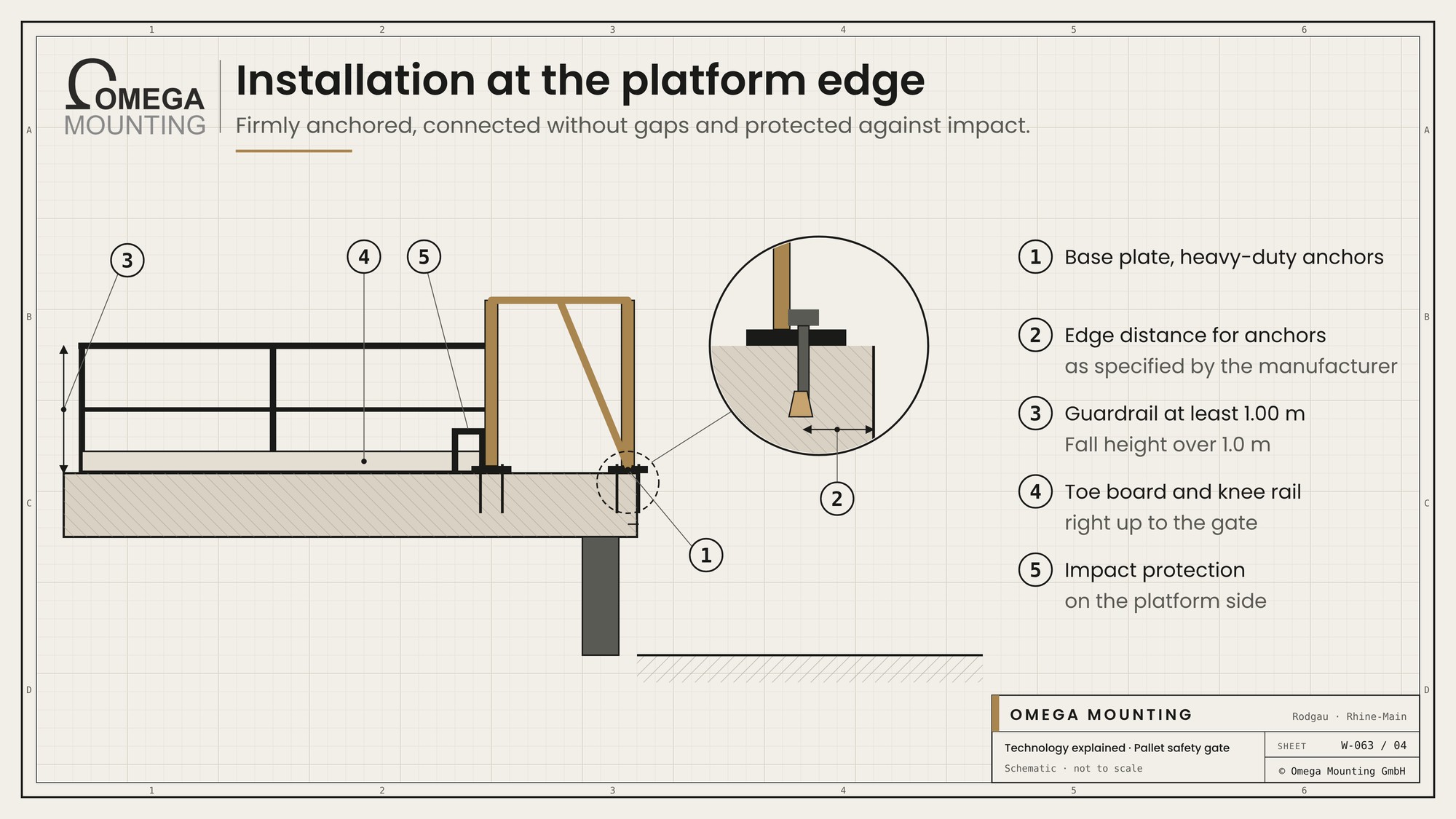
A pallet safety gate is only as safe as its fixing and its connection to the guardrail. Three points are decisive.
Anchoring The gate stands at an edge where forklifts and pallet trucks work. An impact must not move it. It is therefore fixed with heavy-duty anchors in concrete or firmly connected to the steel structure – following the manufacturer's specifications for anchor, drilling depth and edge distance.
Connection without gaps. There must be no gap between the gate and the existing guardrail through which a person or a load could fall. Toe board and knee rail run right up to the gate.
Impact protection. On the forklift side, impact protection guards the posts. On the platform side, a floor marking helps to drive the pallet straight into the bay.
One question must be settled before installation: can the edge carry the load? The pallet in the bay, the impact of the forklift and the force of the gate itself all act on the platform edge and the anchors. For steel platforms, the platform's structural engineer checks this. We do not answer legal questions; how your risk assessment rates the edge is for your occupational safety specialist to decide.
What we pay attention to
When installing a pallet safety gate, we check more than the gate itself.
- We measure the clear height and the space in front of the bay beforehand – the type depends on it.
- We check the substrate before we drill: concrete quality, edge distance, reinforcement and cables in the floor.
- We connect the guardrail without gaps and add toe boards and knee rails where they are missing.
- We position the gate so that the forklift forks can enter straight without touching the posts.
- We secure the edge during installation, while the old barrier is already gone and the new one is not yet fixed.
- We give a briefing at handover: who operates it, how to recognise the position and what to do if the gate jams.
Where we use it
We install pallet safety gates in production and logistics, mostly as a retrofit on existing platforms. In a production plant we installed a triple tilting gate at the fall edge on the first floor . Goods are picked safely into the bay above, the worker closes the gate by hand, and only then does the forklift unload from outside. Our team fixed the gates with heavy-duty anchors, and the old roller door was no longer needed. You will find more on platforms, guardrails and transitions under Steel structures and work platforms.
More technology explained
Guide
when the handover is planned together with the platform.
Technology explained
when work has to be done at the edge without fixed edge protection.
Do you have questions about how this works on your site?
Are pallets on your platform still handed over through an open section of guardrail, or are you planning a new handover point? We will look at the edge and tell you which gate fits there and how it is fixed safely. Request a callback.
Free, no-obligation callback

About the author
Tobias Schott
Managing director of Omega Mounting GmbH, Rodgau · more than 20 years of hands-on experience in installation and maintenance
A trained mechatronics technician, working in maintenance, servicing and industrial installation since 2004 – first alongside his father, and with Omega Mounting since 2012: from overhead conveyors in Frankfurt to the crane system in a new-build hall. He plans and leads lifting operations as an appointed person (AP) in data centers and on industrial sites in the Rhine-Main region, trains and examines operators of cranes, mobile elevating work platforms and telehandlers, and is a qualified occupational safety specialist. On jobs abroad he is known as the “German Troubleshooter” – the person you call when a site gets stuck. He learned what quality means from his father, not from a manual: Made in Germany as a standard for his own work, not a label. That is why quality comes first at Omega Mounting – ahead of speed and price. The Technology explained articles cover the equipment and techniques his team uses every day: what counts on site is in them – what only appears in the brochure is not.
 English
 German