
- Technology explained – technology and procedures
Load roller, guide roller, drive roller: what holds the EMS trolley
By Tobias Schott · 5-minute read · Updated November 2026
The trolley of an electrified monorail hangs on three kinds of roller: load rollers carry vehicle and load, guide rollers keep it on line sideways, and the drive roller transmits the tractive force to the track through contact pressure – if one of them wears, the others suffer too.
An EMS vehicle does many laps every day. Every curve, every switch and every rail joint passes over its rollers. Anyone maintaining an electrified monorail therefore mainly replaces one thing: rollers.
Here we explain what load roller, guide roller and drive roller do, how the drive roller puts its force onto the track, how a roller is built and how to recognise worn rollers.
What is the trolley of an electrified monorail?
The trolley is the assembly that connects an EMS vehicle to the track. It wraps around the rail profile with several rollers and carries the crossbar with the carrier below it.
A vehicle usually has two trolleys: a driven one with motor and drive roller and an idler without a drive. Both are attached to the crossbar so that they can turn, allowing the vehicle to take curves. In German the rollers are called „Laufrolle“, „Führungsrolle“ and „Antriebsrolle“.
Key facts
- Running rollers: carry vehicle and load on the running surfaces of the track.
- Guide rollers: support the trolley sideways, especially in curves and switches.
- Drive roller: transmits the tractive force through friction, pressed on by a spring.
- Materials: plastic tyres or steel, depending on load and system.
- Wear parts: flat spots, chipping, loose tyres, seized bearings.
- Consequential damage: knocking trolleys, slip, damage to track and current collector.
Three rollers, three tasks
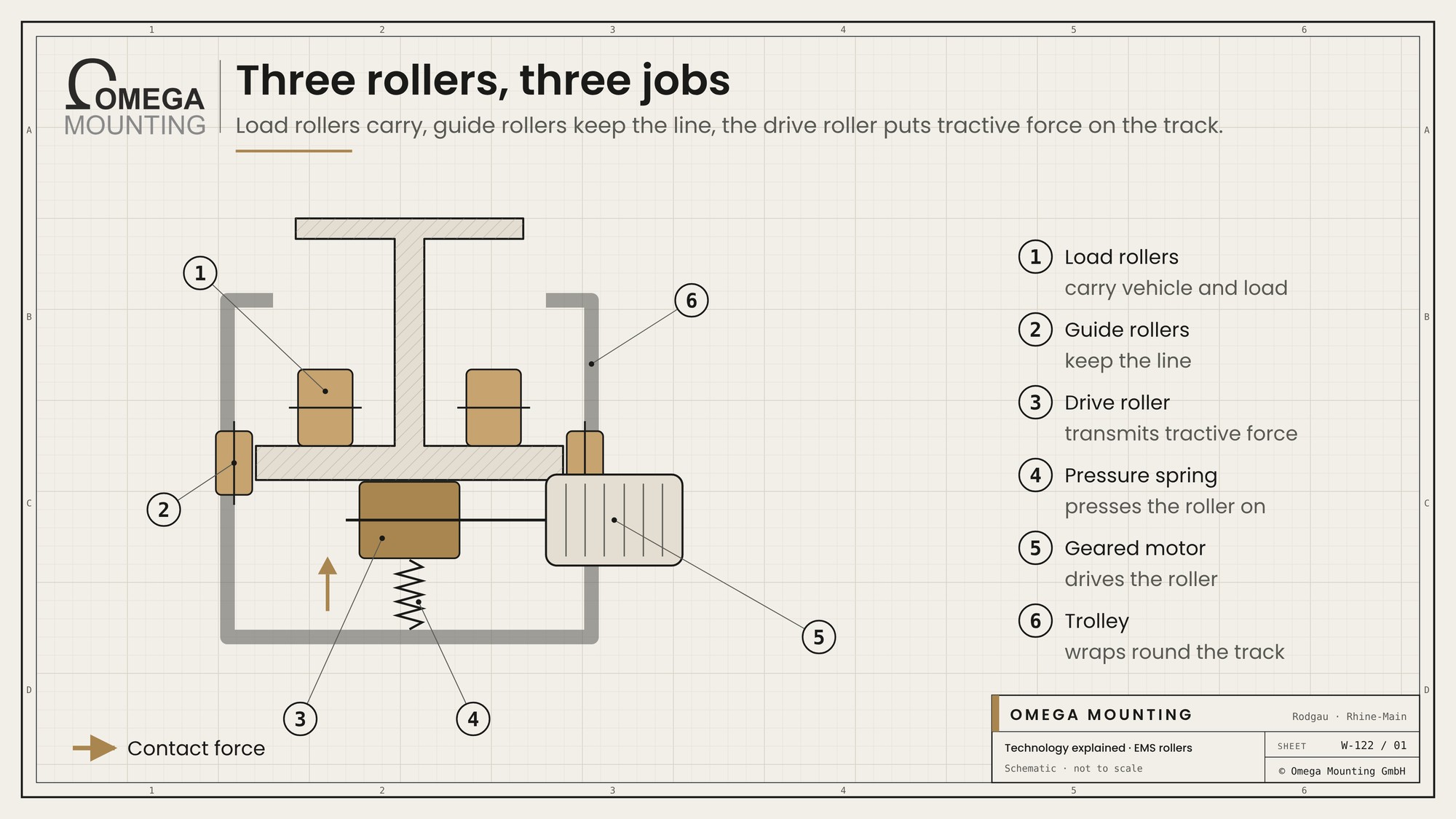
Each type of roller is loaded differently and wears differently.
| Role | Task | Load | Typical wear |
|---|---|---|---|
| Load roller | carries vehicle and load | weight, impacts at joints | flat spots, chipping, worn track |
| Guide roller | keeps the trolley on line | side forces in curves and switches | worn on one side, torn |
| Drive roller | puts the tractive force onto the track | contact pressure, starting, braking | worn tyre, slip |
The rollers work as a set. If a guide roller has torn off, the trolley runs crooked. Then the load rollers carry on one side, the drive roller no longer grips centrally, and the current collector loses clean contact.
The drive roller

The drive roller is the only driven wheel on the vehicle. A geared motor turns it, and it transmits the force to the track through friction. That is why it is also called a friction wheel drive.
To create friction, the roller is pressed against the track by a spring. The contact force determines the tractive force:
- Too little contact pressure: The roller slips, especially when starting, on inclines and with full load. This is called slip.
- Too much contact pressure: Tyre and bearing wear faster.
- Dirty rail: Grease, oil or dust on the running surface act like too little contact pressure.
Slip is not always noticed straight away. The vehicle arrives too late or in the wrong place, and the control reports position errors. A worn tyre also reduces the contact pressure because the diameter changes. The brake usually sits in the geared motor and also holds the vehicle via the drive roller.
Many systems therefore do not determine the position from the revolutions of the drive roller but read it from a code strip on the track. Slip is still a finding: it costs tractive force and wears the tyre and the track.
How a roller is built
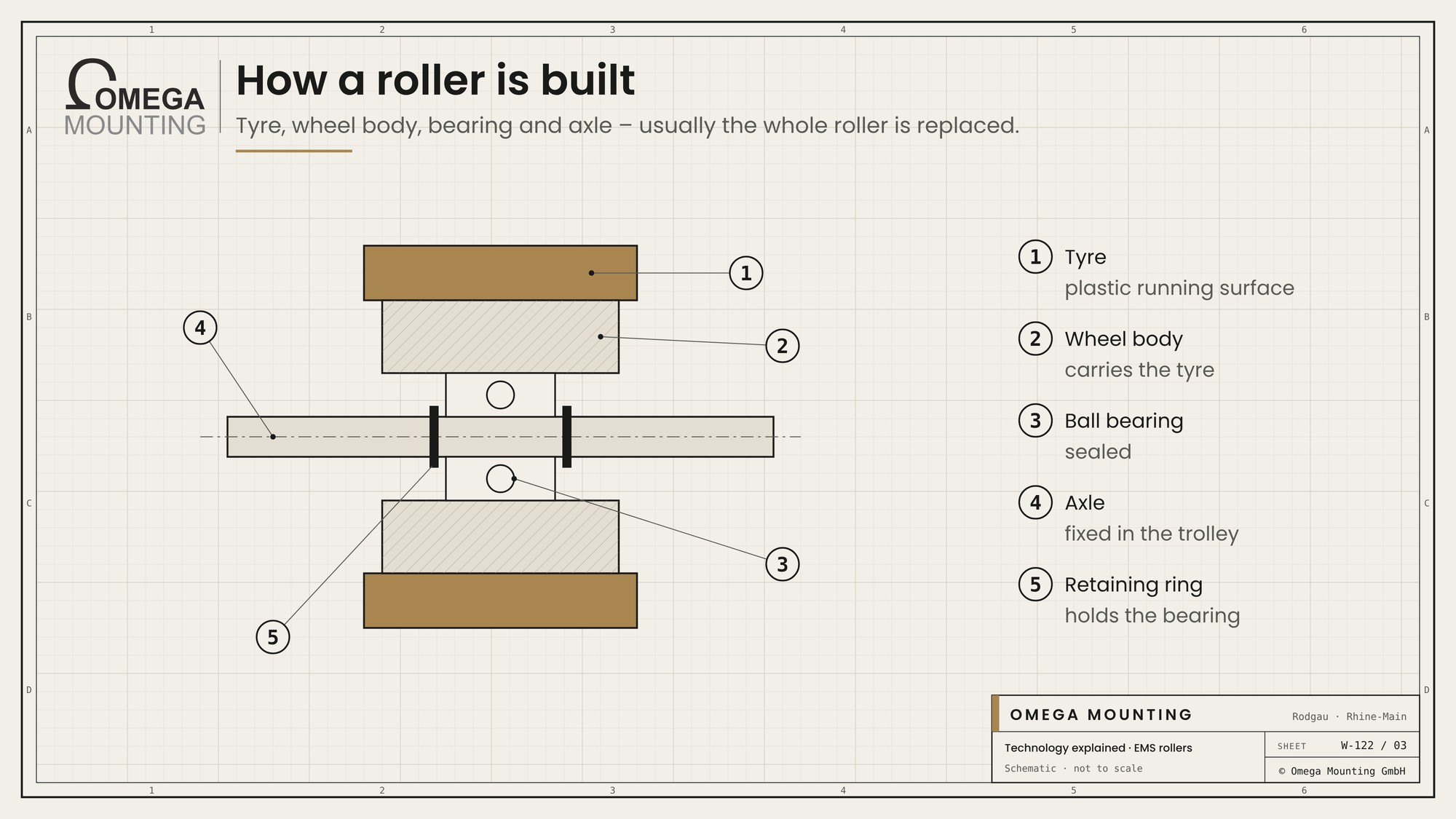
An EMS roller is a small but complete bearing.
- Tyre: the plastic running surface, fitted or moulded on. It dampens and protects the track.
- Wheel body: carries the tyre, usually made of steel or aluminium.
- Rolling bearing: usually a sealed ball bearing in the wheel body.
- Axle or pin: connects the roller to the trolley.
- Retention: a retaining ring or nut holds the roller on the axle.
On many systems the roller is replaced as a whole because tyre and bearing age at about the same rate. Switches also have rollers that guide the switch carriage. They are often on the inside and only accessible when the switch is partly dismantled.
How to spot worn rollers

Rollers announce their condition through sound and appearance.
- Flat spot: The roller was locked or skidded when braking. It knocks on every revolution.
- Chipping: Material is missing from the tyre, often after impacts at offset rail joints.
- Loose tyre: The running surface turns on the wheel body or stands proud.
- Rough-running or seized bearing: The roller turns stiffly, drags or locks.
- One-sided wear: The trolley runs crooked, often because a guide roller is missing.
- Torn-off roller: Axle broken or retention lost.
A broken roller is often only the symptom. The cause lies in the track, the switch or another roller on the trolley.
Replacing wheels
If a wheel is worn, it is replaced before it damages the rail or the travel unit. The procedure:
- Vehicle to the maintenance section: The vehicle is moved to a safe area, such as a maintenance section or a lowering station.
- Isolate and lock off: The section is isolated and the vehicle secured against rolling away and falling.
- Remove the wheel: The wheel is removed with its axle or bearing. At the same time the axle and mounting are checked for damage.
- Think in pairs: Wheels on one axle or one travel unit are often replaced together so that they run evenly.
- Look at the rail: Unusual wheel wear often has a cause at the rail. Joints and running surfaces are checked as well.
- Test run: After fitting there is a test run over curves and switches before the vehicle returns to operation.
If replaced wheels are recorded with date and vehicle number, after a while it becomes clear which vehicles and track sections wear particularly fast. That helps to find the cause instead of just replacing parts.
What we pay attention to
When replacing rollers we look at the vehicle and the line at the same time.
- We check joints and switches before fitting new rollers.
- We replace the rollers of a trolley according to the findings, in sets where wear is widespread.
- We check the contact pressure of the drive roller as specified by the manufacturer.
- We keep running surfaces and the drive surface free of grease and oil.
- We prepare rollers before the shutdown so that the time window is enough for fitting.
- Our qualified electricians check the drive and brake, the manufacturer checks the control.
Where we use it
With the maintenance of an overhead monorail system in Frankfurt many load and guide rollers were heavily worn, partly damaged or torn off. The rollers had worn into the running areas of the tracks, and badly guided vehicles additionally wore out their drive rollers. We replaced lateral guide rollers and inner load rollers at the switches and aligned transitions – with four technicians per weekend and spare parts prepared in advance. More on this on our page on Overhead conveyor maintenance and repair.
More technology explained
Technology explained
what the rollers run on.
Technology explained
how the trolley turns through the curve.
Technology explained
what happens inside the roller.
Do you have questions about how this works on your site?
Does your electrified monorail knock, slip or stop with position errors? We check rollers, trolley and line and replace parts during the shutdown. Request a callback.
Free, no-obligation callback

About the author
Tobias Schott
Managing director of Omega Mounting GmbH, Rodgau · more than 20 years of hands-on experience in installation and maintenance
A trained mechatronics technician, working in maintenance, servicing and industrial installation since 2004 – first alongside his father, and with Omega Mounting since 2012: from overhead conveyors in Frankfurt to the crane system in a new-build hall. He plans and leads lifting operations as an appointed person (AP) in data centers and on industrial sites in the Rhine-Main region, trains and examines operators of cranes, mobile elevating work platforms and telehandlers, and is a qualified occupational safety specialist. On jobs abroad he is known as the “German Troubleshooter” – the person you call when a site gets stuck. He learned what quality means from his father, not from a manual: Made in Germany as a standard for his own work, not a label. That is why quality comes first at Omega Mounting – ahead of speed and price. The Technology explained articles cover the equipment and techniques his team uses every day: what counts on site is in them – what only appears in the brochure is not.
 English
 German