
- Technology explained – technology and procedures
King pin: the pivot between trolley and crossbar
By Tobias Schott · 5-minute read · Updated November 2026
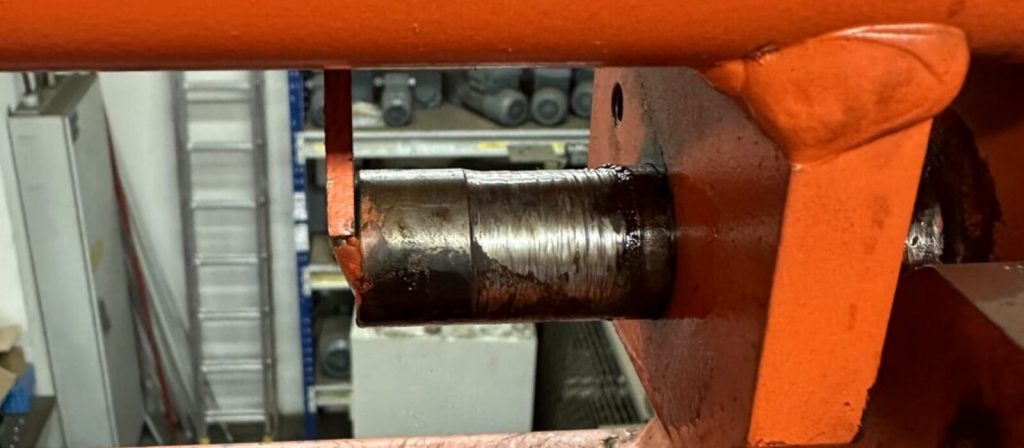
The king pin is a vertical pivot pin that connects a vehicle's trolley to its supporting frame so that it can turn – on an electrified monorail it lets the trolleys follow the track in curves, carries the whole load and wears like any pin-and-bushing joint when lubrication is missing.
The term comes from vehicle engineering. On a semi-trailer, the pin about which the trailer turns is called the king pin. Bogies and the trolleys of overhead conveyors use the same principle: a pin about which one part turns relative to the other.
Here we explain where the king pin sits on an EMS vehicle, why the trolley has to turn, how the bearing point is built and how to recognise wear.
What is a king pin?
A king pin is a pivot pin with a vertical axis. It connects two components so that they can turn relative to each other, and it transmits weight and travel forces.
On an electrified monorail it sits between trolley and crossbar. The crossbar is the beam from which the carrier with the load hangs. In German it is called „Königsbolzen“. Depending on the manufacturer the part is also called a pivot pin or pivot journal.
Key facts
- Task: connect the trolley to the crossbar so that it can turn.
- Loading: weight of vehicle and load, forces when starting and braking.
- Movement: small turning movements in every curve and switch.
- Bearings: usually a plain bearing bushing with thrust washer, depending on the system also rolling bearings.
- Retention: nut with split pin, locking plate or retaining ring.
- Wear parts: Play, worn pin, widened bush, fretting corrosion.
Where the king pin sits

An EMS vehicle usually has two trolleys on the track: a driven one and an idler. Below them is the crossbar, which connects both and carries the carrier.
Each trolley has a king pin. It runs from above through the trolley down into the crossbar. So the whole vehicle with its load hangs on these two pins.
That is why the king pin is a safety-relevant component. If it breaks, the crossbar hangs on only one trolley – or not at all.
Two trolleys, one cross beam: Often a drive trolley and a trolley without a motor carry the cross beam together, each with its own king pin. Gas springs or pendulum dampers between cross beam and hanger calm the load. On many systems a green-yellow earthing strap bridges the joints, because a pin does not reliably conduct current.
Why the trolley has to turn
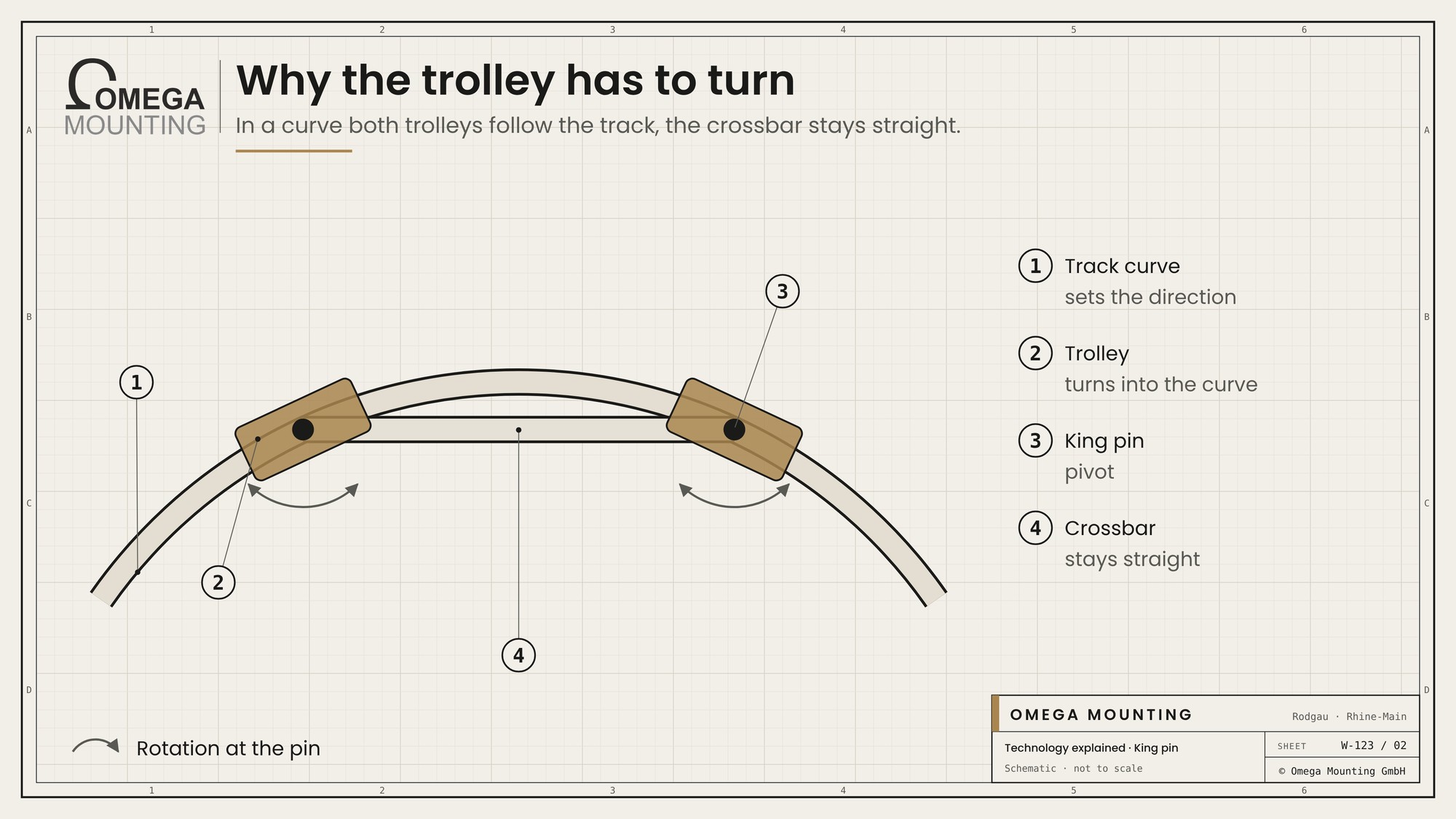
On a straight line, trolleys and crossbar are in line. In a curve each trolley follows the track and turns as it does so. The crossbar, on the other hand, stays straight because it is rigid.
Without a pivot, the vehicle would jam in the curve. The rollers would press against the track, and the guide rollers would wear out in a short time.
The turning movement is small and slow. But it repeats in every curve and every switch, many times a day. That is exactly what makes the bearing point demanding: with small, slow movements no load-bearing lubricating film builds up. The joint runs in mixed friction, and only the grease stops metal working directly on metal.
How a king pin is built

The bearing point consists of a few parts that have to fit together.
- Pin: hardened steel pin, often with a collar or head.
- Bush: plain bearing bushing, for example made of bronze, pressed into trolley or crossbar.
- Thrust washer: takes the weight in the vertical direction and protects the end faces.
- Grease nipple and grease groove: bring grease into the bearing gap.
- Retention: nut with split pin, locking plate or retaining ring, so that the pin cannot creep.
Pin and bushing are a pair. Their clearance is chosen so that the trolley turns easily but does not wobble. If one of the two parts is replaced, the other must match the new dimension.
How to spot wear

Wear on the king pin announces itself long before anything breaks.
- Noises: squeaking or creaking in curves and at switches.
- Play: The trolley can be tilted relative to the crossbar or rattles when starting.
- Misalignment: The trolley sits at an angle on the track, rollers run on one side.
- Fretting corrosion: red-brown dust at the pin ends shows that the joint is running dry.
- Scoring and cracks: only visible on the removed pin.
Every score acts like a notch where fatigue starts. Growing play turns into a knocking joint, and in the end the pin may shear off. The condition cannot be judged reliably from the outside. Only a removed pin gives certainty.
Typical mistakes
- „Maintenance-free“ assumed: Many pin joints need grease. If in doubt, the system documentation or the manufacturer will tell you.
- Only greased, never checked: Grease no longer gets through if the grease groove is clogged.
- Pin replaced without bush: The new pin runs with play in the widened bushing straight away.
- Pulled under load: The pin jams and the crossbar can drop.
- Locking reused: A used split pin or a bent locking plate does not hold reliably.
Replacement and lubrication
A worn king pin is replaced before the play becomes too great. This is how we proceed:
- Support the load: The cross-member and hanger are supported so that the pin can be removed without load.
- Release the locking: The split pin, circlip or nut is removed and replaced for reassembly, not reused.
- Check pin and bush: Pin and bearing bush are checked for scoring, wear marks and ovality. Often both are replaced together.
- Lubricate: Before fitting, it is lubricated with the specified grease. If the joint has a grease nipple, it is greased through.
- Check free rotation: After fitting, the travel unit must turn easily and without sticking.
- Test run in a curve: Running through a curve shows whether the joint works freely and the vehicle runs smoothly.
The lubrication intervals are in the operating manual. For systems with many vehicles it pays to have a plan that covers each vehicle once per cycle – so no joint is forgotten.
What we pay attention to
On pin joints we work to a fixed procedure.
- We jack up the crossbar or carrier and relieve the pin before pulling it.
- We pull a sample first and then decide on the scope.
- We check the bearing seat and replace pin and bushing as a pair.
- We grease as specified by the manufacturer and fit new locking elements.
- After the replacement we run the vehicle through curves and switches and listen.
Where we use it
In a food production plant the electrified monorail squeaked on almost every vehicle, and there were production stoppages. A single removed pin showed the cause: pin, bearing seat and rear bearing were completely worn in, with deep grooves and cracks. The in-house maintenance team had assumed the pins were maintenance-free. During the pin repair on the electrified monorail two to three fitters overhauled all 80 vehicles, ten to fifteen per weekend: jack up the carrier, pull the pin, check the bearing seat, replace the bearing, fit a new pin. The same pin-and-bushing pairing works at the king pin. More on this on our page on Overhead conveyor maintenance and repair.
In depth in our guide (German): EMS king pin and plain bearings: play, squeal, replacement
More technology explained
Technology explained
what happens in the bearing point of the pin.
Technology explained
the trolley that turns about the pin.
Technology explained
the overview of the system.
Do you have questions about how this works on your site?
Does your electrified monorail squeak in curves, or has nobody pulled a pin for years? We check with a sample and overhaul the fleet weekend by weekend. Request a callback.
Free, no-obligation callback

About the author
Tobias Schott
Managing director of Omega Mounting GmbH, Rodgau · more than 20 years of hands-on experience in installation and maintenance
A trained mechatronics technician, working in maintenance, servicing and industrial installation since 2004 – first alongside his father, and with Omega Mounting since 2012: from overhead conveyors in Frankfurt to the crane system in a new-build hall. He plans and leads lifting operations as an appointed person (AP) in data centers and on industrial sites in the Rhine-Main region, trains and examines operators of cranes, mobile elevating work platforms and telehandlers, and is a qualified occupational safety specialist. On jobs abroad he is known as the “German Troubleshooter” – the person you call when a site gets stuck. He learned what quality means from his father, not from a manual: Made in Germany as a standard for his own work, not a label. That is why quality comes first at Omega Mounting – ahead of speed and price. The Technology explained articles cover the equipment and techniques his team uses every day: what counts on site is in them – what only appears in the brochure is not.
 English
 German