
- Guide – Maintenance
EMS king pin and plain bearings: play, squeal, replacement
By Tobias Schott · Reading time approx. 22 minutes · As of: November 2026
The EMS king pin holds trolley and crossbeam together and lets the trolley swivel out in the curve. It runs in a bush, often made of bronze, and carries the load in the process. Because the pin only swivels, hardly any lubricating film builds up. Anyone who takes squealing and play seriously replaces pin and bush in good time – instead of having to recover a carrier later.
An electrified monorail squeals in the curve. First one vehicle, then several. Production gets used to it until vehicles stop. Behind it there is almost always a pin joint running dry – on the EMS king pin or on the pins in the carrier.
This guide goes into depth on one component: function, mixed friction, damage patterns, inspection, replacement, lubrication and re-making. The maintenance plan for the whole system is described in our guide to Overhead conveyor maintenance.
We are a maintenance contractor from Rodgau near Frankfurt. We replace pins, bushes and retainers and re-make parts in our own workshop – to drawing or approval. The inspection before return to service, controls and building electrics are handled by others.
Key points at a glance
- In many designs the king pin is the pivot between trolley and crossbeam or carrier. It allows the trolley to swivel out in curves.
- Pin and bush form a plain bearing. Because they only swivel under load, they run in mixed friction and wear quickly without lubrication.
- “Maintenance-free” often only means: no grease nipple. What really applies is in the manufacturer's data.
- The damage patterns build on each other: squealing, play, worn pin with wear step, oval bush, galling, in the extreme case fracture.
- Pins are safety-relevant because the load hangs on them. Re-making only to drawing or approval.
- Replacement on the unloaded, secured vehicle: pull pin, check bearing seat, replace bush, fit new pin, secure, lubricate.
- Before return to service, a competent person inspects as determined by the operator.
What is the EMS king pin – and where are the plain bearings?
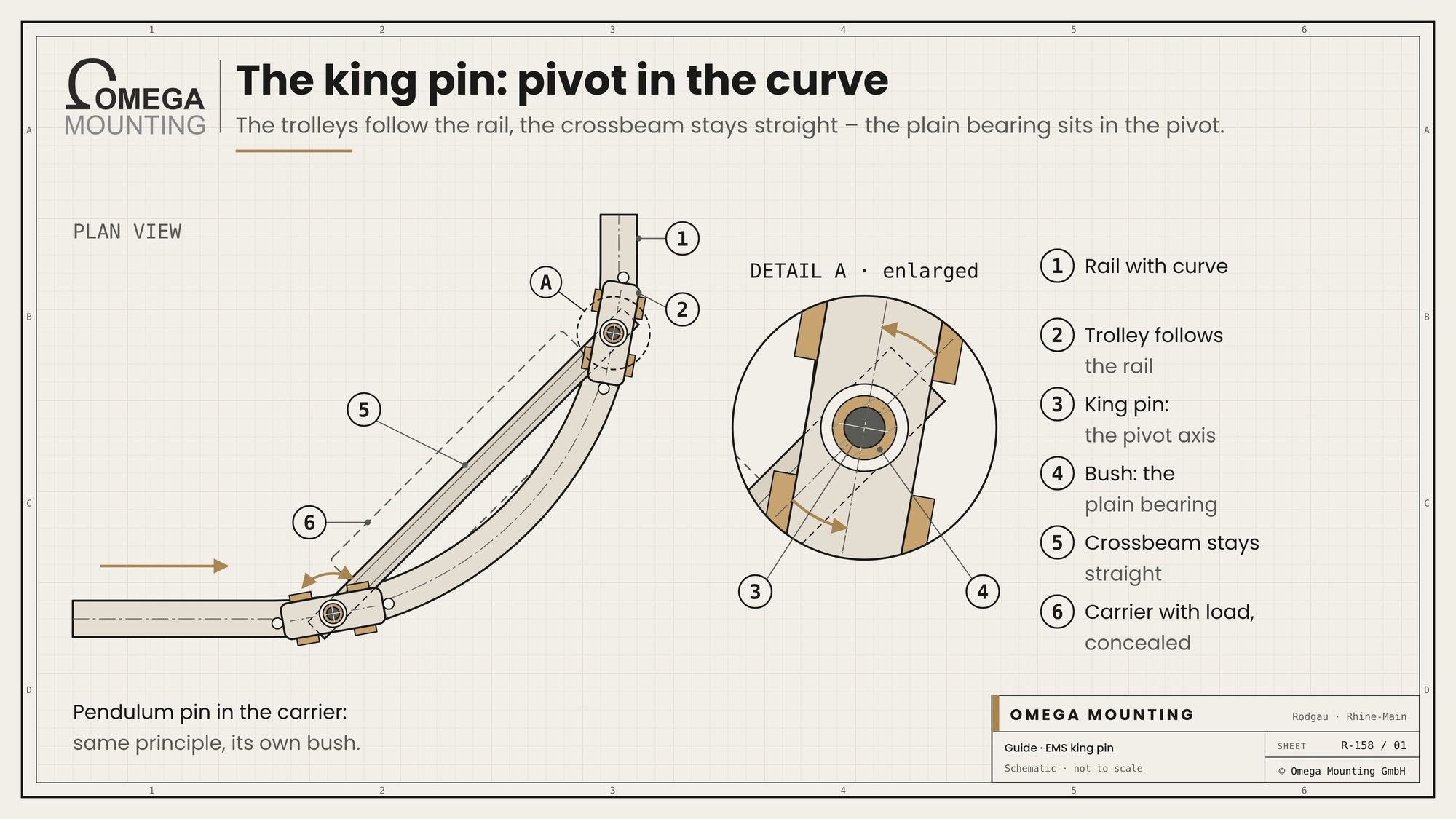
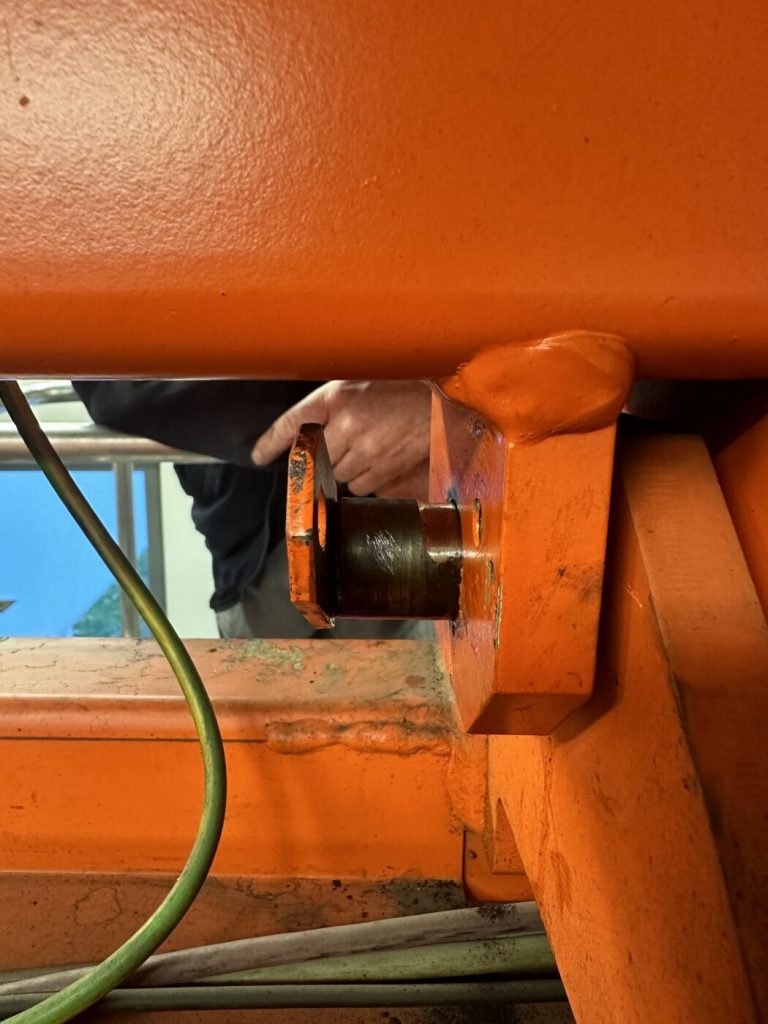
In many designs the EMS king pin is the vertical pivot that connects a trolley to the crossbeam or carrier. The trolley swivels out about it in curves while the load underneath runs on smoothly.
A vehicle of an electrified monorail usually consists of several trolleys in the rail. Below hangs a load carrier, often called a crossbeam, and on it the carrier. In the curve the trolleys follow the radius of the rail, the crossbeam stays straight. Between them sits the king pin as a pivot in the trolley.
How the electrified monorail is built as a whole is explained in our article The electrified monorail: track, trolley, switch.
Pin and bush: a plain bearing
The pin does not turn in a ball bearing but in a bush – a plain bearing. The bush is often made of bronze, depending on the design also of plastic. It is deliberately the softer partner, takes up the wear and is easier to replace than pin or carrier. It sits firmly in the bearing seat, the pin moves in it.
Further pins in the carrier
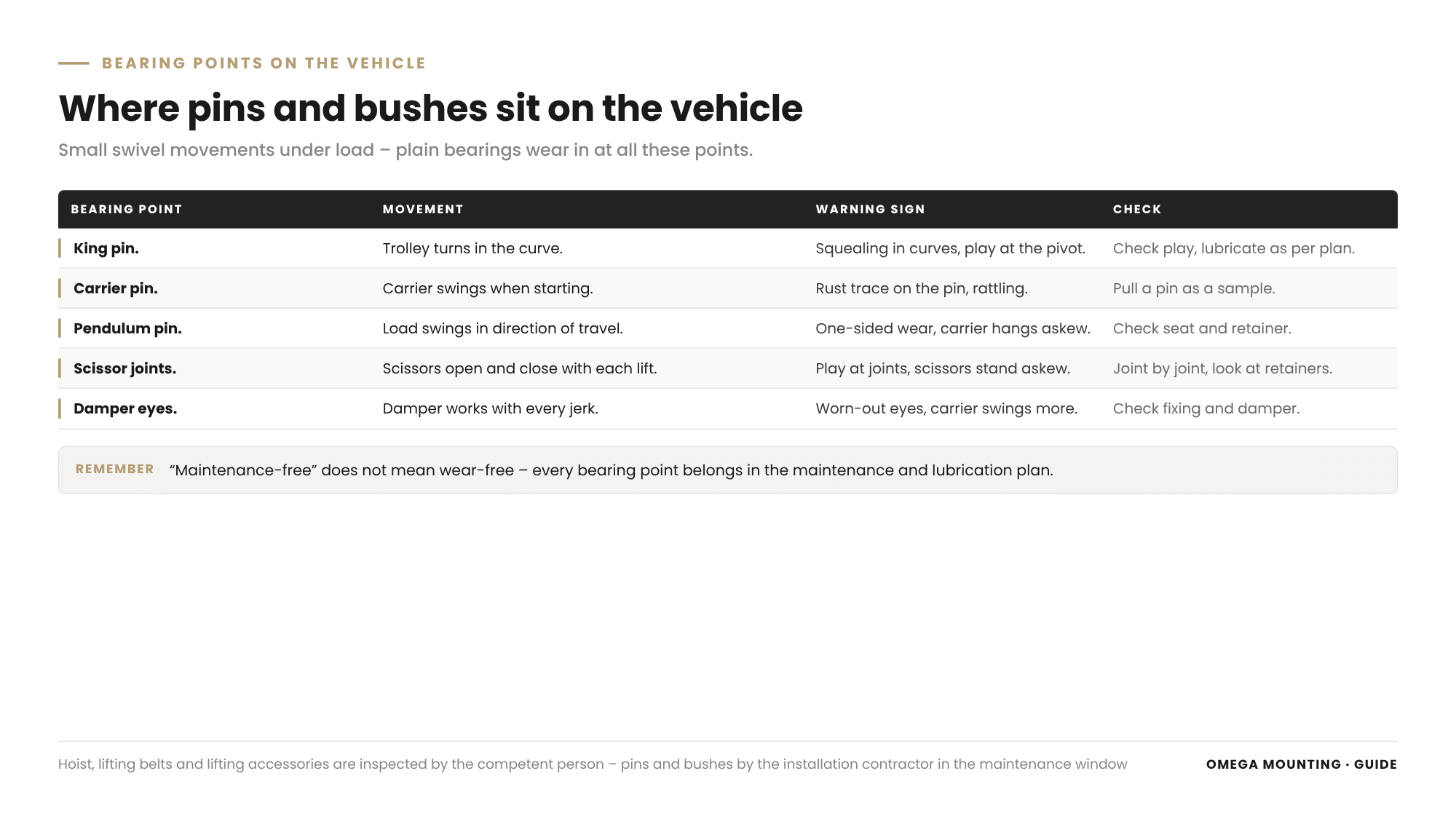
The king pin is not the only pin joint. Depending on the design, the carrier has further pins: pendulum pins on which the carrier can swing in the direction of travel, joint pins on load handling devices and pins on hoists. They all work on the same principle. What this guide says about the king pin therefore applies accordingly to the EMS carrier pins.
Retainers belong to it
Every pin is secured against working out, for example with circlips, split pins or locking plates as specified by the manufacturer. A missing retainer is a finding.
Two trolleys, one crossbeam. On many vehicles a drive trolley and a trolley without a motor carry a crossbeam together. Each swivels about its own king pin in the curve. Between crossbeam and carrier there are often gas springs or pendulum dampers. They calm the carrier when starting and braking. If a damper weakens, the carrier swings more – and the pins take every jolt undamped.
Why does the pairing of pin and bush run in mixed friction?
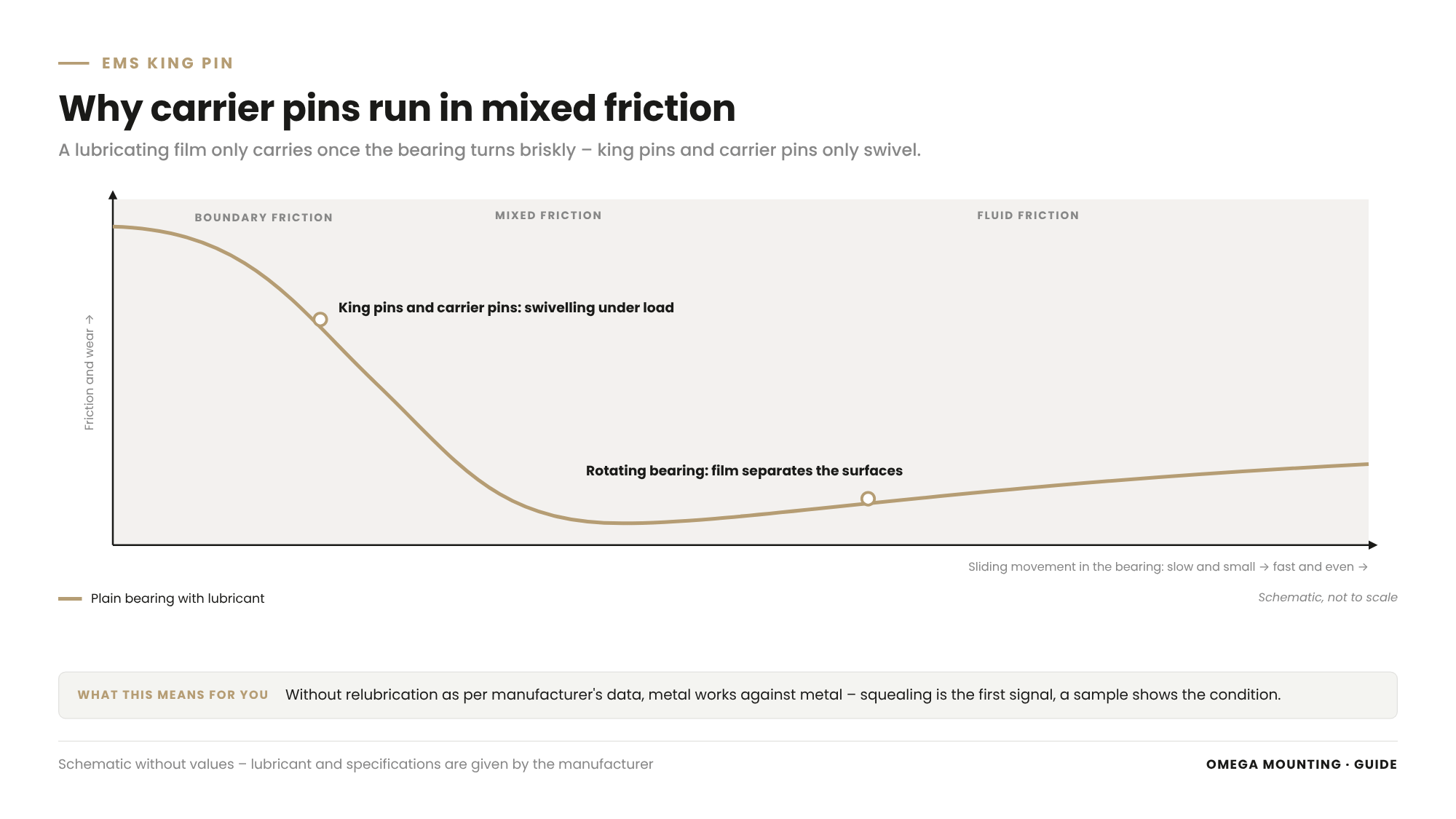
Pin and bush run in mixed friction because under load they only swivel back and forth a little. A load-bearing lubricating film, however, needs an even movement that draws lubricant into the gap – and the joint does not have that.
What a plain bearing needs to slide
A plain bearing knows three states. In boundary friction the surfaces touch almost completely. In mixed friction the lubricant carries part of the load, but the roughness peaks still touch. In fluid friction a closed film separates both surfaces. Then wear is very low. A bearing only reaches this state when it turns quickly and evenly.
Why the king pin does not manage this
A king pin does not turn through. It swivels out in the curve and then back. In between it stands still while the load continues to rest on it. A carrier pin swings when starting and braking. The movement stays small and slow. The lubricant is pressed out of the loaded zone and not drawn back in. A plain bearing in mixed friction is therefore normal in this joint, not a design fault.
What follows from this
If plain bearings and pins run in mixed friction, the lubricant decides the service life. If it is missing, metal works against metal. Abrasion grows quickly, and the bush wears on one side, because the load always pulls downwards.
“Maintenance-free”: why the statement can be misleading
With pin joints, “maintenance-free” often only means that there is no grease nipple or that it was greased once during installation. Whether the pairing really manages without relubrication and inspection is in the manufacturer's data – and only applies to the conditions stated there.
How the misconception arises
A new system runs quietly, the pins are greased. Years pass without anyone thinking about them. Then the maintenance list says: pins maintenance-free. That is sometimes true for self-lubricating bushes. Even then it only applies to the load, movement and surroundings for which the manufacturer designed them. Wet cleaning, dust or heat change these conditions.
What you should check
Look in the operating instructions for the pins and bearings in trolley and carrier. Is a lubricant, an interval or an inspection specification given there? If the information is missing, ask the manufacturer in writing. Until then, treat the pairing as low-maintenance, not maintenance-free: inspect, and take a sample if in doubt.
What damage patterns does an EMS king pin show?

An EMS king pin shows its damage patterns in stages: first it squeals, then the play grows, then pin and bush wear in, the bush becomes oval, and without intervention galling and in the extreme case fracture or shearing follow. The earlier you intervene, the less has to be replaced.
Squealing
Squealing is the first audible signal: metal slides against metal. You often hear it in curves when the trolleys swivel out, or when starting, when the carrier swings. When an EMS squeals, that is a wear signal, not a noise problem.
Play
With abrasion the play grows. The carrier knocks when starting and braking. Every knock is a load peak for pin, bush and bearing seat – play accelerates the wear that caused it.
Worn pin with wear step
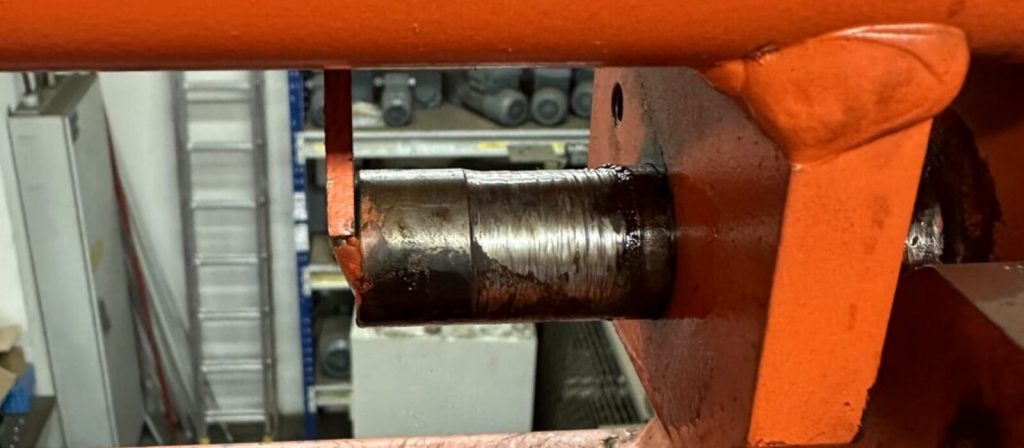
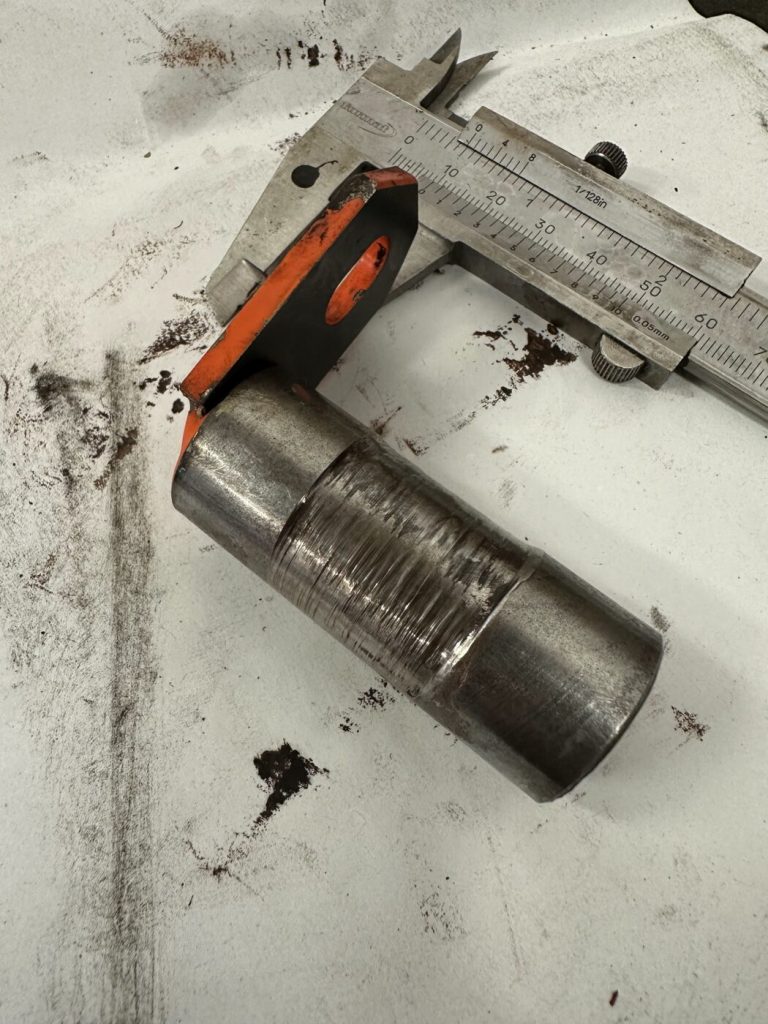
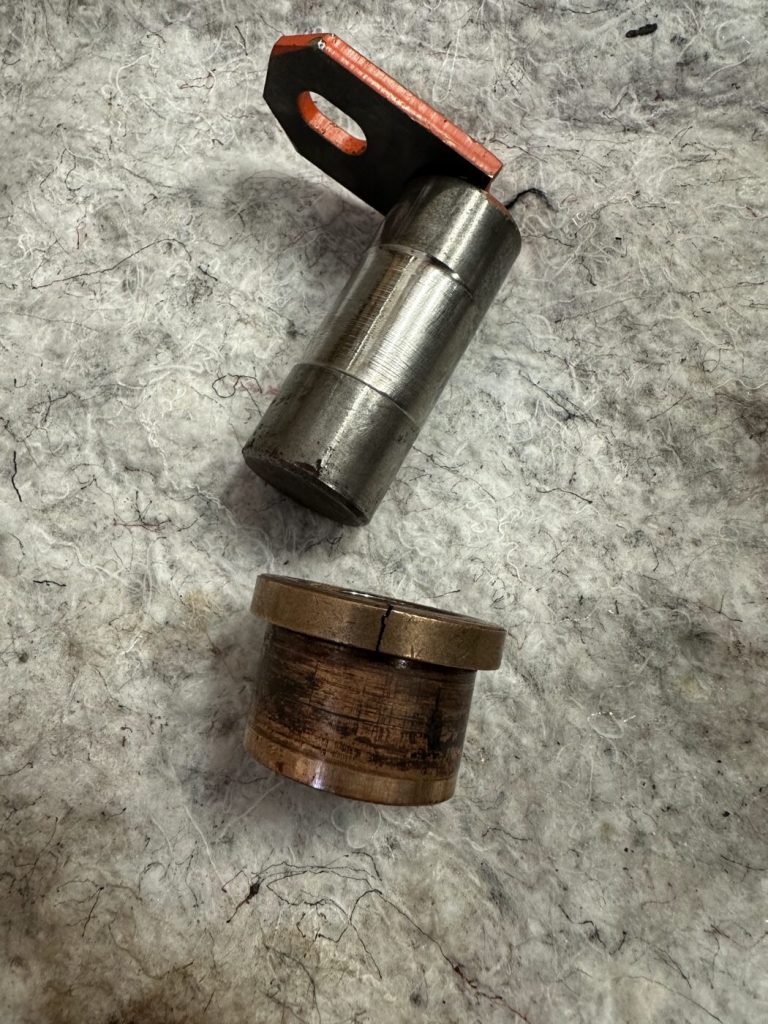
The pin wears where it carries in the bush. At the edge of the bush a step forms between worn and untouched surface. Grooves on the running surface are an additional warning sign, because they act like notches.
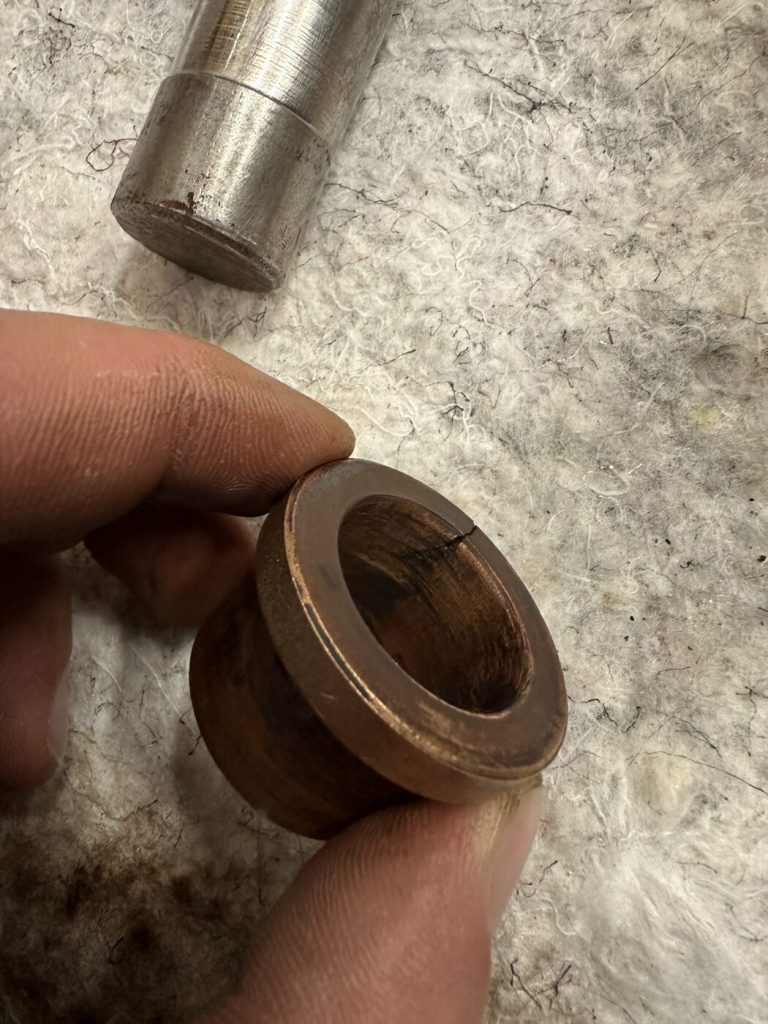
Oval bush
The load always acts in the same direction. That is why the bush becomes oval. A new pin then only rests on a narrow line and soon wears in again. Why the pair is therefore replaced is explored in our guide on Wear on the electrified monorail.
Fretting corrosion and galling
Rust-brown discolouration at the seat is called fretting corrosion. It shows that surfaces are working against each other that should sit firmly. If the lubricant is missing entirely, pin and bush can gall: material tears out of one surface and sticks to the other. The joint becomes stiff or blocks.
Fracture or shearing
In the extreme case a pin breaks. Fatigue cracks start from grooves and steps and grow under load cycles until the pin shears off. That is rare – but the reason why pins are taken seriously.
Why pins are safety-relevant: the load hangs on them
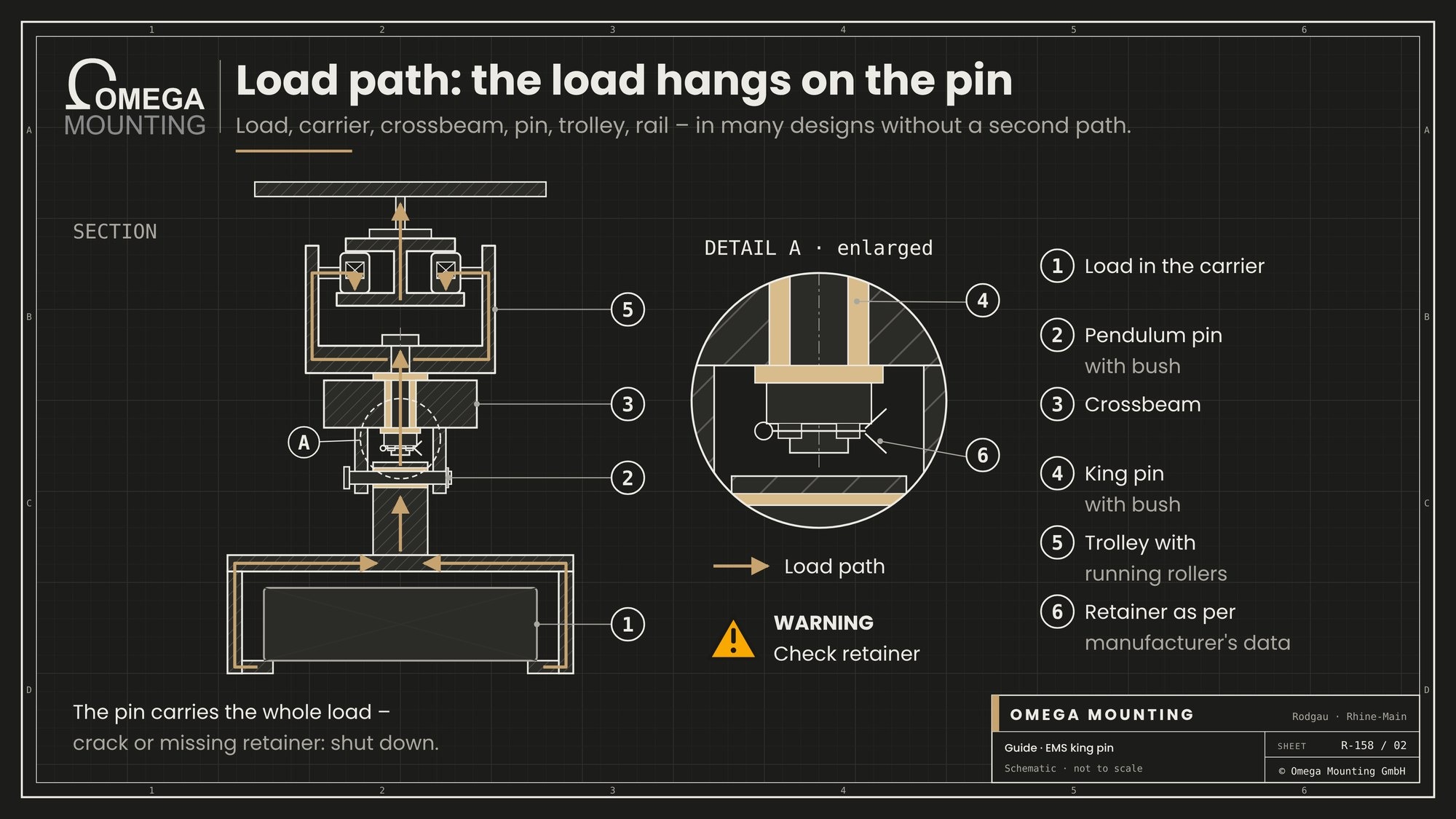
Pins in the trolley and carrier are safety-relevant because the load hangs on them. If a king pin or carrier pin fails, the load can come loose or fall – above people, products and equipment in the hall.
The force flow
The load goes from the carrier via pins and crossbeam into the trolleys and via the rollers into the rail. In many designs no second connection takes over if a pin breaks. That is why pins deserve the same care as a sling.
What this means for findings and decisions
A crack, a missing retainer or a badly worn pin does not wait for the next window. The vehicle is shut down until the finding has been clarified. Whether the others keep running is decided by the operator with their competent person.
Who inspects and releases
After a repair that can affect safety, the work equipment is inspected before return to service. This is required by the German Ordinance on Industrial Safety and Health (BetrSichV). Who inspects, to what extent and with which proof is set by the operator in their risk assessment. The inspection is carried out by a person qualified to inspect. We replace and document; we do not inspect as the competent person. This section is a practical classification, not legal advice.
How do you check pin and bush in trolley and carrier?

You check pin and bush in three stages: in operation by noise and abrasion, on the isolated vehicle for play with the carrier unloaded and, if in doubt, by a sample in which a pin is pulled and measured. Limits are given by the manufacturer.
In operation: listen and look
Walk along below the track, especially in curves. Does a vehicle squeal when swivelling out? Does a carrier knock when starting? Is there bronze-coloured abrasion below a trolley, are there rust-brown traces at bearing points? Note vehicle, location and noise. How to spot wear early is described in our guide on spotting wear on machines.
On the stationary vehicle: check play
For the play check the vehicle stands on the isolated, secured line. The carrier is jacked up or unloaded with lifting gear, because under load the weight presses the pin into the worn spot. Move the carrier by hand across the pin axis and watch the bearing point; a dial gauge makes play comparable. Also check whether the trolley swivels out easily and all retainers are there.
The sample: pulling a pin
From the outside a pin joint can hardly be assessed. If in doubt, a pin is pulled. It is measured at the running surface and at an unloaded spot, plus the inside of the bush. Watch for grooves, cracks, fretting corrosion and the bearing seat. A worn pin often says a lot about the whole fleet.
What belongs in the findings
Vehicle, bearing point, measured values compared with the new part or manufacturer's data, wear pattern and recommendation. The check points around trolleys, carriers and pins can also be found in our overhead conveyor maintenance checklist.
What else belongs to the carrier. Check the rubber buffers at the vehicle ends for cracks and firm seating. Look at the mountings and centring pins at the bottom of the carrier for wear and deformation. On many systems yellow-green earthing straps connect trolley and carrier, because a pin joint does not reliably conduct current. A torn or loose strap is a finding for the qualified electrician.
Scissor lift carrier: many joints on one vehicle. Some carriers lift the load via scissors, pulled by lifting belts or ropes. Every scissor strut turns in joint pins, usually in simple bushes. With every lift they only turn a little – exactly the movement in which plain bearings wear. Check the play at every joint, look at the pin retainers and watch for scissors that stand askew when lifting. Hoist, lifting belts and ropes are inspected by the competent person.
Force is a finding, not a work step
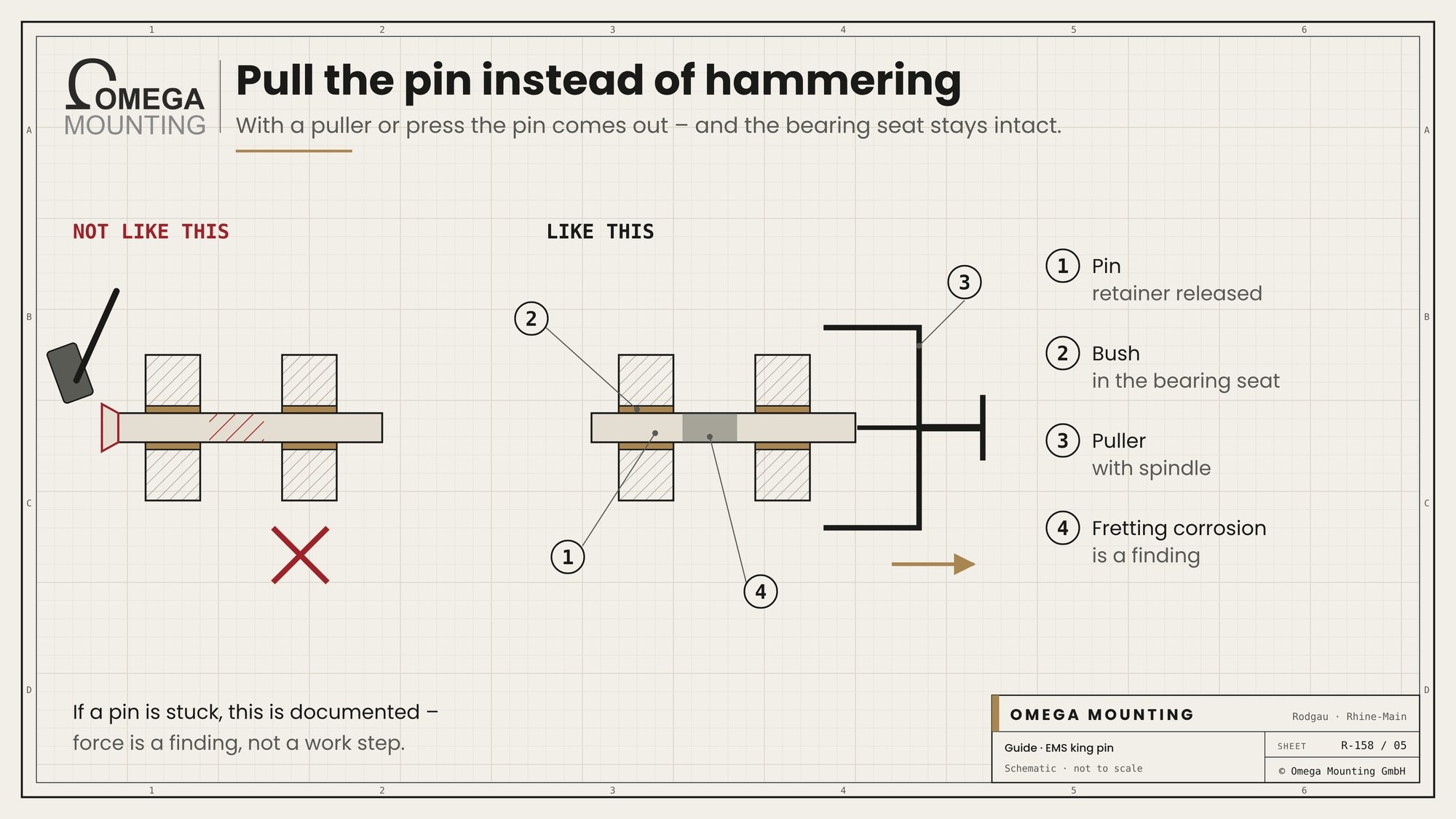
If a pin can only be pulled with force or a joint only moved with force, that in itself is a finding. It shows galling, fretting corrosion, deformation or an alignment error – and must be clarified before anyone hits it again.
An example from another assembly
On a hoist a coupling could only be pushed with a crowbar for years. Maintenance had got used to it. Only after dismantling and measuring did the cause become clear: a crookedly machined mounting face. Every application of the lever had covered up the problem. The lesson applies to pins too.
What stuck pins mean
A pin that cannot be driven out may have galled or be stuck in fretting corrosion. Or the carrier is deformed and the holes no longer line up. Anyone working with an ever bigger hammer damages bearing seat and carrier – the pin replacement turns into a repair on a load-bearing component.
How to proceed correctly
Unload the carrier completely and remove all retainers. Work with a drift, puller or press instead of blows on the pin head. If the pin still sticks, stop, take photos and decide with the operator. The same applies when fitting: a pin that only goes in with force does not fit or is not aligned.
Replacing pin and bronze bush: the sequence on the vehicle
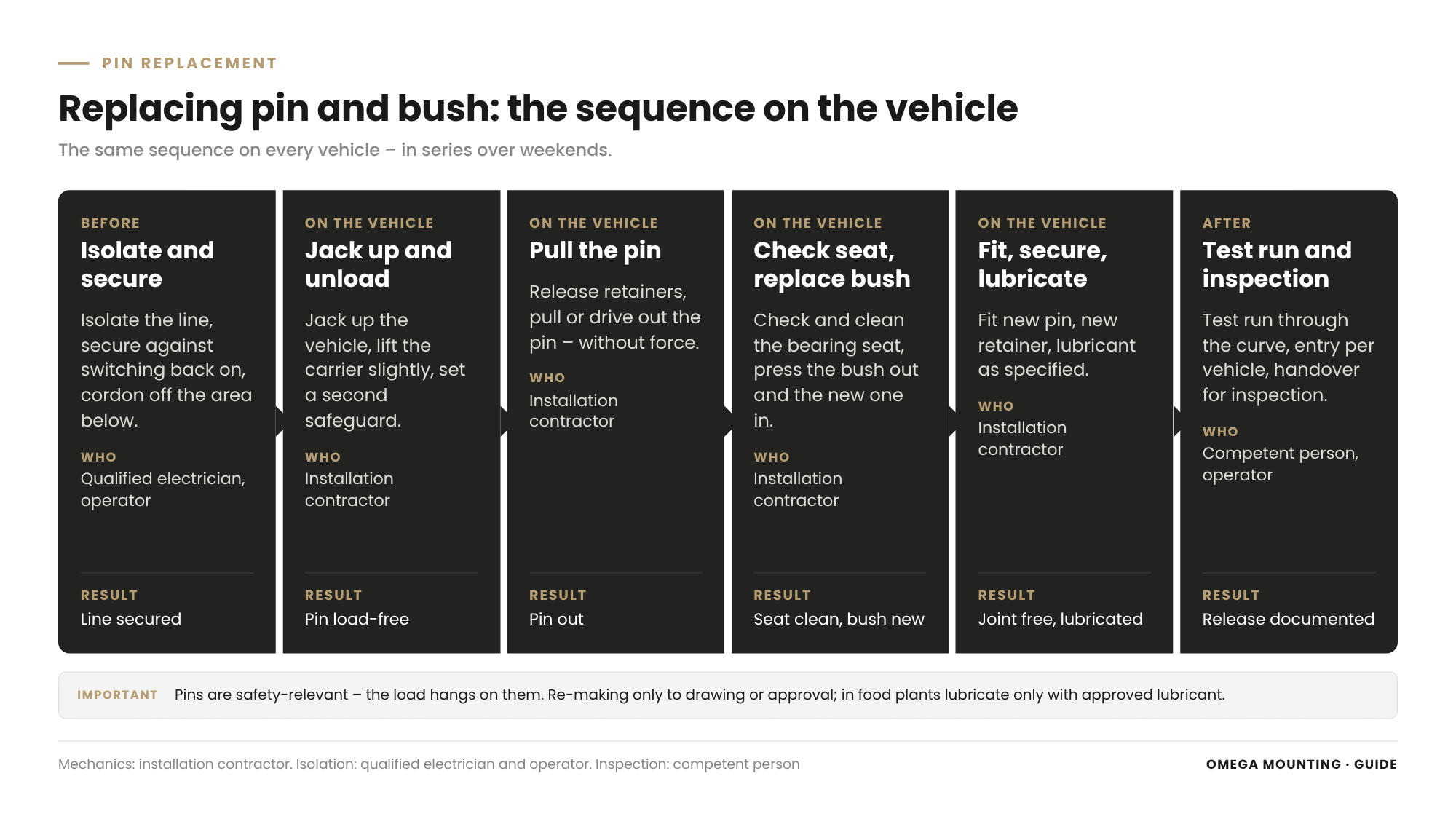
You replace pin and bronze bush on the isolated, secured and unloaded vehicle: pull the pin, check and clean the bearing seat, remove the old bush and fit the new one, set the new pin, secure, lubricate as specified by the manufacturer, check free movement and hand the vehicle over for inspection.
Preparation
New pins, bushes and retainers are ready as pairs, plus tools, lifting gear and supports. The workplace at height is set up, the area below cordoned off. The line is isolated and secured against switching back on according to your procedure – by our or your qualified electrician. How the procedure is organised is described in our guide to Lockout tagout in maintenance.
Jacking up and unloading
The vehicle is jacked up. Carrier or crossbeam are lifted slightly with lifting gear until the pin is free of load. A second, independent safeguard holds the load in case the lifting gear gives way.
Pulling the pin
The retainers are removed, the pin pulled or driven out with the drift. Anyone who has to drive the pin out and meets resistance stops and clarifies the cause.
Checking and cleaning the bearing seat
Is the bearing seat round, clean, without scores and fretting corrosion? It is cleaned, old lubricant and abrasion come out. A damaged seat is assessed with the operator and, if necessary, the manufacturer.
Replacing the bush
The old bush is pressed out, the new one pressed in with suitable tools as specified by the manufacturer – not hammered in. When replacing a bronze bush, watch the position of lubrication grooves and bores.
Setting, securing, lubricating the pin
The new pin is inserted and secured with new retainers; split pins and locking plates are never reused. Lubrication follows the manufacturer's data with the approved lubricant. Afterwards the trolley swivels out easily by hand, without jamming and without play.
Completion
After lowering and release of the line, a test run through a curve follows. Every replacement is documented per vehicle. Then the competent person inspects as determined by the operator.
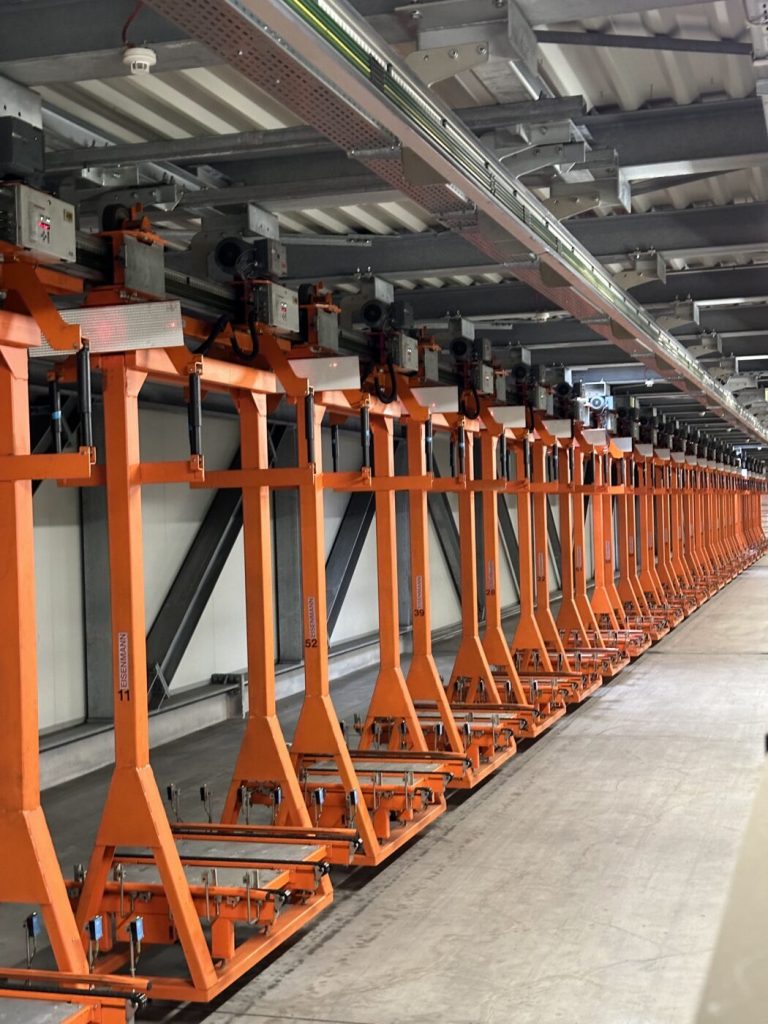
Series rhythm: vehicle by vehicle over weekends
With a whole fleet, it is not one pin that is replaced but vehicle by vehicle in a series rhythm: at weekends or in production-free time, several vehicles at a time, with the same sequence and an entry per vehicle.
Why all vehicles age at the same time
All vehicles of an electrified monorail carry similar loads, run the same curves and stand in the same hall air. If one pin wears, the others wear with it. A sample on one vehicle is therefore often the starting signal for repairing the whole fleet.
How the rhythm works
Per window, a group of vehicles agreed with production is worked on. At the end of every window the complete fleet runs again. A small, well-rehearsed team manages several vehicles per weekend because every move is practised. Parts for the whole series are ready before the first window, and the sequence follows the findings: whoever squeals loudest comes first.
Every vehicle has a number. Most carriers bear a clearly legible vehicle number. Use it as the key for the maintenance history: which pin, which bush, replaced when, which finding. After a few rounds you can see whether individual vehicles cause problems noticeably often. That usually points to a cause on the vehicle, not on the track.
Re-making only to drawing and approval
A king pin or carrier pin is only re-made to the manufacturer's drawing or to a drawing approved by the operator – with material, heat treatment, surface and fit taken from that specification. An old part alone is not enough as a template.
Why the old part is not enough
A removed pin is worn, its dimension at the running surface is not the nominal dimension. Material and hardness cannot be seen from the outside. Anyone who turns a new pin by eye fits a load-bearing part with unknown properties.
When re-making makes sense
If the manufacturer no longer supplies parts, re-making is often the only way. If the manufacturer's drawing is available, manufacturing follows it. If it is missing, a new drawing is created from a survey and manufacturer's documents; material, heat treatment and fit are set by the manufacturer or a designer on behalf of the operator. The operator approves the drawing, only then do we manufacture. The same applies to bushes, including apparent material improvements. More on this in the guide to spare parts that are no longer available.
Lubrication: lubrication plan, lubricant and food plants
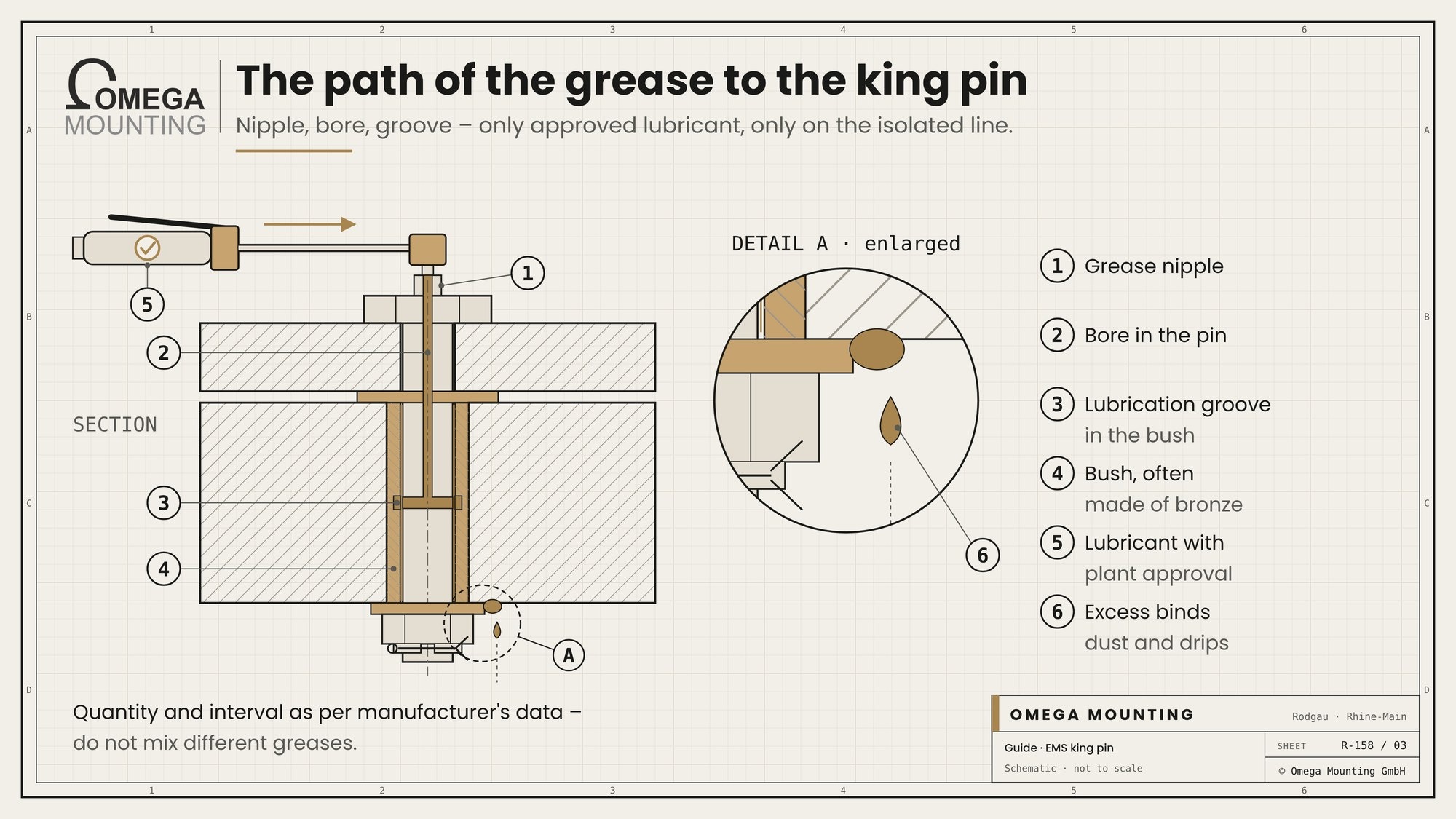
Pins and bushes are lubricated according to the manufacturer's data: with the lubricant named there, at the points named there and at the specified interval. In food plants only food-grade lubricants approved by the plant are used.
Pins in the lubrication plan
Every bearing point with a lubrication specification belongs in the system's lubrication plan: king pin per trolley, carrier and pendulum pins, joints on load handling devices. For each point it lists lubricant, quantity as specified, interval and responsible person. How a lubrication plan is set up and how lubricants are selected is shown in our guide to the lubrication schedule in maintenance.
The suitable lubricant
For plain bearings under load and with small movement the manufacturer usually names a grease with additives that also protect in mixed friction. Different types of grease are not mixed; before a change the bearing point is cleaned. More grease is not better – excess binds dust and in the worst case drips down. Lubrication is done on the isolated line, not on moving vehicles.
Food plant: approval before the first grease
If the electrified monorail hangs above open products, the plant decides which lubricant is permissible – usually food-grade lubricants, approved mostly via quality assurance. We do not bring any lubricant the plant has not approved. What else applies in sensitive areas is described in our guide to Maintenance in food production.
Symptom, finding, measure: the overview for king pins and carrier pins

The table assigns the most common symptoms on king pins and carrier pins to a probable finding and a measure. It does not replace inspection on site. Limits and specifications come from the manufacturer.
| Symptom | Probable finding | Action |
|---|---|---|
| Squealing in the curve | Dry pairing at the king pin, mixed friction without lubricant. | Pull a sample, clean and lubricate as specified, replace if worn. |
| Squealing when starting | Dry carrier or pendulum pin. | As above, add the bearing point to the lubrication plan. |
| Carrier knocks when starting | Play between pin and bush. | Check play on the unloaded carrier, replace pin and bush as a pair. |
| Abrasion below the trolley | Bush or pin wearing away. | Pull pin, measure, assess the fleet by sample. |
| Rust-brown traces at the bearing point | Fretting corrosion, bush not seated firmly or pairing running dry. | Remove, check bearing seat, replace pair. |
| Trolley swivels out stiffly | Galling, soiling or deformation. | Shut down vehicle, remove, clarify cause. |
| Pin stuck on removal | Galling, fretting corrosion or alignment error. | Stop, document, decide with the operator. |
| Grooves or cracks on the pin | Notches, incipient fatigue. | Replace pin, check further vehicles. |
| Retainer missing or damaged | Pin can wander. | Shut down vehicle, check and replace retainer and pin. |
| Bearing seat oval or scored | Wear over a long time, bush turned in the seat. | Assess with manufacturer, repair as specified. |
Typical mistakes with king pins and plain bearings
The typical mistakes with king pins and plain bearings are taking “maintenance-free” at face value, ignoring squealing, replacing only the pin instead of the pair, releasing stuck pins with force and re-making parts without a drawing.
- Believed “maintenance-free”. Nobody looked in the operating instructions. The pairing has been running dry for years.
- Squealing ignored. The noise belongs to the system – until vehicles stop.
- Only the pin replaced. The new pin soon wears in again in the oval bush.
- Bearing seat not checked. The new bush turns with the pin in the worn-out seat.
- Released with force. The hammer damages carrier and seat, the cause remains undiscovered.
- Retainers reused. An old split pin no longer holds reliably.
- Re-made from an old part. The new pin has the dimension of the wear and an unknown material.
- Wrong lubricant. Greases are mixed, or approval is missing in the food plant.
The mistake behind the mistakes
Behind most mistakes is the assumption that a pin is a simple part. In fact it is plain bearing, load-bearing component and wear point at the same time.
EMS king pin in the Rhine-Main region: how we work
We replace EMS king pins and carrier pins mechanically in plants in the Rhine-Main region: findings, sample, replacement of pins, bushes and retainers, checking and cleaning the bearing seat, lubrication as specified and re-making to drawing – from Rodgau in Frankfurt, Offenbach, Hanau, Darmstadt and Aschaffenburg.
Our core is the mechanics. Isolation follows your procedure, by our or your qualified electrician. Inspection is carried out by the competent person, lubricant approval in the food plant by the plant. After every window we hand over a list per vehicle with findings, parts and photos. For EMS maintenance in the Rhine-Main region the distances from Rodgau are short – that helps when a window becomes free at short notice. The full scope of our Maintenance and servicing is set out on our service page.
Project examples
A job from our project diary shows how a noise became a series repair. It concerned the pins in the carrier; the same principle applies to the king pin.
Food plant: the fleet squealed
With the pin repair on an EMS in a food plant the electrified monorail squealed heavily, and there were repeated failures during production time. A pulled pin showed the cause: pin, bearing seat and rear bearing were worn, lubrication was practically non-existent. The pin had grooves, cracks and material loss. In-house maintenance had considered the pins maintenance-free.
The small swivel movements under load had not built up a lubricating film. The whole fleet was then refurbished, at weekends in production-free time, several vehicles per weekend. Per vehicle: unload the carrier, pull the pin, check the bearing seat, replace the bearing, fit a new pin. Afterwards the system ran reliably on cycle and quietly again.
For your system this means: question “maintenance-free”, take squealing and play seriously, and if in doubt pull a pin.
Is your EMS squealing, or are your pins considered maintenance-free?
Then get in touch with us. We walk the track with you, pull a pin with your approval and tell you honestly whether one vehicle, a series or for now only the lubrication is due.
What this means for your role
For maintenance managers: Include king pins, carrier and pendulum pins as separate items in the maintenance and lubrication plan. Clarify with the manufacturer what “maintenance-free” means for your design. Define when a sample is taken.
For buyers: Ask for manufacturer's parts or an approved drawing for pins and bushes. Order pairs, not single parts. For the series, have parts for the whole fleet ready before the first window begins.
For designers: On new or converted systems, make sure lubrication points and jacking points are accessible. Keep drawings of the pins and bushes in the documents. They are later the basis of any re-making.
For project managers and site managers: Plan the series rhythm with production and the plant's windows. On site you coordinate isolation, cordoning off, scaffolding and the handover to the competent person.
For operations and plant managers: A squealing vehicle is an early, inexpensive signal. Release the windows a series needs. And make sure that a critical finding leads to an immediate shutdown, not just into the next window.
EMS carrier pin and bearing plan: template on request
The EMS carrier pin and bearing plan is a one-page working document for your system. Per vehicle it lists the bearing points: king pin per trolley, carrier and pendulum pins. Added to this are condition in operation, play with the carrier unloaded, sample, replaced parts, lubricant with approval, test run and inspection by the competent person. Each point has fields for “responsible” and “done” or “open”. There are deliberately no number fields or limits – those come from the manufacturer. Request the template via our contact form – keyword “EMS carrier pin and bearing plan”.
Why Omega Mounting?
We are based in Rodgau near Frankfurt, can be reached around the clock and work with our own fitters, our own lifting equipment and our own workshop. The linked job shows how we work on pins: one pulled pin led to the refurbishment of a whole fleet, vehicle by vehicle at weekends. We say beforehand where our service ends: inspection, controls and building electrics are handled by others, and we only make parts to drawing or approval. What this means for you: a single point of contact for pins, bushes and plain bearings, who delivers findings, replacement and documentation from a single source.
Conclusion
The EMS king pin is a small part with a big task. It lets the trolley swivel out in the curve and carries the load in the process. Because it only swivels, it runs in mixed friction like every carrier pin. “Maintenance-free” is therefore a statement that should be checked. Squealing and play are early signals, the sample shows the true condition. Replacement takes place on the unloaded, secured vehicle, as a pair, with a new retainer and lubricated as specified. Re-making only to drawing, inspection by the competent person. If your system squeals, send us photos, the type of system and your shutdown windows – we will get back to you with an honest assessment.
Further reading: Electrified monorail track · EMS switch · EMS conductor rail · EMS rollers
Planning a move-in, installation or maintenance in the Rhine-Main region?
Tell us briefly what you need – we'll come back with an honest assessment.
Free, no-obligation callback
You may also be interested in these guides
Maintenance & Servicing
Maintenance & Servicing

About the author
Tobias Schott
Managing director of Omega Mounting GmbH, Rodgau · more than 20 years of hands-on experience in installation and maintenance
A trained mechatronics technician, working in maintenance, servicing and industrial installation since 2004 – first alongside his father, and with Omega Mounting since 2012: from overhead conveyors in Frankfurt to the crane system in a new-build hall. He plans and leads lifting operations as an appointed person (AP) in data centers and on industrial sites in the Rhine-Main region, trains and examines operators of cranes, mobile elevating work platforms and telehandlers, and is a qualified occupational safety specialist. On jobs abroad he is known as the “German Troubleshooter” – the person you call when a site gets stuck. He learned what quality means from his father, not from a manual: Made in Germany as a standard for his own work, not a label. That is why quality comes first at Omega Mounting – ahead of speed and price. He writes these guides from that practice: what works on our sites is in them – what exists only on paper is not.
Frequently asked questions
In many designs the king pin is the vertical pivot between trolley and crossbeam or carrier. The trolley swivels out about it in curves while the load runs on smoothly below. It runs in a bush, often made of bronze, and forms a plain bearing with it. Because the load hangs on it, it is safety-relevant.
Usually a pin joint is running dry, often at the king pin when the trolley swivels out. Metal slides on metal because the lubricating film is missing. Squealing when starting points more to carrier or pendulum pins. The noise is a wear signal. A sample shows whether only lubrication is missing or pin and bush are already worn.
Rarely in the literal sense. “Maintenance-free” often only means that there is no grease nipple. What applies is in the manufacturer's data – and even then only for the conditions stated there. If the information is missing, treat the pairing as low-maintenance: inspect, lubricate as specified, take a sample if in doubt.
In operation by squealing, knocks when starting and abrasion below the trolley. On the unloaded carrier by noticeable play. You only recognise it for certain on the pulled pin: a wear step shows on the running surface, and the caliper makes the material loss measurable. Grooves and cracks are additional warning signs.
As a rule, yes. The bush shares the wear and becomes oval on one side. A new pin then only rests on a narrow line and soon wears in again. Checking the bearing seat is part of the pair replacement. If it is damaged, it is assessed with the manufacturer.
The lubricant specified by the manufacturer and approved by the plant. Above open products these are usually food-grade lubricants. Approval is given by the plant, usually via its quality assurance. Different types of grease are not mixed, and before a change the bearing point is cleaned.
Yes, but only to the manufacturer's drawing or to a drawing approved by the operator. Material, heat treatment, surface and fit come from this specification. A worn old part shows neither the nominal dimension nor the material. Because the load hangs on the pin, nothing is made by eye.
A person qualified to inspect, as determined by the operator in their risk assessment under the German Ordinance on Industrial Safety and Health (BetrSichV). The installation contractor replaces, documents and hands over. Before that, the qualified electrician releases the line again after isolation, and a test run shows that the trolley runs cleanly through the curve.
Send us photos of the trolleys and carriers, the type of system and a description of the noise or fault. Name the windows your plant can release. We arrange a walk-through, pull a pin with your approval and send you a written assessment. Your contact is Tobias Schott – reachable via our contact form.
 English
 German