
- Technology explained – equipment and protection
Hand-held power tools: protection class, inspection, vibration and noise
By Tobias Schott · 5-minute read · Updated November 2026
Drill, hammer drill, angle grinder and reciprocating saw are part of everyday work on every installation job. They are only safe if they are electrically sound, inspected regularly and vibration and noise are kept under control. Here is what matters.
Power tools get thrown, dragged over edges, used in the rain and lifted by the cable. No wonder damaged cables and plugs are among the most common defects found during inspections.
Here we explain what the protection classes mean, how visual checks and periodic inspections work, how vibration and noise put strain on the body and how tools are safely supplied with power on site.
What is a hand-held power tool?
A hand-held power tool is a device with an electric motor that is held and guided by hand while working. This includes drills, hammer drills, screwdrivers, angle grinders, saws and sanders.
In terms of the inspection regulations they are portable electrical equipment: they are moved during operation or can easily be taken from one place to another. That is exactly why they are more at risk than permanently installed equipment.
They are available with a mains cable or with a battery. The same basic rules on condition, inspection and physical strain apply to both.
Key facts
- Task: Drilling, screwing, cutting, grinding by hand.
- Protection classes: I with protective earth, II double insulated, III extra-low voltage.
- Inspection: Visual check before every use, periodic inspection at fixed intervals.
- Strains: Hand-arm vibration, noise, dust.
- Weak points: Cable, plug, strain relief, housing, switch.
- Interfaces: Qualified electrician for inspection, occupational safety specialist, operator.
- Our part: well-maintained and inspected tool stock, site power for the work area.
Protection classes: how the tool protects against electric shock
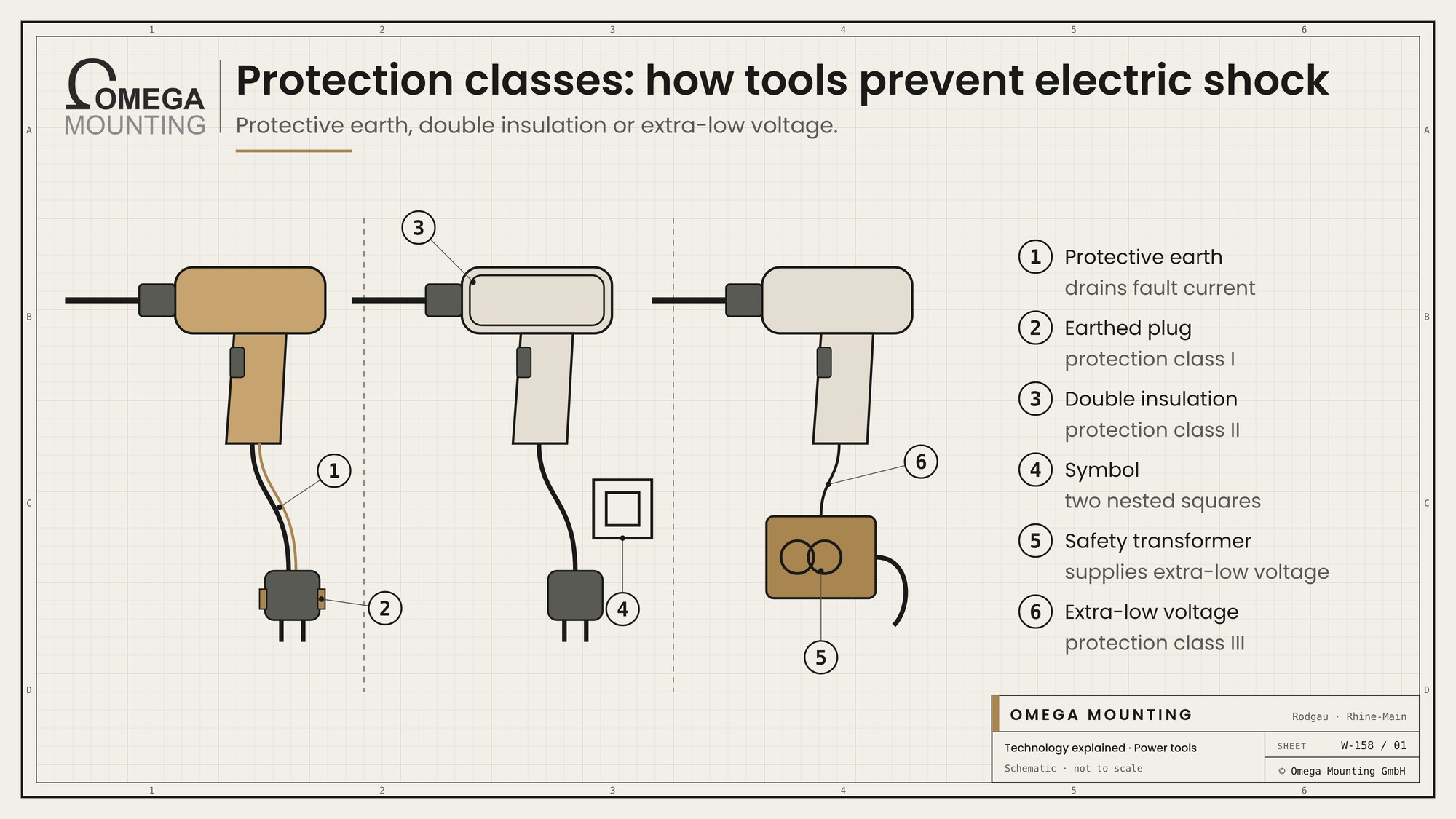
The protection class indicates how a device protects people from an electric shock if something goes wrong inside:
- Protection class I: The metal housing is earthed via the Protective earth . If a fault occurs, the current flows away via the protective earth and the fuse or residual current device trips. The device has an earthed plug.
- Protection class II: The device is double or reinforced insulated. Live parts are enclosed so that they cannot reach the touchable housing. There is no protective earth. Recognisable by the symbol of two nested squares.
- Protection class III: The device runs on safety extra-low voltage, which is so low that it is not dangerous. It comes from a safety transformer or a battery.
Most modern hand tools are double insulated, i.e. protection class II. Important: the protection only works as long as the housing and cable are undamaged.
Visual check before every use
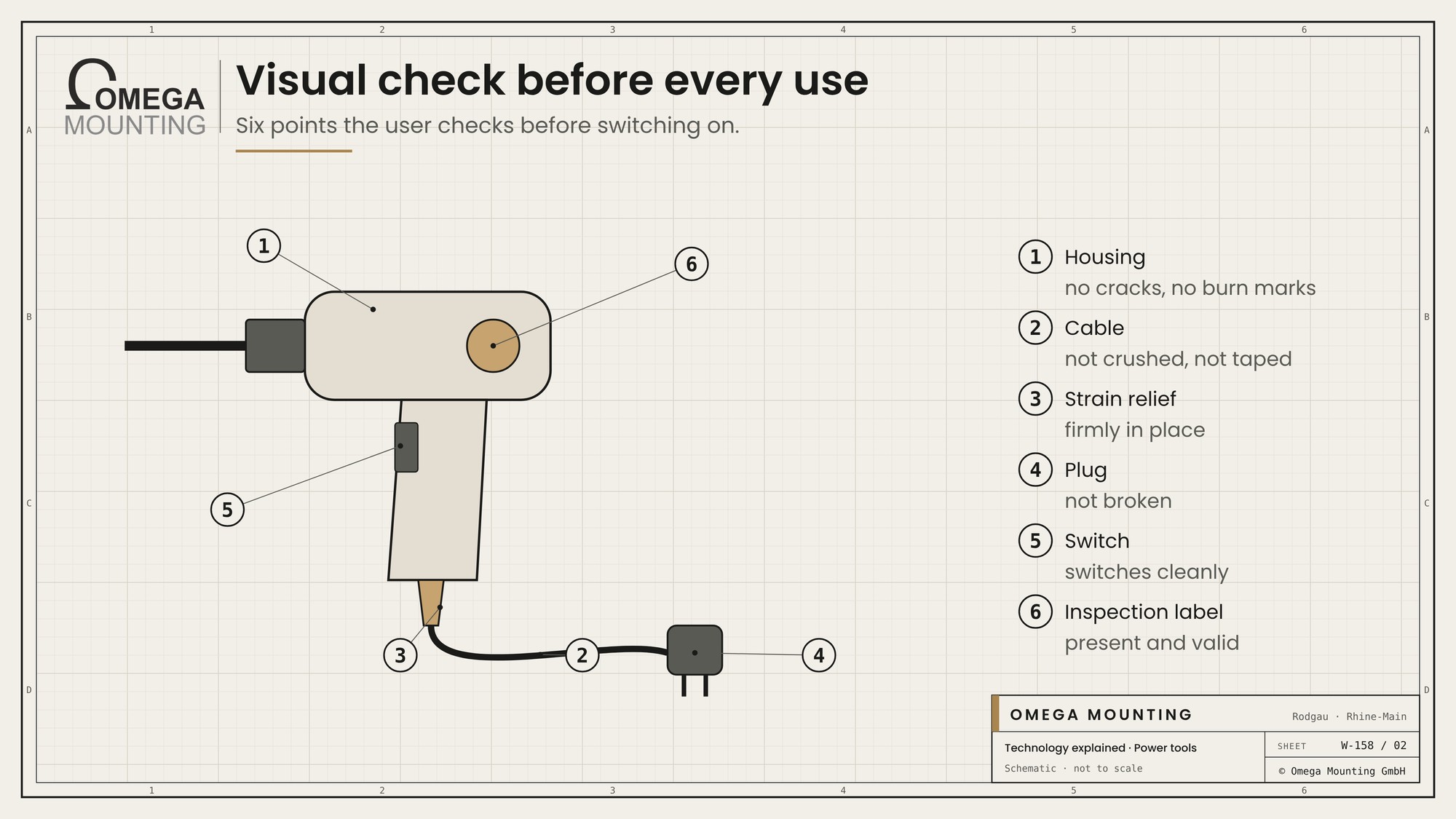
Before a tool is switched on, the user takes a quick look at it:
- Housing: no cracks, no burn marks, no missing screws.
- Cable: no crushing, no cuts, no tape repairs.
- Strain relief: sits firmly on the housing; the cable has not been pulled out.
- Plug: not broken, no bent contacts.
- Switch: switches on and off cleanly, does not stick.
- Inspection label: present and still valid.
A damaged tool is not used but marked and taken out of service. Repairs to cable and housing belong in the hands of a qualified electrician.
Periodic inspection
In addition to the check before use, power tools are inspected at fixed intervals by a Qualified electrician . This includes a visual inspection, measurement of protective conductor and insulation resistance or leakage current, and a function test.
How often inspections take place is defined by the company in its risk assessment. The basis is the German Ordinance on Industrial Safety and Health and DGUV Regulation 3. On construction sites, tools are subjected to more stress than in the workshop, so the intervals are correspondingly shorter. The result is documented, and the device receives an inspection label. This is not legal advice.
Vibration and noise
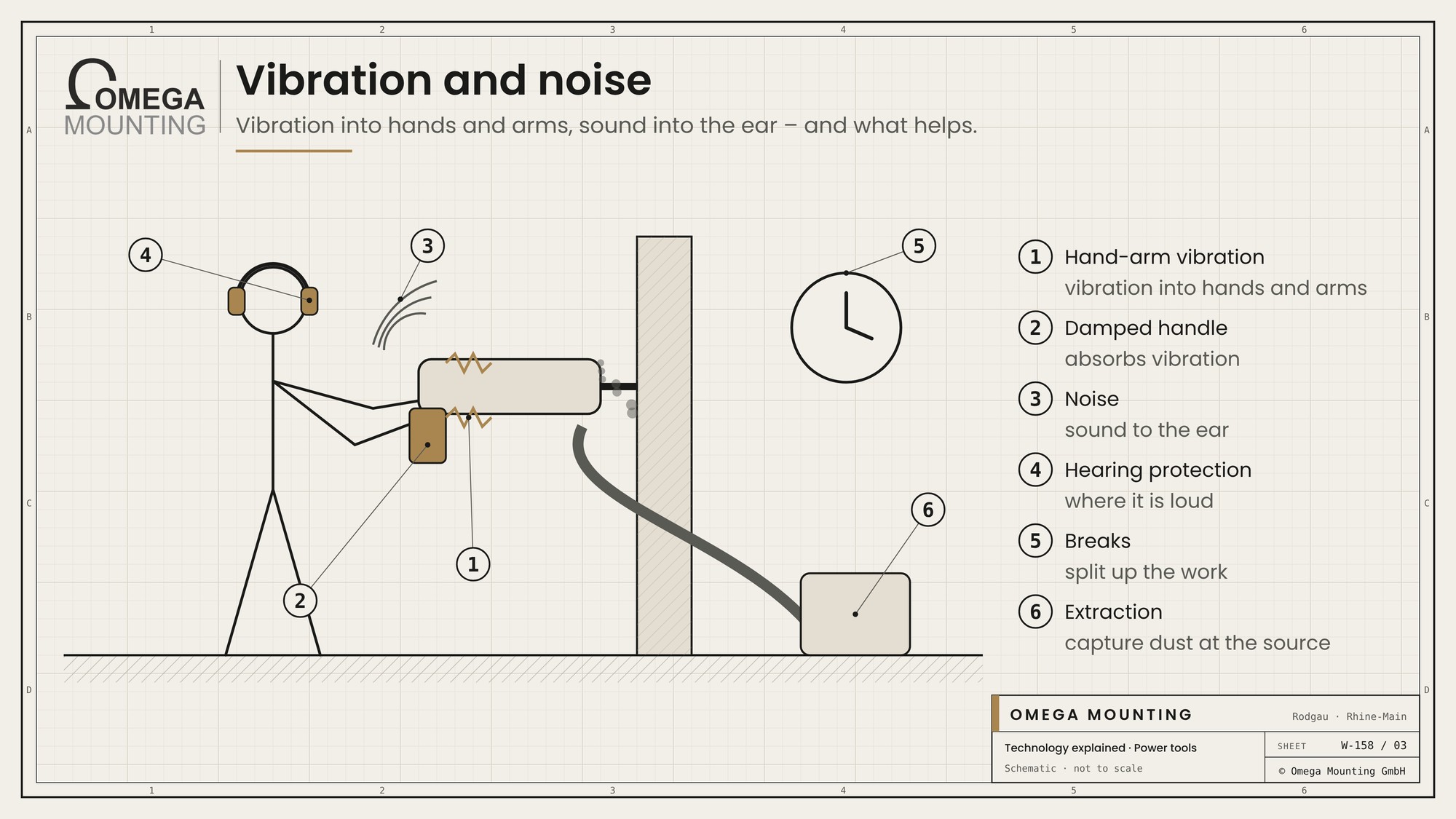
Power tools put strain on the body even when everything is electrically in order:
- Hand-arm vibration: Hammer drills, chipping hammers and angle grinders transmit vibration into hands and arms. Over the years this can damage blood flow, nerves and joints.
- Noise: Many tools are so loud that hearing damage is a risk without hearing protection.
What helps:
- low-vibration tools and damped auxiliary handles,
- sharp drill bits and suitable discs so that no force has to be applied,
- splitting up the work and planning breaks,
- hearing protection worn where it is loud,
- extracting dust and using respiratory protection where dust is produced.
Manufacturers state vibration and noise values in the operating instructions. How long someone may work with the tool follows from the risk assessment under the German Noise and Vibration Occupational Safety Ordinance.
Power on site
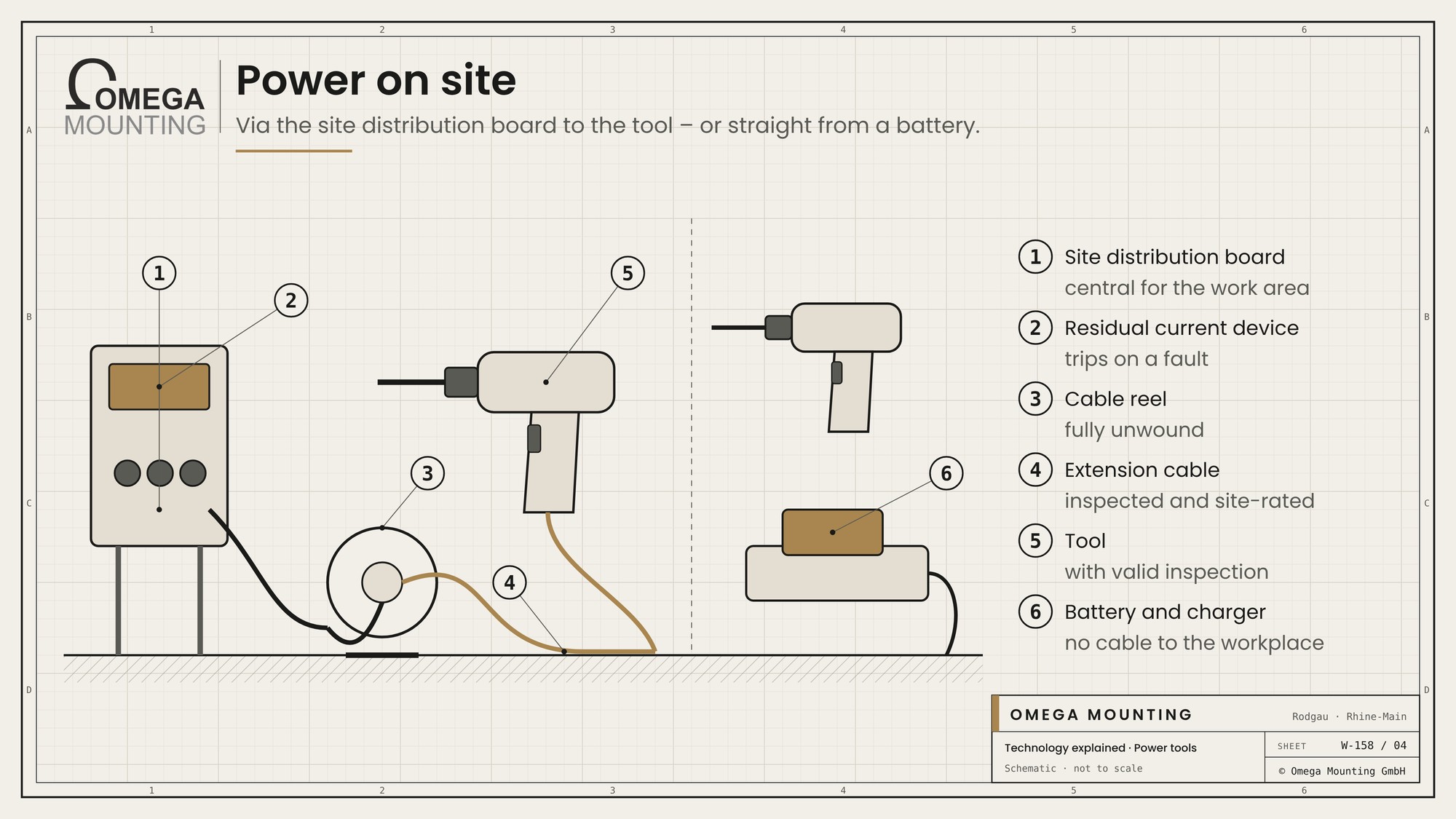
On construction sites, power tools are not operated from any socket but via a Site distribution board with a residual current device. It switches off when current flows away through a person or a damaged cable.
There are also a few simple rules:
- Cable reels must be fully unwound so that they do not overheat under load.
- Extensions only with suitable, inspected cables for site use.
- Lay cables so that they are not driven over or trapped.
Battery tools do without the cable altogether. They are often the first choice on installation jobs when there is no site power nearby. Batteries and chargers are maintained and inspected just like mains tools.
Battery or mains cable?
| Characteristic | Battery tool | Mains tool |
|---|---|---|
| Power source | battery, independent of the mains | socket or site distribution board |
| Cable | none | trip hazard and damage point |
| Continuous output | limited by battery capacity | constant |
| Typical for | screwing, drilling, changing locations | chiselling, cutting, long jobs |
Batteries need attention too. A battery that has been dropped or has swollen is no longer charged but taken out of service. Charging is only done with the matching charger, not on a flammable surface and not unattended overnight in the site hut.
Typical mistakes
- Tool carried or unplugged by the cable.
- Damaged cable “repaired” with tape.
- Cable reel operated half-wound under full load.
- Tool taken to site without a valid inspection label.
- Chiselling for hours without hearing protection.
What we pay attention to
When we work with power tools on installation jobs, we pay attention to the points that protect fitters and plants.
- We only use inspected tools with a valid inspection label.
- We take damaged tools out of service immediately.
- We supply the work area via site distribution boards with residual current protection.
- We use battery tools where cables would get in the way.
- We plan work with hammer drills and angle grinders with breaks and hearing protection.
Where we use it
Power tools need power – and on installation jobs it is not always there. During a crane lift in a data centre in the Rhine-Main area there was no site power at the critical point, so we brought it ourselves. Today we provide generators, distribution boards and cables together with the installation. More about our services is on the page Industrial installation.
More technology explained
Technology explained
how power gets from the generator to the tool.
Guide
our guide to distribution boards, protection and lighting.
Technology explained
flame cutting, plasma or saw.
Do you have questions about how this works on your site?
An installation job needs site power, lighting or a well-practised team with its own tools? We bring both. Request a callback.
Free, no-obligation callback

About the author
Tobias Schott
Managing director of Omega Mounting GmbH, Rodgau · more than 20 years of hands-on experience in installation and maintenance
A trained mechatronics technician, working in maintenance, servicing and industrial installation since 2004 – first alongside his father, and with Omega Mounting since 2012: from overhead conveyors in Frankfurt to the crane system in a new-build hall. He plans and leads lifting operations as an appointed person (AP) in data centers and on industrial sites in the Rhine-Main region, trains and examines operators of cranes, mobile elevating work platforms and telehandlers, and is a qualified occupational safety specialist. On jobs abroad he is known as the “German Troubleshooter” – the person you call when a site gets stuck. He learned what quality means from his father, not from a manual: Made in Germany as a standard for his own work, not a label. That is why quality comes first at Omega Mounting – ahead of speed and price. The Technology explained articles cover the equipment and techniques his team uses every day: what counts on site is in them – what only appears in the brochure is not.
 English
 German