
- Technology explained – equipment and protection
The site distribution board: how power gets from the generator to the tool
By Tobias Schott · 6-minute read · Updated November 2026
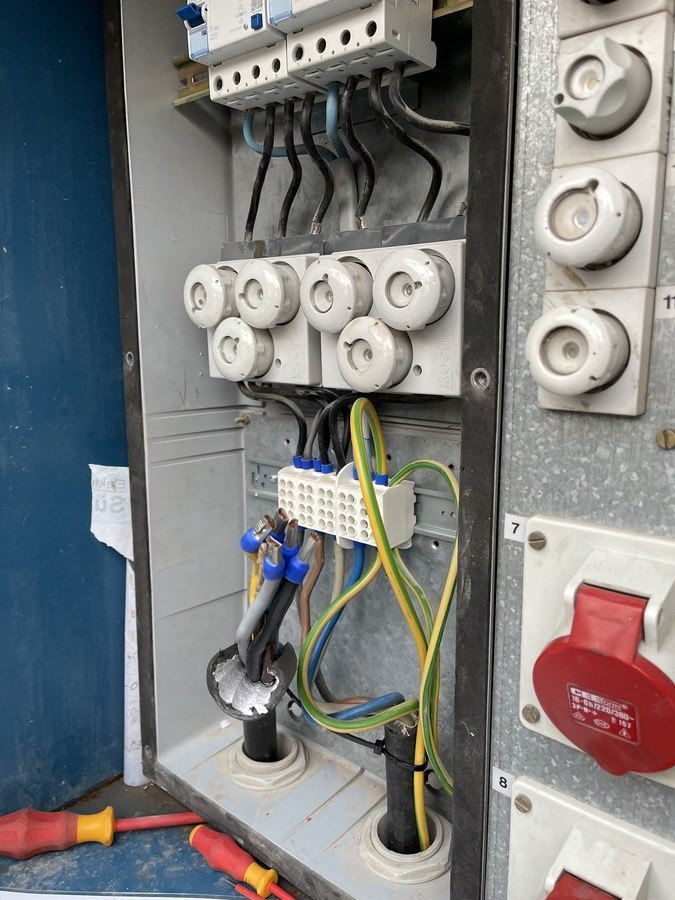
A site distribution board turns one strong supply into many safe sockets – and decides whether work goes on at the site or everyone waits.
The site distribution board is the grey or yellow box on legs where the cables meet on every construction site. It is connected to the utility's site supply or to a generator. From it run the cables to the welder, core drill, compressor, site heater, lighting and hand tools.
Understanding it means planning power like a crane or a scaffold: with capacity, cables and reserve. Here we explain how a site distribution board is built, which levels there are and how much generator it needs behind it.
What is a site distribution board?
A site distribution board is an enclosed, movable switchgear assembly that distributes power on a construction site via protective devices to sockets. The standard for such boards is DIN EN 61439-4; the requirements for the electrical installation of a construction site are set out in DIN VDE 0100-704.
It is robustly built, splash-proof and made for outdoor use. Inside are residual current devices, circuit breakers and, depending on the type, a meter. Outside are the sockets: blue for 230 volts, red for 400-volt three-phase.
Key facts
- Purpose: Distributing power from the site supply or generator safely to many consumers.
- Levels: Main distribution board, sub-distribution board, final distribution board at the workplace.
- Connectors: CEE 16, 32, 63 and 125 amps; Schuko for small equipment.
- Protection: Residual current devices and circuit breakers per outlet; sockets up to 32 amps with a tripping current of no more than 30 milliamps.
- Supply: Utility site supply or generator; we provide generators from 2 to 110 kVA.
- Inspection: Periodically under DGUV Regulation 3, and the RCD test button every working day.
- Responsibility: Set-up, connection and testing by a qualified electrician.
Which distribution boards are there on a construction site?
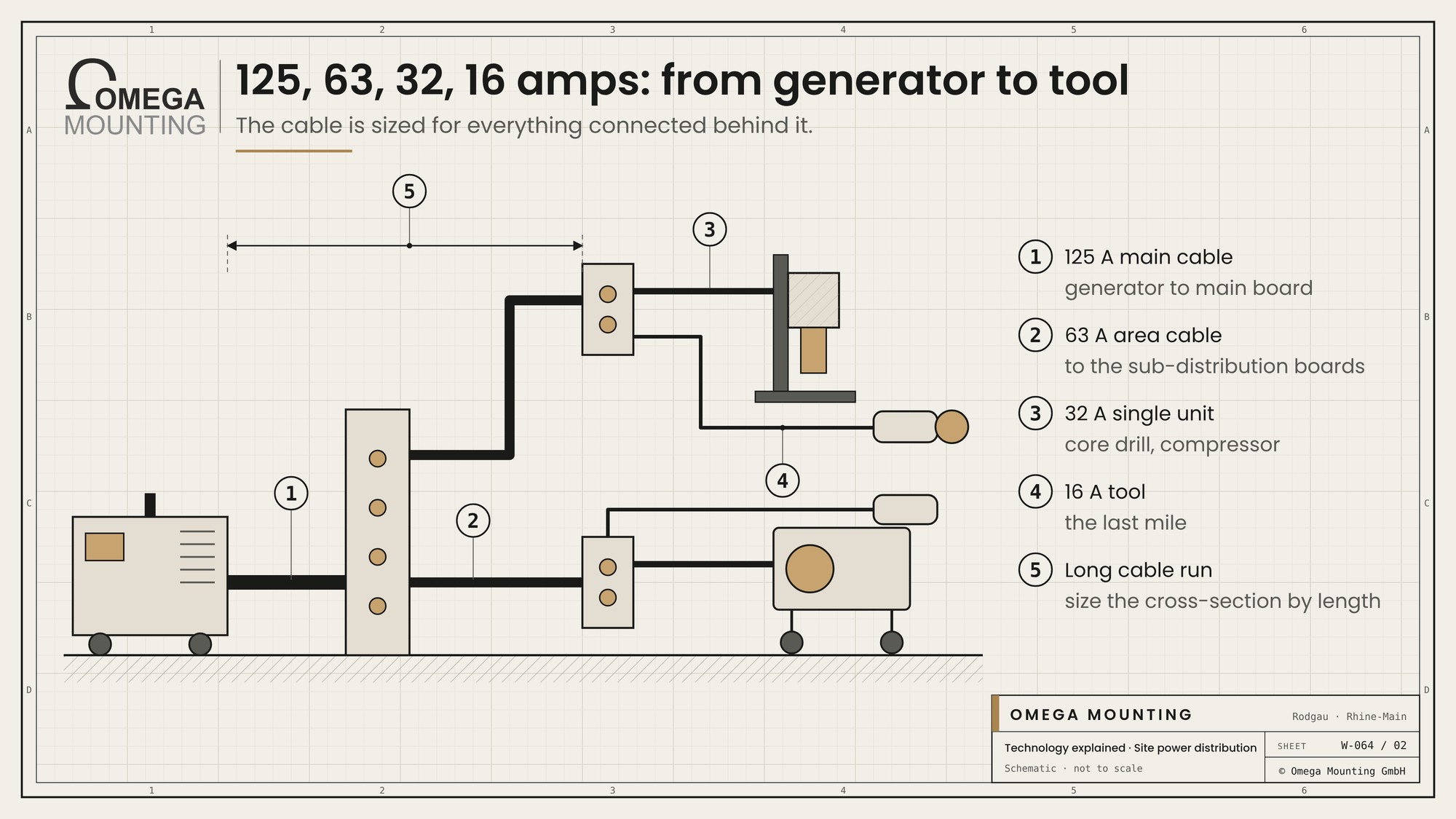
There are three levels on a construction site: the main distribution board takes the supply, sub-distribution boards bring the power into the areas, and final distribution boards stand at the workplace. With each level the cable gets smaller and the number of sockets larger.
| Level | Where it stands | Typical supply | What is connected |
|---|---|---|---|
| Main distribution board | At the site supply or at the generator. | 125 A. | The sub-distribution boards. |
| Sub-distribution board | In the construction section, on the floor. | 63 A. | Site heating, welding rectifiers, final distribution boards. |
| Final distribution board | Directly at the workplace. | 32 or 16 A. | Core drill, compressor, hand tools, lighting. |
The layout in levels has two reasons. A fault on one tool should only trip its own outlet, not the whole site. And heavy cables are only laid as far as necessary.
16, 32, 63 or 125 amps: which connector for what?
The size of the connector does not depend on what hangs at the end of the cable, but on how much is still connected behind it. That is why there are four sizes.
- 125 A is the main cable from the generator to the main distribution board. A 110 kVA generator delivers around 158 amps at 400 volts – connecting it with 63 amps wastes more than half of its output.
- 63 A runs from the main distribution board to the sub-distribution boards in the areas.
- 32 A supplies the heavy single unit: core drill, compressor, larger construction machine, electric site heater.
- 16 A is the last mile to the tool.
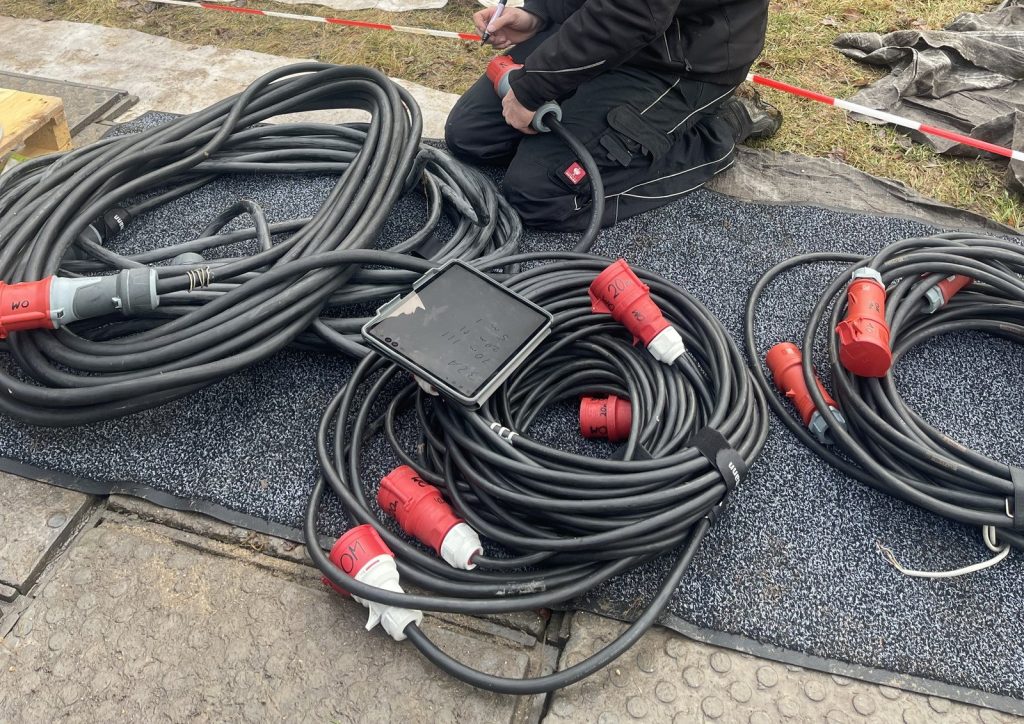
On long cable runs, voltage drop decides. Over a hundred metres of cable, voltage is lost – the more so, the smaller the cross-section and the higher the current. At the end, motors run hot and variable frequency drives trip, even though the generator at the front runs perfectly. The cross-section is therefore planned by length, not by whatever happens to be on the trailer.
How much generator does the board need?
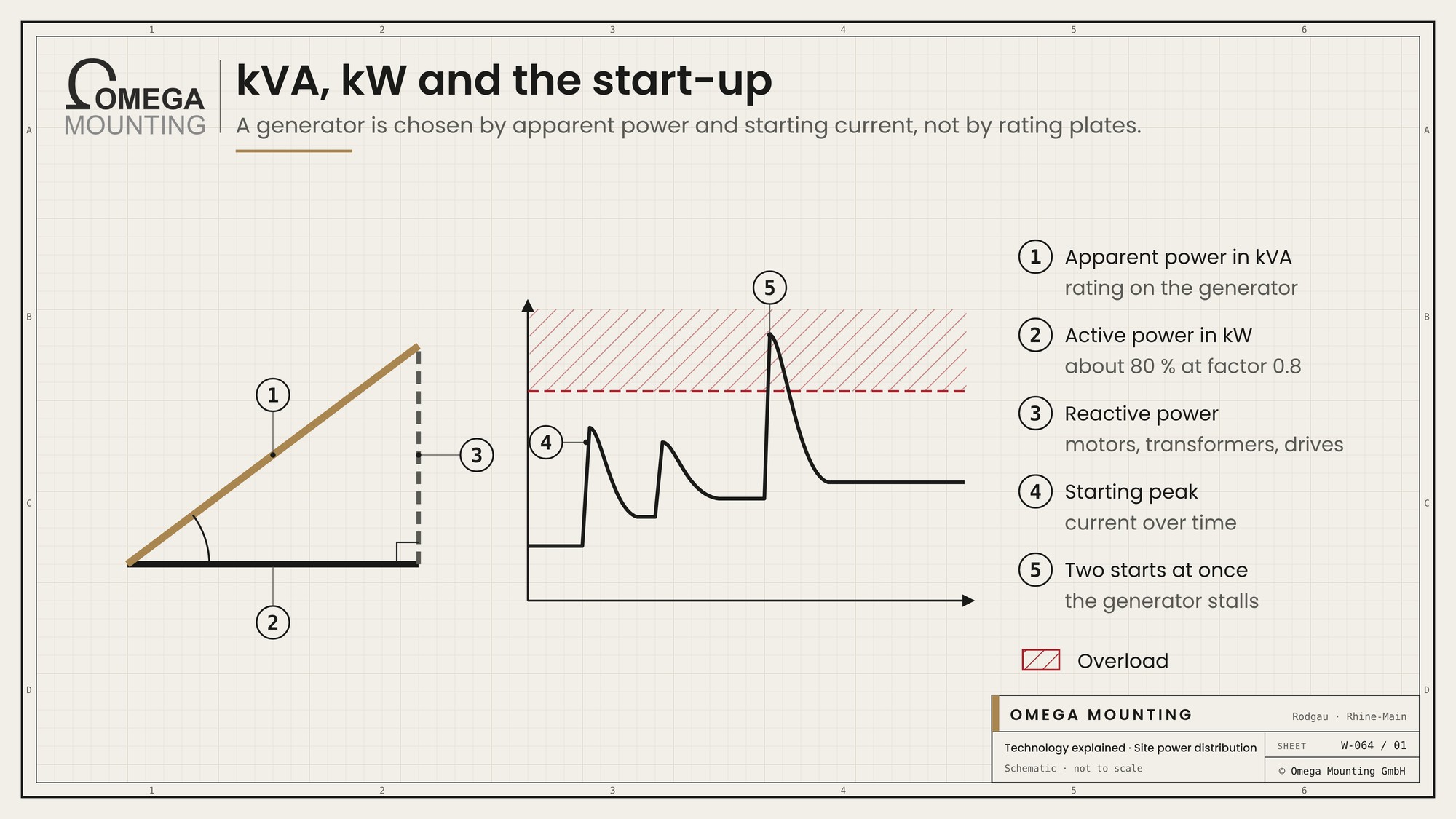
A generator is chosen by apparent power in kVA and by the starting current of the motors – not by the sum of the rating plates.
Apparent power includes the reactive part needed by motors, transformers and variable frequency drives. What can actually be used is the smaller active power in kW. At a typical power factor of 0.8, 110 kVA corresponds to around 88 kW.
The start-up matters even more. A three-phase motor draws a multiple of its rated current when it starts. If two large consumers start at the same time, a tightly sized generator stalls – and in the worst case the whole site goes down. The second question is voltage: anyone who needs three-phase power needs a generator with a 400-volt CEE outlet. We have those from 7.3 kVA.
Site heating is the item most often forgotten. A 22 kW electric heater draws around 32 amps at 400 volts and thus takes up a whole 32 A outlet on its own.
Lighting runs off the same board
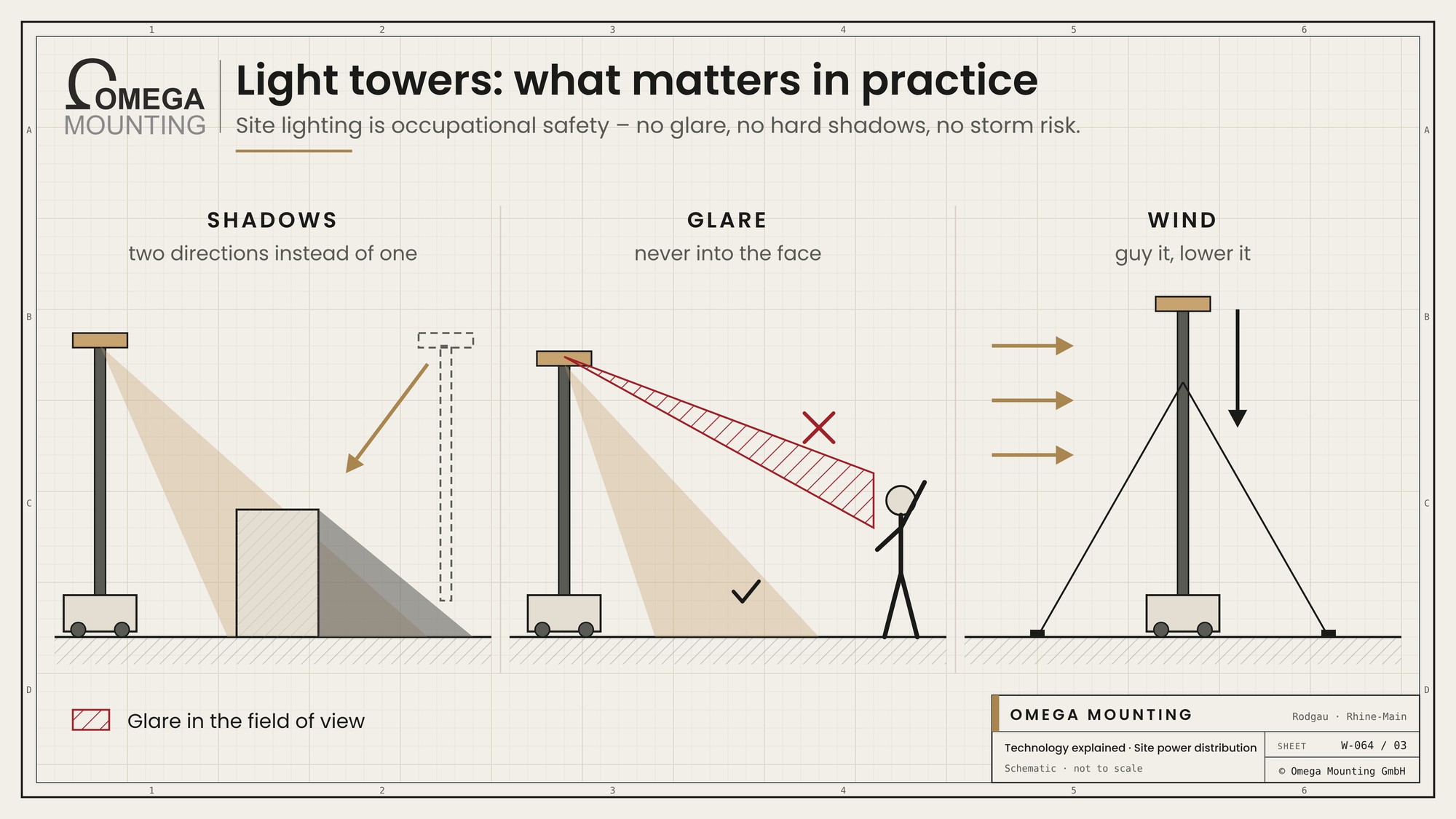
Site lighting is occupational safety and belongs in the generator sizing, not on top of it. The German workplace rule ASR A3.4 sets minimum lighting levels, graded by activity. Two towers from different directions avoid hard shadows, no floodlight may dazzle the crane operator or slinger, and a fully extended tower is guyed or lowered in wind.
Safety around distribution boards, cables and generators
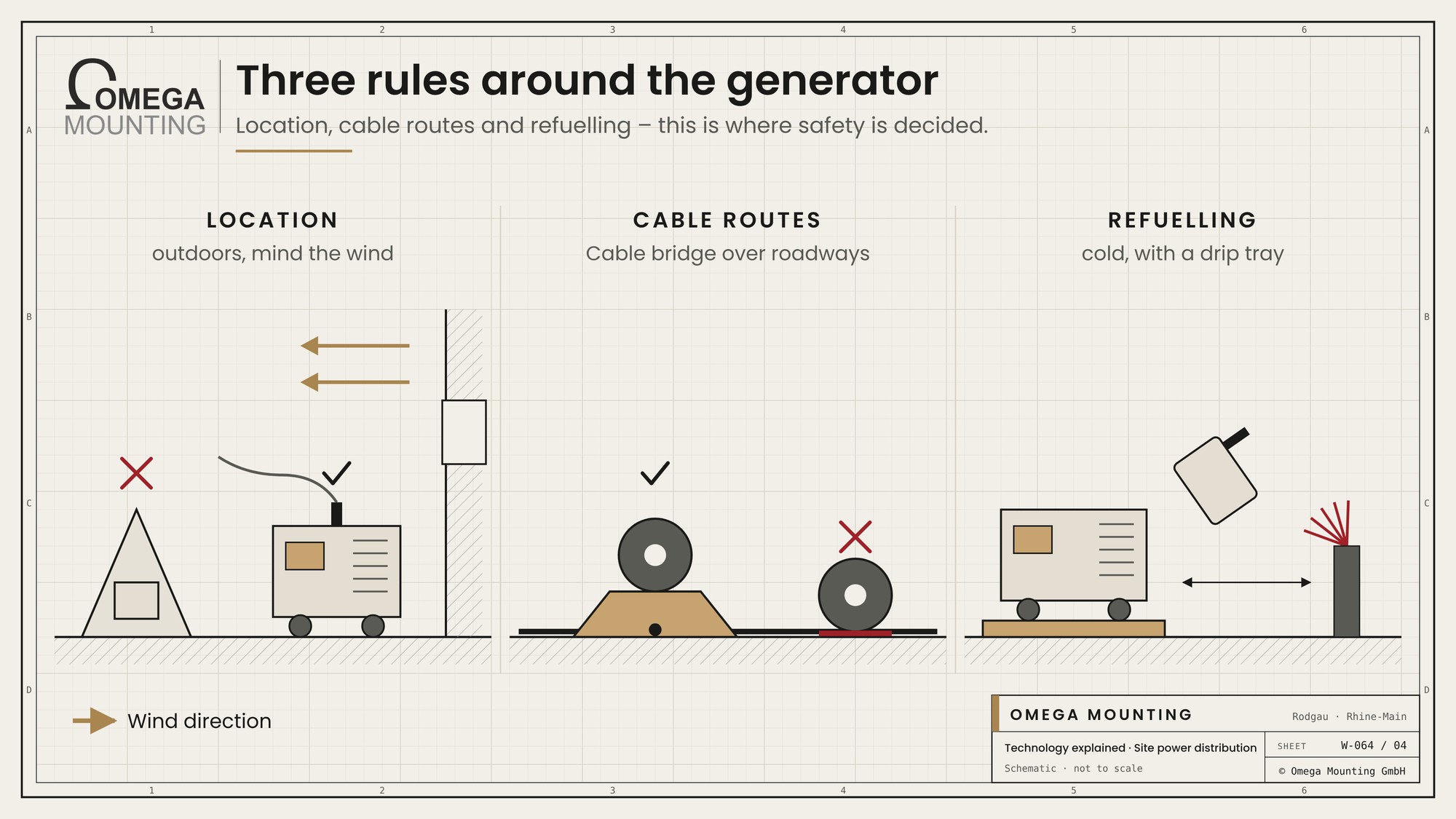
Three simple rules apply at the site distribution board – and yet this is where most things go wrong on construction sites.
- Location: A combustion generator never belongs in a closed room, a tent or under an enclosure – carbon monoxide has no smell. The spot is chosen according to wind direction, away from windows and air intakes.
- Cable routes: Where a cable crosses a roadway, a cable bridge goes over it. A cable crushed under a forklift wheel is a short circuit with personal injury.
- Refuelling: Only with the generator stopped and cooled down, over a drip tray and away from welding and grinding.
Distribution boards, cables and generators are electrical equipment and are inspected periodically under DGUV Regulation 3. Hiring equipment means hiring its inspection status too. Which intervals apply on your site is set by your risk assessment – this is not legal advice, just a pointer to where the answer is.
What we pay attention to
With site power, we think backwards from the tool to the generator.
- We ask about all consumers, including heating, lighting and the welder that only arrives in week three.
- We calculate with the start-up of the largest motors, not just their rated power.
- We ask for the distance from the generator to the last work point and choose the cross-section accordingly.
- We deliver distribution boards and cables inspected and give a briefing at handover.
- We place the generator according to wind direction and fix the cable routes before the first cable is laid.
Where we use it
We offer site power from a single source together with the installation – born out of our own jobs where there simply was no power at the critical point. Generators from 2 to 110 kVA, distribution boards, cables and light towers are kept by our sister company Eventwerk Rodgau, on the same yard in Rodgau. Our technicians are mechatronics engineers and can also connect the board they set up. How this comes together in the Rhine-Main region is shown in our article Site power and site lighting in the Rhine-Main region. You will find more on our power-related services under energy and standby power.
More technology explained
Technology explained
when the power is not needed for the construction site, but for an emergency.
Technology explained
who may inspect distribution boards and cables.
Guide
where power, cable routes and the generator belong in the planning.
Do you have questions about how this works on your site?
Your installation date is set, but the site supply is missing or too weak? We plan the generator, distribution board and cables with you and bring everything to site with the installation team. Request a callback.
Free, no-obligation callback

About the author
Tobias Schott
Managing director of Omega Mounting GmbH, Rodgau · more than 20 years of hands-on experience in installation and maintenance
A trained mechatronics technician, working in maintenance, servicing and industrial installation since 2004 – first alongside his father, and with Omega Mounting since 2012: from overhead conveyors in Frankfurt to the crane system in a new-build hall. He plans and leads lifting operations as an appointed person (AP) in data centers and on industrial sites in the Rhine-Main region, trains and examines operators of cranes, mobile elevating work platforms and telehandlers, and is a qualified occupational safety specialist. On jobs abroad he is known as the “German Troubleshooter” – the person you call when a site gets stuck. He learned what quality means from his father, not from a manual: Made in Germany as a standard for his own work, not a label. That is why quality comes first at Omega Mounting – ahead of speed and price. The Technology explained articles cover the equipment and techniques his team uses every day: what counts on site is in them – what only appears in the brochure is not.
 English
 German