
- Technology explained – technology and procedures
Rolling bearing designation: what 6205-2RS C3 reveals
By Tobias Schott · 5-minute read · Updated November 2026
The designation on the bearing ring is a code: it names type, size, seal and internal clearance – and anyone who can read it orders the right replacement bearing first time.
You encounter the bearing designation on every removed bearing, in the spare parts catalogue and in the equipment list. The outer ring bears something like “6205-2RS C3”. It looks like an article number but is standardised – at least for the most part.
This article explains how to read the designation digit by digit, which bearing types exist and why the suffixes are so important when replacing. How to check and replace bearings in the drive is covered in the guide Maintaining drives, gearboxes and pumps.
What is a rolling bearing designation?
A rolling bearing designation is the short code that uniquely describes the type, dimensions and design of a rolling bearing. Its core is the basic designation according to DIN 623-1, internationally harmonised: it stands for type and size and is the same for all manufacturers. Before and after it are prefixes and suffixes for seal, internal clearance, cage or heat treatment.
A rolling bearing is a bearing in which balls or rollers roll between the inner and outer ring. In German it is called Wälzlager, the ball bearing Kugellager and the designation Bezeichnung.
Key facts
- Purpose: Name a bearing unambiguously so that the replacement fits in dimensions and design.
- Design: Basic designation for bearing type, dimension series and bore, plus prefixes and suffixes.
- Where it is marked: On the face of the outer ring, often also on the inner ring, and on the packaging.
- Standardised: The basic designation; suffixes for seals and shields differ depending on the manufacturer.
- Most important additions: Seal or shield, internal clearance, cage material.
- Standard: DIN 623-1 for the designation system, ISO 5753-1 for internal clearance.
- Common misconception: Same basic number means same bearing – yet seal and internal clearance can differ.
How to read the designation: digit by digit

The designation reads from left to right: first the bearing type, then the dimension series, then the bore, finally the suffixes. Using the example 6205-2RS C3:
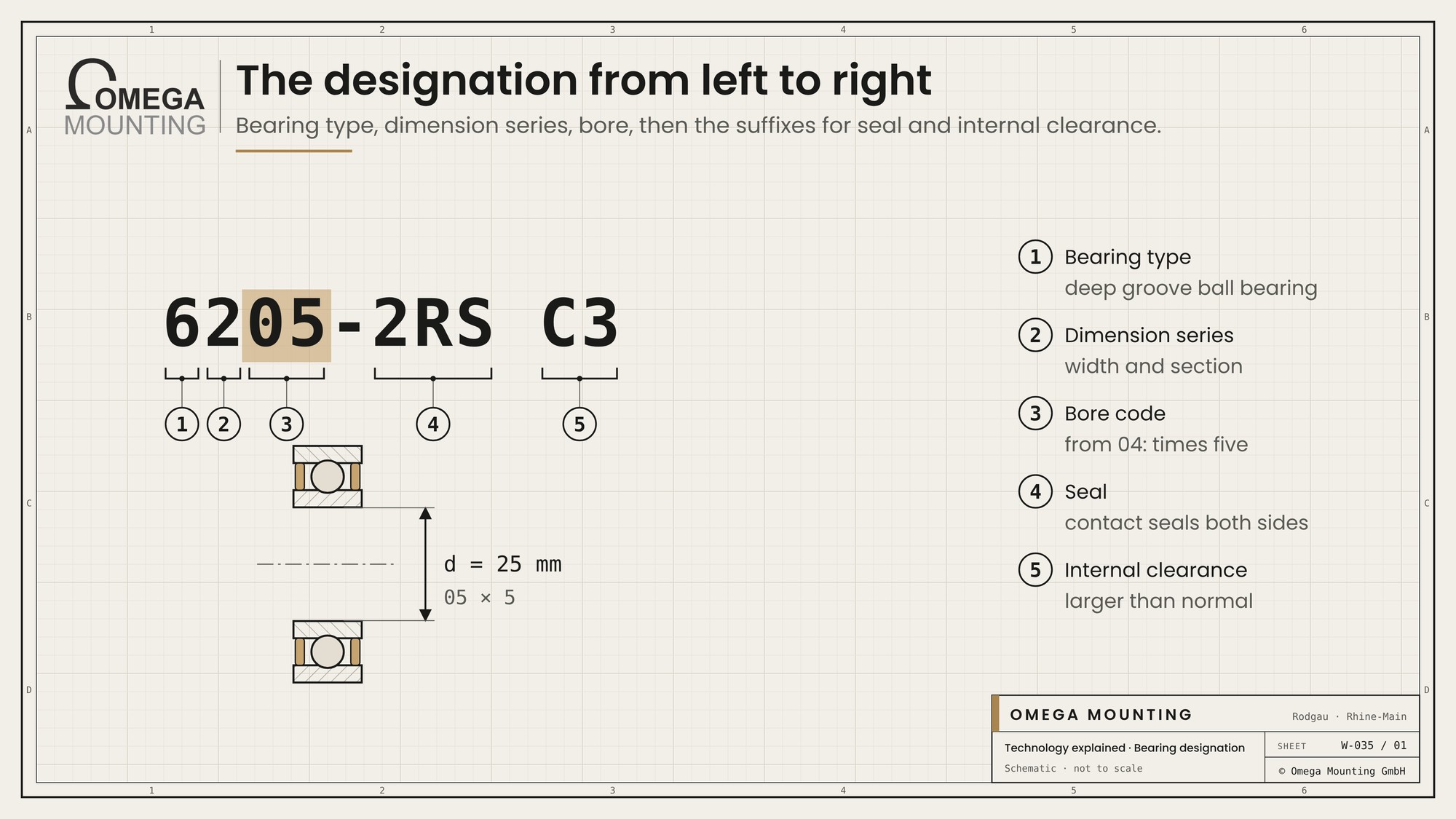
- 6 – bearing type. The first digit names the type; 6 stands for the deep groove ball bearing, the most common bearing of all.
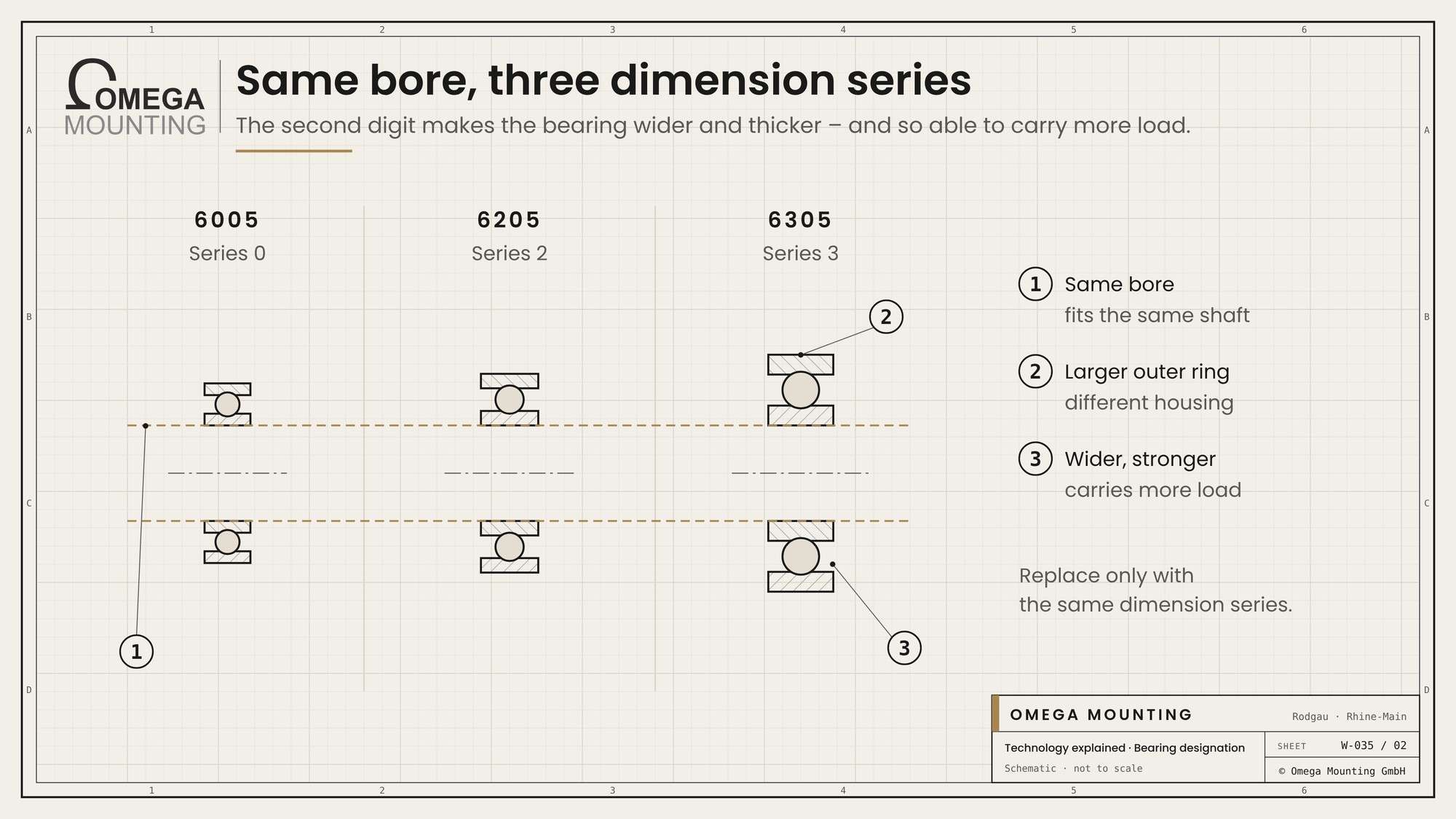
- 2 – dimension series. It says how wide and how thick the bearing is for the same bore. A higher digit means stronger and able to carry more load.
- 05 – bore code. From 04 onwards: code times five gives the bore diameter in millimetres. 05 therefore means 25 millimetres. Below that, fixed values apply: 00 = 10, 01 = 12, 02 = 15 and 03 = 17 millimetres.
- 2RS – seal. Contact rubber seals on both sides. A “Z”, on the other hand, usually stands for a steel shield, “2Z” for two of them.
- C3 – internal clearance. The bearing has more internal play than the standard version.
If there is no suffix for internal clearance, it is normal clearance, often designated CN. The seal codes are not uniform: the same sealed bearing can be called “2RS”, “2RSR” or something else depending on the manufacturer. If in doubt, comparing via the data sheet helps.
Which bearing type for what?
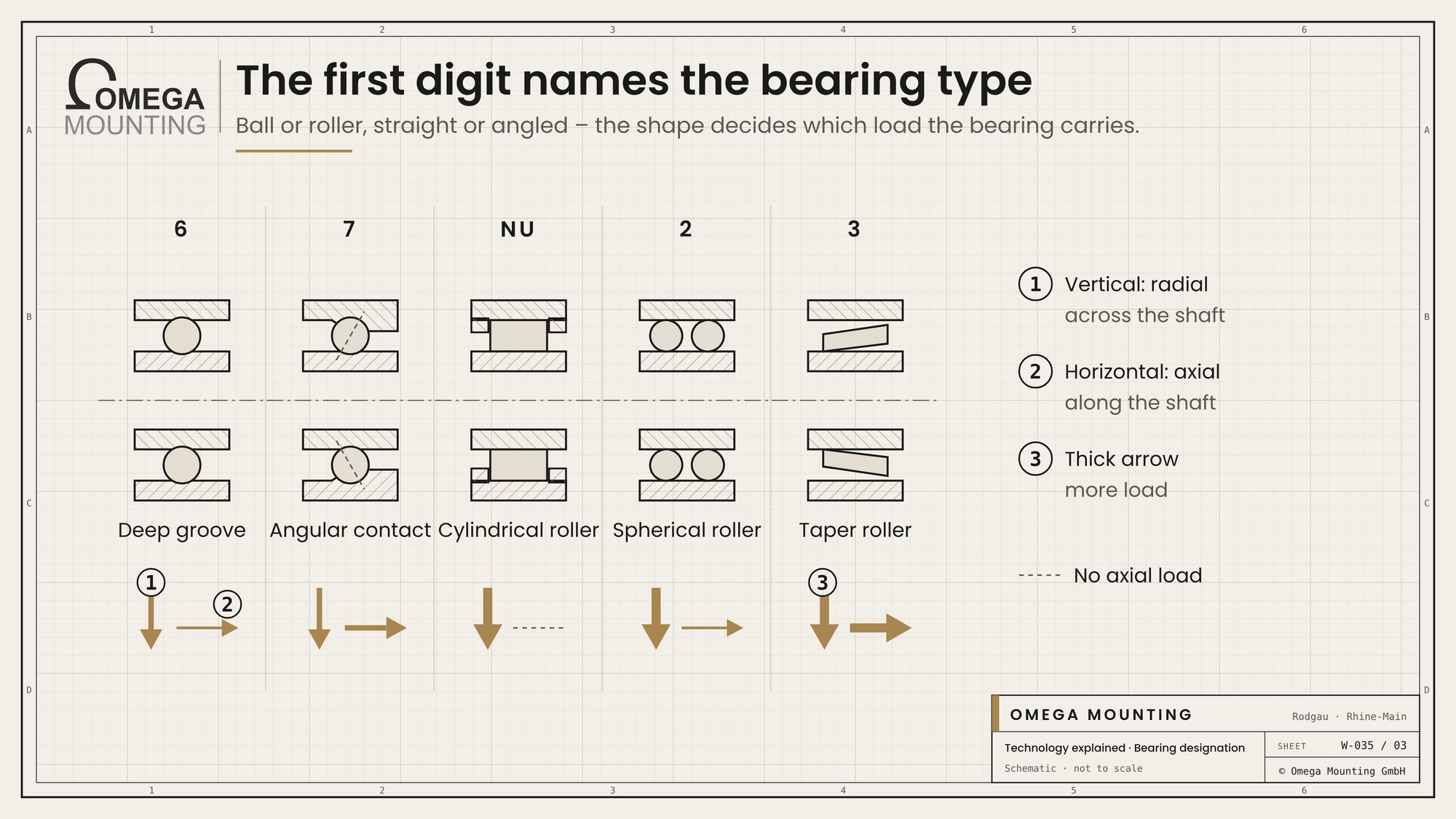
The first digit or the first letters reveal the bearing type – and thus which forces the bearing can take.
| Features | Bearing type | Strength | Typical use |
|---|---|---|---|
| 6 | Deep groove ball bearing. | Versatile, high speed, radial and limited axial. | Electric motors, fans, rollers, pumps. |
| 7 | Angular contact ball bearing. | Combined load, often fitted in pairs. | Pumps, spindles, compressors. |
| NU, NJ, N | Cylindrical roller bearing. | High radial load. | Gearboxes, large motors, rolls. |
| 2 | Spherical roller bearing. | High load, compensates misalignment. | Conveyor belt drums, fans, crushers. |
| 3 | Tapered roller bearing. | High radial and axial load, adjusted in pairs. | Gearboxes, wheel bearings, axles. |
| 1 | Self-aligning ball bearing. | Compensates alignment errors. | Long shafts, agricultural machinery. |
| 5 | Thrust ball bearing. | Axial load only. | Rotary tables, spindles with longitudinal force. |
If there is a “UC” or similar code before the basic designation, it is often an insert bearing for a plummer block or flange housing – here too, it is worth looking at the data sheet.
Why seal and internal clearance count when replacing
A replacement bearing must not only fit in bore and outside diameter, but also in seal and internal clearance – otherwise it runs hot or fails early.
Seal. A sealed bearing is filled with grease and is not relubricated. An open bearing needs lubrication from outside. Anyone who fits an open bearing in a place without a grease nipple builds in an early failure. Conversely, a sealed bearing does not accept grease from the lubrication line.
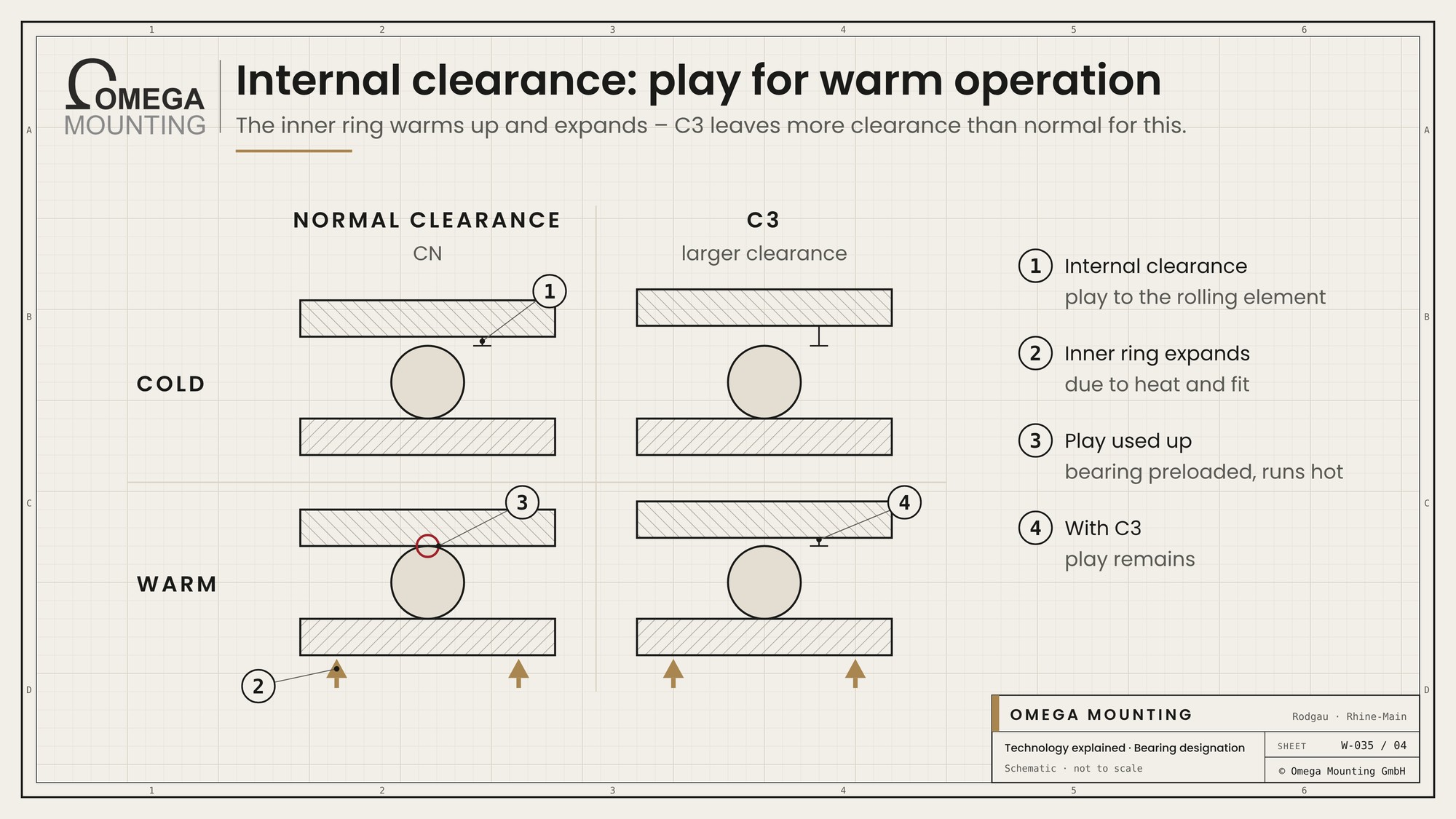
Internal clearance. It is the play between rings and rolling elements. In operation the inner ring warms up and expands, and a tight fit on the shaft expands it further. Electric motors and warm fans therefore often need C3. Anyone who fits a bearing with normal clearance instead risks the play being used up in operation. The bearing becomes preloaded, runs hot and wears quickly.
Therefore: take over the complete designation, not just the four digits.
Bearing replacement: what matters when removing and fitting
The right designation is only the first step. Whether the new bearing lasts is decided during removal and fitting:
- Pull, do not hammer: The old bearing is removed with a puller. Hammer blows damage the shaft and housing.
- Check the seats: Shaft and bore are cleaned and checked for scoring, fretting corrosion and dimensional accuracy.
- Force through the right ring: When pressing on, the force goes only through the ring with the tight fit, never through the rolling elements.
- Fit warm: Larger bearings are heated with an induction heater and slid on. An open flame is not allowed.
- Cleanliness: The new bearing stays in its packaging until fitted. Even a little dirt shortens its service life.
- Grease as specified: Quantity and type depend on the manufacturer and speed. Too much grease heats the bearing.
After fitting, the shaft turns easily and evenly. A short test run, watching temperature and noise, shows whether everything is right. The designation of the fitted bearing goes into the maintenance log so nobody has to search next time.
What we pay attention to
We treat a bearing like a spare part with a complete type designation.
- We read the designation before removal and photograph it while it is still clean.
- We take over the complete designation with all suffixes, not just the basic number.
- If the marking is illegible, we check bore, outside diameter and width with a calliper and compare with the data sheet.
- We replace bearings that work together at the same time, for example both bearings of a motor.
- We fit with the right tool and without blows through the rolling elements.
- After replacement we look for the cause: lubrication, alignment, belt tension, load.
Where we use it
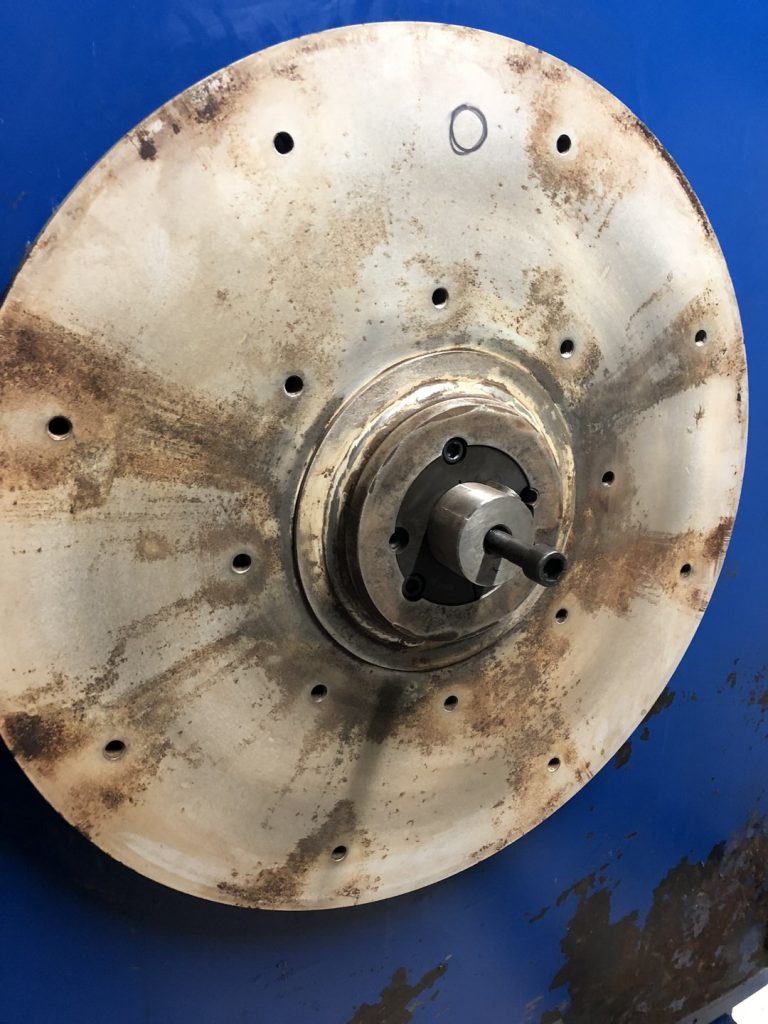
We replace bearings wherever motors, fans and rollers run continuously. During the fan bearing replacement in a paint shop near Offenbach the fans ran practically non-stop in production. Their bearings are among the most heavily stressed wear parts of the plant. For the replacement, the unit consisting of motor and fan impeller of around 1.40 metres had to be pulled out of the plant; bearing replacement and overhaul followed. Such work is part of our Maintenance and servicing.
More technology explained
Technology explained
how bearing damage can be recognised long before failure.
Technology explained
the second plate that counts when replacing a motor.
Guide
the guide to the first signs.
Do you have questions about how this works on your site?
Do you have questions about how this works on your site – for example, which replacement bearing belongs in your drive? We identify the bearing, replace it and look for the cause of the wear. Request a callback – we will get back to you.
Free, no-obligation callback

About the author
Tobias Schott
Managing director of Omega Mounting GmbH, Rodgau · more than 20 years of hands-on experience in installation and maintenance
A trained mechatronics technician, working in maintenance, servicing and industrial installation since 2004 – first alongside his father, and with Omega Mounting since 2012: from overhead conveyors in Frankfurt to the crane system in a new-build hall. He plans and leads lifting operations as an appointed person (AP) in data centers and on industrial sites in the Rhine-Main region, trains and examines operators of cranes, mobile elevating work platforms and telehandlers, and is a qualified occupational safety specialist. On jobs abroad he is known as the “German Troubleshooter” – the person you call when a site gets stuck. He learned what quality means from his father, not from a manual: Made in Germany as a standard for his own work, not a label. That is why quality comes first at Omega Mounting – ahead of speed and price. The Technology explained articles cover the equipment and techniques his team uses every day: what counts on site is in them – what only appears in the brochure is not.
 English
 German