
- Technology explained – technology and procedures
Emergency stop and emergency switch-off: what the red mushroom really does
By Tobias Schott · 5-minute read · Updated November 2026
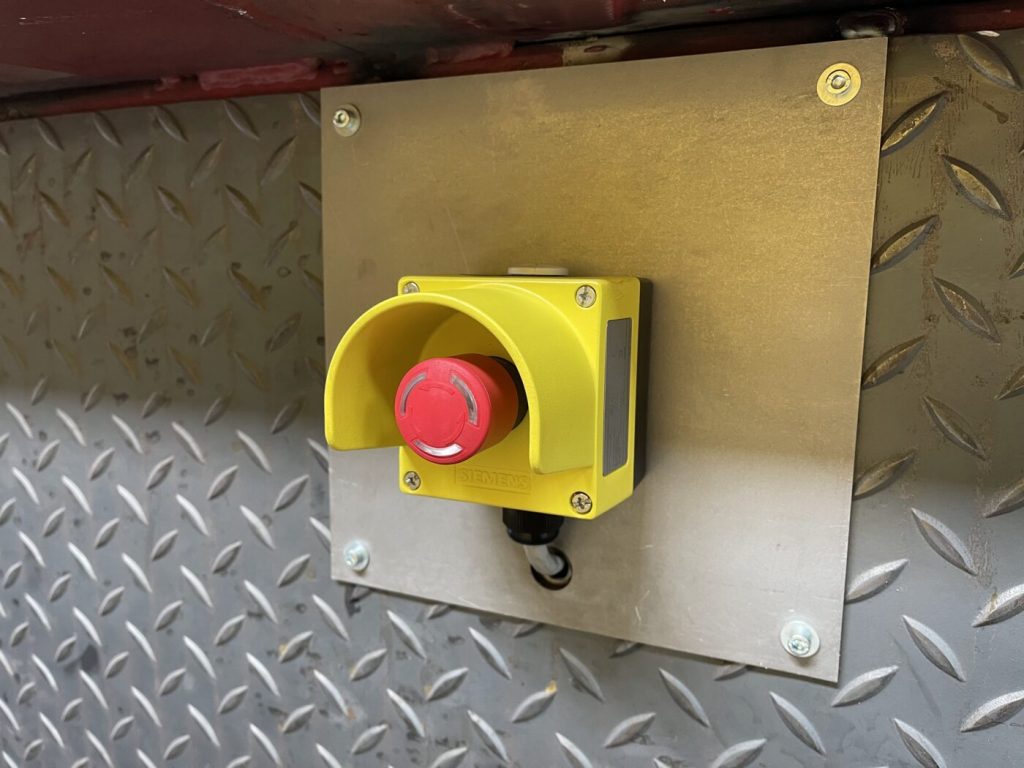
An emergency stop halts a hazardous movement as quickly as possible in an emergency – via a red and yellow mushroom-head button that latches and opens a positive-break contact in the safety circuit; unlatching must never restart the machine, only a deliberate reset releases it.
It sits on almost every machine: the red mushroom button on a yellow background. In everyday work it is hardly ever pressed – but when it is, it has to work, immediately and every time. To keep it that way, it needs the right type, the right position and clean integration into the controls.
Here we explain what distinguishes emergency stop from emergency switch-off, how the safety circuit works, what happens inside the button and where emergency stop devices belong.
What is an emergency stop?
An emergency stop is a function intended to avert or reduce a hazard to people or machinery. It is triggered by hand via an actuator – usually a mushroom-head push button, on long installations also via a pull wire. The basis is the Machinery Directive; the design is governed by the standard EN ISO 13850.
The emergency stop does not replace a safeguard. It is a complementary measure in case something happens despite guard fencing, light grids and door switches. It must also work when the machine is running in another operating mode – such as set-up mode.
Key facts
- Purpose: stop a hazardous movement in an emergency.
- Actuator: red mushroom button on a yellow background or pull wire.
- Contact: positive-break, the button latches.
- Wiring: in series in the safety circuit, evaluated by a safety relay or safety controller.
- Restart: only after unlatching and resetting.
- Inspection: test the function regularly and document it.
Emergency stop or emergency switch-off?
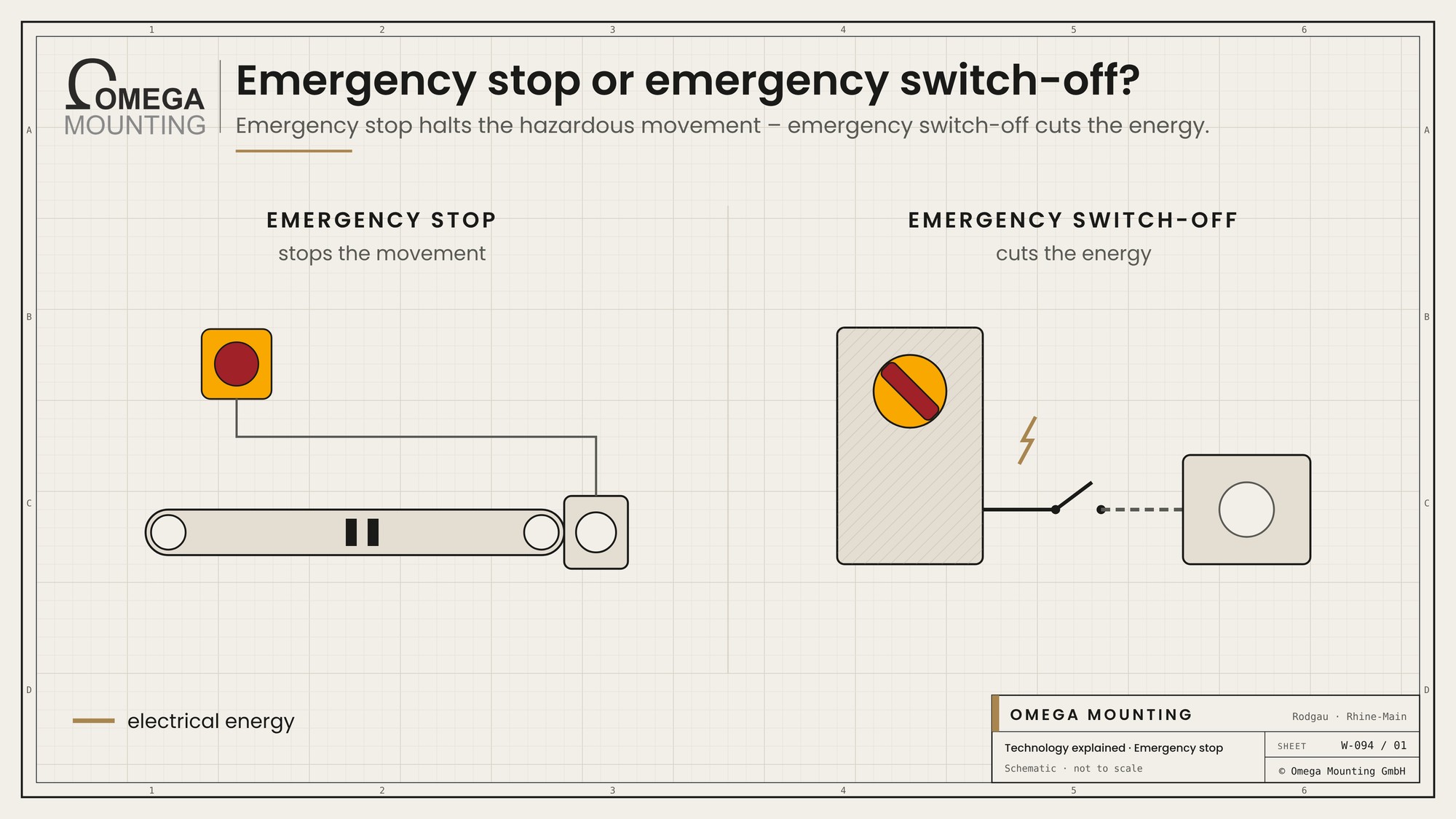
In everyday language the two terms are mixed up – technically there is a difference.
| Function | What it does | Typical for |
|---|---|---|
| Emergency stop | Stops the hazardous movement; the controls often stay powered. | Machines, conveyor systems, robots. |
| Emergency switch-off | Switches off the electrical energy. | Electrical hazards, e.g. in test bays. |
How the stop happens is described by stop categories: in category 0 the energy is removed immediately, in category 1 the movement is first braked in a controlled way and then the energy is disconnected. Which category is right follows from the machine's risk assessment.
The safety circuit
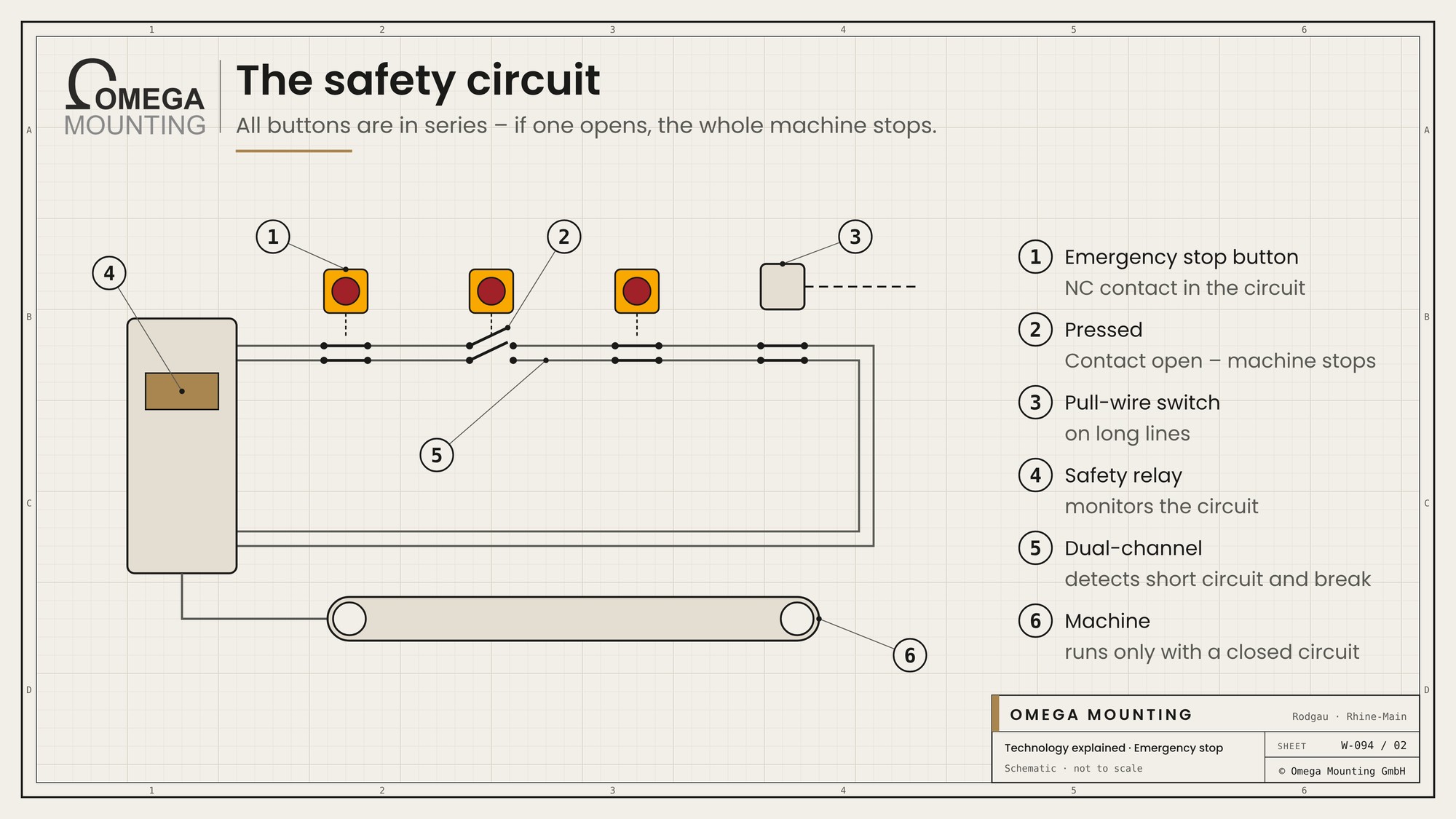
All emergency stop buttons of an installation are wired in series in a circuit of their own – the safety circuit. Guard door switches, pull wires and safety sensors are often added.
- One element opens, everything stops: If a button is pressed anywhere, the circuit is broken.
- Safety relay: It monitors the circuit on two channels and also detects short circuits and cable breaks.
- Extension: If new sections are added, new buttons must be cleanly integrated into the existing circuit – otherwise there are areas that keep running on an emergency stop.
The button in detail
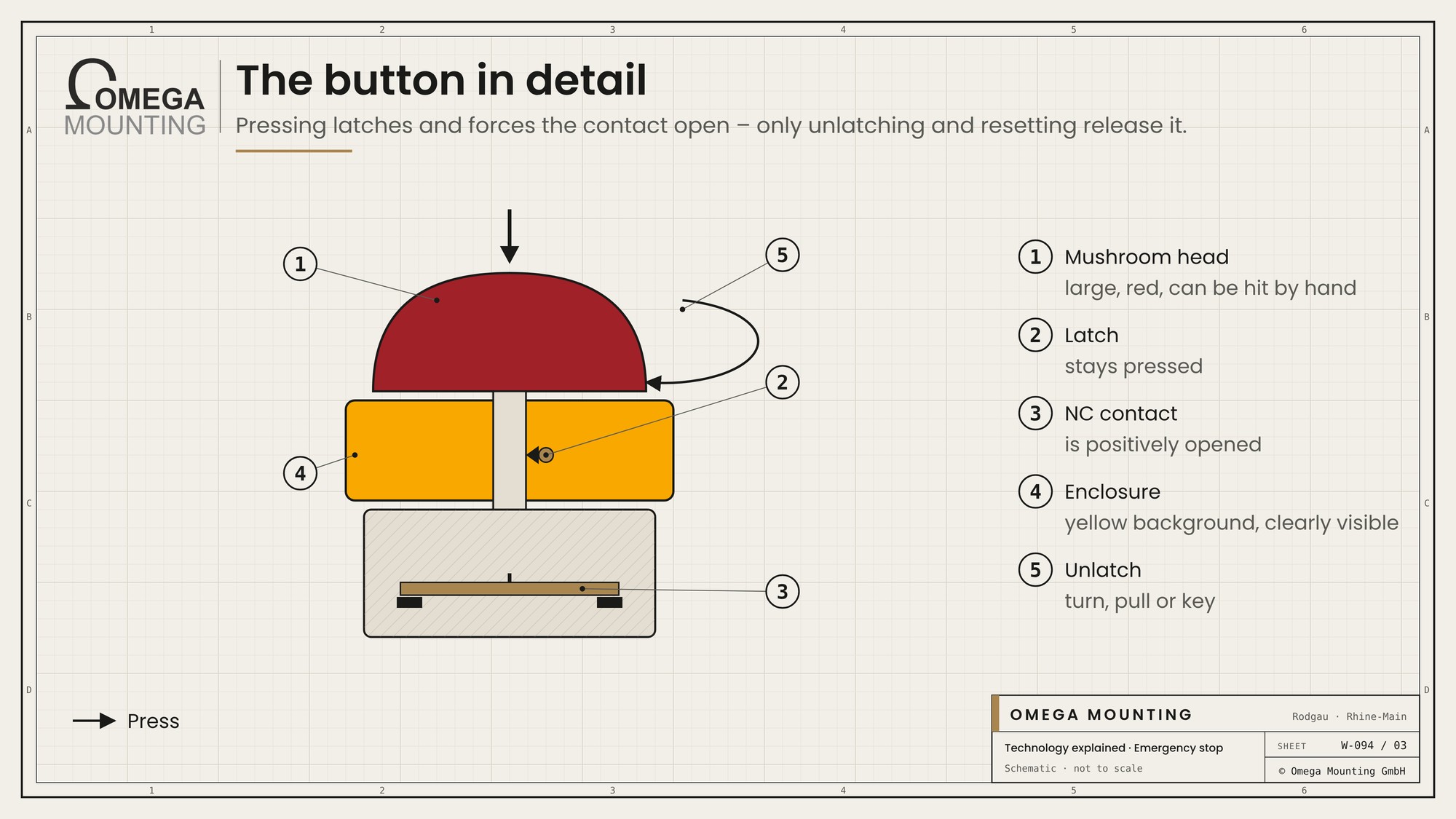
- Mushroom button: large, red, on a yellow background – can be hit with the flat of the hand.
- Latch: The button stays pressed until it is deliberately unlatched.
- Positive-break contact: The NC contact is forced open mechanically, even if it is welded.
- Releasing: by turning, pulling or with a key.
- Acknowledging: Only a separate command releases the machine again – unlatching alone starts nothing.
Where emergency stops belong

- Reachable: quickly reachable from every workstation and every point of intervention.
- Clear: not behind pallets, trolleys or covers.
- Visible: easy to recognise, even from a distance.
- At hand height: firmly mounted on a sturdy bracket.
- Pull wire: on long conveyor lines, so that the stop is within reach everywhere.
How safeguards are retrofitted to existing installations is described in our guide Retrofitting safety devices.
Pull wire and enabling switch
On long conveyor lines, a button every few metres is often not enough. Then a pull wire is fitted: anyone pulling it at any point triggers the emergency stop. The pull-wire switch also detects when the wire breaks or goes slack, and then stops as well. The wire must be clearly visible, freely accessible and correctly tensioned.
For set-up and maintenance work on running machines, enabling switches are added. They only allow movement as long as they are held in the middle position – letting go or squeezing through in a fright stops the machine. They do not replace an emergency stop either, they complement it.
Testing
An emergency stop that is never pressed can fail unnoticed. That is why the function is tested regularly: press each button, check that the installation stops, unlatch, reset and watch the restart. The result is documented. After every change to the circuit – new buttons, new cables – all elements are tested, not just the new ones.
Typical mistakes
- Obstructed: The button is hidden behind material.
- Restart on release: The machine starts without a reset.
- New sections not integrated: Part of the installation keeps running on an emergency stop.
- Emergency stop used as operational stop: It is used to switch off and wears out.
- No testing: A defective contact is only noticed in an emergency.
Emergency stop after alterations
If a machine is altered, extended or moved, the emergency stop has to grow with it. This is what we pay attention to:
- Reach: An emergency stop must be quickly reachable from every new workstation.
- Scope: It must be clear which areas an emergency stop halts. With linked systems that is not self-evident.
- Marking: Red on a yellow background, clearly visible, not hidden by new components.
- Protection against accidental operation: Buttons along traffic routes are mounted so forklifts do not hit them by accident.
- Inspection: After every alteration the function of each emergency stop is tested and documented.
Mounting the buttons mechanically and preparing cable routes is part of our work. Our electricians handle the connection into the safety chain and the function test up to the main switch; changes to the safety controller remain with the manufacturer or integrator of the system.
What we pay attention to
- We prepare brackets and enclosures so that installation fits into the shutdown window.
- We mount buttons at hand height on sturdy brackets.
- We label every enclosure and every terminal.
- We integrate new buttons into the existing safety circuit and test all elements.
- We only work on isolated and secured installations.
Where we use it
At Frankfurt Airport we extended a parcel sorting system and in the process retrofitted 32 emergency stop buttons and numerous sensors. Two fitters pre-assembled mounting plates, installed the buttons and integrated every new button and sensor into the existing safety circuit in two days – during the system's daytime downtimes, without disrupting sorting operations.
More technology explained
Technology explained
installations with long lines.
Technology explained
safeguards alongside the emergency stop.
Technology explained
how the controls think.
Do you have questions about how this works on your site?
Are you extending an installation or want to retrofit emergency stop devices? We install, wire and test – mechanics and electrics from a single source. Request a callback.
Our service for this: Maintenance and servicing →
Free, no-obligation callback

About the author
Tobias Schott
Managing director of Omega Mounting GmbH, Rodgau · more than 20 years of hands-on experience in installation and maintenance
A trained mechatronics technician, working in maintenance, servicing and industrial installation since 2004 – first alongside his father, and with Omega Mounting since 2012: from overhead conveyors in Frankfurt to the crane system in a new-build hall. He plans and leads lifting operations as an appointed person (AP) in data centers and on industrial sites in the Rhine-Main region, trains and examines operators of cranes, mobile elevating work platforms and telehandlers, and is a qualified occupational safety specialist. On jobs abroad he is known as the “German Troubleshooter” – the person you call when a site gets stuck. He learned what quality means from his father, not from a manual: Made in Germany as a standard for his own work, not a label. That is why quality comes first at Omega Mounting – ahead of speed and price. The Technology explained articles cover the equipment and techniques his team uses every day: what counts on site is in them – what only appears in the brochure is not.
 English
 German