
- Technology explained – technology and procedures
Gearbox types: spur, bevel, worm, planetary – which for what
By Tobias Schott · 5-minute read · Updated November 2026
A gearbox turns the fast rotation of a motor into a slow, powerful one – and the type decides at which angle the shafts sit, how much energy is lost and how the gearbox needs to be maintained.
You encounter gearboxes in almost every drive: as a gear motor on conveyor belts and roller conveyors, on the hoist of a crane, on agitators, pumps and doors. The spare parts catalogue contains terms such as helical gearbox, bevel helical gearbox, worm gearbox or shaft-mounted gearbox. Anyone who can tell them apart orders correctly and spots faults earlier.
This article explains what a gearbox does, which basic types exist and what matters in operation. How to maintain gearboxes and change the oil is described in the guide Maintaining drives, gearboxes and pumps.
What is a gearbox?
A gearbox is a machine element that converts speed and torque between an input and an output shaft, usually via gears. An electric motor turns fast but with little torque. The gearbox reduces the speed and increases the torque in the same ratio – minus the losses due to friction.
The ratio is called the transmission ratio: input speed divided by output speed. If the motor turns 1,400 times a minute and the output shaft 70 times, the gearbox has a ratio of 20. Motor and gearbox together are called a gear motor. In German the gearbox is called „Getriebe“, the gear motor „Getriebemotor“.
Key facts
- Purpose: Reduce speed, increase torque, adapt shaft position and direction of rotation.
- Basic types: Spur, bevel, worm and planetary gearboxes, plus combinations such as bevel helical and helical worm gearboxes.
- Characteristics: Ratio, output torque, output speed, service factor, mounting position.
- Shaft position: Parallel, at right angles or in one axis.
- Lubrication: Usually an oil bath with gear oil; quantity and oil type depend on the mounting position.
- Typical applications: Conveyor belts, roller conveyors, hoists, travel drives, agitators, doors.
- Common misconception: A worm gearbox holds the load by itself – nobody may rely on that.
The four basic types compared
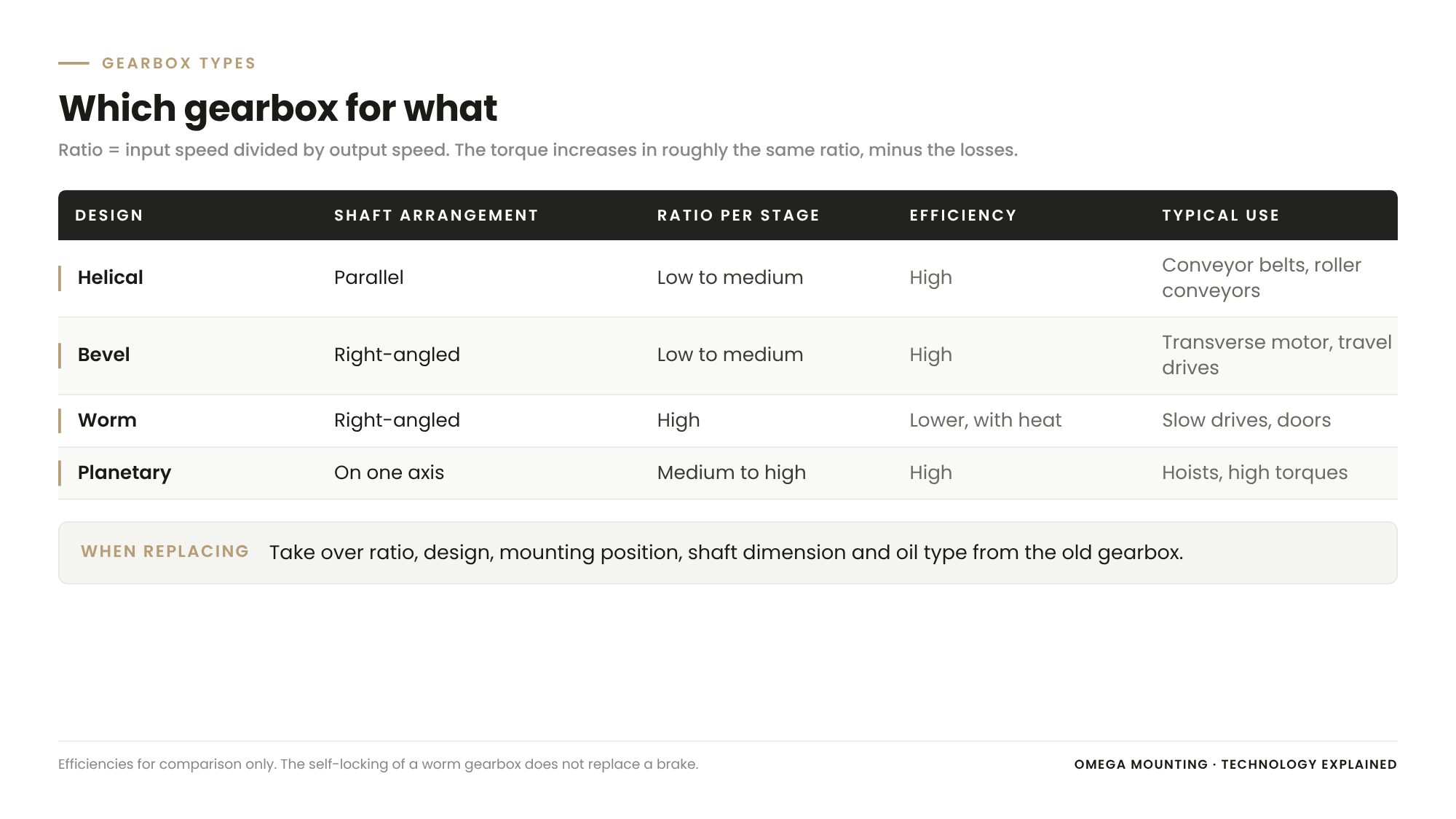
The type mainly follows the question of how the input and output shafts are positioned relative to each other.
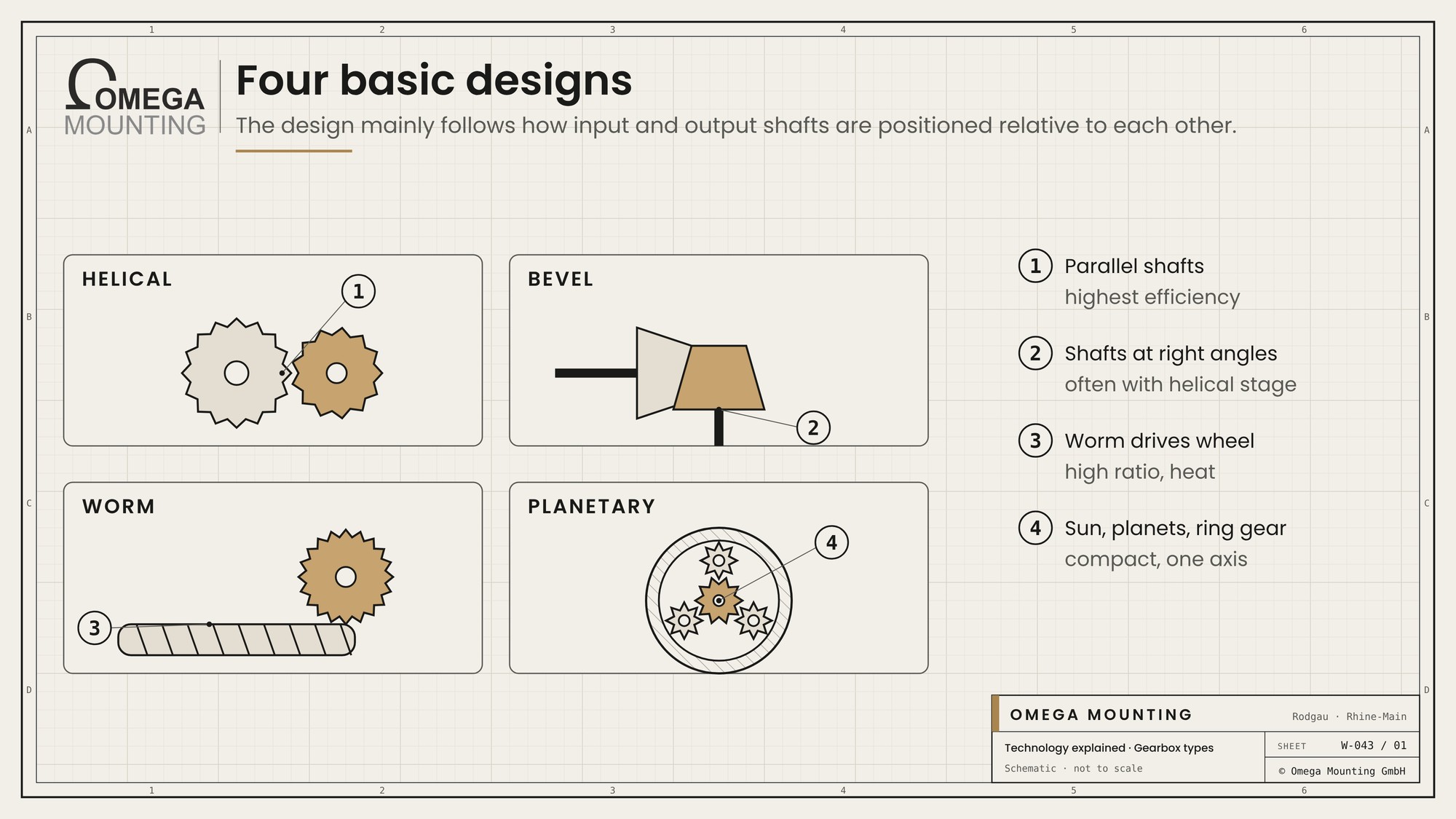
Spur gearbox. Two or more gears on parallel shafts. It has the highest efficiency, is robust and is the most common type. Several stages in a row give large ratios. Flat versions are pushed directly onto the driven shaft and are called shaft-mounted gearboxes.
Bevel gearbox. Conical gears turn the rotation through 90 degrees. It is usually combined with a spur stage and is then called a bevel helical gearbox. It has good efficiency and fits where the motor has to lie across the drive shaft.
Worm gearbox. A helical worm drives a worm wheel, the shafts are at right angles. It achieves very large ratios in one stage and runs quietly. Because the teeth slide on each other instead of rolling, efficiency is lower and it runs warmer. The worm wheel is often made of bronze – the gear oil must be approved for it.
Planetary gearbox. A sun gear in the middle drives several planet gears that revolve in a ring gear. Input and output lie in one axis. It is compact, transmits very high torques and spreads the load over several teeth at the same time.
| Type | Shaft position | Ratio per stage | Efficiency | Typical use |
|---|---|---|---|---|
| Spur. | Parallel. | Short to medium. | High | Conveyor belts, roller conveyors, agitators. |
| Bevel and bevel helical. | Right-angled. | Short to medium. | High | Conveyor systems with transverse motor, travel drives. |
| Worm. | Right-angled. | Large. | Lower, with heat. | Slow drives, doors, small conveyors. |
| Planetary. | In one axis. | Medium to large. | High | Hoists, rotary drives, high torques. |
Self-locking, mounting position, oil: what counts in operation
Three points decide whether a gearbox lasts long: the right oil for the mounting position, the right expectation of self-locking and the clean connection to motor and machine.
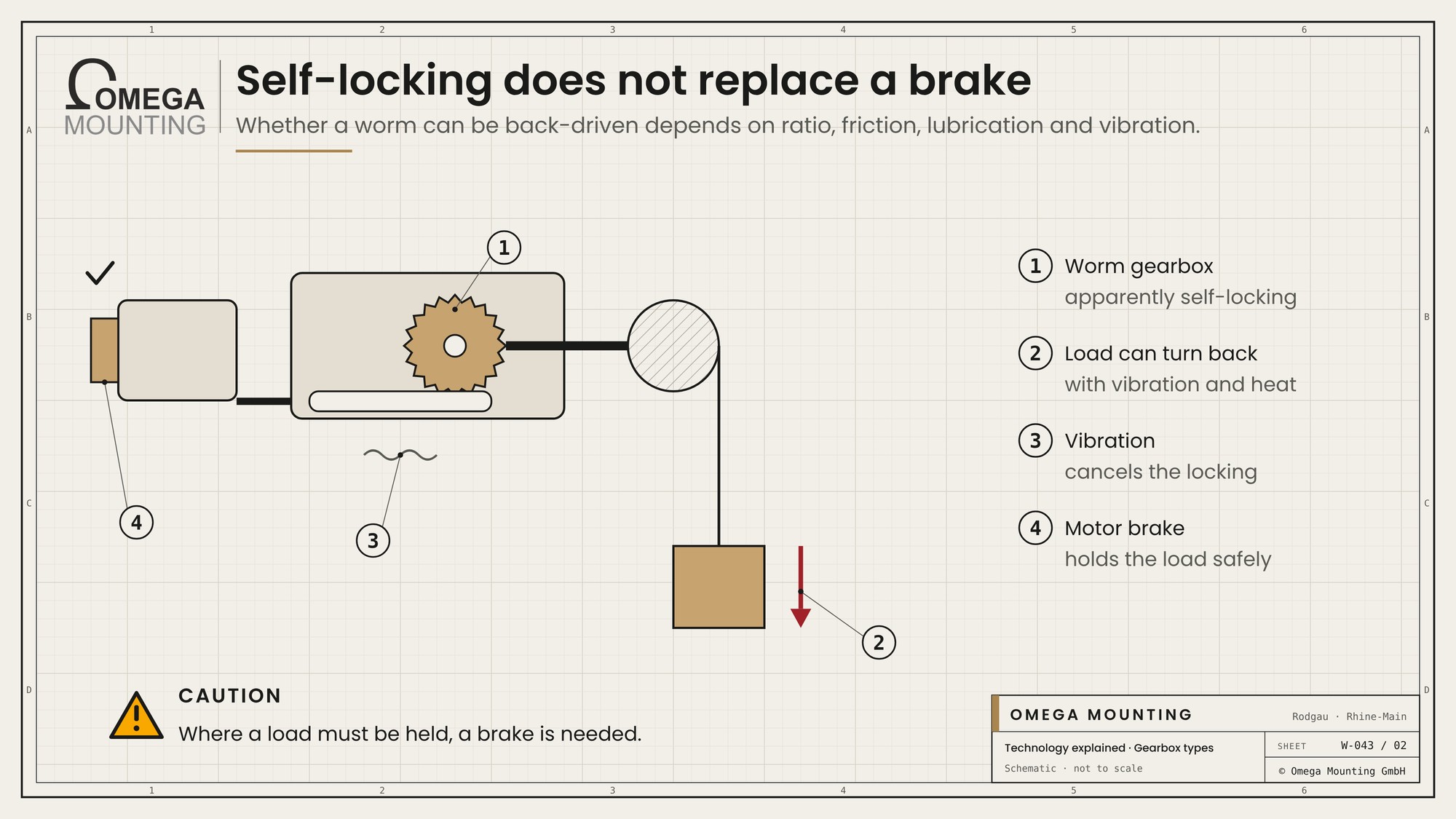
Self-locking. Some worm gearboxes are difficult or impossible to turn back from the output side. However, this depends on ratio, friction, lubrication and vibration and can change in operation. For hoists and anything that has to hold a load, a brake is required.
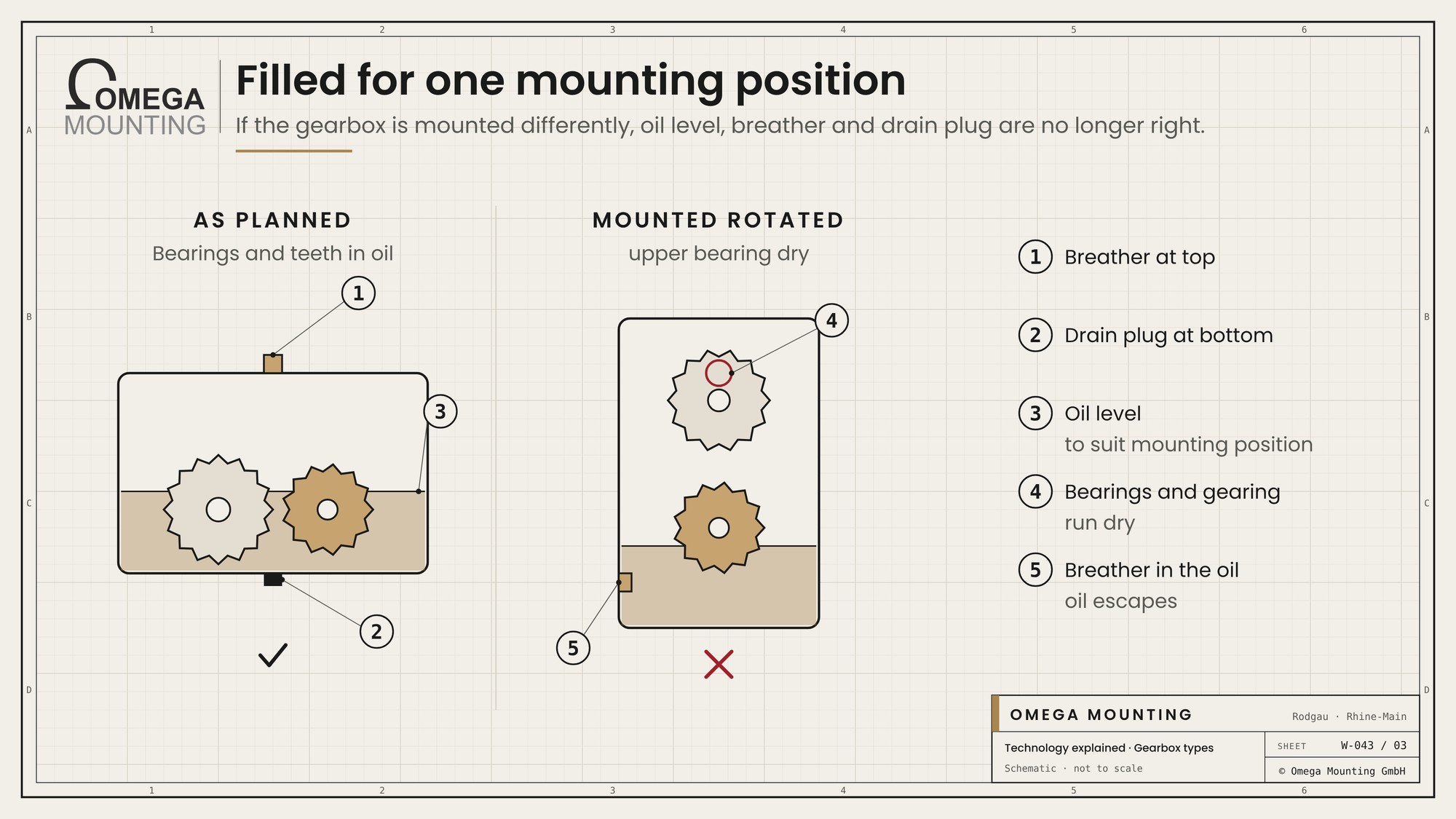
Mounting position. A gearbox is filled for a specific mounting position. If it is installed differently, oil level, breather and drain plug are no longer correct. The mounting position is on the rating plate and must be adopted when replacing.
Oil and seal. Gear oil ages, picks up wear debris and loses its additives. A leaking shaft seal lets oil out and dirt in. Increased heat, noise and oil on the housing are early warning signs.
How to recognise gearbox damage early
A gearbox almost always announces damage – through noise, heat, oil or play.

- Noise: An even hum is normal. Whining indicates worn gearing, rumbling or cracking indicates bearing damage.
- Heat: A housing that is noticeably warmer than usual is running with too little, too old or the wrong oil.
- Oil: Oil on the housing or under the drive indicates a leaking shaft seal or a blocked breather.
- Play: If the output shaft can be turned noticeably back and forth at standstill, tooth flanks or bearings are worn.
- Oil in the sample: Metal debris on the magnetic plug or rising iron values in the oil analysis show wear before it becomes audible.
Replacing and aligning a gearbox
Replacing a gearbox is more than lifting and bolting. The procedure decides whether the new gearbox runs for a long time:
- Weight and lifting points: Gearboxes are heavy and often top-heavy. They are lifted at the designated eyes, not by shafts or covers.
- Drain the oil: Before transport the oil is drained or the gearbox secured as specified so nothing leaks.
- Observe the mounting position: Oil quantity and breather depend on the mounting position. The new gearbox must be ordered for the existing position.
- Aligning: Motor, gearbox and driven machine are aligned with a laser or dial gauge.
- Fill with oil: Type and quantity as per the rating plate. The breather is refitted after transport.
Installation is followed by a test run, watching noise, temperature and leaks. Many manufacturers require a first oil change after a running-in period. These dates belong in the maintenance plan so they are not forgotten.
What we pay attention to
We replace gear motors according to the rating plate and check what caused the wear.
- We take over ratio, output speed, design, mounting position and shaft dimension from the old gearbox.
- We check oil level and oil type according to the rating plate and operating instructions, especially if the mounting position has changed.
- We never rely on self-locking where a load has to be held.
- We align motor, gearbox and machine to each other and check the coupling and torque arm.
- We replace gears, sprockets and chains that wear together also together.
- We leave gearbox overhauls to the manufacturer or a specialist workshop.
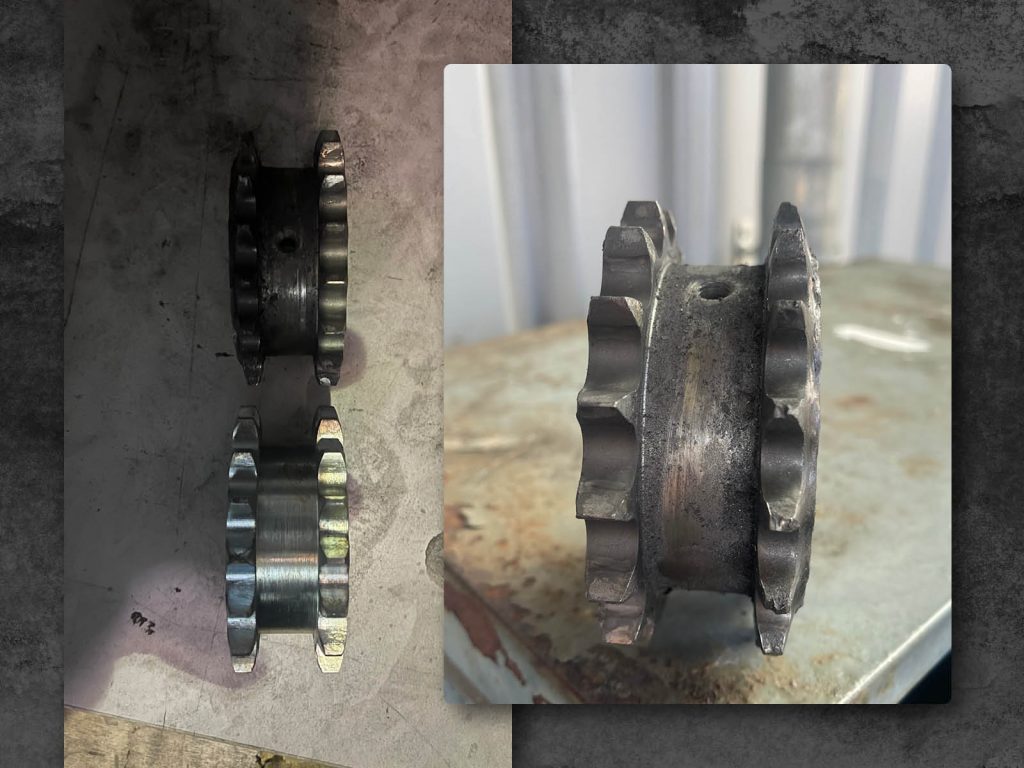
Where we use it
Worn gears are a common reason why a drive fails. During a High-bay warehouse at Frankfurt Airport a gear of the drive unit was worn. The drive chain jammed and partly skipped, the roller conveyor stopped conveying, and the entire high-bay warehouse went out of operation. We dismantled the chain conveyor, replaced all drive chains and gears and then adjusted the systems. Such work is part of our Maintenance and servicing.
More technology explained
Technology explained
the motor in front of the gearbox.
Technology explained
the connection between motor, gearbox and machine.
Technology explained
the gear oil and its designation.
Do you have questions about how this works on your site?
Do you have questions about how this works on your site – for example, which gear motor fits your conveyor system? We determine, replace, align and check. Request a callback – we will get back to you.
Free, no-obligation callback

About the author
Tobias Schott
Managing director of Omega Mounting GmbH, Rodgau · more than 20 years of hands-on experience in installation and maintenance
A trained mechatronics technician, working in maintenance, servicing and industrial installation since 2004 – first alongside his father, and with Omega Mounting since 2012: from overhead conveyors in Frankfurt to the crane system in a new-build hall. He plans and leads lifting operations as an appointed person (AP) in data centers and on industrial sites in the Rhine-Main region, trains and examines operators of cranes, mobile elevating work platforms and telehandlers, and is a qualified occupational safety specialist. On jobs abroad he is known as the “German Troubleshooter” – the person you call when a site gets stuck. He learned what quality means from his father, not from a manual: Made in Germany as a standard for his own work, not a label. That is why quality comes first at Omega Mounting – ahead of speed and price. The Technology explained articles cover the equipment and techniques his team uses every day: what counts on site is in them – what only appears in the brochure is not.
 English
 German