

Locating and non-locating bearings: how an electric motor is supported

By Tobias Schott  · 5-minute read · Updated November 2026

A shaft gets warm in operation and therefore longer – that is why a locating bearing holds it in position while a floating bearing lets it move, and anyone who mixes them up when replacing bearings builds in damage.

You encounter locating and floating bearings in every electric motor, in pumps, fans, gearboxes and on long shafts with plummer blocks. In the motor the bearing points are called drive end and non-drive end; data sheets use terms such as adjusted arrangement, wave spring or current-insulated bearing. For maintenance, the arrangement decides how a bearing is installed and why it fails.

This article explains the bearing arrangements, the typical motor bearing arrangement and the topic of bearing currents. Which bearing types exist is explained in our article on Bearing types: ball, roller, thrust and plain bearings – which for what.

What is a locating and a floating bearing?

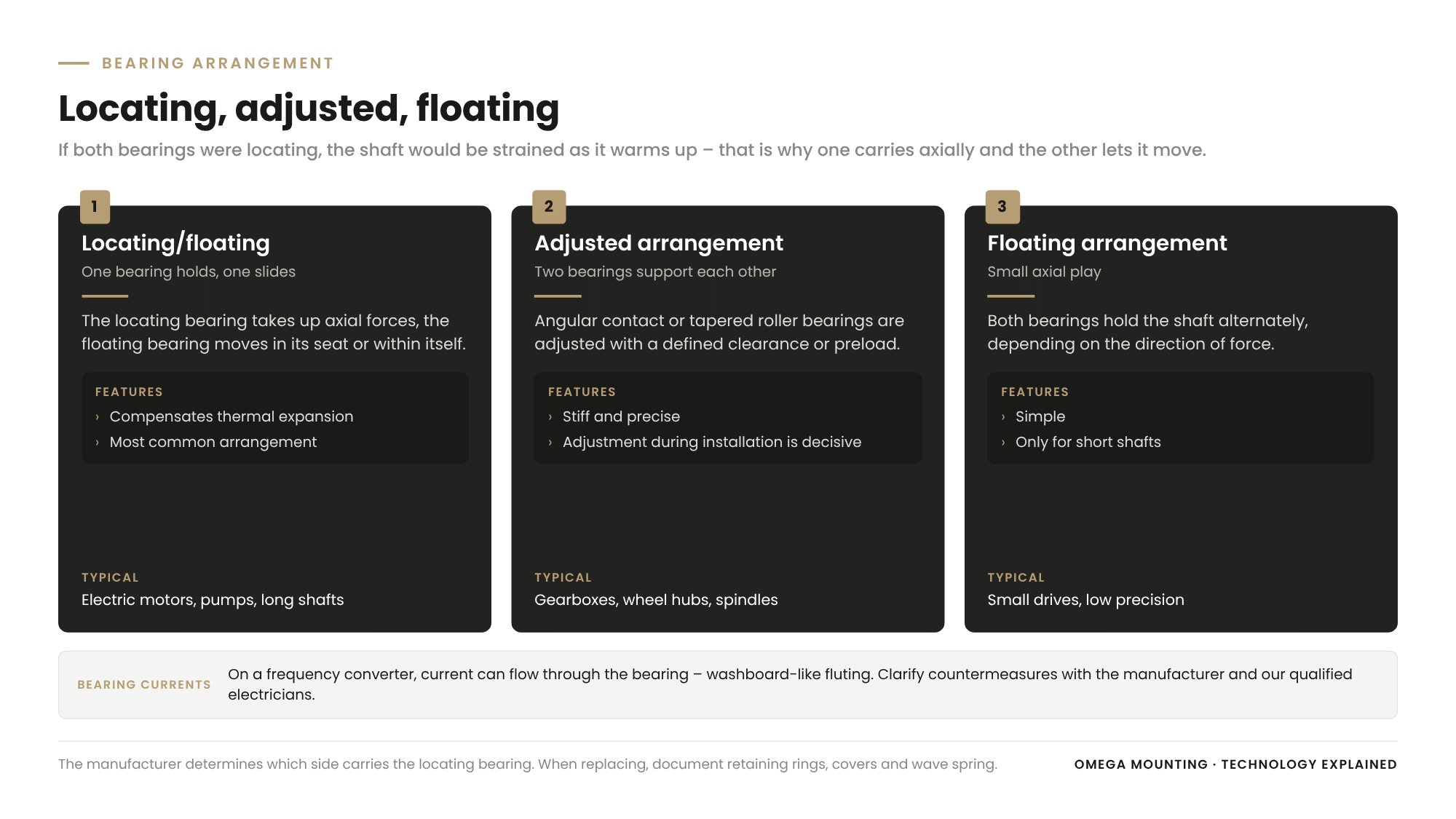
A locating bearing is a bearing that holds a shaft in the longitudinal direction and takes up radial and axial forces; a floating bearing carries only radially and lets the shaft move longitudinally. Together they form a locating/floating bearing arrangement.

The reason is heat. A steel shaft expands as the temperature rises, the housing often differently. If both bearings were locating, the shaft would be strained between them as it warms up. The bearings would receive a load they are not designed for and would fail early. They are also called locating and non-locating bearings; in German Festlager and Loslager.

Key facts

Three ways to support a shaft

Explanatory graphic: locating and floating bearings – locating/floating arrangement, adjusted arrangement and floating arrangement compared
A shaft grows when it gets warm: the bearing arrangement determines which bearing holds it and which lets it move. Graphic: Omega Mounting

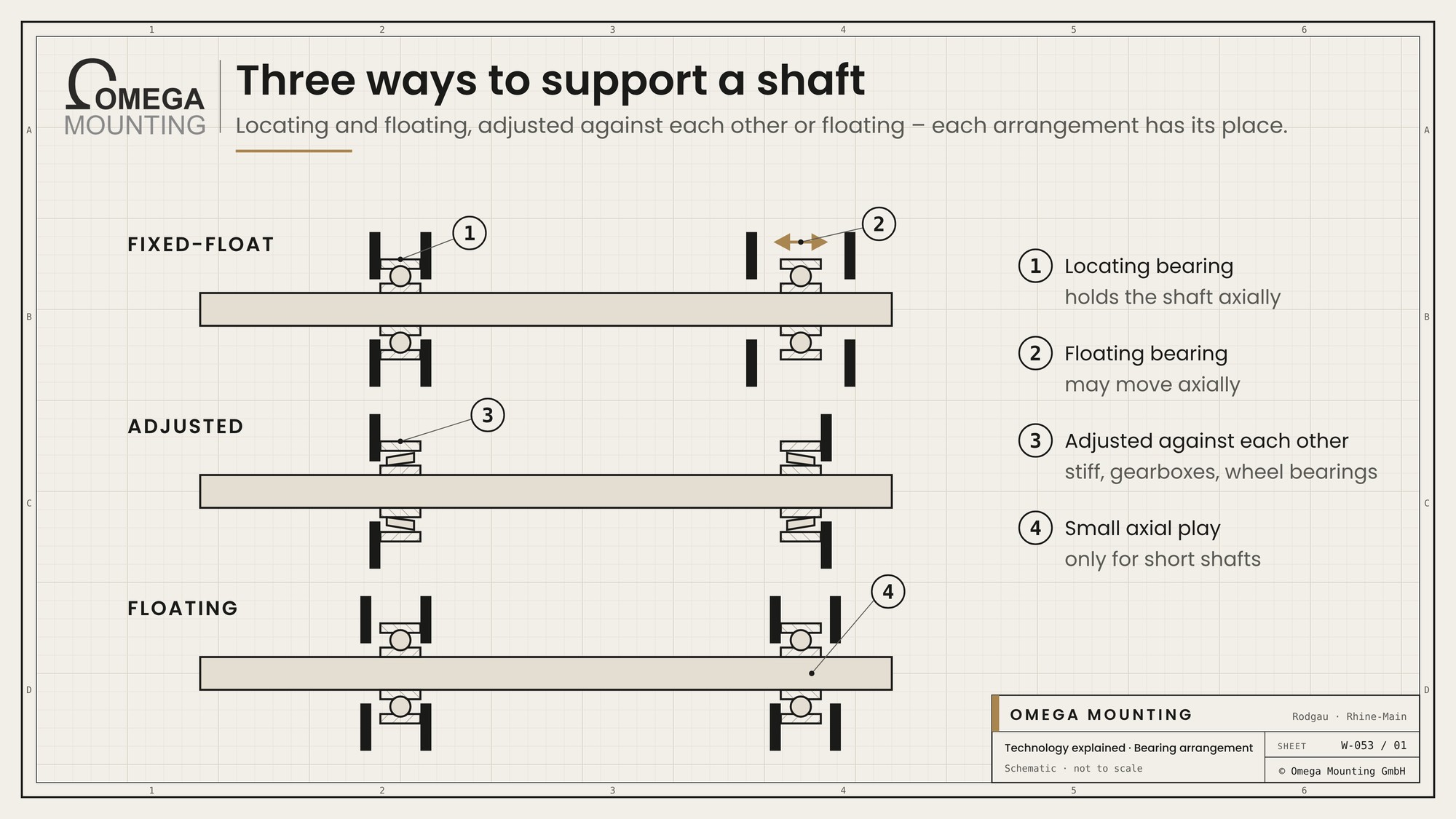
There are three basic principles – and each has its typical place.

Technical drawing: three shafts with two bearings each – locating/floating arrangement with one axially held and one movable bearing, adjusted arrangement with two tapered roller bearings against each other and floating arrangement with small axial play
Locating and floating, adjusted against each other or floating: each arrangement has its typical place. Graphic: Omega Mounting

Locating/floating arrangement. One bearing holds the shaft axially, the other slides in the housing seat or lets the rollers move on the ring. This is the most common arrangement for motors, pumps and long shafts.

Technical drawing: above, a shaft with two locating bearings that lengthens with heat and strains both bearings; below, the same shaft with locating and floating bearing, the floating bearing slides and takes up the expansion
The warm shaft gets longer: two locating bearings strain each other, the floating bearing takes up the expansion without strain. Graphic: Omega Mounting

Adjusted arrangement. Two angular contact or tapered roller bearings support each other, each in one direction. During installation they are adjusted with precisely defined clearance or light preload. This arrangement is stiff and precise, typical for gearboxes, wheel hubs and spindles.

Floating arrangement. Both bearings have a small axial play and hold the shaft alternately. It is simple, but only suitable for short shafts and low precision.

How an electric motor is supported

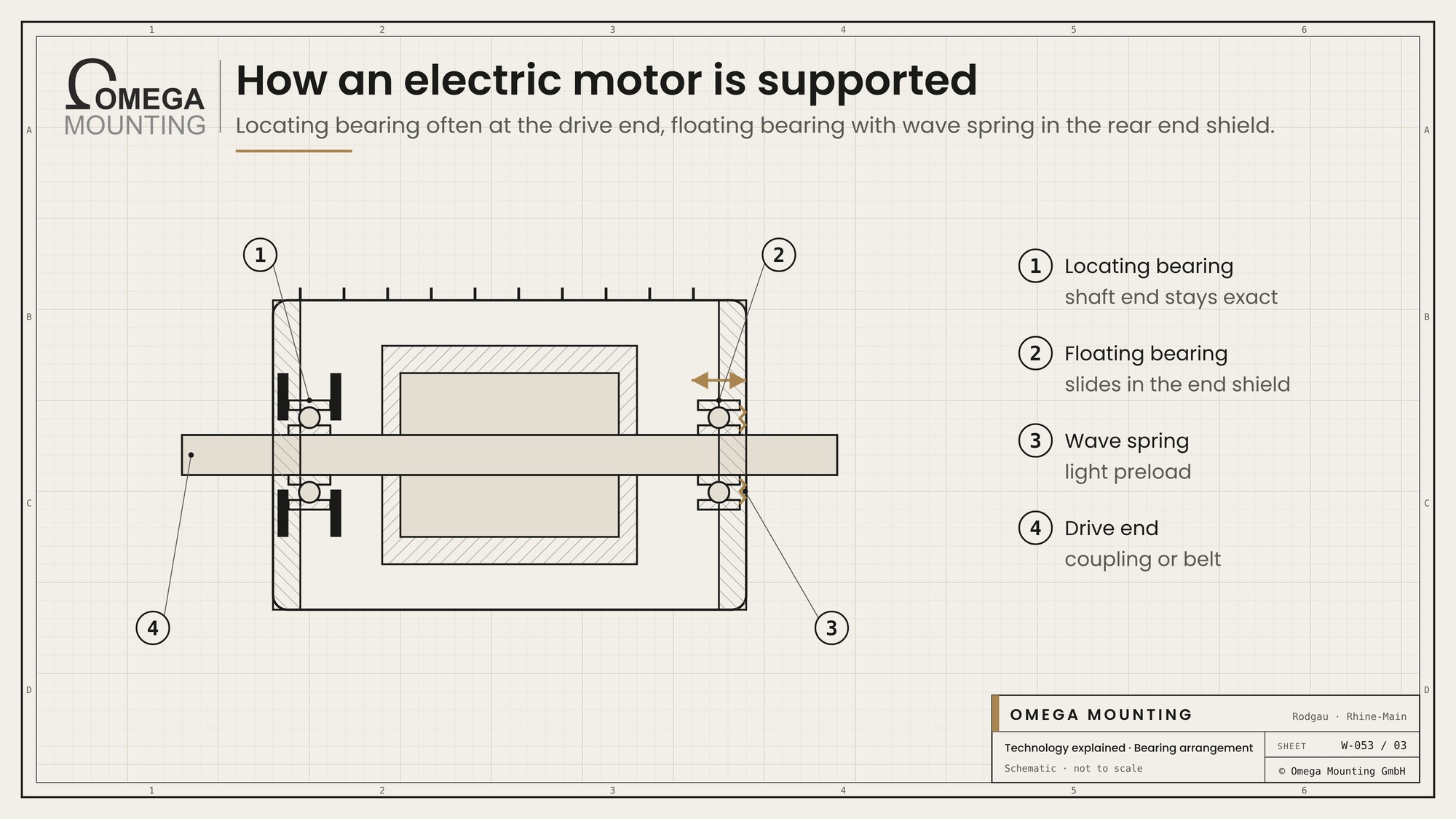
A typical three-phase motor has two deep groove ball bearings – one as locating bearing, one as floating bearing, often with a wave spring.

Technical drawing: electric motor in section with locating bearing at the drive end and floating bearing with wave spring in the rear end shield
Locating bearing often at the drive end, floating bearing with wave spring at the rear – which side is locating is determined by the manufacturer. Graphic: Omega Mounting

The manufacturer determines which side carries the locating bearing. It often sits at the drive end so that the shaft end stays exact. The floating bearing on the other side slides in the end shield. A wave spring lightly preloads the deep groove ball bearings. It prevents the balls from skidding at idle and makes the motor quieter. If it is missing after a bearing replacement, the motor gets louder and the bearings wear faster.

With belt drives the belt pulls strongly across the shaft. For such cases there are motors with reinforced bearings, often with a cylindrical roller bearing at the drive end. Such a motor always needs sufficient radial load; without a belt it can be damaged.

Bearing currents: when current flows through the bearing

Motors on frequency converters can send currents through their bearings – they leave a typical pattern and destroy the bearing from the inside.

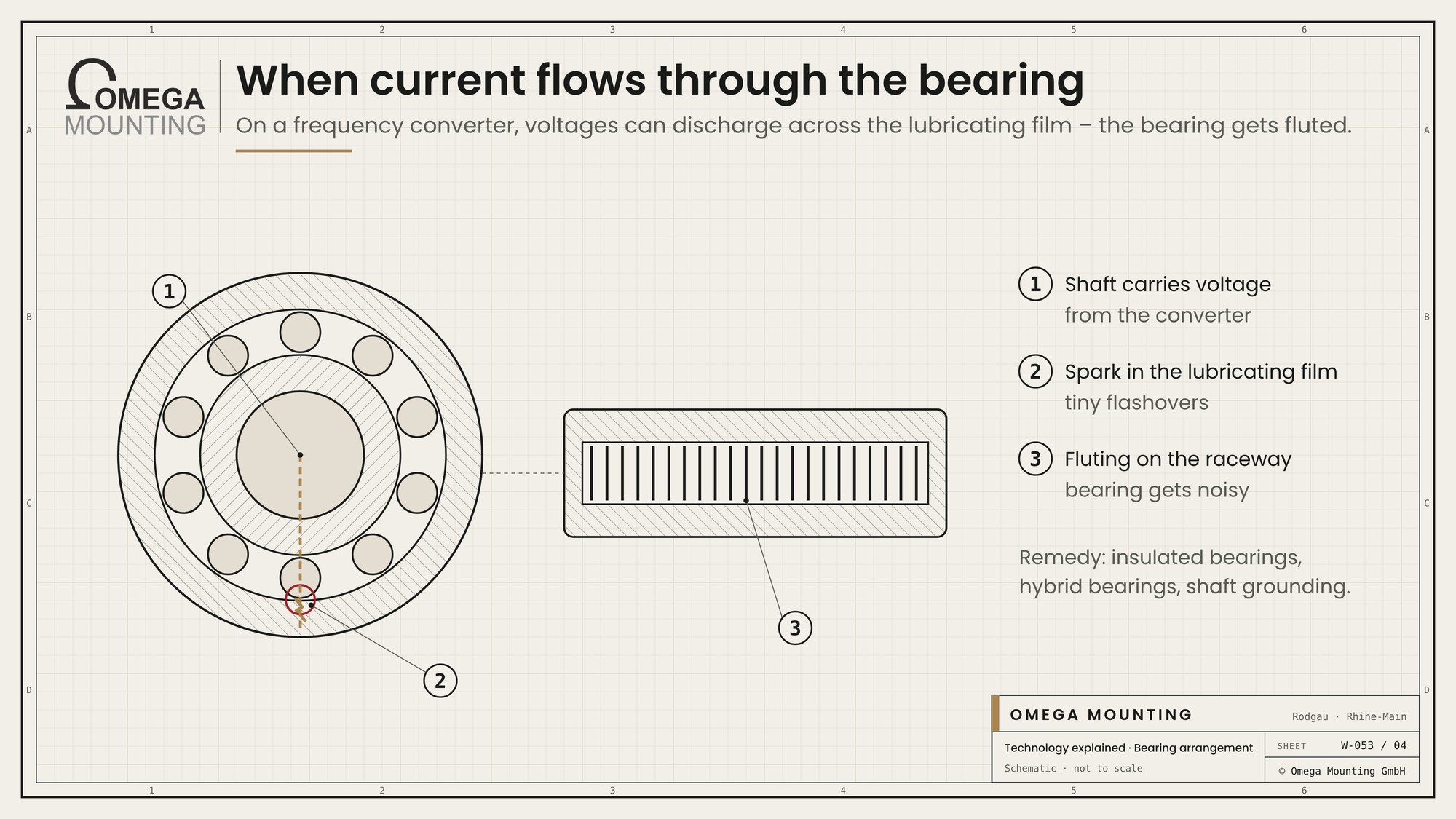
Technical drawing: rolling bearing in cross-section with the current path from the shaft via a ball to the outer ring and a spark in the lubricating film, next to it the unrolled raceway with even fluting
On a frequency converter, voltages can discharge across the lubricating film – the raceway gets fluted, the bearing noisy. Graphic: Omega Mounting

The converter generates fast voltage changes that build up small voltages via winding, shaft and housing. If they discharge through the lubricating film, tiny spark flashovers occur. Over time fine grooves form on the raceway at regular intervals, a washboard-like pattern. The bearing gets noisy, the grease dark and burnt.

Countermeasures are current-insulated bearings with a coated ring, hybrid bearings with ceramic balls and shaft grounding. Which solution fits is decided by the motor manufacturer and our qualified electricians.

Checking the bearing arrangement when replacing a motor

When a motor is replaced or overhauled, it pays to look at the bearing arrangement. We check these points:

Fluting patterns on the raceway of a removed bearing are a typical sign of current passage. Then a new bearing is not enough – the cause is investigated together with the electricians before the motor runs again.

What we pay attention to

We reinstall motor bearings the way the manufacturer intended the arrangement.

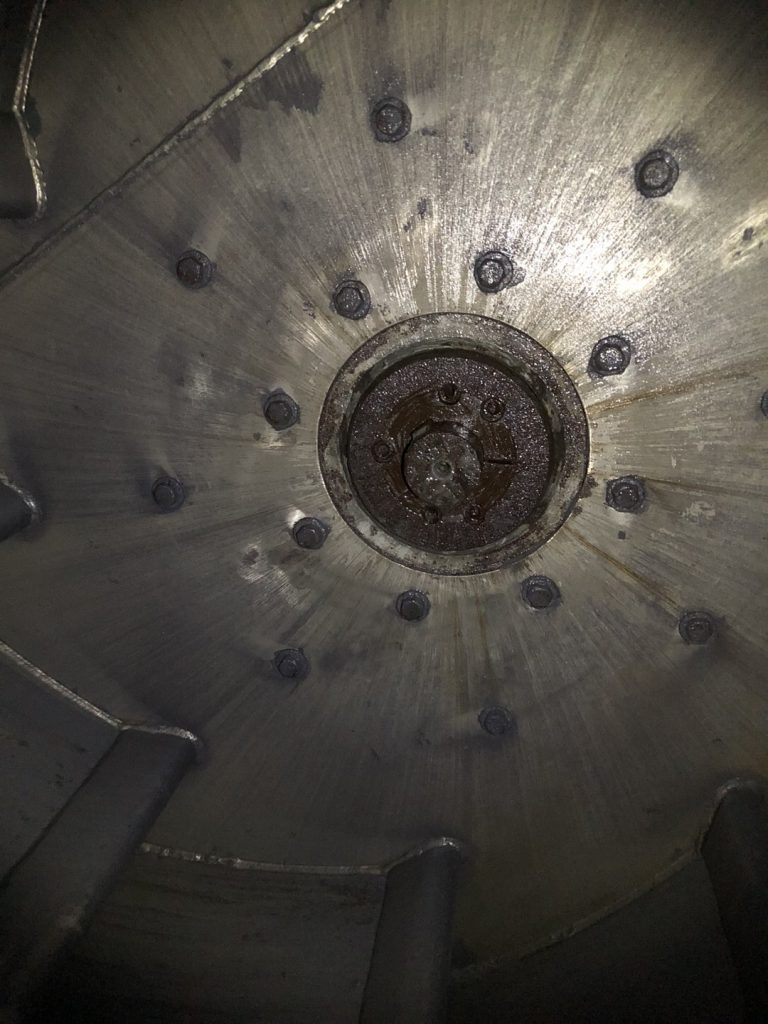
The approx. 1.40 m fan impeller in its installed state
Fan impeller directly on the motor shaft: here the motor bearings carry the whole impeller – and run practically non-stop in continuous operation.

Where we use it

We replace motor bearings on fans, pumps and drives, often directly on site in the shutdown window. During the fan bearing replacement in a paint shop near Offenbach the fan impeller of around 1.40 metres sat directly on the motor shaft, and the fans ran practically non-stop in production. A worn bearing would have risked vibration and consequential damage to motor and impeller. We removed the unit, replaced the bearings and overhauled it. Such work is part of our Maintenance and servicing.

More technology explained

Technology explained

the bearings from which every arrangement is made.

Technology explained

how to recognise current passage and incorrect installation.

Guide

the guide to bearing replacement and alignment.

Do you have questions about how this works on your site?

Do you have questions about how this works on your site – for example, why the bearings on your motor keep failing? We replace, check the bearing arrangement and look for the cause. Request a callback – we will get back to you.

Free, no-obligation callback

Tobias Schott, managing director of Omega Mounting GmbH, on a construction site in front of scaffolding

About the author

Tobias Schott

Managing director of Omega Mounting GmbH, Rodgau · more than 20 years of hands-on experience in installation and maintenance

A trained mechatronics technician, working in maintenance, servicing and industrial installation since 2004 – first alongside his father, and with Omega Mounting since 2012: from overhead conveyors in Frankfurt to the crane system in a new-build hall. He plans and leads lifting operations as an appointed person (AP) in data centers and on industrial sites in the Rhine-Main region, trains and examines operators of cranes, mobile elevating work platforms and telehandlers, and is a qualified occupational safety specialist. On jobs abroad he is known as the “German Troubleshooter” – the person you call when a site gets stuck. He learned what quality means from his father, not from a manual: Made in Germany as a standard for his own work, not a label. That is why quality comes first at Omega Mounting – ahead of speed and price. The Technology explained articles cover the equipment and techniques his team uses every day: what counts on site is in them – what only appears in the brochure is not.

EnglishEnglish