
- Technology explained – technology and procedures
Bearing types: ball, roller, thrust and plain bearings – which for what
By Tobias Schott · 5-minute read · Updated November 2026
A bearing guides a shaft and carries its forces – and whether balls, rollers, needles or a sliding surface do the work decides how much load it takes, how fast it may turn and how it wears.
You encounter bearing types in every drive: in the electric motor, the gearbox, the pump, in idlers, in wheels and trolleys of cranes and electrified monorails. Terms such as ball bearing, spherical roller bearing, thrust bearing or bushing come up in conversation. Each has its own principle behind it.
This article classifies the bearing types by design principle and load. How to read the designation on the bearing ring is explained in our article on Rolling bearing designation: what 6205-2RS C3 reveals.
What is a bearing?
A bearing is a machine element that guides moving parts relative to each other, transmits forces and keeps friction as low as possible. In drive technology it usually guides a rotating shaft in the housing.
There are two basic principles. In the Rolling bearing balls or rollers roll between two rings. In the Plain bearing the shaft slides on a surface, separated by a lubricating film or a sliding material. In German they are called Wälzlager and Gleitlager.
Key facts
- Purpose: Guide shafts, take up forces, keep friction low.
- Basic principles: Rolling bearings with balls, rollers or needles; plain bearings with a sliding surface.
- Load direction: Radial bearings for forces across the shaft, thrust bearings for forces along the shaft, angular contact bearings for both.
- Rolling elements: Balls with point contact, rollers and needles with line contact.
- Typical applications: Electric motors, gearboxes, pumps, fans, idlers, wheels, joints and pins.
- Wear parts: Fatigue of the raceways in rolling bearings, abrasion of the sliding surfaces in plain bearings.
- Common misconception: A larger bearing always lasts longer – too little load harms roller bearings just as much as too much.
Radial or axial: which force the bearing carries
The first question to ask of a bearing is: where does the force come from?

Radial bearings take up forces across the shaft, such as the weight of a fan impeller or the pull of a belt. The deep groove ball bearing is the best known.
Thrust bearings take up forces along the shaft, such as the pressure of a spindle, the load on a rotary table or the thrust of a worm. They carry no radial forces and are therefore usually combined with a radial bearing.
Angular contact bearings such as angular contact ball bearings and tapered roller bearings take up both. They are often fitted in pairs and adjusted against each other.
Rolling bearings compared: which shape carries what
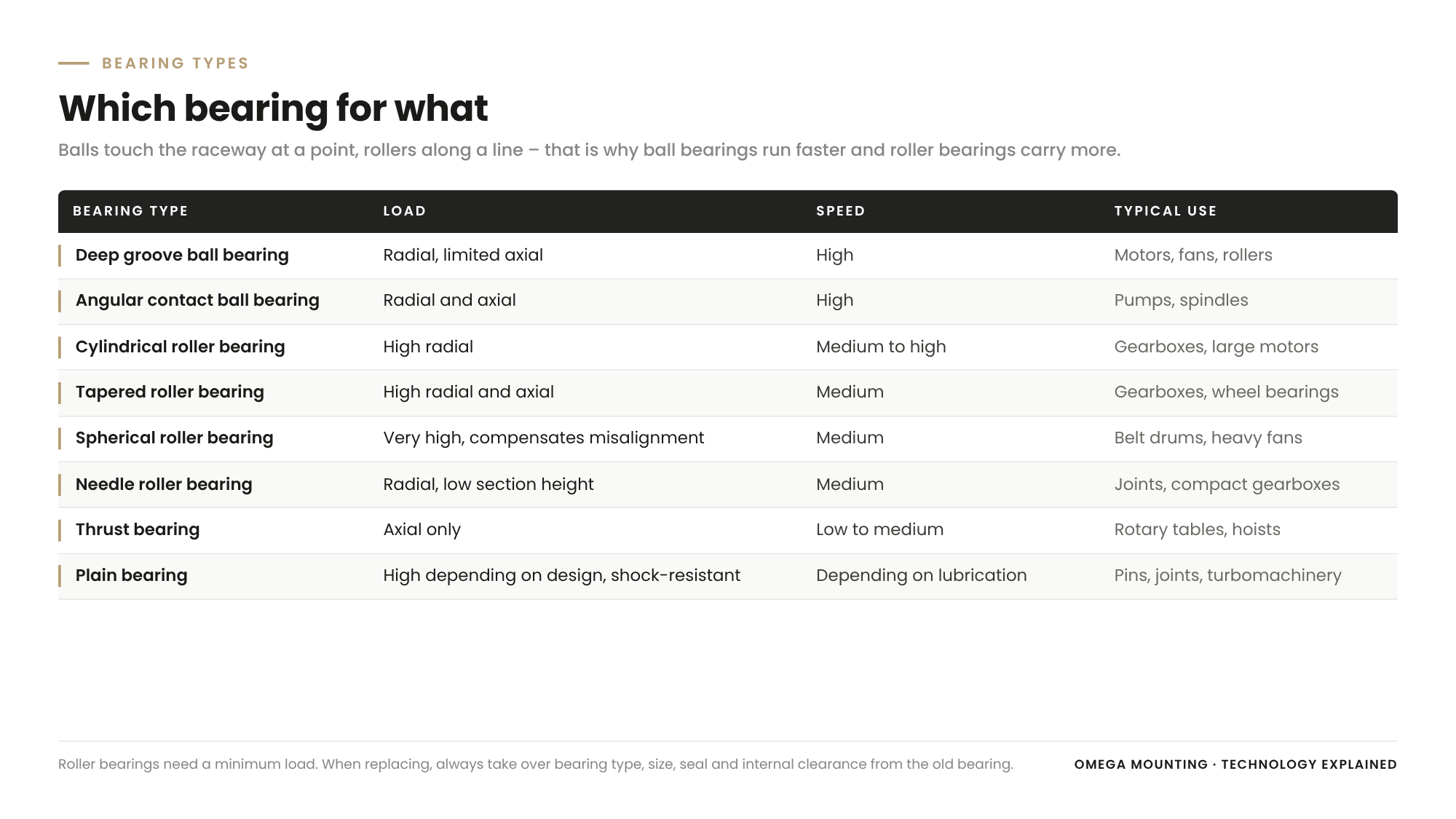
Balls touch the raceway at only one point, rollers along a line – that is why ball bearings run faster and roller bearings carry more.
| Bearing type | Load | Speed | Strength | Typical use |
|---|---|---|---|---|
| Deep groove ball bearing. | Radial, limited axial. | High | Versatile, quiet, often sealed. | Electric motors, fans, rollers. |
| Angular contact ball bearing. | Radial and axial. | High | Precise, adjusted in pairs. | Pumps, spindles, compressors. |
| Cylindrical roller bearing. | High radial. | Medium to high | High load rating, length compensation possible. | Gearboxes, large motors, rolls. |
| Tapered roller bearing. | High radial and axial. | Medium | Very high load capacity, adjustable. | Gearboxes, wheel bearings, axles. |
| Spherical roller bearing. | Very high radial, also axial. | Medium | Compensates misalignment. | Conveyor belt drums, heavy fans. |
| Needle roller bearing. | Radial. | Medium | Very low section height. | Joints, levers, compact gearboxes. |
| Thrust bearing. | Axial only. | Low to medium. | Takes up longitudinal forces. | Rotary tables, spindles, hoists. |
| Plain bearing. | High depending on design. | Depending on lubrication. | Shock-resistant, quiet, compact. | Pins, joints, large turbomachinery. |

Two special cases are important: self-aligning bearings, i.e. self-aligning ball and spherical roller bearings, have a spherical outer ring raceway and compensate small misalignments of the shaft. Roller bearings need a minimum load. If they run almost without load, the rollers slide instead of rolling, and the raceways are damaged.
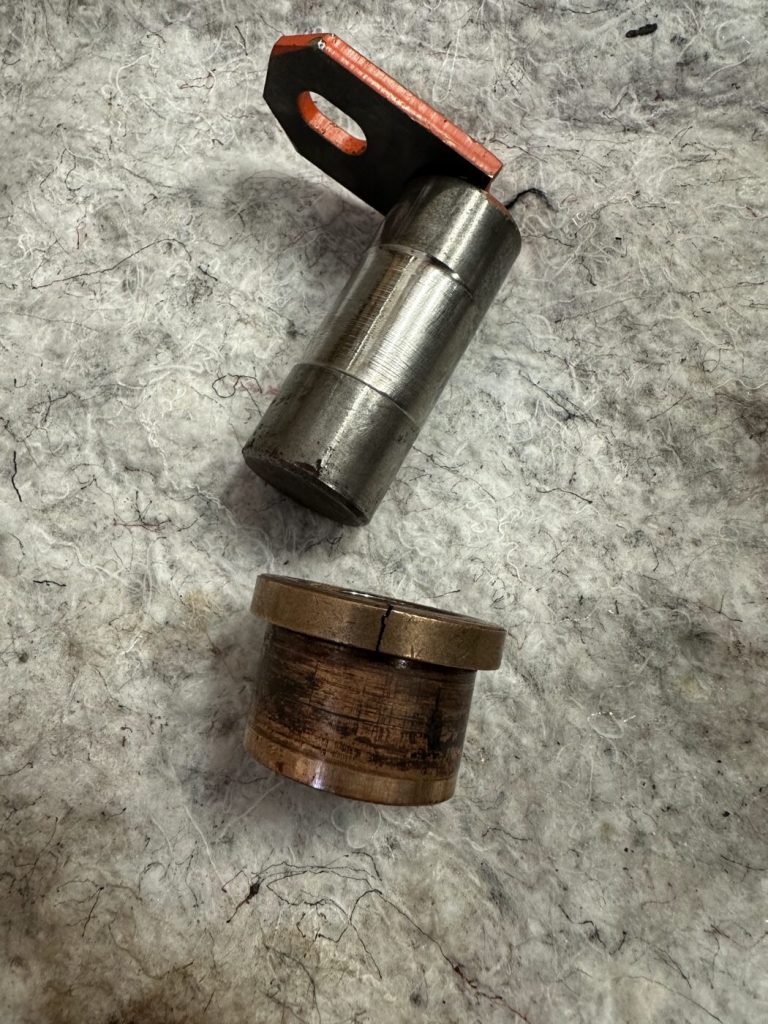
Plain bearings: when nothing rolls
In a plain bearing a lubricating film or a sliding material separates shaft and bearing shell – if it is missing, metal rubs on metal.
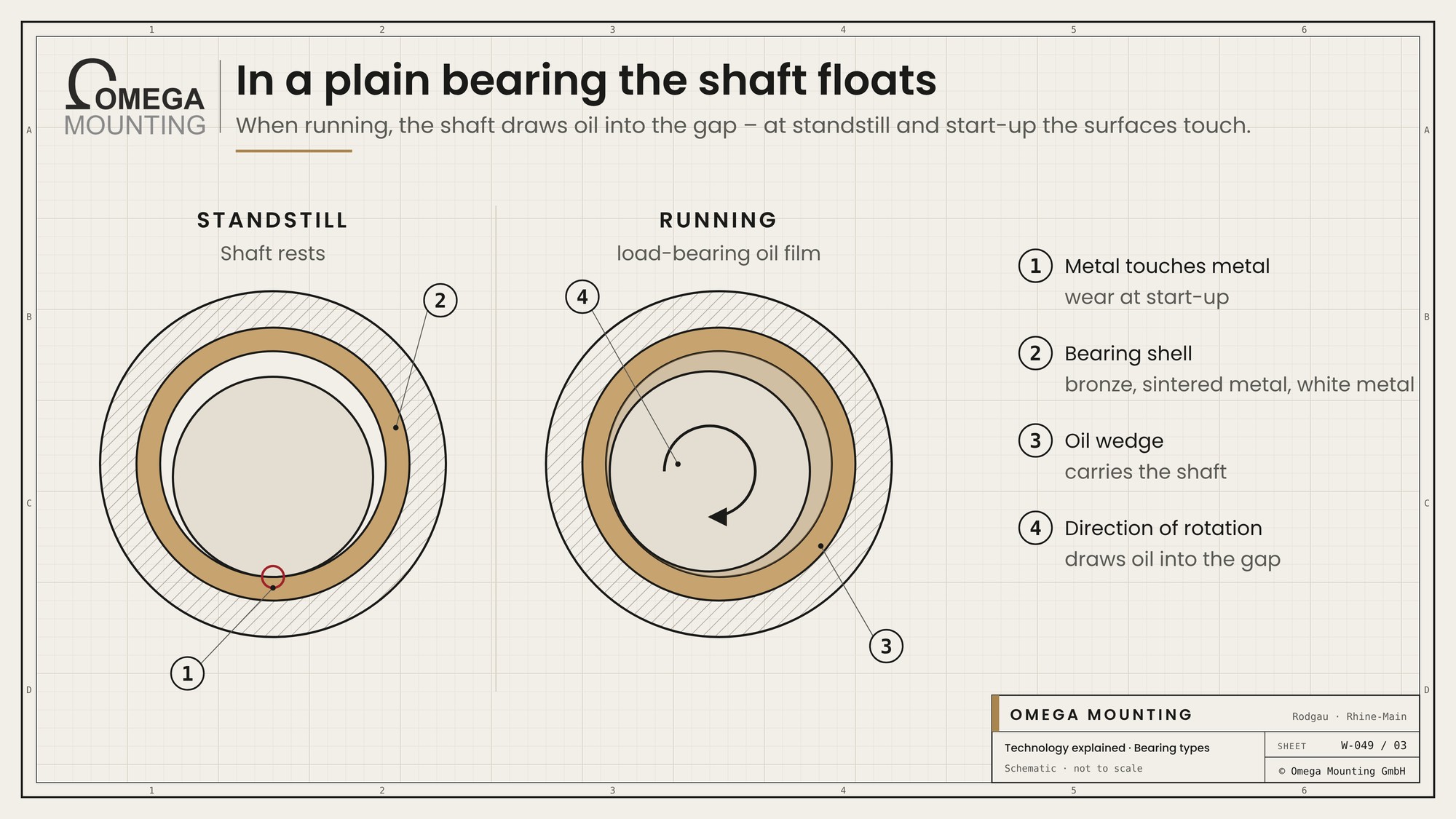
Large plain bearings in turbines and compressors work hydrodynamically: the rotating shaft draws oil into the gap and floats on a load-bearing film when running. At standstill and start-up the surfaces touch. Small plain bearings are often bushings made of bronze, sintered metal or plastic, on pins, joints and pivot points. Some are impregnated with oil or equipped with solid lubricant and are considered maintenance-free.
Plain bearings are insensitive to shocks and dirt, quiet and need little space. Their wear shows as play: pin and bushing wear in, the movement becomes loose and noisy.
Bearings in housings: bearing units
Many bearings do not sit directly in the machine housing, but in a separate bearing unit – ready to bolt on.
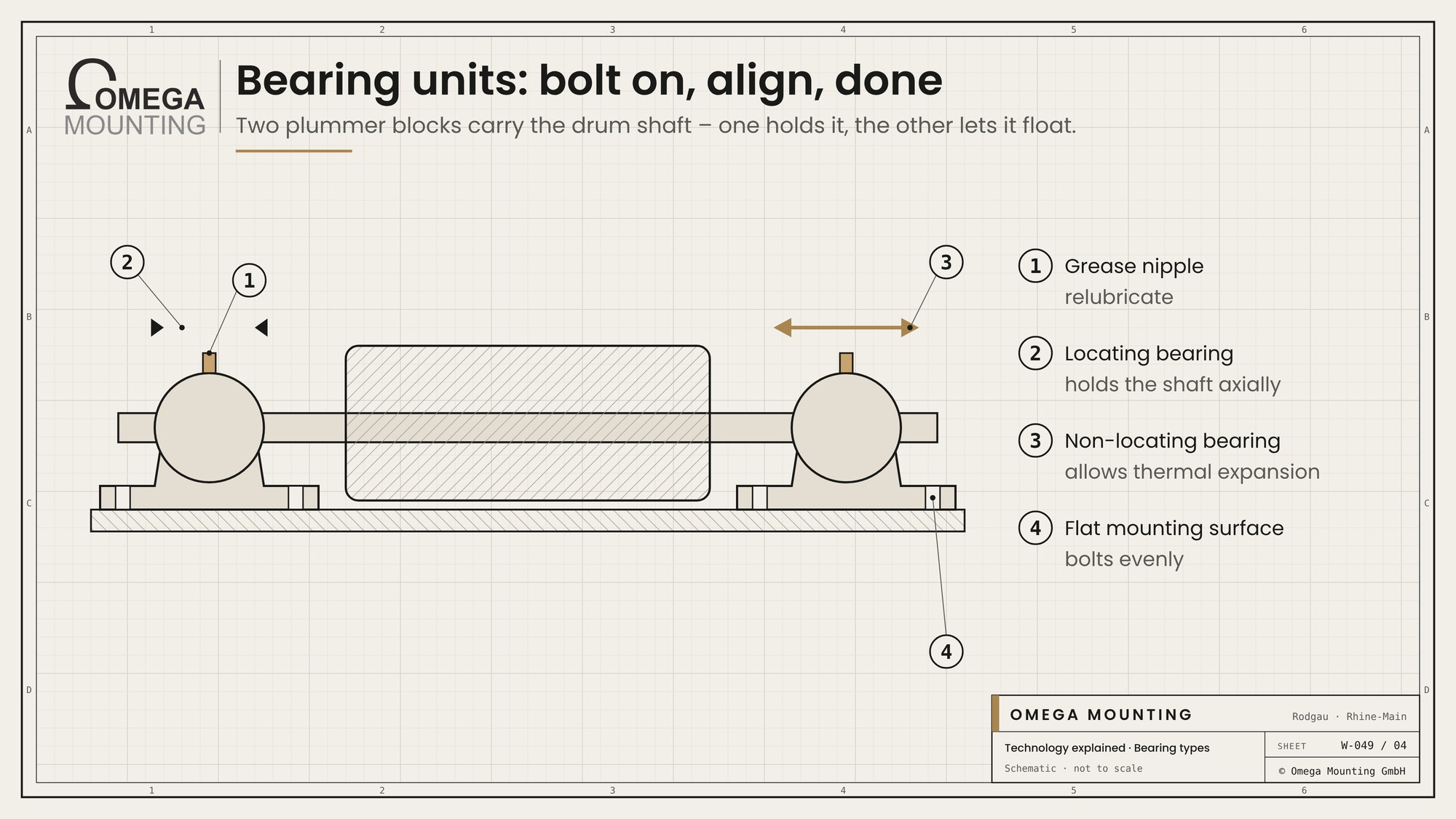
Plummer block and flange bearing units consist of a housing and a matching bearing, often with relubrication facility and seal. They carry the shafts of conveyor belts, fans, agitators and agricultural machinery. The advantage: the housing can be fixed to almost any frame, and the bearing is quickly replaced. What counts during installation is alignment, fastening on a flat surface and the question of which of the two bearings on a shaft is the locating bearing.
How a bearing fails – and how to notice early
Bearings rarely fail suddenly. Usually the damage announces itself over weeks. These signs are worth knowing:
- Noise: An even hum is normal. Rushing, droning or knocking point to damage on the raceway or rolling elements.
- Temperature: A bearing that gets warmer than its neighbour has a problem with lubrication, alignment or load.
- Vibration: Rising vibration levels often show the damage long before it can be heard.
- Grease: Dark, burnt grease or grease mixed with metal is a warning sign.
- Play: Noticeable play at the shaft means the bearing is already badly worn.
Checking these signs regularly means the replacement can be planned instead of waiting for the breakdown. During removal it pays to look at the old bearing: the damage pattern shows whether lubrication, installation or load was the cause – and what must change with the new bearing.
What we pay attention to
We choose and replace bearings according to their designation – and ask why the old bearing failed.
- We take over bearing type, size, seal and internal clearance from the old bearing, not just the basic number.
- We check whether locating and non-locating bearings are correctly assigned so that the shaft can expand when warm.
- We fit angular contact and tapered roller bearings in the right direction and adjust them as specified.
- We check plain bearing points for play, even where they are considered maintenance-free.
- We replace pins and bushings that wear together at the same time.
- After every bearing failure we look for the cause: lubrication, alignment, load, installation.
Where we use it
We replace bearings in motors, fans, conveyor systems and trolleys. With the worn monorail pins in a food plant a pin joint considered maintenance-free ran practically without lubrication; pin and bushing were worn in. Two to three fitters replaced pins and bushings on 80 vehicles, ten to 15 per weekend. During the fan bearing replacement in a paint shop near Offenbach we replaced and overhauled the rolling bearings of a fan running non-stop. Both are part of our Maintenance and servicing.
More technology explained
Technology explained
how to read the marking on the bearing ring.
Technology explained
why one bearing is fixed and the other may float.
Guide
the guide to bearing replacement and alignment.
Do you have questions about how this works on your site?
Do you have questions about how this works on your site – for example, which bearing belongs in your drive or why it keeps failing? We identify, replace and look for the cause. Request a callback – we will get back to you.
Free, no-obligation callback

About the author
Tobias Schott
Managing director of Omega Mounting GmbH, Rodgau · more than 20 years of hands-on experience in installation and maintenance
A trained mechatronics technician, working in maintenance, servicing and industrial installation since 2004 – first alongside his father, and with Omega Mounting since 2012: from overhead conveyors in Frankfurt to the crane system in a new-build hall. He plans and leads lifting operations as an appointed person (AP) in data centers and on industrial sites in the Rhine-Main region, trains and examines operators of cranes, mobile elevating work platforms and telehandlers, and is a qualified occupational safety specialist. On jobs abroad he is known as the “German Troubleshooter” – the person you call when a site gets stuck. He learned what quality means from his father, not from a manual: Made in Germany as a standard for his own work, not a label. That is why quality comes first at Omega Mounting – ahead of speed and price. The Technology explained articles cover the equipment and techniques his team uses every day: what counts on site is in them – what only appears in the brochure is not.
 English
 German