
Overhead conveyor maintenance in practice: what wears, what warns – and what belongs on the checklist

Maintenance checklist for electric overhead conveyors in use on the system
Overhead conveyor below the hall roof – maintenance-intensive, but very rewarding if you listen to it

A guide drawn from 15 years of overhead conveyors – with a checklist for your next maintenance window

An overhead conveyor rarely fails without warning. It announces itself – over weeks, sometimes over months. It squeals in the curve. It reports intermittent communication faults that cannot be reproduced. A carrier stops, but runs again once the fault is acknowledged. Systems like this keep running until they don’t – and the moment almost always picks its own time.

We have been maintaining and repairing overhead conveyors for over 15 years, in car plants, in food production and at airports. We keep seeing the same patterns: systems that are treated as “maintenance-free” and never were. Wear that could be proven with a pair of callipers in two minutes. And control faults whose cause lies not in the electronics but in a dirty conductor rail six metres above the floor.

This guide sums up what matters when maintaining an overhead conveyor: which assemblies really wear, which warning signs are no small matter and how to plan a maintenance window in which even the things you did not know beforehand get done. At the end you will find our overhead conveyor maintenance checklist to download.

Maintenance at a glance

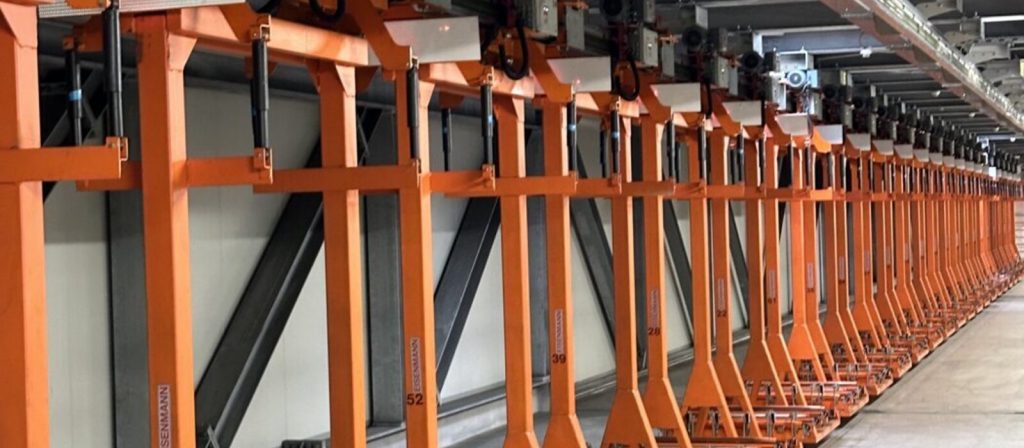
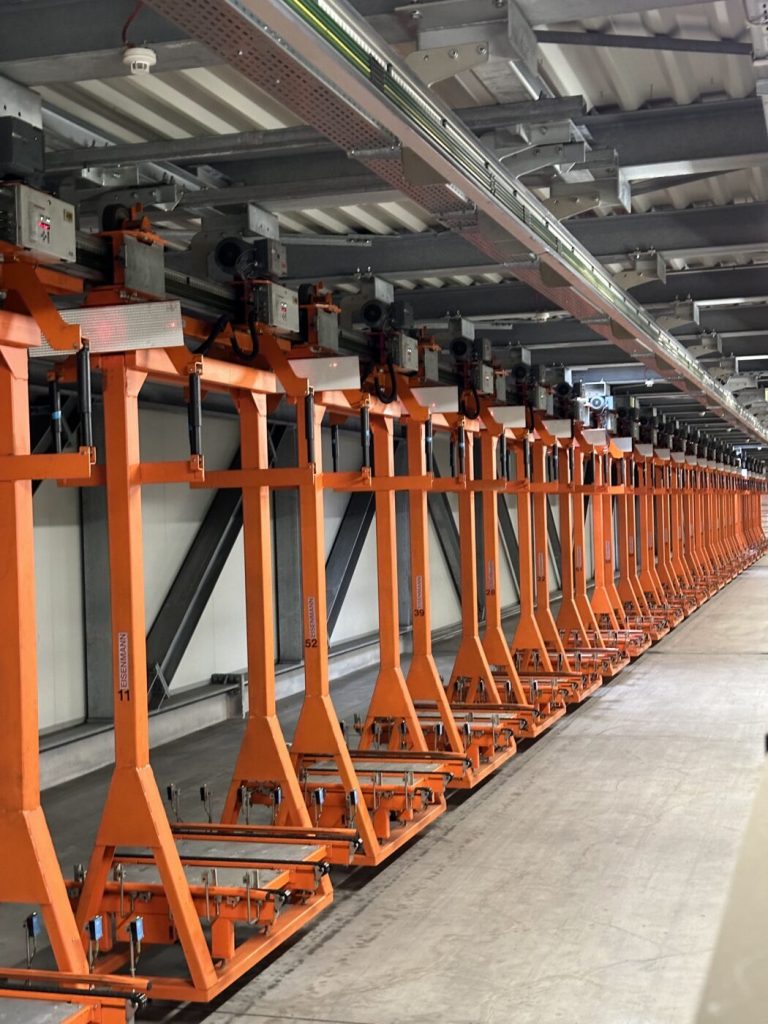
Row of overhead conveyor carriers in the production hall
Overhead conveyor in operation: carrier after carrier on the rail below the hall roof

What is an electrified monorail?

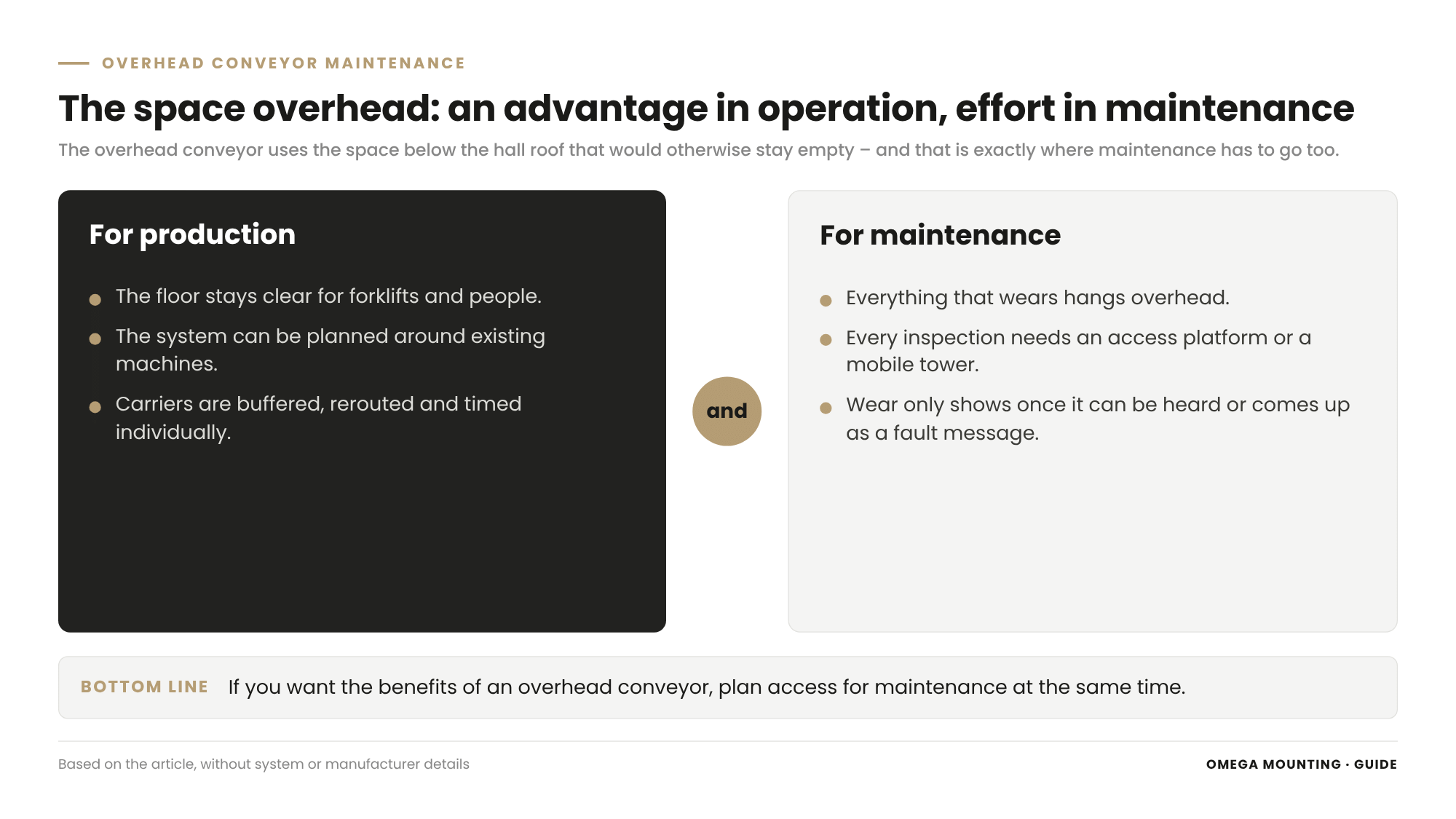
Explanatory graphic: the overhead conveyor from a production point of view – clear floor, flexible planning, individually timed carriers – and from a maintenance point of view – wearing parts overhead, an access platform for every inspection, wear noticed late
The overhead conveyor keeps the floor clear – and hangs everything that wears overhead. Graphic: Omega Mounting

An overhead conveyor is an overhead handling system: carriers hang from a rail below the hall roof and move components, workpiece carriers or hangers through production. Each carrier has its own drive and takes power and control signals through current collectors from a conductor rail that runs along the track. Switches distribute the carriers to different routes, and lifters bridge height differences between levels.

The big advantage: the overhead conveyor uses space that would otherwise stay empty. The floor stays clear for forklifts and people, the system can be planned around existing machines, and individual carriers can be buffered, rerouted and timed independently of each other.

The drawback from a maintenance point of view follows directly from this: everything that wears hangs overhead. Every inspection needs an access platform or a mobile tower, every task takes longer than at floor level, and wear only becomes noticeable once it can be heard or shows up as a fault message.

Why overhead conveyor maintenance works differently from machine maintenance

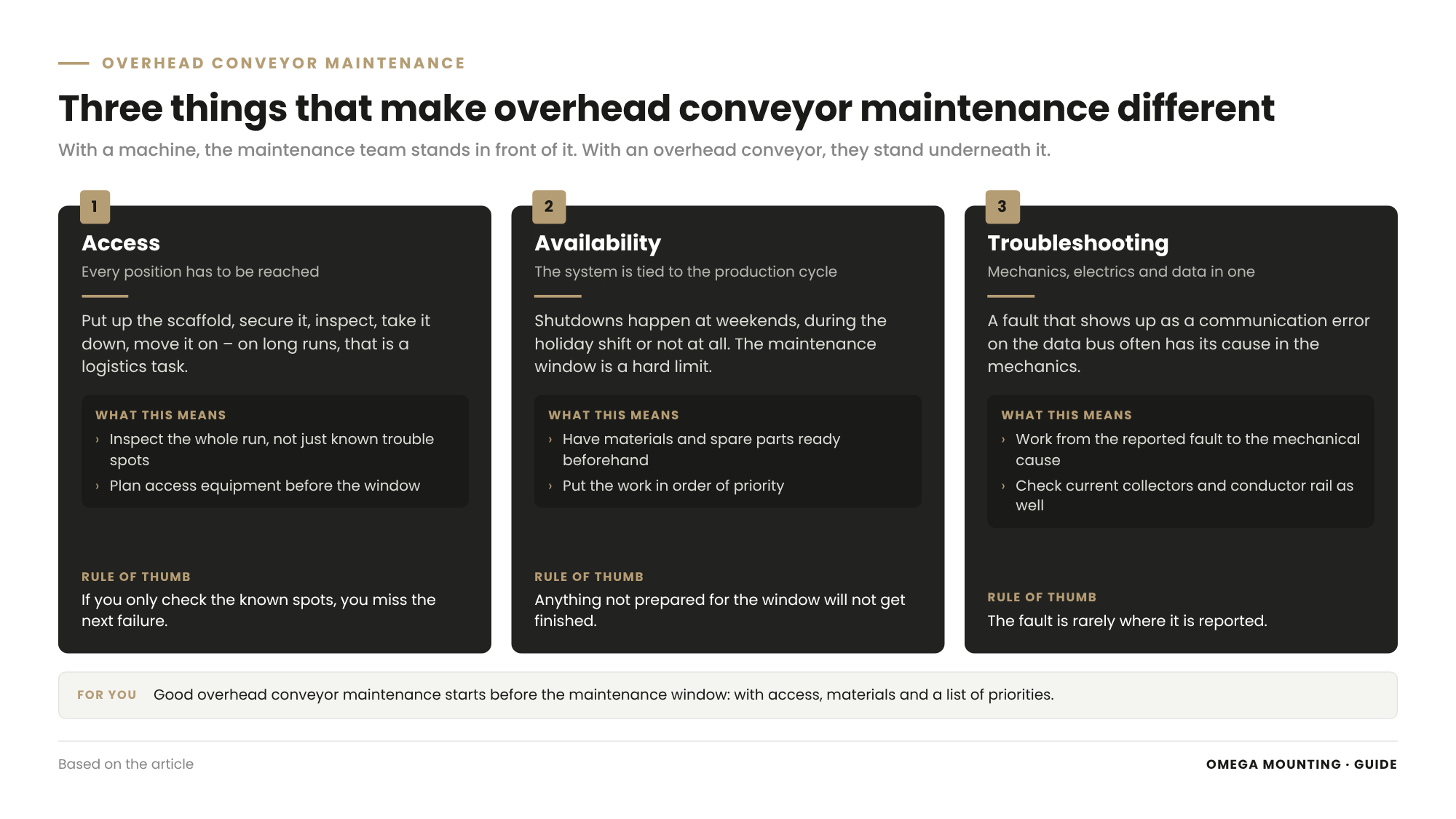
Explanatory graphic with three tiles: access – every position has to be reached with a scaffold, availability – the maintenance window is a hard limit, troubleshooting – bus faults often have a mechanical cause
Access, availability and troubleshooting set overhead conveyor maintenance apart from machine maintenance. Graphic: Omega Mounting

With a machine, the maintenance team stands in front of it, opens a cover and sees the component. With an overhead conveyor, they stand underneath it – six metres lower down. That changes three things fundamentally.

First, access. Every position has to be reached: put up the scaffold, secure it, inspect, take it down, move it on. On a system with several hundred metres of rail, that is not a quick job but a logistics task. If you only go to the known trouble spots, you inspect exactly the points where the next failure will not start.

Second, availability. Most overhead conveyors are tied directly to the production cycle. Shutdowns happen at weekends, during the holiday shift or not at all. That makes the maintenance window not a recommendation but a hard limit – and anything that has not been prepared for the window will not get finished.

Third, troubleshooting. An overhead conveyor is mechanics, electrics and data communication in one. A fault that shows up as a communication error on the data bus regularly has its cause in the mechanics: in a current collector that loses contact on a dirty track. If you look for the fault where it is reported, you are looking in the wrong place.

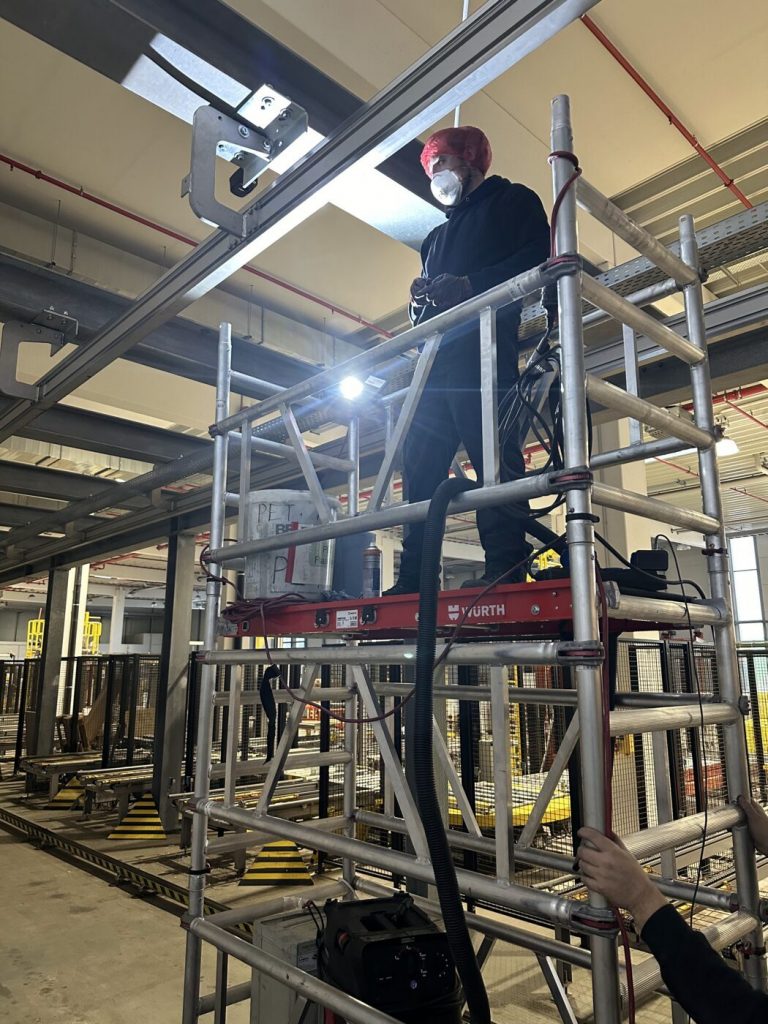
Cleaning the EMS rail from a mobile tower in the production hall
Every inspection starts with access: working on an overhead conveyor means working at height

The five assemblies that matter in overhead conveyor maintenance

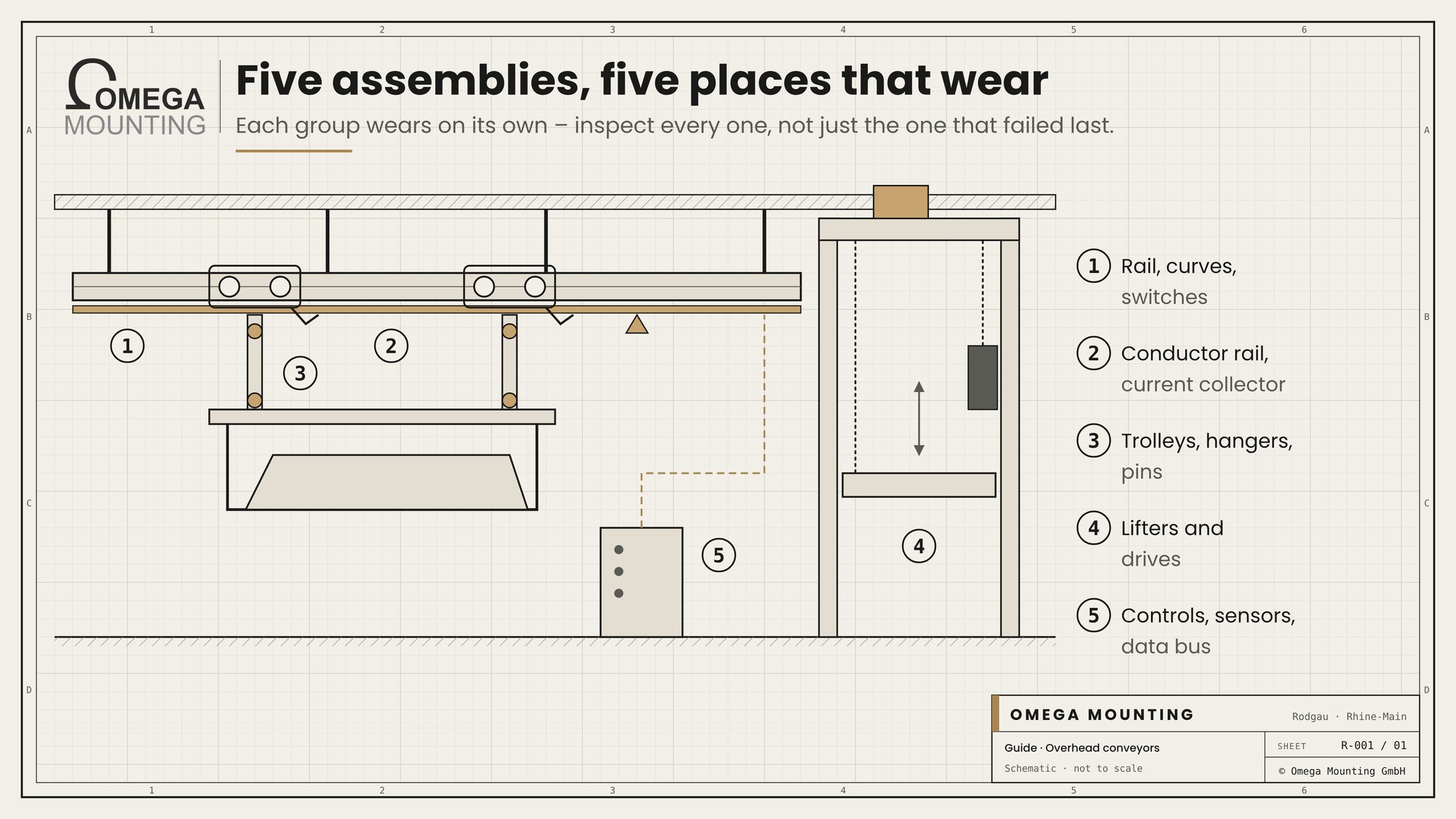
Technical drawing of an overhead conveyor with its five assemblies: rail, conductor rail with current collector, trolleys with hanger and pins, lifter with drive, controls with sensors and data bus
An overhead conveyor has five assemblies that wear independently of each other – each one is inspected during maintenance. Graphic: Omega Mounting

An overhead conveyor consists of five groups that wear independently of each other – and that therefore have to be inspected independently of each other. If you only look where something last broke, you systematically miss the rest.

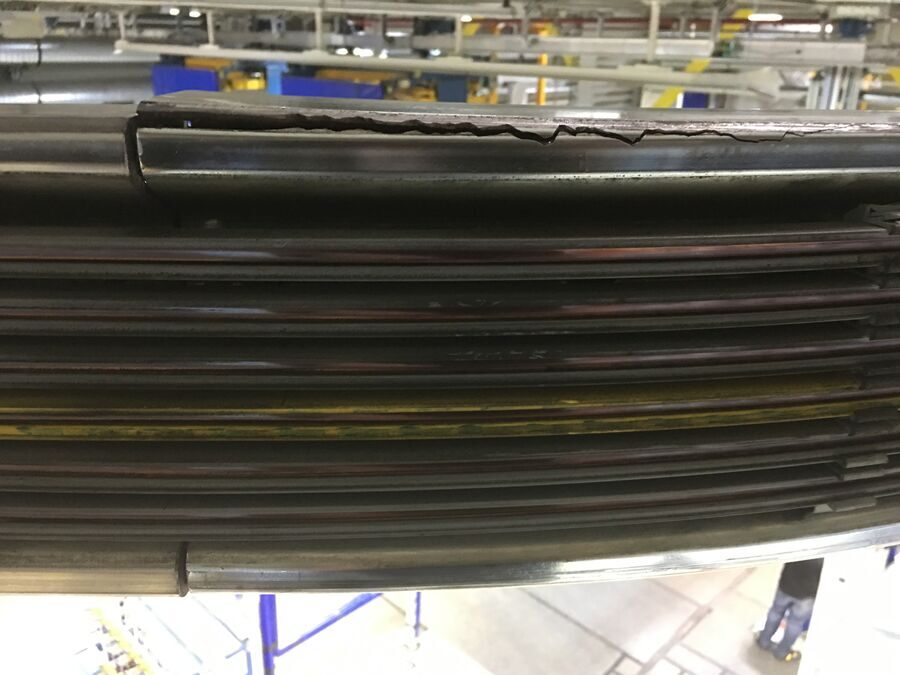
Badly torn curve section of the overhead conveyor
Torn curve section – the crack starts at the most highly stressed weld

Rail, curves and switches: where the highest forces act

The rail carries everything. It is usually a closed or open profile in which the carriers’ running wheels travel – and it is most highly stressed in the curves. That is where centrifugal forces act, where the profile is loaded in torsion and where the welds sit that were used to make the curve segments.

We have seen curve sections that have literally torn open over the years: the crack starts at the most highly stressed weld and then works its way through the profile in a jagged line. On older systems there is the added problem that original spare parts have long been unavailable – a rail segment then cannot be ordered, only repaired.

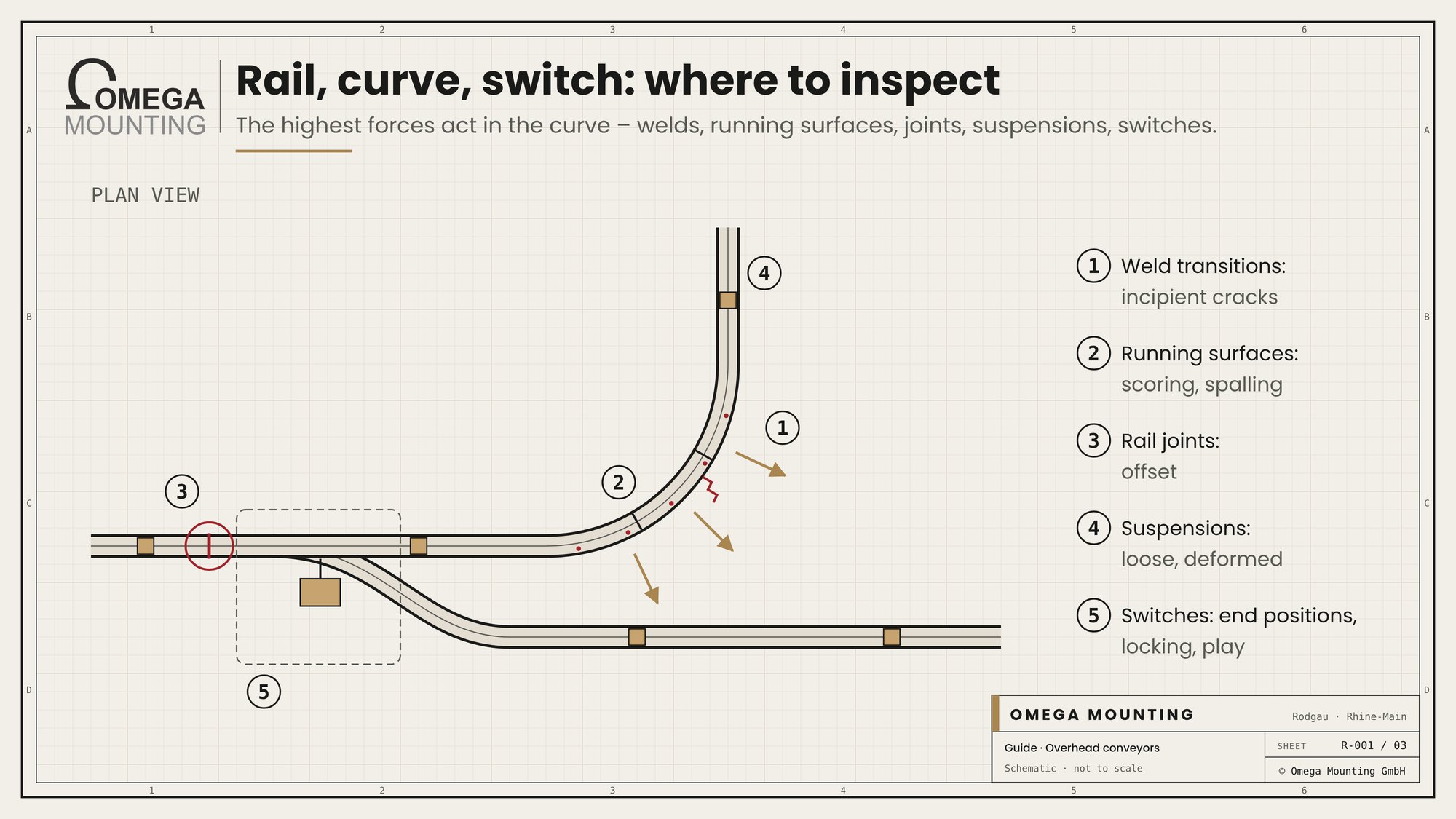
What matters in the inspection: incipient cracks at the weld transitions, running surfaces with scoring or spalling, offset at the rail joints, loose or deformed suspensions. And at the switches: end positions, locking, play in the drive.

Technical drawing, plan view of an overhead conveyor rail with curve and switch: incipient crack at the weld transition, scoring on the running surface, offset at the rail joint, suspensions and switch with drive
The highest forces act in the curve – the weld transitions, running surfaces, rail joints, suspensions and switches are inspected. Graphic: Omega Mounting

Conductor rail and current collectors: the lifeline of the system

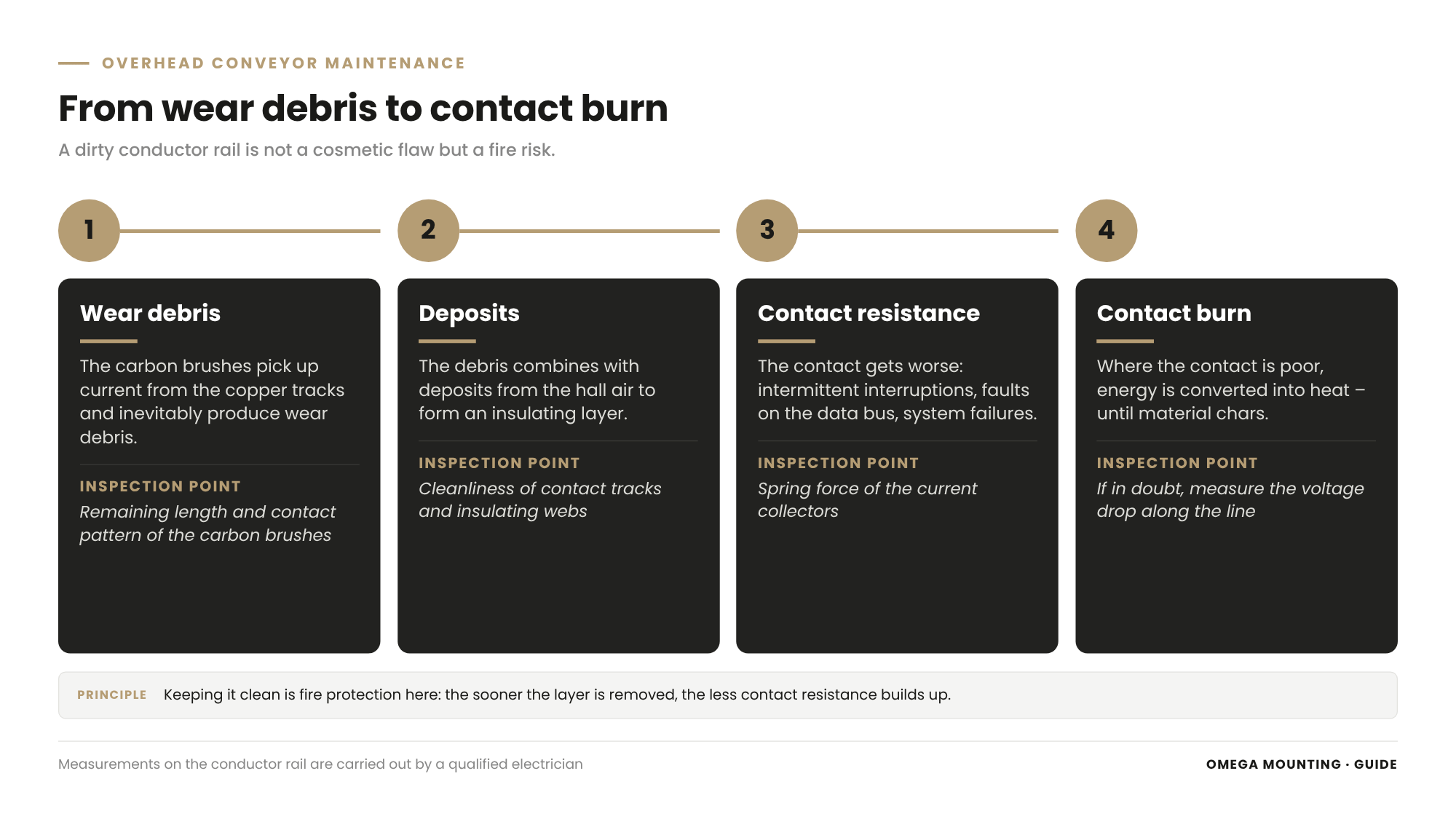
Explanatory graphic in four steps: wear of the carbon brushes, deposits from the hall air, rising contact resistance with contact interruptions and bus faults, contact burn – each with one inspection point
Wear debris and hall air form an insulating layer – the contact resistance rises until a contact burn occurs. Graphic: Omega Mounting

The conductor rail is the lifeline of the system. It carries power and – on most modern systems – the control data into the carrier as well. Its copper contact tracks are picked up by carbon brushes, which inevitably produce wear debris as they do so.

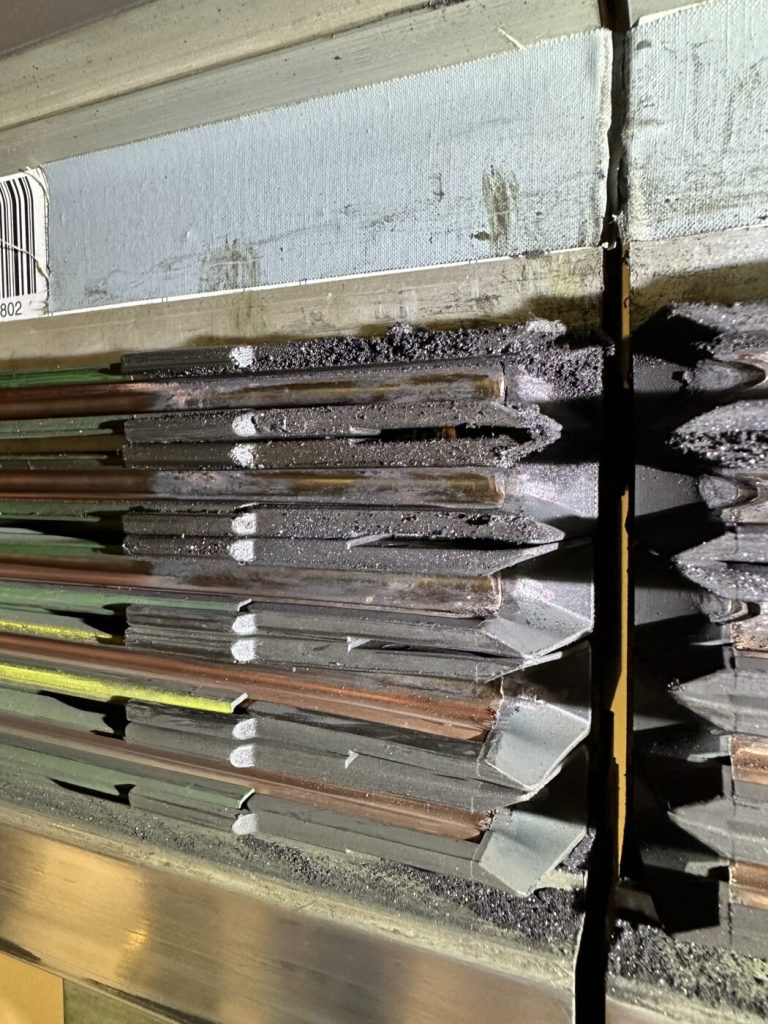
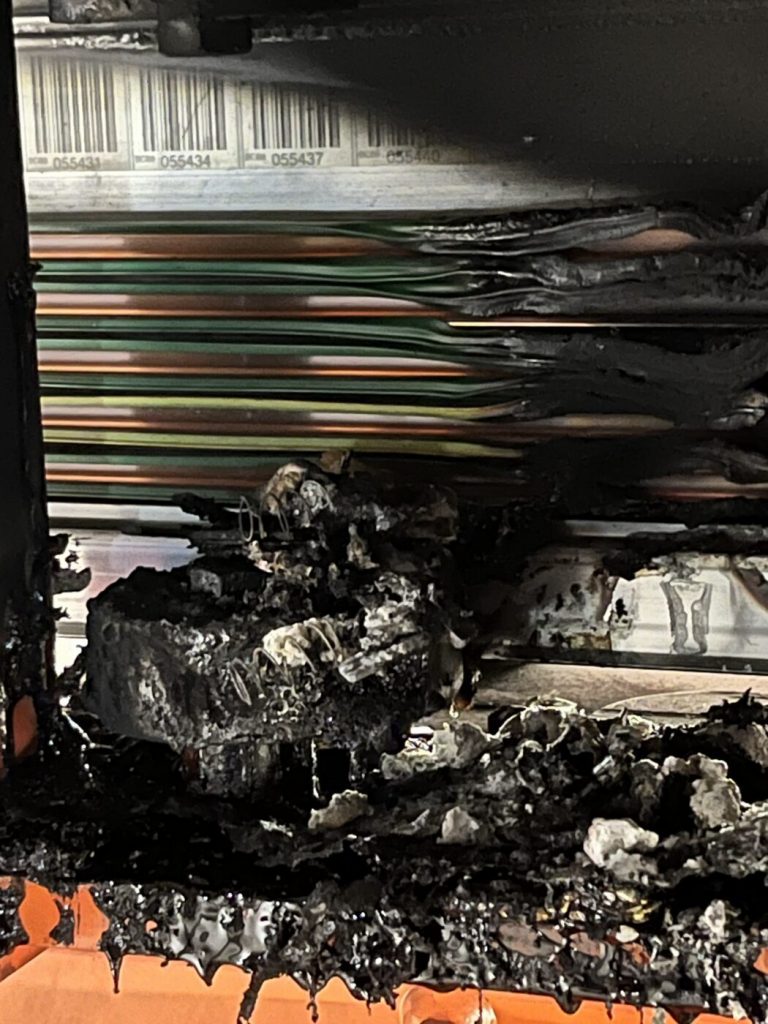
This wear debris is one thing. The other is the hall air. At a plant where sugary air hung in the hall, we had a conductor rail that had become completely gummed up over the years – the debris had combined with the deposits to form an insulating layer. The result: intermittent contact interruptions, communication faults on the data bus, constant system failures. And finally a contact burn that left charred residue and made the matter clear.

A contact burn occurs when the contact resistance rises: where the contact is poor, energy is converted into heat. With the currents an overhead conveyor draws, that is enough to damage material. That is why a dirty conductor rail is not a cosmetic flaw but a fire risk.

What matters: condition of the contact tracks, remaining length and contact pattern of the carbon brushes, spring force of the current collectors, cleanliness of the insulating webs – and, if in doubt, a measurement of the voltage drop along the line.

EMS conductor rail gummed up by sugary hall air
Gummed-up conductor rail: carbon dust and hall air form an insulating layer
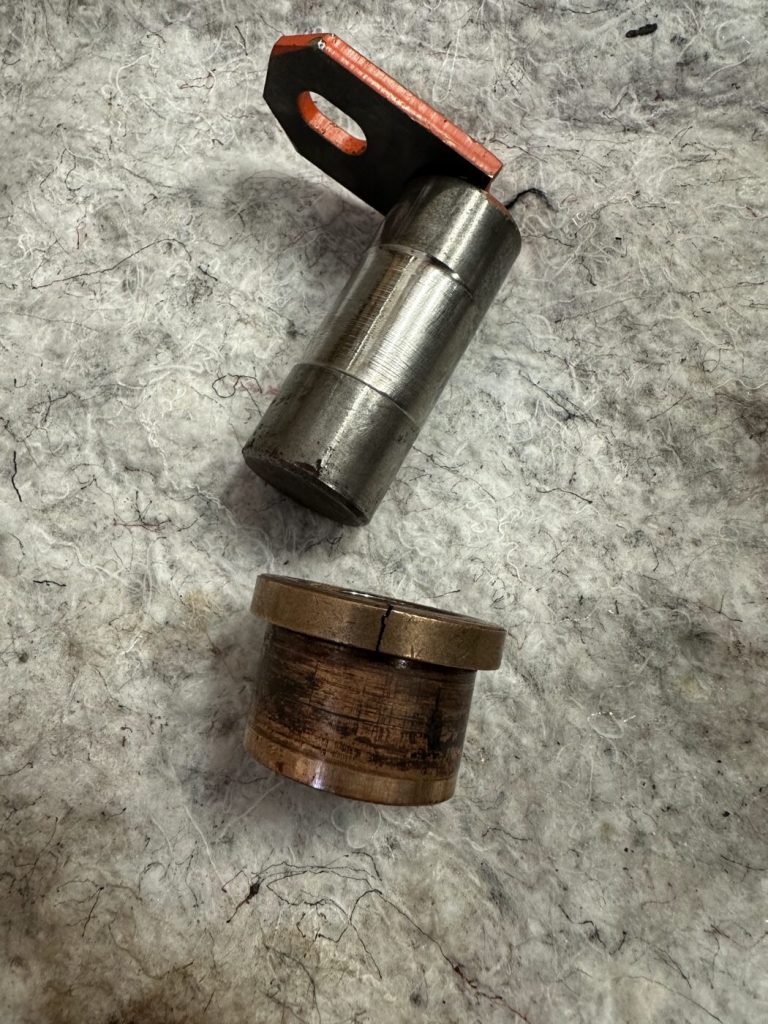
Worn bronze bushing and pin with wear step
Worn-in bronze bushing and pin with a clear wear step – the two are replaced as a pair

Trolleys, hangers and pins: the wear that gets overlooked

This is where the wear sits that is most often on nobody’s list. Trolleys run on wheels, hangers hang in pin joints, and many operators regard both as “maintenance-free”.

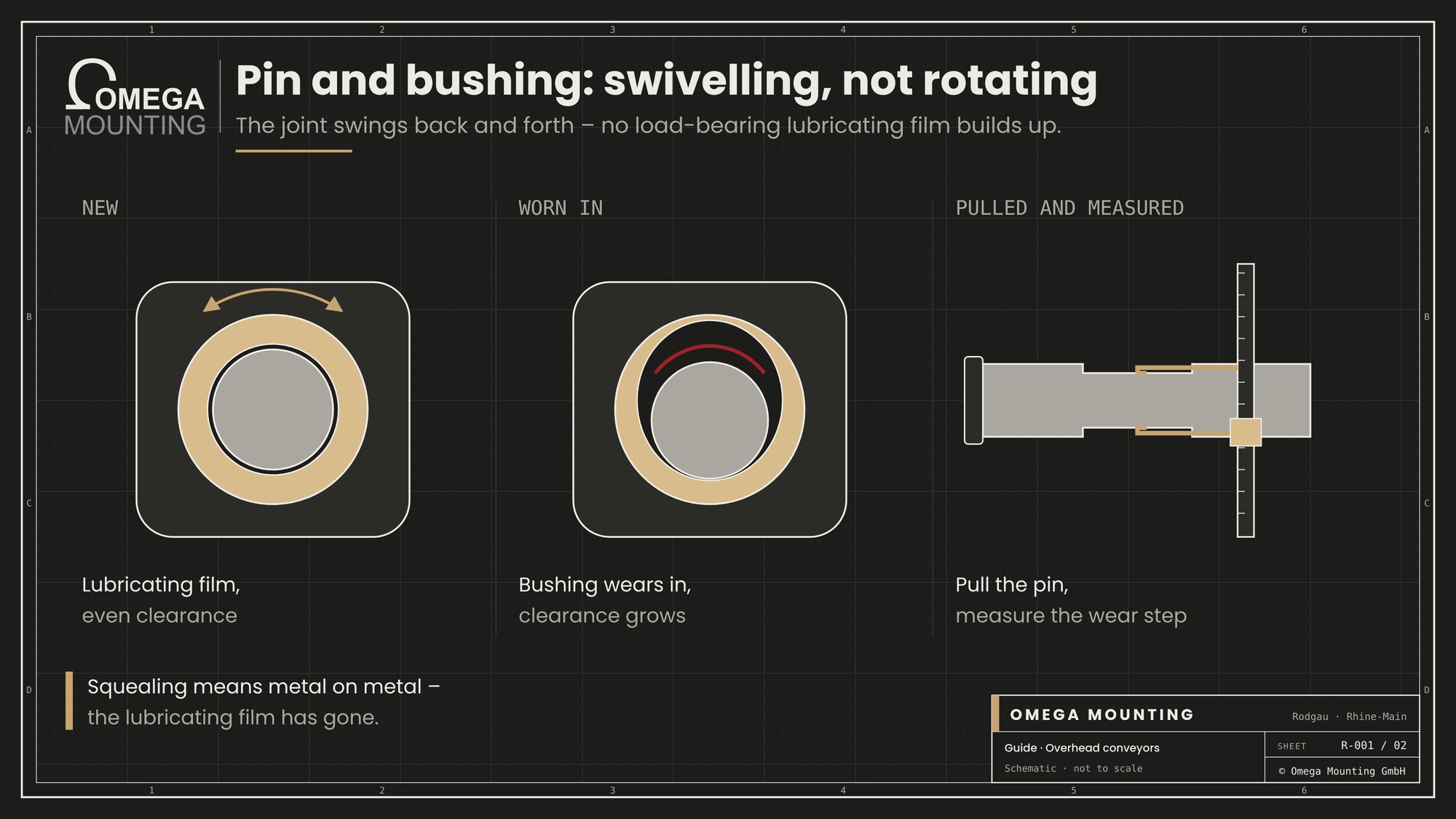
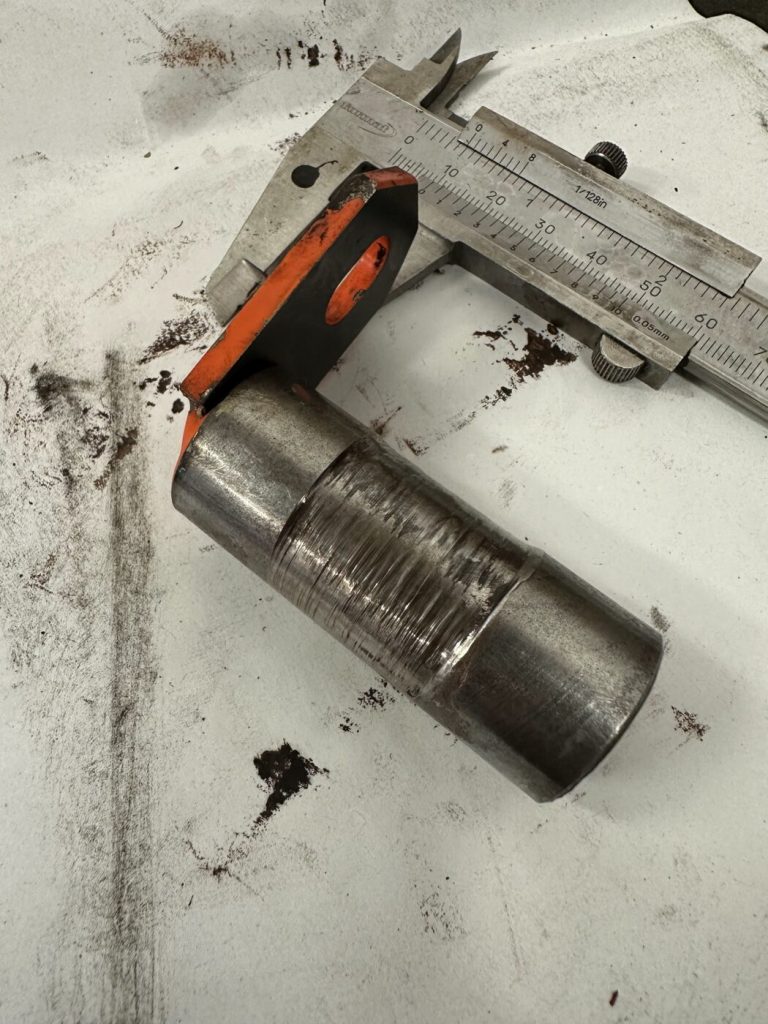
That is a costly mistake. A pin joint in the hanger does not rotate like a rolling bearing – it swivels, a little way back and forth every time the carrier starts, takes a curve or brakes. No load-bearing lubricating film can build up. The movement takes place in the mixed-friction regime, and that is exactly where the bronze bushing wears in and the pin develops its wear step. If you pull the pin and measure it with callipers, you can see in two minutes how far it has gone. In the refurbishment of 80 overhead conveyor carriers this was exactly the initial finding.

The first audible signal is squealing. It means metal is working against metal and the lubricating film has gone. If you ignore it, you get play in the hanger, uneven running, peak loads in the suspension – and at some point a carrier that no longer reaches the transfer position cleanly.

What matters: play in the pin joints, condition of the bushings, running surfaces and free movement of the wheels, condition of the buffers, retaining elements complete.

Technical drawing of a pin joint in the hanger: new bronze bushing with even clearance, worn bushing with growing clearance, pulled pin with wear step on the callipers
The pin joint swivels back and forth, no load-bearing lubricating film forms – the bushing wears in, and the pulled pin shows the wear step. Graphic: Omega Mounting

Lifters and drives: continuous duty under load

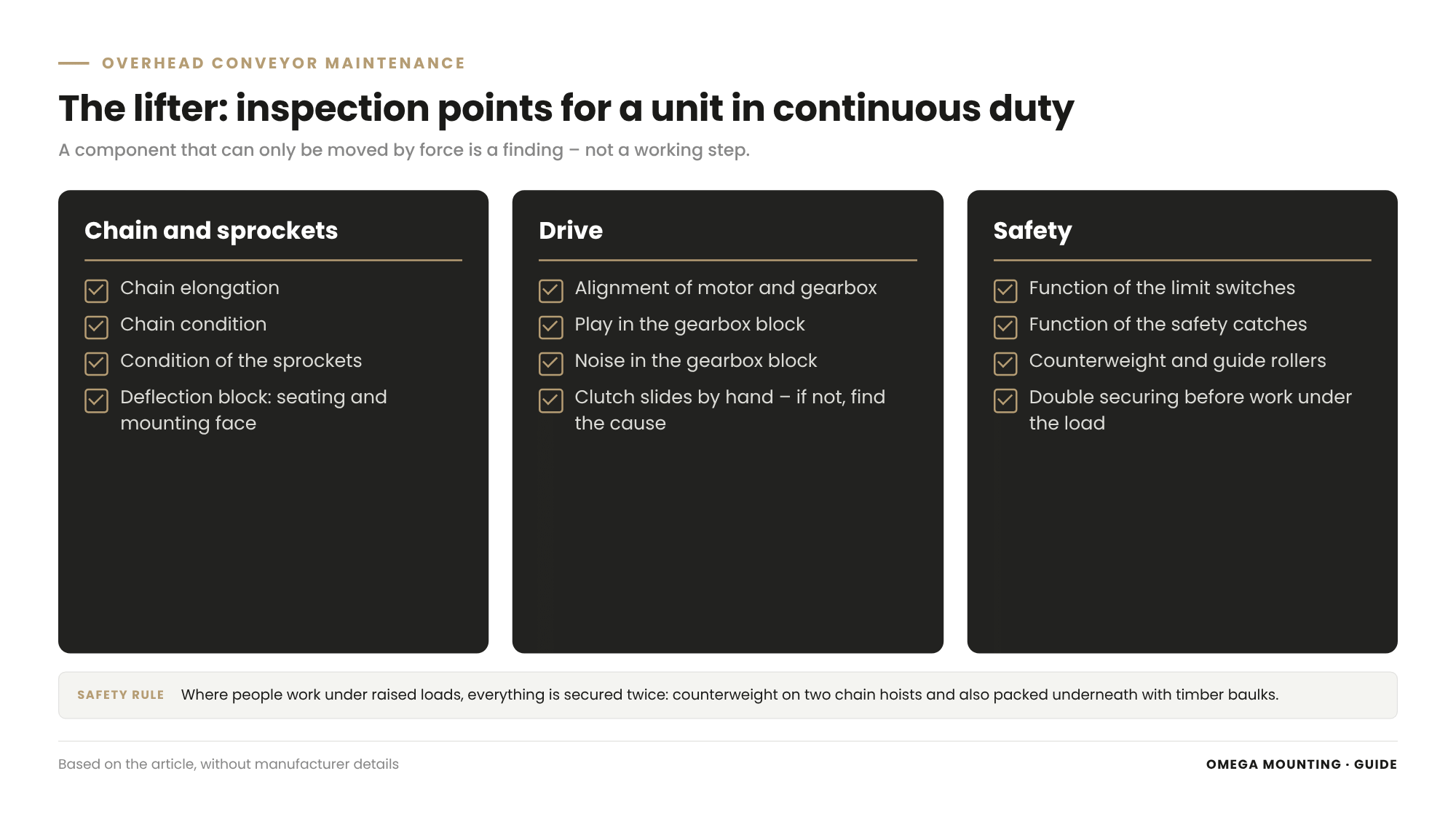
Explanatory graphic as a checklist for lifter maintenance: chain and sprockets, drive with alignment and gearbox block, safety with limit switches, safety catches, counterweight and guide rollers, plus the rule on double securing
Chain, drive and safety devices – and securing everything twice as soon as anyone works under the load. Graphic: Omega Mounting

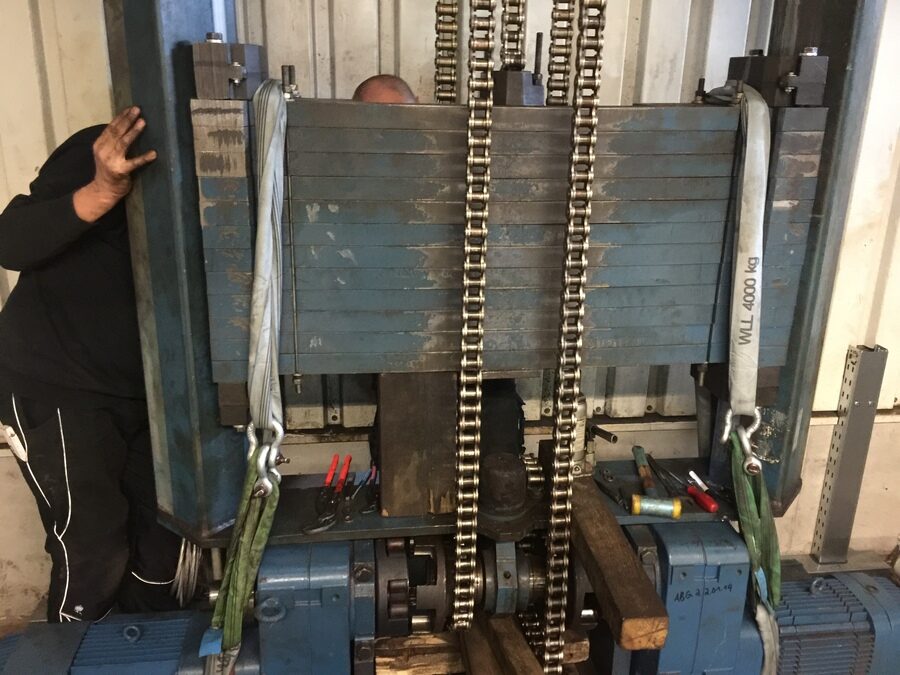
The lifter is the vertical interface of the system: it raises and lowers the load between levels, driven by lifting and load chains that work against a counterweight. In the automotive industry, lifters are in continuous duty – sometimes with several lifting cycles a minute, day and night. Over a year, that adds up to hundreds of thousands of load cycles, each with a reversal of the forces.

Under these conditions, every inaccuracy accelerates wear. When servicing a lifter with a redundant twin drive, we came across a problem that the in-house maintenance team had been solving with a crowbar for years: the dog clutch could not be pushed into position by hand. We only found the cause once we had completely dismantled and measured the deflection block – the mounting face had been milled out of true at the factory. The block had sat slightly tilted since commissioning, and no amount of careful installation can make up for a skewed reference surface.

The point here is not the individual case but the principle: on lifters, it pays to follow up the symptom. A component that can only be moved by force is a finding – not a working method.

What matters: chain elongation and chain condition, condition of the sprockets, alignment of motor and gearbox, play and noise in the gearbox block, function of the limit switches and safety catches, condition of the counterweight and guide rollers.

And one safety rule that is not up for discussion: Where people work under raised loads, everything is secured twice. We hang the counterweight from two chain hoists and also pack it underneath with timber baulks. On paper, one means of securing is enough. For people working underneath, it is not.

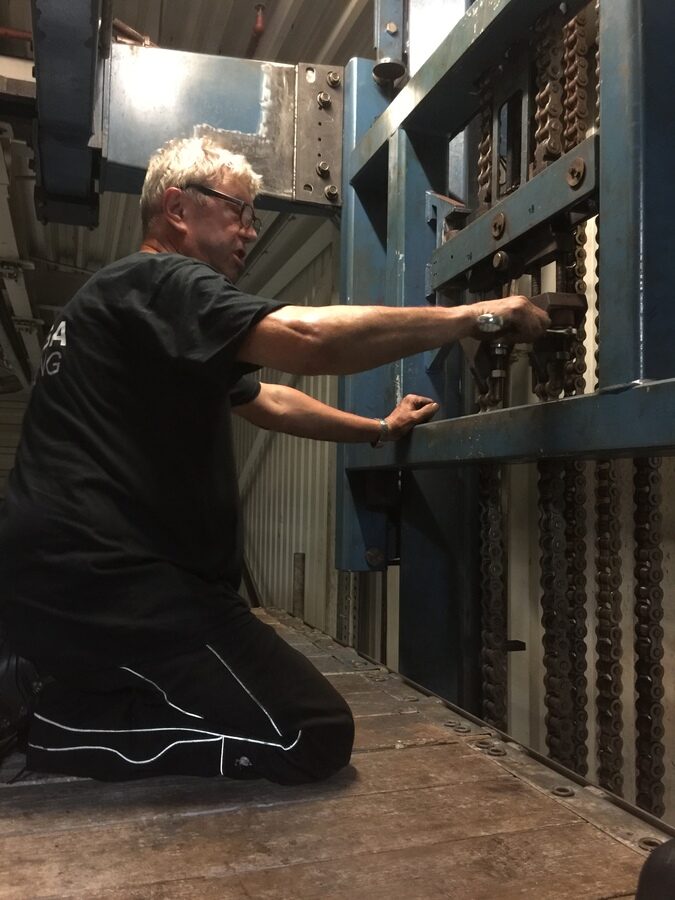
Fitter servicing the lifting and load chains of an overhead conveyor lifter
Maintenance on an overhead conveyor lifter: lifting and load chains work against a counterweight
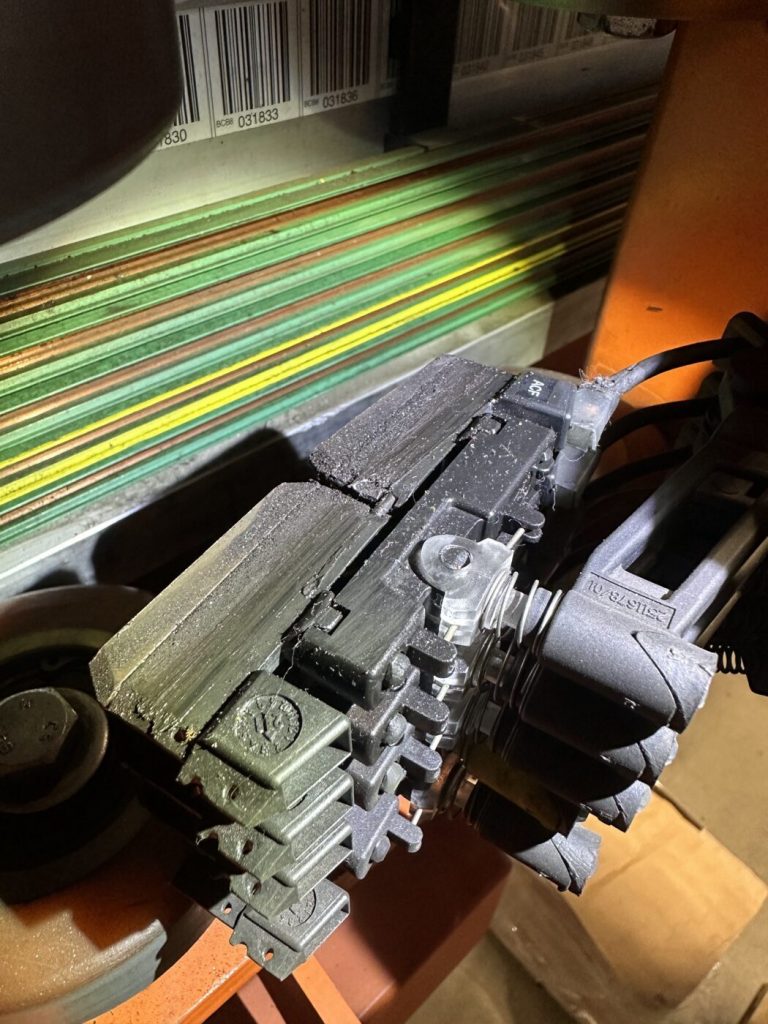
Current collector of the EMS vehicle in the conductor rail
Current collector in the conductor rail: this is where it is decided whether power and data arrive cleanly

Controls, sensors and data bus: when the electronics only report the symptom

Proximity sensors report end positions, encoders report positions, and the controller processes both. If something is wrong here, the system goes into fault – and the cause is often mechanical: a misaligned proximity sensor, a worn clamp that no longer holds the switching cam in position, a sensor fouled with wear debris.

That is why we always follow this order: clean first, then measure, then replace. If you start replacing parts on a dirty system, you keep replacing until you happen to hit the right one.

What matters: switching points and mounting of the proximity sensors, condition of the clamps, cleanliness of the sensors, reading the controller’s fault memory and comparing it with the mechanical findings.

Five signals you should not wait on

Charred residue after a contact burn in the conductor rail
Contact burn: charred residue in the conductor rail – the last of all the warning signs

How often does an overhead conveyor need maintenance?

There is no interval that applies to every system. As a guide, this has proven itself: a visual inspection every six months of the critical points and an annual main service with measurement, cleaning and repair based on the findings. Three factors bring this rhythm forward:

Cycle rate. A system running three shifts collects as many load cycles in one year as a single-shift system does in three. For lifters running at automotive cycle rates, a main service every six months can make sense.

Environment. Sugar, flour, oil, swarf, moisture: everything in the hall air ends up on the conductor rail. In contaminated environments, cleaning becomes its own, shorter interval.

Age and spare-parts situation. On systems older than 15 years, the focus shifts: less replacing, more inspecting and repairing – because spare parts have long lead times or no longer exist at all. That is exactly when an early finding is worth hard cash.

Double securing: counterweight held by two lifting accessories
Counterweight secured twice – standard as soon as people work under the load

What belongs in a maintenance window – and what comes before it

A maintenance window at the weekend is not a period of time but a countdown. What gets done in it is decided in the week before.

Before: Review the findings from the last maintenance, read out the fault memory, procure wearing parts, pre-measure critical components. If it is clear that something will have to be made – a reinforcement plate, a fitting piece, a face-milled connecting flange – that belongs in the workshop lead time, not in the window.

In the window: First clean, then inspect and measure, then repair. This order sounds obvious, but it saves half of the searching. Work in parallel wherever possible: while one team cleans the conductor rail section by section, a second can be at the lifter.

Afterwards: Test runs with several carriers, not just one. Only with a realistic load does it become clear whether transfers, switches and buffers work cleanly. And: document the findings, including the ones that were not fixed this time – they are the shopping list for the next window.

Repair instead of replace: what is possible on old systems

On systems whose manufacturer no longer supplies spare parts, maintenance often ends with one question: there is no new part – so what now?

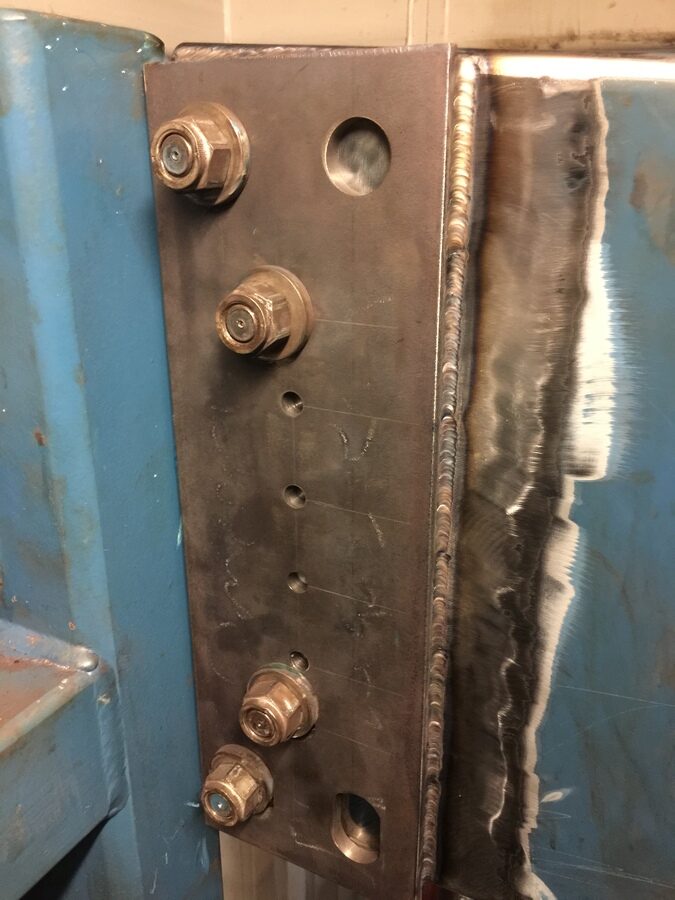
There is usually a third way. A torn curve section can be removed, TIG-welded in several passes and ground so that the running surfaces are true to size again. Cracks in a lifter structure can be closed permanently with precisely made reinforcement plates. A gearbox block with a skewed mounting face can be face-milled. That is exactly what we do in our workshop in Rodgau: metalwork, welding, milling – and then installation in the maintenance window.

The economic point behind this: a repair weld costs a fraction of a new system and can be carried out over a weekend. The precondition is that the damage is spotted early enough – and that takes the maintenance this article is about.

Finished welded-in reinforcement plate with a continuous TIG weld
Welded-in reinforcement plate on the lifter structure – repair instead of a new system
Overhead conveyor pin being measured with the calliper
Wear becomes measurable: the pulled pin in the callipers

Do it in-house or bring in a partner?

Both work, and in practice a combination is strongest. The in-house maintenance team knows the system, its quirks and the production. What it usually lacks day to day are three things: time in the window, access at height with enough people – and the in-house fabrication capability for parts that can no longer be bought.

That is exactly where we come in: as extra capacity in the maintenance window, for the work at height, for welding and milling based on the findings – and as an expert second opinion when a problem has persisted for years and nobody asks why any more. What we offer in concrete terms – from inspection and DGUV testing to repairs on monorail and power & free systems – is set out on our page Overhead conveyor maintenance.

downloadable overhead conveyor maintenance checklist

We have summarised our inspection points in a checklist: five assemblies, specific inspection points, space for findings and action, header and signature fields for the records. It is meant as a worksheet for the next maintenance window – to print out and take up the scaffold.

We will send you the checklist as a PDF. Simply enter your email address in the form below this section.

Why Omega Mounting?

Conclusion

An overhead conveyor is a rewarding system: it can take a lot, it runs for a long time and it warns you before it fails. You just have to listen to it. If you take the squealing seriously, keep the conductor rail clean and inspect systematically once a year instead of repairing here and there, you prevent exactly the shutdowns that cost the most in the production cycle.

And if something does crack: most damage to overhead conveyors can be repaired – even when the spare part has long since ceased to exist.

Request a callback – we’ll look at your system and tell you honestly what needs doing now and what can wait.

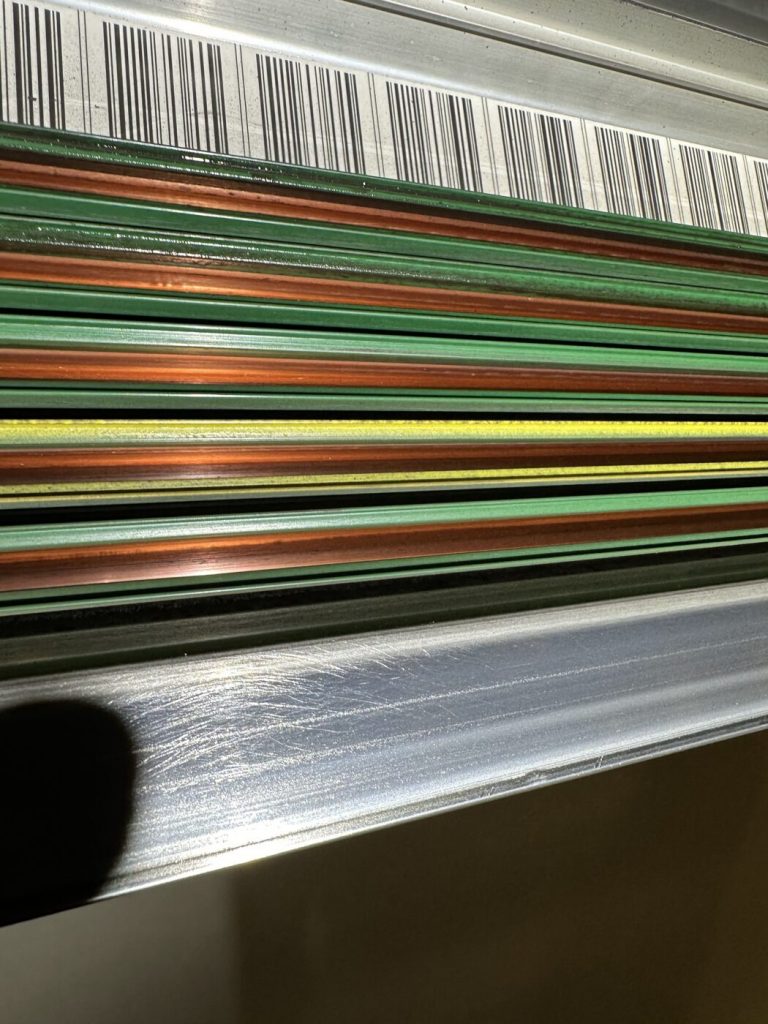
Cleaned conductor rail with bare contact tracks

Not sure what your system needs next?

Tell us briefly what you need – we'll come back with an honest assessment.

Free, no-obligation callback

Tobias Schott, managing director of Omega Mounting GmbH, on a construction site in front of scaffolding

About the author

Tobias Schott

Managing director of Omega Mounting GmbH, Rodgau · more than 20 years of hands-on experience in installation and maintenance

A trained mechatronics technician, working in maintenance, servicing and industrial installation since 2004 – first alongside his father, and with Omega Mounting since 2012: from overhead conveyors in Frankfurt to the crane system in a new-build hall. He plans and leads lifting operations as an appointed person (AP) in data centers and on industrial sites in the Rhine-Main region, trains and examines operators of cranes, mobile elevating work platforms and telehandlers, and is a qualified occupational safety specialist. On jobs abroad he is known as the “German Troubleshooter” – the person you call when a site gets stuck. He learned what quality means from his father, not from a manual: Made in Germany as a standard for his own work, not a label. That is why quality comes first at Omega Mounting – ahead of speed and price. He writes these guides from that practice: what works on our sites is in them – what exists only on paper is not.

Frequently asked questions

As a guide: a visual inspection every six months, an annual main service with measurement, cleaning and repair based on findings. With high cycle rates, contaminated hall air or older systems, shorter intervals make sense – especially for cleaning the conductor rail.

That the lubricating film in a sliding joint no longer carries the load and metal is working against metal. Usually worn pins and bronze bushings in the hangers are behind it. The noise is an early signal – at this point the replacement can still be planned.

No. They are low-maintenance, not maintenance-free. Because the joint swivels instead of rotating, it works in the mixed-friction regime, where no load-bearing lubricating film builds up. Wear is therefore built into the design and has to be monitored.

Because power and data are transmitted over the same tracks. Insulating deposits of carbon dust and hall air lead to intermittent contact interruptions. The system reports a communication fault, but the cause is mechanical.

A contact burn occurs when the contact resistance between carbon brush and contact track rises and energy is converted into heat. With the currents of an overhead conveyor, that is enough to damage material and, in the worst case, start a fire. A dirty conductor rail is therefore a safety issue.

As a rule, yes. The affected segment is removed, the crack is gouged out, TIG-welded in several passes and then ground so that the running surfaces are true to size again. This is followed by installation and test runs with several carriers.

Partly. Cleaning and inspection work can be scheduled section by section in production breaks, hanger refurbishments in series over several weekends. Work on lifters, switches and load-bearing components, however, needs a real shutdown window.

Review the findings from the last maintenance, read out the fault memory, procure wearing parts and prefabricate everything that has to be made. A maintenance window is too short to make parts in it – the workshop lead time decides the result.

EnglishEnglish