
- Technology explained – technology and procedures
Pins and bolts: dowel pin, spring pin, grooved pin, split pin and locking bolt
By Tobias Schott · 5-minute read · Updated November 2026
Pins and bolts are small standard parts with a big effect. Pins align parts precisely or hold them against turning. Bolts form joints and carry loads. Anyone who knows the designs and locks them correctly prevents play, wear and failures.
Almost every plant contains pins and bolts: in gearboxes, joints, couplings, travel units and hangers. They are only noticed when they are missing, have moved or are worn.
Here we explain which pins exist and what they are for, how a dowel pin aligns components, how bolts are locked and what matters when driving them in and out.
What is a pin, what is a bolt?
A pin is a small, usually cylindrical part that sits firmly in a hole. It fixes the position of two parts relative to each other, transmits small forces or secures against turning. A pin does not move in operation.
A Pin is larger and often forms a joint. It connects, for example, a lug to a clevis, and the parts turn around it. A bolt carries load and is therefore secured against working its way out.
Both are standardised parts. Diameter, length, material and fit are specified in standards and drawings. A replacement part must match the original in all details.
Key facts
- Task: Aligning parts, securing against turning, forming joints.
- Pins: Parallel pin, taper pin, slotted spring pin, coiled spring pin, grooved pin.
- Pin: with head, without head, with cross hole or groove for locking.
- Retention: Split pin, retaining ring, R-clip, axle retainer.
- Weak points: Wear, missing locking, damaged hole.
- Interfaces: Manufacturer, design engineer, operator.
- Our part: Dismantling, replacing bolts and bushes, reassembly with locking.
Pins: designs and functions
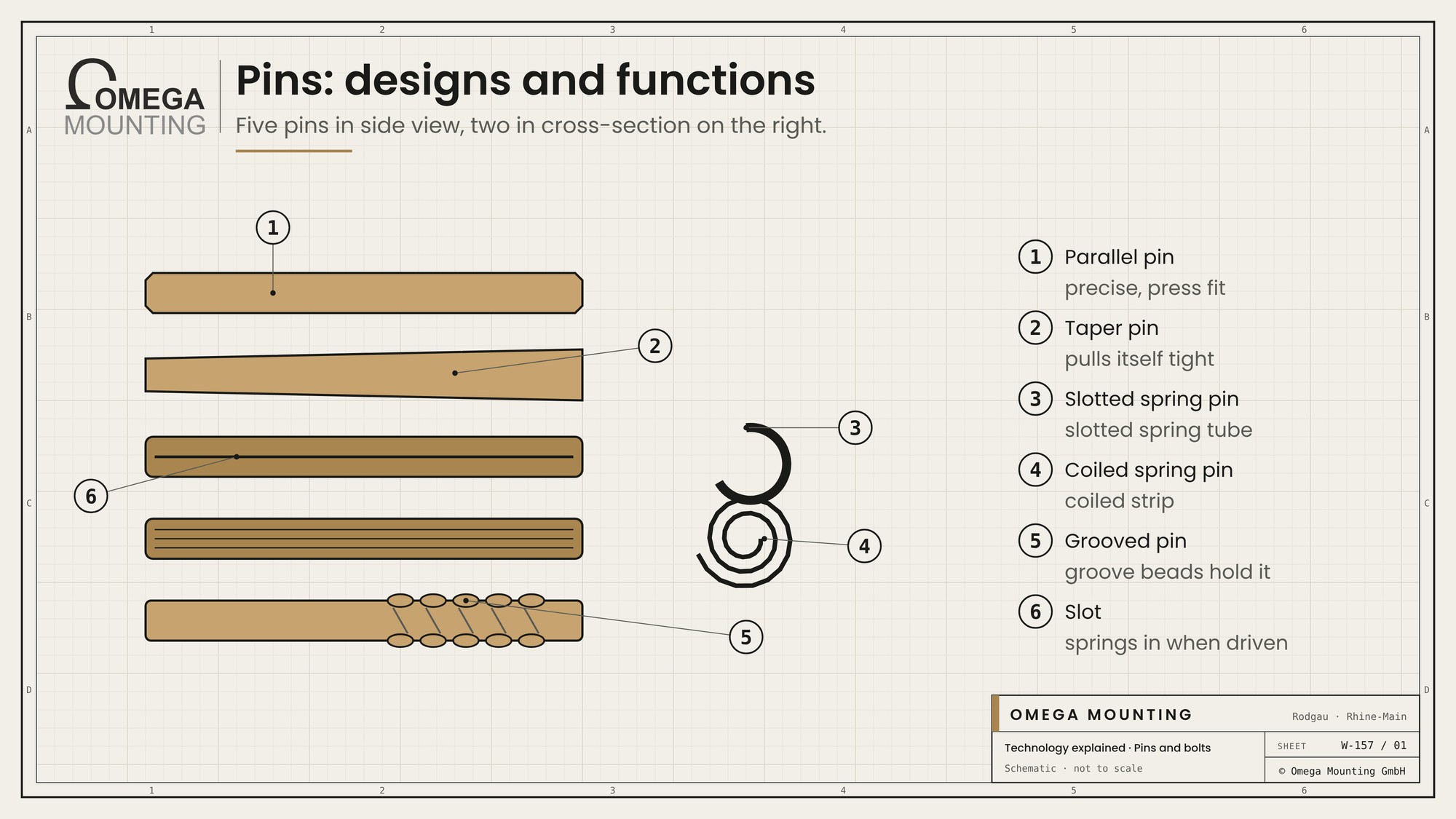
- Parallel pin: a precisely ground, smooth pin. It sits in the hole with a press fit and serves as a dowel pin for alignment.
- Taper pin: slightly tapered. It pulls itself tight when driven in and can be released cleanly again. Good for parts that are dismantled frequently.
- Slotted spring pin: a slotted tube of spring steel. It is slightly larger than the hole and springs together when driven in. This way it sits firmly without the hole having to be particularly precise.
- Coiled spring pin: made of spirally coiled strip. It springs more evenly than the slotted spring pin and copes better with vibration.
- Grooved pin: a pin with rolled-in grooves. When driven in, the groove beads deform and hold the pin in the hole.
Which pin is right depends on the task: precise alignment, simple fastening or vibration-proof securing.
The material also matters. Pins are available in unhardened and hardened steel, stainless steel for damp environments and spring steel for spring pins. A hardened dowel pin keeps the hole accurate but does not forgive a wrong blow when driven in. Which material is required is stated in the manufacturer's drawing or parts list.
Dowel pin: aligning parts precisely
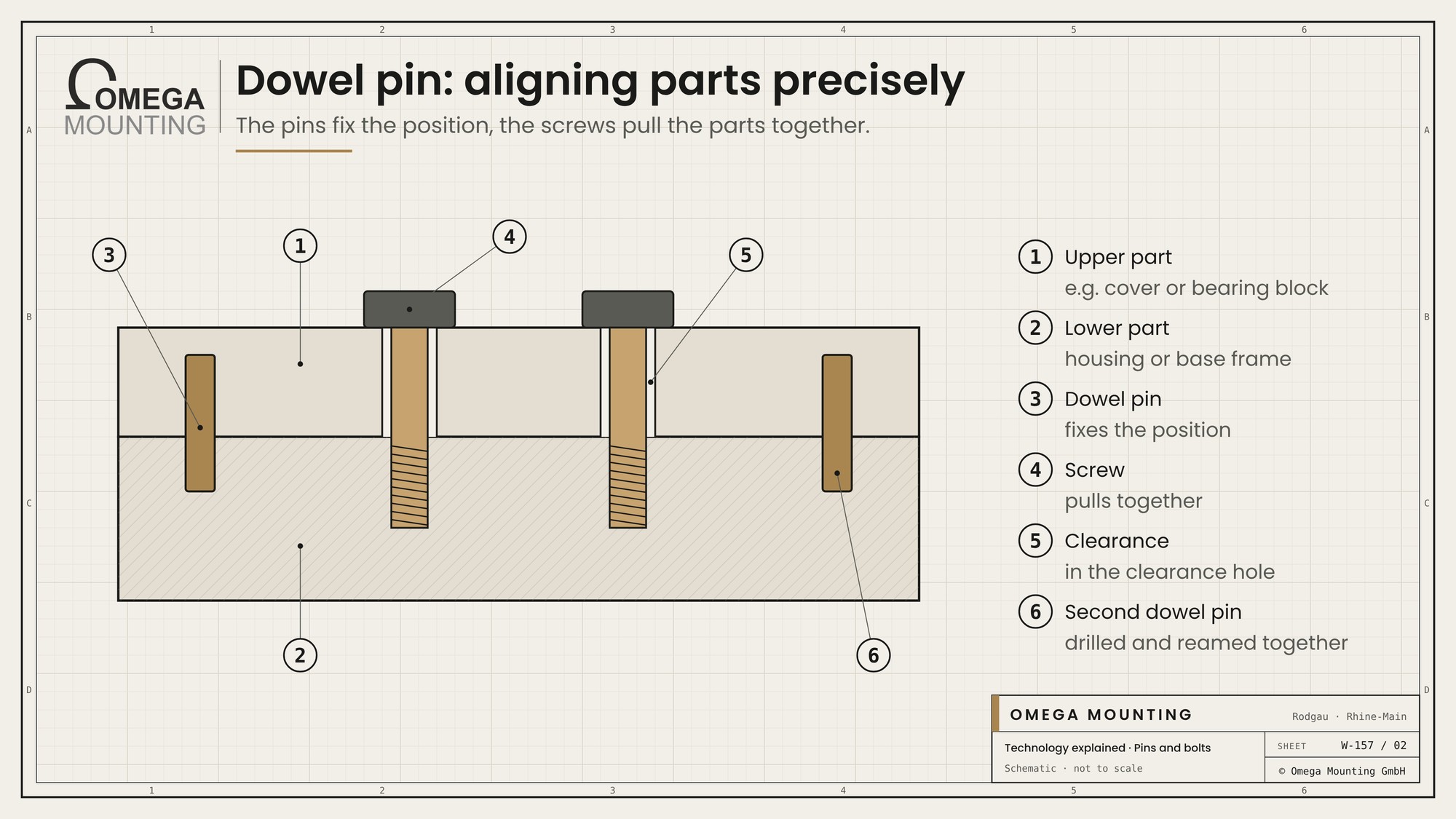
Screws hold parts together, but they do not align them precisely. A screw always has some clearance in its clearance hole.
That is why dowel pinsare used. Usually these are two parallel pins that engage in holes drilled and reamed together through both parts. They fix the position. The screws only pull the parts together.
The advantage shows during dismantling: if a gearbox cover, a bearing block or a bracket is removed and refitted, the part sits exactly as before thanks to the dowel pins. Without pins it would have to be realigned every time.
Dowel pins are not forgotten when dismantling and are refitted on reassembly. If a pin is missing, the part shifts under load – and bearings, seals or gears no longer run cleanly.
Bolts and how they are locked
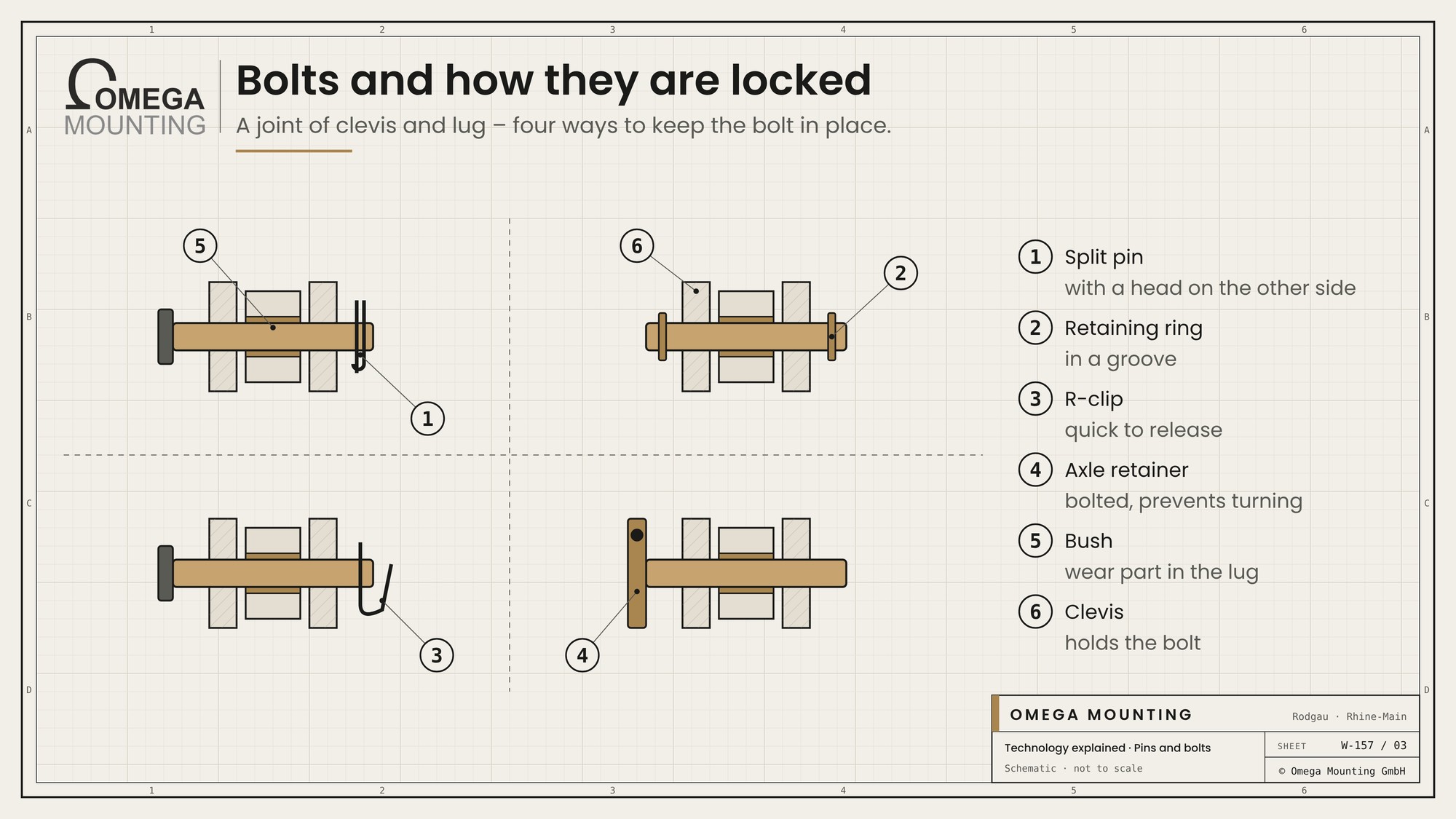
A bolt in a joint is pushed outwards by movement and vibration. Without locking it works its way out. The common locking methods:
- Bolt with head and split pin: The head rests on one side, and a split pin goes through a cross hole on the other. Simple and secure; the split pin is replaced after removal.
- Bolt with retaining ring: A retaining ring sits in a groove at the bolt end. Compact, but needs the right pliers for fitting and removal.
- Bolt with R-clip: A spring clip is pushed through the cross hole. Quick to release, good for connections that are often separated.
- Axle retainer: A plate engages in a groove or flat on the bolt and is screwed on. It prevents the bolt from working out and from turning at the same time.
For bolts that turn under load, a bush is added. It is the wear part, not the hole in the component. When it wears, bolt and bush are replaced – the expensive lug remains.
Driving in and out
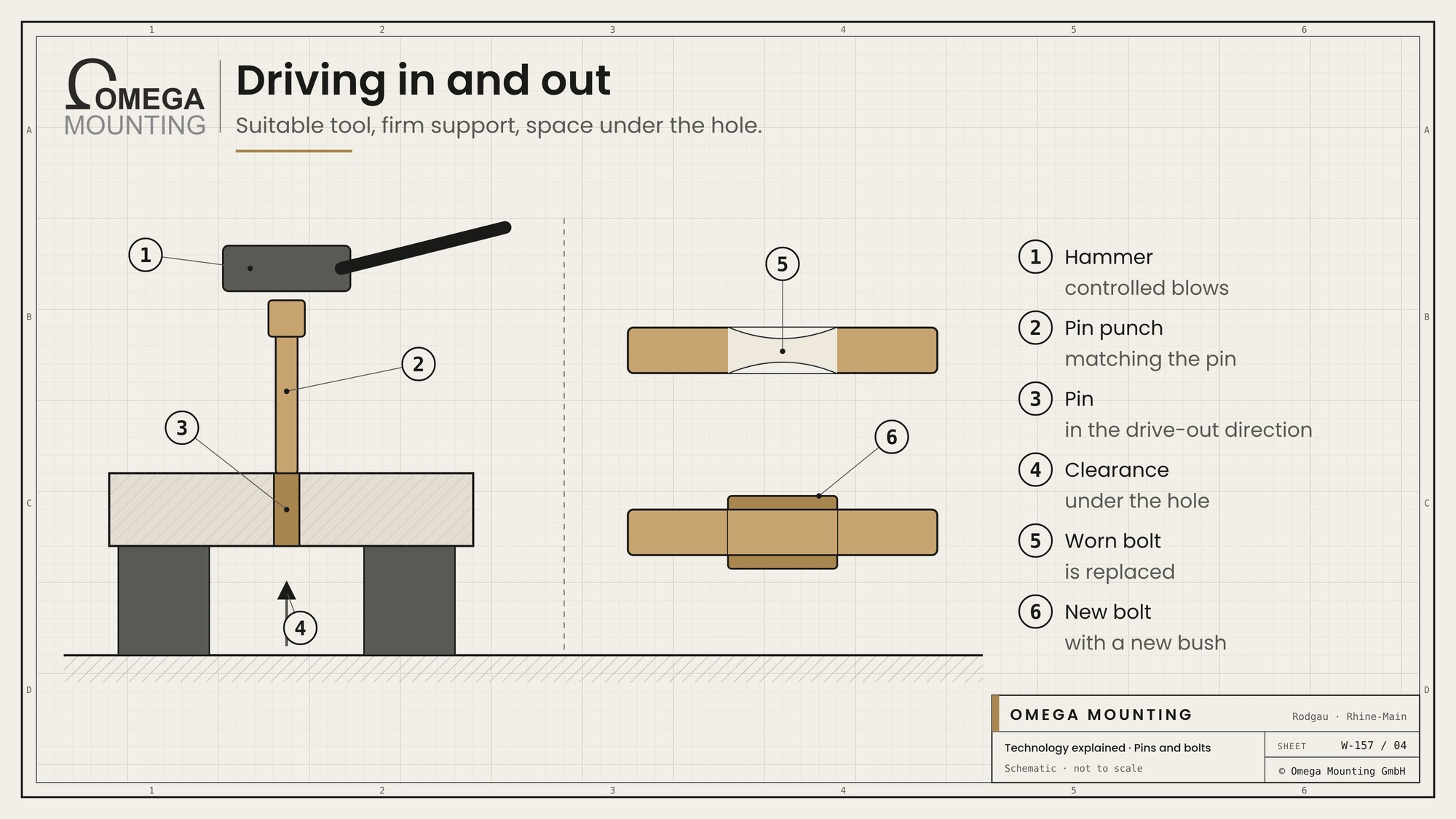
Pins and bolts are often stuck. Using force quickly damages the hole, and then the new pin will not fit either. What matters:
- Direction: Many pins have a drive-out direction. Taper pins are always driven out from the thin end.
- Tools: Pin punch or drift of the right size, not smaller than necessary and never larger than the pin.
- Support: The component rests firmly. There must be space under the hole so that the pin can come out.
- Set screws: Many dowel pins have an internal thread. With an extractor they can be pulled out, even from blind holes.
- Stuck bolts: Penetrating oil, heat or a press instead of ever harder blows.
On installation, the hole and pin are cleaned and, where intended, lightly oiled. Spring pins are driven in with a suitable drift so that they do not deform.
Typical mistakes
- Dowel pins lost during dismantling and not replaced.
- Split pin reused or replaced with wire.
- Taper pin knocked out from the thick end.
- Worn bolt turned and refitted.
- Bolt fitted into the lug hole without a bush.
What we pay attention to
When we dismantle assemblies, repair joints or replace bolts, we pay attention to the points that keep the connection holding permanently.
- We mark and collect pins and bolts when dismantling.
- We drive pins out in the right direction and with suitable tools.
- We replace bolt and bush together when they are worn.
- We fit new split pins and locking parts, not used ones.
- After assembly we check that every locking part is in place.
Where we use it
With the bolt renovation on an electric monorail system in a food production plant a single pulled bolt revealed the cause of noise and failures: completely worn hanger bolts, unmaintained for years. We then fitted all 80 vehicles with a new bolt and a new bush in a weekend series programme. More about our services is on the page Maintenance and servicing.
More technology explained
Technology explained
what holds and why the spring washer has had its day.
Technology explained
the swivel joint between travel unit and crossbeam.
Guide
our guide to play, squeaking and replacement.
Do you have questions about how this works on your site?
A joint has play or a bolt is worn? We dismantle, replace and reassemble. Request a callback.
Free, no-obligation callback

About the author
Tobias Schott
Managing director of Omega Mounting GmbH, Rodgau · more than 20 years of hands-on experience in installation and maintenance
A trained mechatronics technician, working in maintenance, servicing and industrial installation since 2004 – first alongside his father, and with Omega Mounting since 2012: from overhead conveyors in Frankfurt to the crane system in a new-build hall. He plans and leads lifting operations as an appointed person (AP) in data centers and on industrial sites in the Rhine-Main region, trains and examines operators of cranes, mobile elevating work platforms and telehandlers, and is a qualified occupational safety specialist. On jobs abroad he is known as the “German Troubleshooter” – the person you call when a site gets stuck. He learned what quality means from his father, not from a manual: Made in Germany as a standard for his own work, not a label. That is why quality comes first at Omega Mounting – ahead of speed and price. The Technology explained articles cover the equipment and techniques his team uses every day: what counts on site is in them – what only appears in the brochure is not.
 English
 German