
- Technology explained – Tools and equipment
Turnbuckle and rope tensioner: designs, securing, loading
By Tobias Schott · 5-minute read · Updated November 2026
A turnbuckle shortens or lengthens a connection by turning. It tensions ropes, round bars and guy lines and adjusts them precisely. To hold, it must be correctly selected, screwed in far enough and secured against loosening.
Turnbuckles are found in the wind bracing of halls, in the guying of masts, in rope railings and in many structures that need adjusting. They are inconspicuous – and still carry the full tensile force.
Here we explain how a turnbuckle works, which designs and end fittings exist, how to secure it and what matters for loading and installation.
What is a turnbuckle?
A turnbuckle is a component for tensioning and adjusting tension connections. It consists of a body with two internal threads and two threaded bolts, which are screwed in from both sides.
The trick: one thread is a right-hand thread, the other a left-hand thread. When the body is turned, both bolts are drawn in or pushed out at the same time. The connection becomes shorter or longer without the ends turning.
A rope tensioner is basically the same principle, adapted to wire ropes. It has a fitting for the rope at one or both ends, such as an eye with a thimble or a pressed end.
Key facts
- Task: Tensioning tension connections and adjusting their length.
- Principle: Body with right-hand and left-hand thread, two threaded bolts.
- Designs: open frame body, closed pipe body.
- Ends: Eye, hook, jaw, weld-on end, rope fitting.
- Weak points: insufficient thread engagement, missing locking, bending.
- Interfaces: Structural engineer, manufacturer, operator.
- Our part: Installation, tensioning as specified, locking and checking on site.
How a turnbuckle works
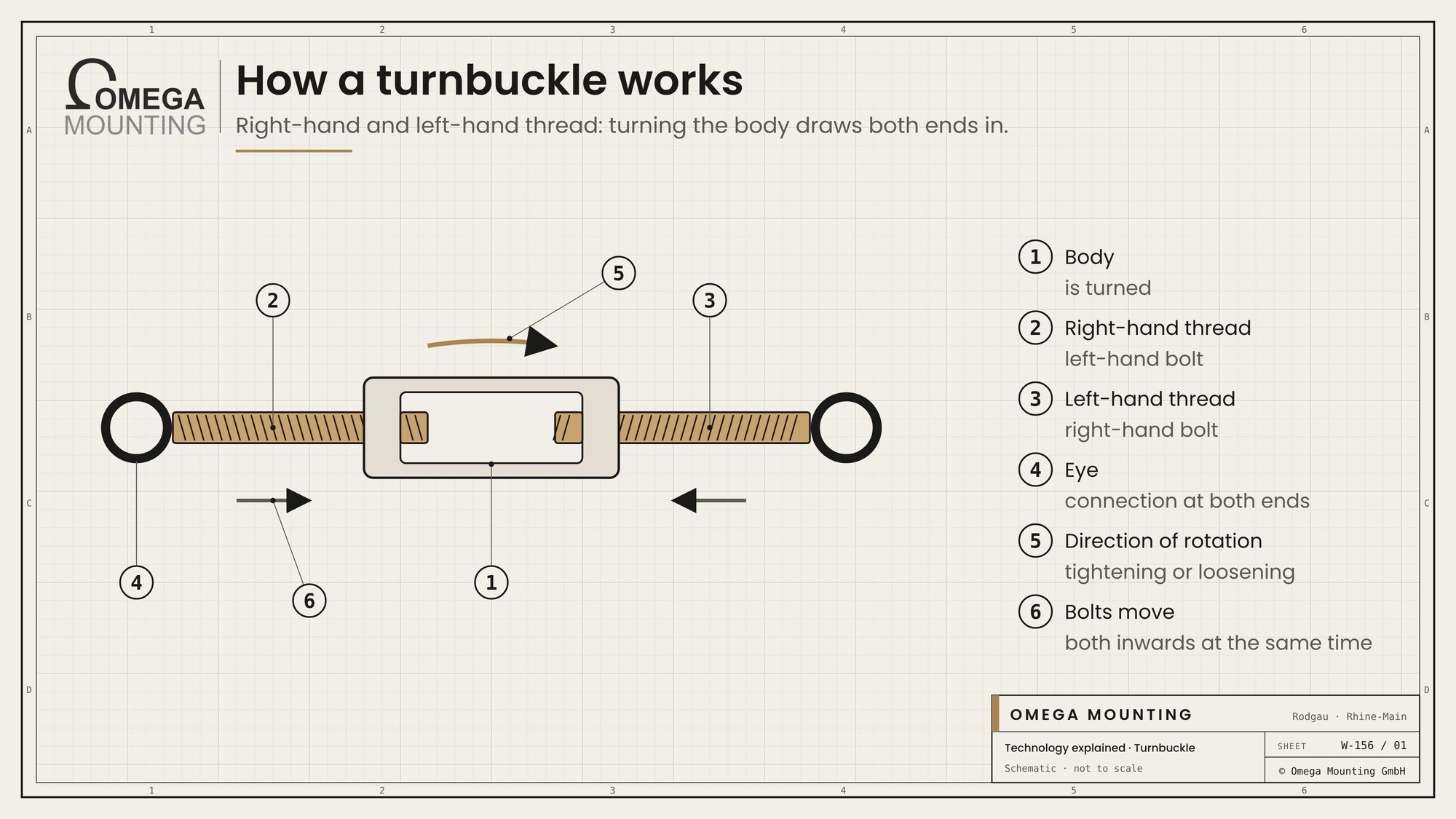
The turnbuckle is placed between the two points to be connected, and the bolts are screwed a few turns into the body evenly. Then the body is turned – by hand or with a round bar through the open frame.
With each turn, both bolts move inwards by one thread pitch. Because two threads work at the same time, the connection shortens by twice the pitch per turn. This allows the tension to be set finely.
It is important that both bolts are screwed in to roughly the same depth. A bolt that only hangs in the body by a few threads does not carry the full load – even if the other one sits deep inside.
Designs and end fittings
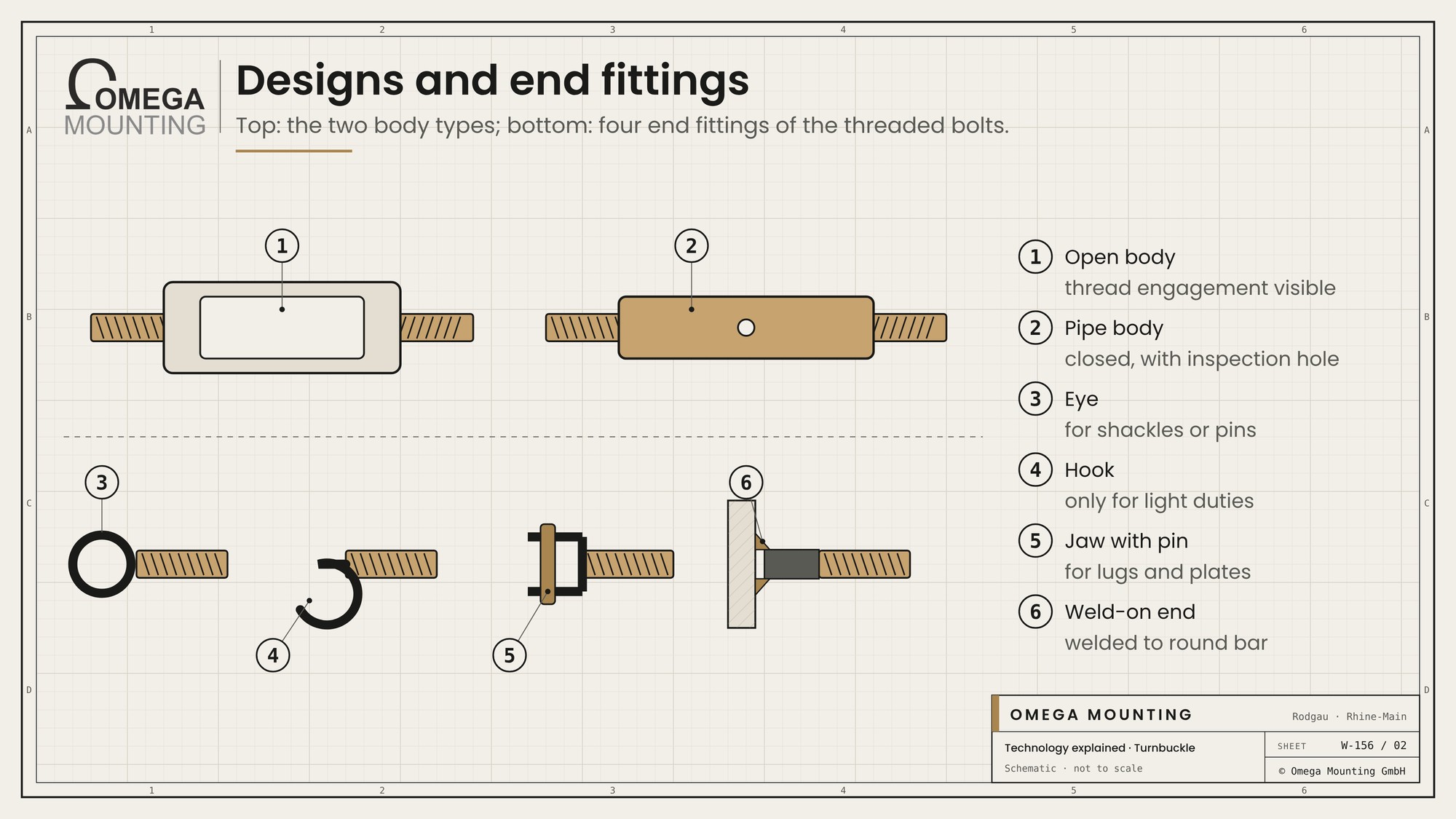
There are two basic body types:
- Open body: a forged frame you can look into. Thread engagement is easy to check, and a round bar fits through for turning.
- Closed pipe body: a piece of tube with an internal thread at both ends. It is compact and smooth, but thread engagement can only be seen via inspection holes or markings.
There are standards for both types, such as DIN 1480 for forged open turnbuckles and DIN 1478 for turnbuckle bodies made of steel tube.
The threaded bolts carry different end fittings:
- Eye: for shackles or pins.
- Hook: quick to hook in, but only for light duties and not where the connection could come unhooked.
- Jaw with pin: for lugs and plates; sits securely and without play.
- Weld-on end: is welded to a round bar or structure.
- Rope fitting: eye with thimble or pressed end for wire ropes.
Whether the turnbuckle needs to be bright, galvanised or stainless steel depends on the environment and service life.
Securing against loosening
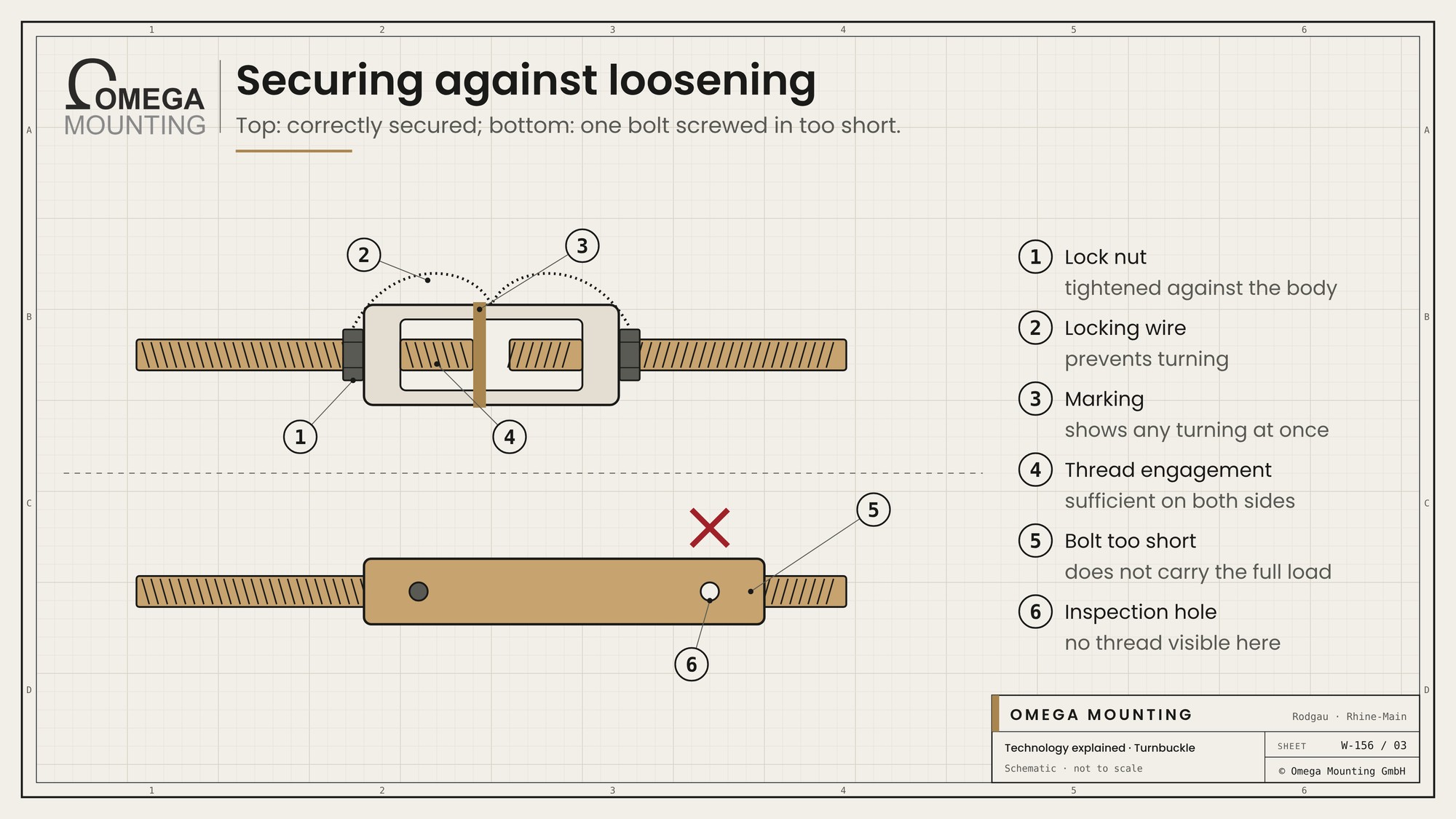
A turnbuckle that slowly unscrews under vibration or wind loses its tension. That is why it is secured after tensioning:
- Lock nuts: Each threaded bolt carries a nut that is tightened against the body.
- Locking wire: A wire is passed through the body and the ends and twisted so that the body cannot turn.
- Split pin or locking plate: provided on some designs.
- Marking: A paint line across body and bolt shows immediately during a check whether anything has turned.
Then there is the thread engagement. Both bolts must be screwed in at least as far as the manufacturer specifies. With the open body this can be seen directly, with the pipe body at the inspection hole.
Loading: what a turnbuckle can – and cannot – do
A turnbuckle is built for tension along its longitudinal axis . Anything else weakens it:
- Bending: If the turnbuckle is loaded sideways or lies over an edge, the bolt can break in the thread.
- Side pull: The ends must be able to swivel freely in the direction of pull, for example via a shackle.
- Shock: Sudden loading, for example from a slack rope that is suddenly tensioned, puts far more than the normal tensile force on it.
The permissible load is given in the manufacturer's documentation. How tightly a guy line or bracing must be tensioned is specified by the structural engineer. Turnbuckles are not lifting accessories for lifting loads. This is not legal advice.
Where turnbuckles are used
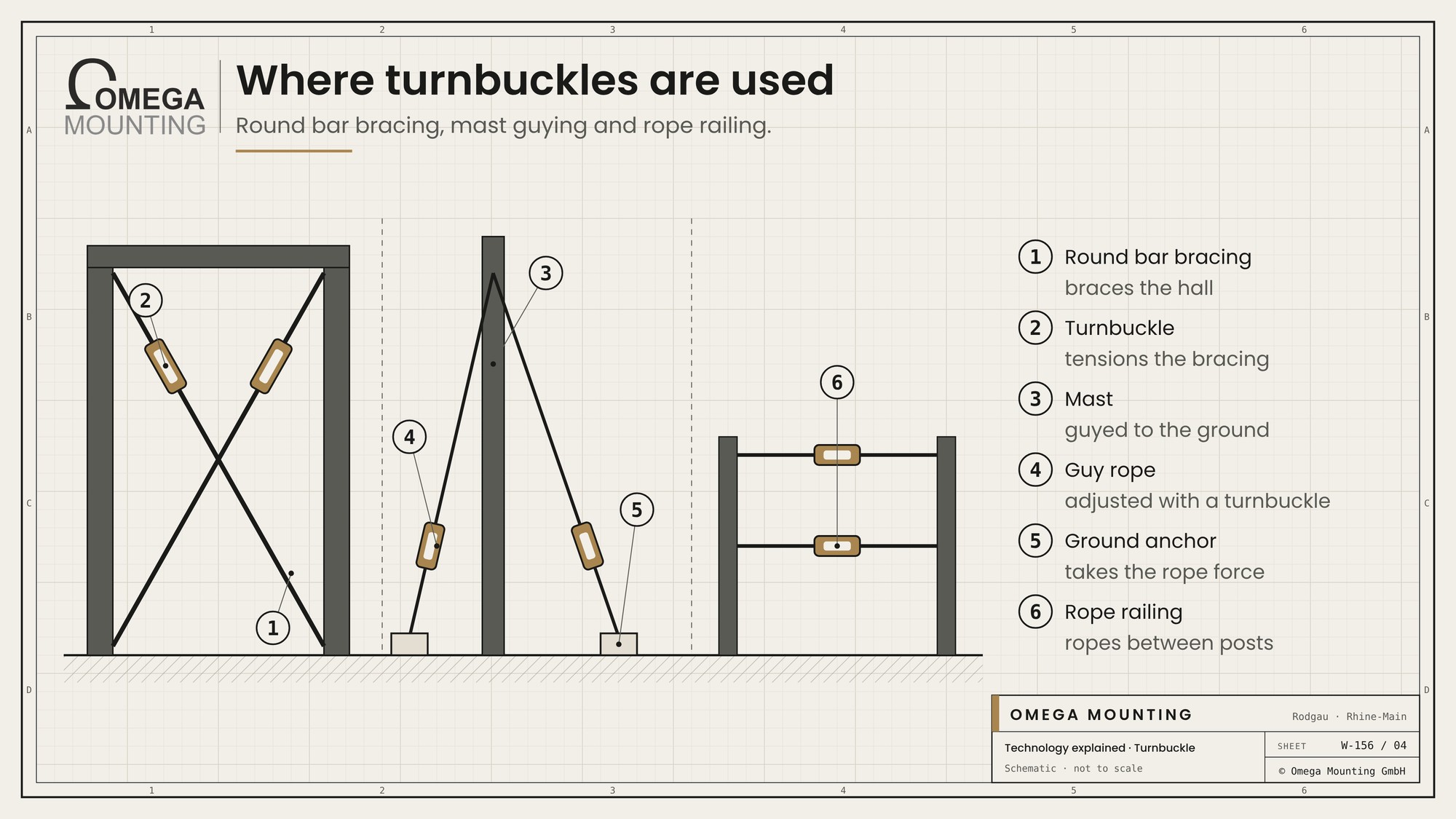
- Round bar bracing: In halls and steel platforms, crossed round bars brace the structure. Turnbuckles put them under tension.
- Guying: Masts, antennas and chimneys are guyed to the ground with ropes. The turnbuckle adjusts each rope.
- Rope railings and nets: Wire ropes between posts are tensioned and adjusted.
- Installation aids: Components are temporarily braced during alignment until they are bolted.
For lashing down loads there are dedicated chain tensioners and lashing equipment with their own rules.
Checks in operation
Turnbuckles are installed and then often forgotten. Yet it is worth taking a look at every inspection round:
- Position: If the marking has moved, the body has turned.
- Tension: If a rope or round bar sags, pretension is missing – the cause is clarified before retensioning.
- Corrosion: Rust in the thread makes the turnbuckle stiff and weakens the cross-section.
- Deformation: A bent bolt or an opened-up hook is replaced, not straightened.
Retensioning is not a cure-all. Anyone who has to adjust a bracing again and again looks for the cause – such as loosened connections or settlement.
Typical mistakes
- Bolt screwed in by only a few threads.
- No lock nut, no locking wire.
- Hook end at a point where the connection can come unhooked.
- Turnbuckle bent over an edge.
- Bracing over-tensioned on one side during installation.
What we pay attention to
When we tension bracing, guy lines or ropes, we pay attention to the points that keep the connection holding permanently.
- We install turnbuckles as specified by the structural engineer and manufacturer.
- We screw both sides in evenly and deep enough.
- We secure every turnbuckle with lock nuts or locking wire.
- We tension crossed bracing evenly, not on one side.
- We mark the position so that later checks are easy.
Where we use it
With the loading of a cable drum in the port of Aschaffenburg, we created new anchor points on the drum and tensioned the protective tarpaulin on them so that it would not flap during transport. The drum itself was loaded lashed onto the low-loader. More about our services is on the page Industrial installation.
More technology explained
Do you have questions about how this works on your site?
A structure is to be guyed, braced or adjusted? We install and tension as specified. Request a callback.
Free, no-obligation callback

About the author
Tobias Schott
Managing director of Omega Mounting GmbH, Rodgau · more than 20 years of hands-on experience in installation and maintenance
A trained mechatronics technician, working in maintenance, servicing and industrial installation since 2004 – first alongside his father, and with Omega Mounting since 2012: from overhead conveyors in Frankfurt to the crane system in a new-build hall. He plans and leads lifting operations as an appointed person (AP) in data centers and on industrial sites in the Rhine-Main region, trains and examines operators of cranes, mobile elevating work platforms and telehandlers, and is a qualified occupational safety specialist. On jobs abroad he is known as the “German Troubleshooter” – the person you call when a site gets stuck. He learned what quality means from his father, not from a manual: Made in Germany as a standard for his own work, not a label. That is why quality comes first at Omega Mounting – ahead of speed and price. The Technology explained articles cover the equipment and techniques his team uses every day: what counts on site is in them – what only appears in the brochure is not.
 English
 German