
- Technology explained – technology and procedures
The wire rope: strands, core, lay type and rope terminations
By Tobias Schott · 6-minute read · Updated November 2026
A wire rope consists of many thin steel wires that are stranded into strands and then into the rope. Construction, core and lay type determine how it behaves. Anyone who understands this chooses the right rope, terminates it correctly and handles it so that it lasts a long time.
Wire ropes carry loads on cranes, winches and lifts, hold guy lines and are used as lifting accessories. From the outside they all look similar. Inside they differ greatly.
Here we explain how a wire rope is built, what core and lay type mean, which rope terminations exist and what matters when unreeling and fitting a rope.
What is a wire rope?
A wire rope is a component made of many individual steel wires. They are twisted together helically – this is called stranding. This makes the rope both very strong and flexible. A solid steel bar with the same cross-section would be similarly strong but could not be run over a sheave.
Flexibility is the reason why ropes work on cranes and winches. They are bent over sheaves and drums with every lift. The more and the thinner the wires in a rope, the more flexible it is – and the more sensitive to crushing and abrasion.
Key facts
- Task: Transmitting tensile forces, running over sheaves and drums.
- Design: Wires, strands, core.
- Lay type: Ordinary lay or Lang lay, right-hand or left-hand.
- Use: Crane and winch ropes, guy lines, lifting accessories.
- Weak points: Kinks, crushing, corrosion, wrong termination.
- Interfaces: Manufacturer, competent persons for inspection, operator.
- Our part: Rope replacement, installing guy lines and anchor points, correct handling on site.
How a wire rope is built
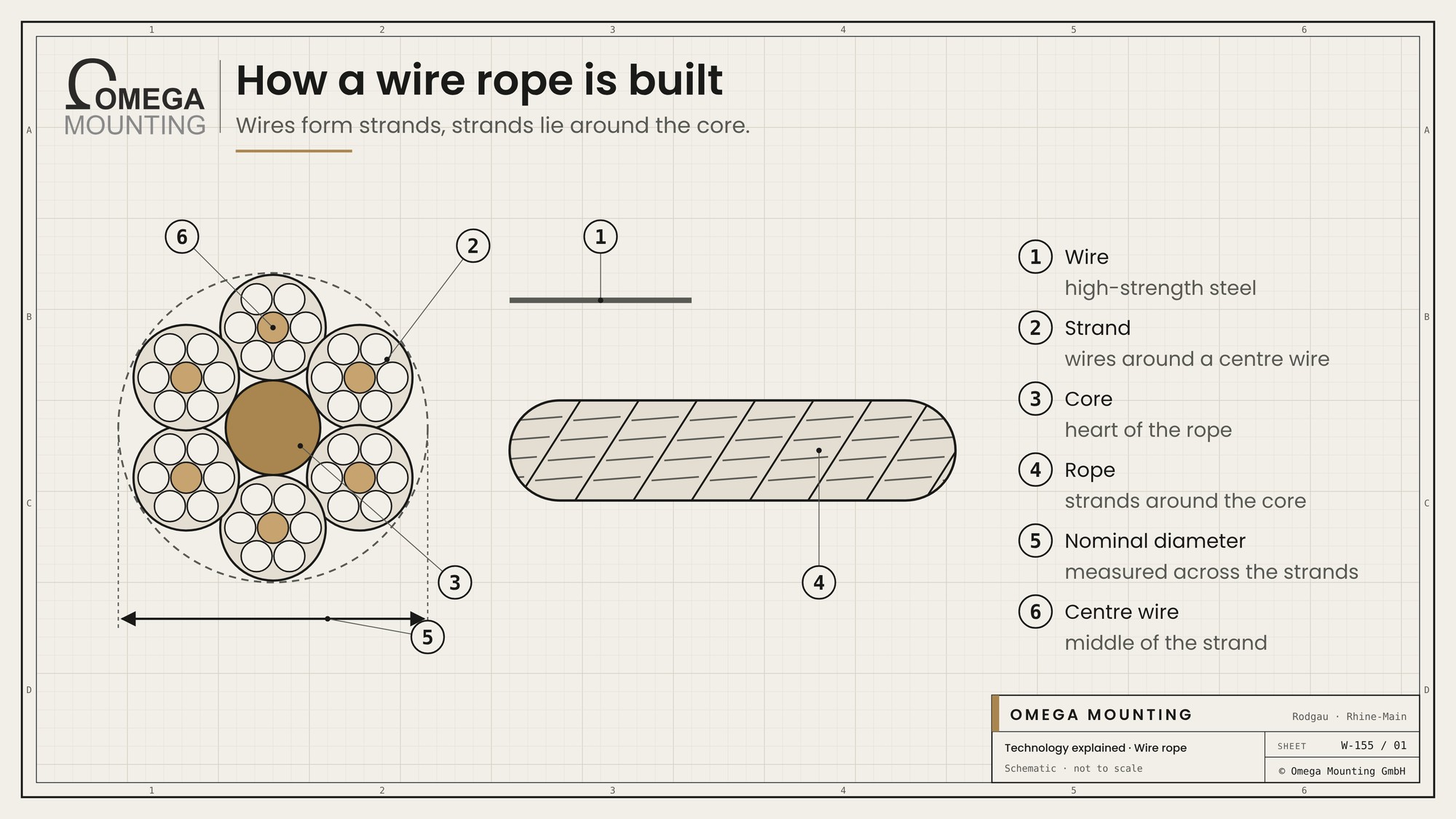
A wire rope is made in three stages:
- Wire: The smallest building block is a thin, high-strength steel wire, bright or galvanised.
- Strand: Several wires are stranded around a centre wire. This forms a strand.
- Rope: Several strands are stranded around a core . This forms the finished rope.
The core is the heart of the rope. A fibre core made of natural or synthetic fibre makes the rope flexible and stores lubricant. A steel core is itself a small rope or strand. It supports the outer strands better; the rope becomes stronger and is crushed less on the drum.
Crane ropes therefore usually have a steel core. Ropes for simple guy lines and lifting accessories often manage with a fibre core.
Lay type: ordinary lay and Lang lay
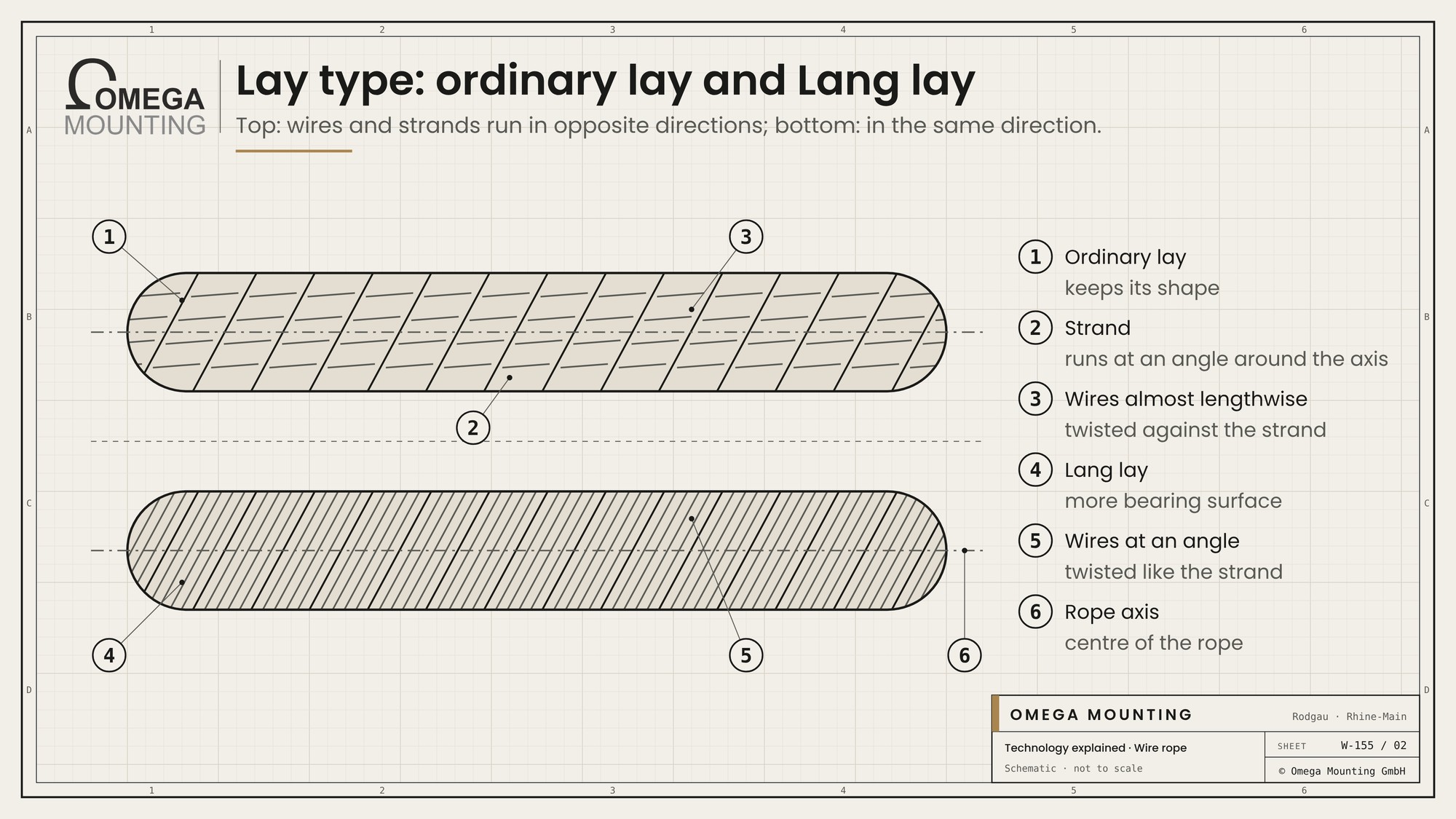
The lay type describes the direction in which wires and strands are twisted:
- Ordinary lay: The wires in the strand run in the opposite direction to the strands in the rope. From the outside, the wires lie almost parallel to the rope axis. The rope keeps its shape and has little tendency to untwist.
- Lang lay: Wires and strands run in the same direction. From the outside, the wires lie at an angle. The rope has a larger bearing surface and wears more slowly, but has a greater tendency to untwist.
In addition there is the direction: right-hand or left-hand. It must suit the drum and the application.
For great lifting heights with only one rope fall, there are rotation-resistant ropes. They have several layers of strands stranded in opposite directions. As a result, the load hardly rotates when lifted. Which rope belongs on a crane is specified by the manufacturer of the hoist.
Key data on the rope certificate
Every rope comes with a certificate or manufacturer's declaration. The most important information in it:
- Nominal diameter: measured across the strands, not across a flat spot.
- Rope construction: number of strands and wires and the type of core.
- Grade: how strong the wire used is.
- Minimum breaking force: the force at which a new rope breaks at the earliest.
- Lay type and lay direction.
The minimum breaking force is not the permissible load. Between the two lies a safety factor that standards and manufacturers define depending on the application. A replacement rope must match the old one in all details – a rope that is merely the same thickness is not enough.
Rope terminations
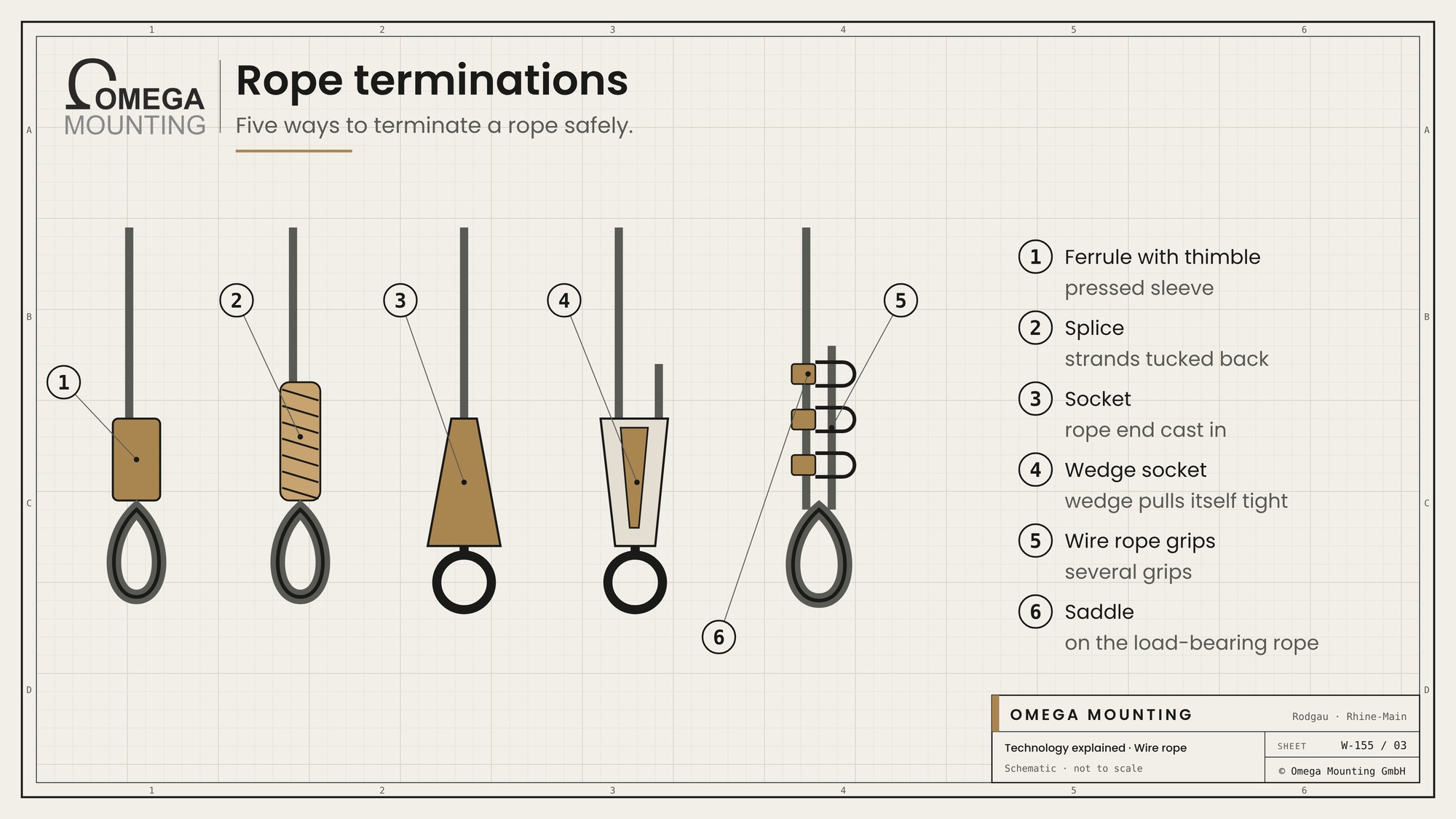
A rope is only as strong as its end. The most important rope terminations:
- Ferrule with thimble: The rope is laid around a thimble , a shaped part that protects the eye, and pressed with a sleeve. Common for lifting slings.
- Splice: The strands are tucked back into the rope by hand. This requires experience and is less common today.
- Socket: The splayed rope end is cast into a conical socket. This termination is particularly strong.
- Wedge socket: The rope is laid around a wedge that pulls itself into the housing under load. It can be released again and is often used at drum and anchor points of cranes.
- Wire rope grips: Several grips with U-bolt and saddle hold the eye. The saddle always sits on the load-bearing rope, the U-bolt on the loose end.
How many wire rope grips are needed, at what spacing and with what tightening torque is defined by manufacturers and standards. For certain applications, such as lifting people, wire rope grips are not permitted. This is not legal advice.
Handling ropes correctly
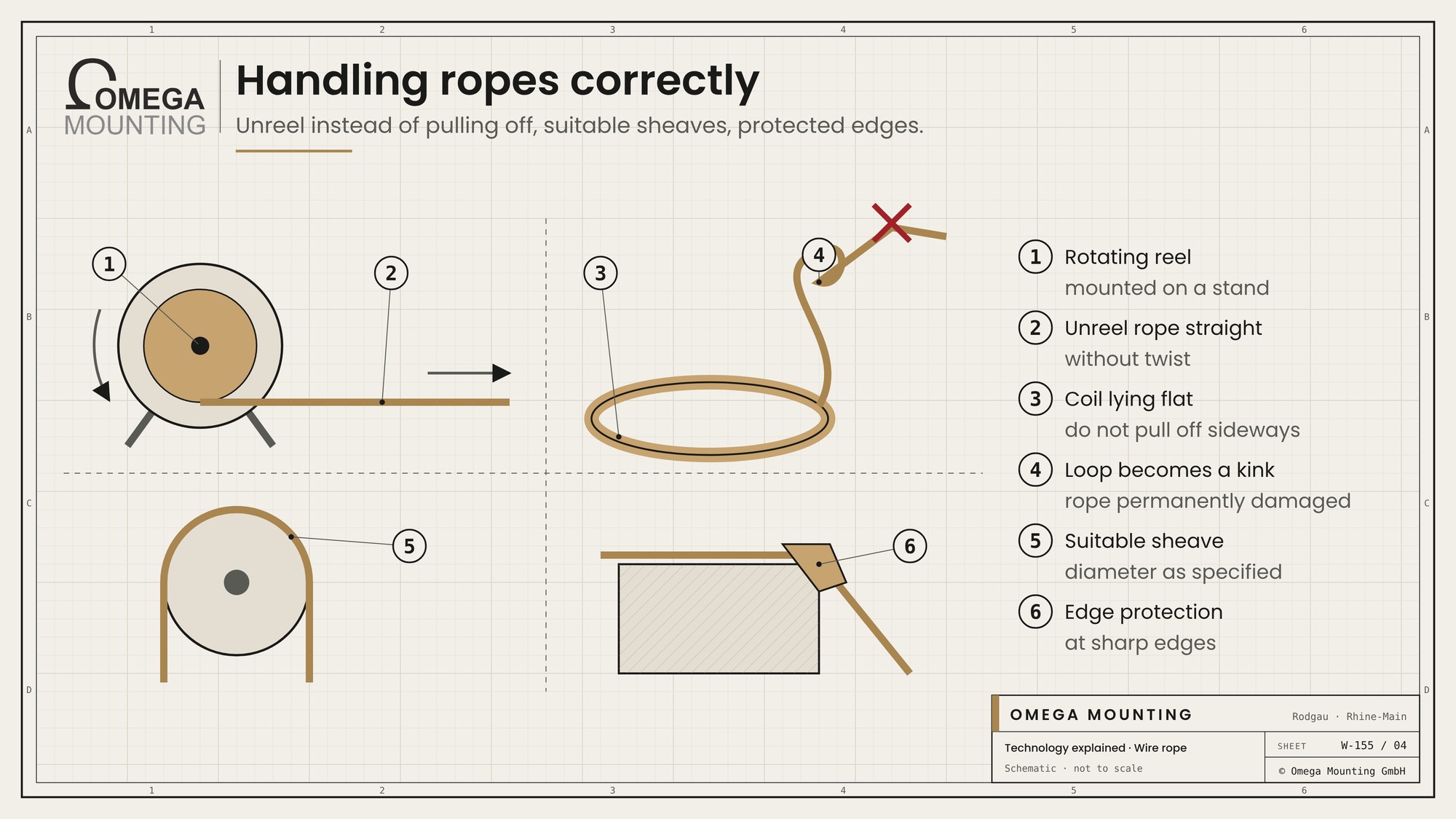
Many ropes are damaged before they carry their first load:
- Unreeling: Unwind the rope from the rotating reel or roll the coil out. Anyone who pulls it sideways off a coil lying flat twists loops into the rope – these turn into kinks, which permanently damage the rope.
- Fitting: Wind new ropes onto the drum under slight pretension. Otherwise the lower layers lie loosely and are crushed later.
- Sheaves and drums: The diameter must suit the rope. Sheaves that are too small bend the rope too sharply and shorten its service life.
- Edges: Never lay ropes unprotected over sharp edges. Use edge protection.
- Lubrication: Ropes are lubricated at the factory. In operation they are relubricated as specified by the manufacturer.
- Storage: dry, on timber or pallets, not on the bare floor.
A damaged rope is not straightened or repaired but replaced.
Typical mistakes
- Rope pulled sideways off a coil lying flat, kink built in.
- Wire rope grips fitted the wrong way round, saddle on the loose end.
- Rope tensioned over an unprotected steel edge.
- Wrong lay direction fitted on the drum.
- Rope wound on without pretension.
What we pay attention to
When we replace ropes, install guy lines or create anchor points, we pay attention to the points that make the rope safe and durable.
- We only use ropes and terminations as specified by the manufacturer.
- We unreel ropes from the rotating reel, never sideways from the coil.
- We fit wire rope grips the right way round and tighten them as specified.
- We protect ropes at edges.
- We coordinate the rope replacement on the crane with the competent person for acceptance.
Where we use it
With the loading of a cable drum in the port of Aschaffenburg, we created anchor points on the drum flange with clamps and wire ropes where none had existed before, and tensioned the protective tarpaulin on them with ratchet straps. In the end the drum was lashed on the low-loader – and the loading date was met. More about our services is on the page Industrial installation.
More technology explained
Technology explained
rope drum, rope guide and how to recognise a worn rope.
Technology explained
how to tell that lifting accessories have reached the end of their life.
Technology explained
what each lifting accessory can do.
Do you have questions about how this works on your site?
A rope is to be replaced or a guy line installed? We plan and carry it out. Request a callback.
Free, no-obligation callback
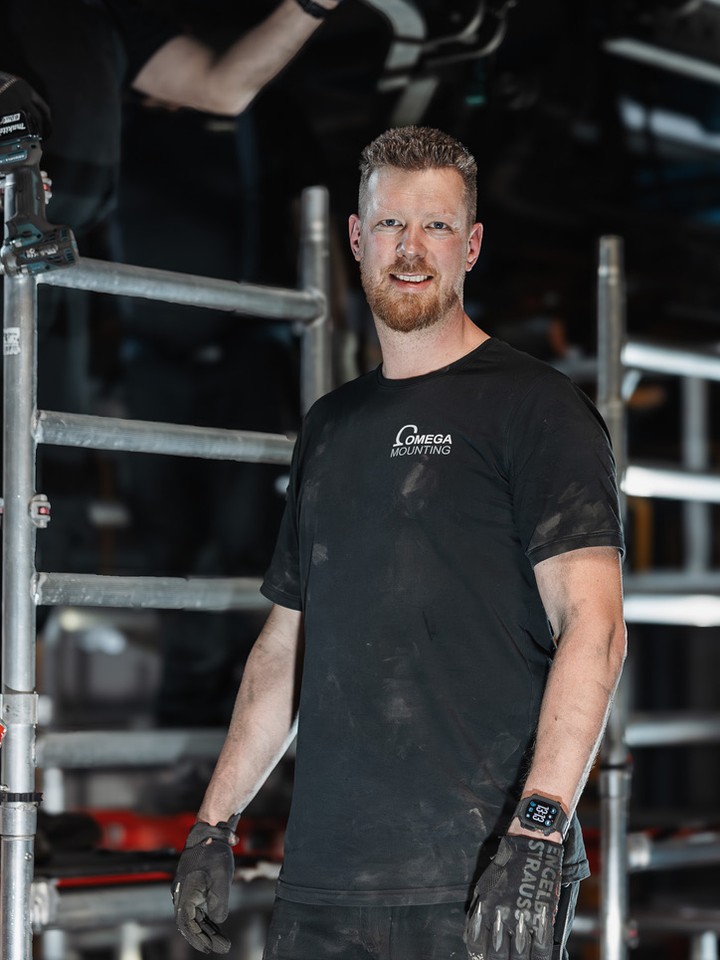
About the author
Tobias Schott
Managing director of Omega Mounting GmbH, Rodgau · more than 20 years of hands-on experience in installation and maintenance
A trained mechatronics technician, working in maintenance, servicing and industrial installation since 2004 – first alongside his father, and with Omega Mounting since 2012: from overhead conveyors in Frankfurt to the crane system in a new-build hall. He plans and leads lifting operations as an appointed person (AP) in data centers and on industrial sites in the Rhine-Main region, trains and examines operators of cranes, mobile elevating work platforms and telehandlers, and is a qualified occupational safety specialist. On jobs abroad he is known as the “German Troubleshooter” – the person you call when a site gets stuck. He learned what quality means from his father, not from a manual: Made in Germany as a standard for his own work, not a label. That is why quality comes first at Omega Mounting – ahead of speed and price. The Technology explained articles cover the equipment and techniques his team uses every day: what counts on site is in them – what only appears in the brochure is not.
 English
 German