
- Technology explained – technology and procedures
The electric wire rope hoist: rope drum, rope guide, bottom block and how to recognise a worn rope
By Tobias Schott · 6-minute read · Updated November 2026
An electric wire rope hoist winds a wire rope onto a drum and lifts the load this way. It is found in most large overhead cranes. Anyone who understands the drum, rope guide and bottom block spots wear early – and knows when the rope has to be replaced.
Wire rope hoists hang on single-girder cranes, sit on the trolleys of double-girder overhead cranes and work as fixed units in lifting stations. They lift heavy loads quickly, smoothly and over great heights.
Here we explain how an electric wire rope hoist is built, what reeving means, how the drum and rope guide work together and how to recognise a rope that must be discarded.
What is an electric wire rope hoist?
An electric wire rope hoist is a hoist with an electric drive in which a wire rope carries the load. The rope is wound onto or off a drum. Via one or more sheaves it runs to the bottom block, on which the hook hangs.
Its little brother is the electric chain hoist. It works with a round steel chain and is more compact. For large loads, great lifting heights and high lifting speeds, the wire rope hoist is the usual solution.
The wire rope hoist usually sits in a trolley, which travels on the crane girder. This way it moves the load not only up and down but also across the hall.
Key facts
- Task: Lifting and lowering loads, usually as the hoist of a crane.
- Crane-fixed lifting gear: Wire rope, wound onto a grooved drum.
- Designs: Monorail trolley, double-rail trolley, stationary.
- Main parts: Motor, brake, gearbox, drum, rope guide, bottom block, limit switch.
- Weak points: Rope, rope guide, brake, sheaves.
- Interfaces: Manufacturer, competent persons for crane inspection, operator.
- Our part: Installation, modification, rope replacement, plant electrics up to the main switch.
How an electric wire rope hoist is built
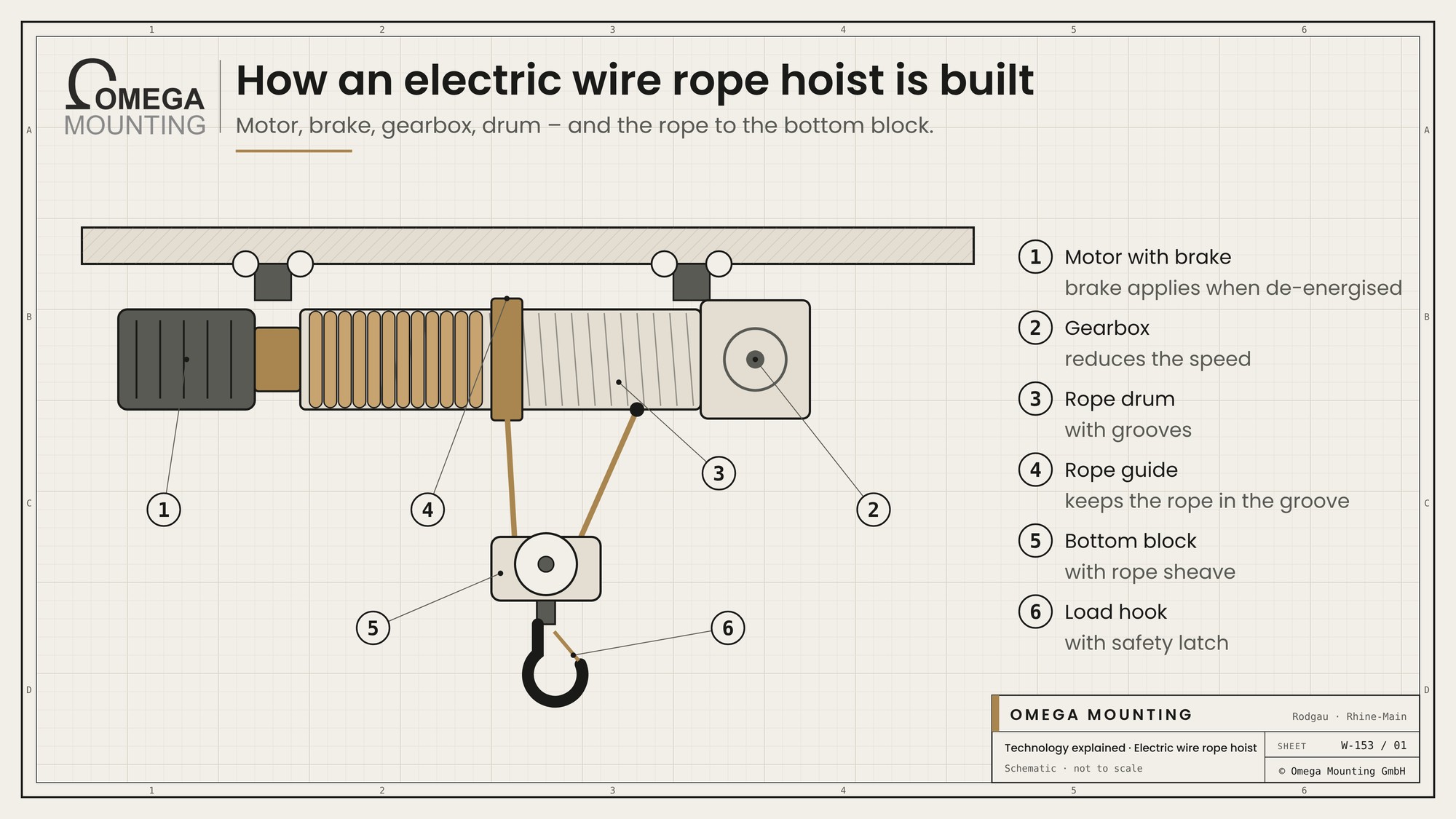
A motor drives the rope drum via a gearbox. A spring-applied brake holds the load as soon as the motor is de-energised. It therefore also applies safely in the event of a power failure.
The rope drum is the heart of the hoist. Its surface has helical grooves in which the rope lies neatly side by side. The rope end is fixed to the drum with clamping plates.
From the drum circumference the rope runs down to the bottom block. It carries one or more sheaves and the load hook with safety latch. With several rope falls, the rope runs back up to a fixed sheave or to an equaliser sheave on the hoist.
Then there are the safety devices: Limit switches limit the lift at the top and bottom, an overload protection prevents loads that are too heavy from being lifted.
Reeving: how many rope falls carry the load

The reeving indicates how many rope falls carry the bottom block. It is written, for example, as 2/1 or 4/1.
- Two falls: The load is shared by two rope sections. The hook travels comparatively fast.
- Four falls: The load is shared by four rope sections. The hoist lifts more, the hook travels more slowly.
The principle is the block and tackle: more falls mean less force in each rope, but more rope that has to be wound onto the drum for the same lift.
Many hoists wind the rope from both sides of the drum towards the middle. The hook then stays exactly vertical below the trolley during lifting and does not drift sideways. Specialists call this true vertical lift.
Rope drum and rope guide
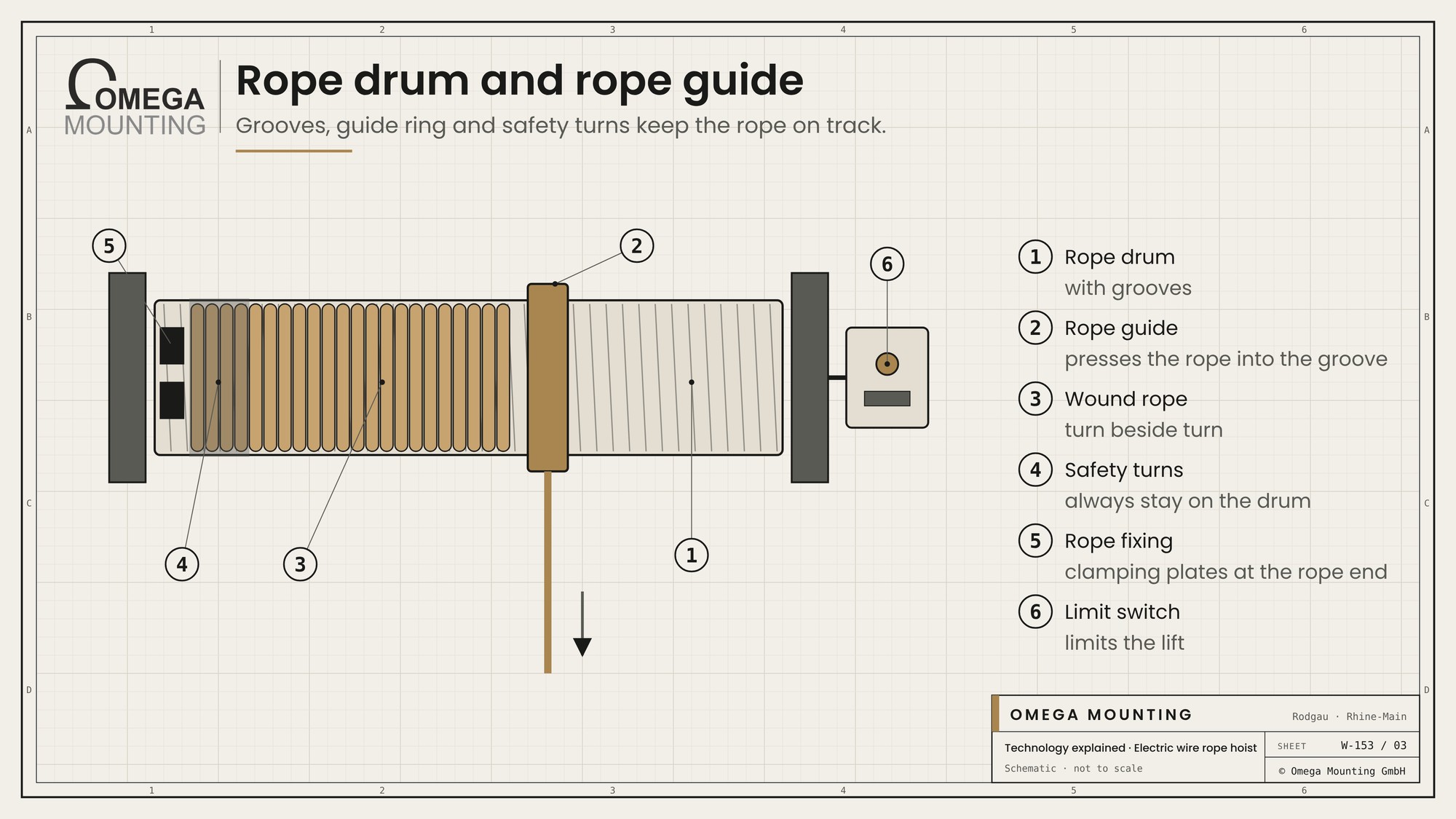
For a rope to last, it has to lie neatly on the drum. Three things ensure this:
- Grooves: Each turn lies in its own groove. The rope is not crushed and not pulled over the neighbouring turn.
- Rope guide: A ring runs along on the drum and presses the rope into the groove. It prevents the rope from jumping out of track with a slack rope or side pull.
- Safety turns: Even in the lowest hook position, a few turns remain on the drum. They relieve the rope fixing.
Side pull is the biggest enemy of the rope guide. If a load is lifted at an angle or dragged across the floor, the rope runs in at an angle. The rope guide wears, the rope can climb out of the groove and be damaged.
How to recognise a worn rope
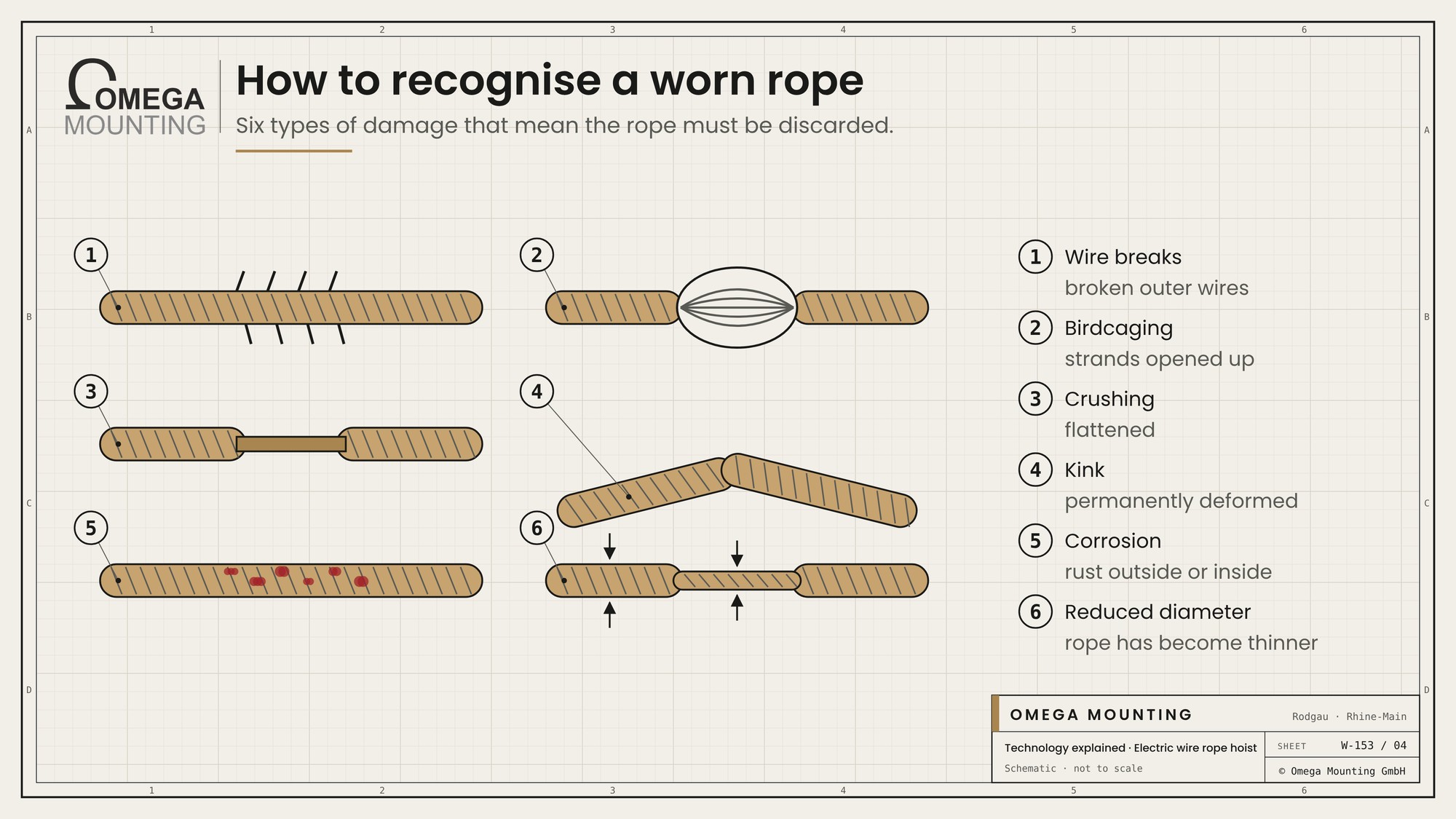
A wire rope is a wear part. With every lift it is bent over sheaves and the drum. At some point it is ready for discard – it must be replaced before it fails. Typical signs:
- Wire breaks: individual broken wires on the surface, often at the point that runs over the sheave most often.
- Birdcaging: The strands open up like a cage. The rope has lost its structure.
- Crushing: flattened areas, usually caused by incorrect winding or a trapped load.
- Kink: a permanent deformation, for example after a slack rope or an impact.
- Corrosion: rust outside or inside, often on outdoor cranes or in damp halls.
- Rope that has become thinner: The diameter decreases through abrasion and internal wear.
How many wire breaks are permissible and when a rope must be discarded is defined by the manufacturer and the relevant standards. The assessment belongs in the hands of a competent person. This is not legal advice.
Inspecting and servicing
A wire rope hoist is inspected regularly – before every shift by a visual check by the crane operator, at least once a year by a competent person. Typical inspection points:
- Rope over its entire length, especially at sheaves and drum.
- Rope guide for wear and play.
- Brake: does it hold the load, how large is the air gap?
- Limit switches at the top and bottom.
- Hook with safety latch, bottom block, sheaves.
- Gearbox for oil level and noise.
For many wire rope hoists, the remaining service life is also determined. It results from operating hours and load spectrum and shows when a general overhaul is due.
Wire rope hoist or chain hoist?
| Characteristic | Electric wire rope hoist | Electric chain hoist |
|---|---|---|
| Load-bearing element | Wire rope on drum | Round steel chain in chain container |
| Loads | medium to very large | small to medium |
| Lifting height | large | limited |
| Lifting speed | high, smooth | lower |
| Installation space | larger, heavier | compact, light |
| Wear part | Rope, rope guide | Chain, chain sprocket |
Which design is right depends on load, lifting height, frequency of use and space under the roof.
Typical mistakes
- Pulling loads at an angle or dragging them across the floor.
- Slack rope from setting down and continuing to lower.
- Only looking at the rope superficially and missing internal damage.
- New rope wound on without pretension; the lower layers are crushed later.
- Limit switch used as an operating switch.
What we pay attention to
When we install or modify cranes or replace ropes, we pay attention to the points that keep the hoist running for a long time.
- We install hoist and trolley according to the manufacturer's specifications and check the alignment.
- We wind new ropes on in a controlled manner under load.
- We check the rope guide, sheaves and limit switches after every intervention.
- Our qualified electricians connect up to the system's main switch.
- We coordinate the inspection before recommissioning with the competent person.
Where we use it
With the installation of a double-girder overhead crane we slewed a crane with a total capacity of 16 tonnes and two trolleys of 10 tonnes each into position and wired it up to the main switch – with two fitters in one day. More about our services is on the page Crane installation.
More technology explained
Technology explained
construction, inspection and wear of the chain.
Guide
our guide to crane inspection and service life.
Do you have questions about how this works on your site?
A wire rope hoist is to be modified, a crane relocated or a rope replaced? We install and integrate. Request a callback.
Free, no-obligation callback

About the author
Tobias Schott
Managing director of Omega Mounting GmbH, Rodgau · more than 20 years of hands-on experience in installation and maintenance
A trained mechatronics technician, working in maintenance, servicing and industrial installation since 2004 – first alongside his father, and with Omega Mounting since 2012: from overhead conveyors in Frankfurt to the crane system in a new-build hall. He plans and leads lifting operations as an appointed person (AP) in data centers and on industrial sites in the Rhine-Main region, trains and examines operators of cranes, mobile elevating work platforms and telehandlers, and is a qualified occupational safety specialist. On jobs abroad he is known as the “German Troubleshooter” – the person you call when a site gets stuck. He learned what quality means from his father, not from a manual: Made in Germany as a standard for his own work, not a label. That is why quality comes first at Omega Mounting – ahead of speed and price. The Technology explained articles cover the equipment and techniques his team uses every day: what counts on site is in them – what only appears in the brochure is not.
 English
 German