
- Technology explained – technology and procedures
Spring-applied brake: why it brakes without power – and how to check it
By Tobias Schott · 5-minute read · Updated November 2026
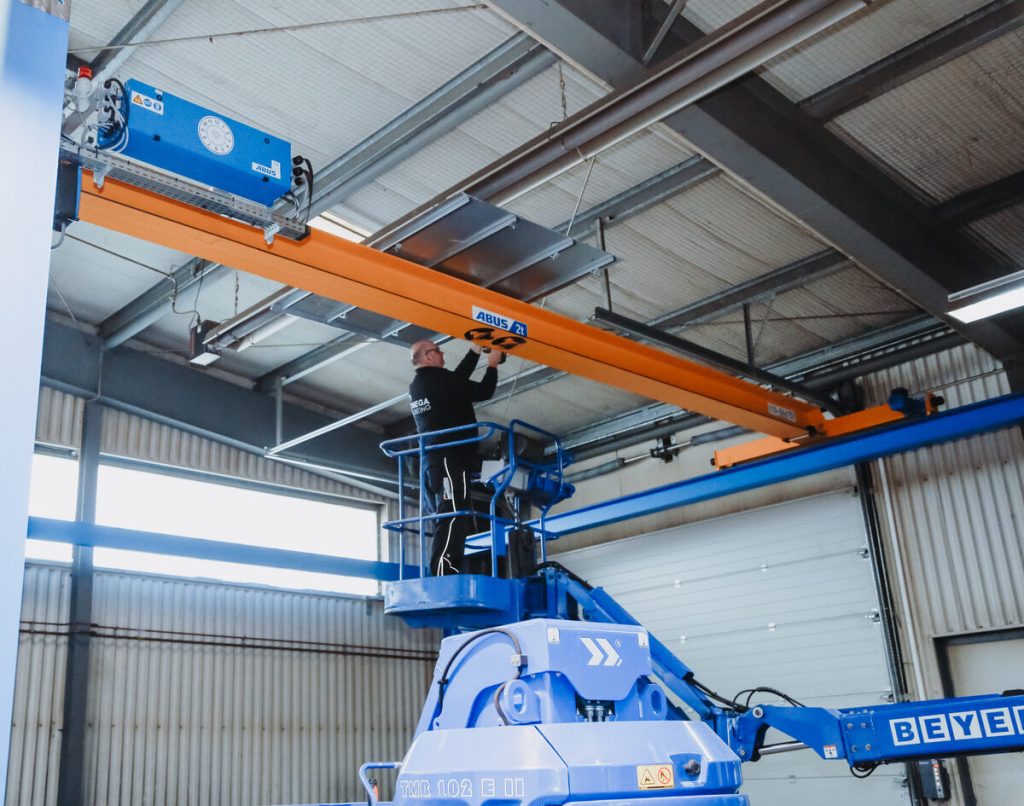
A spring-applied brake brakes by spring force and is released electrically – if the power fails, it engages and holds the load; for this to work at all times, air gap, lining, release and control must be checked regularly.
Whether hoist, crane travel drive, inclined conveyor or door drive: wherever a load must not keep moving or creep down after switching off, there is a brake on the motor. Usually it is a spring-applied brake. It is considered safe because it works on the fail-safe principle – as long as it is set correctly.
Here we explain how a spring-applied brake works, how it is arranged on the motor, why the air gap matters so much and how to check it.
What is a spring-applied brake?
A spring-applied brake is an electromagnetically released brake. Springs press an armature plate against a rotor with brake lining and so brake the motor shaft. When current flows through the coil, the magnet pulls the armature plate back and the rotor can turn freely – the brake is released.
The principle is called the fail-safe or closed-circuit principle: without power it brakes. If the supply fails, a cable breaks or an emergency stop trips, the brake engages automatically. That is why it is the usual holding brake on hoists and cranes.
Key facts
- Principle: Springs brake, power releases.
- Use: Hoists, crane travel drives, conveyors, doors, lifting tables.
- Parts: Magnet body, springs, armature plate, rotor with lining, friction surface.
- Most important value: the air gap.
- Accessories: Manual release, brake rectifier, wear monitoring.
- Inspection: Holding test, air gap, lining, release function.
How a spring-applied brake works
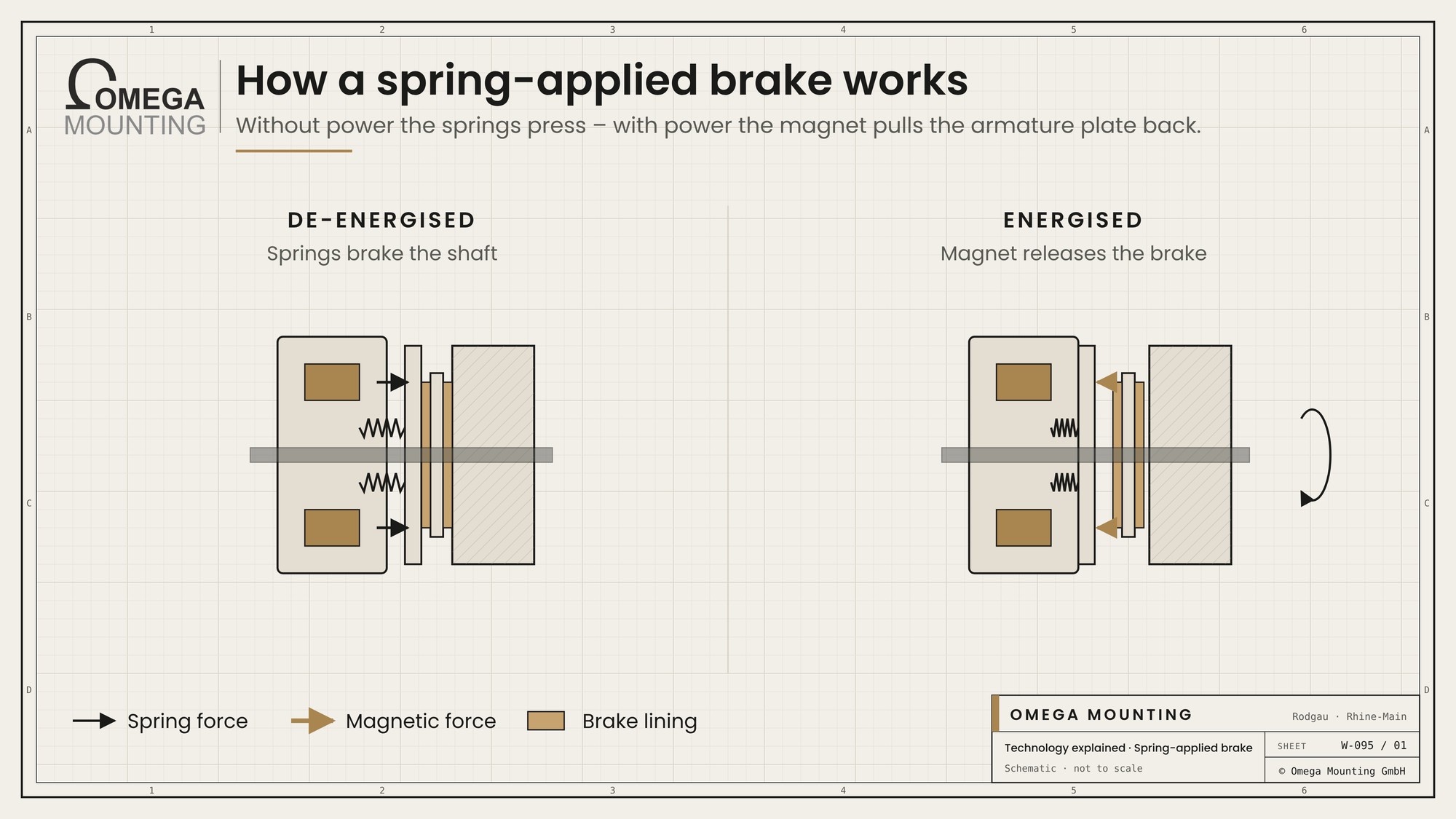
There are two states.
| State | What happens | Result |
|---|---|---|
| De-energised | Springs press the armature plate onto the rotor. | The shaft is braked. |
| Energised | The magnet attracts the armature plate, creating an air gap. | The shaft turns freely. |
When switching on, the brake gets power first and releases, then the motor starts. When switching off, the brake is de-energised and engages. How quickly it engages also depends on the wiring – switching on the DC side makes it considerably faster.
Layout on the motor
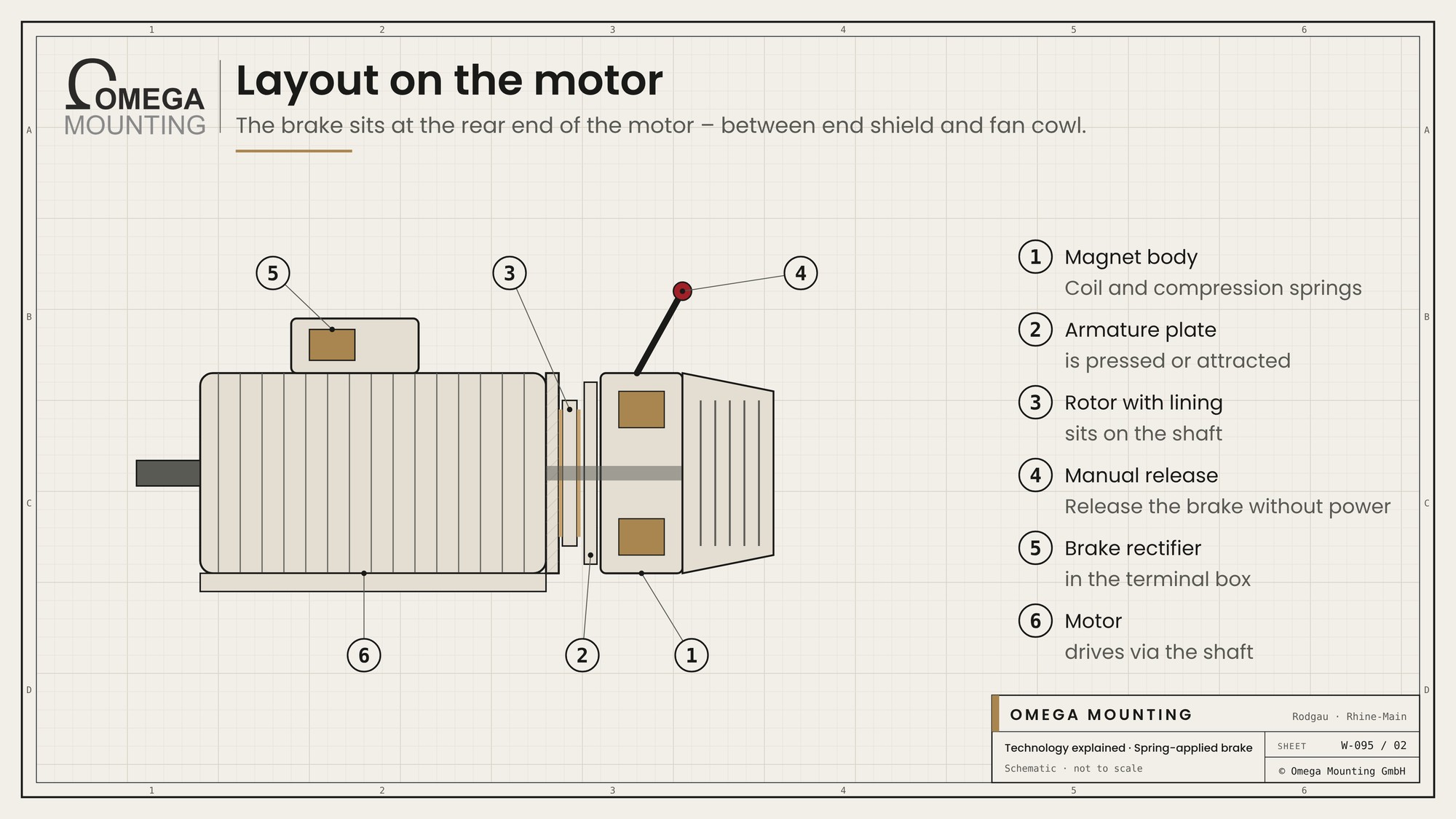
- Magnet part: housing with coil and compression springs, fixed to the motor.
- Armature disc: is pressed by the springs and attracted by the magnet.
- Rotor: sits on the shaft and carries lining on both sides.
- Friction surface: on the motor end shield or on a separate plate.
- Manual release: a lever with which the brake can be released without power – for example to lower a load in a controlled way.
- Brake rectifier: converts the mains voltage into direct current for the coil.
Air gap and wear
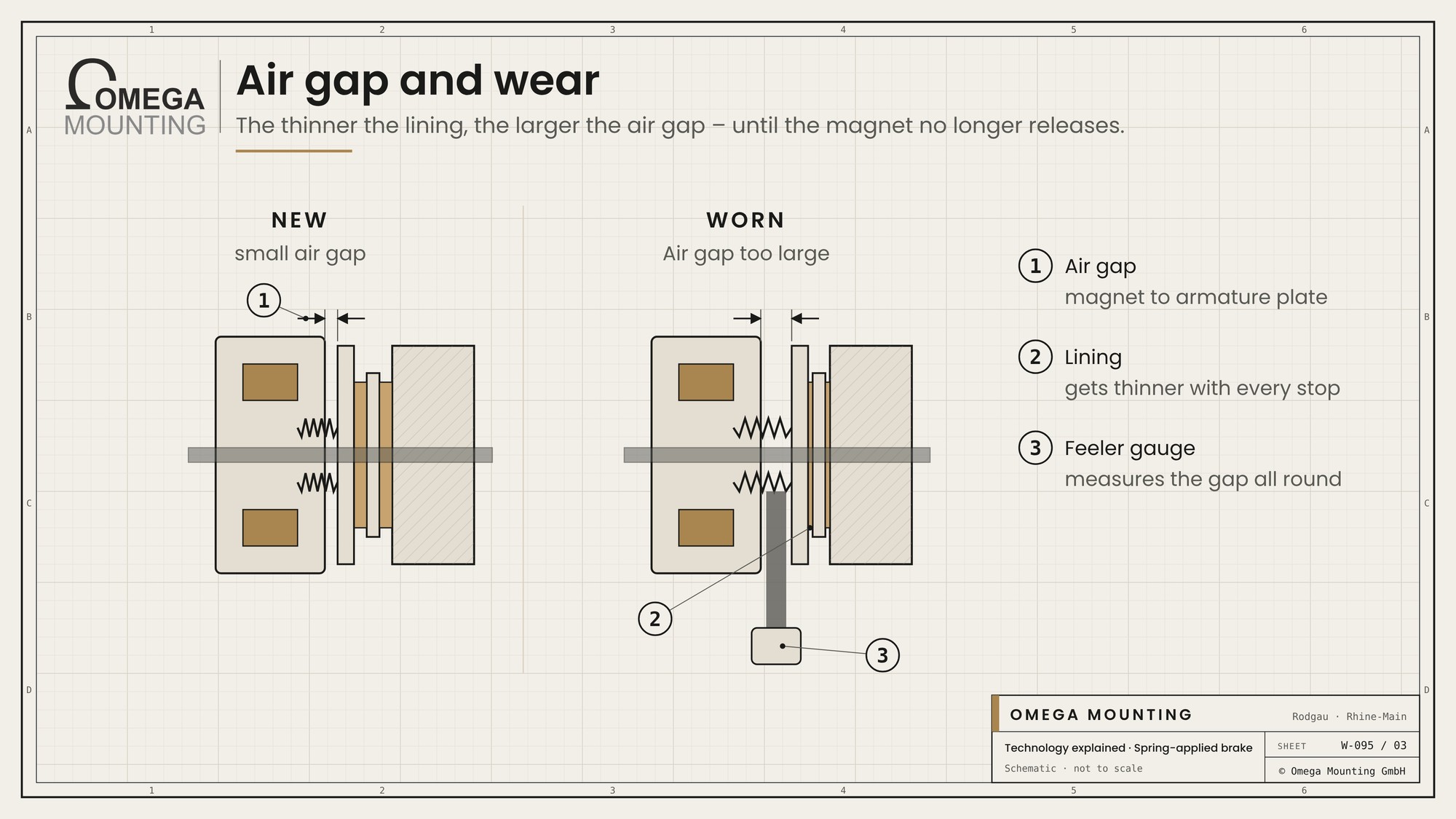
The air gap is the distance between armature plate and magnet body in the released state. With every stop the lining wears and the air gap grows.
- Too large: The magnet can no longer reliably attract the armature plate. The brake drags or does not release at all – the motor runs against the brake and overheats.
- Too small: The brake does not release fully and drags constantly.
- Lining worn: Below the minimum thickness the rotor is replaced.
It is measured with a feeler gauge at several points all round. The target values are in the manufacturer's operating instructions. Many brakes can be readjusted until the lining is used up.
Brake on the hoist and on the travel drive
On the hoist the brake holds the load in the air. It must engage reliably after every stop and hold the full load – here it is a safety component in the strictest sense. That is why many hoists also have monitoring that reports whether the brake has released or the lining is worn.
On the travel drive it brakes the crane bridge or trolley and holds it in position. What matters most here is smooth, even braking so that the load does not swing. Modern drives brake electrically via the variable frequency drive, and the spring-applied brake only engages at standstill – it then works mainly as a holding brake and hardly wears.
Inspecting and servicing
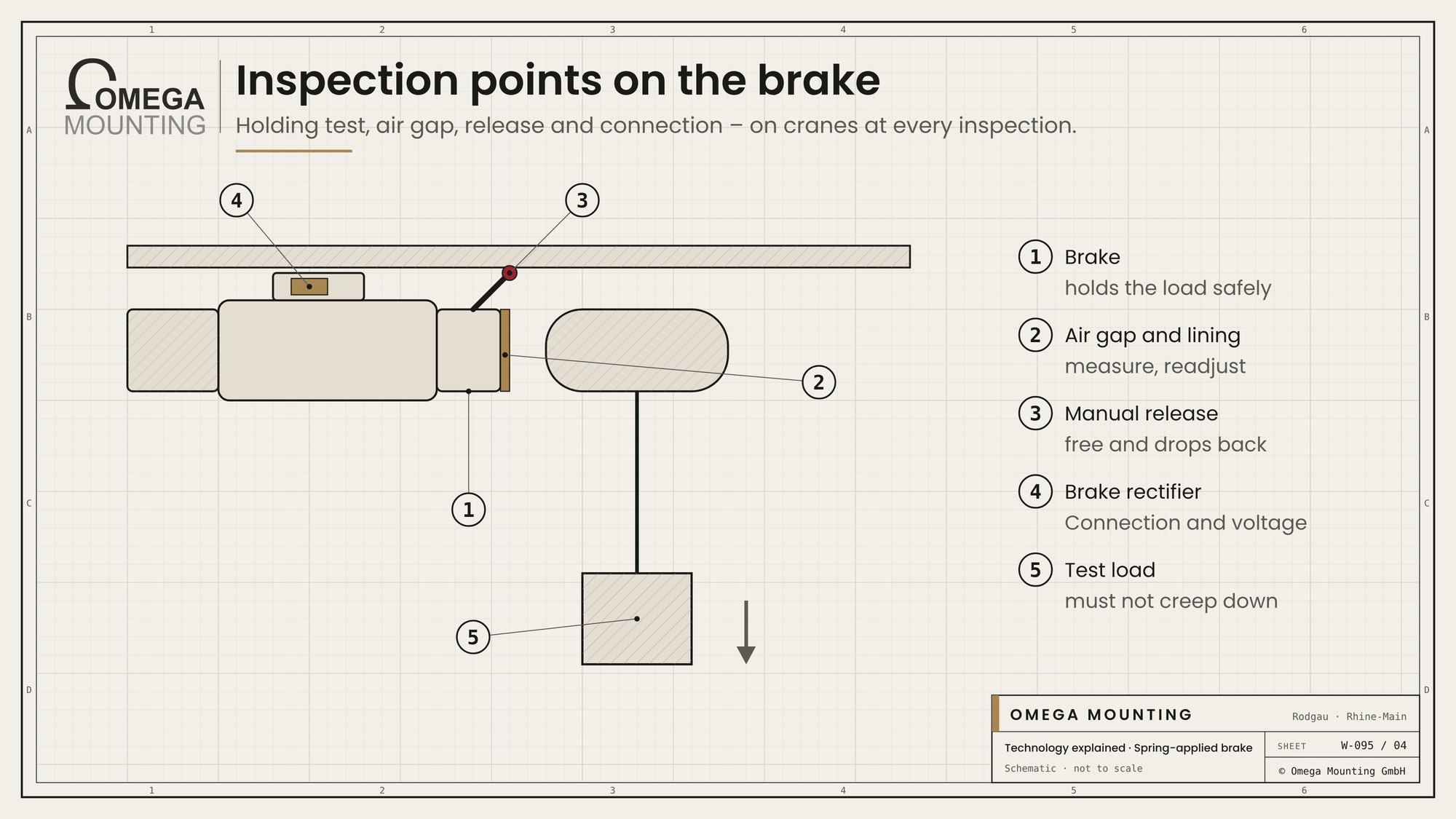
- Holding test: The brake must hold the load safely without it creeping down.
- Air gap: measure and readjust if needed.
- Lining and rotor: thickness, scoring, glazing, oil or grease on the lining.
- Release: The brake must release cleanly when switched on – grinding noises or heat are a warning sign.
- Manual release: must move freely and spring back by itself.
- Electrics: rectifier, connections and coil resistance.
On cranes, the brake is part of the periodic inspection by a competent person. How crane installations are serviced and renewed is described in our guide on crane installations.
Typical mistakes
- Air gap never readjusted: The brake drags or no longer releases.
- Manual release jammed: The brake cannot engage – life-threatening on hoists.
- Oil on the lining: Braking performance collapses.
- Wrong rectifier: The coil gets too little current or overheats.
- Motor runs against the brake: This destroys lining and winding.
Replacing and adjusting the brake
If the friction disc is worn or the brake is defective, it is replaced. The sequence is always the same:
- Isolate and lock off: The drive is isolated and secured against being switched on again. On a hoist, the load is set down or secured mechanically.
- Remove the brake: The cover, fan cowl and brake are removed and the parts laid out in their fitted order.
- Measure the parts: Friction disc, armature plate and friction surface are checked for thickness, scoring and discolouration.
- Set the air gap: After installation the air gap is set to the manufacturer’s specification and measured at several points.
- Check the manual release: If the brake has a manual release, it must return to the braking position by itself after being released.
- Test run: Finally there is a test run and a brake test, on a hoist with a load.
Our electricians handle the electrical connection of the brake coil at the motor as part of the machine wiring. Whoever replaces a brake writes the air gap, date and test result in the maintenance log.
What we pay attention to
- We check brakes as part of installing and commissioning hoists and travel drives.
- We measure the air gap and set it to the manufacturer's specifications.
- We check that the manual release is free and springs back.
- We test holding under load before a crane is handed over.
- We only work on brakes when the load has been set down or secured.
Where we use it
Crane hoists and travel drives hold their position with brakes on the motor. In Babenhausen we installed a gantry crane – with single-girder bridge, electric chain hoist, travel drive and complete electrics through to the slow-down and end limit switches. In the Aschaffenburg area we brought a double-girder overhead crane with two 10-tonne trolleys onto the crane runway and connected it up to the main power switch.
More technology explained
Technology explained
where the brake sits on the hoist.
Technology explained
details of the brake motor.
Technology explained
what sits between motor and load.
Do you have questions about how this works on your site?
Is your crane brake dragging, is the load creeping down or does nobody know when the brake was last adjusted? We inspect, adjust and replace wear parts. Request a callback.
Our service for this: Crane construction and crane systems →
Free, no-obligation callback

About the author
Tobias Schott
Managing director of Omega Mounting GmbH, Rodgau · more than 20 years of hands-on experience in installation and maintenance
A trained mechatronics technician, working in maintenance, servicing and industrial installation since 2004 – first alongside his father, and with Omega Mounting since 2012: from overhead conveyors in Frankfurt to the crane system in a new-build hall. He plans and leads lifting operations as an appointed person (AP) in data centers and on industrial sites in the Rhine-Main region, trains and examines operators of cranes, mobile elevating work platforms and telehandlers, and is a qualified occupational safety specialist. On jobs abroad he is known as the “German Troubleshooter” – the person you call when a site gets stuck. He learned what quality means from his father, not from a manual: Made in Germany as a standard for his own work, not a label. That is why quality comes first at Omega Mounting – ahead of speed and price. The Technology explained articles cover the equipment and techniques his team uses every day: what counts on site is in them – what only appears in the brochure is not.
 English
 German