
- Technology explained – technology and procedures
Electric motor rating plate: kW, IP55, IE3, B3 – what it says
By Tobias Schott · 5-minute read · Updated November 2026
The rating plate is the motor’s profile: it says what the motor delivers, how it is connected and whether a replacement motor fits mechanically and electrically.
You encounter the electric motor rating plate with every motor replacement, when ordering spare parts and in the equipment list. The small metal or foil plate carries a dozen details: output, voltage, current, speed, plus codes such as IE3, IP55, Ins. Cl. F, S1 and IM B3.
This article explains the details line by line and says what matters when replacing. How to maintain and replace drives as a whole is covered in the guide Maintaining drives, gearboxes and pumps.
What is the rating plate of an electric motor?
The rating plate of an electric motor is the plate permanently attached to the housing with the rated data for which the motor was built and tested. Rated data are the values at which the motor runs safely in continuous operation – output, voltage, current and speed are among them.
In industry, the three-phase asynchronous motor is the standard. It drives belts, pumps, fans and compressors, often via a mounted gearbox. In German the plate is called Typenschild.
Key facts
- Purpose: Describe the motor unambiguously – for connection, operation and replacement.
- Electrical data: Voltage with connection, current, frequency, power factor.
- Mechanical data: Output at the shaft, speed, mounting, frame size.
- Protection and efficiency: IE class, IP rating, insulation class, duty type.
- Where it sits: On the housing, often on the terminal box or at the side; on installed motors sometimes difficult to access.
- Standard: Standard series IEC 60034 for rotating electrical machines, plus the EU Ecodesign Regulation for efficiency.
- Common misconception: Same output means suitable replacement – yet mounting, frame size and speed decide whether it can be installed at all.
The details line by line
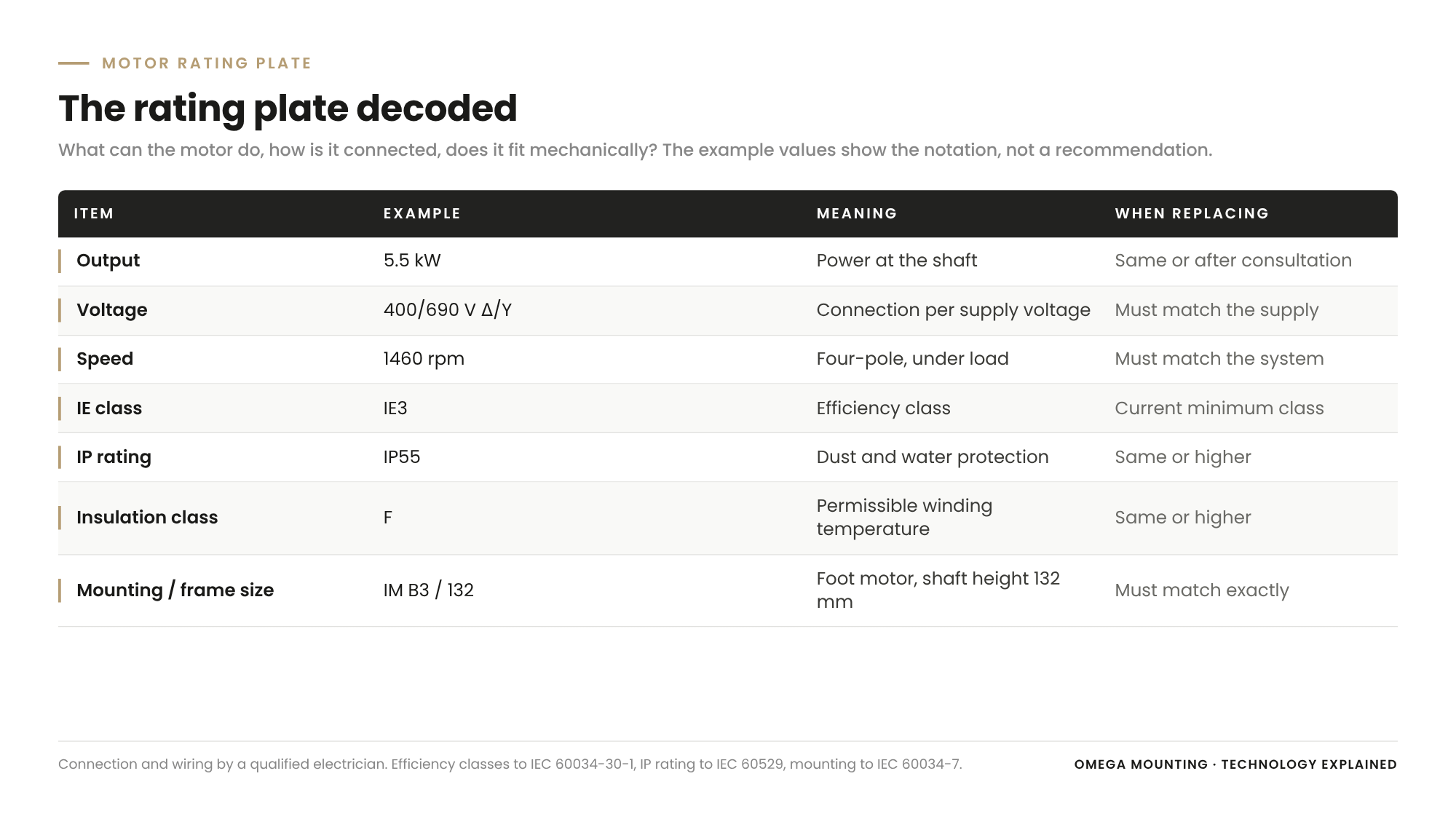
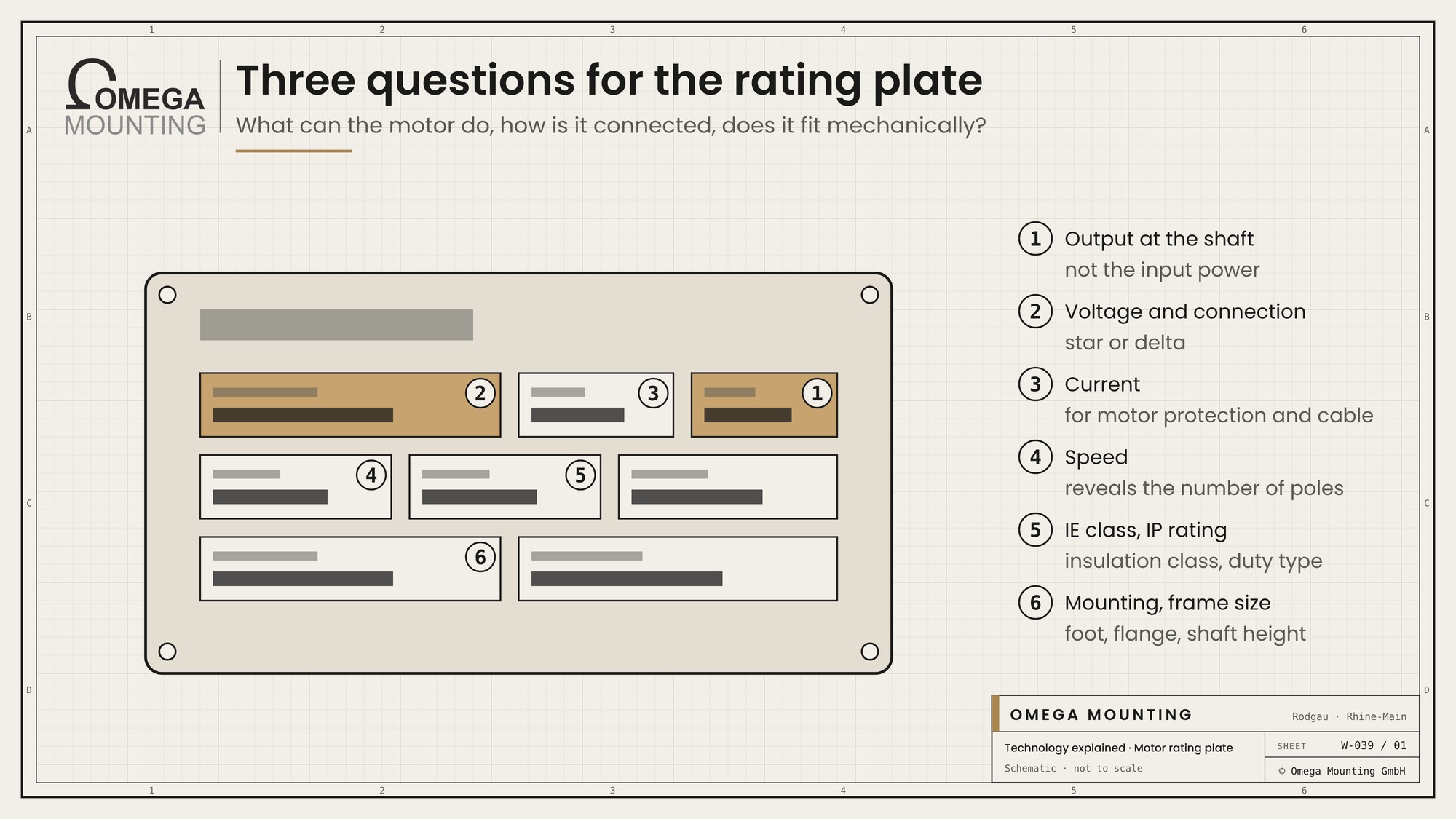
The most important details can be sorted into three questions: what can the motor do, how is it connected, does it fit mechanically?
| Detail | Example | Meaning | What matters when replacing |
|---|---|---|---|
| Output. | 5.5 kW. | Mechanical output at the shaft in continuous operation, not the input power. | Same, or larger after consultation. |
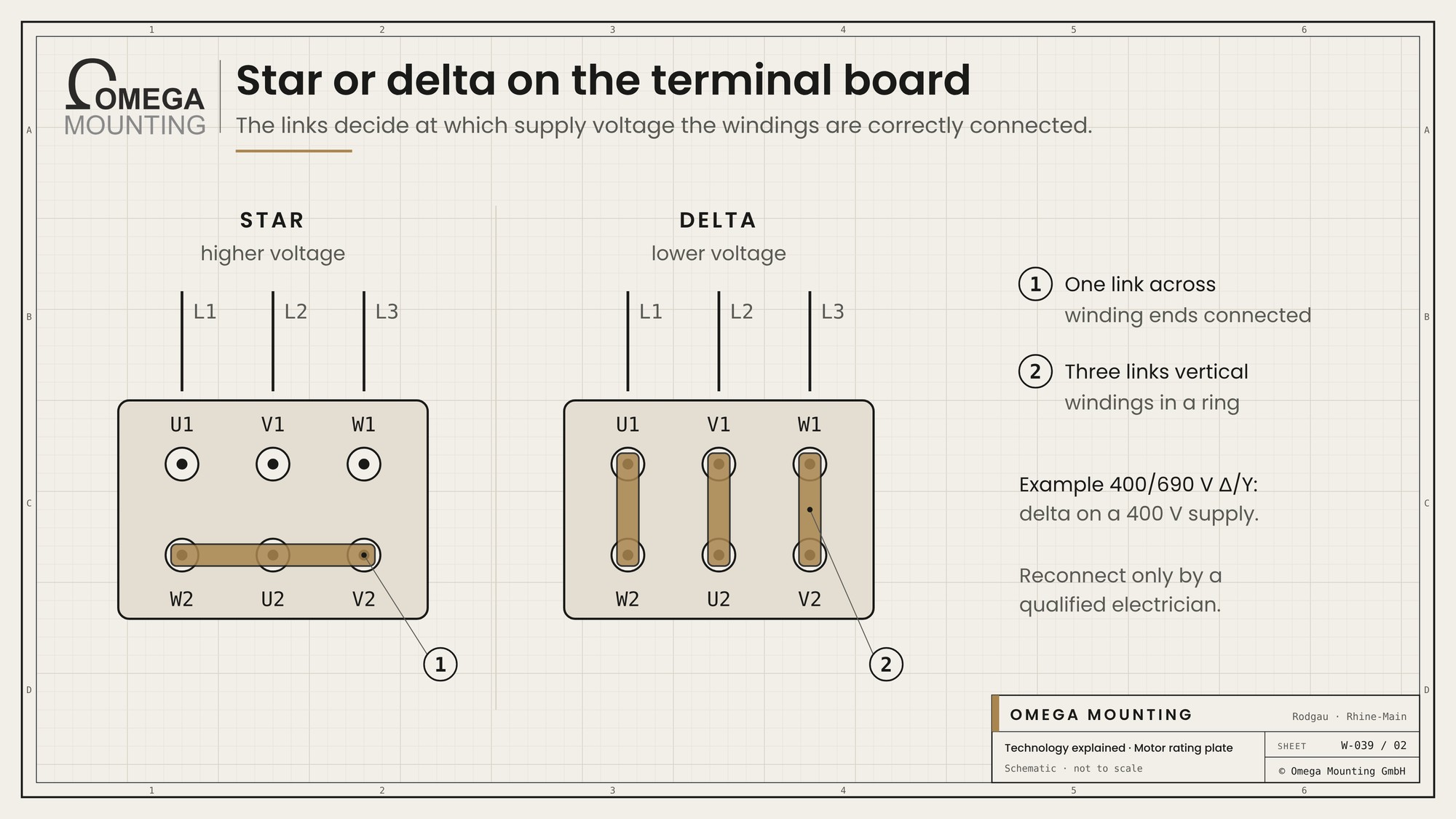
| Voltage and connection. | 400/690 V Δ/Y. | At 400 V it is connected in delta, at 690 V in star. | Must match the supply; connection by a qualified electrician. |
| Current. | Amperes at each voltage. | Rated current at full load. | Basis for motor protection and cable. |
| Speed. | 1460 rpm. | Rated speed under load, slightly below synchronous speed. | Must match the system, otherwise the conveying speed changes. |
| Efficiency class. | IE3. | Efficiency class according to IEC 60034-30-1. | For a replacement, the currently prescribed minimum class applies. |
| IP rating. | IP55. | Protection against dust and water. | Same or higher, to suit the environment. |
| Insulation class. | F. | Permissible temperature of the winding insulation. | Same or higher. |
| Duty type. | S1. | Continuous operation with constant load. | Different code for intermittent duty. |
| Mounting. | IM B3. | Fixing: foot, flange or both. | Must match exactly. |
| Frame size. | 132. | Shaft height in millimetres, determines foot and shaft dimensions. | Must match, otherwise foundation and coupling do not fit. |
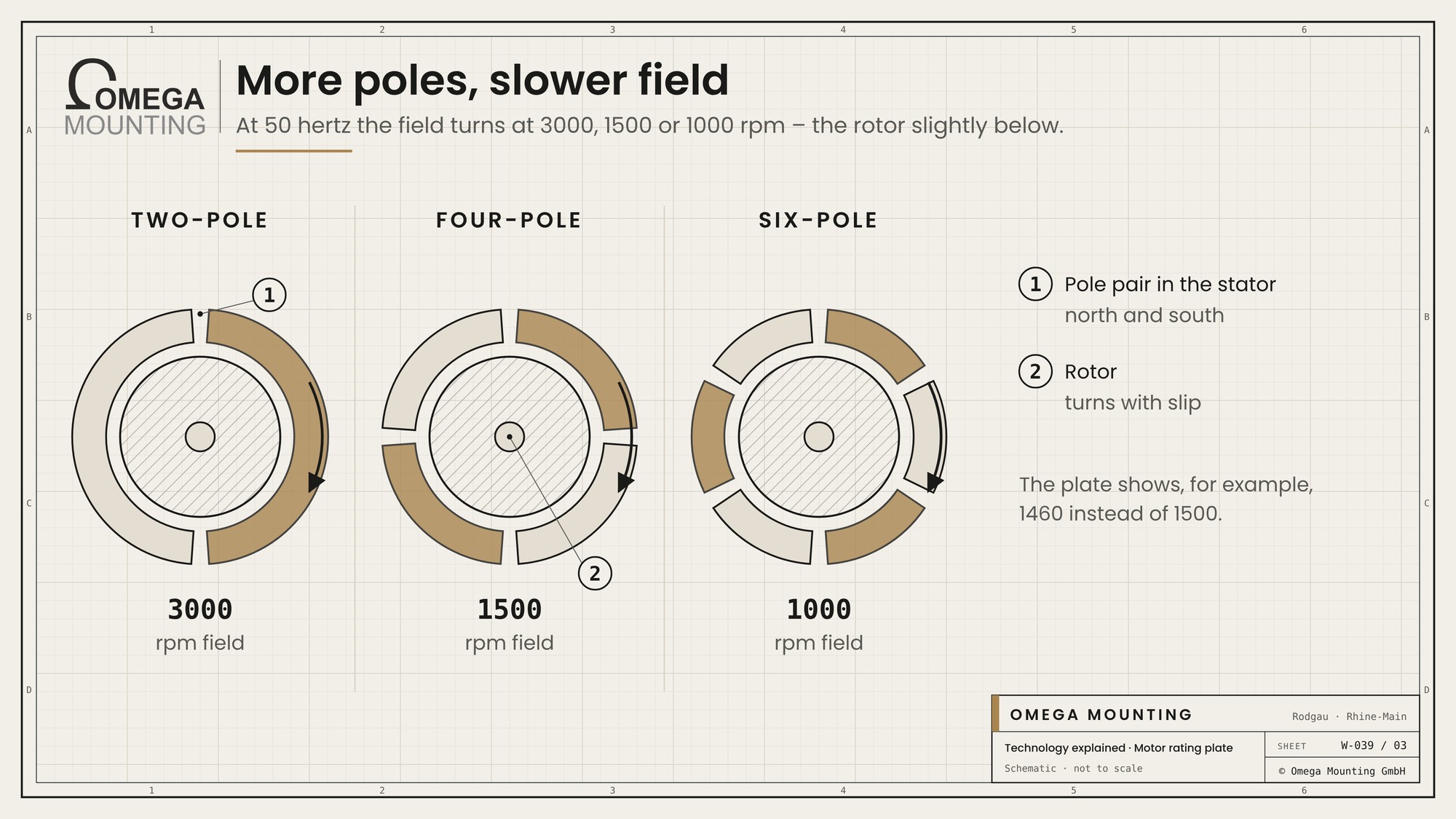
The speed reveals the number of poles. At 50 hertz the field of a two-pole motor turns at 3000, of a four-pole motor at 1500 and of a six-pole motor at 1000 revolutions per minute. Because of slip the rotor stays slightly below – that is why the plate shows, for example, 1460.
IE class and IP rating: the codes in more detail
Two codes most often cause queries when replacing: the efficiency class and the IP rating.
IE class. IE stands for “International Efficiency”. The classes range from IE1 to IE5, a higher number means lower losses. The EU Ecodesign Regulation 2019/1781 prescribes minimum classes for newly placed three-phase motors: IE3 for a wide power range, IE4 for certain larger motors. An old motor may continue to run; the replacement must meet today’s minimum class. More efficient motors may be built slightly differently, so it is worth comparing dimensions before replacing.
IP rating. It follows IEC 60529. The first digit stands for protection against foreign bodies and dust, the second for protection against water. IP55 means: dust-protected and protected against water jets from any direction. In wet areas or with high-pressure cleaning, a higher second digit is needed.
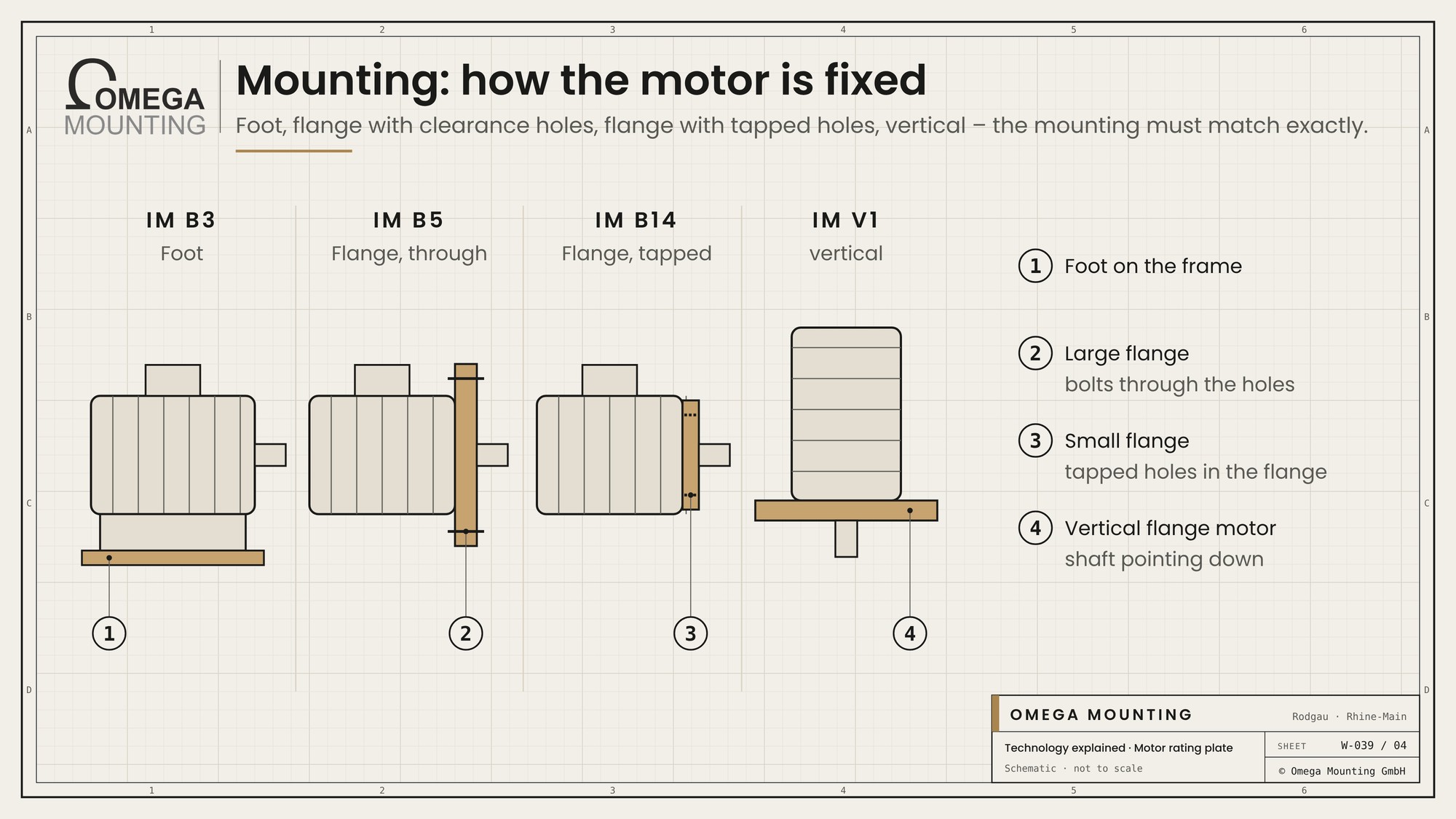
Mounting. The code follows IEC 60034-7. IM B3 is the foot-mounted motor, IM B5 the flange motor with clearance holes, IM B14 the flange with tapped holes, IM V1 the vertical flange motor with the shaft pointing down.
What the rating plate reveals when replacing a motor
If a motor has to be replaced, the rating plate is the most important source. We compare these details between the old and the new motor:
- Mounting and frame size: Foot, flange or both – and the frame size determine whether the new motor fits the same holes.
- Shaft dimensions: Diameter, length and key must match the coupling or pulley.
- Power and speed: The same power with a different number of poles gives a different speed – and therefore a different machine.
- Voltage and connection: Whether the motor runs in star or delta depends on the supply and the motor. The electrician checks this.
- IP rating: The new motor needs at least the same protection class as the old one, rather more in damp or dusty surroundings.
If the old plate is no longer legible, dimensions, weight and mounting type help. The mechanical replacement – releasing, lifting, aligning, coupling – is part of our work. Our electricians handle the electrical connection up to the main switch.
What we pay attention to
We replace motors according to the rating plate – and clarify beforehand what has to fit mechanically.
- We photograph the rating plate before removal while it is legible and accessible.
- When replacing we check mounting, frame size, shaft dimension and flange, not just output and speed.
- We pay attention to the bearing details that many rating plates also give, and to the direction of rotation.
- After installation we align the motor to the machine and measure again.
- Our own qualified electricians disconnect and reconnect the motor; connecting according to the rating plate is part of it.
- We document the new motor in the equipment list so that the next replacement is quicker.
Where we use it
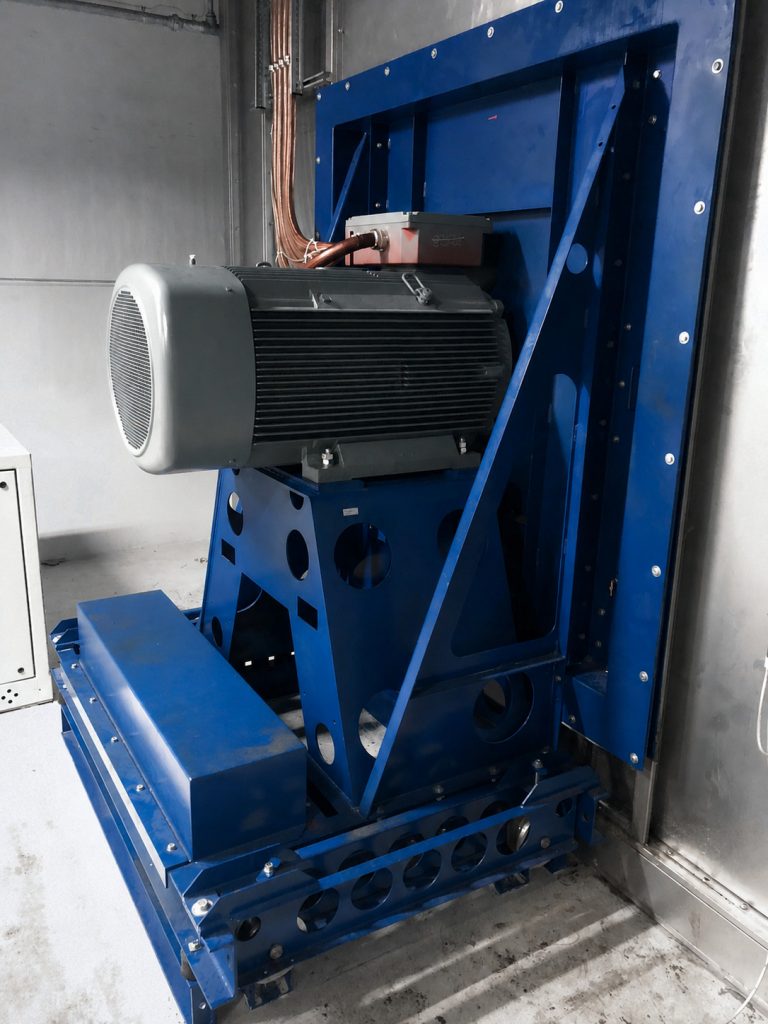
We remove and install motors when bearings, fans or drives are replaced. During the fan bearing replacement in a paint shop near Offenbach the whole unit of motor and fan impeller of around 1.40 metres had to be pulled out of the plant in a controlled way. This was followed by overhaul, bearing replacement and reinstallation. Such work is part of our Maintenance and servicing.
More technology explained
Technology explained
the bearings that are also given on many rating plates.
Technology explained
what adjusts the speed behind the motor.
Guide
the guide to drives and energy consumption.
Do you have questions about how this works on your site?
Do you have questions about how this works on your site – for example, which replacement motor fits your system? We check rating plate and installation dimensions, replace and align. Request a callback – we will get back to you.
Free, no-obligation callback

About the author
Tobias Schott
Managing director of Omega Mounting GmbH, Rodgau · more than 20 years of hands-on experience in installation and maintenance
A trained mechatronics technician, working in maintenance, servicing and industrial installation since 2004 – first alongside his father, and with Omega Mounting since 2012: from overhead conveyors in Frankfurt to the crane system in a new-build hall. He plans and leads lifting operations as an appointed person (AP) in data centers and on industrial sites in the Rhine-Main region, trains and examines operators of cranes, mobile elevating work platforms and telehandlers, and is a qualified occupational safety specialist. On jobs abroad he is known as the “German Troubleshooter” – the person you call when a site gets stuck. He learned what quality means from his father, not from a manual: Made in Germany as a standard for his own work, not a label. That is why quality comes first at Omega Mounting – ahead of speed and price. The Technology explained articles cover the equipment and techniques his team uses every day: what counts on site is in them – what only appears in the brochure is not.
 English
 German