
- Technology explained – technology and procedures
Plain bearings: bushing, lubrication and why they run dry
By Tobias Schott · 5-minute read · Updated November 2026
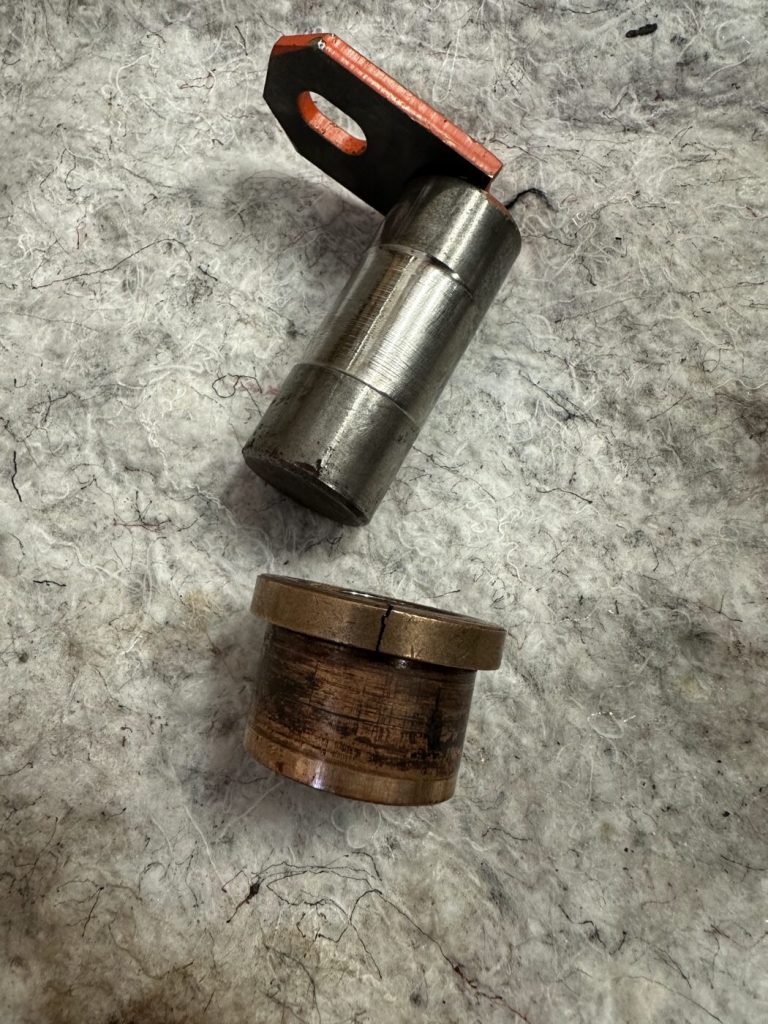
A plain bearing guides a shaft or pin in a bushing on which it slides directly – it is simple, robust and tolerates shocks, but needs a lubricating film in the gap, and with slow, small movements that is exactly what is often missing, so the bearing works in mixed friction and wears in quickly without grease.
Plain bearings sit in many components that hardly look like bearings: in pivot pins, pivot points of flaps and levers, trolleys of overhead conveyors, crane wheels and pumps. Because they are inconspicuous, they are often forgotten – until something squeaks.
Here we explain how plain bearings differ from rolling bearings, which friction states exist, which bushings and materials are common and how a plain bearing wears in.
What is a plain bearing?
A plain bearing is a bearing in which the moving parts slide on each other. Ideally there is a lubricating film of oil or grease between shaft and bearing shell, or with some materials a built-in sliding layer.
In German it is called „Gleitlager“, the bushing „Buchse“. In maintenance it usually appears as a bushing in which a pin or shaft runs. Our article on ball, roller, thrust and plain bearings gives an overview of all bearing types.
Key facts
- Principle: shaft or pin slides in a bushing.
- Strengths: simple, compact, shock-resistant, quiet, also suitable for swivelling movements.
- Weakness: needs a lubricating film, otherwise wear through direct contact.
- Materials: bronze, sintered bronze, composite materials with a sliding layer, plastics.
- Lubrication: grease or oil via grease nipple and grease groove, or self-lubricating.
- Wear parts: Running grooves, widened bush, growing play, fretting corrosion.
Plain or rolling bearing?
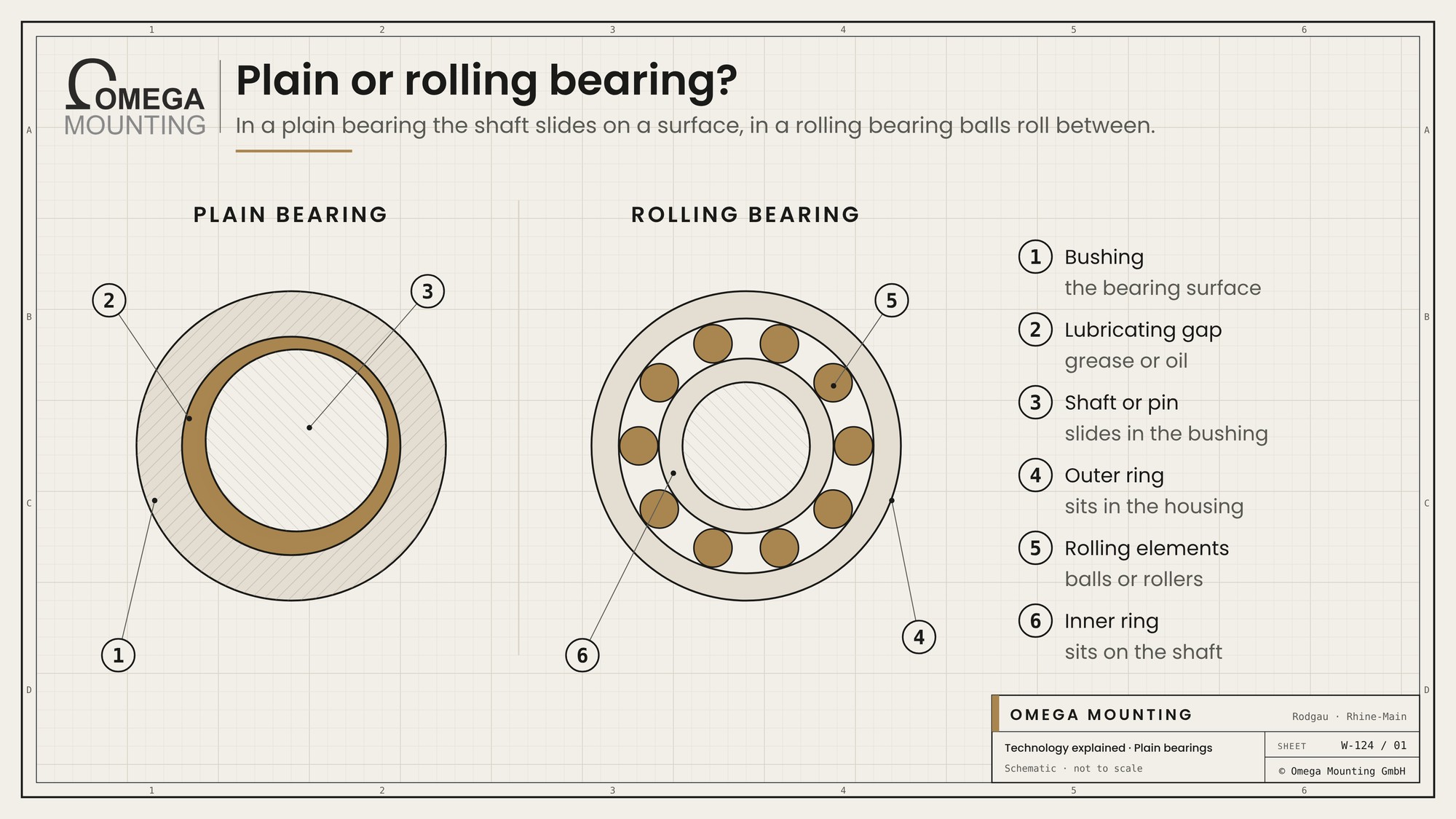
Both bearings guide a shaft, but in different ways.
| Characteristic | Plain bearing | Rolling bearing |
|---|---|---|
| Principle | Sliding on a surface | Rolling of balls or rollers |
| Installation space | very small, often just a bushing | larger, with rings and cage |
| Shocks | good, large contact area | more sensitive, load on small contact points |
| Swivelling movement | well suited | less suited, false brinelling possible |
| Lubrication | decisive for the lubricating film | usually grease-filled, often sealed |
| Typical use | Pins, joints, slow pivots | fast-rotating shafts, motors, rollers |
For joints that only swivel back and forth, the plain bearing is often the better choice. For shafts that turn fast and for long periods, usually the rolling bearing.
The three friction states
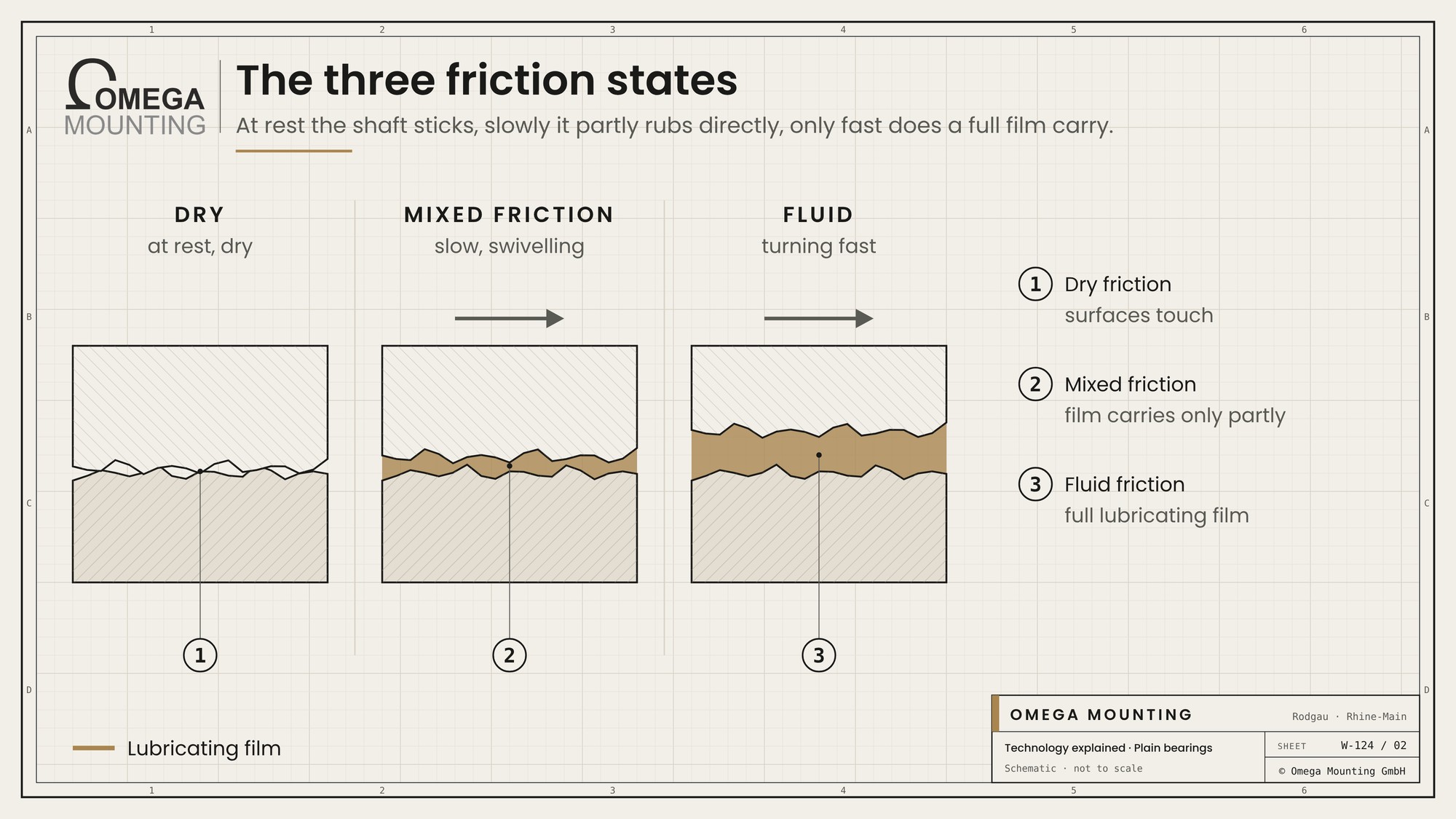
How well a plain bearing runs depends on whether the lubricating film separates the surfaces.
- Dry friction: The surfaces touch directly, for example at rest or without lubrication.
- Mixed friction: The lubricating film carries only partly, the surfaces still touch in many places.
- Fluid friction: A full lubricating film separates the surfaces, there is hardly any wear.
A full lubricating film only builds up when the shaft turns fast enough. It then draws the lubricant into the gap and floats on it. With slow, small swivelling movements under load, this does not happen. Pins in joints therefore almost always work in mixed friction. Then only the grease in the gap stops metal rubbing on metal.
Bushings and materials
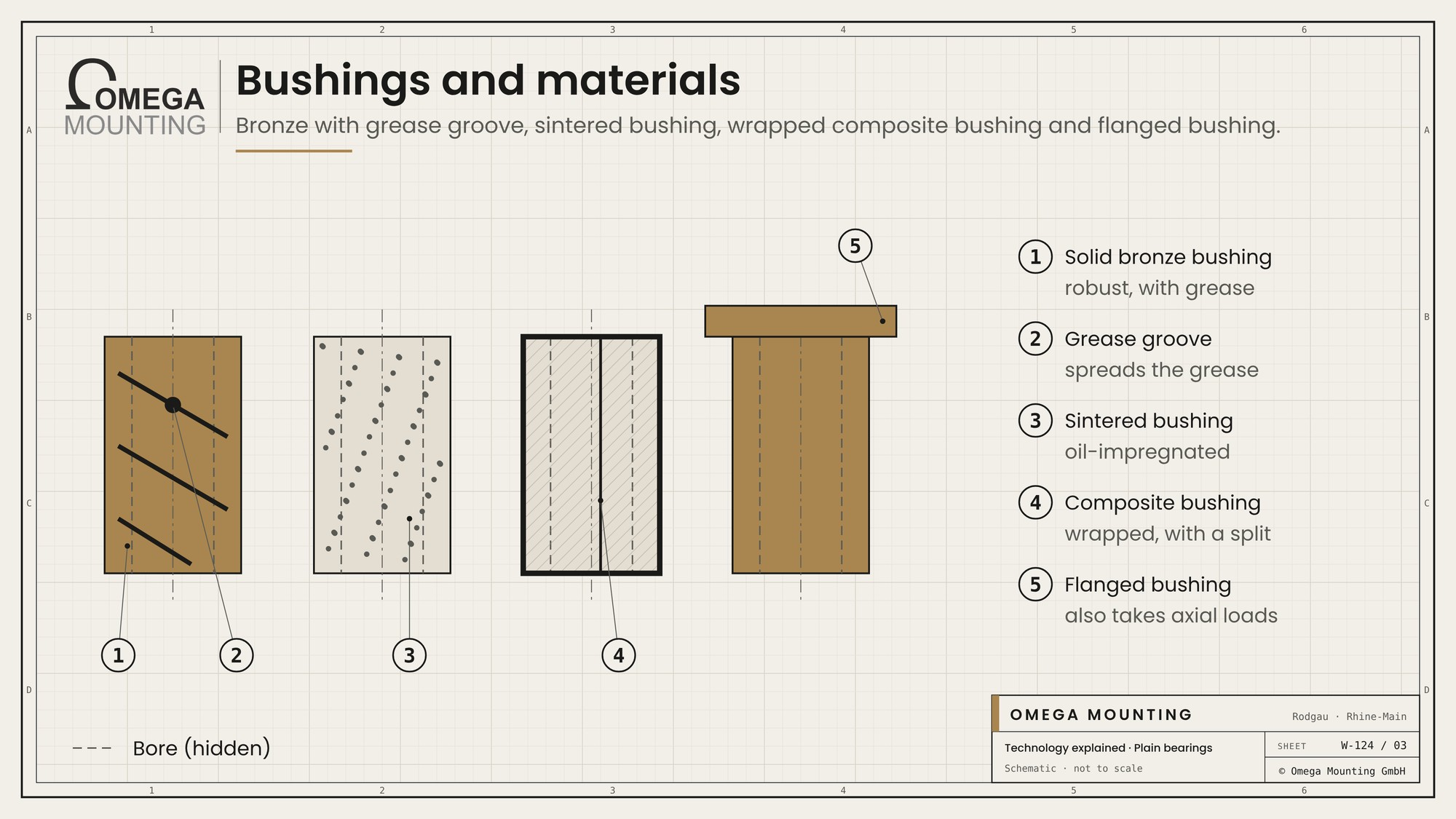
Plain bearing bushings come in many designs.
- Solid bronze bush: robust and shock-resistant, with grease grooves. The classic for pins under high load.
- Sintered bush: made of pressed metal powder, impregnated with oil. Releases oil when moving, for low loads.
- Wrapped composite bush: steel back with a sliding layer, often containing plastic. Depending on design runs with little or no lubrication.
- Plastic bush: light and corrosion-resistant, for smaller loads.
- Flanged bushing and thrust washer: also take forces in the axial direction.
Self-lubricating bushings are often called maintenance-free. But that only applies within the limits they are designed for. Whether a bearing point needs grease is stated in the system documentation or by the manufacturer.
How a plain bearing wears in
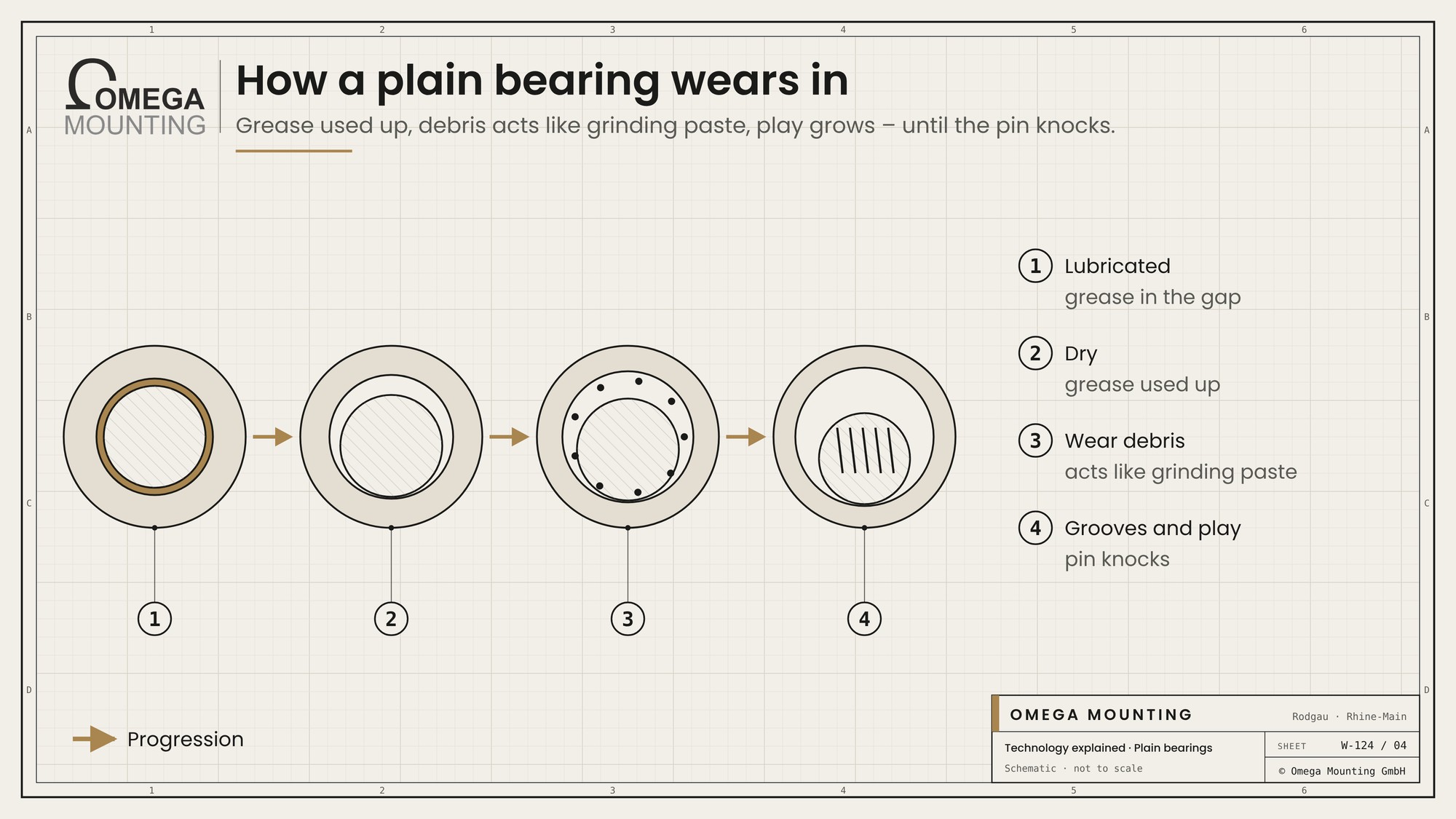
A plain bearing rarely fails suddenly. Usually a chain of events takes place.
- Grease ages: It resinifies, is pushed out or used up by heat and debris.
- Dry running: Pin and bushing rub directly on each other.
- Debris: The particles act like grinding paste in the gap.
- Running grooves: The pin gets grooves, the bushing widens.
- Play: The fit turns into a knocking joint.
Warning signs are squeaking and creaking, noticeable play and red-brown dust at the ends of the bearing point – fretting rust. Every running groove also acts as a notch where fatigue of the pin starts.
Record per carrier: On an electrified monorail each hanger usually carries a vehicle number. Sorting findings and pin and bush replacements by that number quickly shows whether individual carriers wear in unusually often – then the cause usually lies with the carrier, not the bearing.
Typical mistakes
- Only the pin replaced: The new pin runs with play in the old, widened bushing straight away.
- Bush driven in: Driven in with a hammer it deforms and the bore is damaged.
- Wrong grease: It does not suit load, temperature or environment, for example in food production.
- Lubrication groove clogged: The grease nipple takes grease, but it does not reach the gap.
- „Maintenance-free“ never checked: The bearing point runs for years without anyone looking inside.
Replacing a bush
If a plain bearing is worn, usually only the bush is replaced. For the new bearing to last, the details matter:
- Press out the old bush: The bush is removed with a press or puller, not knocked out. Blows damage the bore.
- Check the bore: The housing is cleaned and checked for scoring, rust and dimensional accuracy. If the new bush does not sit tightly, it creeps.
- Look at the shaft: A worn shaft destroys the new bush too. It is checked and reworked or replaced if necessary.
- Press in: The new bush is pressed in straight with suitable tooling. Lubrication holes and grooves must then be in the right place.
- Lubricate and run in: Depending on the design, it is lubricated before starting. The bearing then runs in under light load.
With maintenance-free bushes the opposite applies: they are not additionally greased, because grease and dirt can form a grinding paste. Which variant is fitted is stated in the parts list or on the bush itself.
What we pay attention to
With plain bearings, cleanliness and fit are decisive.
- We pull a sample and measure pin and bushing before deciding on the scope.
- We always replace pin and bushing as a pair.
- We clean the bearing seat and check it for damage.
- We press bushings in with a mandrel or press, not with a hammer.
- We grease with the grease that the manufacturer and the environment require.
Where we use it
In a food production plant the electrified monorail squeaked on almost every vehicle. During the pin repair on the electrified monorail a removed pin showed the typical picture: bronze bushing and pin worn in, deep grooves, significant material loss, lubrication practically gone. The pin-and-bearing joint in the carrier swivels under load on every trip – mixed friction in its purest form. Two to three fitters overhauled all 80 vehicles, ten to fifteen per weekend, replacing pin and bushing as a pair each time. More on this on our page Maintenance and servicing.
In depth in our guide (German): EMS king pin and plain bearings: play, squeal, replacement
More technology explained
Technology explained
the overview of all bearings.
Technology explained
a plain bearing that carries the whole load.
Technology explained
which grease belongs in the bushing.
Do you have questions about how this works on your site?
Do you have joints and pins that squeak or have play? We pull a sample, measure and replace pin and bushing as a pair. Request a callback.
Free, no-obligation callback

About the author
Tobias Schott
Managing director of Omega Mounting GmbH, Rodgau · more than 20 years of hands-on experience in installation and maintenance
A trained mechatronics technician, working in maintenance, servicing and industrial installation since 2004 – first alongside his father, and with Omega Mounting since 2012: from overhead conveyors in Frankfurt to the crane system in a new-build hall. He plans and leads lifting operations as an appointed person (AP) in data centers and on industrial sites in the Rhine-Main region, trains and examines operators of cranes, mobile elevating work platforms and telehandlers, and is a qualified occupational safety specialist. On jobs abroad he is known as the “German Troubleshooter” – the person you call when a site gets stuck. He learned what quality means from his father, not from a manual: Made in Germany as a standard for his own work, not a label. That is why quality comes first at Omega Mounting – ahead of speed and price. The Technology explained articles cover the equipment and techniques his team uses every day: what counts on site is in them – what only appears in the brochure is not.
 English
 German