
- Technology explained – key term
Property classes of bolts: why 12.9 is not always better
By Tobias Schott · Reading time approx. 8 minutes · As of: November 2026
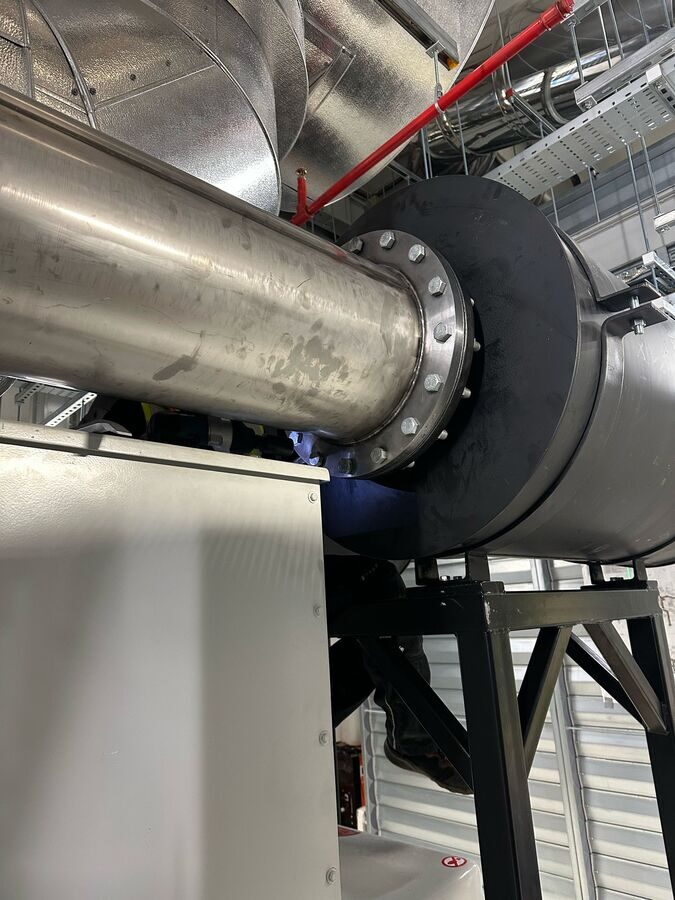
The property class on the bolt head says how much tension a bolt can withstand and from when it stretches permanently – anyone who can read it uses neither a bolt that is too weak nor blindly the strongest one.
You encounter bolt property classes on every hexagon head, on the delivery note, in assembly instructions and in tenders: 8.8, 10.9, 12.9, A2-70. Almost everyone knows the numbers, far fewer know what lies behind them.
This article explains the whole world of classes from the steel bolt to the structural bolting assembly. Which tightening torque belongs to which class is given in the torque table for bolts – we deliberately do not give torques here.
What is a bolt property class?
A property class is a standardised marking that indicates which tensile strength and which yield strength the material of a bolt achieves. For bolts made of carbon steel and alloy steel this is governed by ISO 898-1, for stainless steel bolts by ISO 3506. Tensile strength is the stress at which the bolt breaks. Yield strength is the stress from which it stretches permanently.
The class describes the material, not the whole bolt. How much force an M12 carries only follows from class and stress cross-section, the load-bearing area in the thread. In German the property class is called Festigkeitsklasse, the high-strength bolt hochfeste Schraube.
Key facts
- Definition: Standardised marking for tensile strength and yield strength of the bolt material, for steel as two numbers with a dot, for stainless steel as steel group with a number.
- Also known as: In companies often called “quality” or “grade” (“an 8.8”), for stainless steel “A2-70” as short form for steel group and class.
- Terminology: Property class; in German Festigkeitsklasse; high-strength bolt: hochfeste Schraube.
- Where you find it: Head marking, delivery note, mill certificate, drawing, assembly instructions, tender.
- Often confused with: With the steel grade of the component, such as S235 in steelwork, with hardness, with the grade system of American inch bolts and with the height of the nut.
What do the numbers mean? The formula behind 8.8
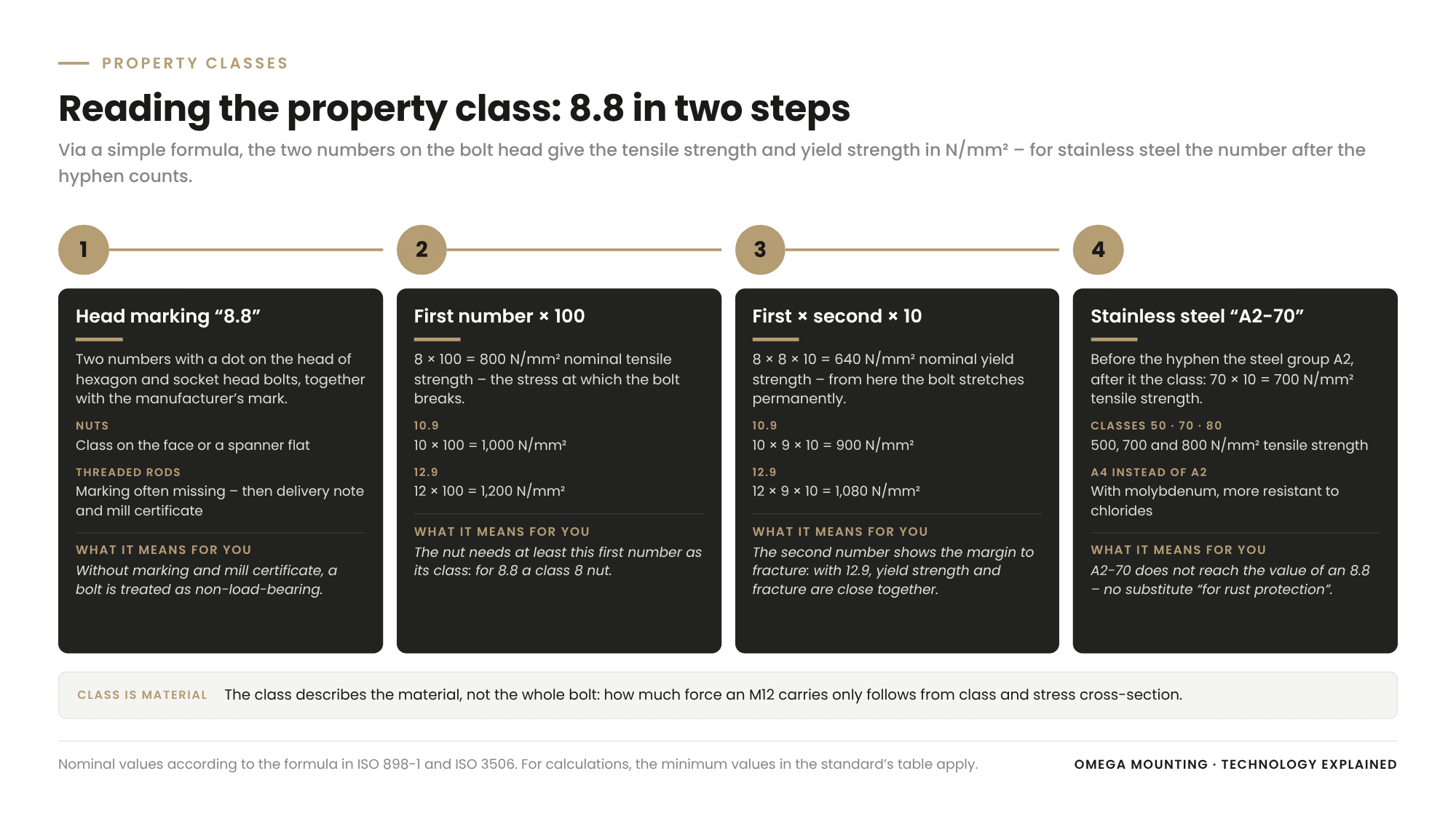
Via a simple formula, the two numbers of a steel class give tensile strength and yield strength in newtons per square millimetre. The first number times 100 is the nominal tensile strength. The first number times the second times 10 is the nominal yield strength.
Using 8.8 as an example:
- First number 8: 8 × 100 = 800 N/mm² tensile strength.
- Second number 8: The yield strength is eight tenths of the tensile strength.
- Both together: 8 × 8 × 10 = 640 N/mm² yield strength.
For 10.9 the formula gives 1,000 and 900 N/mm², for 12.9 it is 1,200 and 1,080 N/mm². The standard tables give minimum values at or just above these nominal values – for a calculation the table counts, for understanding the formula is enough.
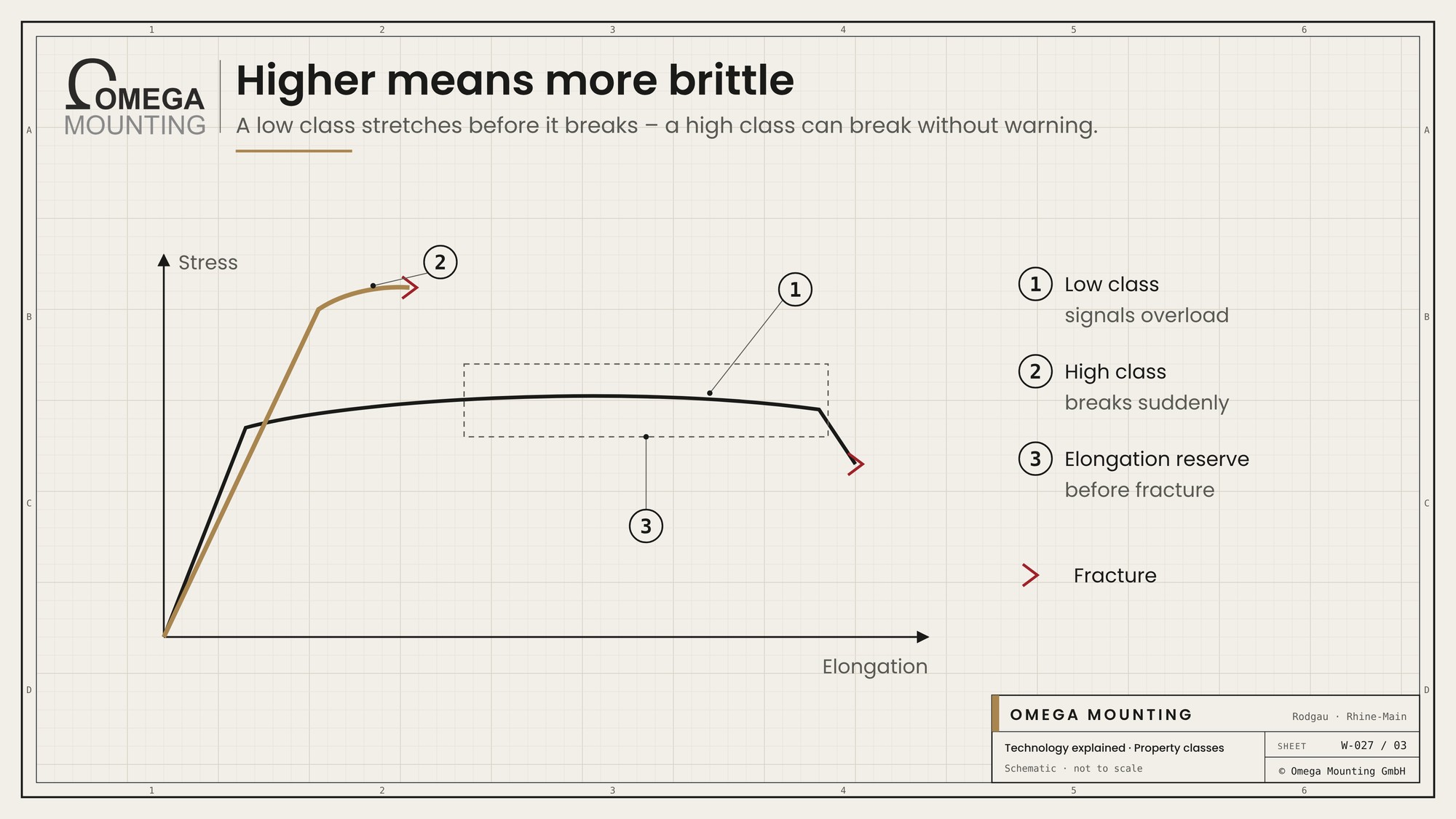
The second number shows how much margin there is between permanent elongation and fracture. A 4.6 stretches for a long time before it breaks; with a 12.9 both limits are close together.
From 4.6 to 12.9: all steel classes compared
The steel standard has nine property classes for bolts: 4.6, 4.8, 5.6, 5.8, 6.8, 8.8, 9.8, 10.9 and 12.9. From 8.8 upwards, bolts are considered high-strength in practice; they are quenched and tempered. The classes below are usually not heat-treated.
| Class | Material | Typical use | Note |
|---|---|---|---|
| 4.6 | Carbon steel, usually not heat-treated. | Simple fastenings, black bolts in steelwork. | According to the formula 400 and 240 N/mm². |
| 4.8 | Carbon steel, usually not heat-treated. | Threaded rods, sheet metal joints, secondary fastenings. | 400 and 320 N/mm². |
| 5.6 | Carbon steel, usually not heat-treated. | Non-preloaded joints in steelwork, brackets, railings. | 500 and 300 N/mm². |
| 5.8 | Carbon steel, usually not heat-treated. | Threaded rods, fastenings with medium load. | 500 and 400 N/mm². |
| 6.8 | Carbon steel, usually not heat-treated. | Threaded rods; less common in trade. | 600 and 480 N/mm². |
| 8.8 | Carbon steel, partly with additions, quenched and tempered. | Standard in mechanical engineering, plant installation and steelwork. | 800 and 640 N/mm²; nut at least class 8. |
| 9.8 | Like 8.8, quenched and tempered. | Small diameters; rare in trade. | 900 and 720 N/mm²; only standardised for smaller diameters. |
| 10.9 | Carbon steel with additions or alloy steel, quenched and tempered. | Highly loaded machine joints, preloaded joints in steelwork. | 1,000 and 900 N/mm²; nut class 10, hardened washer. |
| 12.9 | Alloy steel, quenched and tempered. | Socket head cap screws in tool and fixture making. | 1,200 and 1,080 N/mm²; nut class 12, notch-sensitive. |
A bolt needs a nut whose class corresponds at least to the first number of the bolt. The nut standard ISO 898-2 includes classes 5, 8, 10 and 12 for this, among others. Thin nuts, such as lock nuts, carry a leading zero and are not designed for the full load.
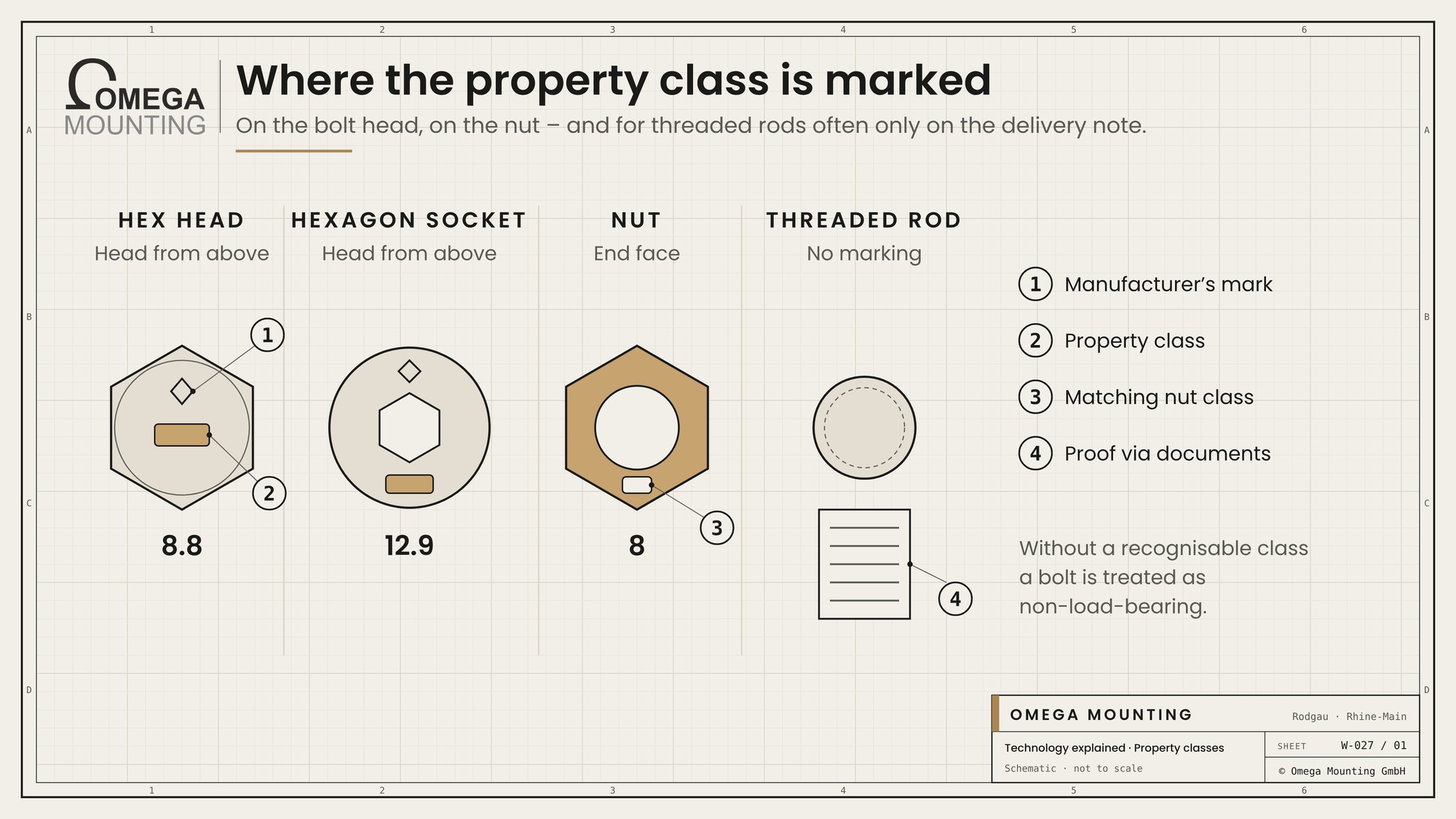
Hexagon and socket head bolts carry class and manufacturer’s mark on the head, nuts their class on the face or a spanner flat. Threaded rods often lack the marking – then delivery note and mill certificate remain.
Stainless steel A2 and A4: why A2-70 does not replace an 8.8
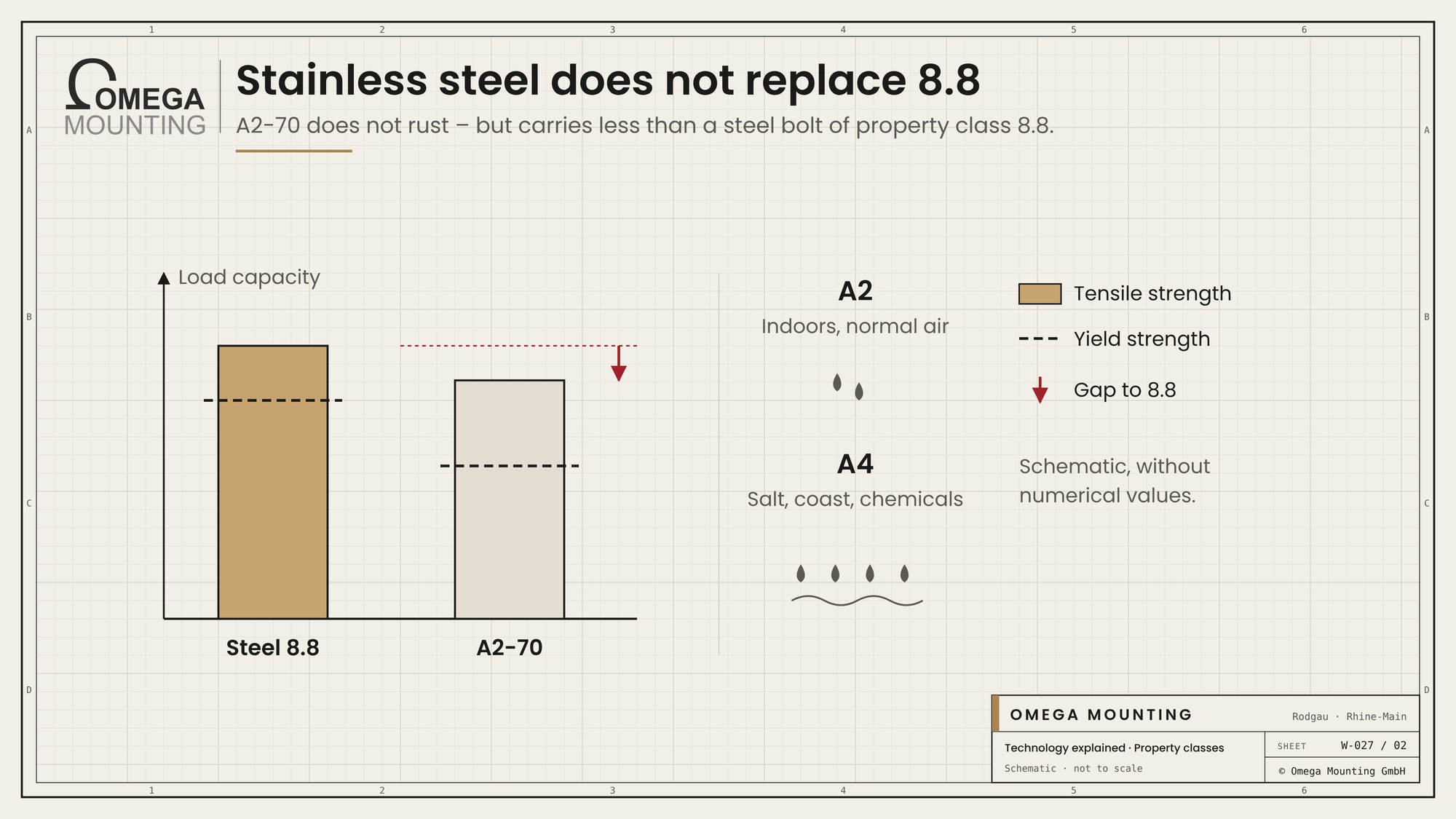
For stainless steel bolts the steel group is in front of the hyphen and the property class after it; its number times 10 gives the tensile strength. A2-70 therefore means: austenitic stainless steel of group A2 with 700 N/mm² tensile strength. The stainless steel standard has classes 50, 70 and 80 for these steels, i.e. 500, 700 and 800 N/mm².
- A2: Chromium-nickel steel, the standard for indoor use and normal outdoor air.
- A4: Additionally alloyed with molybdenum and therefore more resistant to chlorides – for coastal areas, chemicals and plants with aggressive cleaning agents.
A2-70 does not reach the value of an 8.8 even in tensile strength, and the yield strength is proportionally lower. Anyone who swaps an 8.8 for A2-70 “for rust protection” is therefore using a weaker bolt. In addition, stainless steel on stainless steel tends to seize, i.e. the thread flanks cold-weld – a suitable assembly paste belongs there.
Why not 12.9 everywhere? Toughness, hydrogen, galvanising
Higher strength costs toughness: the higher the class, the less the bolt stretches before breaking and the more sensitive it is to notches, impacts and corrosion. A 4.6 signals overload by elongation. A 12.9 can break without warning, for example at a score in the thread root.
Three points from the surface are added:
- Hydrogen embrittlement: During electroplating, hydrogen can get into the steel. Above all 10.9 and 12.9 become brittle and can suffer delayed fracture, i.e. only some time after tightening under load.
- Zinc flake instead of electroplating: For high-strength bolts a zinc flake coating is common, which is applied without this hydrogen ingress.
- Hot-dip galvanising: The thick zinc layer needs nuts with an oversize tapped thread. Hot-dip galvanising is not usual for 12.9.
In steelwork there are separate assemblies to EN 14399 for joints that are preloaded as planned, known in German as HV for “high-strength preloaded”. Bolt, nut and washers come as a matched unit from one manufacturer, carry the HV marking and are not mixed with loose parts. HV bolts are available in 8.8 and 10.9.
This results in the replacement rule: never use a lower class than intended. A bolt without a recognisable class is treated as non-load-bearing. And higher is not automatically better – a 12.9 in place of an 8.8 needs a matching nut, hardened washer, a different tightening torque and a design that allows it. Whoever changes the class changes the design.
What we pay attention to
On every load-bearing joint we read the class before we apply the spanner.
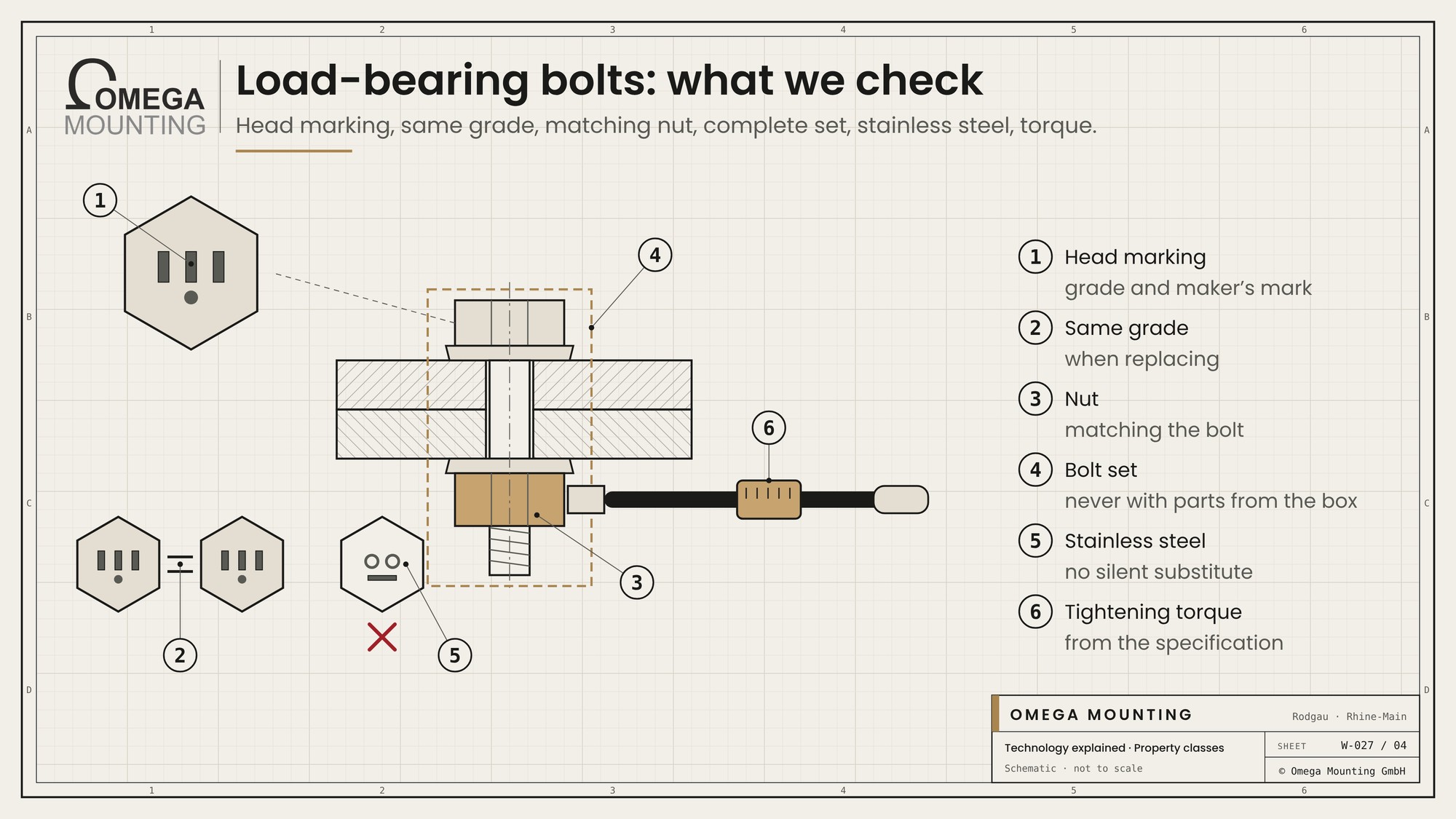
- We check the head marking and manufacturer’s mark of every load-bearing bolt; without marking and mill certificate it is not used for load-bearing purposes.
- We replace removed bolts with the same class and a matching nut, unless the design specification requires otherwise.
- We check the nut too: a 10.9 on a nut that is too weak does not deliver what the bolt promises – the nut thread can strip.
- We do not mix HV assemblies with parts from the box.
- For stainless steel we clarify whether A2 or A4 is required, and never use stainless steel as a silent substitute for high-strength steel.
- We take the tightening torque from the specification for class and friction, for anchors from the anchor manufacturer’s data – how this works when aligning and anchoring a machine is described in the guide.
Where we use it
In our work, bolted joints occur in steelwork as well as on machines and systems. During the construction of a Steel platform at Kassel Airport we bolted profiles and beams and connected the railing brackets to the load-bearing steel profiles, not just to the decking. During the installation of turbo silencers in a data center in Offenbach we aligned the silencers on base frames more than 2 m high and bolted them firmly; the stainless steel piping hangs on bolted flanges. Such joints are part of our Industrial installation.
- Torque table for bolts: tightening torques, friction, flange – the guide with tightening torques per class and friction.

Need fitters who know this process?
Thread types: metric, inch, pipe, trapezoidal – how to recognise them – the thread on which the property class sits. Bolt locking: what holds – and why the spring washer is obsolete – why the preload force from the right class is the first lock.
Are you planning a project that requires steelwork or machine joints with specified property classes and need fitters who know them? We read the specification, check every assembly and document what has been installed. Request a callback – we will get back to you.
Free, no-obligation callback

About the author
Tobias Schott
Managing director of Omega Mounting GmbH, Rodgau · more than 20 years of hands-on experience in installation and maintenance
A trained mechatronics technician, working in maintenance, servicing and industrial installation since 2004 – first alongside his father, and with Omega Mounting since 2012: from overhead conveyors in Frankfurt to the crane system in a new-build hall. He plans and leads lifting operations as an appointed person (AP) in data centers and on industrial sites in the Rhine-Main region, trains and examines operators of cranes, mobile elevating work platforms and telehandlers, and is a qualified occupational safety specialist. On jobs abroad he is known as the “German Troubleshooter” – the person you call when a site gets stuck. He learned what quality means from his father, not from a manual: Made in Germany as a standard for his own work, not a label. That is why quality comes first at Omega Mounting – ahead of speed and price. The Technology explained articles cover the equipment and techniques his team uses every day: what counts on site is in them – what only appears in the brochure is not.
 English
 German