
- Technology explained – key term
Discard criteria: how to tell when lifting accessories must be withdrawn from service
By Tobias Schott · 7-minute read · Updated October 2026
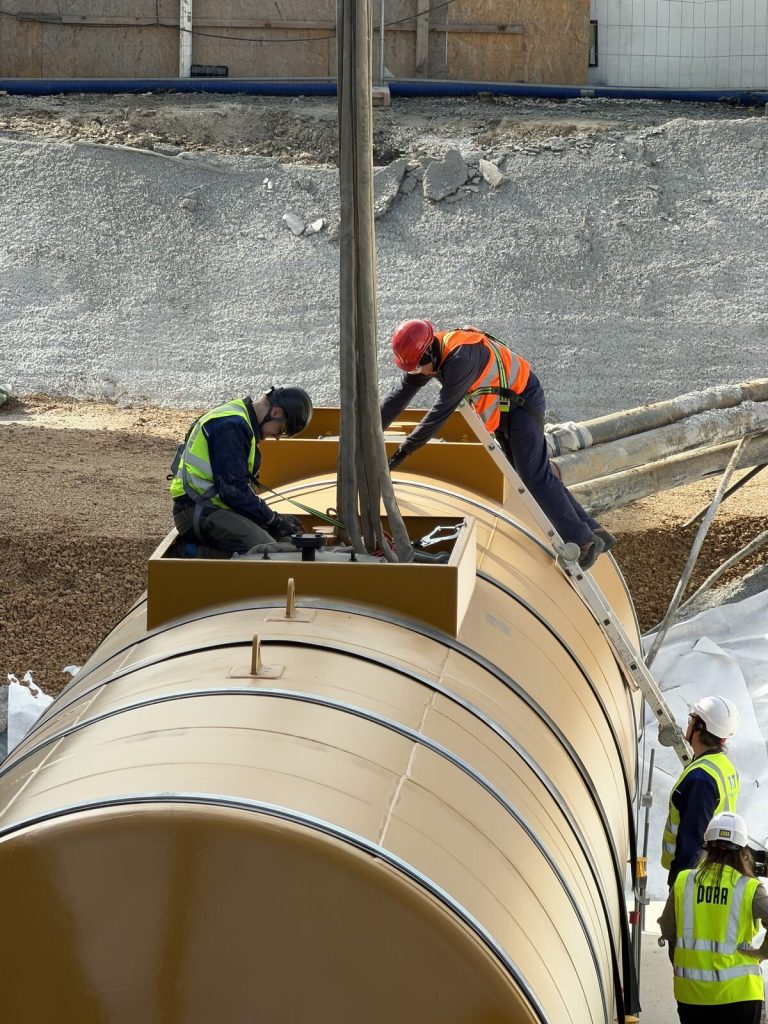
Discard criteria define when a lifting accessory or fall arrest equipment may no longer be used – miss them and you hang the load on a part whose capacity nobody knows any more.
The German term Ablegereife appears in inspection records, operating instructions and slinger training. On site it sounds shorter: “That sling’s done” or “The chain goes in the bin”. The meaning is always the same: the item is discarded, i.e. permanently taken out of service.
This article explains what discard criteria mean, how to recognise them and what happens to the item afterwards. How round slings, chains and harnesses are built is covered in separate articles – we link to them at the end.
What are discard criteria?
Discard criteria describe the condition in which a lifting accessory, below-the-hook lifting device or part of a fall protection system may no longer be used because of damage, wear or missing marking.
Discarding does not mean putting an item aside until next time; it means removing it for good. A discarded item is not used again, not lent out and not kept “just for light loads”. The criteria come from the German statutory accident insurance rules, the product standards and the manufacturer. The German term is Ablegereife; English documents speak of discard criteria or removal from service.
For lifting accessories used with cranes and hoists, DGUV Rule 100-500 summarises the discard criteria. For fall arrest PPE (personal protective equipment against falls from height), DGUV Rule 112-198 applies.
Key facts
- Definition: The condition in which a lifting accessory, below-the-hook lifting device or part of the fall arrest PPE may no longer be used for safety reasons and is withdrawn from service.
- Also known as: removal from service, withdrawal from service, condemned (in inspection reports)
- Terminology: German: Ablegereife, Ablegekriterien; an item that meets them is “ablegereif”. English: discard criteria, “to be discarded” or “withdrawn from service”.
- Where you find it: Inspection records of the competent person, manufacturers’ operating instructions, slinger training, lift plans and inspection checklists in tender documents
- Often confused with: The inspection tag (it shows the last inspection, not today’s condition), the service life stated by the manufacturer (discard criteria can be met much earlier) and a repairable defect (a discarded item is replaced, not patched up).
- Who decides: First the user, at the visual check before use; then the competent person at the periodic inspection.

How do you recognise discard criteria on lifting accessories and PPE?
You recognise them by damage that can reduce the working load limit or the protective function – and by missing or illegible marking, however new the item looks. Each type has its own signs. The table summarises the typical criteria; limits not listed here follow the relevant standard or the manufacturer’s data.
| Item | Typical discard criteria | Who inspects |
|---|---|---|
| Round sling | Cover damaged so that the load-bearing core is visible; cuts, abrasion, melted or hardened areas; chemical damage; knots; label missing or illegible | User before every use; competent person at least once a year |
| Webbing sling | Cuts and tears in the webbing, especially at the edges; damaged load-bearing stitching; heat distortion; chemical damage; label missing or illegible | User before every use; competent person at least once a year |
| Chain sling | Broken link; cracks; permanent deformation; elongation of more than 5%; link thickness reduced by more than 10%; deep corrosion pitting; tag missing | User before every use; competent person at least once a year, plus a crack test at least every three years |
| Wire rope sling | Broken strand; more visible broken wires over a reference length than the standard allows; kinks, crushing, birdcaging; heavy corrosion; damaged ferrule or splice | User before every use; competent person at least once a year |
| Hooks and shackles | Hook throat opened by more than 10%; deformation, cracks, wear; safety latch missing or sticking; bent or non-matching shackle pin; damaged thread | User before every use; competent person together with the sling set |
| Fall arrest PPE | Any arrested fall; deployed energy absorber; cuts, abrasion and opened stitching on harness and lanyard; deformed metal parts; end of the service life stated by the manufacturer | User before every use; qualified person at least once a year and after every fall |
Two rules apply to every item. An item without legible marking has no known working load limit and must therefore be discarded. And an item exposed to heat, acid or alkali is suspect: textile fibres can be damaged without any sign on the surface.
Pre-use check or periodic inspection: who decides on discard?
Two parties decide: the user at the visual check before every use, and the competent person at the periodic inspection.
The pre-use check is short but thorough. The slinger runs the sling through their hand and looks at the label, edges and stitching. On a chain, they check links, hooks and safety latch. If they find damage, the lift is over for that item – no second opinion needed.
The periodic inspection goes deeper. The German Industrial Safety Ordinance (BetrSichV) requires the employer to set the type, scope and intervals of inspection for its work equipment. The inspection is carried out by a competent person (befähigte Person) as described in TRBS 1203. For lifting accessories, the German accident insurance rules set a maximum interval of one year. UK readers: under LOLER 1998, lifting accessories need a thorough examination at least every six months.
The competent person measures what the eye cannot: chain elongation, link thickness, hook throat opening. They record the findings and either return the item to service or discard it. Who may carry out which inspection, and how to organise inspection intervals in your company, is covered in our guide to inspection obligations for operators. This is not legal advice but a practical guide for everyday work on site.
A valid inspection tag does not replace the pre-use check. The tag says the item was fine at the last inspection. It says nothing about whether it survived the last lift undamaged.
What happens to a lifting accessory that meets the discard criteria?
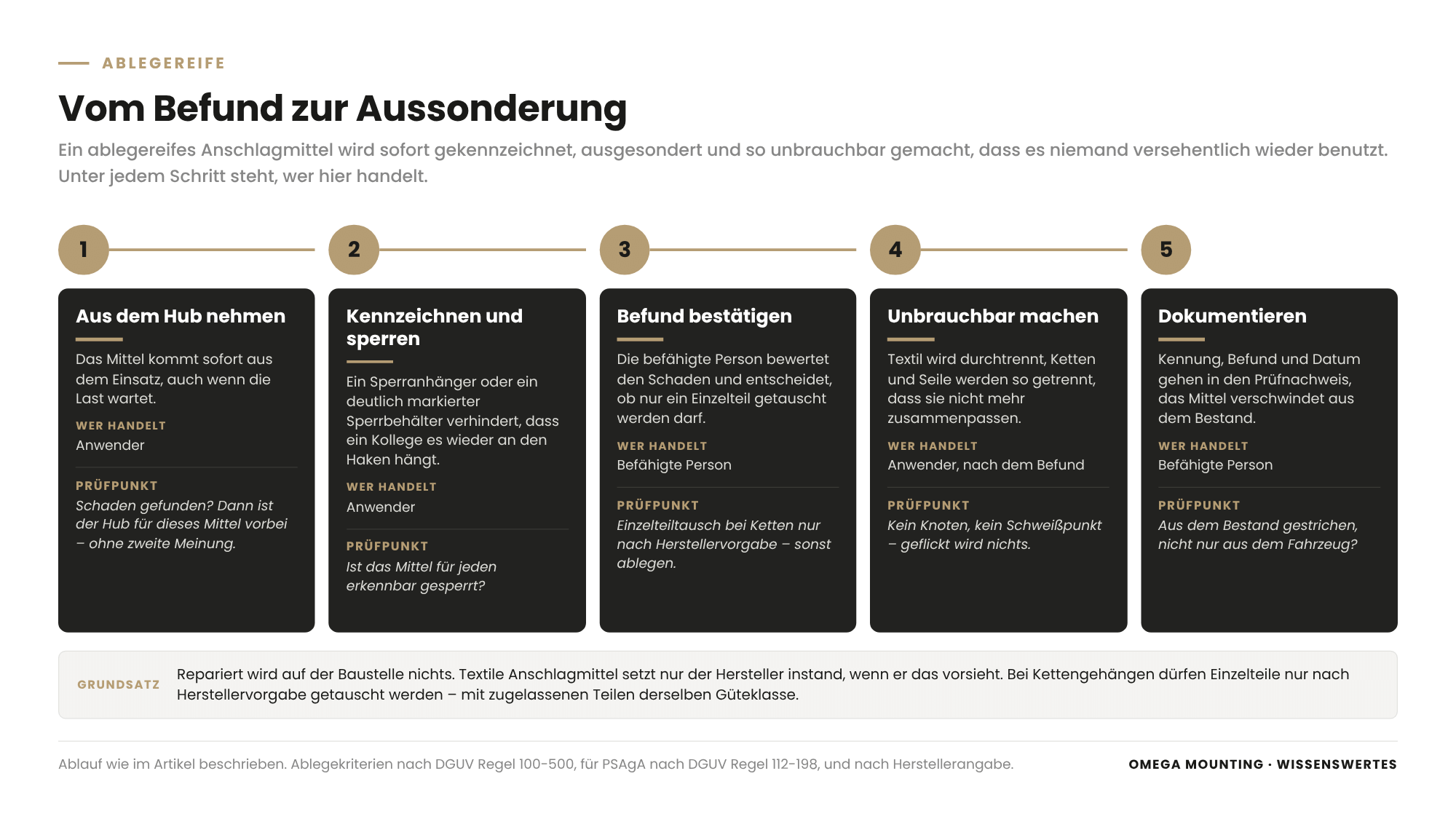
A lifting accessory that meets the discard criteria is tagged, withdrawn and made unusable at once, so that nobody uses it again by mistake.
- Take it out of the lift. The item is withdrawn at once, even if the load is waiting.
- Tag and quarantine. A quarantine tag or a clearly marked quarantine bin stops a colleague from putting it back on the hook.
- Confirm the findings. The competent person assesses the damage and decides whether a single component may be replaced.
- Make it unusable. Textile slings are cut through; chains and wire ropes are cut so that the parts no longer fit together.
- Record it. Identification, findings and date go into the inspection record, and the item is removed from the inventory.
Nothing is repaired on site. Textile slings are repaired only by the manufacturer, and only if the manufacturer allows it. On chain slings, components such as hooks or connecting links may only be replaced as the manufacturer specifies – with approved parts of the same grade to DIN EN 818. A knot in a damaged sling or a weld on a chain link does not make a discarded item safe.
Why are discard criteria often spotted too late?
Discard criteria are rarely missed because nobody looks. They are missed because the damage is hidden or the item is familiar.
- The damage sits in the hook. The section that lay in the hook or over an edge is often not exposed during the visual check.
- The label has faded. UV light, abrasion and dirt make it illegible long before the sling looks worn.
- The chain looks solid. The eye can barely judge elongation and link thickness, and cannot see hairline cracks at all.
- Discarding gets postponed. “It’ll do for today” – that is exactly how a damaged sling ends up back in the van.
What we pay attention to
Our fitters treat discard as a decision made before the lift, not after it.
- We check every lifting accessory twice: when loading the vehicle and directly before slinging.
- We read the label or tag first – if the marking is missing or illegible, the item stays out of use.
- We discard as soon as one criterion applies, with no debate about “still good enough”.
- We make discarded textile slings unusable at once, so they cannot find their way back.
- We discard fall arrest PPE after every fall, even if it looks undamaged, and pass it to the qualified person.
- We check lifting accessories supplied by the client exactly like our own before any load goes on them.
Where we use it
In the Rhine-Main region, we make the discard decision on every lift. When five diesel tanks were installed in Raunheim, each tank of around 16 tonnes hung from a sling set of round slings and shackles. Before slinging, each of the four welded-on lifting points had a visual check. When moving standby generators into a data center the rule is: lifting accessories as the manufacturer specifies, not as habit dictates – and chains instead of round slings at sharp edges, because an edge cuts through textile under load. We plan and run lifts like these as part of Lift & Shift; the lift plan sets out in advance which lifting accessories with which working load limit are used.
More technology explained
Technology explained
Construction, colour code and working load limit of the accessories whose discard criteria you now know.
Technology explained
The fall protection equipment that is always discarded after a fall.
Guide
the guide to choosing, for when you have to decide.
Need fitters who know this process?
Planning a project that requires inspected lifting accessories and a check before every lift, and need fitters who recognise discard criteria? We bring lifting accessories with inspection certificates – also available in English – and discard whatever meets the criteria. Request a callback – we will get back to you.
Free and without obligation

About the author
Tobias Schott
Managing director of Omega Mounting GmbH, Rodgau · more than 20 years of hands-on experience in installation and maintenance
A trained mechatronics technician, working in maintenance, servicing and industrial installation since 2004 – first alongside his father, and with Omega Mounting since 2012: from overhead conveyors in Frankfurt to the crane system in a new-build hall. He plans and leads lifting operations as an appointed person (AP) in data centers and on industrial sites in the Rhine-Main region, trains and examines operators of cranes, mobile elevating work platforms and telehandlers, and is a qualified occupational safety specialist. On jobs abroad he is known as the “German Troubleshooter” – the person you call when a site gets stuck. He learned what quality means from his father, not from a manual: Made in Germany as a standard for his own work, not a label. That is why quality comes first at Omega Mounting – ahead of speed and price. The Technology explained articles cover the equipment and techniques his team uses every day: what counts on site is in them – what only appears in the brochure is not.
 English
 German