
- Technology explained – machines and equipment
The pillar jib crane: lifting at the workstation without an overhead crane
By Tobias Schott · 7-minute read · Updated October 2026
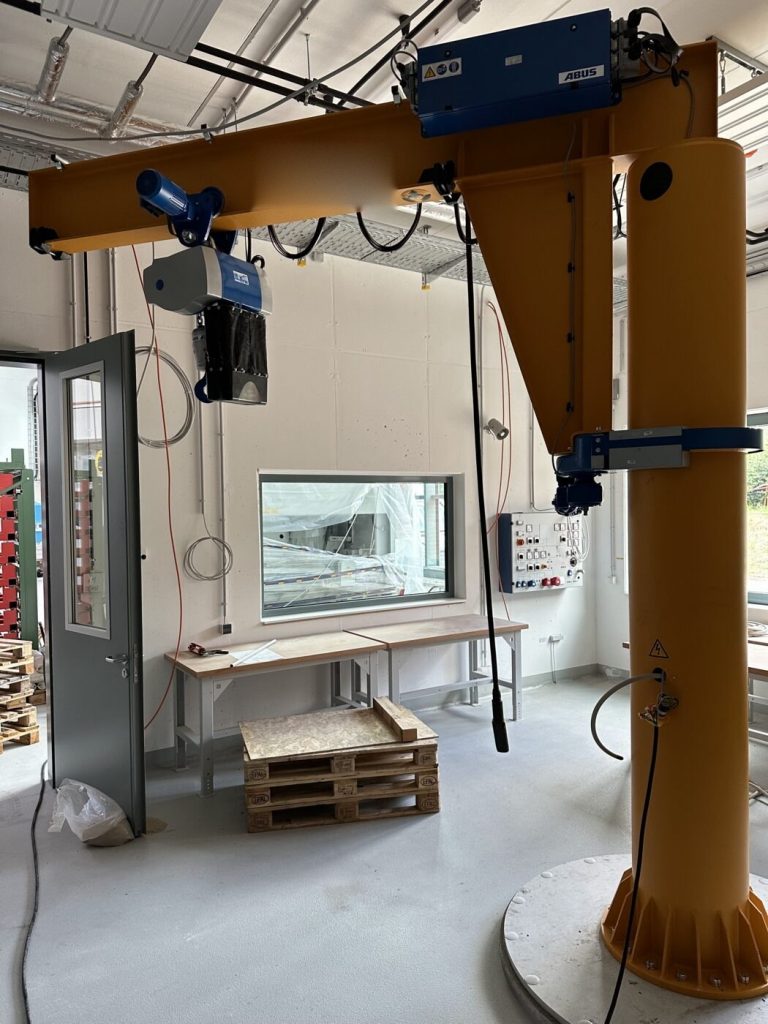
A pillar jib crane brings lifting to exactly the workstation where it is needed – no crane runway, no connection to the building, but only as safe as its anchorage in the floor.
A pillar jib crane stands where heavy parts are moved often but over short distances: next to the workbench, at the machine tool, at the assembly station or at the test bay. It lifts workpieces, fixtures and assemblies that are too heavy for hands and backs. It saves the trip to the nearest overhead crane – or replaces one where there is none.
Planners and maintenance teams usually ask the same thing: will our floor carry it, and what does the crane need before it may lift? This article explains the design, the types, the role of the foundation and the inspections.
What is a pillar jib crane?
A pillar jib crane is a fixed crane whose jib slews around a free-standing pillar anchored in the floor and lifts the load with a chain or wire rope hoist within a circle or part of a circle. In German it is called a Säulenschwenkkran; “jib crane” is the generic term.
It belongs to the workstation cranes: it serves one workstation or a small group of machines, not the whole hall. Its working area is a circle whose radius is set by the jib. Unlike a wall jib crane it needs no wall or building column, and unlike an overhead crane it needs no runway.
Key facts
- Type: Jib crane on a free-standing pillar with base plate; jib mounted on the pillar head or hinged at the side and tie-braced
- Typical capacity: From a few hundred kilograms up to several tonnes, depending on the design; the permitted value is marked on the crane
- Outreach and slewing range: Outreach typically a few metres; slewing range limited or continuous depending on the design, usually up to a full circle
- Drive: Manual or electric chain hoist, less often a wire rope hoist; trolley travel and slewing by hand or powered
- Field of use: Workshop, machine loading, assembly and test stations, loading points
- Requirements: Load-bearing floor slab or separate foundation, clear slewing range, inspection before first use
- Operator qualification: Trained employees authorised by the operator; slinging only after instruction
How is a pillar jib crane built?
A pillar jib crane consists of five assemblies: base plate, pillar, slewing bearing, jib, and hoist with trolley. The base plate is anchored to the concrete, the pillar stands vertically on it and carries the bearing at the top, around which the jib slews.
- Base plate and anchors: The base plate spreads the forces from the pillar into the floor. Chemical anchors – threaded rods bonded into the drill hole with resin mortar – hold it in place.
- Pillar: A steel tube or steel section, usually stiffened to the base plate with gusset plates. It must stand plumb.
- Slewing bearing and slewing drive: A bearing or slewing ring at the pillar head. With a powered slew, a pinion drives a gear ring.
- Jib: A beam, usually a rolled section, with the trolley running on its bottom flange. Its design partly determines how much hook height remains beneath it.
- Trolley and hoist: The trolley carries the chain or wire rope hoist and moves the load in and out along the jib.
On small cranes, the operator slews by hand by guiding the load. Larger cranes have a slewing drive that starts and stops the jib in a controlled way.
The key principle is leverage. The overturning moment is load times distance from the pillar axis. The same load at the end of the jib therefore acts far more strongly on pillar and foundation than close to the pillar.
Pillar, wall or overhead crane: which type fits?

The right type depends on which area the crane has to serve and where it can transfer its forces. The pillar jib crane suits a fixed workstation in the middle of the hall, the wall jib crane a position on a wall or column, and the overhead crane the whole floor area.
| Type | Strength | Limit | Space required | Foundation |
|---|---|---|---|---|
| Pillar jib crane | Free-standing, independent of the building, slewing range up to a full circle | Reach ends with the jib; the pillar stands in the working area | Pillar and base plate on the floor, clear circle for the jib | Anchored in a load-bearing floor slab or on a separate pad foundation |
| Wall-mounted jib crane | Needs no floor space, uses an existing wall or column | Slewing range usually a semicircle; only possible on a wall | Only the bracket on the wall or column | The wall or column must take the moment; a structural engineer checks this |
| Overhead crane (bridge crane) | Serves the whole hall and lifts much heavier loads | Needs a crane runway with columns or a load-bearing steel hall structure | Headroom below the roof; the floor stays clear | Runway columns with foundations or brackets on the hall steelwork |
The types often complement each other. The overhead crane brings heavy parts into the bay, and the pillar jib crane then serves the individual machine. Where neither roof nor wall can take a load, a gantry crane on its own legs is an option.
Why does the foundation decide on a pillar jib crane?
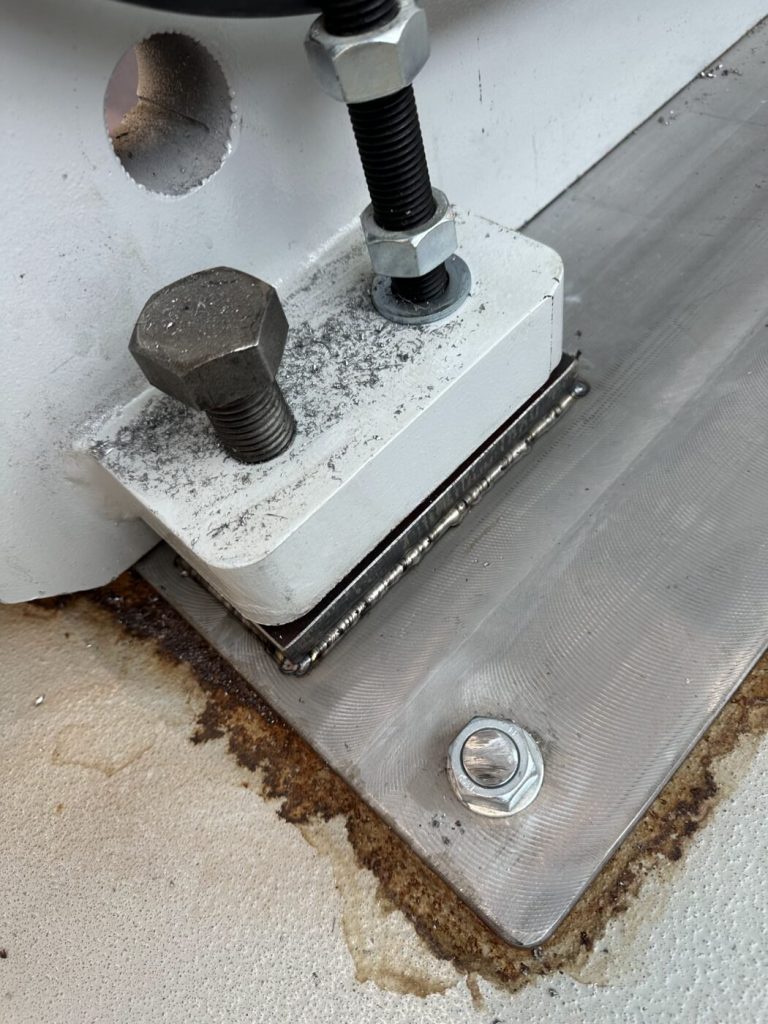
The foundation decides because the pillar jib crane transfers its entire overturning moment through the base plate into the floor – it has no other support. Load times outreach creates a bending moment at the pillar. It puts the anchors on one side of the base plate in tension and the concrete on the other side in compression.
This raises three questions that must be answered before the first hole is drilled:
- Will the floor slab carry it? The structural engineer assesses thickness, concrete grade and reinforcement. If the slab is not enough, the pillar gets its own pad foundation.
- What is in the floor? Services, joints and floor ducts must not lie within the hole pattern of the base plate.
- Does the slewing range fit? We check with the jib whether it slews freely past machines, racking and traffic routes.
Anchoring is usually done with chemical anchors. The hole pattern is drilled, every hole blown out and brushed, then the resin mortar and threaded rods go in. Tightening and loading are only allowed after the full curing time. How anchors, shims and levelling work together is explained in our guide Aligning and anchoring a machine.
After that, the pillar must stand plumb. If it leans, the jib swings by itself to the lowest point – the load then slews without the operator doing anything. That is not a cosmetic flaw but a safety problem.
Which inspections does a pillar jib crane need?
A pillar jib crane is inspected before first use, after significant modifications and then at least once a year, based on DGUV Regulation 52 “Cranes”. The periodic inspection is carried out by a qualified person (Sachkundiger), also referred to as a competent person. For certain cranes and inspection occasions, the crane regulation requires an approved expert. UK readers: under LOLER 1998, cranes need a thorough examination at least every 12 months.
Heavy use can call for shorter intervals; the operator sets them in the risk assessment. This is not legal advice – the regulation itself remains authoritative.
The first inspection also covers installation and anchorage: are the anchors tightened, is the pillar plumb, does the jib stay put in every position? Function, brake, hook with safety latch, chain or rope and the capacity marking are checked as well. Findings and intervals go into the crane log book.
If a pillar jib crane is relocated, we treat it like a new installation: check the floor, re-anchor, re-align and have it inspected again.
What we pay attention to
With a pillar jib crane, safety is decided in the floor and in the plumb line, not at the hook. This is what we pay attention to:
- Slewing range before drilling: We check the slewing range with the jib before the first hole is drilled. A base in the wrong place cannot be moved.
- Clarify floor slab and services: We clarify the thickness and build-up of the floor slab and any services in the floor with the operator beforehand. Without a statement on load-bearing capacity, we do not drill.
- Clean holes, full curing time: Blowing out and brushing are mandatory, otherwise the mortar does not bond to the concrete. Installation can be done in one day, but the curing time sets the sequence.
- Plumb in two directions: We align the pillar with two spirit levels at 90 degrees to each other and take out the last millimetre with shims. Only then is it tightened.
- Protect finished areas: In working workshops we cover floors and equipment and extract drilling dust directly at the source.
- Clear handover: Mechanical work and installation by us, electrical connection by a qualified electrician, then the inspection before first use.
Where we use it
We mainly install pillar jib cranes when fitting out workshops and workstations, as in a workshop fit-out with two pillar jib cranes in a nuclear facility in which two of our mechatronics technicians installed the cranes, workbenches, power distribution and a press brake in two one-week visits. One crane stands in the main workshop, the second in a test laboratory; both pillars are fixed with chemical anchors in the finished hall floor. Access required a security check for every fitter (under § 12b of the German Atomic Energy Act). We install jib cranes, crane runways and brackets in the Rhine-Main region and beyond – see crane installation in existing buildings.
More technology explained
Technology explained
When the crane has to serve the whole hall rather than one workstation.
Technology explained
The design on its own legs, when neither roof nor wall can take the load.
Guide
How inspection, maintenance and replacement fit together over the service life.
Do you need this machine together with a team on site?
Need a pillar jib crane and a team that takes the floor, anchors and plumb seriously? Let’s talk about your workstation, your loads and your hall floor: Request a callback.
Free, no-obligation callback

About the author
Tobias Schott
Managing director of Omega Mounting GmbH, Rodgau · more than 20 years of hands-on experience in installation and maintenance
A trained mechatronics technician, working in maintenance, servicing and industrial installation since 2004 – first alongside his father, and with Omega Mounting since 2012: from overhead conveyors in Frankfurt to the crane system in a new-build hall. He plans and leads lifting operations as an appointed person (AP) in data centers and on industrial sites in the Rhine-Main region, trains and examines operators of cranes, mobile elevating work platforms and telehandlers, and is a qualified occupational safety specialist. On jobs abroad he is known as the “German Troubleshooter” – the person you call when a site gets stuck. He learned what quality means from his father, not from a manual: Made in Germany as a standard for his own work, not a label. That is why quality comes first at Omega Mounting – ahead of speed and price. The Technology explained articles cover the equipment and techniques his team uses every day: what counts on site is in them – what only appears in the brochure is not.
 English
 German