
- Technology explained – equipment and protection
Bolt locking: what holds – and why the spring washer is obsolete
By Tobias Schott · Reading time approx. 8 minutes · As of: November 2026
Bolt locking is meant to prevent a joint from losing preload force or falling apart – which method can do that depends on why the bolt would come loose.
You encounter bolt locking as a bottle of adhesive, as a nut with a plastic ring, as a split pin or as a spring washer from the old drawer. It is usually only asked for once a nut has come loose on a vibrating system.
This article explains the principle behind it. How to use the methods when tightening is covered in the guide to torque table.
What is bolt locking?
A bolt locking device is a component, a coating or an adhesive that protects a bolted joint against loss of preload, self-loosening or loss of parts.
Specialists distinguish three groups: settling protection, anti-rotation locking and loss prevention. Each group works against a different cause. None replaces another. In German the topic is called Schraubensicherung; the prevailing torque nut is a Klemmteil-Mutter and the lock washer a Sicherungsscheibe.
The basis of every locking method, however, is the preload force, i.e. the force with which the tightened bolt presses the components together.
Key facts
- Purpose: Maintain preload force, prevent self-loosening or prevent bolt and nut from falling out.
- Types: Settling protection, anti-rotation locking and loss prevention; plus the torque stripe as a pure check marking.
- Marking: Liquid threadlocker by strength according to the data sheet; prevailing torque nuts recognisable by the plastic ring or deformed thread.
- Inspection: No separate inspection interval; the bolted joint is inspected with the system, according to the operating instructions and maintenance plan.
- Reuse: Split pins, tab washers and micro-encapsulated bolts only once; prevailing torque nuts and wedge-locking washers only according to the manufacturer’s data.
- Ready for discard: Spring washer, tooth lock washer and serrated lock washer – their standards have been withdrawn.
Why do bolts come loose? Settling and self-loosening
Bolts come loose in two ways: with settling, the joint loses preload force without the nut turning; with self-loosening, the nut turns back by itself.
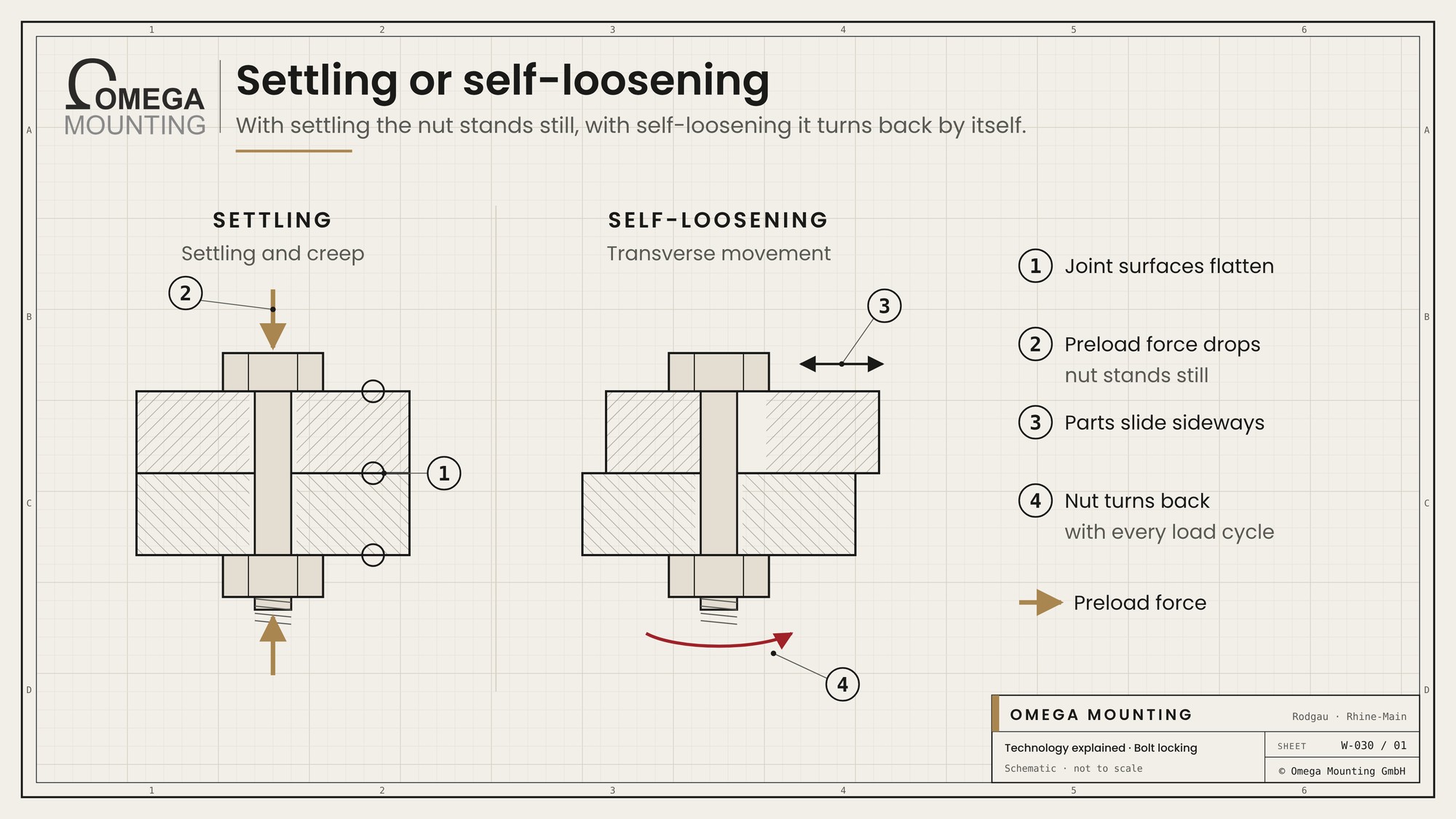
Loss of preload through settling and creep. Every joint interface, i.e. every contact surface between head, washer, components and nut, has fine roughness. Under load it is flattened, the joint “settles”. Creep means: a material yields slowly under permanent load and heat. This is typical for gaskets, plastics and thick paint layers. In both cases the clamping length becomes minimally shorter, and the stretched bolt springs back a little. The nut stands still, but the preload force drops anyway.
Self-loosening through transverse movement. Metric fastening threads are self-locking: the friction in the thread is greater than the force that the lead generates in the loosening direction. However, this self-locking only holds as long as nothing slides. If the components shift across the bolt axis due to vibration or alternating load, head and thread slip briefly. Then friction is lost, and the inclined plane of the thread turns the nut back by a small angle – a little more with every load cycle.
This leads to the most important rule: something different helps against settling than against self-loosening. Adhesive in the thread does not prevent settling under the head.
Preload force: the first lock is in the bolt itself
The most effective bolt locking is sufficient, correctly applied preload force, because where the components do not slide, no nut turns loose either.
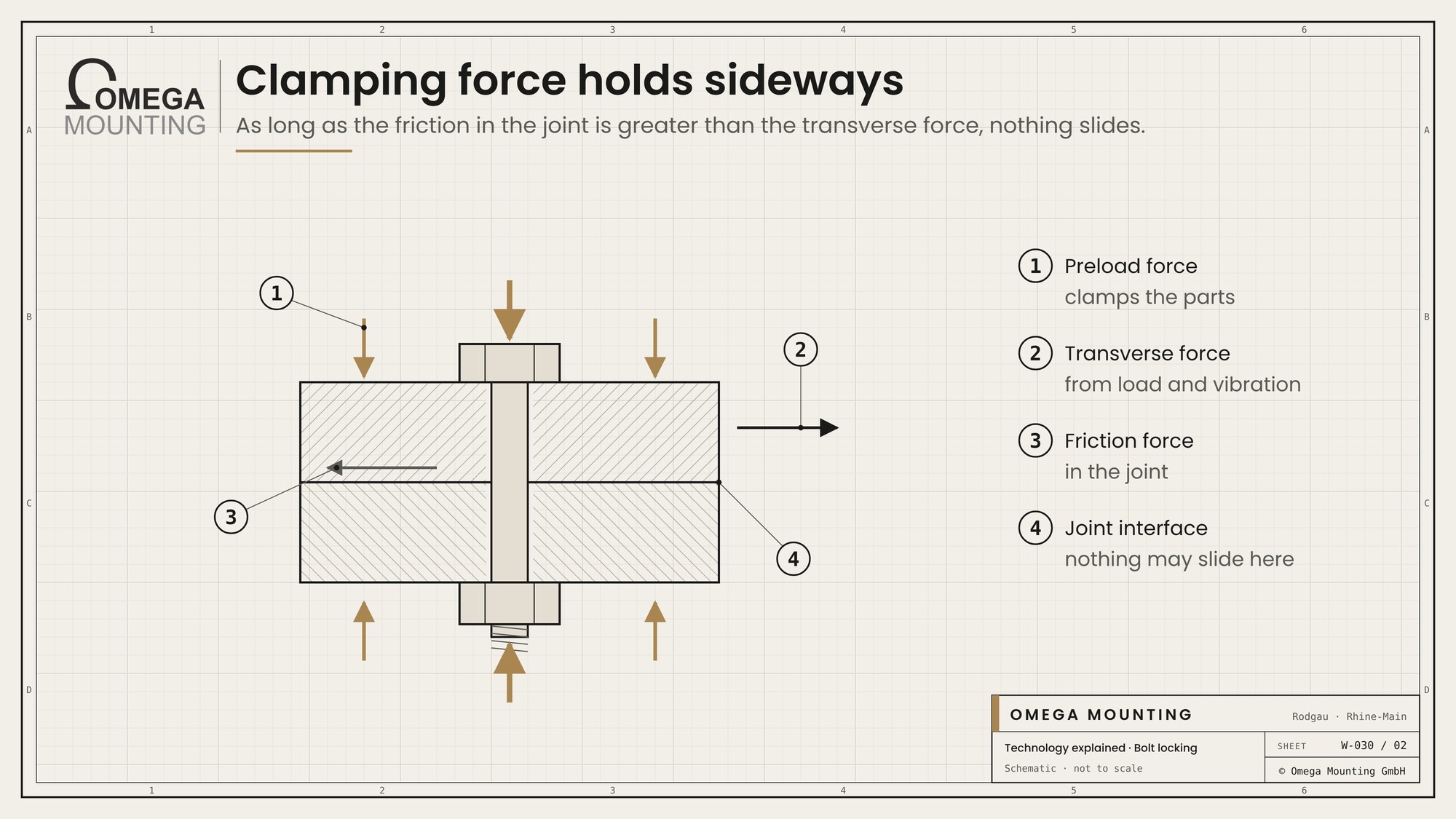
The preload force presses the components together so strongly that the friction in the joint takes up the transverse forces. As long as the transverse force remains smaller than this friction force, nothing moves. The guideline VDI 2230, the standard work for calculating bolted joints, therefore sees locking devices as a supplement to a correctly designed joint, not as a substitute.
Design also helps more against settling than an additional part:
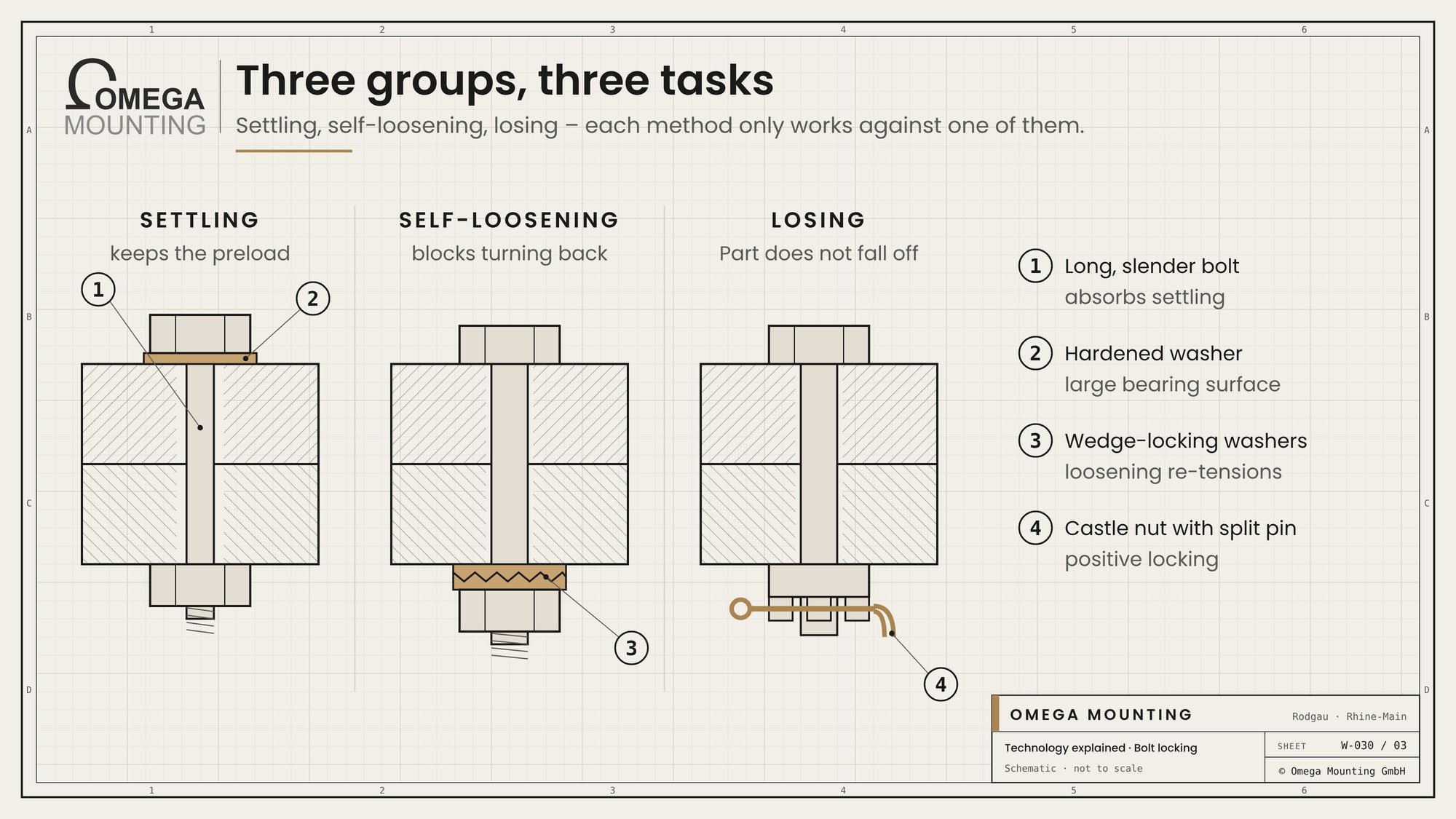
- Long, slender bolts lose less preload force through the same amount of settling than short, stiff ones.
- Few joint interfaces offer less surface that can flatten – every additional washer is one more joint.
- Large, hard bearing surfaces such as flange bolts or hardened washers prevent the head from pressing into soft components.
- Soft interlayers only belong where the design expressly provides for them.
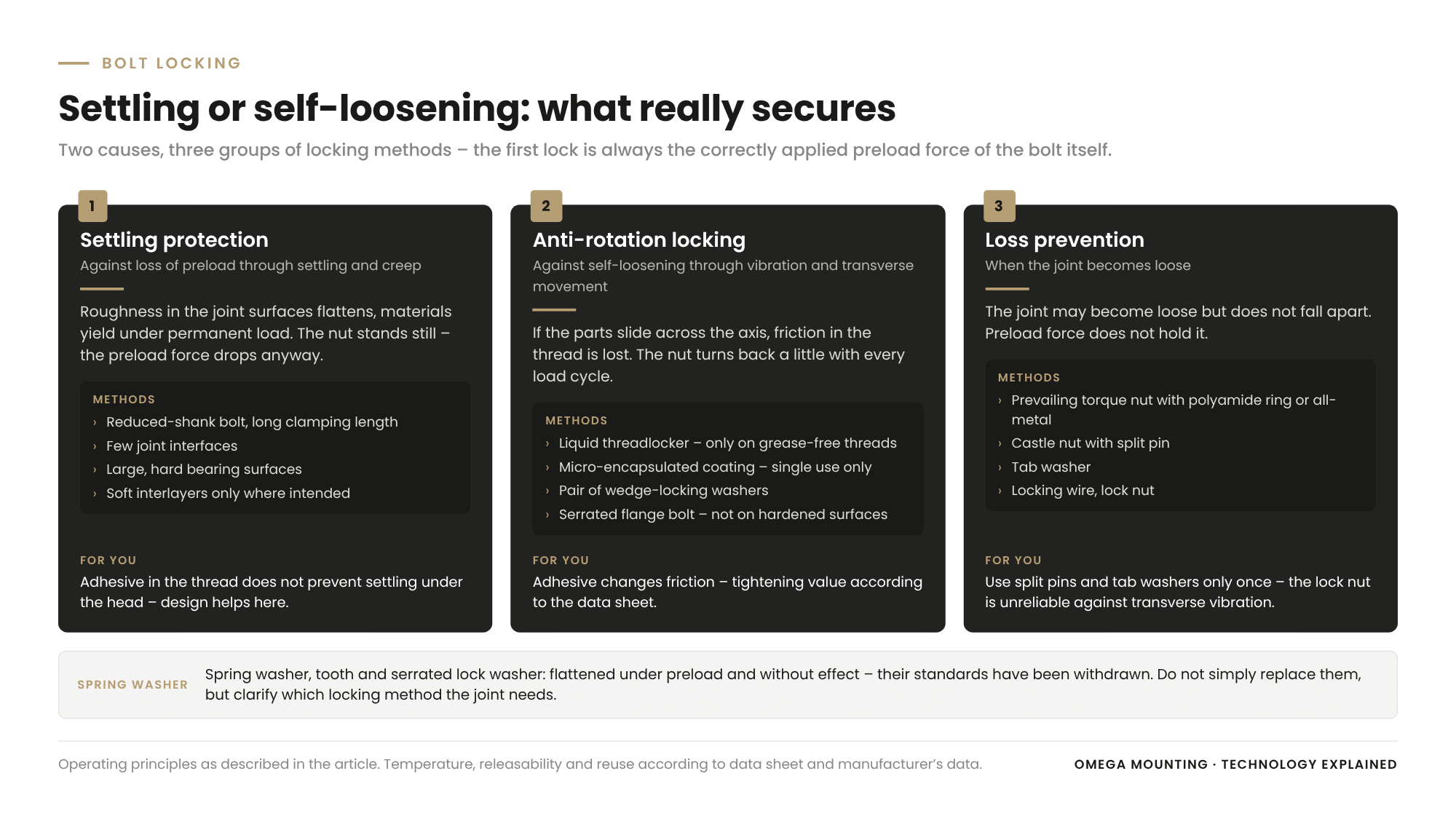
Settling protection, anti-rotation locking, loss prevention: what each method can do
Every method belongs to one of the three groups: settling protection keeps the preload force, anti-rotation locking prevents turning back, loss prevention lets the joint become loose but not fall apart.
| Securing method | Group | Operating principle | Limit |
|---|---|---|---|
| Reduced-shank bolt, long clamping length, hardened washer. | Settling protection. | The elastic bolt absorbs settling without losing much preload force. | Does not work against self-loosening if the clamping force is too low. |
| Liquid threadlocker. | Anti-rotation locking. | Anaerobic adhesive cures in the thread in the absence of air, fills the play and bonds the flanks. | Only on clean, grease-free threads; temperature and releasability according to the data sheet; changes friction. |
| Micro-encapsulated coating. | Anti-rotation locking. | Adhesive in capsules on the thread that burst when screwed in. | Single use only; working time according to the manufacturer’s data. |
| Pair of wedge-locking washers. | Anti-rotation locking. | Inside there are wedge faces with a larger pitch than the thread: turning loose tensions the joint more. | The outer serrations need a bearing surface to bite into; reuse according to the manufacturer’s data. |
| Serrated flange bolt or serrated flange nut. | Anti-rotation locking. | Inclined teeth under the head dig into the bearing surface and lock against the loosening direction. | Not on hardened surfaces; damages surface and coating. |
| Prevailing torque nut with polyamide ring or all-metal. | Loss prevention. | The locking element generates a friction torque in the thread, the nut does not fall off. | Does not hold preload force; polyamide ring limited in temperature; limited reuse. |
| Castle nut with split pin. | Loss prevention. | The split pin through the nut slot and cross hole locks positively. | Needs a hole; the nut is turned to the next slot; split pin only once. |
| Tab washer. | Loss prevention. | Bent-up tabs hold the nut or head positively. | Bend only once; the joint can loosen up to the stop. |
| Locking wire. | Loss prevention. | The wire connects several bolts so that any loosening direction tensions it. | Needs cross holes in the head and practised hands. |
| Lock nut. | Loss prevention. | A second nut is tightened against the first and clamps in the thread. | Unreliable against transverse vibration; only works when correctly locked. |
| Spring washer, tooth lock washer, serrated lock washer. | Formerly intended as settling or anti-rotation locking. | Supposed to spring or bite into the bearing surface. | Flattened under preload and therefore ineffective; standards withdrawn. |
| Torque stripe. | Not a lock. | A paint marking across nut and component shows any rotation. | Secures nothing, only shows whether something has moved. |
Liquid threadlocker is available in low, medium and high strength. High-strength types can often only be released with heat. Many suppliers distinguish the strengths by colour, but this is not a binding system – the data sheet is what counts. On stainless steel the adhesive cures more slowly; the data sheet often specifies an activator there.
Why is the spring washer obsolete?
The spring washer is obsolete because it is already flattened at a fraction of the preload force of a modern bolt – after that it no longer springs and is merely an additional joint that can settle.
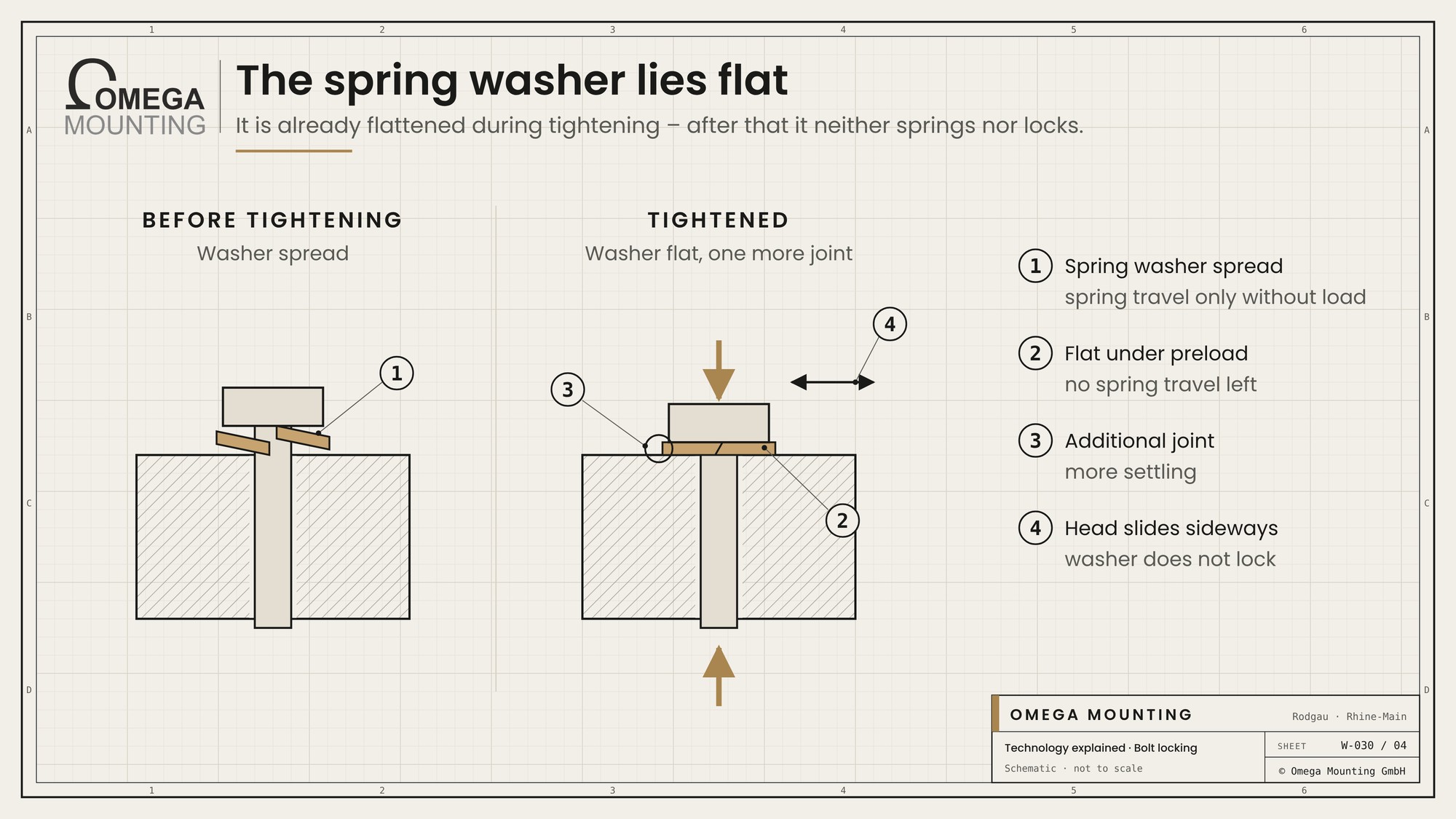
The split ring was supposed to spring back during settling and bite against self-loosening with its edges. In practice its spring force is much smaller than the preload force of a bolt of property class 8.8 or higher. It lies flat already during tightening. Without spring travel it no longer compensates for any settling.
It does not help against self-loosening either. With transverse movement the head simply slides over the flat ring. In the transverse vibration test, in which a joint is moved back and forth across the axis, joints with spring washers show no advantage over joints without locking.
In addition, the ring adds an extra joint interface and a narrow bearing surface that presses into soft components – i.e. more settling instead of less. Tooth and serrated lock washers share the same fate: their teeth are flattened and damage the surface in the process.
The product standards for all three have been withdrawn, yet we still often find them in existing installations. Anyone who finds a spring washer there does not simply replace it with a new one, but clarifies whether the joint needs locking at all – and if so, from which group.
What we pay attention to
Our fitters choose bolt locking according to the cause, not out of habit.
- We first ask why a bolt has come loose – settling, transverse movement or too little preload force – before we choose a method.
- We tighten as specified with the torque wrench ; because adhesive changes friction, the value from the data sheet applies.
- We clean threads grease-free before bonding and remove old adhesive residues instead of adding new adhesive on top.
- We do not reuse split pins, tab washers and prevailing torque nuts unless the manufacturer expressly allows it.
- We do not fit spring washers in load-bearing joints and only change existing locking devices as specified by the design.
- We apply a torque stripe after tightening so that any rotation is noticed immediately on the next inspection round.
Where we use it
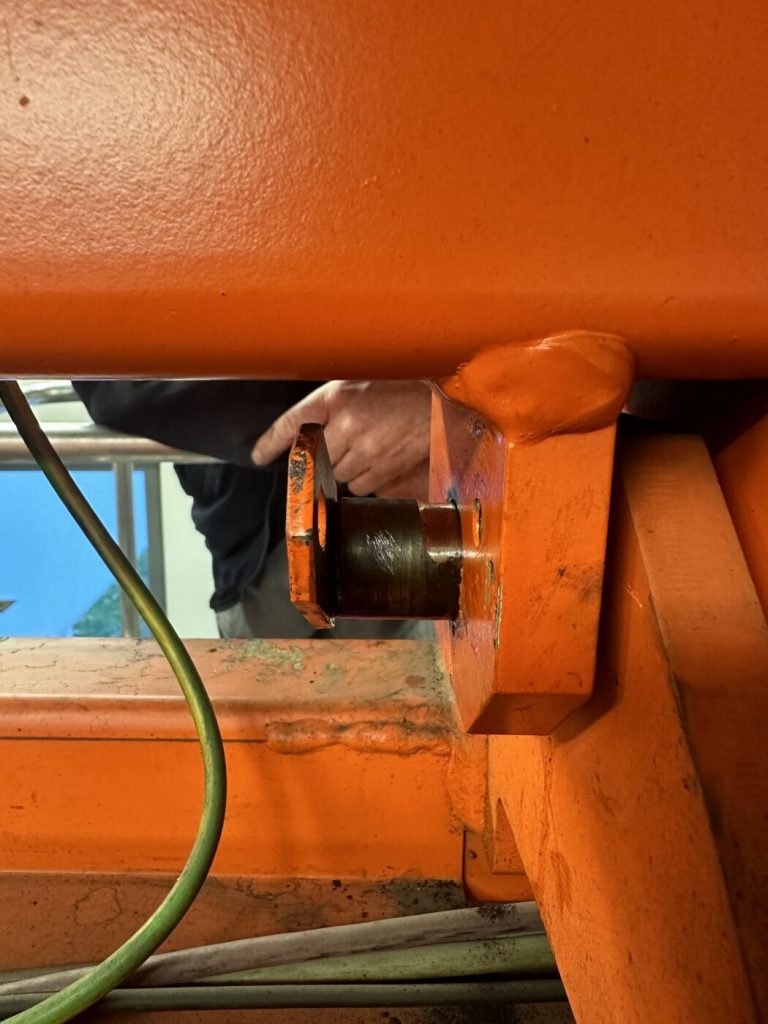
We encounter locked bolted joints wherever systems vibrate or loads alternate. During the installation of twelve double turbo silencers in a data center in Offenbach we aligned the silencers on base frames more than two metres high and bolted them firmly. Underneath runs a generator that produces considerable vibration under full load; rubber sleeves decouple the turbochargers from the silencers. On the carriers of electrified monorail vehicles in a food plant , pins carry thousands of load cycles every day – there we replaced worn pins and bushings in pairs. We install such joints in the Rhine-Main region as part of our Industrial installation.
- Torque table for bolts: tightening torques, friction, flange – the guide with tightening torques and locking methods in practice.
Do you have questions about how this works on your site?
Property classes of bolts: why 12.9 is not always better – why high-strength bolts finally overtax the spring washer. Thread types: metric, inch, pipe, trapezoidal – how to recognise them – the self-locking on which every locking method builds, in detail.
Do you have questions about how bolted joints on your vibrating system can hold permanently? We clarify the cause with you and install with the locking method that fits. Request a callback – we will get back to you.
Free, no-obligation callback

About the author
Tobias Schott
Managing director of Omega Mounting GmbH, Rodgau · more than 20 years of hands-on experience in installation and maintenance
A trained mechatronics technician, working in maintenance, servicing and industrial installation since 2004 – first alongside his father, and with Omega Mounting since 2012: from overhead conveyors in Frankfurt to the crane system in a new-build hall. He plans and leads lifting operations as an appointed person (AP) in data centers and on industrial sites in the Rhine-Main region, trains and examines operators of cranes, mobile elevating work platforms and telehandlers, and is a qualified occupational safety specialist. On jobs abroad he is known as the “German Troubleshooter” – the person you call when a site gets stuck. He learned what quality means from his father, not from a manual: Made in Germany as a standard for his own work, not a label. That is why quality comes first at Omega Mounting – ahead of speed and price. The Technology explained articles cover the equipment and techniques his team uses every day: what counts on site is in them – what only appears in the brochure is not.
 English
 German