
- Technology explained – technology and procedures
Brazing or welding? When brazing is the better repair
By Tobias Schott · 5-minute read · Updated November 2026
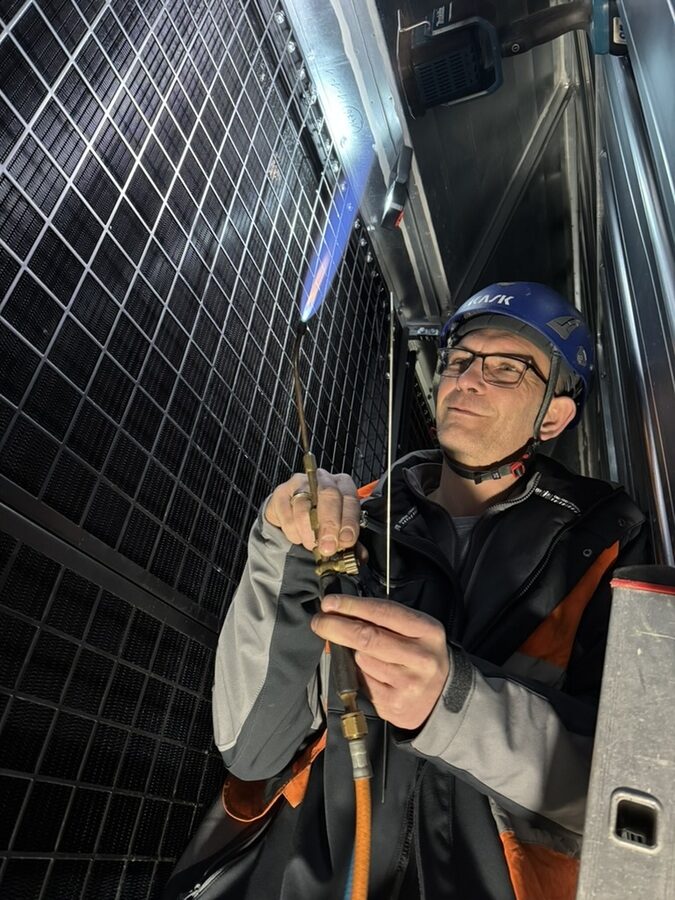
In brazing, metal parts are joined with a molten filler metal without the components themselves melting – which is why brazing is the right repair where welding would put in too much heat: on thin sheet, copper, coolers and pipework.
Anyone who sees a leak on a cooler soon thinks of welding. But with thin sheet and copper fins that would be the wrong way: the flame or arc would burn away the delicate material, and a small hole would become a big one. This is where brazing shows its strength.
Here we explain what distinguishes brazing from welding, how brazing works, when it is the better choice and how a brazed joint is tested.
What is brazing?
Brazing is a thermal joining process. A filler metal is melted and flows into the narrow gap between two components. As it cools it solidifies and joins the parts firmly and tightly. The components themselves get hot, but they do not melt.
The filler therefore always has a lower melting point than the components. For it to bond, the surface must be bare, and a flux keeps it free of oxide during heating. On site, the heat usually comes from a gas flame.
Key facts
- Principle: Filler melts, parent metal stays solid.
- Heat source: usually a gas flame, in the workshop also induction or a furnace.
- Materials: Copper, brass, steel, stainless steel, also dissimilar joints.
- Typical for: Coolers, heat exchangers, pipework, thin sheet.
- Important: narrow gap, clean surfaces, flux, even heat.
- Approval: Leak or pressure test.
Brazing and welding: the difference
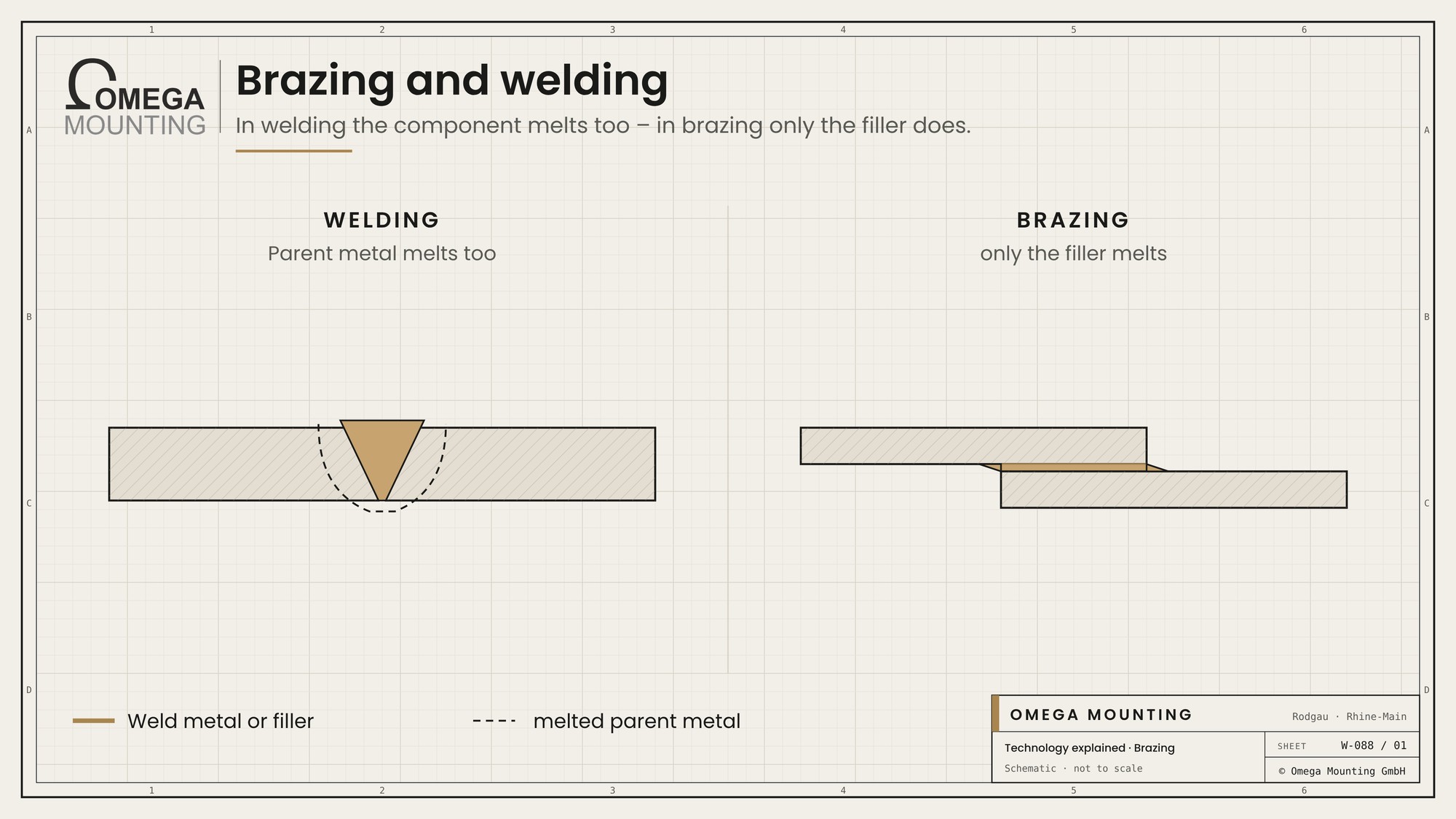
The decisive difference lies in the parent metal.
- Welding: The parent metal melts at the weld. Weld metal and component fuse into a solid unit. This needs a lot of heat.
- Brazing: Only the filler melts. It flows into the gap between the components and joins them while they stay solid. This needs considerably less heat.
A distinction is made between soldering and brazing. Soldering works at lower temperatures and is familiar from electronics, for example. Brazing works hotter, the joint is stronger and withstands pressure, heat and vibration better – which is why it is the process for coolers, pipework and pressurised components.
How brazing works
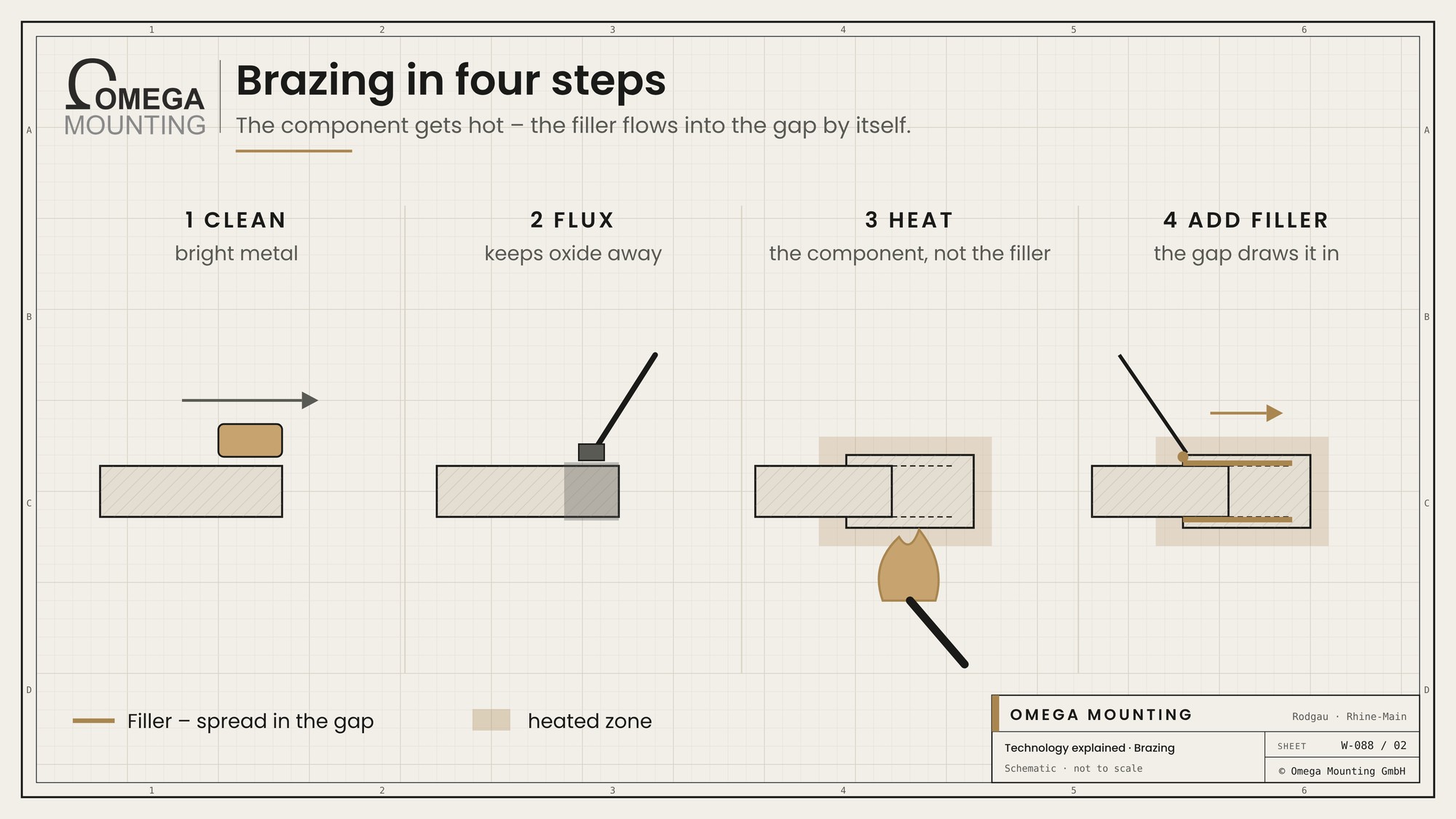
Brazing follows a fixed sequence.
- Clean: The joint surfaces are made bright metal. Grease, oxide and paint prevent the filler from bonding.
- Flux: It dissolves oxides and protects the area during heating. Some fillers for copper already contain it.
- Heating: The components are brought evenly to working temperature – it is not the filler but the component that must be hot enough.
- Adding filler: The filler melts on the hot component and is drawn into the narrow gap by capillary action.
- Cooling and cleaning: Flux residues are removed because they could otherwise cause corrosion.
The gap is important here: if it is too wide, capillary action does not draw the filler in and the joint stays porous. If it is too narrow or dirty, the filler does not reach the end. In a repair on an installed component there is often no ideal gap – then it takes experience, patience and a steady hand.
When brazing is the better choice
Brazing plays to its strengths where welding would be too coarse.
| Situation | Why brazing |
|---|---|
| Thin sheet | Welding would burn through. |
| Copper and brass | Easy to braze, difficult to weld. |
| Coolers and heat exchangers | Delicate fins are preserved. |
| Different metals | Filler also joins dissimilar materials. |
| Little distortion wanted | Less heat, less stress. |
Welding remains the right choice where a joint must carry high forces – on steelwork, brackets or frames. Which welding process suits what is explained in our article Welding processes.
Testing and securing
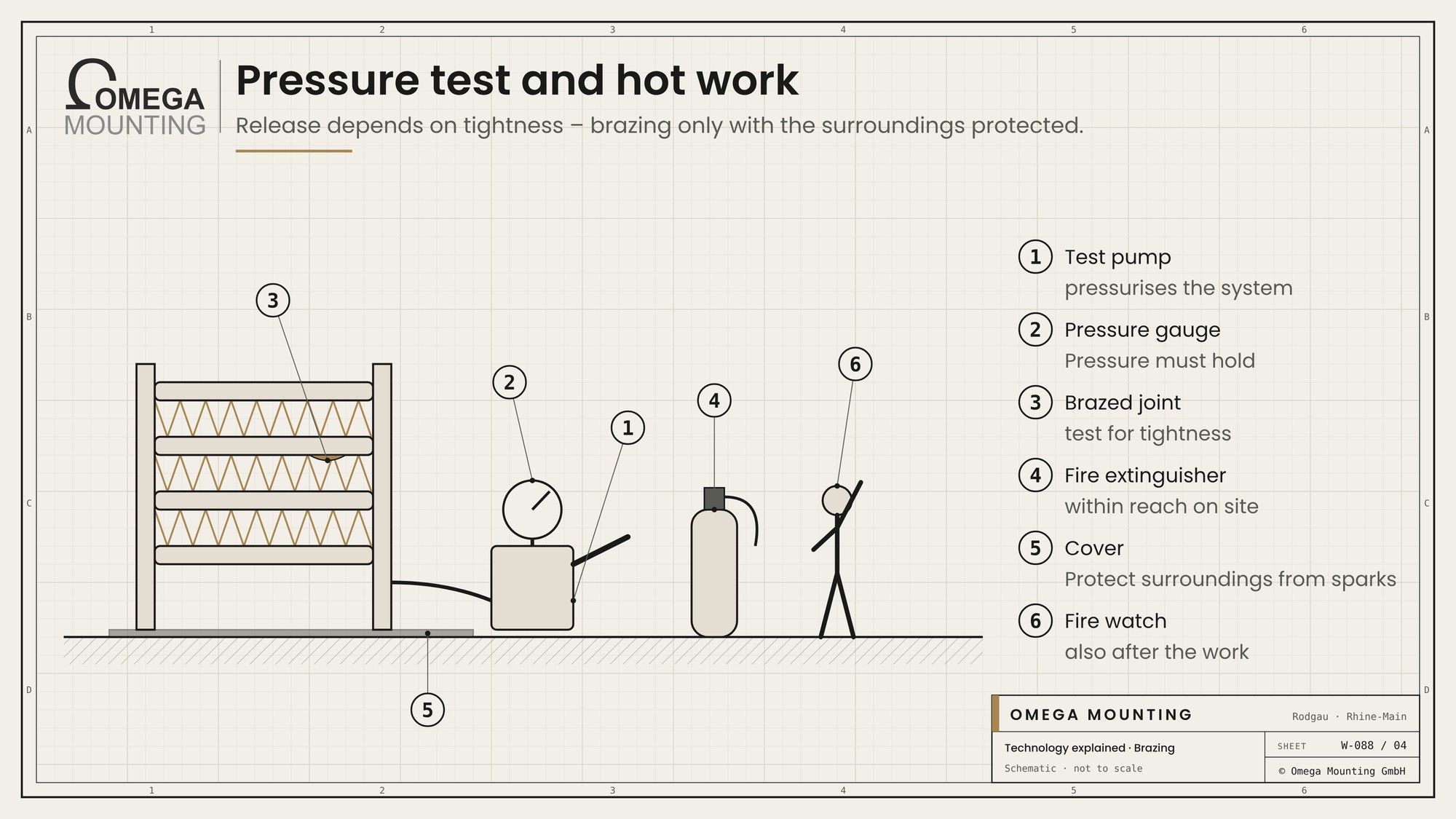
A brazed joint is not released on looks but on tightness.
- Visual check: The filler must have flowed all round into the gap, without holes or edges.
- Pressure test: The system is pressurised and the joint is checked for tightness.
- Protective layer: For emergency repairs, a special metal adhesive can be applied over the brazed joint as an additional layer.
- Hot work: Brazing with an open flame is hot work – with a permit, fire extinguisher, covered surroundings and fire watch.
- Be honest about it: A brazed repair on an installed component can be a temporary solution. The permanent repair is then planned.
How standby generators are serviced and repaired is described in our guide on standby generator maintenance.
Typical mistakes
- Not made bright: No filler bonds to oxide or grease.
- Only the filler heated: The filler drips off instead of flowing into the gap – the component must be hot.
- Overheated: Too much heat burns the flux and damages thin material.
- Gap too wide: The filler does not fill it, the joint stays leaky.
- Flux forgotten: Residues not removed – corrosion later.
Workplace and safety when brazing
Brazing works with an open flame and high temperatures. Before brazing on site we clarify:
- Hot work permit: In operating plants brazing is approved like welding, with fire watch and extinguishers.
- Protect the surroundings: Insulation, cables and plastic parts nearby are covered with heat shields.
- Purge the lines: Copper lines in refrigeration systems are purged with inert gas during brazing so no scale forms inside.
- Ventilation: Flux and heated coatings produce fumes. Extraction or ventilation starts from the beginning.
- Gas cylinders: Cylinders are secured; hoses and fittings are checked before work begins.
After brazing, flux residues are removed because they can cause corrosion later. On pressure lines a leak test follows before the system goes back into operation.
What we pay attention to
- We decide by component, not by habit: brazing where welding would be too coarse.
- We bring in specialist firms when the component requires it – for coolers, for example.
- We register hot work and secure the area.
- We only release after a passed pressure test.
- We say clearly whether a repair is a temporary solution.
Where we use it
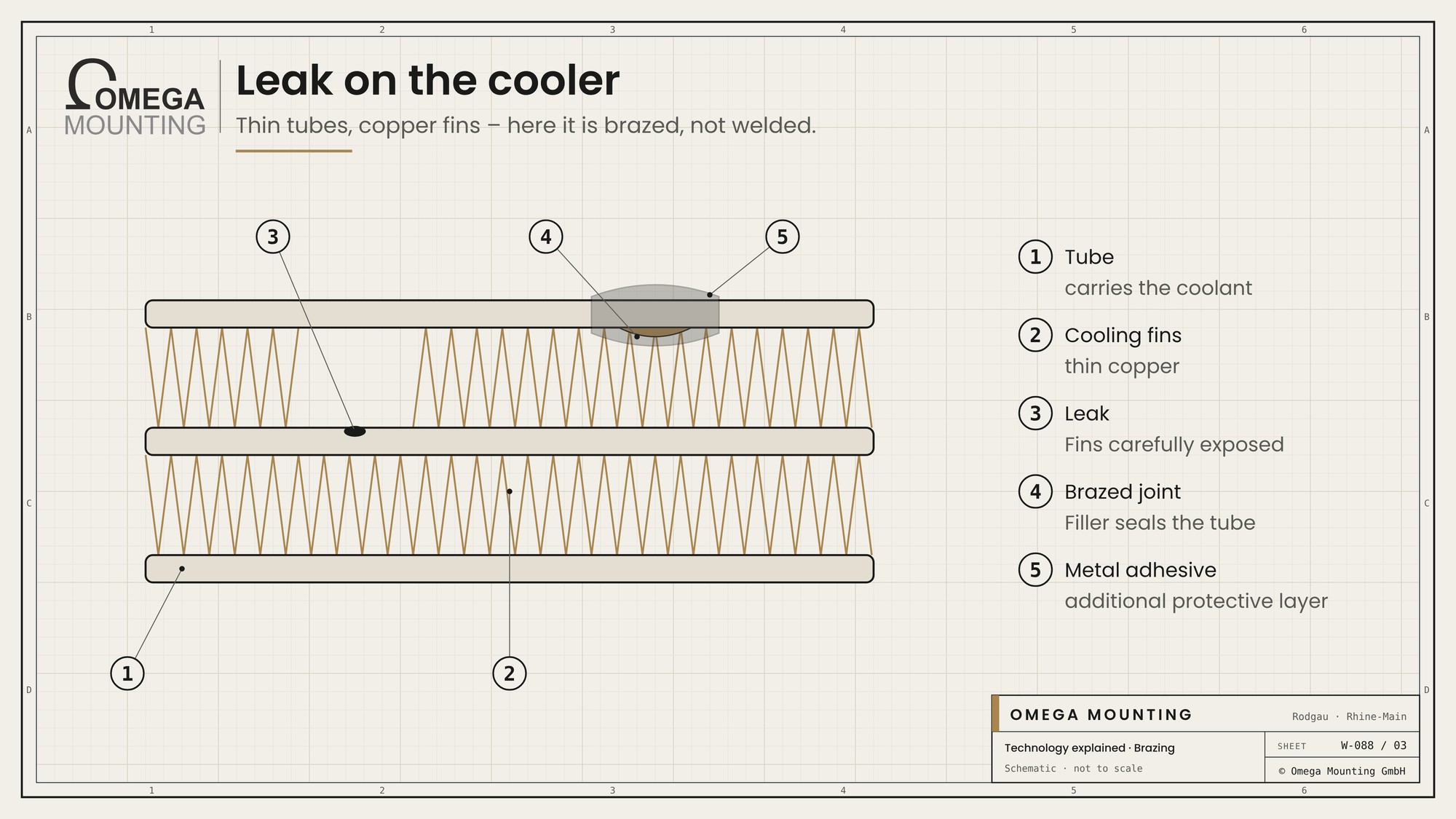
At the data center in Offenbach, the radiator of an installed standby generator had a leak – four days before go-live. Welding was out of the question: the sheets were too thin and the cooling fins were copper. Together with a radiator specialist we exposed the fins, brazed the leak in the narrow gap with a gas flame and sealed it with special metal adhesive. After a passed pressure test, the generator was ready for service again the same day.
More technology explained
Technology explained
when to weld.
Technology explained
getting the heat right.
Technology explained
how joints are tested.
Do you have questions about how this works on your site?
Do you have a leak on a cooler, a pipe or a component that cannot simply be removed? We find the right way with you – brazing, welding or replacement. Request a callback.
Our service for this: Custom fabrication and welding →
Free, no-obligation callback

About the author
Tobias Schott
Managing director of Omega Mounting GmbH, Rodgau · more than 20 years of hands-on experience in installation and maintenance
A trained mechatronics technician, working in maintenance, servicing and industrial installation since 2004 – first alongside his father, and with Omega Mounting since 2012: from overhead conveyors in Frankfurt to the crane system in a new-build hall. He plans and leads lifting operations as an appointed person (AP) in data centers and on industrial sites in the Rhine-Main region, trains and examines operators of cranes, mobile elevating work platforms and telehandlers, and is a qualified occupational safety specialist. On jobs abroad he is known as the “German Troubleshooter” – the person you call when a site gets stuck. He learned what quality means from his father, not from a manual: Made in Germany as a standard for his own work, not a label. That is why quality comes first at Omega Mounting – ahead of speed and price. The Technology explained articles cover the equipment and techniques his team uses every day: what counts on site is in them – what only appears in the brochure is not.
 English
 German