
- Technology explained – technology and procedures
Preheating for welding: why cold steel cracks – and what counts in winter
By Tobias Schott · 5-minute read · Updated November 2026
Preheating means warming the steel around the weld area before welding so that the weld cools more slowly, moisture evaporates and no brittle zones or cold cracks form – on site in winter, this is often the difference between a weld that holds and one that cracks.
A weld can turn out just as well in snow as in summer – but not without preparation. Cold steel draws the heat out of the weld pool in a flash. The weld solidifies too quickly, penetration suffers, and a hard, brittle zone forms at the transition to the parent metal. Add moisture and numb fingers.
Here we explain why cold steel cracks, how preheating and measuring are done and what matters when welding in winter.
What is preheating?
Preheating means bringing the parent metal around the weld to a specified temperature before welding and keeping it there during welding. The temperature between two passes is called the interpass temperature.
How warm to preheat depends on the material, the wall thickness, the hydrogen content of the filler and the surroundings. The specification is in the welding procedure or follows from standards such as DIN EN 1011-2. Thick plates, high-strength steels and cast steel need more heat than thin structural steel plates.
Key facts
- Purpose: Slow down cooling, avoid hardening and cold cracks, drive off moisture.
- When: for thick plates, high-strength steels, cast steel and always in cold and wet conditions.
- How: Gas torch, induction or electric heating mats.
- Measuring: beside the joint with a temperature crayon or contact thermometer.
- Afterwards: let it cool slowly, cover if needed.
- Also in winter: Wind shield, dry filler materials, warmth for the welder.
Why cold steel cracks
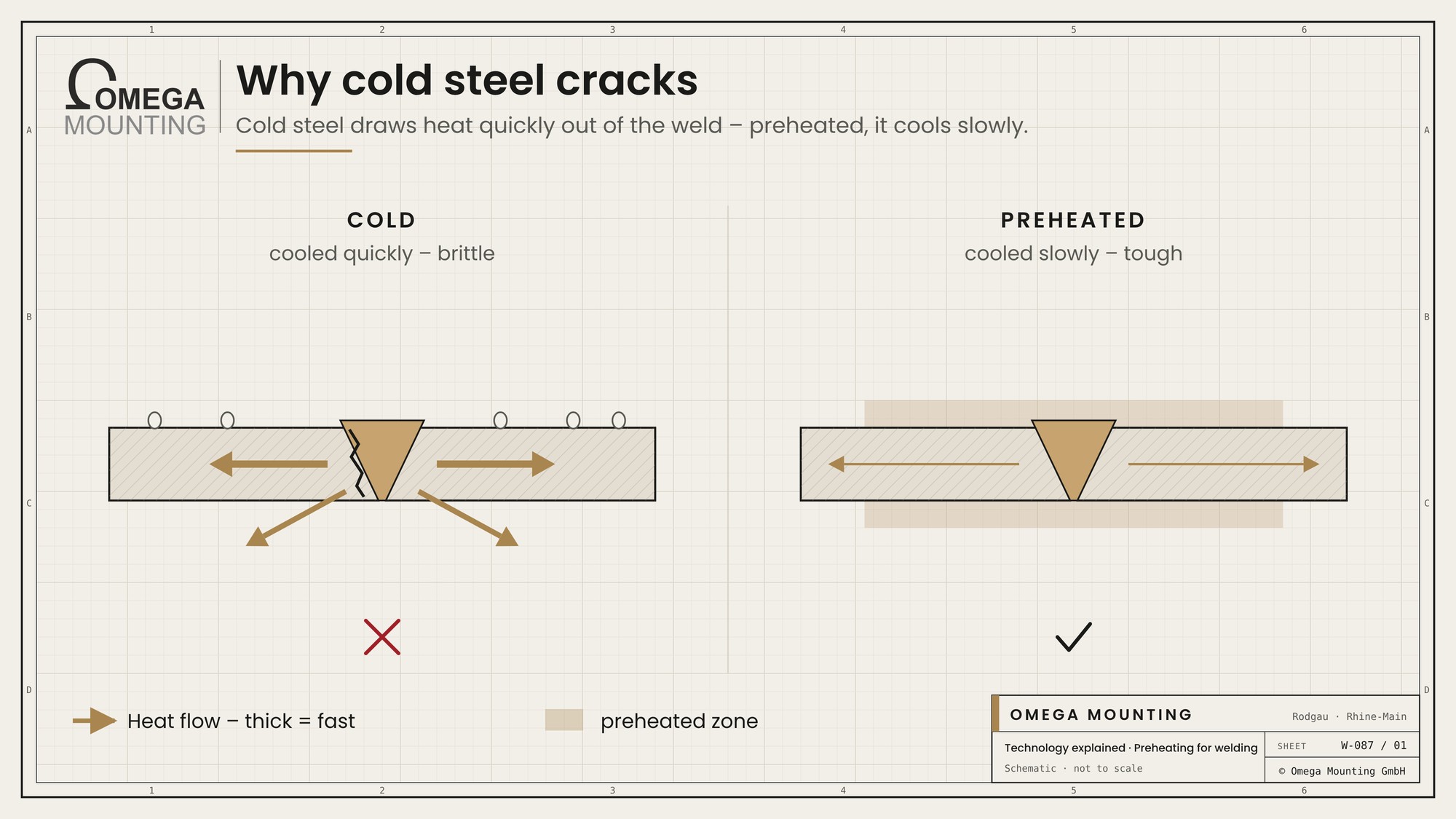
Cold harms a weld in three ways.
- Rapid cooling: Cold steel conducts the heat out of the weld quickly. A hard, brittle zone forms at the transition and cracks under load.
- Hydrogen: Moisture brings hydrogen into the weld pool. If it cools quickly, the hydrogen cannot escape – cold cracks form, often only hours later.
- Poor penetration: The weld pool solidifies before it has fused with the parent metal. The weld just sits on top – a so-called cold lap.
Preheating counters all three: the weld cools more slowly, moisture evaporates beforehand, and the weld pool fuses cleanly with the parent metal.
How is preheating done?

What matters is that the heat reaches evenly through the whole wall thickness – not just the surface.
| Method | How it works | What it suits |
|---|---|---|
| Gas torch | A broad flame is moved over the joint. | Fast, mobile, for smaller areas. |
| Induction | A coil generates heat directly in the steel. | Even, easy to control, for pipes and larger components. |
| Heating mats | Electric resistance mats lie on the component. | Long holding times, also for slow cooling afterwards. |
It is important not just to heat a spot at the joint, but a wide strip on both sides. Otherwise the surrounding steel still cools the weld quickly.
Measuring temperature
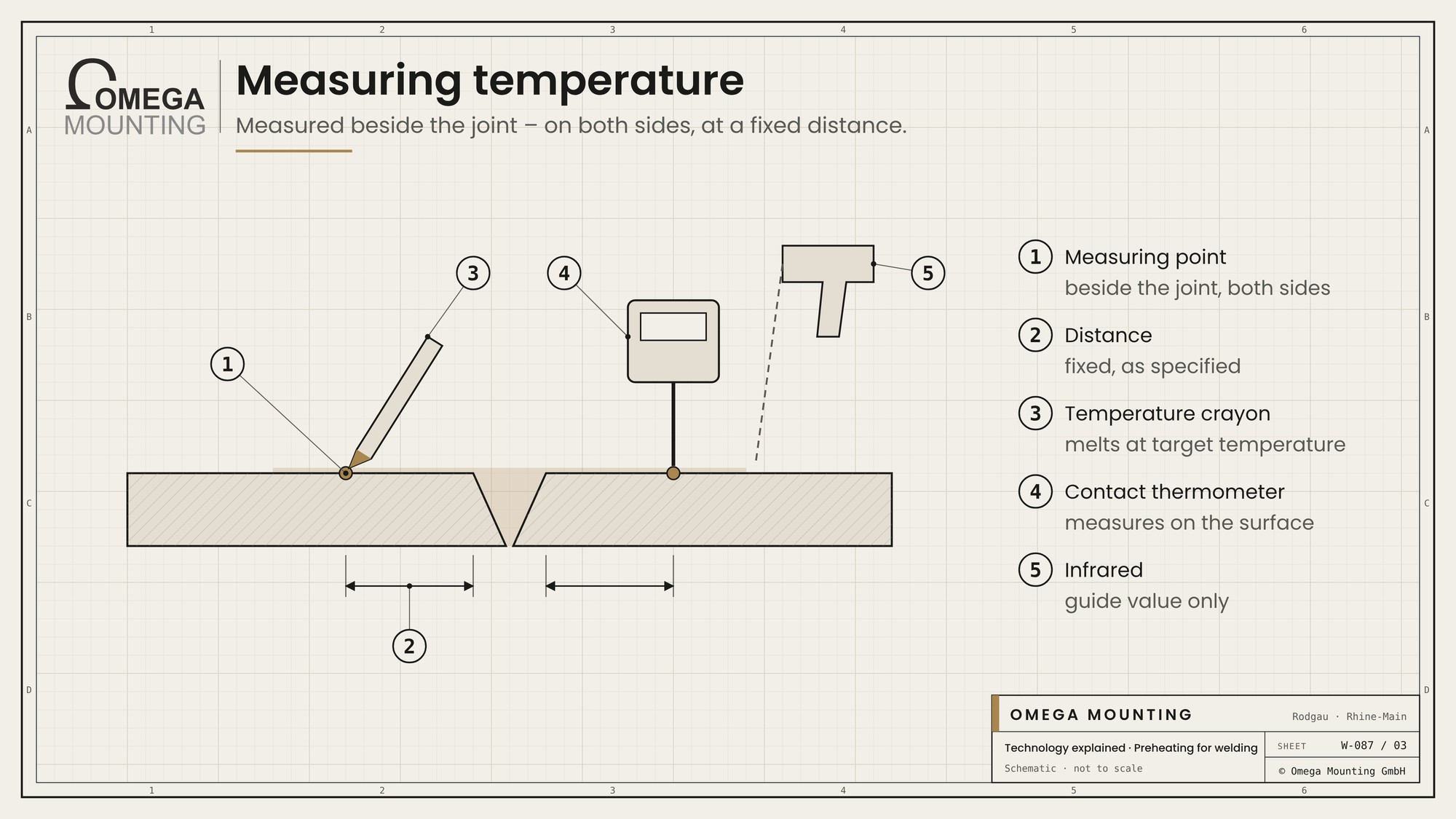
Preheating without measuring is guesswork.
- Measuring point: beside the joint, at a fixed distance, on both sides – not in the flame.
- Temperature crayon: melts at a specific temperature and shows whether it has been reached.
- Contact thermometer: measures directly on the surface and displays the value.
- Infrared: fast, but inaccurate on bright or reflective surfaces – guide value only.
- Between passes: measure between passes too, so that the temperature neither drops too low nor rises too high.
Welding on site in winter
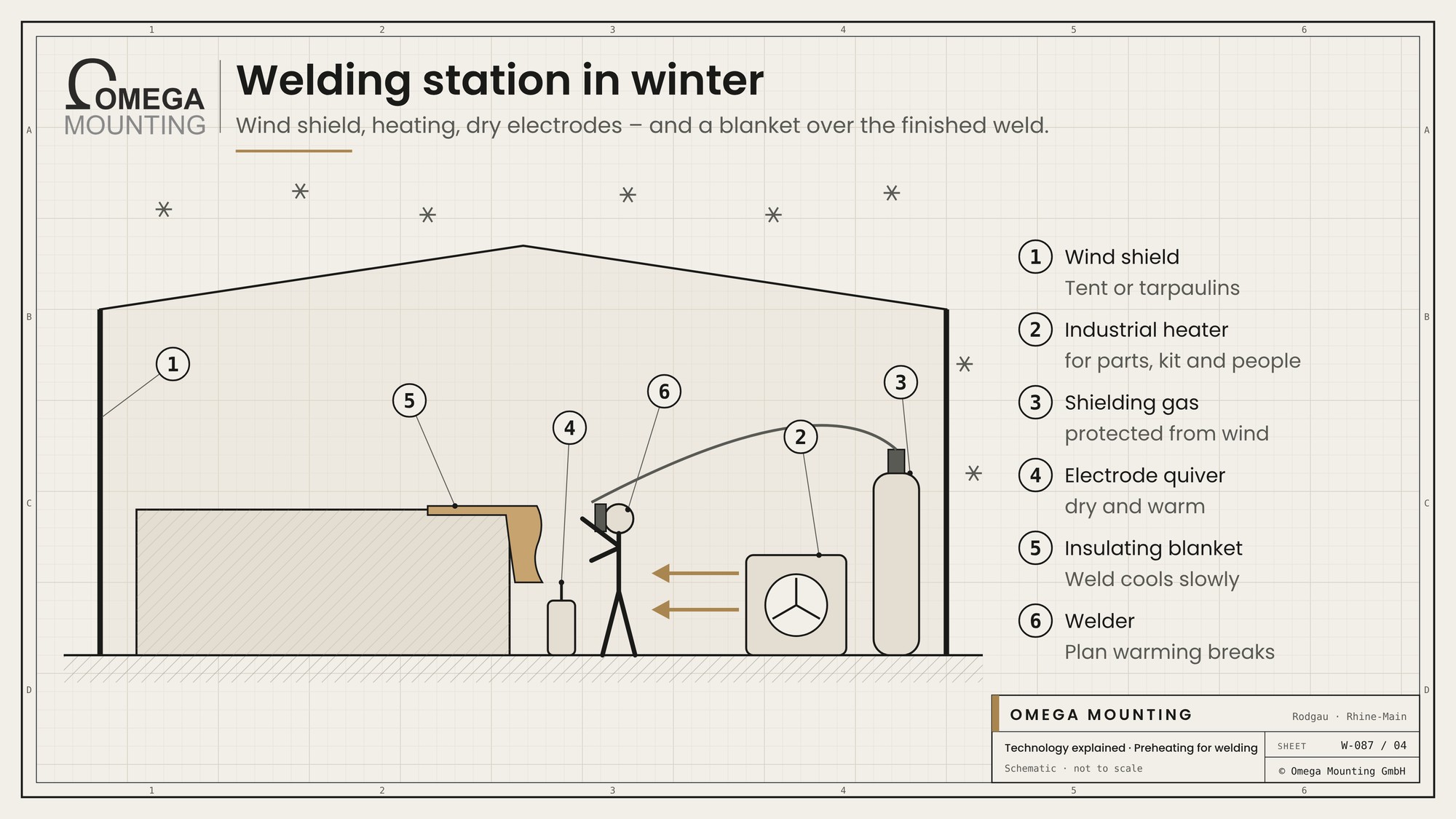
Outdoors in snow and wind, the site adds to the materials science.
- Wind shield: Wind blows the shielding gas away and cools the weld – a tent or tarpaulins around the welding station.
- Heating: an industrial heater keeps component, equipment and people warm.
- Dry filler materials: store electrodes and wire dry, re-dry electrodes if needed.
- Snow and ice: remove before preheating, dry off condensation.
- Cool slowly: cover the finished weld so that it does not cool abruptly.
- Warming breaks: a frozen welder does not hold the torch steady.
How an on-site repair is planned overall is described in our guide on repair welding.
Typical mistakes
Most problems arise not during welding itself, but before and after.
- Only the surface warmed: The joint feels warm, but inside the steel is still cold – the heat is gone after a few seconds.
- Heated too narrowly: Only a finger's width beside the joint heated – the cold rest draws the heat off immediately.
- Not measured: “That'll do” is no substitute for a temperature crayon.
- Damp electrodes: Straight from the cold vehicle into the weld – this brings hydrogen into the weld pool.
- Cooled too quickly: The finished weld lies exposed to the wind – cooling becomes abrupt again.
- Heated too much: Too much heat also does harm – it can change the steel's microstructure. The upper limit is also in the welding procedure.
Preheating in practice
Preheating is easy to describe and hard to do well. This is what we pay attention to on site:
- Width of the zone: Not just the joint is heated, but an area on either side. Otherwise the cold steel draws the heat away immediately.
- Evenly: The heat is applied slowly and evenly, not locally with the flame.
- Measuring: The temperature is measured with temperature crayons or a contact thermometer at the specified point.
- Maintain: With multi-pass welds the temperature must not drop below the specified value between passes.
- Cool slowly: Covers or blankets prevent the weld cooling too quickly in the wind.
The preheat temperature comes from the welding procedure or the material specification, not from feel. Measuring and recording it makes it possible to prove later that the weld was made under the right conditions.
What we pay attention to
In winter we plan the heat like the tools.
- We bring heating and wind shields when welding outdoors.
- We preheat as specified and measure beside the joint.
- We store electrodes and wire dry.
- We cover finished welds so that they cool slowly.
- We plan warming breaks – for a steady hand.
Where we use it
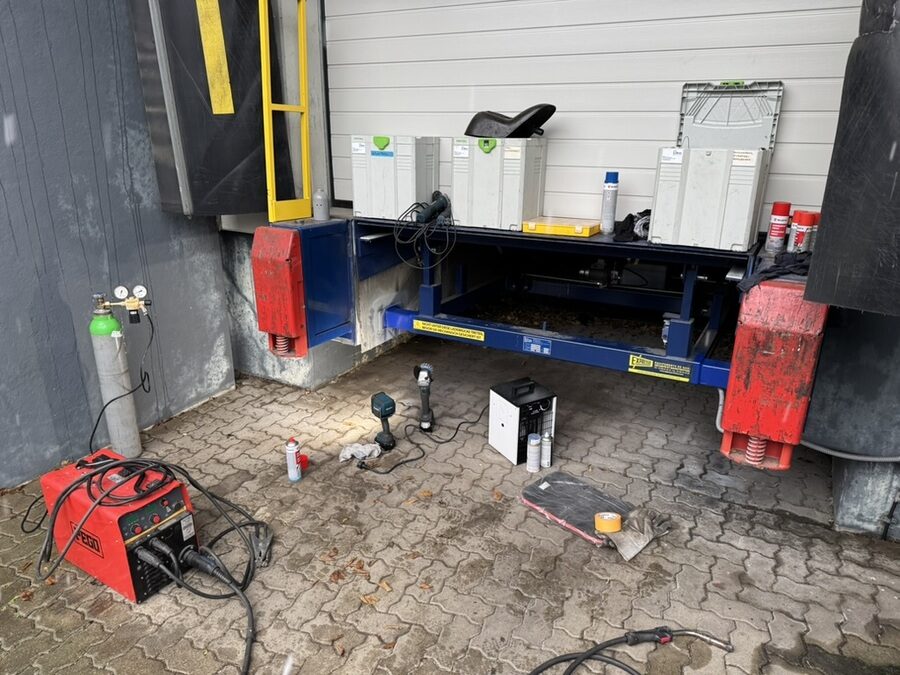
At two loading docks we renewed defective welds after the statutory inspection – on a single working day, in snowfall and sub-zero temperatures. We specially obtained an industrial heater and placed it right next to the dock. If the steel is too cold, the weld pool cools too quickly, penetration suffers and the weld becomes brittle. With heat it could be welded through cleanly – and the fitters had a steady hand too.
More technology explained
Technology explained
which process works in wind.
Technology explained
how cold cracks are found.
Technology explained
which weld is preheated.
Do you have questions about how this works on your site?
Do you need welding done outdoors in winter – on a dock, a steel structure or an installation? We bring heat, wind shields and experienced welders. Request a callback.
Our service for this: Custom fabrication and welding →
Free, no-obligation callback

About the author
Tobias Schott
Managing director of Omega Mounting GmbH, Rodgau · more than 20 years of hands-on experience in installation and maintenance
A trained mechatronics technician, working in maintenance, servicing and industrial installation since 2004 – first alongside his father, and with Omega Mounting since 2012: from overhead conveyors in Frankfurt to the crane system in a new-build hall. He plans and leads lifting operations as an appointed person (AP) in data centers and on industrial sites in the Rhine-Main region, trains and examines operators of cranes, mobile elevating work platforms and telehandlers, and is a qualified occupational safety specialist. On jobs abroad he is known as the “German Troubleshooter” – the person you call when a site gets stuck. He learned what quality means from his father, not from a manual: Made in Germany as a standard for his own work, not a label. That is why quality comes first at Omega Mounting – ahead of speed and price. The Technology explained articles cover the equipment and techniques his team uses every day: what counts on site is in them – what only appears in the brochure is not.
 English
 German