
- Technology explained – machines and equipment
The baggage handling system at the airport: from check-in to the aircraft
By Tobias Schott · 6-minute read · Updated November 2026
A baggage handling system takes every checked suitcase from the check-in desk through screening and sorting to the right aircraft – and on arrival back to the reclaim belt. Behind it are kilometres of conveyors, diverters, sorters and a safety circuit that has to work around the clock.
Passengers only see the beginning and the end of the system: the belt at the desk and the carousel in the arrivals hall. In between lies a world of its own beneath and behind the terminals.
Here we explain how a baggage handling system is built, what happens at check-in, how belt and tray systems differ and what matters for safety, installation and maintenance.
What is a baggage handling system?
A baggage handling system is an airport's conveyor system for checked baggage. Specialists also call it the baggage system or BHS for short.
It is made up of many familiar building blocks of conveyor technology: belt conveyors, roller conveyors, curves, inclines, diverters and sorters. A control system tracks every suitcase from the desk to its destination. To do so it reads the tag with scanners and registers every position via photo eyes.
What is special is availability. If a section fails, suitcases are left behind and flights are delayed. That is why many routes are duplicated and maintenance takes place in fixed shutdown windows.
Key facts
- Task: Take checked baggage from check-in to the aircraft and from the aircraft to reclaim.
- Modules: Check-in conveyors, collector belts, screening levels, sorters, storage, discharge chutes, reclaim belts.
- Types: Belt conveyors with direct contact or a tray system.
- Control: Read the tag, track the suitcase, assign the destination.
- Safety: Emergency stops, guard fences, guard doors, pull cords in one safety circuit.
- Interfaces: System manufacturer, airport operator, security screening, IT, building services.
- Our part: Installation, extension, mechanical maintenance, system electrics up to the main switch.
The journey of a suitcase
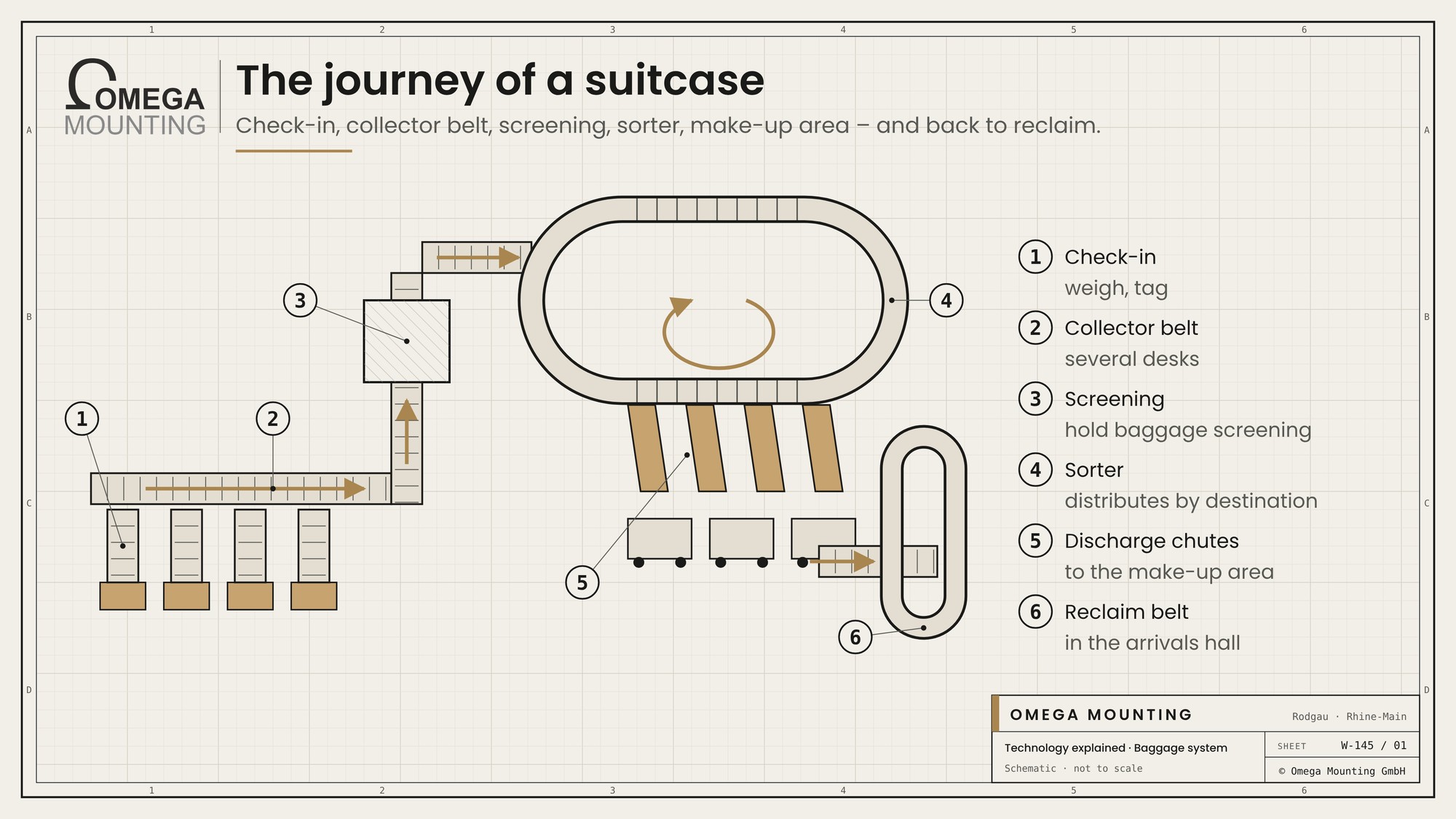
On its way from the desk to the aircraft, a suitcase passes through several stations:
- Check-in: The suitcase is weighed, tagged and placed on the belt.
- Collector belt: Several rows of desks feed a common belt.
- Check: Every suitcase passes through hold baggage screening. Suspicious items are diverted.
- Sorting: A sorter distributes the suitcases to their destinations. Scanners read the tag for this.
- Storage: If you check in early, your suitcase waits in an early baggage store.
- Make-up area: Via discharge chutes or carousels the baggage reaches the teams who load it into containers and carts.
On arrival it runs the other way, but shorter: from the aircraft onto an infeed belt and on to the reclaim belt in the arrivals hall. Transfer baggage is fed straight back into sorting.
At the check-in desk

There are usually three short conveyors in a row at the desk.
| Conveyor | Task | What matters |
|---|---|---|
| Weigh conveyor | Weighs the suitcase. | Scale clear, belt clean. |
| Label conveyor | This is where the tag is attached. | Photo eye correctly adjusted. |
| Dispatch conveyor | Releases the suitcase into the right gap. | Belt runs straight, drive quiet. |
| Collector belt | Takes suitcases from several desks. | Transfers without edges, side guides secure. |
| Photo eyes | Report position and length. | Clean, secure, correctly aligned. |
| Emergency stop | Stops the section immediately. | Within reach, clearly visible, tested. |
Transfers between belts are critical points. If an edge sticks up, wheels, straps and belts of suitcases get caught. That is why conveyors are carefully aligned in height and line during installation.
Belt or tray

In the classic design the suitcase lies directly on belts and rollers. This is simple and robust, but bags with long straps, round items and oversized baggage cause problems.
Tray system: Each suitcase has its own plastic tray. The tray has a fixed shape, so its route can be tracked precisely. Straps do not get caught. Empty trays run back to the start on a separate level.
Tray systems need more conveyor length and more mechanics, such as stackers for empty trays and tilt stations for unloading. In return, the number of faults caused by snagged baggage falls.
For oversized baggage such as pushchairs or sports equipment there is often a separate line with wider conveyors.
Safety and maintenance
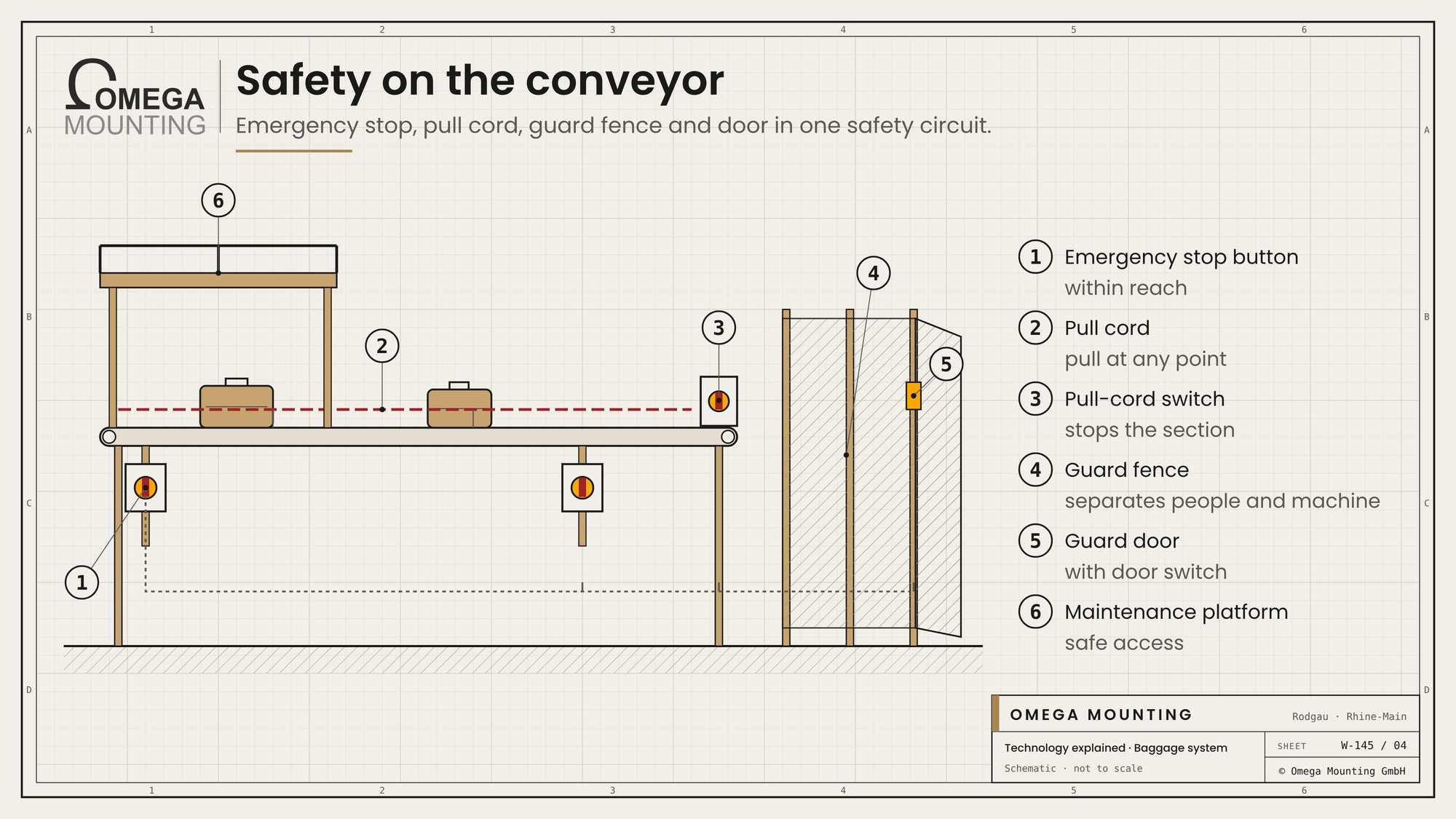
A baggage handling system is a machine with many moving parts, often in areas where people also work. Safety rests on several building blocks:
- Emergency stop buttons: along the lines within reach, at every workstation.
- Pull cords: on long conveyors, which can be pulled at any point.
- Guard fences and guard doors: A door switch stops the section as soon as someone enters.
- Safety sensors: secure transfer points and work areas.
All these elements are connected in a safety circuit. When the system is extended, new buttons and sensors must be integrated into this circuit and then tested.
Maintenance follows a plan: belt tracking and tension, rollers and bearings, drives and chains, photo eyes and scanners, discharge chutes and side guides. Because the system can hardly stop during operation, this work takes place in fixed shutdown windows, often at night.
Working at the airport
Anyone working on a baggage system works in the airport's security area. That means access authorisation for every person, controlled routes for tools and material, and fixed time windows.
For installation teams this means preparing parts as far as possible in advance, pre-assembling brackets and plates in the workshop and splitting the work on site into short, well-planned steps. Anything not finished in the shutdown window must be safely removed or secured before the system runs again.
Controls, IT and the authorities' screening technology are the responsibility of the system manufacturer and the operator. Our qualified electricians handle the system electrics up to the main switch; the building electrics remain with the operator.
Typical faults
Most faults on baggage systems are mechanical and have known causes.
Snagged baggage at transfers and diverters is the classic. Straps, belts and loose tags catch on edges or in gaps. Cleanly aligned transfers and intact side guides are the remedy.
Dirty or misaligned photo eyes report suitcases that are not there or miss real ones. The control system then loses track, and baggage ends up in the problem bag area. Regular cleaning and checking of the sensors helps.
Wear on drives, chains, sprockets and bearings sooner or later brings a section to a standstill. Keeping an eye on noise, play and temperature during maintenance lets you replace parts before they fail.
What we pay attention to
For installation and maintenance on conveyor and sorting systems at the airport, we pay attention to the points that keep operations running.
- We plan every step to fit the shutdown window.
- We align conveyors in height and line so that transfers run without edges.
- We fully integrate new emergency stop buttons and sensors into the existing safety circuit.
- After every job we check that each button really stops the section.
- In agreement with the operator, we keep spare parts ready for critical drives.
Where we use it
At Frankfurt Airport we supported the extension of a parcel sorting system – installing, aligning and integrating 32 emergency stop buttons and numerous sensors into the existing safety circuit, with two technicians over two days, each time during the shutdown periods. In an emergency at a high-bay warehouse at the airport the roller conveyor had stopped because a worn sprocket blocked the drive chain. We replaced chains and sprockets and readjusted the system. More about our services is on the page Airport and security areas.
More technology explained
Technology explained
what the red mushroom button really does.
Guide
our guide to working at the airport.
Do you have questions about how this works on your site?
Are you planning an extension or do you need support maintaining your conveyor system at the airport? We work in the shutdown window and know the procedures in the security area. Request a callback.
Free, no-obligation callback

About the author
Tobias Schott
Managing director of Omega Mounting GmbH, Rodgau · more than 20 years of hands-on experience in installation and maintenance
A trained mechatronics technician, working in maintenance, servicing and industrial installation since 2004 – first alongside his father, and with Omega Mounting since 2012: from overhead conveyors in Frankfurt to the crane system in a new-build hall. He plans and leads lifting operations as an appointed person (AP) in data centers and on industrial sites in the Rhine-Main region, trains and examines operators of cranes, mobile elevating work platforms and telehandlers, and is a qualified occupational safety specialist. On jobs abroad he is known as the “German Troubleshooter” – the person you call when a site gets stuck. He learned what quality means from his father, not from a manual: Made in Germany as a standard for his own work, not a label. That is why quality comes first at Omega Mounting – ahead of speed and price. The Technology explained articles cover the equipment and techniques his team uses every day: what counts on site is in them – what only appears in the brochure is not.
 English
 German