
- Technology explained – technology and procedures
Silencers on standby generators: intake side, exhaust and cooling air
By Tobias Schott · 5-minute read · Updated November 2026
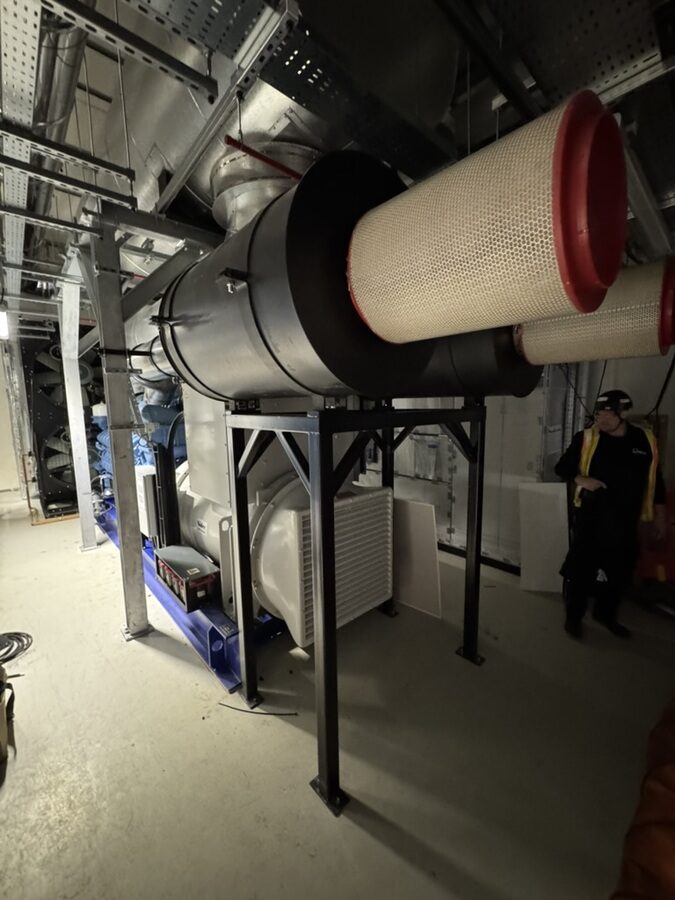
A standby generator is loud in several places – at the turbocharger, the exhaust, the radiator and the engine itself; turbo silencers on the intake side, exhaust silencers in the exhaust line and splitter attenuators in the air path help, provided they are properly installed and measured at full load.
Data centers and hospitals are often located in the middle of town. Their standby generators rarely run, but with every test and every power failure they run at full output. Then what counts is not only that the power comes, but also how loud it gets for the neighbours. Silencers are therefore often a precondition for operating a standby power system in compliance with its permit.
Here we explain where a generator makes noise, which silencers there are, how they are installed and why measurement comes at the end.
What is a generator silencer?
A generator silencer is a component that reduces the noise along a particular path out of the generator – on the intake side, in the exhaust or in the cooling airflow. It absorbs the noise in absorption material, reflects it in chambers, or both.
What matters here: the silencer must not hold the engine back. Air and exhaust must continue to flow freely so that the generator delivers its full output. Every silencer is therefore designed to suit engine, air flow and exhaust flow – usually by the generator set manufacturer or an acoustic consultant.
Key facts
- Noise sources: turbocharger, exhaust, radiator fan, engine.
- Intake side: turbo silencer between filter and turbocharger.
- Exhaust: exhaust silencer in the exhaust line.
- Cooling: splitter attenuators and weather louvres in the air path.
- Installation: Frames, pipework, flexible connections.
- Evidence: noise measurement at full load.
Where a generator makes noise
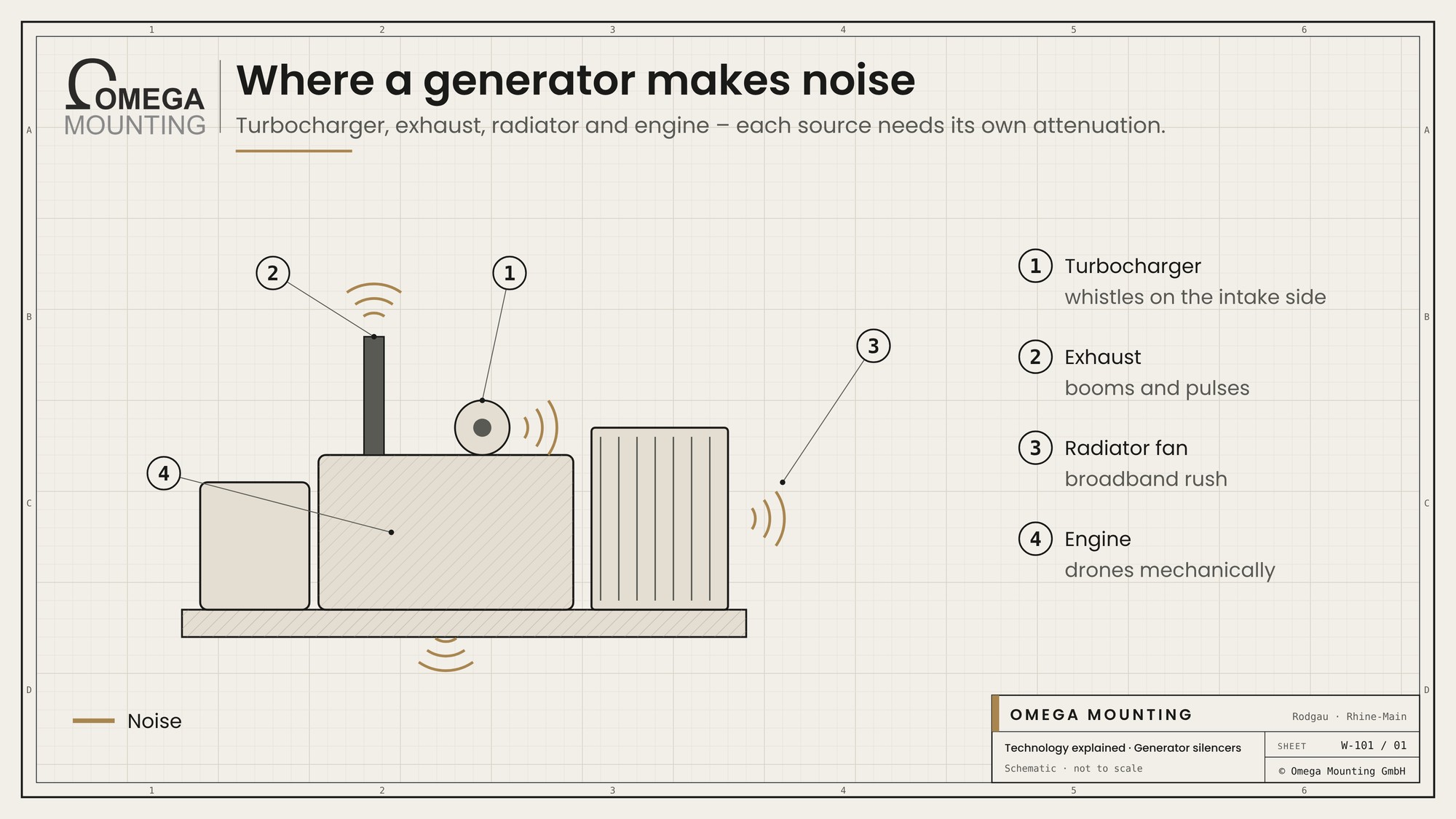
| Source | How it sounds | What helps |
|---|---|---|
| Turbocharger | High-pitched whistle on the intake side | Turbo silencer |
| Exhaust | Low booming and pulsing | Exhaust silencer |
| Radiator fan | Broadband rushing | Splitters in the supply and exhaust air path |
| Engine | Mechanical droning | Acoustic room or container |
Which source is a nuisance depends on the location. In a container it is different from a generator room in a building, and stricter limits apply at night than during the day. The whistle of the turbochargers carries far and is particularly noticeable to neighbours – even if the overall level is not that high.
Three silencers compared
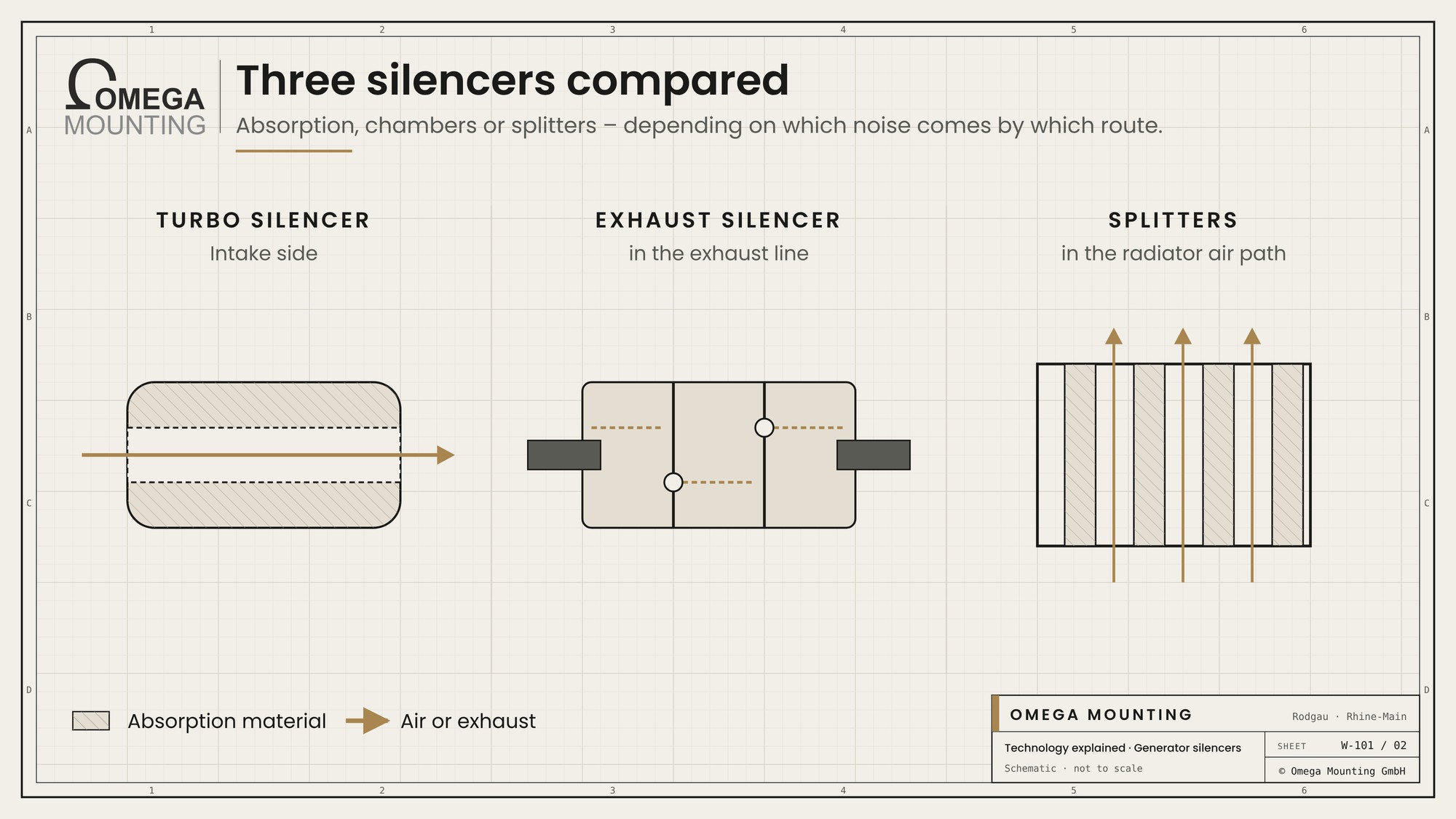
- Turbo silencer: It sits between intake filter and turbocharger and absorbs exactly the turbocharger's high frequencies without throttling the airflow.
- Exhaust silencer: It sits in the exhaust line and works with chambers and absorption material against the low frequencies. Because exhaust is hot and the engine vibrates, it needs expansion joints and secure suspension.
- Splitter attenuator: Parallel splitters of absorption material in the supply and exhaust air duct damp the radiator's rushing noise. Weather louvres are often fitted in front of or behind them.
Installation above the generator
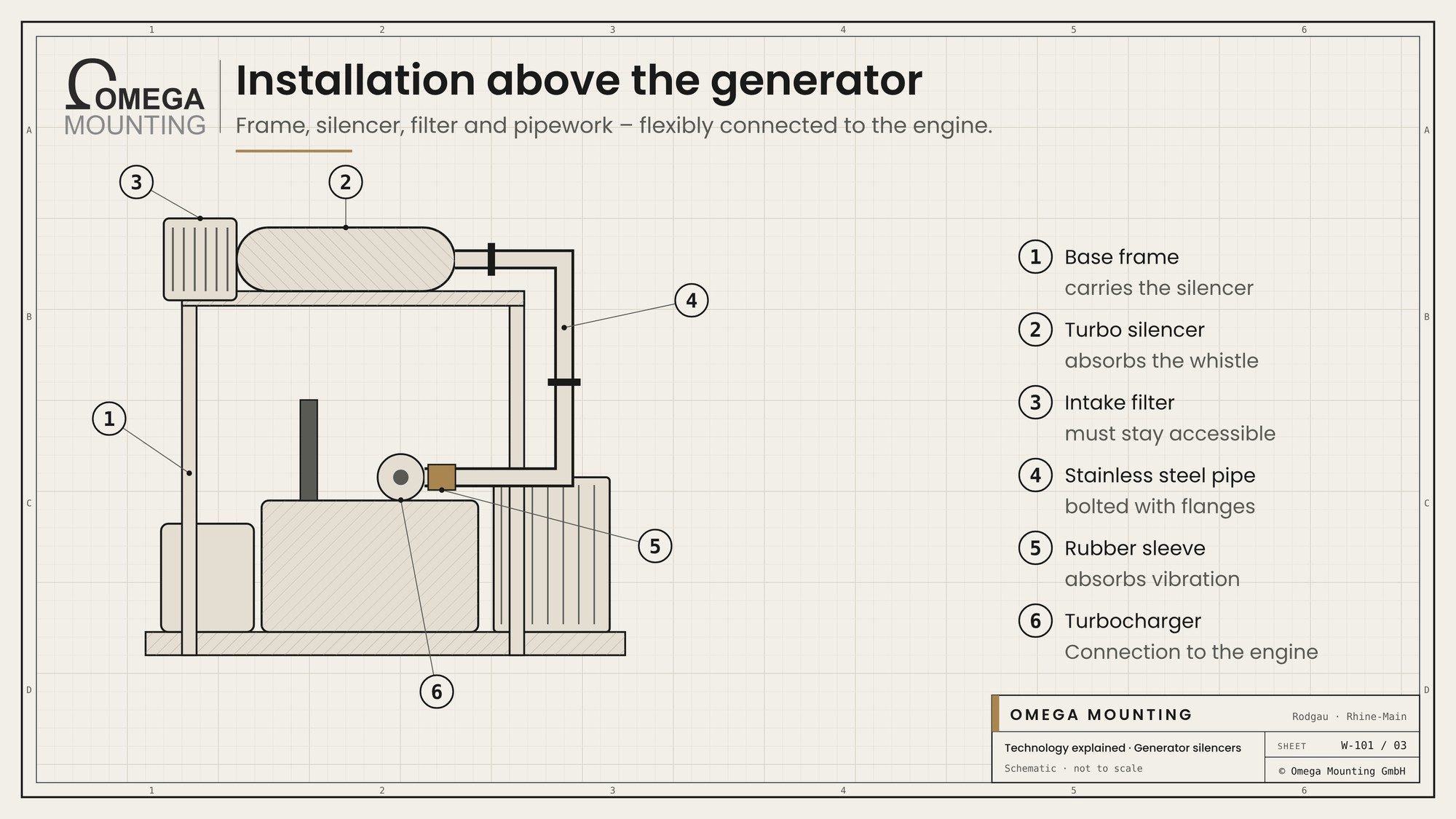
Silencers are big and heavy – and they often have to go into rooms where no crane is available.
- Bringing in: via goods lifts and corridors, often in several stages.
- Base frame: Where the silencers sit above the generator, a sturdy, aligned frame is needed.
- Lifting without a crane: with manual stackers, chain hoists or lifting devices.
- Pipework: Stainless steel pipes with flanges connect filter, silencer and engine.
- Flexible connections: Rubber sleeves and expansion joints absorb vibration and thermal expansion.
- Accessibility: Filters, radiator and maintenance openings must remain accessible.
How standby generators are maintained is described in our guide on standby generator maintenance.
Planning for space and maintenance
Silencers are often retrofitted – into rooms that were never designed for them. Then things get tight. Sometimes only a hand's width remains between silencer, louvre and radiator. That is not a problem for operation, but it is for maintenance: filters have to be changed, radiators cleaned and repaired in the event of damage.
That is why installation planning always includes the question of how to get at everything again later. Maintenance openings, removable pipe sections and enough room in front of the filter save hours later – and, in an emergency, removing whole assemblies.
Structural matters count too: a silencer on a frame above the generator puts weight up high. The frame must transfer the load safely into the floor and must not vibrate along when the engine starts.
Measuring at full load
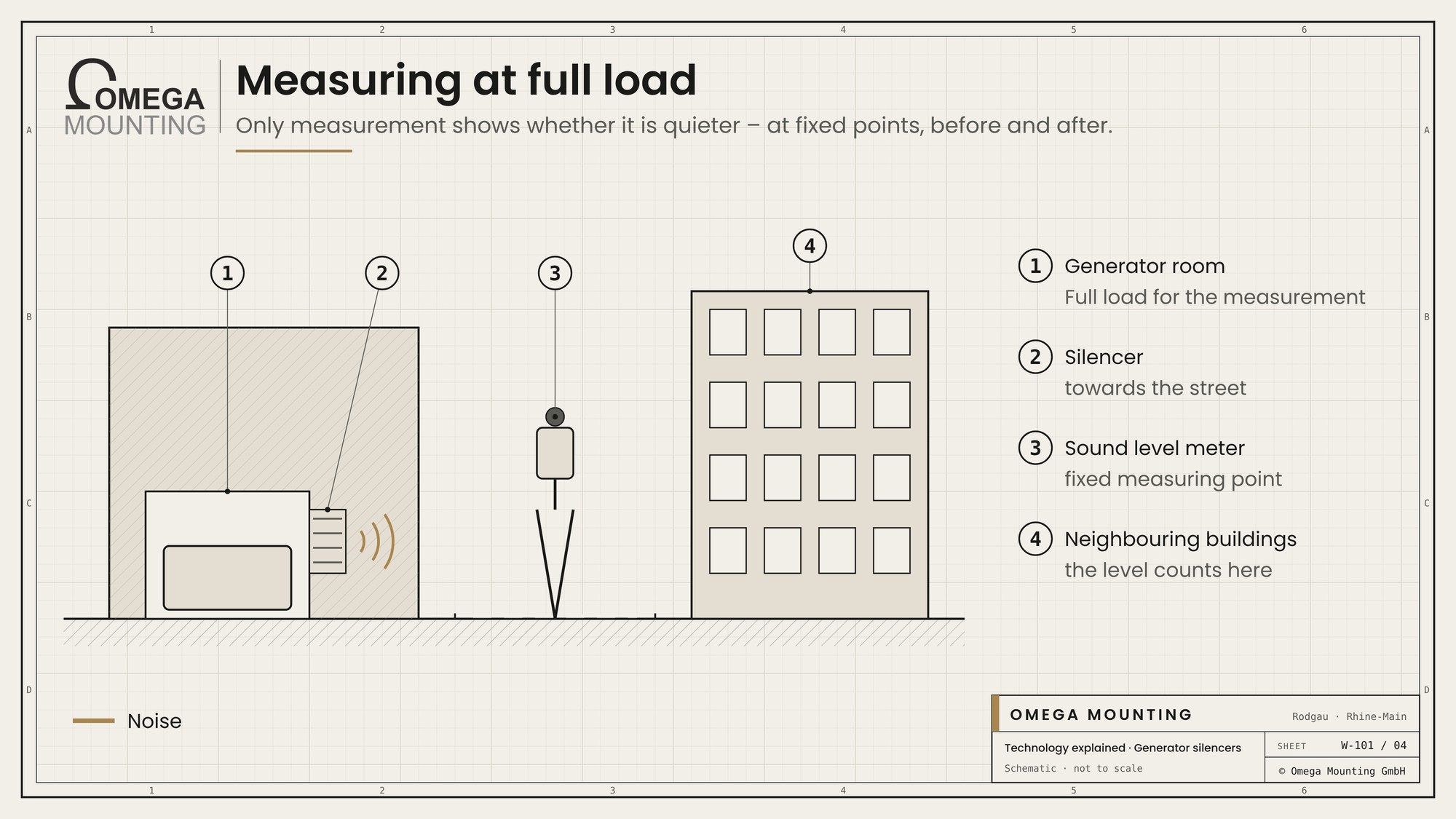
Only measurement shows whether a silencer works. Measurement is done at full load at defined measuring points – ideally before and after at the same spot. This provides evidence that the noise protection conditions are met.
This also includes a performance test: with the new silencers the engine must still deliver its full output without intake depression or exhaust back pressure becoming too high.
Typical mistakes
- Rigid connection to the engine: Vibration cracks flanges and welds.
- Filter not accessible: Changing it becomes an installation job.
- No room at the radiator: Maintenance and repair become almost impossible.
- Accepted without measurement: Nobody knows whether it is really quieter.
- Back pressure not checked: The engine loses power.
Inspecting and maintaining
Silencers on a generator work unnoticed until they leak or come loose. During maintenance we pay attention to:
- Exhaust side: Cracks, leaking flanges and soot marks at joints are signs of leaks.
- Expansion joints: The flexible pieces take up movement and thermal expansion. They age and crack.
- Suspension: Brackets and springs carry the weight. Deformed or loose brackets are replaced.
- Splitters: In air silencers, insulation can come loose and block the air path.
- Insulation: Thermal insulation on the exhaust path protects people and the building. Damaged areas are renewed.
A load test on the load bank is the best opportunity to watch silencers and exhaust path at full load. Leaks show up immediately. We plan repairs so the plant is out of service only briefly.
What we pay attention to
- We plan the move-in route into the generator room.
- We build base frames sturdy and aligned.
- We connect pipes flexibly to the engine.
- We keep filters, radiator and maintenance openings accessible.
- We support the performance test and noise measurement.
Where we use it
At a data center in Offenbach, just one street away from office buildings, we got 12 twin turbo silencers installed: distributed to the floors by goods lift, lifted with crank-operated stackers onto base frames over two metres high above the generators, connected with intake filters and welded stainless steel pipework with rubber sleeves – and then measured at full load. How tight it can get between silencer, louvre and radiator is shown by our radiator repair in Offenbach, where barely a hand's width of space remained.
More technology explained
Technology explained
where the generator belongs.
Technology explained
repair on the radiator.
Technology explained
full load for testing and measurement.
Do you have questions about how this works on your site?
Is your generator too loud or do you need to retrofit silencers? We bring them in, install them and support the measurement. Request a callback.
Our service for this: energy and standby power →
Free, no-obligation callback

About the author
Tobias Schott
Managing director of Omega Mounting GmbH, Rodgau · more than 20 years of hands-on experience in installation and maintenance
A trained mechatronics technician, working in maintenance, servicing and industrial installation since 2004 – first alongside his father, and with Omega Mounting since 2012: from overhead conveyors in Frankfurt to the crane system in a new-build hall. He plans and leads lifting operations as an appointed person (AP) in data centers and on industrial sites in the Rhine-Main region, trains and examines operators of cranes, mobile elevating work platforms and telehandlers, and is a qualified occupational safety specialist. On jobs abroad he is known as the “German Troubleshooter” – the person you call when a site gets stuck. He learned what quality means from his father, not from a manual: Made in Germany as a standard for his own work, not a label. That is why quality comes first at Omega Mounting – ahead of speed and price. The Technology explained articles cover the equipment and techniques his team uses every day: what counts on site is in them – what only appears in the brochure is not.
 English
 German