
- Guide – Maintenance and servicing
Maintaining industrial and high-speed doors: inspecting, adjusting and servicing sectional doors, roller shutters and high-speed doors
By Tobias Schott · 20-minute read · As of November 2026
Maintaining industrial doors means: checking springs, cables, tracks and rollers, inspecting curtain and seals, adjusting limit positions and running behaviour, testing safety devices, repairing impact damage and recording everything in the inspection log. A door that nobody maintains usually fails just when the dock is full.
An industrial door moves many times a day. It withstands wind, cold and forklifts. As long as it runs, hardly anyone notices it. When it stops, loading backs up, heat escapes or a lorry cannot be unloaded.
Power-operated doors must be inspected regularly. Many operators know the obligation but not the difference between inspection and maintenance. Anyone searching for “high-speed door maintenance”, “sectional door maintenance” or “replacing door springs” usually wants to know exactly this: what needs to be done, who may do it, and how does the door stay available during operation?
This guide shows how to have industrial doors maintained – sectional doors, roller shutters and high-speed doors. It is written for operators and site managers, maintenance managers, facility managers, warehouse and shift managers, buyers and safety officers. How the whole loading bay with dock leveller, buffers and vehicle restraint is maintained is described in the guide Loading dock maintenance.
Key points at a glance
- Maintaining industrial doors means: check mechanics, test safety, adjust, fix defects, document.
- Inspection is mandatory. Power-operated doors are inspected at least once a year by a competent person.
- Maintenance keeps the door available. It goes beyond inspection and prevents breakdowns.
- Springs are critical. Broken torsion springs are dangerous and belong only in trained hands.
- Test the safety devices. Safety edge, light curtain and fall arrest device must work.
- Repair impact damage immediately. A distorted door runs crooked and wears quickly.
- Controls stay with the door service. Parameters and safety functions remain with the manufacturer.
- Keep an inspection log. Every inspection and every repair is documented.
What does maintaining industrial doors actually involve?
Maintaining industrial doors covers the regular checking, care and adjustment of all mechanical and safety-relevant parts of a door, the rectification of defects and documentation – in addition to the legally required inspection by a competent person.
An industrial door consists of a door leaf or curtain, guide tracks, counterbalance, drive, controls and safety devices. Each of these parts wears differently. Maintenance looks at all of them.
Inspection and maintenance are not the same
Inspection establishes whether the door is safe. It is mandatory. Maintenance keeps the door in a condition in which it passes inspection and does not fail. Both are often done in one visit, but they are not the same.
Why maintenance pays off
A maintained door fails less often and lasts longer. Small defects such as a loose roller or a worn seal cost little if found early. Found late, they become a broken shaft or a fallen door leaf.
Door types: sectional door, roller shutter, high-speed door
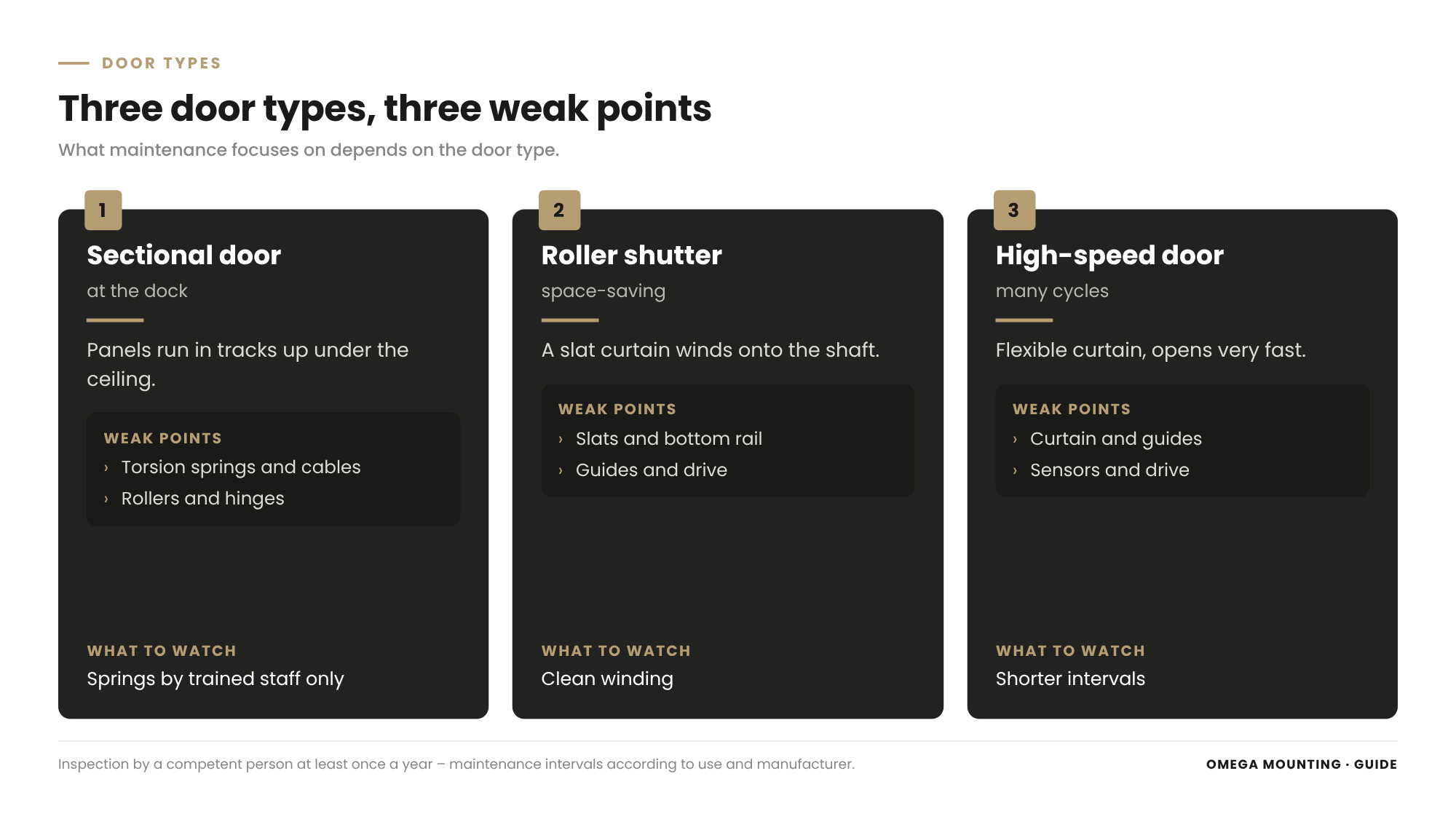
Each door type has its own technology and its own weak points.
Sectional door
A sectional door consists of horizontal panels that run in tracks up under the ceiling when opening. Torsion springs on a shaft balance the weight. It is the typical door at a loading dock. How it is built is explained in the article on the Sectional door at the dock.
Roller door
A roller shutter winds a curtain of slats onto a shaft above the opening. It needs little space and is robust. Weak points are the slats, the guides and the drive.
High-speed door
A high-speed door opens and closes very quickly, often with a flexible plastic curtain. It separates areas with different temperatures or hygiene requirements. Because of the many cycles, it wears particularly quickly and needs more frequent maintenance.
Fire doors
Fire doors close automatically in the event of fire. Their hold-open system and closing function are inspected under separate rules, usually by the manufacturer or an approved specialist company. We only work on the general mechanics here, and by arrangement.
Other door types
Sliding doors, folding doors and vertical lift doors are less common but follow the same basic rules: check the mechanics, test safety, document.
Inspection obligation: what operators need to know
Power-operated doors are work equipment and subject to an inspection obligation.
How often they are inspected
Power-operated doors are inspected by a competent person before first use and at least once a year thereafter. For heavy use, the operator can set shorter intervals.
Who inspects
Inspections may be carried out by a competent person who knows the design, technology and rules. This can be the manufacturer's door service or another competent specialist company. What obligations operators have overall is described in the guide inspection obligations for operators.
Inspection log
Result, scope and name of the inspector are recorded in the inspection log. If the record is missing, the door is considered uninspected in case of doubt.
What the competent person checks
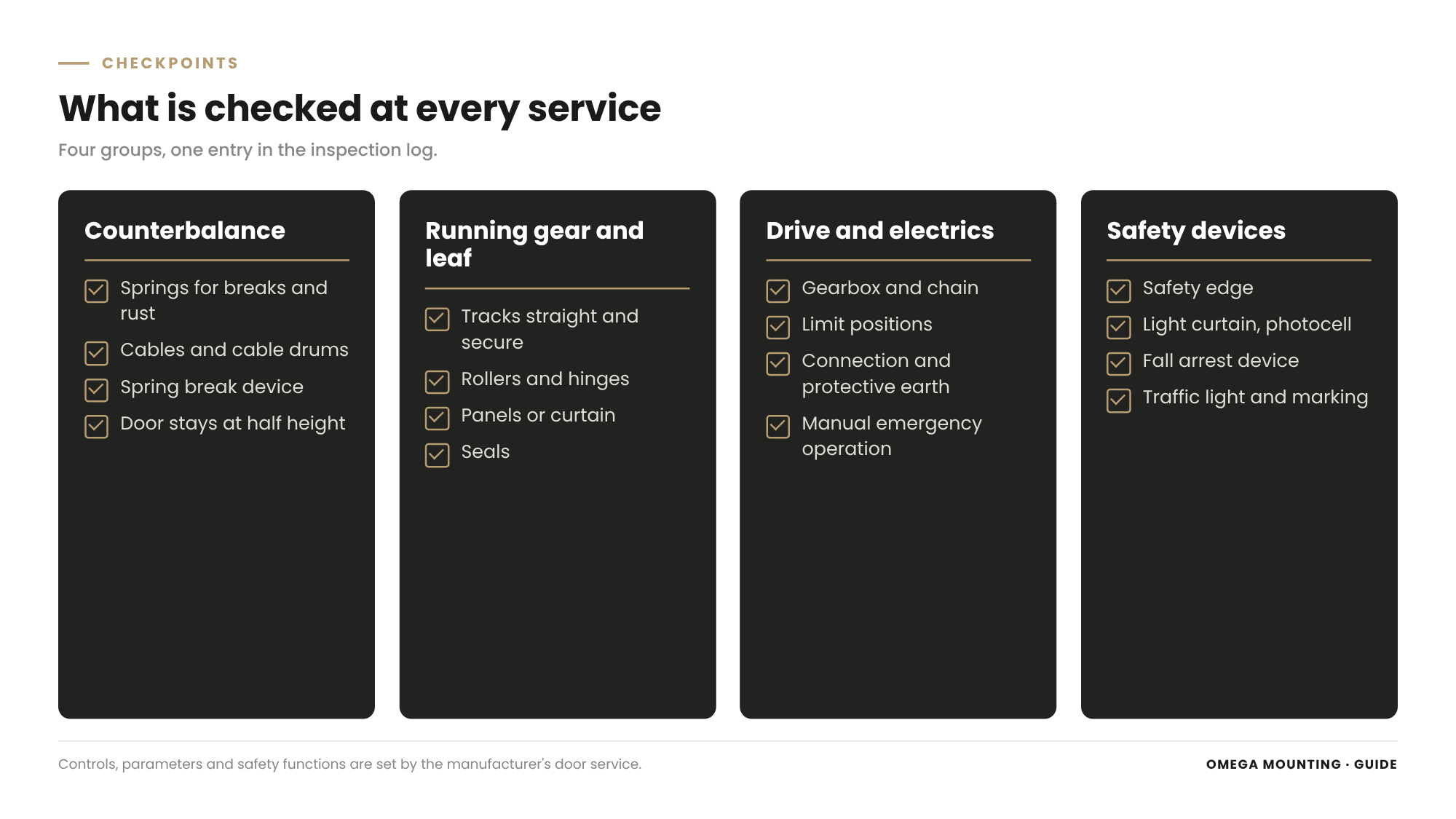
The competent person checks, among other things, fixings, counterbalance, running gear, drive, controls, safety devices, marking and documents. They determine whether the door may continue to be operated.
Manually operated doors
Manually operated doors also need regular checks, for example of springs and cables. The obligations follow from the operator's risk assessment.
Springs, cables and counterbalance
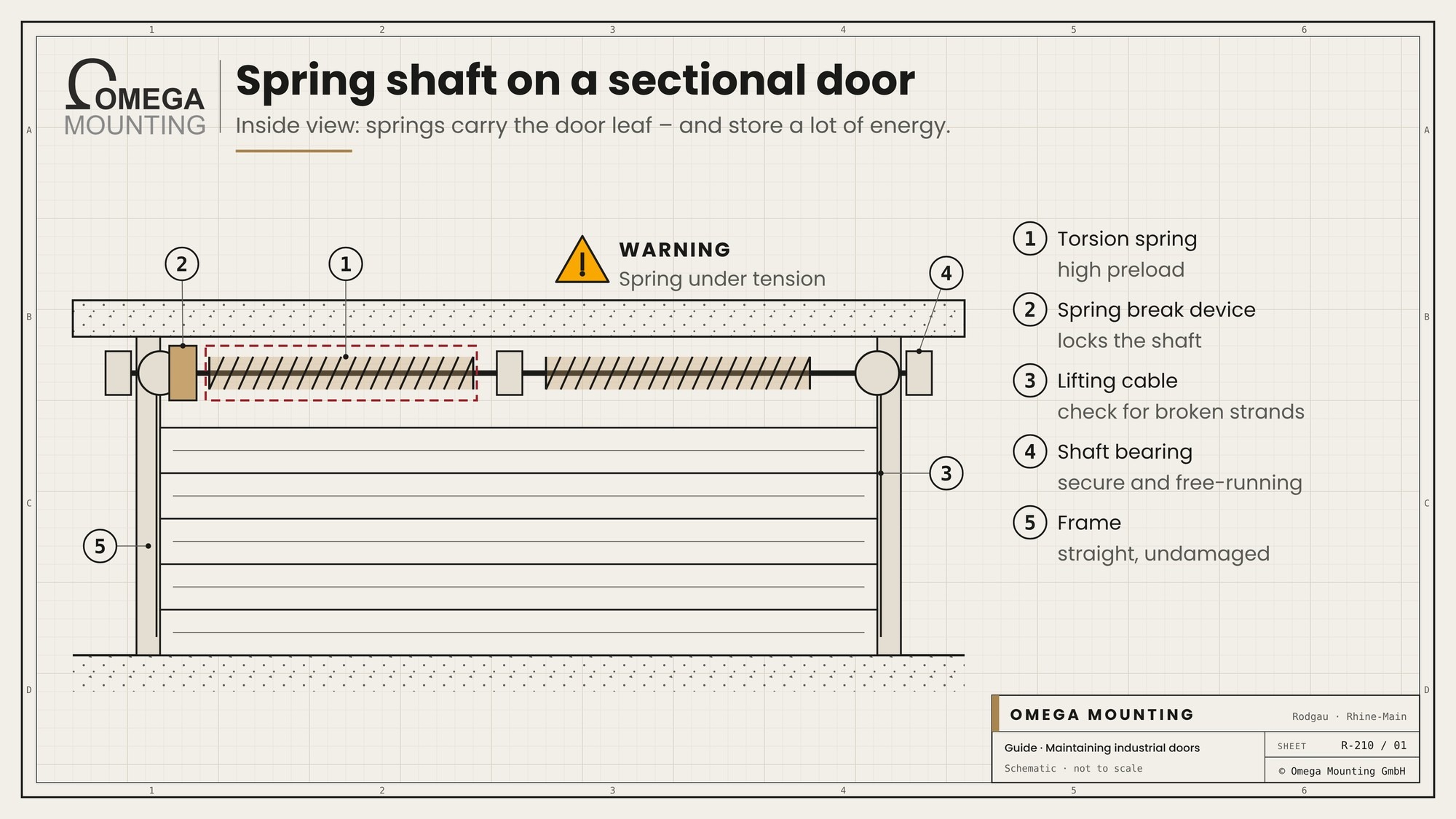
The counterbalance is the heart of the sectional door – and its most dangerous point.
Torsion springs
The springs are heavily preloaded and carry the weight of the door leaf. Over time they fatigue and break. A door with a broken spring runs heavily, crookedly or not at all.
Spring break device
Modern sectional doors have a spring break device that locks the shaft if a spring breaks. Its function is checked during maintenance.
Cables and cable drums
The lifting cables run over drums at the shaft ends. They are checked for broken strands, kinks, rust and correct position on the drum.
Replacing springs
Springs are replaced in pairs and preloaded as specified by the manufacturer. This is dangerous work: a spring released incorrectly can cause serious injury. It belongs only in the hands of trained fitters with the right tools.
Extension springs on older doors
Older doors sometimes have extension springs at the side of the tracks instead of torsion springs on the shaft. They are also under tension and need a safety cable so that a breaking spring does not lash through the hall.
Checking the counterbalance
A correctly balanced door stays at half height when moved by hand. If it sinks or rises, the spring tension is wrong.
Running gear: tracks, rollers, hinges

The running gear guides the door. If it binds, everything else suffers too.
Tracks
The tracks must be straight, clean and firmly bolted. Tracks bent by impact damage make the door bind or jump out.
Rollers
Rollers wear and can seize. Worn or knocking rollers are replaced.
Hinges and panels
The hinges between the panels loosen over time. Screws are retightened and broken hinges replaced. Dented panels are replaced before they distort the door.
Aligning the door leaf
If the door leaf runs at an angle, the cable lengths or spring tension on the left and right often do not match. This is adjusted before the tracks or rollers are damaged.
Lubrication
Rollers, bearings and hinges are lubricated as specified by the manufacturer. Too much grease attracts dirt, too little lets parts run dry.
Curtain and slats: high-speed doors and roller shutters
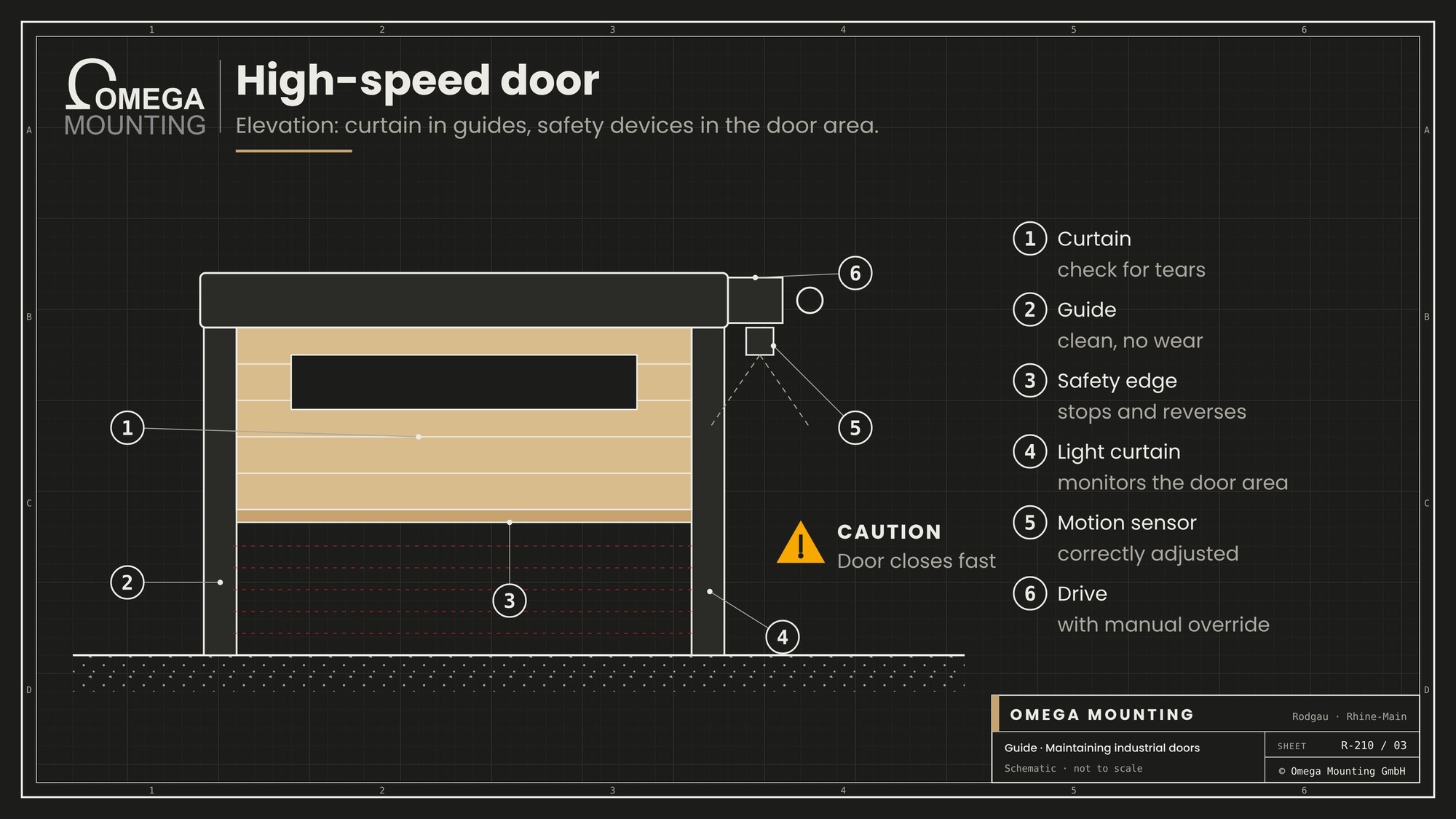
On high-speed doors and roller shutters, the curtain is the wearing part.
Flexible curtain
Tears, holes and torn-out stiffeners are checked. Small damage can be patched; larger damage requires a new curtain.
Guides
On high-speed doors the curtain runs in side guides. Many doors can re-thread the curtain after an impact. The guides are cleaned and checked for wear.
Winding shaft and bearings
On high-speed doors and roller shutters, the shaft above the opening carries the whole curtain. Its bearings are checked for play and noise. A knocking bearing announces the next breakdown.
Slat curtain
On roller shutters, slats, bottom rails and suspensions are checked. Bent slats are replaced so that the curtain winds up cleanly.
Seals and thermal protection
A door separates inside from outside. Leaky doors cost energy and let in draughts, dust and moisture.
Bottom, side and header seals
Seals are checked for cracks, deformation and secure fit. A torn bottom seal lets rainwater into the hall.
Doors in cold and freezer stores
Tight doors are particularly important here. Iced-up seals and curtains need special attention. How maintenance works in frost is described in the guide Maintaining cold stores.
Controls, drive and electrics: where the boundary lies
With the electrics, the boundary between the parties involved is important.
Drive and chain
Geared motor, chain, sprocket and coupling are checked for noise, wear and secure fit. Chain tension and oil level are checked as specified.
Electrical connection
The electrical connection of the door up to the main switch is carried out by our own electricians. They check the supply cable, terminals and protective earth.
Controls and parameters
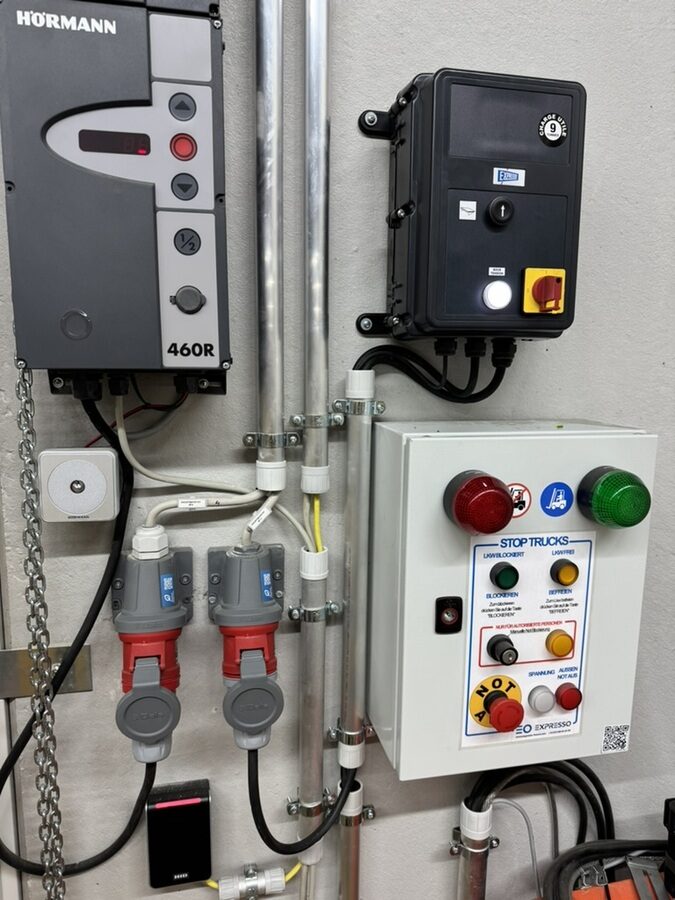
Controls, running times, limit position logic and safety functions are usually manufacturer-specific. This is where the manufacturer's door service works. We take care of the mechanics and coordinate.
Chain and gearbox on chain drives
Many industrial doors have a shaft-mounted drive or a chain drive. A stretched chain jumps, a dry gearbox becomes noisy. Both are checked and adjusted during maintenance.
End positions
The limit positions determine where the door stops at the top and bottom. If they are misadjusted, the door hits the end or does not close fully. Electronic limit positions are set by the door service.
Testing safety devices
A power-operated door can trap or strike people. The safety devices prevent this.
Safety edge
A strip on the bottom edge stops the door and reverses it if it meets an obstacle. It is triggered and checked at every service.
Light curtain and photocell
They detect people and vehicles in the door area before the door closes. Optics and function are checked, dirty sensors cleaned.
Fall arrest device
It prevents the door leaf from falling if a spring, cable or drive breaks. Its function is safety-relevant and documented.
Manual emergency operation
In a power failure, the door must be openable by hand. Manual emergency operation is tested so that it works when needed.
Impact damage: the most common reason for door repairs
Forklifts and lorries are a door's worst enemies.
Typical damage
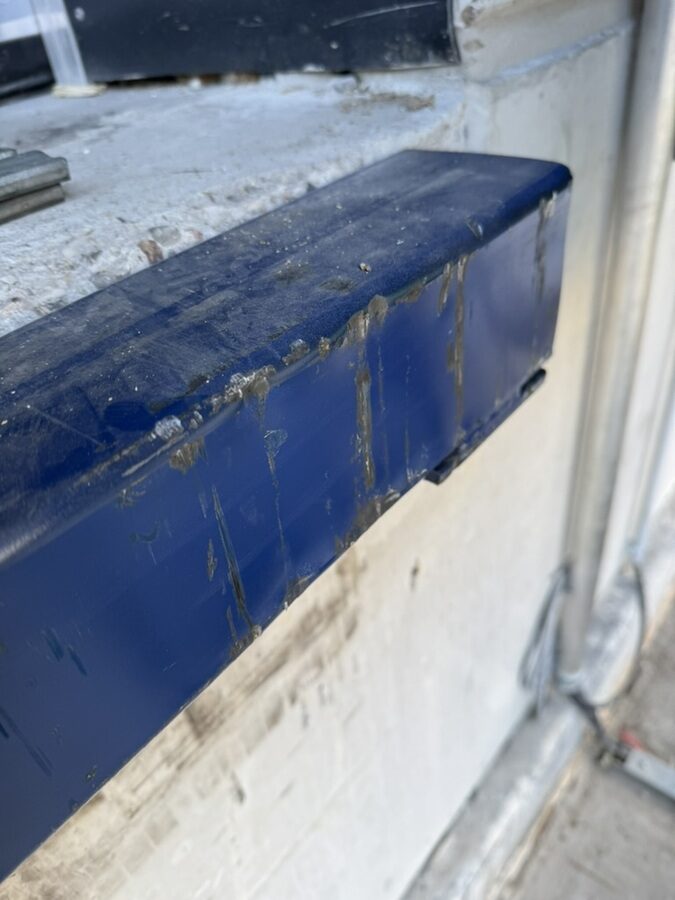
Dented panels, bent tracks, torn curtains, damaged frames. After an impact the door often still runs – but crookedly and with heavy wear.
Take out of service or keep running?
If the door runs crooked, binds or a safety device is damaged, it is taken out of service. A damaged door in operation is a risk to people and to the door itself.
Prevention
Buffers, impact protection and guards on frames and guides protect the door. Which impact protection belongs where is described in the guide Impact protection: plastic or steel?.
Operation and safety in everyday use
Much damage is caused by incorrect operation. Here the operator can do a lot themselves.
Clear operation
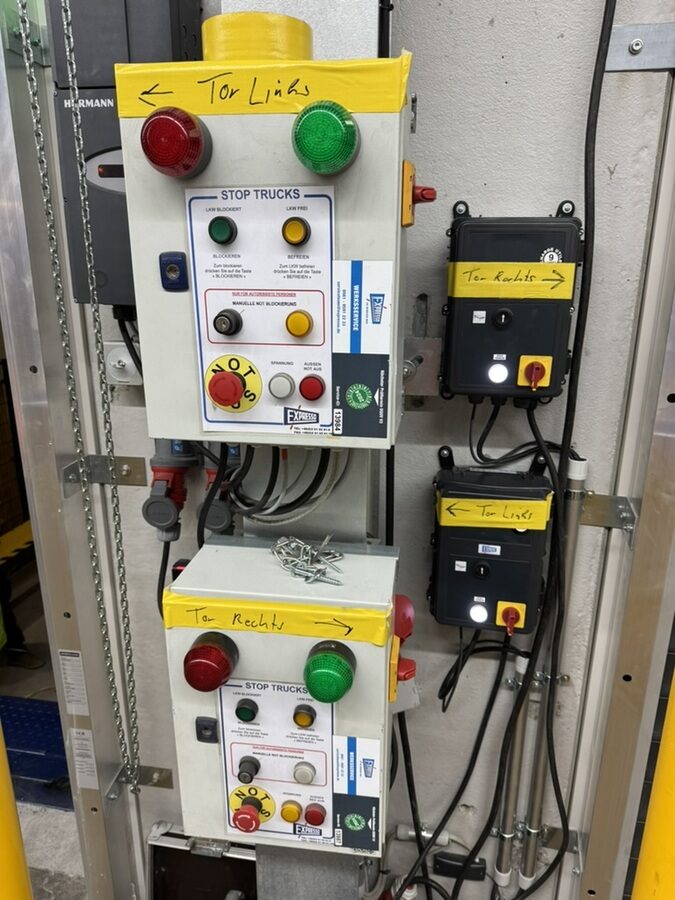
Controls are easy to reach and clearly labelled. Traffic lights show when a door is open and when a vehicle may dock.
Remote controls and pull switches
Hand transmitters, ceiling pull switches and radar sensors are arranged so that the operator can see the door while closing it. A door closed from a forklift without a view is an accident risk.
Instruction
Anyone who operates doors is instructed: do not walk under a moving door, do not drive into the door, report damage immediately.
Marking traffic routes
Floor markings in front of the door show where forklifts stop and where pedestrians walk. This reduces the risk of someone being struck by the door or a forklift hitting it.
Daily visual check
Shift managers or operators take a quick look at the door: does it run straight? Are there new dents? Are cables slack? This visual check does not replace maintenance but catches a lot early.
Maintaining a sectional door step by step
A typical sectional door service follows a fixed sequence. That way nothing is forgotten.
Visual inspection when closed
First the door is inspected from inside and outside: panels, seals, frame, tracks, springs, cables. Anything conspicuous is photographed.
Test run and observation
The door is opened and closed a few times. Does it run evenly, without jerks or noise? Does it stay straight? Does it stop cleanly at the limit positions?
Checking the counterbalance
The drive is disengaged and the door moved by hand. It should run easily and stay at half height.
Retightening and lubricating
Screws on hinges, roller brackets and tracks are retightened, rollers and bearings lubricated, worn parts noted or replaced straight away.
Testing safety
Safety edge, light curtain, spring break device and manual emergency operation are triggered and checked for function.
Documenting
Result, defects and actions go into the inspection log. The operator receives a list with photos.
Maintaining a high-speed door: what is different
High-speed doors are more sensitive than slow doors. They run very often and very fast.
Many cycles
A high-speed door between warehouse and production may open with every forklift journey. Bearings, drive and curtain wear correspondingly faster. The manufacturer's maintenance intervals are therefore shorter.
Sensors
High-speed doors often open automatically via motion sensors, radar or induction loops. These sensors are checked and cleaned. An incorrectly set sensor makes the door open too often or too late.
Self-repair after impact
Many high-speed doors re-thread the curtain themselves after an impact. That is practical but tempts people to overlook damage. After every impact, curtain and guides are still inspected.
Hygiene
In food plants and cleanrooms, high-speed doors must be easy to clean. Lubricants and spare parts are chosen to suit the area.
Doors at the loading dock: working with dock leveller and buffers
At the dock the door does not work alone. Door, dock leveller, buffers, dock seal and vehicle restraint form a unit.
Damage travels
Worn buffers make lorries dock harder. The impact goes into the dock, frame and door tracks. Anyone who repairs only the door but does not replace the buffers will soon be repairing again.
Maintaining together
It pays to maintain the door and dock leveller in the same visit. How a dock leveller works is explained in the article on the Dock leveller. How fold-out dock ramps are maintained is described in the guide Servicing a folding dock leveller.
Dock shelter
Dock seals and dock shelters seal the gap between lorry and building. They are checked for tears and wear because they save a lot of energy.
Door maintenance in autumn and winter
Cold, wet and road salt are particularly hard on doors.
Before winter
Check seals, clean tracks, use lubricants for low temperatures, check the bottom seal against freezing.
In winter
Never force a frozen door open. The drive or spring can be damaged. Ice is released carefully.
After winter
Rust on tracks and fittings is removed, salt residues washed off. What autumn and spring maintenance covers overall is described in the guide Winter maintenance for plant.
Planning maintenance during operation
Doors are needed in operation. Maintenance has to fit around that.
Door by door
At a dock with many doors, one door after another is maintained. The others stay in operation. The order is agreed with warehouse management.
Short downtimes
A service usually takes only a short time per door if spare parts and tools are ready. Larger repairs such as spring replacement or a new curtain are announced in advance so that warehouse management can replan.
Time window
Quiet periods, weekends or shift changes are well suited. For high-speed doors in production areas, maintenance is agreed with production.
Keeping spare parts ready
Springs, rollers, seals and curtains for the most common door types should be in stock or quickly available. What belongs in a spare parts store is described in the guide spare parts store in maintenance.
Several sites
Operators with several warehouses benefit from uniform maintenance lists and fixed dates per site. That way it is clear at a glance which door was inspected when and where defects are open.
Maintenance contract
With many doors, a maintenance contract with fixed dates pays off. What matters is described in the guide Maintenance contract.
Repair or replace?
At some point a door reaches the end of its service life.
Signs
Frequent faults, unavailable spare parts, distorted door leaves, corroded tracks and outdated safety technology are signs that replacement is due.
Partial renewal
Often it is enough to renew individual assemblies: spring set, curtain, panels, drive. That is cheaper than a new door.
Retrofitting instead of replacing
Older doors can often be retrofitted with new safety technology: light curtain, safety edge, spring break device. This extends their use and brings the door to a better safety standard. What is retrofitted is agreed by the operator with the competent person and the manufacturer.
Complete replacement
A new door is made to measure. Before replacement, opening, lintel and connections are surveyed. The replacement is coordinated with operations so that the dock is out of action no longer than necessary.
Maintenance intervals: by use, not by calendar
The annual inspection is the minimum. How often a door is maintained depends on how heavily it is used.
Lightly used doors
A hall door that is moved only occasionally often manages with the annual inspection and service. It is important that it is still moved regularly so that nothing seizes.
Heavily used doors
Dock doors in logistics centres and high-speed doors in production run many times a day. Here, six-monthly or even more frequent services make sense. Many drives count the cycles, and the service date is based on them.
After special events
After impact damage, a storm, a spring breakage or a repair, the door is inspected outside the plan before it is released again.
Documentation and door list
Good documentation makes maintenance plannable and saves time in the event of damage.
The door list
Each door is given a number, location, door type, year of manufacture and manufacturer in the records. Inspection dates, services and repairs are added.
Tracking defects
Defects from the inspection are recorded with a deadline and person responsible and only closed when rectified. Open defects are a problem for the operator in the event of damage.
Photos
Photos of the condition before and after the service show what was done. They also help when ordering spare parts.
Safety rules when maintaining industrial doors
Some rules apply to every door service.
- The door is isolated and secured against reconnection before work starts.
- The door leaf is secured against falling before springs, cables or drive are released.
- Springs are only tensioned or released with suitable tools and only by trained fitters.
- The work area is cordoned off and traffic diverted.
- For work at height, a mobile elevating work platform or safe ladders are used.
- Safety devices are tested after the work before the door is released.
Typical mistakes when maintaining industrial doors
Inspection confused with maintenance: The door is inspected but not cared for.
Springs released by unqualified staff: High risk of injury from the stored energy.
Impact damage ignored: The door runs crooked and wears quickly.
Safety device bypassed: The door runs again, but dangerously.
No inspection log: In the event of damage, the record is missing.
Seals forgotten: Draughts and energy loss go unnoticed.
The mistake behind the mistakes
Most mistakes happen because doors are taken for granted. Anyone who treats them as machines with a maintenance plan has fewer breakdowns.
Who does what when maintaining industrial doors?
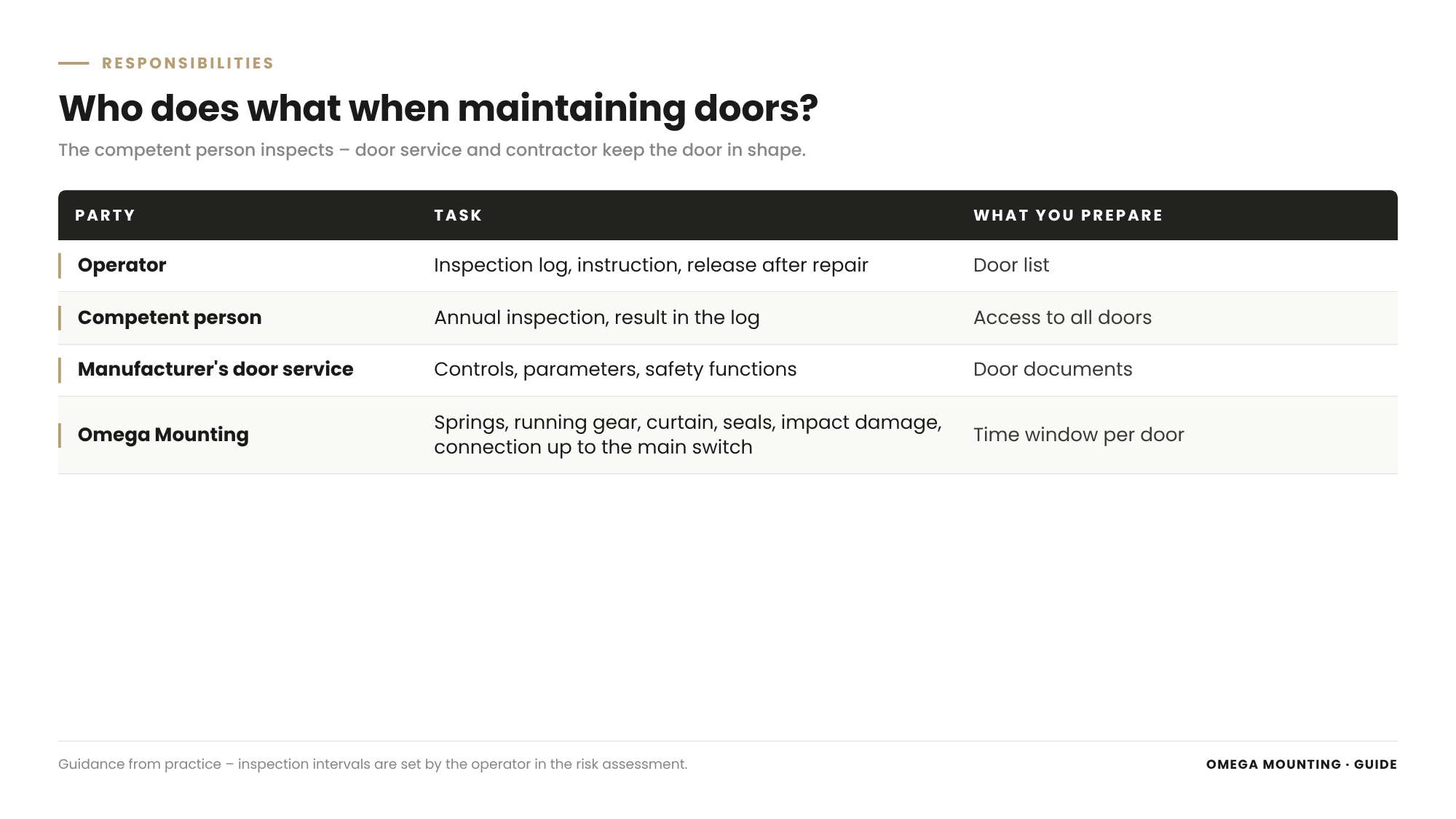
When maintaining industrial doors, several parties have their own tasks.
Operator
They ensure inspection and maintenance, keep the inspection log, instruct operators and release doors after repairs.
Qualified inspector
They inspect the door at least once a year and document the result.
Manufacturer's door service
They look after controls, parameters, safety functions and manufacturer-specific drives.
Omega Mounting
We maintain and repair the mechanics – springs, cables, tracks, rollers, panels, curtain, seals – repair impact damage, fit buffers and impact protection, connect up to the main switch with our own electricians and coordinate with the door service.
Maintaining industrial doors: what it means for your planning
Four questions help to set up door maintenance well.
Do you know your doors?
Create a list with door type, location, year of manufacture and inspection status.
Who inspects, who maintains?
Clarify who carries out the competent person's inspection and who does the maintenance.
How does operation stay available?
Plan maintenance door by door in quiet periods.
What happens after impact damage?
Decide who reports, who takes the door out of service and who repairs it.
What belongs in the order for maintaining industrial doors
A good quotation names each of these points explicitly.
Service
Check of the mechanics, adjustment, lubrication, test of safety devices, minor repairs.
The frame
Time window, order of doors, access, elevating work platform, spare parts.
Record
Entry in the inspection log, defect list with photos, proposed actions.
Legal framework
Power-operated doors are governed, among other things, by the German workplace rule for doors and gates with inspection by a competent person, the German Ordinance on Industrial Safety and Health and the standards for doors. In addition there is the operator's risk assessment and the manufacturers' specifications. This guide is not legal advice – which obligations apply in your case should be clarified with your safety officer and the competent person.
Maintaining industrial doors in the Rhine-Main region: how we do it
From Rodgau we quickly reach Frankfurt, Offenbach, Hanau, Darmstadt, Aschaffenburg and the logistics centres of the region – and our own teams work nationwide. Anyone wanting industrial doors maintained in the Rhine-Main region gets mechanics, impact protection and electrics from a single source with us.
We work on loading bays with doors, docks, buffers and vehicle restraints. How we otherwise work in maintenance is shown on the page on Maintenance and servicing.
For you, that means one contact for the whole loading bay.
Project examples
Three jobs show how we work on loading bays.
Dock ramps and door controls in Frankfurt
In a logistics centre in Frankfurt, we replaced two manual fold-out dock ramps with hydraulic ones, installed control cabinets inside the building and wired them to the ramps. The control boxes for the doors sit right next to them. The job is described in the report Replacing a fold-out dock ramp in a Frankfurt logistics centre.
Vehicle restraints at loading doors near Leipzig
In a logistics centre near Leipzig, we installed and wired vehicle restraint systems at loading doors and commissioned them with the system manufacturer. The job is described in the report Installing vehicle restraint systems in a logistics centre in Leipzig.
Impact protection at Frankfurt Airport
At Frankfurt Airport, we installed impact protection at a loading bay so that vehicles no longer hit doors and components. The job is described in the report Impact protection at a loading dock at Frankfurt Airport.
Shall we take a look at your doors?
Send us a list of your doors or photos of the damage – we will tell you what maintenance and repair could look like. Get in touch now.
What this means for your role
Operators and site managers: Ensure inspection, maintenance and a complete inspection log.
Maintenance managers: Keep a door list with inspection status and plan maintenance door by door.
Warehouse and shift managers: Have damage reported immediately and damaged doors taken out of service.
Buyers: Ask whether testing of safety devices, inspection log entry and defect list are included in the quotation.
Facility managers: Pay attention to seals and heat loss.
Occupational safety specialists: Check instruction, cordoning off and the handling of springs.
Industrial door maintenance list: template on request
For your doors, we have put together the industrial door maintenance list. It asks about door type, inspection log, springs and cables, running gear, curtain, seals, drive, limit positions, safety devices, manual emergency operation and impact damage. Request the template via our contact form – keyword “Industrial door maintenance list”.
Why Omega Mounting?
With over twenty years of experience in installation and maintenance, we know: a door is only as good as its maintenance. We know loading bays from door to buffer and repair impact damage before it becomes a breakdown. Mechanics, impact protection and electrics up to the main switch come from a single source, and we coordinate with the door service. For you, that means doors that run when the dock is full. Talk to us about your doors – we will get back to you promptly.
Conclusion
Maintaining industrial doors means regularly checking springs, cables, running gear, curtain and seals, testing safety devices, repairing impact damage quickly and recording everything in the inspection log. Inspection and maintenance belong together, but they are not the same.
Anyone who knows their doors, plans maintenance door by door and reports damage immediately has fewer breakdowns at the dock. If you want your industrial doors maintained, get in touch with us.
Planning a move-in, installation or maintenance in the Rhine-Main region?
Tell us briefly what you need – we'll come back with an honest assessment.
Free, no-obligation callback
You may also be interested in these guides
Maintenance & Servicing
Maintenance & Servicing

About the author
Tobias Schott
Managing director of Omega Mounting GmbH, Rodgau · more than 20 years of hands-on experience in installation and maintenance
A trained mechatronics technician, working in maintenance, servicing and industrial installation since 2004 – first alongside his father, and with Omega Mounting since 2012: from overhead conveyors in Frankfurt to the crane system in a new-build hall. He plans and leads lifting operations as an appointed person (AP) in data centers and on industrial sites in the Rhine-Main region, trains and examines operators of cranes, mobile elevating work platforms and telehandlers, and is a qualified occupational safety specialist. On jobs abroad he is known as the “German Troubleshooter” – the person you call when a site gets stuck. He learned what quality means from his father, not from a manual: Made in Germany as a standard for his own work, not a label. That is why quality comes first at Omega Mounting – ahead of speed and price. He writes these guides from that practice: what works on our sites is in them – what exists only on paper is not.
Frequently asked questions
Power-operated doors are inspected at least once a year by a competent person. Heavily used doors, such as high-speed doors, often need more frequent maintenance according to the manufacturer's specifications.
Inspection establishes whether the door is safe. Maintenance cares for and adjusts it so that the door stays safe and does not fail.
No, this should only be done by trained fitters with suitable tools. The springs are heavily preloaded and can cause serious injury.
Take the door out of service if it runs crooked, binds or a safety device is damaged. Then have the damage assessed and repaired.
Controls, parameters and safety functions are usually looked after by the manufacturer's door service. With us, our own electricians carry out the electrical connection up to the main switch.
Safety edge, light curtain or photocell, fall arrest device, spring break device and manual emergency operation.
Above all the German workplace rule for doors and gates, the German Ordinance on Industrial Safety and Health, the standards for doors and the operator's risk assessment.
Yes. From Rodgau we are quickly on site in the region, and we work throughout Germany with our own teams.
Send us a list of your doors or photos of the damage. We will check the effort involved and come back to you with a proposal. Go to the contact page.
 English
 German