
- Technology explained – equipment and protection
Welding fume extraction: torch, extraction arm or hall ventilation?
By Tobias Schott · 5-minute read · Updated November 2026
Welding fume extraction captures the fume directly at the weld and removes it via a filter before it reaches the welder's breathing zone – the closer it is to the source, the better it works; room ventilation alone is usually not enough for welding.
Welding fume looks harmless, a grey haze over the seam. But it consists of the finest metal particles and gases that get deep into the lungs. Anyone who welds regularly breathes it in every day – in the workshop, on site, in the cramped interior of a plant.
Here we explain why welding fume is hazardous, how it is captured, how an extraction arm is positioned correctly and what filters and air recirculation achieve.
What is welding fume extraction?
Welding fume extraction is a device that draws in the fume produced during welding where it is created, removes it from the breathing zone and cleans it via a filter or discharges it to the outside.
In German it is called „Schweißrauchabsaugung“. The basis in Germany is the technical rule for welding work. It sets an order of priority: first processes and materials that produce little fume, then extraction at the source, then ventilation, and only last respiratory protection.
Key facts
- Task: capture and separate fume at the source.
- Types: on-torch extraction, extraction arm, extraction table, hall ventilation.
- Equipment: mobile or stationary, with filter or with exhaust to the outside.
- Filter: welding fume filters in classes according to material.
- Particularly critical: stainless steel, galvanised and coated parts.
- In addition: respiratory protection where extraction is not enough.
Why welding fume is hazardous
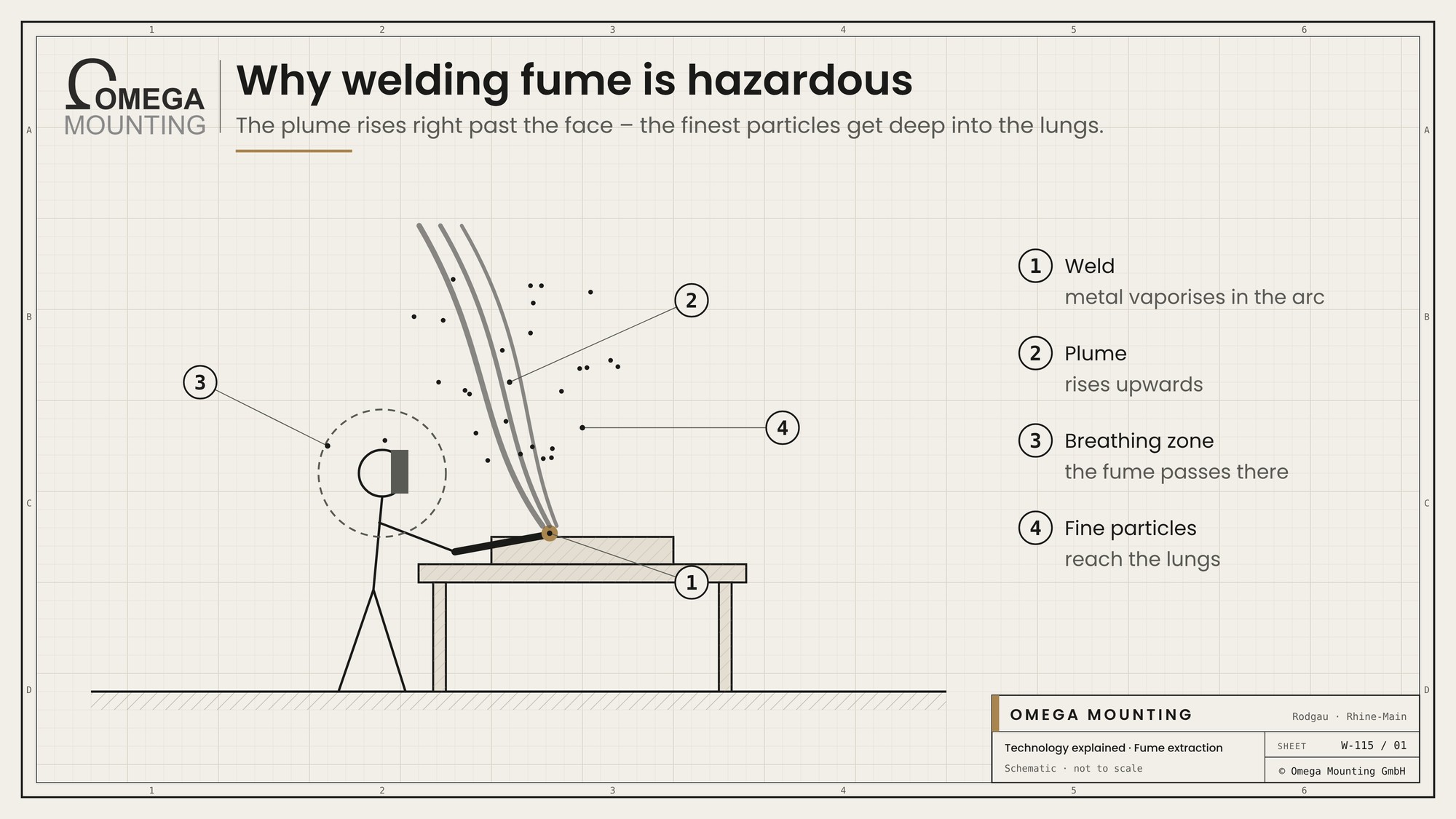
Welding fume is produced when metal and filler material vaporise in the arc and immediately solidify into the finest particles in the air.
- Fine dust: The particles are so small that they reach the alveoli of the lungs.
- Stainless steel: Welding chromium-nickel steels produces carcinogenic compounds.
- Galvanised parts: Zinc fume can cause metal fume fever.
- Coatings: Paint, oil and plastic decompose into toxic gases.
- Gases: Ozone and nitrogen oxides are produced particularly in gas-shielded welding.
How much fume is produced depends on the process. Stick and flux-cored welding produce a lot of fume, TIG welding much less – but more ozone and UV radiation.
Three ways to capture the fume
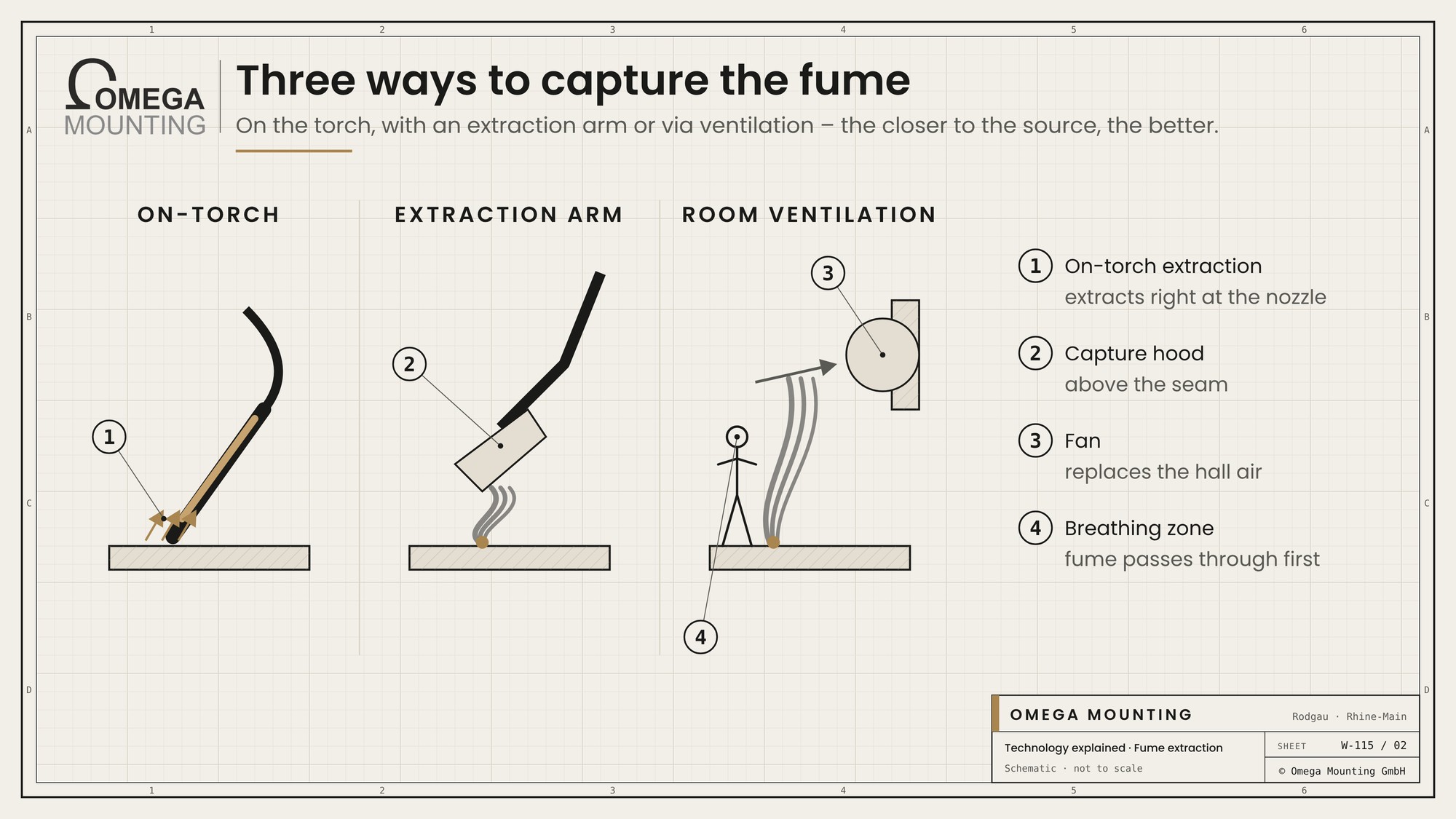
The most effective extraction is the one that captures the fume before it rises.
| Type | How it works | Strengths | Limits |
|---|---|---|---|
| On-torch extraction | Suction channel directly on the welding torch. | Always at the source, even when the position changes. | Heavier torch, not for every process. |
| Extraction arm | Movable arm with capture hood above the seam. | Flexible, for workshop and installation. | Only works if it is close enough. |
| Extraction table | Extraction through the table surface or at the back wall. | Good for series parts at a fixed workstation. | Only for small components. |
| Room ventilation | Air exchange in the whole hall. | Supplement for residual fume. | Fume passes through the breathing zone first. |
On construction sites and in plants, mobile extraction units with an arm are common. In confined spaces and vessels extraction is particularly important because the fume does not disperse there.
Setting the extraction arm correctly
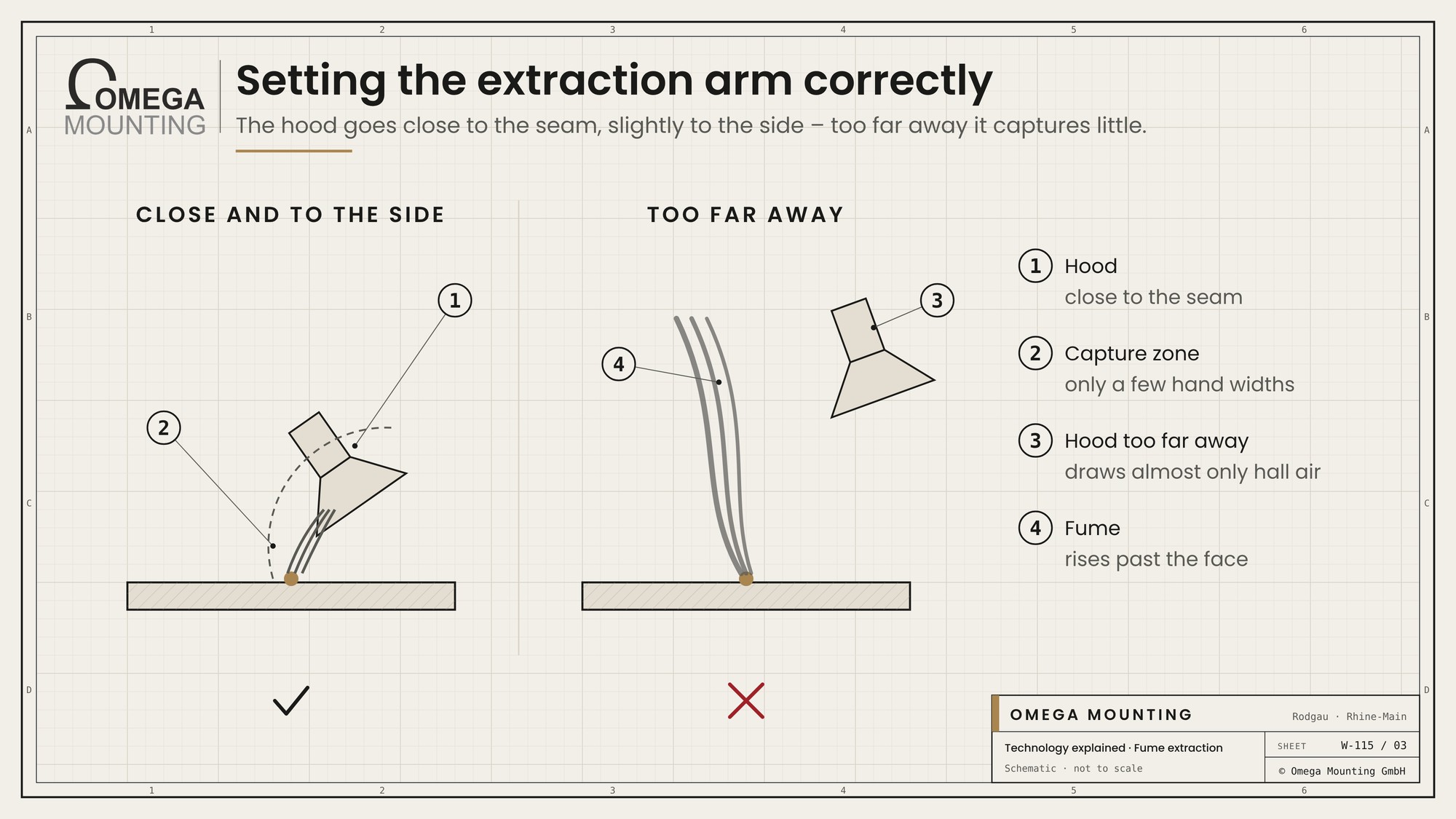
An extraction arm only captures the fume in a small area in front of the hood. A few hand widths further away the effect is already much lower.
- Close to the seam: the hood as close as possible without obstructing the welder.
- Slightly to the side above: so that the fume rises into the hood and not past the face.
- Move it along: If the seam moves, the arm moves with it.
- Mind the shielding gas: The extraction must not draw away the shielding gas – otherwise the seam suffers.
The most common mistake is an arm hanging somewhere above the component because it got in the way during work. Then the unit runs, but it extracts hardly any fume.
Filter and recirculation
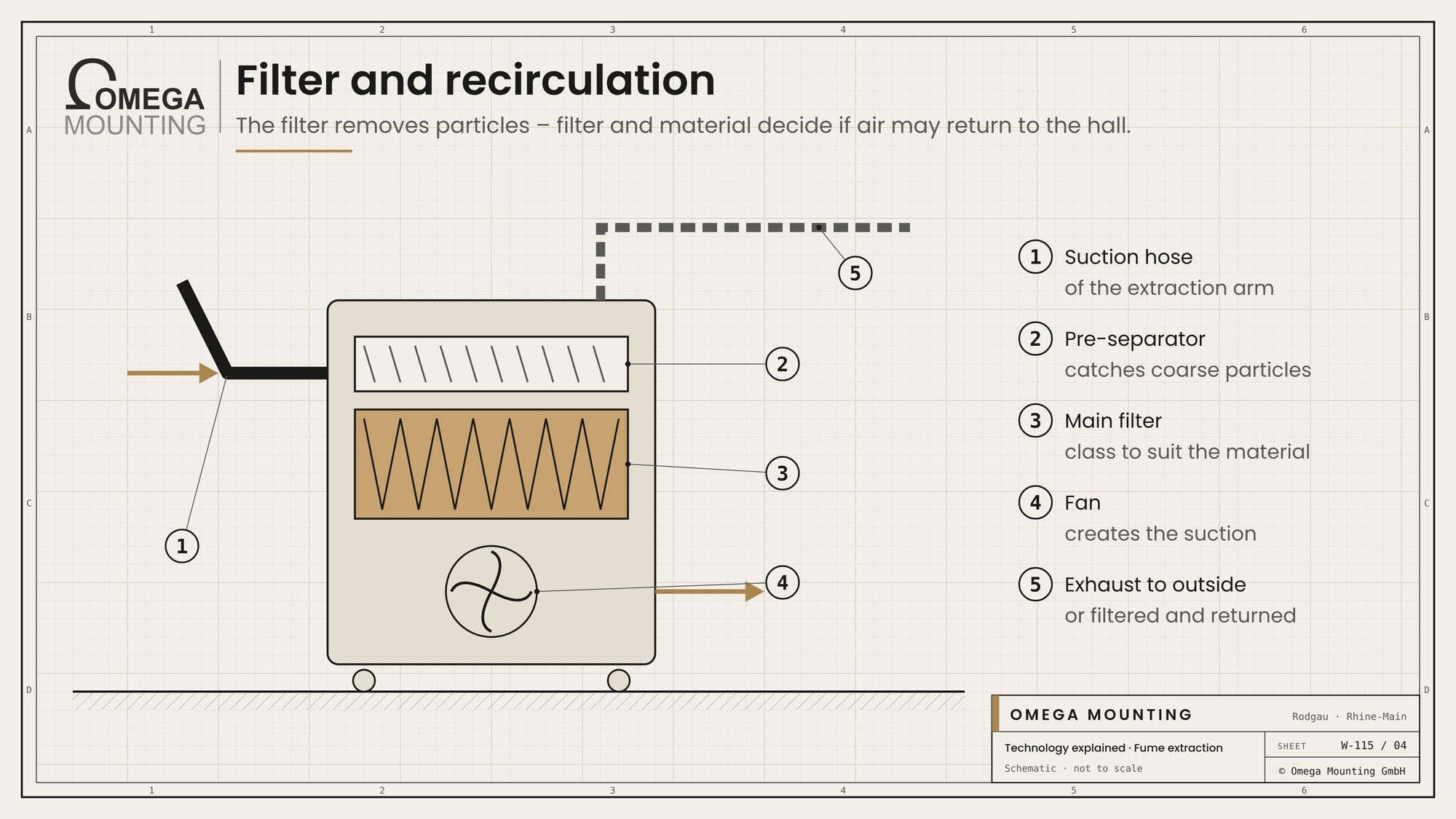
A welding fume filter separates the particles from the extracted air. The air is then either discharged outside or returned to the hall.
The filters are divided into classes that indicate which materials they are suitable for. The highest class applies to high-alloy steels such as stainless steel. Whether filtered air may return to the room depends on the material and the filter – strict requirements apply to carcinogenic substances.
Filters clog over time. A unit with a full filter only extracts weakly. The display on the unit or a look at the volume flow shows when to change it.
Typical mistakes
- Arm too far away: the unit runs, but the fume still rises into the face.
- Only ventilated: an open door is not enough, the fume passes through the breathing zone.
- Coating not removed: paint and zinc burn at the seam.
- Filter never changed: the extraction performance drops unnoticed.
- Respiratory protection as the first choice: instead of extracting at the source.
Maintenance and inspection
An extraction system only protects if it extracts properly. During maintenance we pay attention to:
- Filter: A clogged filter reduces suction. The differential pressure indicator shows when to change it.
- Extraction arms: Joints must hold their position. An arm that sinks is no longer positioned correctly.
- Hoses: Cracks and holes in hoses draw in false air and weaken the extraction.
- Spark protection: Spark arresters in front of the filter prevent fires. They are cleaned and checked.
- Dust disposal: Filter dust is disposed of with minimal dust, wearing protective equipment.
The effectiveness of extraction systems is measured and documented regularly. With mobile units on site we check filter condition and suction before use, because a unit from the store is not automatically ready for use.
What we pay attention to
For welding work in the workshop and plant we plan protection against fume as part of the job.
- We remove coatings in the seam area before welding.
- We extract at the source wherever the situation allows.
- In confined areas we also use respiratory protection.
- We cover cables, equipment and combustible materials against sparks and spatter.
- We do not leave any embers behind after welding.
Where we use it
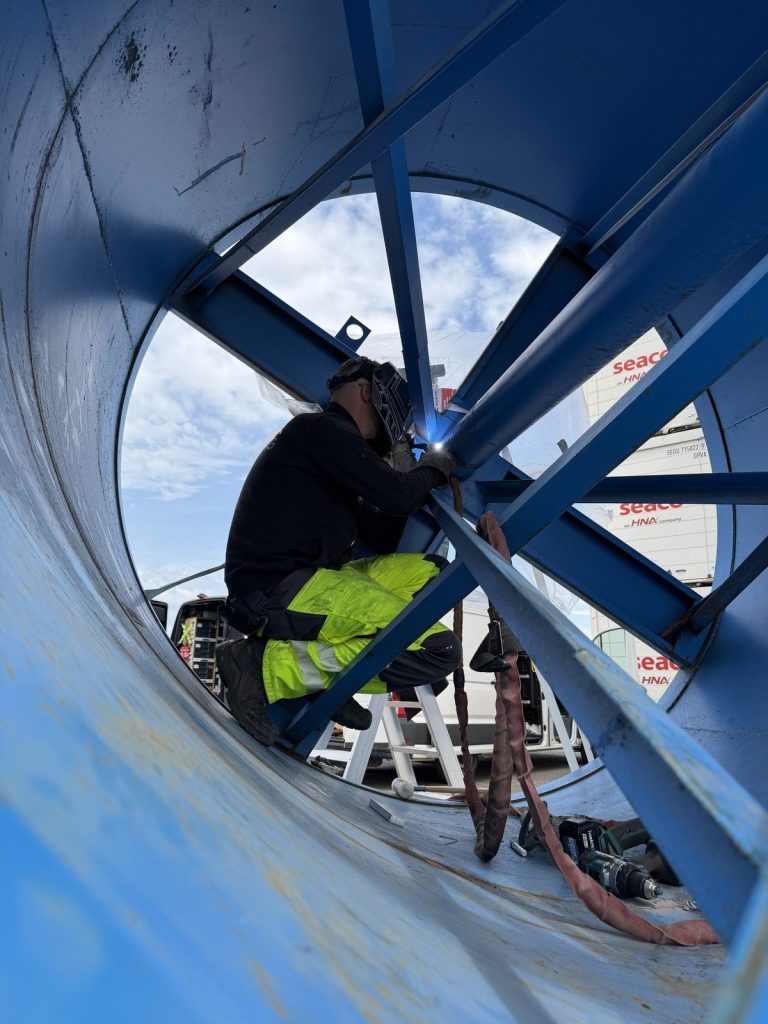
At the port of Aschaffenburg we repaired the tubular shaft of a cable drum on site. With mobile TIG equipment our welders worked inside the drum between the braces – kneeling, sitting and in awkward positions up to overhead. Covers kept sparks, weld spatter and grinding dust away from the cable winding. In such confined areas in particular, protection against fume and heat is part of the planning. More on this on our page on Maintenance and servicing.
More technology explained
Technology explained
which process produces how much fume.
Technology explained
fume and sparks when cutting too.
Do you have questions about how this works on your site?
Do you need a weld repair on your plant and want it to be carried out safely and cleanly? We weld on site – with an eye on fume, sparks and surroundings. Request a callback.
Free, no-obligation callback

About the author
Tobias Schott
Managing director of Omega Mounting GmbH, Rodgau · more than 20 years of hands-on experience in installation and maintenance
A trained mechatronics technician, working in maintenance, servicing and industrial installation since 2004 – first alongside his father, and with Omega Mounting since 2012: from overhead conveyors in Frankfurt to the crane system in a new-build hall. He plans and leads lifting operations as an appointed person (AP) in data centers and on industrial sites in the Rhine-Main region, trains and examines operators of cranes, mobile elevating work platforms and telehandlers, and is a qualified occupational safety specialist. On jobs abroad he is known as the “German Troubleshooter” – the person you call when a site gets stuck. He learned what quality means from his father, not from a manual: Made in Germany as a standard for his own work, not a label. That is why quality comes first at Omega Mounting – ahead of speed and price. The Technology explained articles cover the equipment and techniques his team uses every day: what counts on site is in them – what only appears in the brochure is not.
 English
 German