
- Guide – Occupational safety
Racking inspection: inspecting racks, classifying damage, carrying out repairs
By Tobias Schott · Reading time approx. 23 minutes · Last updated: October 2026
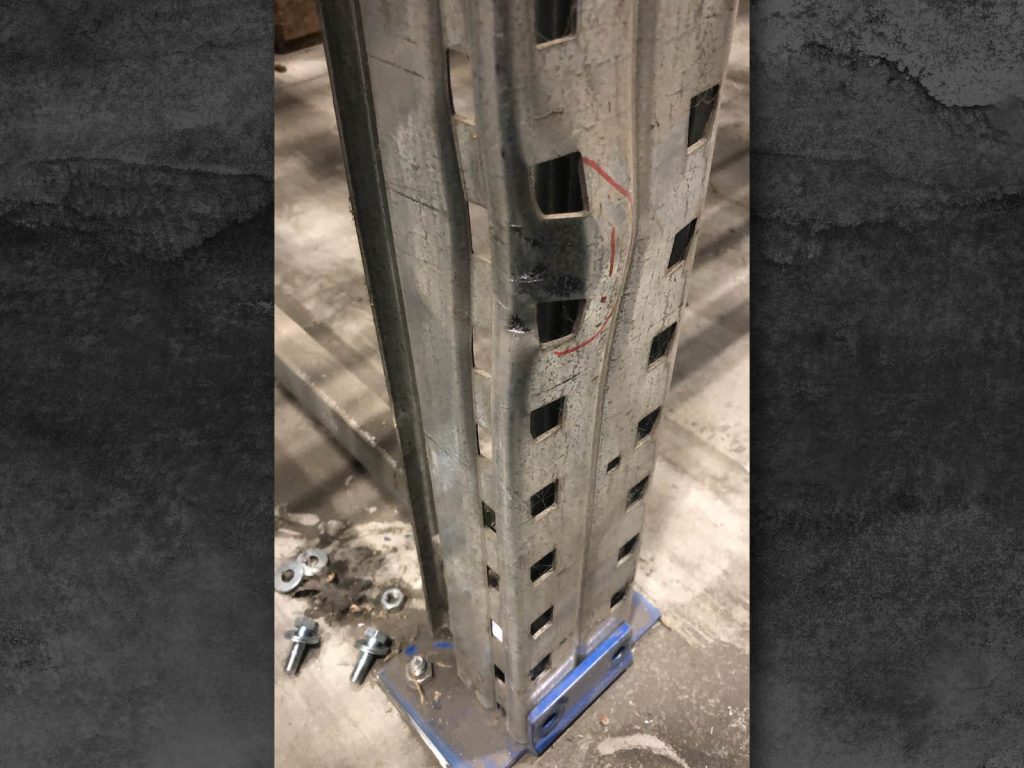
A racking inspection establishes whether uprights, beams, bracing and locks still carry their design load – and which damage is watched, fixed or locked off.
A pallet rack rarely fails without warning. It accumulates damage: a forklift impact against the upright foot, a pallet set down too fast, a diagonal that has hung askew since the beam levels were changed. Overall, the load capacity decreases until an upright buckles and a bay tips into the aisle together with the goods.
For you as maintenance or warehouse manager, the racking inspection is therefore the periodic inspection that makes this creeping weakening visible. You need to know who may inspect as a competent person, which inspection interval applies, what is assessed and what happens after the finding: observe, unload, lock out, replace?
This guide answers these questions along the lines of the freely available DGUV Information 208-043 "Safety of racking" – referred to below as "the operator information" – and the racking standard DIN EN 15635. It explains the traffic-light system of risk levels and shows, with examples from our project diary, how a racking repair proceeds from inspection report to re-release.
Key points at a glance
- Practically every rack operated with industrial trucks must be inspected periodically – this is required by the BetrSichV (German Industrial Safety Ordinance).
- The racking standard requires an inspection by a competent person at least every twelve months as well as visual checks at shorter intervals, usually weekly.
- Damage to uprights and bracing of pallet racking is classified into a green, amber or red risk level; the level determines whether the rack is monitored, unloaded or locked out immediately.
- For cantilever racking and other designs without deformation limits: every safety-relevant damage is rectified, otherwise the rack goes out of service.
- Damaged components are generally replaced; a repair is only permissible with the supplier's approval or with guaranteed and certified load capacity.
- Inspections, findings and their rectification belong in the inspection logbook and are kept at least until the next inspection.
- The most effective prevention is floor-anchored impact protection at the racking corners, supplemented by upright protection, forklift driver briefing and a living reporting culture for impacts and near misses.
What is a racking inspection?
A racking inspection is the systematic assessment of a racking installation for damage, deviations from the installed condition and incorrect loading by a competent person. The aim is to evaluate defects by risk level, document them and initiate their rectification. Legally, it is a periodic inspection of work equipment. Technically, it follows the racking standard "Steel static storage systems – Application and maintenance of storage equipment".
Regular and internal inspection
The standard distinguishes an expert inspection by a qualified person at least every twelve months from visual checks at shorter intervals. The operator information calls these "regular inspection" and "internal inspection" by a competent person. In content, the two do not fundamentally differ. For the internal inspection, however, the scope may be limited to the components on which damage is to be expected – above all the lower racking area.
Which racks are subject to the inspection duty?
The inspection duty applies in principle to all types of racking: pallet racking, cantilever racking for long goods, shelving, drive-in and flow racking, as well as power-operated racking such as mobile racking. The decisive factor is whether the rack is exposed to damaging influences – with forklift operation, this is to be assumed. For purely hand-operated racking, the employer can usually dispense with the periodic inspection; for power-operated racking, never.
Which legal bases apply to the racking inspection?
The racking inspection rests on three levels: the German Product Safety Act for the design, the BetrSichV for operation and inspection, and standards and the rules of the statutory accident insurance that specify both.
Design: Product Safety Act and standards
The German Product Safety Act is the basis for the construction and equipment requirements; for power-operated racking, the Machinery Ordinance also applies. This is specified by European standards, above all the design standard DIN EN 15512 for adjustable pallet racking and the standard for deformations and clearances. Where no European standard yet exists, the older accident insurance rule "Storage equipment and devices" can continue to be applied.
Operation and inspection: ordinance and technical rules
The Betriebssicherheitsverordnung (BetrSichV, Industrial Safety Ordinance) requires an inspection before first use by a competent person. This applies in principle after every installation, with the focus on erection according to the manufacturer's specifications. The periodic inspection takes place at intervals that the employer defines in the risk assessment. The German technical rule TRBS 1201 (inspections and checks of work equipment) – referred to below as "the inspection rule" – names one year as a proven inspection interval. TRBS 1203 describes the competent person. The documentation duty is also governed by the ordinance.
Racking standard and operator information
The racking standard governs the application and maintenance of racking. It is the source of the minimum inspection interval, risk levels and deformation limits. The operator information "Safety of racking" (June 2020) summarises standard and ordinance for operators and is available free of charge from the accident insurance. Every person responsible for a warehouse should read it in full once. It is short, concrete and exactly what an inspector expects. How the racking inspection fits in with the other inspection obligations for operators – doors, cranes, platforms, industrial trucks – is shown in our overview.
Who may inspect racking? The competent person
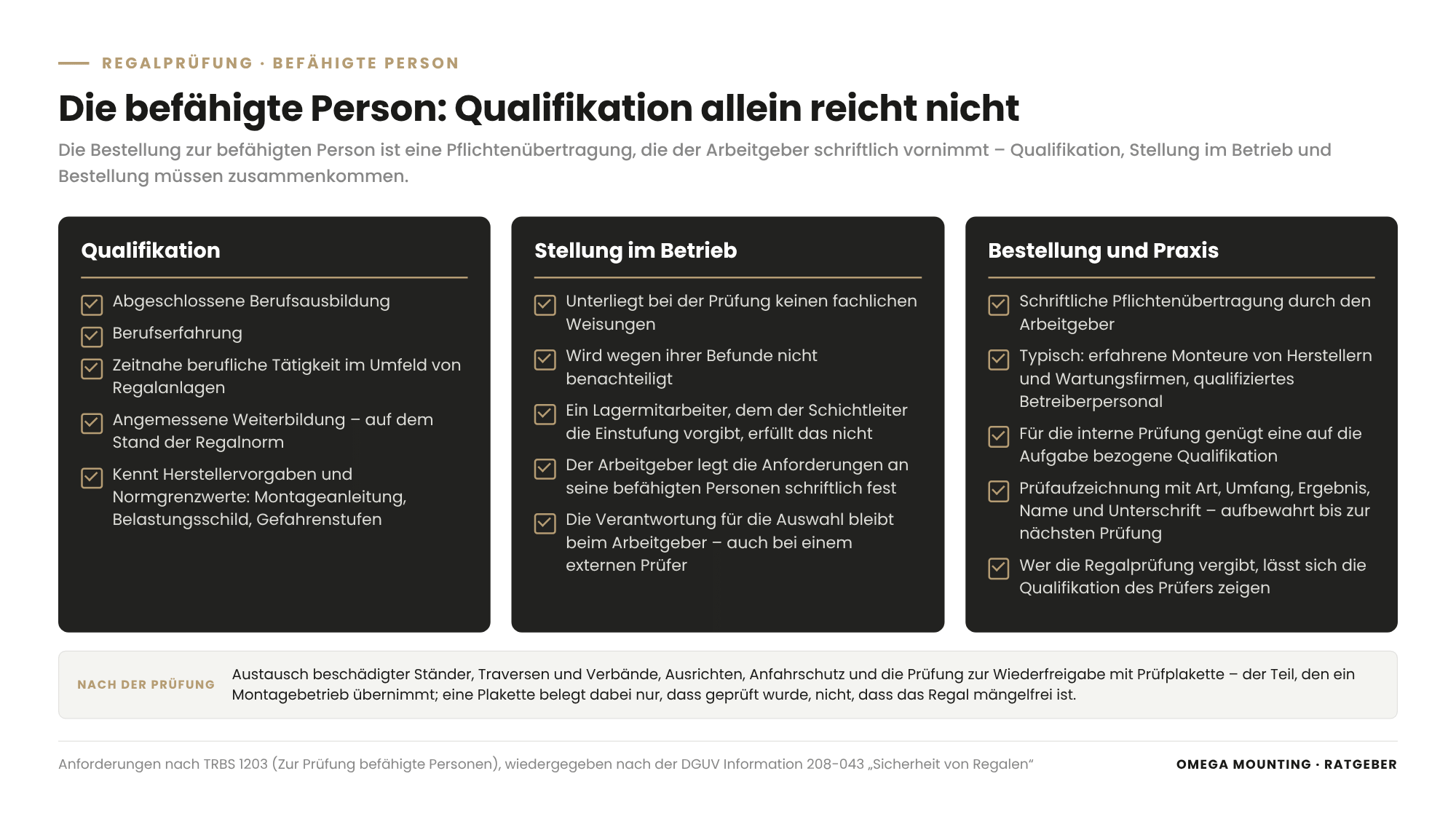
Racking may be inspected by anyone who meets the requirements for a competent person as described in the technical rule on competent persons. These are completed vocational training, professional experience, recent professional activity in the field of the object being inspected and appropriate further training. Two conditions are often overlooked: the competent person must not be subject to technical instructions during the inspection and must not be disadvantaged because of their findings. A warehouse employee whom the shift supervisor tells which upright to classify as "green" does not meet this. The appointment as a competent person is a delegation of duties that the employer makes in writing. The same rule also requires the employer to define the requirements for their competent persons in writing. It also makes clear that the responsibility for the selection remains with the employer, even if an external inspector inspects. For you this means: anyone who awards the racking inspection asks to see the inspector's qualification.
As examples, the operator information names experienced fitters from manufacturers and maintenance companies as well as qualified operator personnel. For the internal inspection, a task-related qualification is sufficient. Our fitters inspect racking installations as part of Maintenance and servicing and above all take on the part that follows: replacement, repair, impact protection and the inspection for re-release with inspection sticker.
How often must racking be inspected?
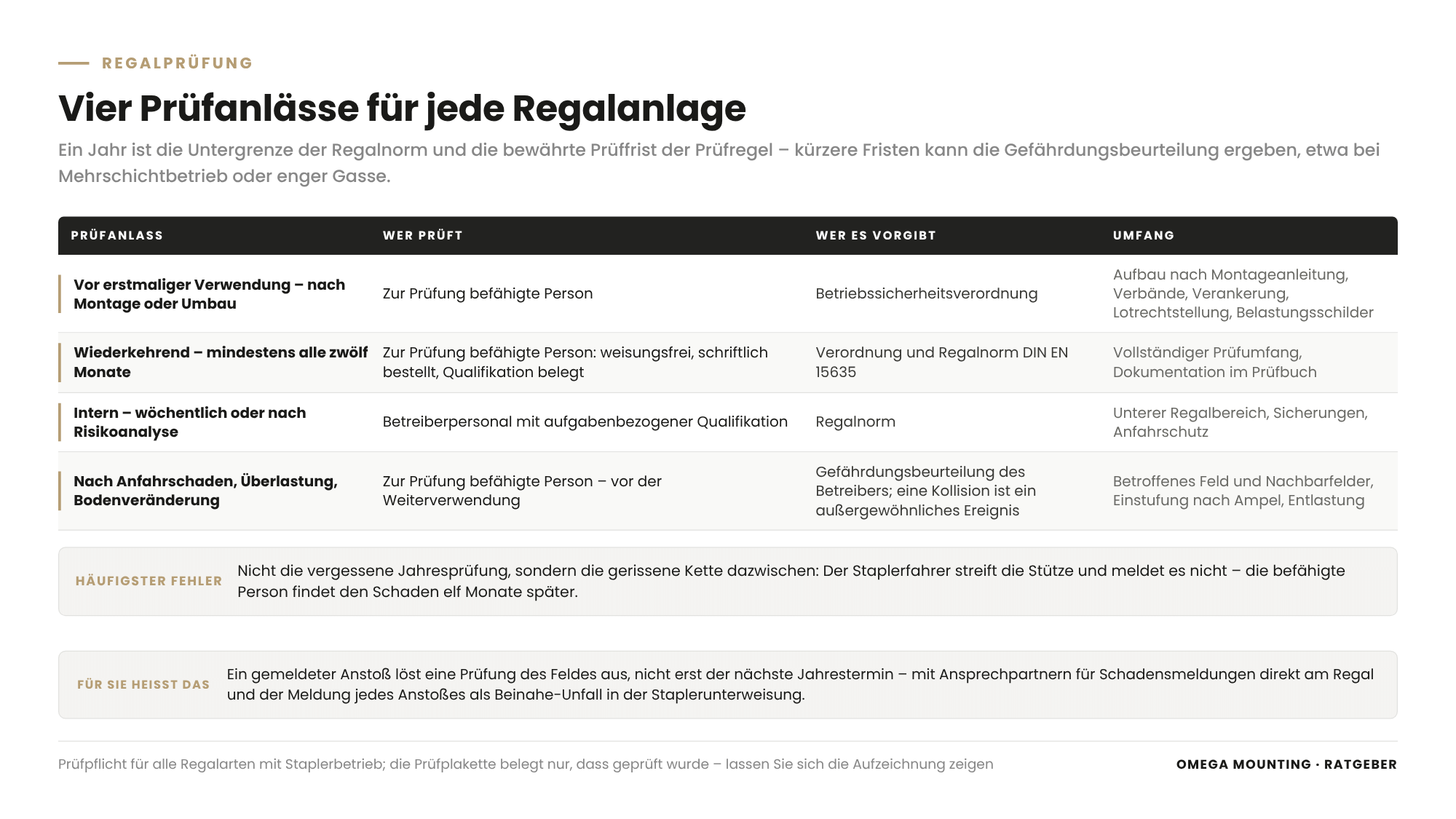
Racking must be inspected at least once a year by a competent person and subjected to a visual check at shorter intervals – usually weekly. After every installation or modification, it must be accepted before first use. The year is the lower limit of the racking standard and at the same time the proven inspection interval named by the inspection rule for work equipment. Shorter inspection intervals may result from the risk assessment, for example with multi-shift operation or narrow aisles.
| Reason for inspection | Who specifies it | Scope |
|---|---|---|
| Before first use, after installation or conversion. | Ordinance. | Erection according to installation instructions, bracing, anchoring, plumb alignment, load notices. |
| Periodically, at least every twelve months. | Ordinance and racking standard. | Full inspection scope, documentation in the inspection logbook. |
| Internally, weekly or according to risk analysis. | Racking standard. | Lower racking area, locks, impact protection. |
| After impact damage, overloading, floor changes. | Operator's risk assessment. | Affected bay and neighbouring bays, classification, unloading. |
The most common error is not the forgotten annual inspection but the broken chain in between. The forklift driver grazes the upright and does not report it; the competent person finds the damage pattern eleven months later. That is why the standard requires damage to be reported and rectified promptly – with contacts for damage reports directly at the rack. The inspection rule classifies a collision as an exceptional event after which work equipment must be inspected before further use. For you this means: a reported impact triggers an inspection of the bay, not just the next annual date.
What is checked during the racking inspection?
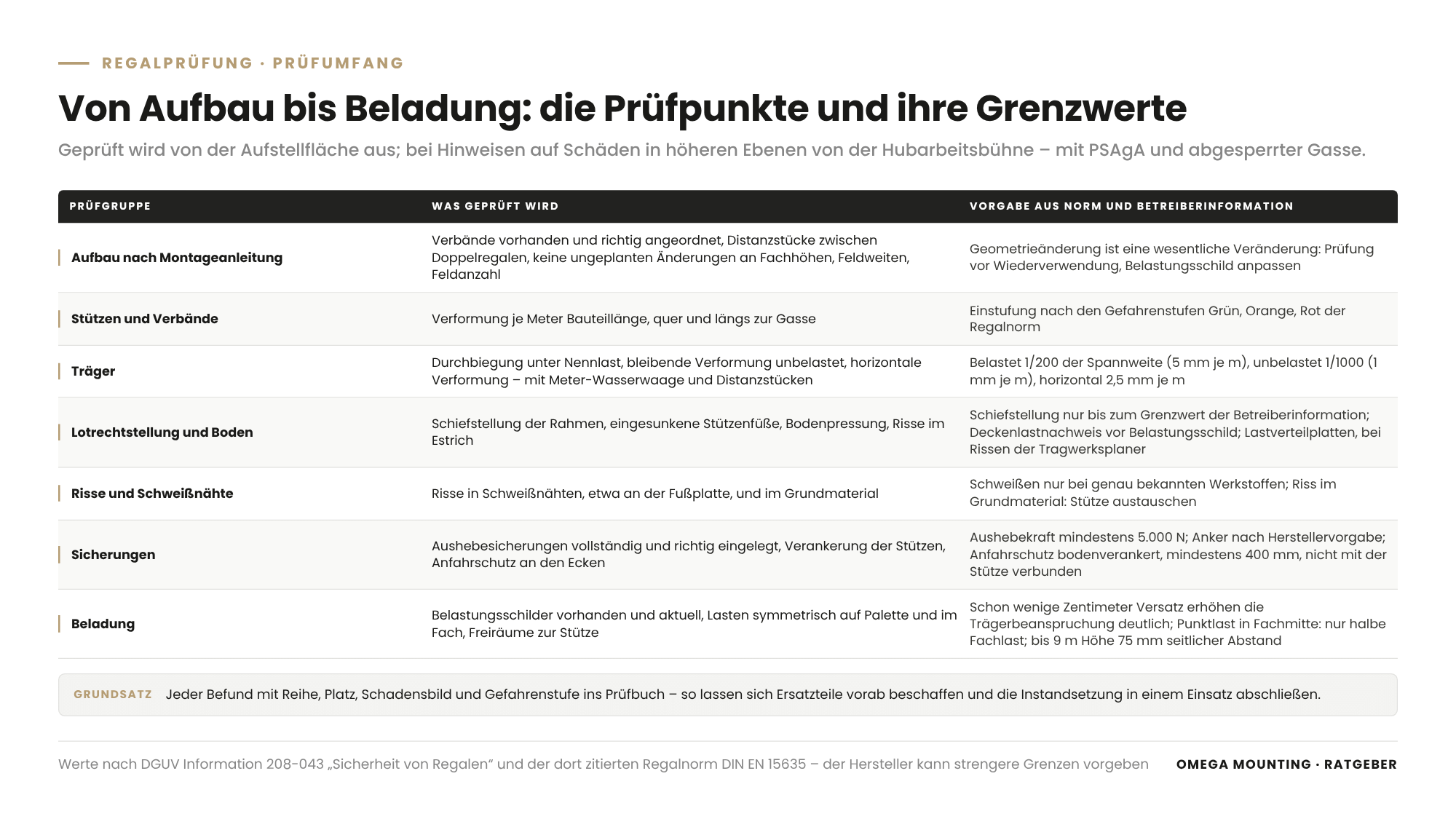
During the racking inspection, erection, load-bearing structure, locks, floor and loading of the rack are checked against manufacturer's specifications and standard limits. The operator information summarises this in fourteen inspection questions, which we arrange here in six groups. Inspection is usually carried out from floor level. Where there are indications of damage at higher levels, also from a MEWP – with fall arrest PPE and a cordoned-off aisle.
Erection according to installation instructions
Bracing (the diagonal and horizontal stiffeners in the frame) must be present and correctly arranged; spacers between double racks must correspond to the installation instructions. Subsequent changes to the geometry are critical. If beam levels, bay widths or the number of bays are changed, the load assumptions change considerably and the load notice is no longer correct. The conversion is then a substantial modification that triggers an inspection before further use.
Uprights, bracing and beams
Uprights (the vertical frame sections) and bracing are measured for deformation and classified according to the traffic-light system – more on this in the next section. Beams (the horizontal members on which the pallets rest) are checked for deflection. The standard specifies 1/200 of the span at rated load, i.e. 5 millimetres per metre. If more is measured with the rack fully loaded, the rack is overloaded or was previously overloaded to the point of permanent deformation. In the unloaded condition, a maximum of 1/1000 of the span is permissible, i.e. 1 millimetre per metre. Horizontal permanent deformations are particularly critical because they can lead to buckling or bulging. Here the limit is 2.5 millimetres per metre. Measurement is made with a one-metre spirit level with 5-millimetre spacers.
Plumb alignment and floor
Unless the manufacturer specifies something stricter, the operator information names a maximum permissible out-of-plumb of 0.5 per cent. Out-of-plumb often has a cause beneath the rack. On a floor whose imposed load or strength does not carry the point load of the upright feet, the uprights sink – the ground bearing pressure is too high. Then the rack must be realigned and set plumb after unloading, and the load transferred into the floor via load spreading plates. With cracks in the screed, the structural engineer is brought in. This applies especially to racking on mezzanine floors or steel platforms. The BG BAU/BAuA module "Site set-up – traffic areas, transport routes, storage areas and parking areas" requires every floor slab used as a storage area to be checked beforehand for its load capacity. For you this means: floor load verification before load notice.
Cracks in welds and base material
Cracked welds, for example on the base plate of an upright, may only be welded if materials and filler metals are precisely known. If this knowledge is missing or the crack is in the base material, the upright must be replaced. Improper welding on thin-walled, cold-formed racking sections changes the microstructure and can reduce the load capacity to the point of collapse.
Locks: beam locks, anchoring, impact protection
Beam locks (the pins or clips that hold the beam in the upright section) must be fully present and correctly inserted. According to the design standard, they must withstand a lifting force of at least 5,000 newtons. The uprights must be secured against displacement, usually with heavy-duty or chemical anchors to manufacturer's specification, set with the prescribed tightening torque. At the corners of racking served by free-ranging industrial trucks, impact protection must be in place. It is anchored in the floor, at least 400 millimetres high and not connected to the racking upright.
Loading: position, placement, weight and dimensions
Load notices (the details of maximum permissible unit load weight and maximum bay load) must be present and up to date. Loads must be placed symmetrically on the pallet and the pallet symmetrically in the compartment. The operator information calculates that an offset of 6 centimetres with a Euro pallet and one metre beam spacing increases the stress by 12 per cent. The compartment load is also designed as a distributed load. A point load in the middle of the compartment doubles the bending stress in the beam. Then only half the compartment load may be stored. Up to 9 metres height, the standard requires lateral clearances of at least 75 millimetres between unit load and upright.
How is racking damage classified?
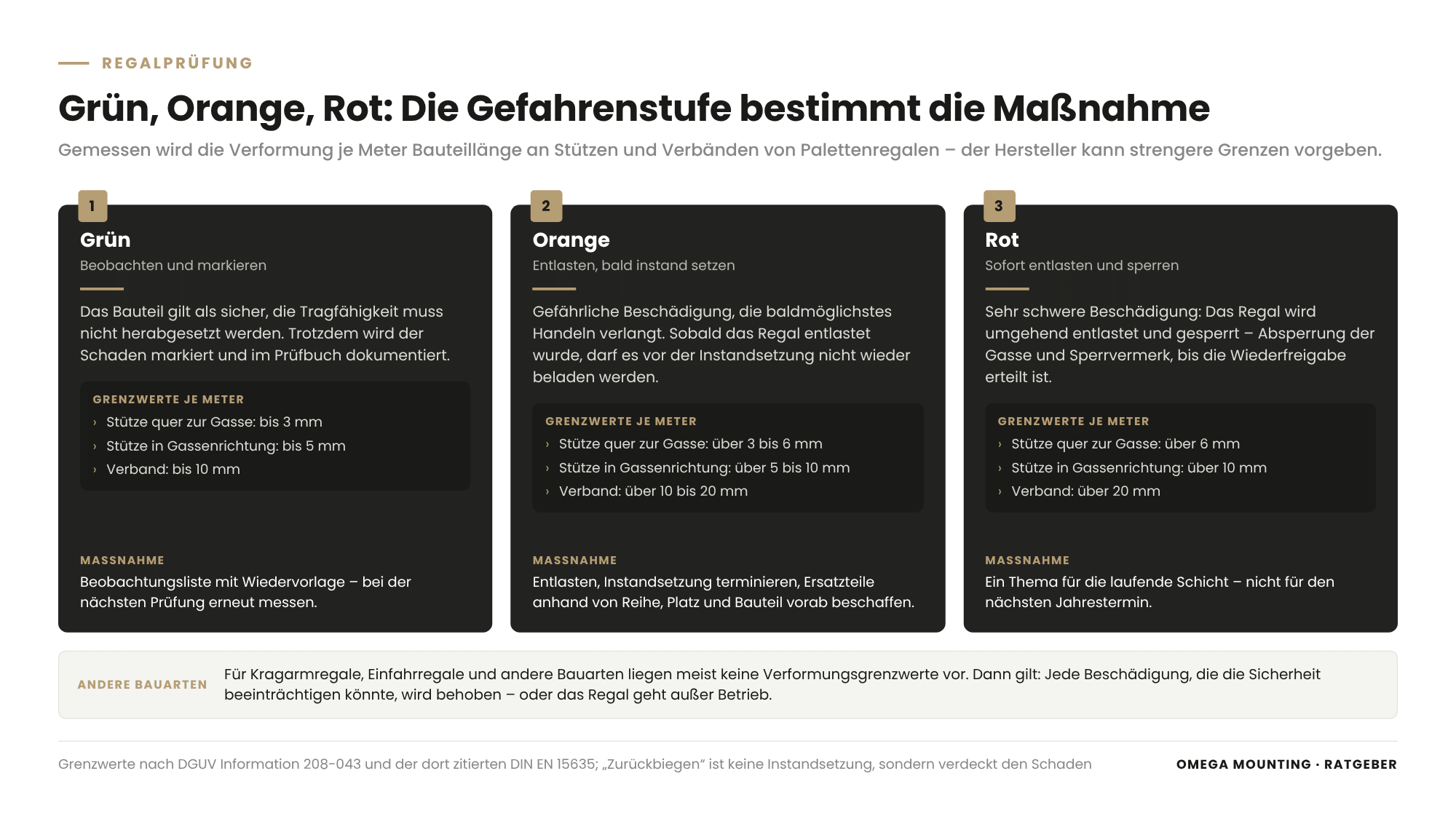
Racking damage to uprights and bracing of pallet racking is classified according to the racking standard into the risk levels green, amber and red – the defect classes of racking construction. The level directly determines the measure: monitor, unload or lock out. Anyone wanting to classify racking damage measures the deformation per metre of component length. The traffic-light system matches the logic of the inspection rule. A defect that creates a hazard leads to a ban on use. For lesser defects, inspection interval or operating limits are reduced – i.e. unloaded and repaired promptly.
| Component and direction | Green | Amber | Red |
|---|---|---|---|
| Upright, across the aisle. | Up to 3 mm over 1 m. | Over 3 to 6 mm over 1 m. | Over 6 mm over 1 m. |
| Upright, in aisle direction. | Up to 5 mm over 1 m. | Over 5 to 10 mm over 1 m. | Over 10 mm over 1 m. |
| Bracing. | Up to 10 mm over 1 m. | Over 10 to 20 mm over 1 m. | Over 20 mm over 1 m. |
The values come from the operator information and the standard cited there. The manufacturer may specify stricter limits.
- Green means that the component is considered safe and the load capacity does not have to be reduced. Nevertheless, the damage must be marked and documented in the inspection logbook. Green is a watch list with follow-up.
- Amber is hazardous damage that requires action as soon as possible. Once a rack with amber damage has been unloaded, it may not be reloaded before repair.
- Red stands for very serious damage. The rack must be unloaded and locked out immediately – aisle cordoned off and lock-out note – until the repair is complete and re-release has been granted.
For cantilever racking, drive-in racking and other designs, there are usually no permissible deformation values. Then: every damage that could impair safety is rectified – or the rack goes out of service.
Repair or replace? How racking is repaired
Damaged racking components are generally replaced by new ones. A repair of the damaged part is only permissible under the narrow conditions named by the standard and the accident insurance. This determines how we approach a racking repair.
What standard and accident insurance say about repair
The racking standard permits repairs of damaged components only with the supplier's approval. The responsible expert committee of the accident insurance concluded in 2011 that companies other than the manufacturer may also repair – under strict conditions. The repairer guarantees and certifies to the operator that the load capacity is at least equal to the new condition. On request from the trade supervisory authority or the employers' liability insurance association, they prove this by calculation or tests. Anyone who cannot or will not provide this replaces instead.
Why "bending back" is not a repair
Pushing a hit upright straight with a lever is not a repair within the meaning of the standard but conceals the damage. Cold-formed racking sections lose load capacity when deformed and deformed back. Afterwards, the inspector sees a straight upright whose remaining load capacity nobody knows. The same applies to welded-on straps without knowledge of the materials.
Our position is therefore clear. We replace damaged uprights, beams, bracing and shelves with components of verified load capacity – as a rule original parts or spare parts approved by the manufacturer according to its installation specifications. Repairs going beyond replacement we carry out only with manufacturer's approval or calculated verification by the structural engineer. Where an operator pushes us to do more, we raise formal concerns. More on the limits of welding on load-bearing components can be read in the guide Rectifying UVV defects.
Aligning, anchoring, securing
Not every finding concerns a component. Frames standing out of plumb are realigned after unloading, set plumb and checked for alignment in the aisle. The anchoring is checked, missing beam locks and bracing are added according to the installation instructions, outdated load notices renewed.
How do you document racking inspection and repair?
Document inspections, identified defects and their rectification in the installation's inspection logbook – electronically is fine too – and keep the documents at least until the next regular inspection. That is what the ordinance requires. The inspection rule names the minimum contents of the inspection record. These are type and scope of the inspection, result, and name and signature of the inspector. It also makes clear that an inspection sticker only proves that an inspection took place, not that the rack is free of defects. Therefore ask to see the record, not just the sticker. For repaired racking, the operator information recommends keeping the documents for the entire service life. They belong to the installation's as-built documentation.
A table per installation with master data has proven useful: location, racking type, manufacturer, type, bay and compartment load. For each finding it records row, position, inspection item, damage pattern with risk level and completion note. Plus the measure: repair, install, replace, store centrally or align. This creates a punch list that is closed with the re-release. Anyone who knows row, position, component and risk level procures spare parts in advance and completes the repair in one job. How to bundle inspection and rectification of defects contractually is described in the guide Maintenance contract or individual order.

How do you avoid racking damage in warehouse operations?
You avoid racking damage most effectively with floor-anchored impact protection at the racking corners, upright protection on exposed uprights, reserves in load capacity and a reporting culture that immediately turns every impact into a finding. The operator information justifies this as follows: the safety factors for pallet racking were considerably reduced in the European design standard compared with the values previously customary in Germany. A hit rack today has less reserve.
Impact protection at the corners – anchored, not bolted on
Corner impact protection according to the standard stands free in front of the upright, is at least 400 millimetres high and anchored in the floor. This way, the impact energy is not transferred into the racking frame. In warehouses with reach trucks, tight swept paths or mesh box traffic, catalogue elements are often not enough. Then a custom fabrication is the better solution. When this is worthwhile is shown in the guide custom-made impact protection.
Upright protection, load capacity reserve, reporting culture
Unlike corner impact protection, upright protection devices may be connected directly to the uprights. Where accessories do not fit, we fabricate protective elements in our workshop as Custom fabrication to site survey. Organisationally, the load capacity on the load notice can be stated lower than permissible by calculation, so that the installation is never loaded to 100 per cent. And the most effective prevention costs no material: forklift drivers who report every impact as a near miss. The standard emphasises that racking is only designed for careful use. Neither impacts with the pallet nor collisions by the industrial truck are taken into account in the load assumptions. This belongs in every forklift driver briefing and in the operating instructions.
Part of prevention lies in the traffic routing of the warehouse. The module recommends separating pedestrian and vehicle traffic, preferring directed traffic to turning, and avoiding reversing as far as possible because of the blind spot. Transferred to the warehouse, this means: one-way traffic in the aisles, marked footpaths and turning areas outside the racking rows noticeably reduce the number of impacts.
What does this mean for operators in the Rhine-Main region?
For operators of warehouses between Frankfurt, Hanau, Darmstadt and Aschaffenburg, the racking inspection means one thing above all: the finding comes quickly. The repair must follow just as quickly, because every locked-out storage location costs throughput.
Typical for the region are high turnover frequencies in logistics centres around Frankfurt Airport, in Raunheim, Dietzenbach and Rodgau, as well as cantilever racking for long goods in production warehouses between Offenbach and Aschaffenburg. In these environments, impact damage is the norm. As an installation contractor for logistics and intralogistics and Workshop equipment , we take on assessment, unloading and cordoning there in coordination with warehouse management. Plus replacement aisle by aisle and the inspection for re-release. Anyone awarding a racking inspection in the Rhine-Main region thus gets inspection and repair from a single source.

How we do it in practice
Three jobs from our project diary show how an inspection finding becomes a released racking installation.
Racking repair following a defect list during ongoing operations
For a Racking Repair in Fulda , the starting point was an inspection with a defect list: repair the racking, replace damaged parts. Inspection and maintenance of the installation had not been properly carried out for several years. So more and more components had gradually suffered damage.
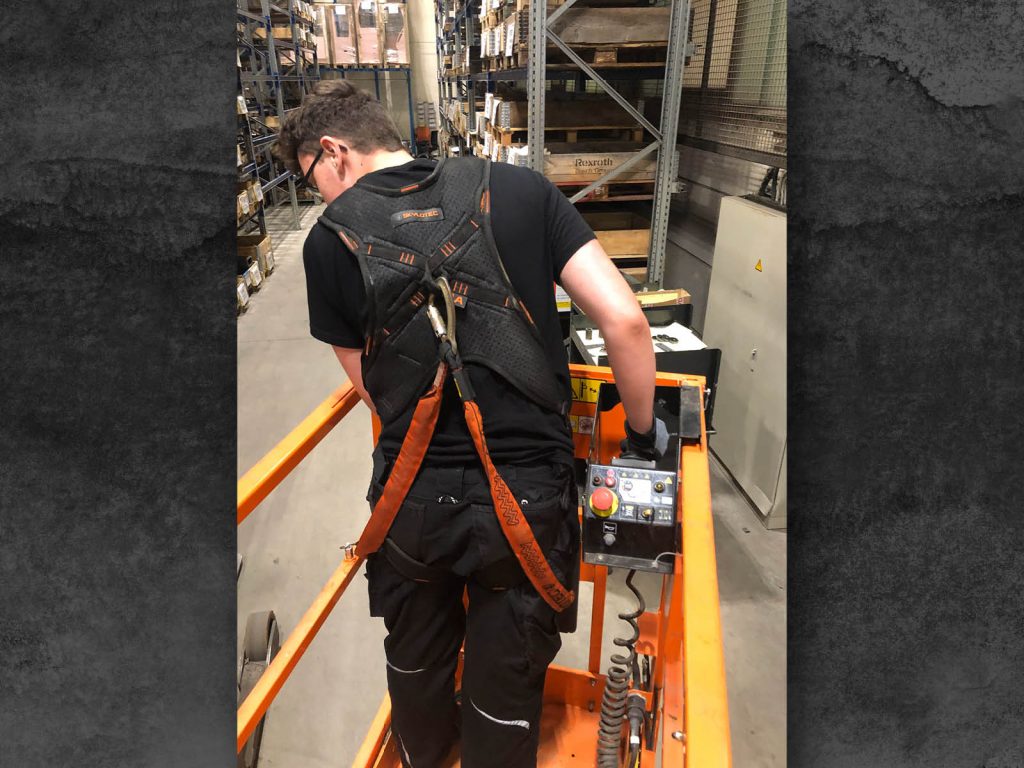
We procured a MEWP and the matching spare parts – uprights, beams and bracing – and replaced the damaged racking parts component by component. Because the customer wanted the repair during the ongoing process, we emptied and cordoned off individual racking aisles. At height: nobody walks through the aisle, everyone in the danger zone wears PPE. Our fitters work only with fall arrest PPE – harness and anchor point. The job was completed within two days. The customer was able to release all storage locations of the high-bay installation again and received a new racking inspection – with a one-year interval until the next.
Impact protection as a solid custom fabrication
What impact protection that withstands forklift traffic every minute looks like is shown by our made-to-measure impact protection near Offenbach. It protects a production plant from fast-moving forklifts with mesh boxes. Two metalworkers cut and welded the structure in our workshop in Rodgau in about a day. Two more installed it in a single working day, anchored it with heavy-duty anchors and painted it signal yellow. The design follows the principle that the standard requires for racking impact protection. A 200 × 100 × 10 millimetre steel angle forms the anchored floor rail. Above it, a frame of 80 × 80 × 5 millimetre steel tube absorbs the impact and directs it into the floor instead of the protected structure.
High-bay warehouse at Frankfurt Airport
An automated high-bay warehouse is also a racking installation, where the conveyor technology must additionally be inspected and maintained. During an emergency call-out at the high-bay warehouse at Frankfurt Airport , the only report was that the high-bay racking was no longer working. The root cause analysis revealed a worn gear in the drive unit of the roller conveyor that had blocked the drive chain. Because the customer had spare parts stocked on site, we were able to replace chains and gears, readjust the system and issue the completion notice after a trial run. Production then continued without faults. The lesson: a high-bay racking at a standstill is as lost for availability as a locked-out one.
Do you have a defect list on the table, or is the last documented inspection missing? Then get in touch with us. A walk-round of your racking installation usually clarifies within an hour which bays must be unloaded immediately and what can be done in one job.
What this means for your role
For buyers: Bundle racking inspection, rectification of defects and impact protection in a framework agreement with call-off orders per inspection finding. In the scope of works, set up component replacement per upright, beam and brace as a unit price item, impact protection to site survey as a contingent item. Require the competent person's qualification as proof of suitability. Acceptance is only complete with the inspection for re-release and the inspection report.
For designers: What you define in the warehouse layout determines the frequency of damage over the entire service life. Plan aisle widths with reserve for the swept path of the industrial trucks, one-way traffic, floor-anchored corner impact protection and upright protection from the outset. Have the imposed load and ground bearing pressure under the upright feet checked by the structural engineer before the rack is erected. Prefer designs with a replaceable lower upright section – component replacement instead of bay replacement.
For project managers and site managers: For installation, conversion or extension of a racking installation, your responsibility only ends with the inspection before first use and a load notice that matches the actual configuration. Changes to beam levels, bay widths or bracing are agreed with the supplier beforehand. As site manager, you brief the fitters, cordon off the aisle, separate forklift and installation areas, keep the punch list and release the bays only after inspection. Hand over installation instructions, inspection and installation report and master data as a documentation package to maintenance. These are the as-built documents for every later racking inspection.
For maintenance managers: Define the inspection intervals in the risk assessment, appoint the competent persons in writing and keep the inspection logbook with damage pattern and risk level for each finding. Make sure that every finding at amber or red level immediately triggers unloading.
For warehouse and logistics managers: You are the person responsible for the warehouse within the meaning of the standard and define which areas are checked internally and how often. Anchor damage reporting in the forklift driver briefing and in the operating instructions for industrial trucks. For a repair, plan the removal of goods aisle by aisle with shift management so that throughput continues.
For safety officers and HSE coordinators: Check whether the risk assessment identifies racking as work equipment subject to inspection and whether the competent persons meet the requirements of the inspection rule. Also check whether the inspection logbook is complete and whether impacts are reported as near misses. For repairs at height, check the installation contractor's work instruction for fall protection and cordoning.
Racking inspection and findings form: template on request
Our racking inspection and findings form brings together on one sheet what is checked, measured, classified and initiated during the racking inspection. It ranges from the installation's master data via the inspection points of the racking standard with measured values to re-release with signature. It helps maintenance and warehouse managers as an inspection logbook sheet and checklist for the internal inspection. For buyers, it serves as the basis for a precise scope of works, and for safety officers as evidence to the employers' liability insurance association and trade supervisory authority. Request the inspection and findings form via our Contact form – keyword "racking findings form".
Why Omega Mounting?
Omega Mounting is based in Rodgau near Frankfurt and is therefore available at short notice in the warehouses of the Rhine-Main region – from Offenbach and Hanau via Darmstadt to Aschaffenburg and Mainz. Our fitters assess racking installations, replace damaged uprights, beams and bracing to manufacturer's specification and align frames plumb. They retrofit beam locks, load notices and impact protection and document every step in the installation report. In our own workshop in Rodgau, impact and upright protection is made as a custom fabrication. The linked jobs in Fulda, near Offenbach and at Frankfurt Airport show this. In a breakdown, you can reach us around the clock via the 24-hour hotline. For you this means one contact from assessment via replacement and impact protection to the inspection for re-release. Get in touch, if you want your storage locations free again quickly.
Conclusion
The racking inspection makes the creeping weakening of your racking installation visible – annually by a competent person, weekly by your own staff, always after impact damage. The traffic-light system of risk levels gives you clear limits and consequences: observe, unload, lock out. Damaged components are replaced or repaired only with verified load capacity, never simply bent back. Impact protection in accordance with the standard ensures that the next finding does not arise in the first place. If your defect list is on the table or the last documented racking inspection was some time ago, send us the inspection report, racking type and photos of the load notices. We will get back to you with an honest assessment of how quickly your storage locations will be free again.
Further reading: How a racking installation is converted without clearing the warehouse: Converting racking during ongoing operations: relocation concept, compartment loads, access.
Planning maintenance, moving in or installation in the Rhine-Main region?
Tell us briefly what it is about – we will come back to you with an honest assessment.
100% free and without obligation
You may also be interested in these guides
Maintenance & Servicing

About the author
Tobias Schott
Managing director of Omega Mounting GmbH, Rodgau · more than 20 years of hands-on experience in installation and maintenance
A trained mechatronics technician, at home in maintenance, servicing and industrial installation since 2004 – first at his father's side, since 2012 with Omega Mounting: from the overhead conveyor in Frankfurt to the crane system in a new-build hall. Plans and leads lifting operations as appointed person in data centers and on industrial sites in the Rhine-Main region, is an instructor and examiner for cranes, mobile elevating work platforms and telehandlers, and a safety officer. On jobs abroad he is known as the “German Troubleshooter” – the one you call when things get stuck on site. He learned what quality means not from a manual but from his father: Made in Germany as a standard for his own work, not as a label. That is why it comes first at Omega Mounting – before speed and before price. He writes these guides from that practice: what works on our sites is in them – what only exists in the standard is not.
Frequently asked questions
The racking standard DIN EN 15635 requires an inspection by a competent person at least every twelve months. The inspection rule for work equipment also names one year as a proven inspection interval that the employer defines in the risk assessment. In addition, visual checks are required, usually weekly. After installation, conversion or impact damage, the rack must be inspected on that occasion.
A competent person with vocational training, professional experience, recent activity in the field of racking installations and appropriate further training. For example, qualified fitters from manufacturers and maintenance companies or trained operator personnel. They must be able to inspect free from instructions, must not be disadvantaged because of their findings and are appointed in writing by the employer.
Green: the component is considered safe, is marked and observed. Amber: hazardous damage that is rectified as soon as possible. An unloaded bay may not be reloaded beforehand. Red: very serious damage, unload and lock out immediately. The limits of the standard are 3 or 5 millimetres per metre for uprights and 10 millimetres per metre for bracing.
As a rule, the component is replaced. The racking standard permits repairs only with the supplier's approval. The responsible expert committee of the accident insurance considers repairs by third parties permissible. Condition: the repairer guarantees, certifies and on request proves the load capacity as in the new condition. Bending back is not a repair.
The affected bays are emptied and cordoned off aisle by aisle, forklift and installation areas separated, while the rest of the warehouse continues to operate. Spare parts are procured in advance based on the inspection report so that the replacement is completed in one job and the aisle is released after inspection. In Fulda: within two days.
At the corners of racking served by free-ranging industrial trucks, impact protection must be in place. It is anchored in the floor, at least 400 millimetres high and not connected to the racking upright. Upright protection on individual uprights, by contrast, may sit directly on the section.
Yes, the inspection duty applies to all types of racking as soon as they are exposed to damaging influences such as forklift operation. For cantilever racking, there are usually no deformation limits. Then every safety-relevant damage must be rectified.
Yes, the system of visual check, annual inspection, classification, unloading and repair applies to every racking installation served by industrial trucks. This applies to cantilever racking in mechanical engineering, pallet racking in the spare parts store of a data center and shelving in the workshop. The limits of the traffic-light system, however, apply only to pallet racking.
Send us via the Contact form three details: the inspection report with risk levels, the racking type and photos of the load notices. We will get back to you and arrange a walk-round if necessary – from Rodgau in Frankfurt, Offenbach, Hanau, Darmstadt and Aschaffenburg at short notice. You receive a written assessment with spare parts requirement, sequence of aisles and job duration. For older installations without a supplier, we clarify re-manufacture or bay replacement in advance. Your contact is Tobias Schott, in a breakdown via the 24-hour hotline.
 English
 German