


- Technology explained – technology and procedures
Thread types: metric, inch, pipe, trapezoidal – how to recognise them
By Tobias Schott · Reading time approx. 8 minutes · As of: November 2026
A thread is more than a groove on the bolt: profile, flank angle and pitch decide whether it holds, seals or moves – and whether two parts fit together at all.
You encounter thread types wherever something is screwed, adjusted or connected: on flanges and brackets, on hydraulic lines, on the spindle of a lifting table or vice. The thread type usually only gets noticed when a spare part does not fit or a fitting leaks after tightening.
Here we explain the thread as a system: families, profile shapes and designations. How to drill and tap a thread is covered in our guide.
What is a thread, and what distinguishes the thread types?
A thread is a profiled groove that runs helically around a cylinder or cone; thread types are its standardised versions, which differ in profile shape, flank angle, pitch and system of measurement. The external thread sits on the outside of the bolt, the internal thread in the nut or bore.
The flank is the inclined side face of the profile. The flank angle is the angle that two neighbouring flanks form with each other. The lead is the distance the nut travels along the axis in one full revolution. In German the thread is called Gewinde and the distance from one thread to the next Teilung (pitch).
Key facts
- Principle: An inclined profile converts rotation into linear motion or torque into clamping force.
- Two families: Fastening threads hold parts together, motion threads adjust, lift or press.
- Profile shapes: V-thread, trapezoidal thread, buttress thread and round thread; plus the ball screw.
- Key parameters: Nominal diameter, pitch, flank angle, number of starts and direction of rotation.
- Systems of measurement: Metric threads in millimetres, inch and pipe threads in inches and threads per inch.
- Standards: Metric ISO thread to DIN 13, trapezoidal thread to DIN 103, buttress thread to DIN 513, round thread to DIN 405, pipe thread not sealing in the thread to ISO 228.
- Recognise: Thread gauge, calliper and the symbol on the drawing or data sheet.
Fastening thread or motion thread: why does one hold and the other slide?
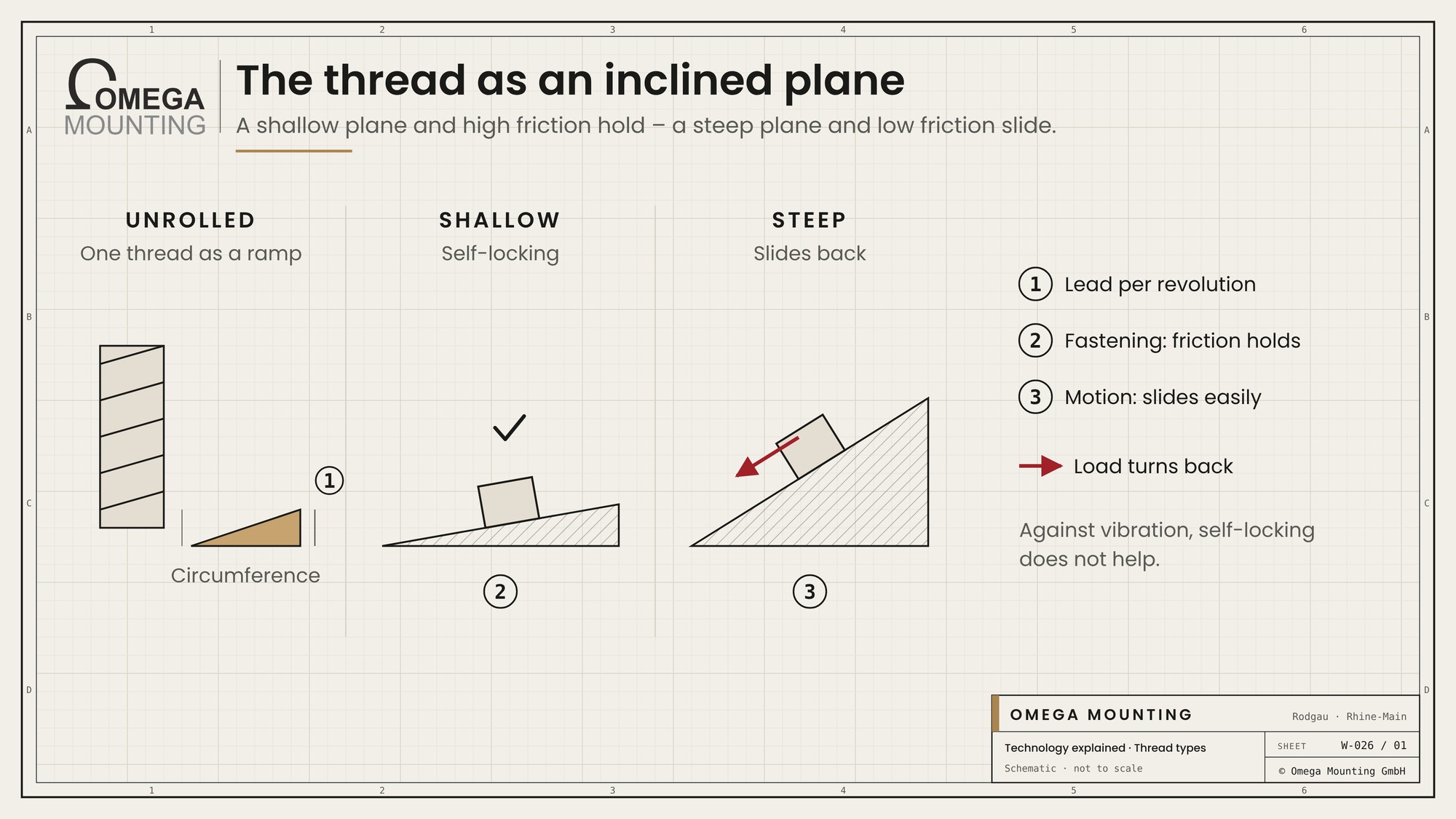
The fastening thread holds because its friction is greater than the force with which the load wants to turn the nut back; the motion thread is designed for low friction and force in the axial direction.
A thread is basically an inclined plane wound around a cylinder. If the plane is shallow and friction is high, the load does not slide back by itself. This is called self-locking: the nut stays put even when the bolt is under tension.
The V-thread reinforces this effect. Its flank angle acts like a wedge, the flanks press against each other at an angle, and friction rises. That is why almost all fastening bolts have V-threads with a small pitch.
Motion threads want the opposite. Their flank angle is smaller, the wedge effect lower – more force goes into the axis, less into friction. Often the lead is larger too.
A single-start trapezoidal thread is usually still self-locking – the spindle of a vice stays put when you let go of the handle. Multi-start spindles and ball screws are usually not. They need a brake or clamp if the load must not run back.
Important: self-locking protects against turning back under steady load, not against vibration. Transverse movements can loosen even a self-locking joint – that is what bolt locking is for.
What thread profiles are there?
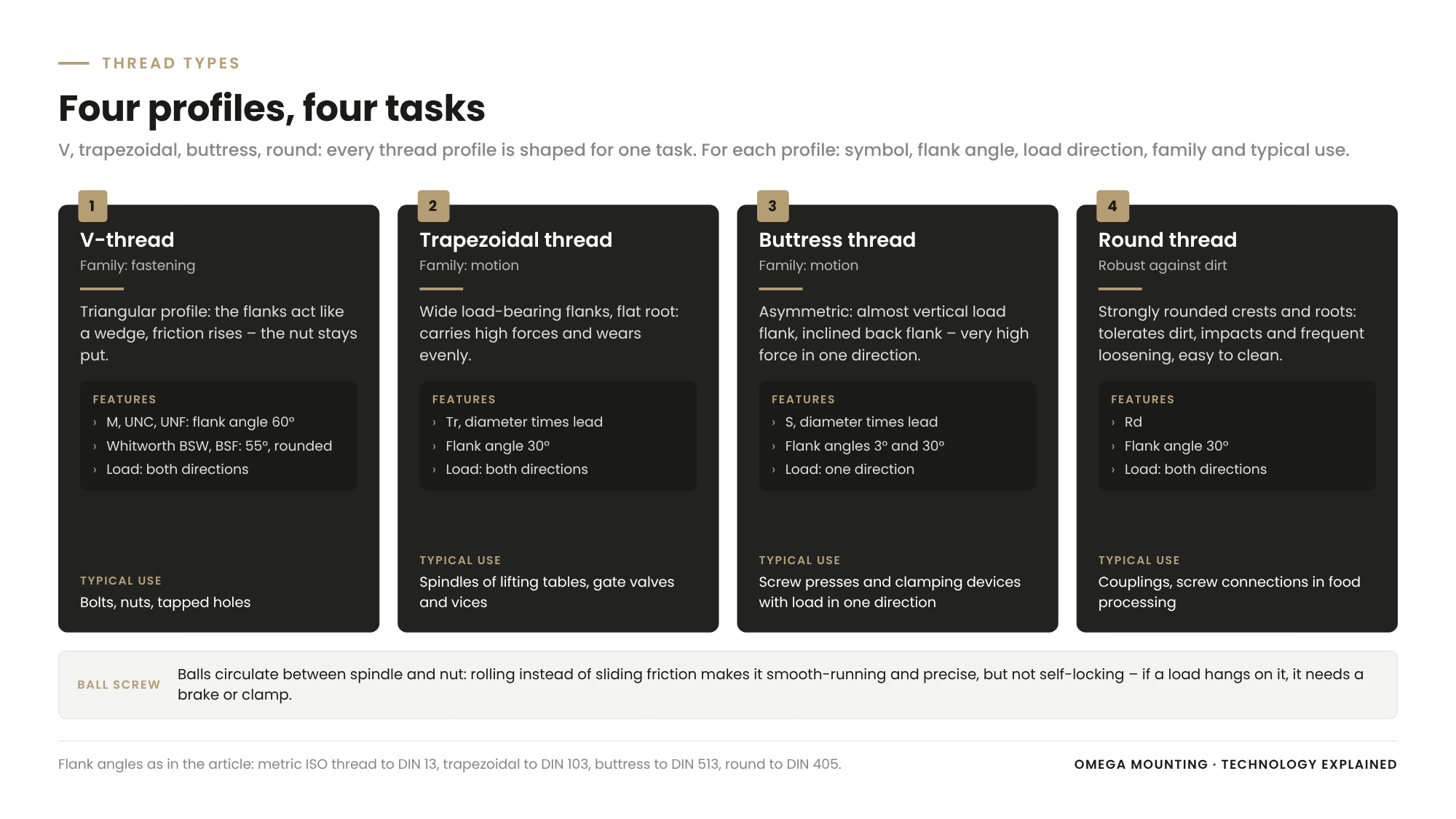
There are four basic profiles – V, trapezoidal, buttress and round thread – and each is shaped for a specific task.
- V-thread: Triangular profile for fastenings. The metric thread and the American Unified thread have 60 degrees, as coarse UNC and fine UNF. The British Whitworth thread has 55 degrees and rounded crests.
- Trapezoidal thread: Trapezoidal profile with 30 degrees, wide load-bearing flanks and a flat root. It carries high forces in both directions and wears evenly; in German Trapezgewinde.
- Buttress thread: Asymmetric profile with an almost vertical load flank of 3 degrees and an inclined back flank of 30 degrees. It takes very high force in one direction; in German Sägengewinde.
- Round thread: Strongly rounded crests and roots with 30 degrees. It tolerates dirt, impacts and frequent loosening and is easy to clean.
- Ball screw: Spindle and nut with ball grooves, with balls circulating between them. Rolling instead of sliding friction makes it smooth-running and precise, but not self-locking.
| Thread type | Profile and flank angle | Features | Typical use |
|---|---|---|---|
| Metric ISO thread | V, 60 degrees. | M, dimensions in millimetres. | Bolts, nuts, tapped holes. |
| Unified inch thread | V, 60 degrees. | Inch dimensions, threads per inch, symbol UNC or UNF. | Machines and components from North America. |
| Whitworth thread | V, 55 degrees, rounded. | BSW or BSF, inch dimensions. | Older machines of British design. |
| Pipe thread | Whitworth profile, parallel or tapered. | G, R, Rp, Rc; American NPT with 60 degrees. | Pipelines, valves and fittings, hydraulic and pneumatic connections. |
| Trapezoidal thread | Trapezoidal, 30 degrees. | Tr, diameter times lead. | Spindles of lifting tables, gate valves and vices. |
| Buttress thread | Asymmetric, 3 and 30 degrees. | S, diameter times lead. | Screw presses and clamping devices with load in one direction. |
| Round thread | Rounded, 30 degrees. | Rd. | Couplings, screw connections in food processing. |
| Ball screw | Ball grooves with circulating balls. | Spindle and nut as one unit. | Linear axes, machine tools, precise actuators. |
The devil is in the detail: a Whitworth and a Unified thread of similar size can often be screwed into each other a few turns. Then it jams, and both threads are damaged.
Pipe threads: where is the seal – in the thread or in front of it?
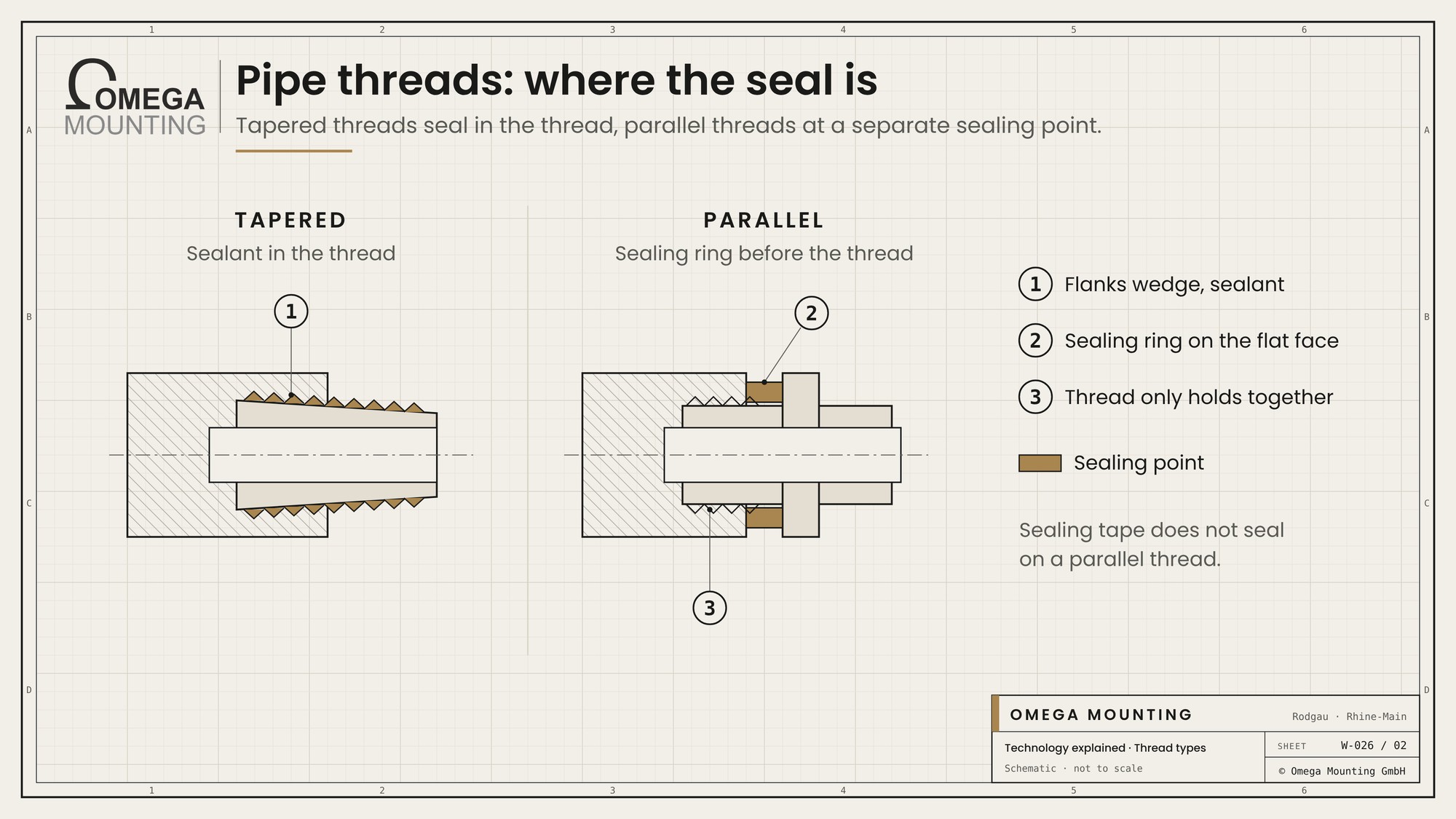
That depends on the shape: a tapered pipe thread seals in the thread itself, a parallel one does not – there a ring, a sealing face or a sealing cone seals.
On a tapered thread the flanks wedge when screwed in. Together with a sealant in the thread, the joint becomes tight. The parallel pipe thread with the symbol G, on the other hand, only holds the parts together; sealing takes place at a separate point.
This is the rule for hydraulic fittings: the thread provides the clamping force, the seal is made at the cone or sealing ring. Sealing tape in the thread does not seal anything here, but can leave residues at the sealing point.
Parallel and tapered pipe threads look confusingly alike. How to reliably distinguish G, R and NPT is covered in our guide Tapping and drilling threads.
Reading thread designations: what do M10, M10x1.25 and Tr 20x8 P4 mean?
A thread designation gives, in a fixed order, the symbol of the thread type, the nominal diameter and – where necessary – pitch, number of starts and direction of rotation.
- M10: Metric coarse thread with a nominal diameter of 10 millimetres. The pitch of 1.5 millimetres is not stated because it belongs to the coarse thread.
- M10x1.25: Same diameter, but fine thread with a pitch of 1.25 millimetres. Fine threads lock more strongly and fit thin-walled parts.
- Tr 20x4: Trapezoidal thread with a diameter of 20 millimetres and a pitch of 4 millimetres, single-start.
- Tr 20x8 P4: Trapezoidal thread with a lead of 8 millimetres and a pitch of 4 millimetres – i.e. two-start.
- G 1/2: Parallel pipe thread; the fraction is a size in inches, not a measured diameter.
- LH: Left-hand thread – it tightens when turned anticlockwise.
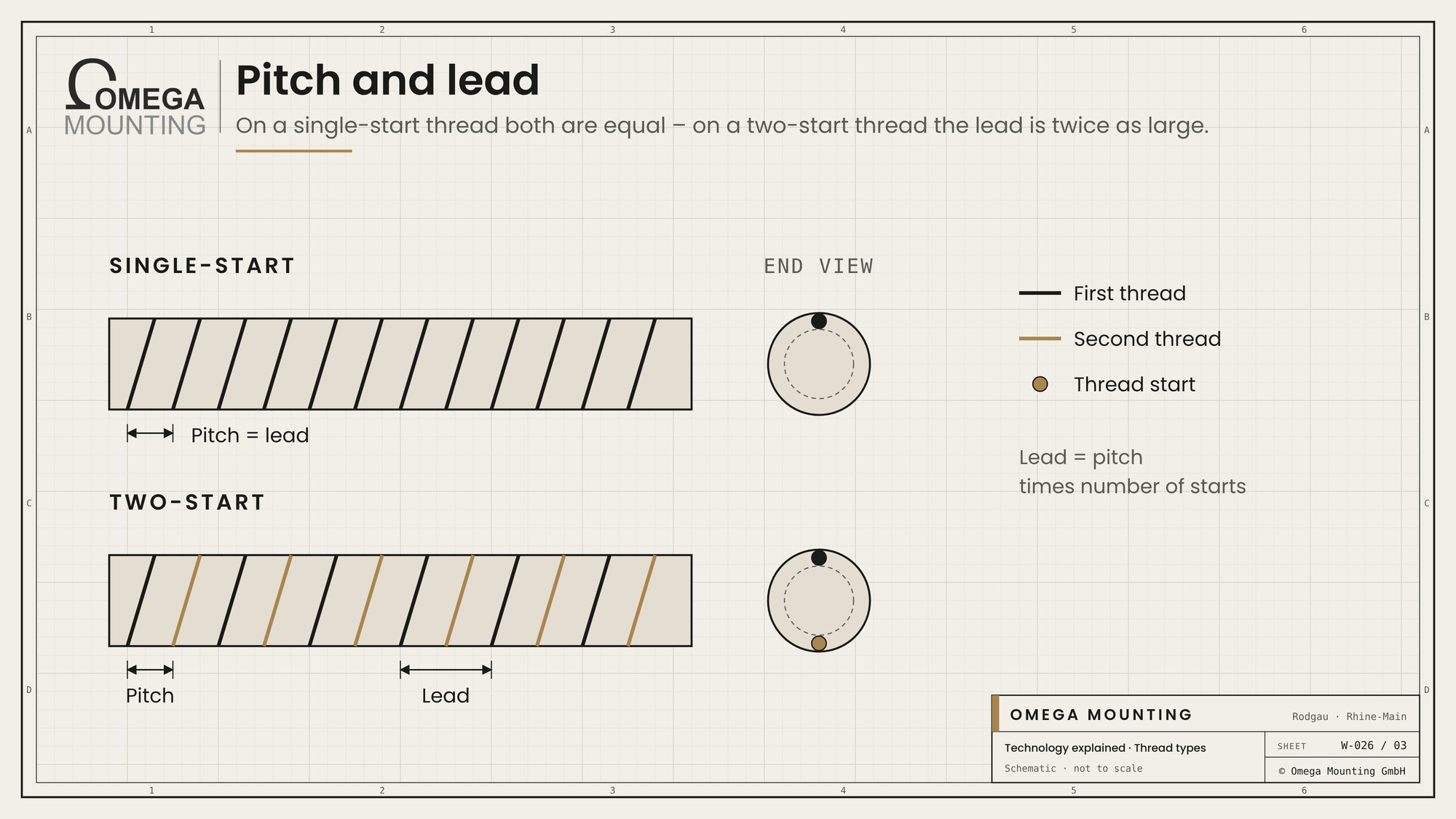
On single-start threads, lead and pitch are equal. Multi-start threads have two or more threads running in parallel. The pitch is then the distance to the neighbouring thread, the lead the distance per revolution: pitch times number of starts. In German the pitch is called Teilung and the lead Steigung.
You recognise multi-start threads by several thread starts at the end face. They give a lot of travel per revolution, but lock less.
What we pay attention to
Threads decide whether an installation holds cleanly or causes trouble later – that is why our rule is:
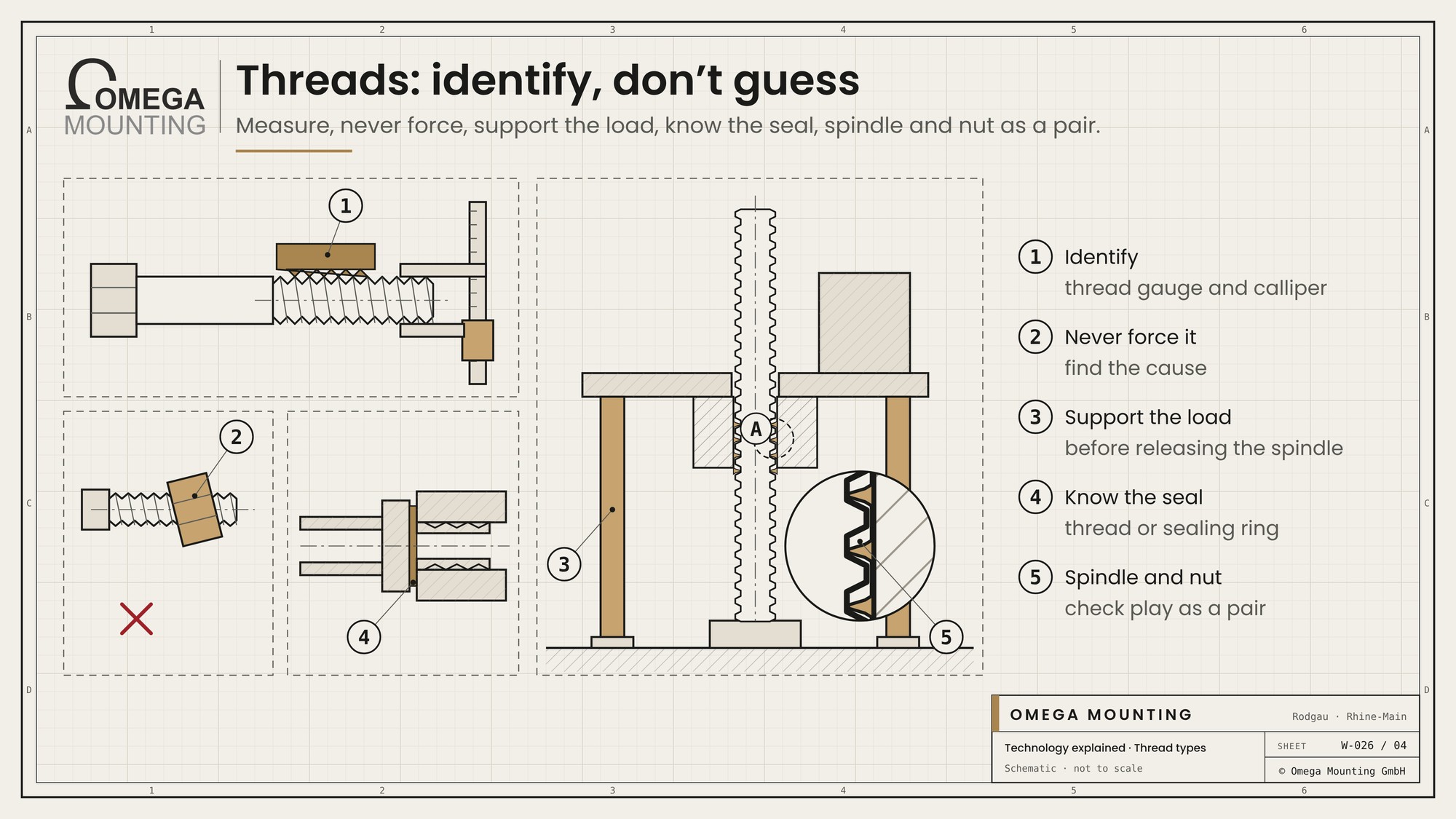
- Identify first, then turn. We measure with a thread gauge and calliper instead of judging by eye; 55 and 60 degrees or metric and inch are hardly distinguishable in small sizes.
- Never force a fit. If a thread runs stiffly, we look for the cause – wrong thread type, dirt or a damaged thread – instead of forcing it in.
- Support the load before intervening. If a load hangs on a spindle, we support it mechanically before brake, nut or spindle are released – especially on drives that are not self-locking.
- Know the sealing point. On pipe and hydraulic connections we clarify beforehand whether the thread or a cone seals, and only work on depressurised lines.
- Spindle and nut as a pair. We check the axial play; if a trapezoidal nut is worn, we also look at the spindle.
- Thread type is not strength. The symbol says nothing about property class and tightening torque; the values are in our torque table.
Where we use it
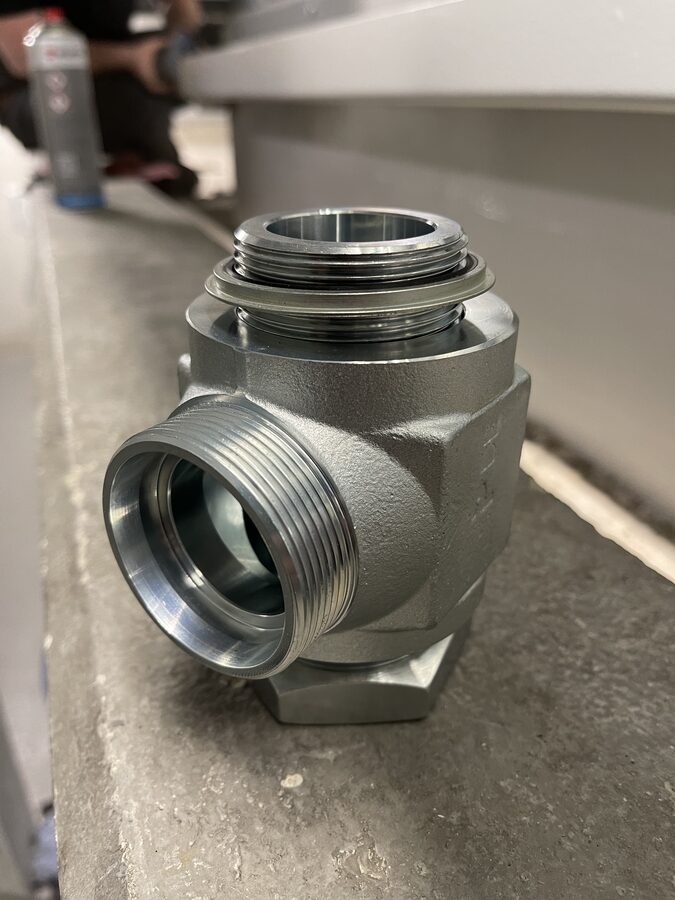
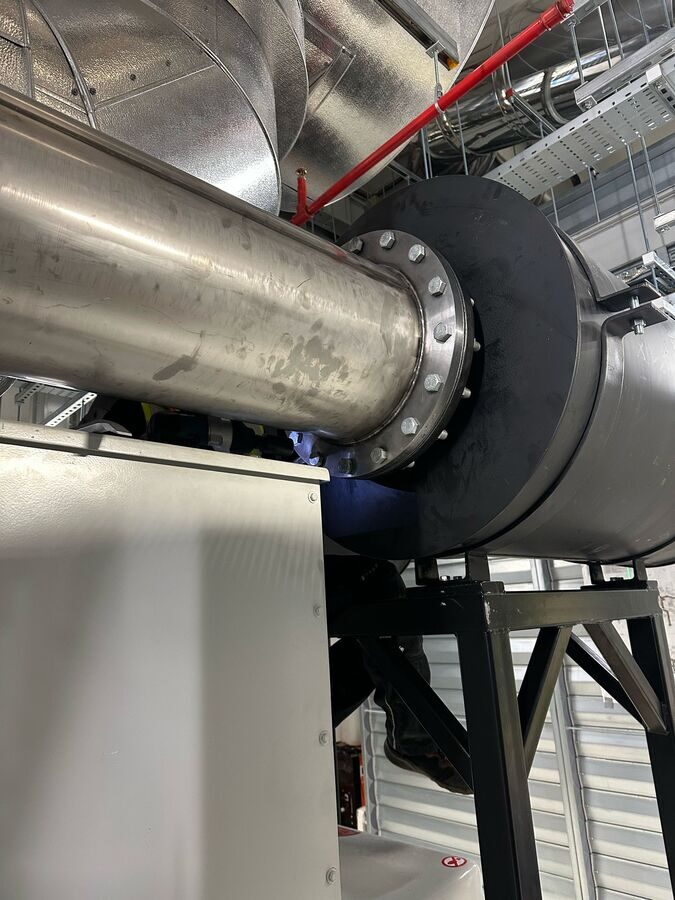
We encounter threads in almost every installation in existing buildings, whether in the Rhine-Main region or beyond. During the conversion of a vehicle test stand with a new oil pan we adapted the hydraulic lines to the new configuration; elbow fittings connect them pressure-tight, the pan segments are fixed to the concrete foundation with anchors and bolts. During the installation of turbo silencers in a data center in Offenbach 12 silencers were lifted onto frames, aligned and bolted firmly, the stainless steel piping hangs on bolted flanges. What we install in operating buildings is described on our page Industrial installation.
- Tapping and drilling threads: tap drill table M2.5 to M30 – the guide to tap drill, tap and pipe thread in detail.
Do you have questions about how this works on your site?
Property classes of bolts: why 12.9 is not always better – what the numbers on the bolt head reveal about material and load capacity. Bolt locking: what holds – and why the spring washer is obsolete – why self-locking alone is not enough against vibration.
Do you have questions about how this works on your system – which thread is on the spindle or why the fitting leaks after tightening? The quickest way is a callback – briefly describe the system, the component and your time window.
Free, no-obligation callback
About the author
Tobias Schott
Managing director of Omega Mounting GmbH, Rodgau · more than 20 years of hands-on experience in installation and maintenance
A trained mechatronics technician, working in maintenance, servicing and industrial installation since 2004 – first alongside his father, and with Omega Mounting since 2012: from overhead conveyors in Frankfurt to the crane system in a new-build hall. He plans and leads lifting operations as an appointed person (AP) in data centers and on industrial sites in the Rhine-Main region, trains and examines operators of cranes, mobile elevating work platforms and telehandlers, and is a qualified occupational safety specialist. On jobs abroad he is known as the “German Troubleshooter” – the person you call when a site gets stuck. He learned what quality means from his father, not from a manual: Made in Germany as a standard for his own work, not a label. That is why quality comes first at Omega Mounting – ahead of speed and price. The Technology explained articles cover the equipment and techniques his team uses every day: what counts on site is in them – what only appears in the brochure is not.