
- Technology explained – equipment and protection
The dock leveller: hinged lip or telescopic lip – how the bridge to the lorry is made
By Tobias Schott · 5-minute read · Updated November 2026
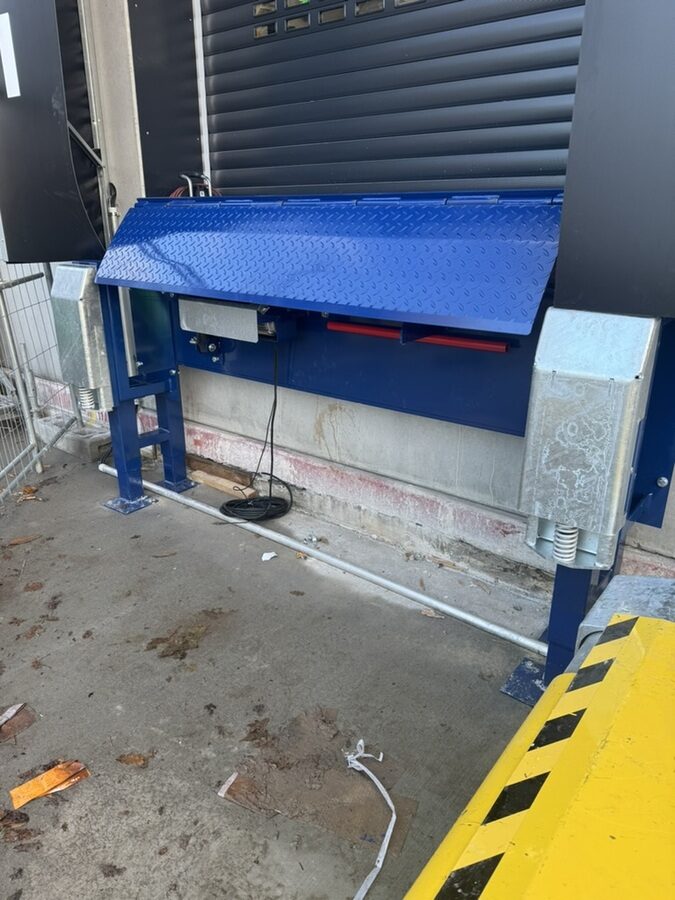
A dock leveller is the movable steel platform at the loading bay that bridges the gap and the height difference between hall floor and lorry load bed, so that forklifts and pallet trucks can cross safely.
Every loading bay has the same task: the hall floor is at one height, the load bed at another. There is a gap in between, and the lorry sinks on its suspension during loading. The dock leveller compensates for both – many times a day, in all weathers.
Here we explain how a dock leveller is built, what distinguishes a hinged lip from a telescopic lip, how docking works and what is checked in the annual inspection.
What is a dock leveller?
A dock leveller is a steel bridge permanently installed at the dock, hinged to the building at the rear and resting with a lip on the load bed at the front. Other names are loading dock leveller, dock plate or loading bridge; in German it is called Überladebrücke.
It sits in a pit or in front of the dock edge and is moved by hand, mechanically or hydraulically. Today the hydraulic type is standard: a push of a button raises the leveller, the lip extends, the leveller lowers into place.
It is part of the loading bay. This also includes the door, dock seal, dock bumpers, wheel chock and impact protection. If any of these is missing or worn, the whole bay suffers.
Key facts
- Purpose: Bridging the height difference and gap between hall and load bed so that industrial trucks can cross safely.
- Types: Hinged-lip leveller with swinging lip, telescopic-lip leveller with extending lip.
- Drive: By hand, mechanically with a spring or hydraulically with power pack and cylinders.
- Key safety parts: Pipe rupture valve, side toe guards, warning markings, dock bumpers.
- Standard: Safety requirements to DIN EN 1398, inspection as work equipment under the German Industrial Safety Ordinance (BetrSichV).
- Inspection: Usually once a year by a competent person.
How is a dock leveller built?
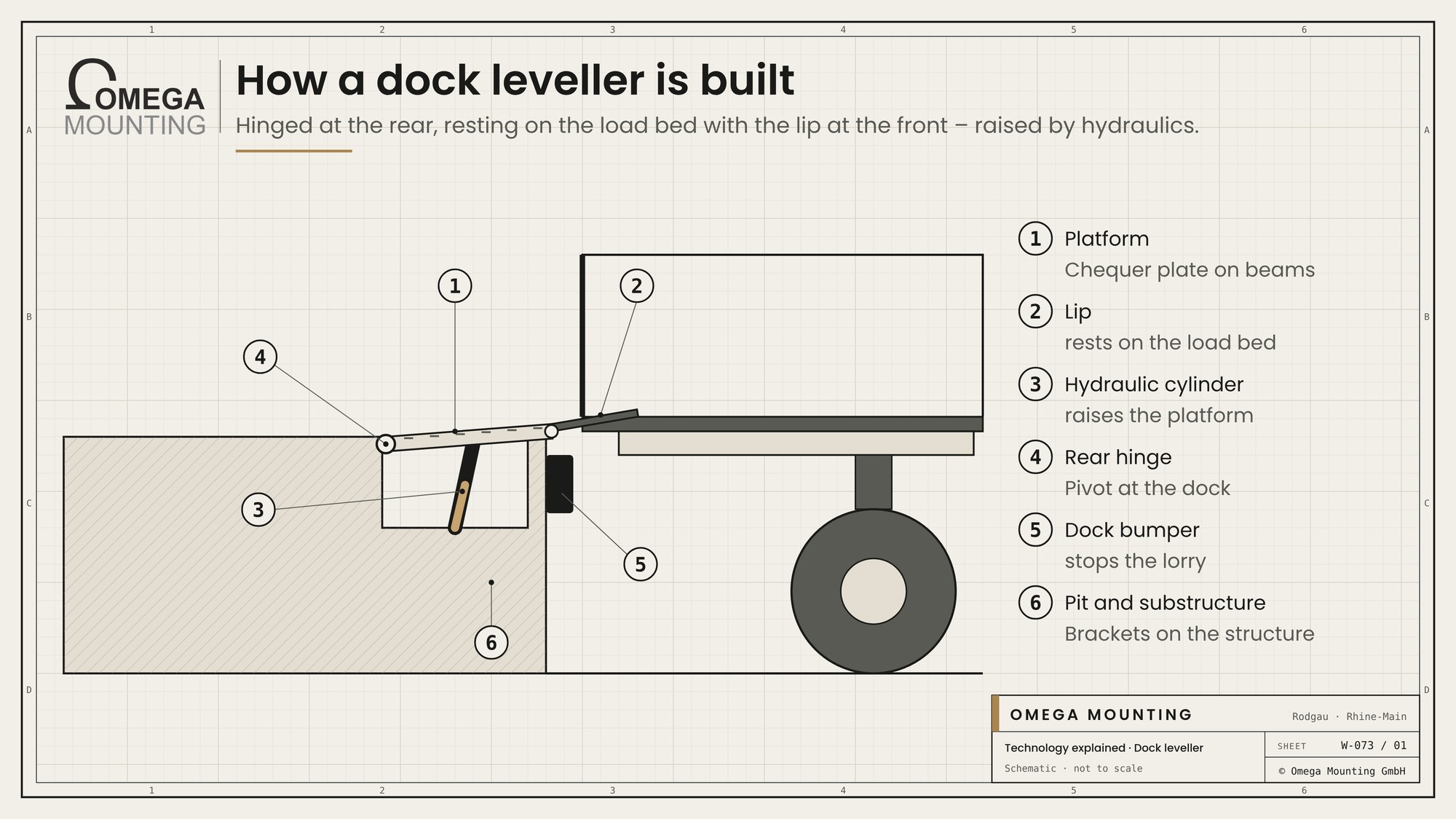
A dock leveller consists of a platform, a lip, a drive and the substructure everything hangs on.
- Platform: the driving surface of chequer plate, with longitudinal beams below that carry the load.
- Lip: the front part that rests on the load bed – as a hinged lip or a telescopic lip.
- Hydraulic cylinders: raise the platform and move the lip; the pump sits in a small power pack.
- Rear hinge: connects the platform to the dock edge; the leveller pivots about this point.
- Substructure and brackets: steel frame and brackets welded or anchored to the structure.
- Dock bumpers: stop the lorry before it hits the leveller or the building.
It is operated from a control panel next to the door, often with a traffic light for the driver. How pump, valves and accumulator work together in the power pack is explained in our article on the hydraulic power pack.
Hinged lip or telescopic lip?

The difference lies in the lip: on the hinged-lip leveller it swings forward, on the telescopic-lip leveller it slides straight out.
| Type | How the lip works | What it suits |
|---|---|---|
| Hinged-lip leveller | The lip is hinged at the front and swings forward as the leveller rises. | Standard lorries parked directly against the bumpers. |
| Telescopic-lip leveller | The lip slides out of the platform, so it can be placed more precisely. | Varying vehicles, larger gaps, vehicles with tail lifts. |
The hinged-lip leveller is simpler and widespread. The telescopic-lip leveller is more flexible because it can place the lip exactly where there is room. Which one fits depends on which vehicles dock at that door.
How does docking work?
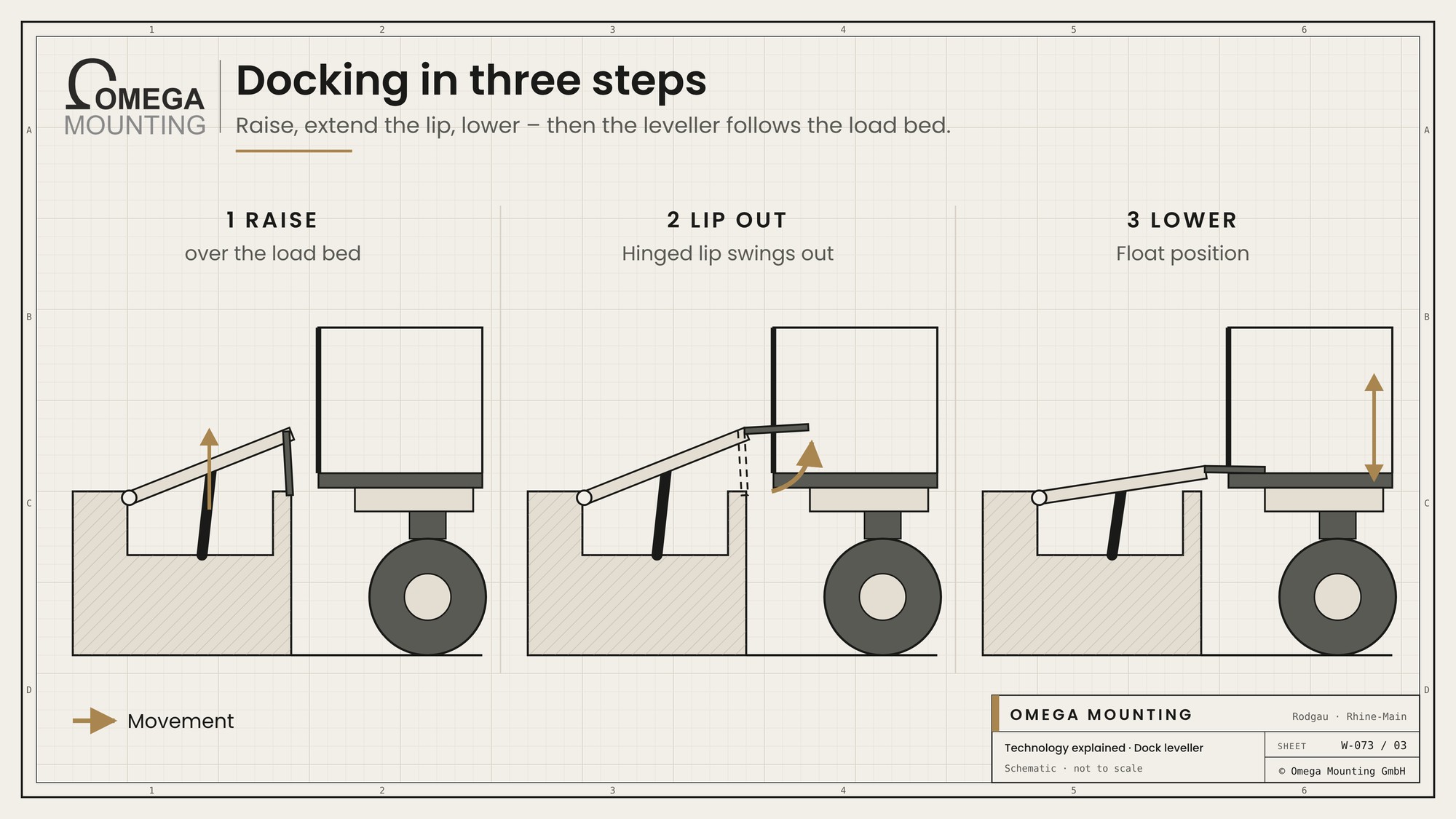
Docking takes three steps, once the lorry is against the bumpers and secured against rolling away.
- Lift: The leveller rises above the height of the load bed.
- Extend the lip: The hinged lip swings out or the telescopic lip slides out.
- Lower: The leveller lowers until the lip rests on the load bed.
After that the leveller is in float position. It is hydraulically free and follows the load bed when the lorry sinks during loading or rises during unloading. After loading, the leveller returns to its rest position, and only then may the lorry leave.
If a lorry still pulls away too early, the lip loses its support. Then the pipe rupture valve has to catch the platform before it falls into the pit with a forklift on it.
What is checked during the inspection?
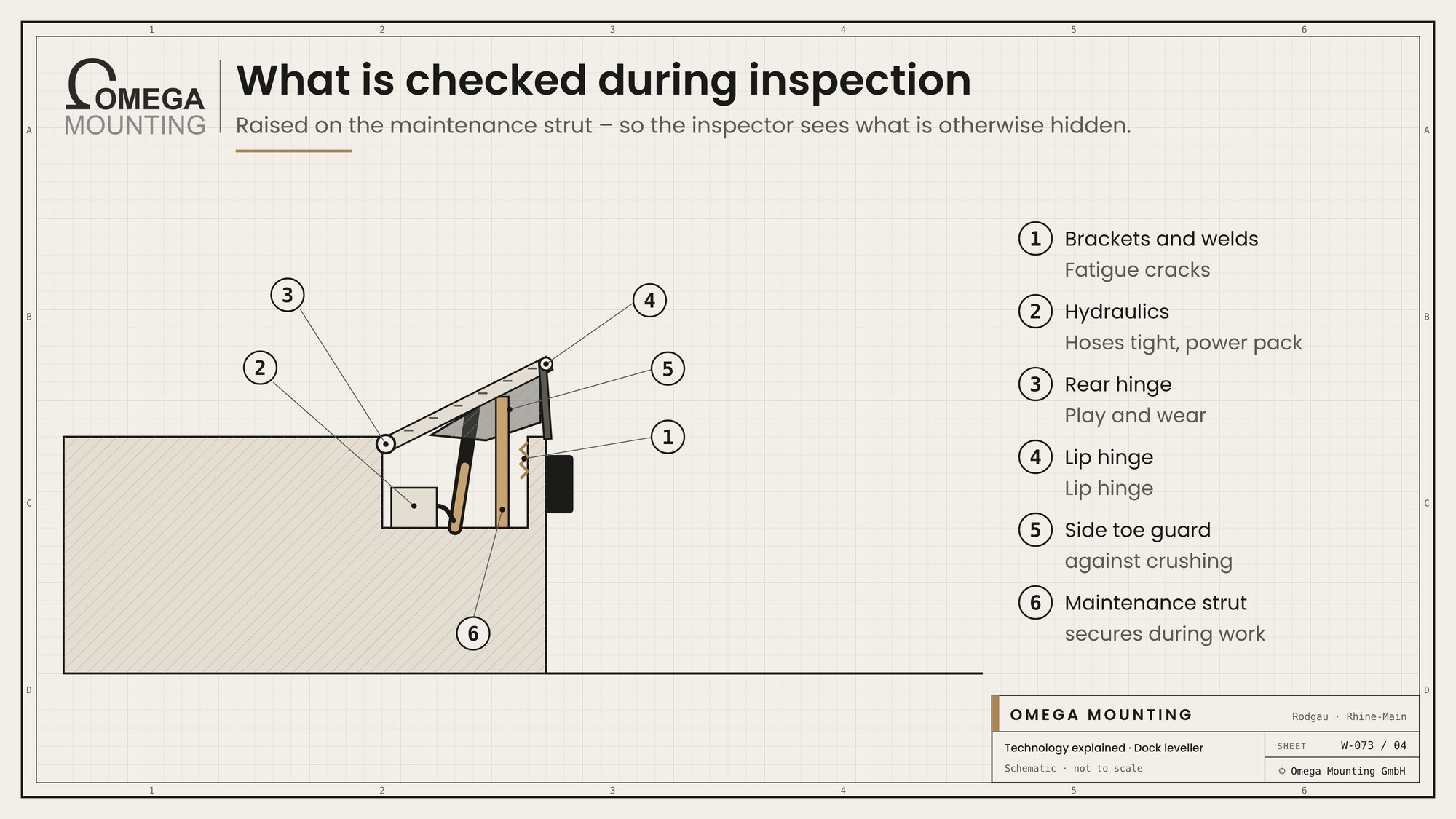
A dock leveller is power-operated work equipment and is usually inspected once a year by a competent person. Much more than the function is checked.
- Structure and welds: cracks in brackets and longitudinal beams, especially where load cycles act.
- Hydraulics: cylinders, hoses and fittings for tightness, pipe rupture valve for function.
- Hinges and supports: play and wear on the rear hinge and the lip hinge.
- Safety devices: side toe guards, labelling and warning markings.
- Bumpers and surroundings: worn dock bumpers, damaged impact protection.
If the leveller passes, it gets its inspection sticker. If it fails, it must not be used – and usually that closes the whole door. Who may carry out which inspection is explained in our article on the competent person. How to organise inspection deadlines in your operation is covered in the guide on inspection obligations for operators.
What we pay attention to
Whether replacement or repair – at the loading bay we work so that the door is out of action for as short a time as possible.
- We close off the door and secure the leveller mechanically before anyone works underneath.
- We grind out defective welds completely instead of laying a new weld over them.
- We weld with deep penetration and protect the area against corrosion afterwards.
- We align support feet and brackets so that the leveller sits without stress.
- We connect hydraulics and controls ourselves and check every movement before handover.
How a defect from the inspection is rectified before the follow-up date is described in our guide Rectifying UVV defects.
Where we use it
In a logistics centre in Frankfurt we replaced two manually operated dock levellers with hydraulic ones – in one working day with two mechatronics technicians. The old levellers were cut out, the new ones set with a forklift, welded to the steel structure and hydraulics, control cabinets and cables connected. Because the permanent power connection was missing, the equipment initially ran from a site distribution board.
At a logistics service provider, a dock leveller had failed its statutory inspection: the inspector had found fault with the welds and the door was closed. We ground out the welds on two levellers, re-welded and sealed them – in snowfall, with an industrial heater for steel and equipment. More under repair welding in industrial plants.
More technology explained
Technology explained
what protects door and panel at the dock.
Technology explained
who inspects the dock leveller.
Technology explained
what moves the leveller.
Do you have questions about how this works on your site?
Has your dock leveller failed its inspection, or do you want to convert from manual to hydraulic? We replace, weld and connect – mechanics, hydraulics and electrics from a single source. Request a callback.
Our service for this: Logistics installation and maintenance →
Free, no-obligation callback

About the author
Tobias Schott
Managing director of Omega Mounting GmbH, Rodgau · more than 20 years of hands-on experience in installation and maintenance
A trained mechatronics technician, working in maintenance, servicing and industrial installation since 2004 – first alongside his father, and with Omega Mounting since 2012: from overhead conveyors in Frankfurt to the crane system in a new-build hall. He plans and leads lifting operations as an appointed person (AP) in data centers and on industrial sites in the Rhine-Main region, trains and examines operators of cranes, mobile elevating work platforms and telehandlers, and is a qualified occupational safety specialist. On jobs abroad he is known as the “German Troubleshooter” – the person you call when a site gets stuck. He learned what quality means from his father, not from a manual: Made in Germany as a standard for his own work, not a label. That is why quality comes first at Omega Mounting – ahead of speed and price. The Technology explained articles cover the equipment and techniques his team uses every day: what counts on site is in them – what only appears in the brochure is not.
 English
 German