
- Technology explained – equipment and protection
The double-walled tank: how diesel and heating oil are stored safely
By Tobias Schott · 5-minute read · Updated November 2026
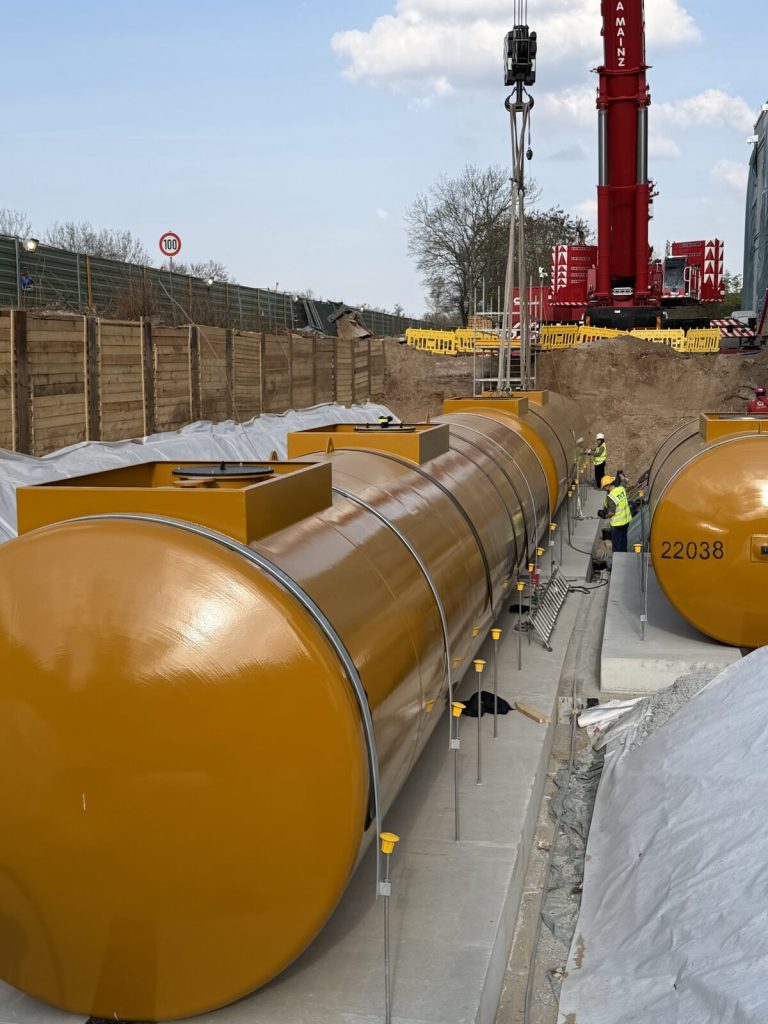
A double-walled tank has two walls with a monitored interstitial space: if one wall leaks, a leak detector reports it before fuel gets into the ground or groundwater.
Wherever standby generators, burners or vehicles need fuel, there is a storage tank. In data centers it holds diesel for days, in industry the heating oil for the burner. Because diesel and heating oil are hazardous to water, the tank must be built so that a leak is noticed and nothing gets into the environment. There are two ways to do this: a bund or a second wall.
Here we explain how a double-walled tank is built, when a bund is enough, how leak detection works and what matters when lifting in large tanks.
What is a double-walled tank?
A double-walled tank is a storage vessel in which an inner tank is completely enclosed by an outer shell. The narrow space in between is called the monitored space or interstitial space. Other names are double-walled storage tank or tank with leak protection.
Tanks are made of steel or glass-fibre reinforced plastic (GRP), horizontal or vertical, above ground or underground. In Germany, how a tank must be built and monitored is governed by the Ordinance on Installations for Handling Substances Hazardous to Water (AwSV) together with the manufacturer's approval.
Key facts
- Purpose: Store fuel and report a leak before anything escapes.
- Design: Inner tank, monitored space, outer shell, manhole with connections.
- Monitoring: Leak detector with vacuum, pressure or liquid in the interstitial space.
- Alternative: Single-walled tank in a bund.
- Material: Coated steel or GRP.
- Installation: Lifting in at the lifting points, setting on supports or a foundation, anchoring.
How is a double-walled tank built?
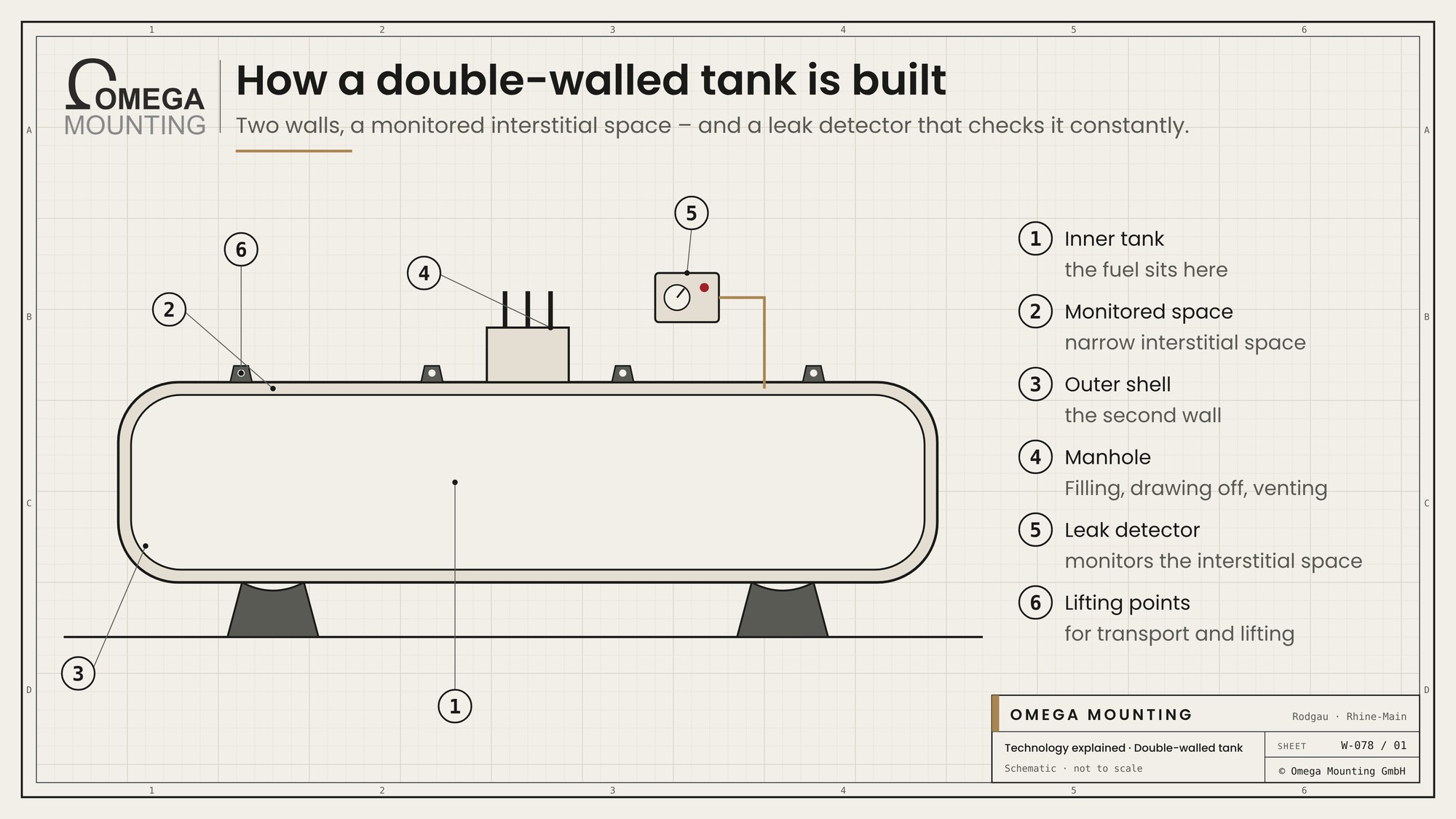
A horizontal double-walled tank consists of several parts that together must be tight and monitored.
- Inner tank: the cylinder with domed ends, the dished heads, in which the fuel sits.
- Monitored space: the narrow gap between the two walls.
- Outer shell: the second wall, usually coated on the outside.
- Manhole: the opening on top with fill, draw-off and vent lines and level measurement.
- Leak detector: monitors the interstitial space and reports any change.
- Lifting points: welded on by the manufacturer, for transport and lifting in.
At a data center the tank supplies the standby power system. How day tank and storage tank work together there is explained in our article on the Standby power system.
Single-walled with bund or double-walled?
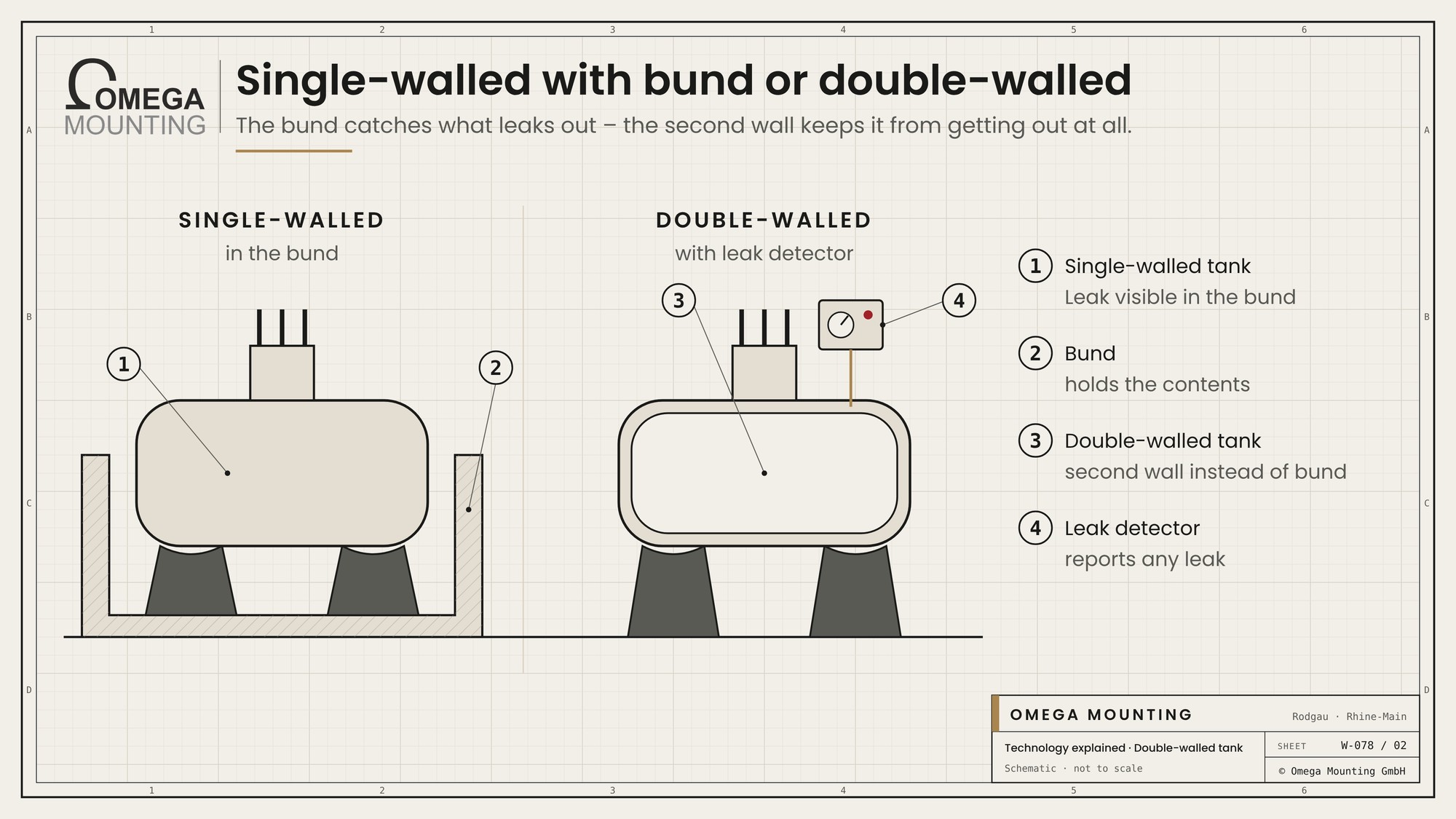
Both designs prevent fuel from escaping. They do it in different places.
| Type | How it protects | What it needs |
|---|---|---|
| Single-walled with bund | If the tank leaks, the bund catches the contents. | A bund that is large enough, and regular visual checks. |
| Double-walled | The second wall holds and the leak detector reports the leak immediately. | A working leak detector and its regular testing. |
Double-walled tanks need less space because no bund has to be built, and they are also suitable for underground tanks where a bund is not possible. Single-walled tanks with a bund are simpler, and a leak can be seen with the naked eye.
How does leak detection work?
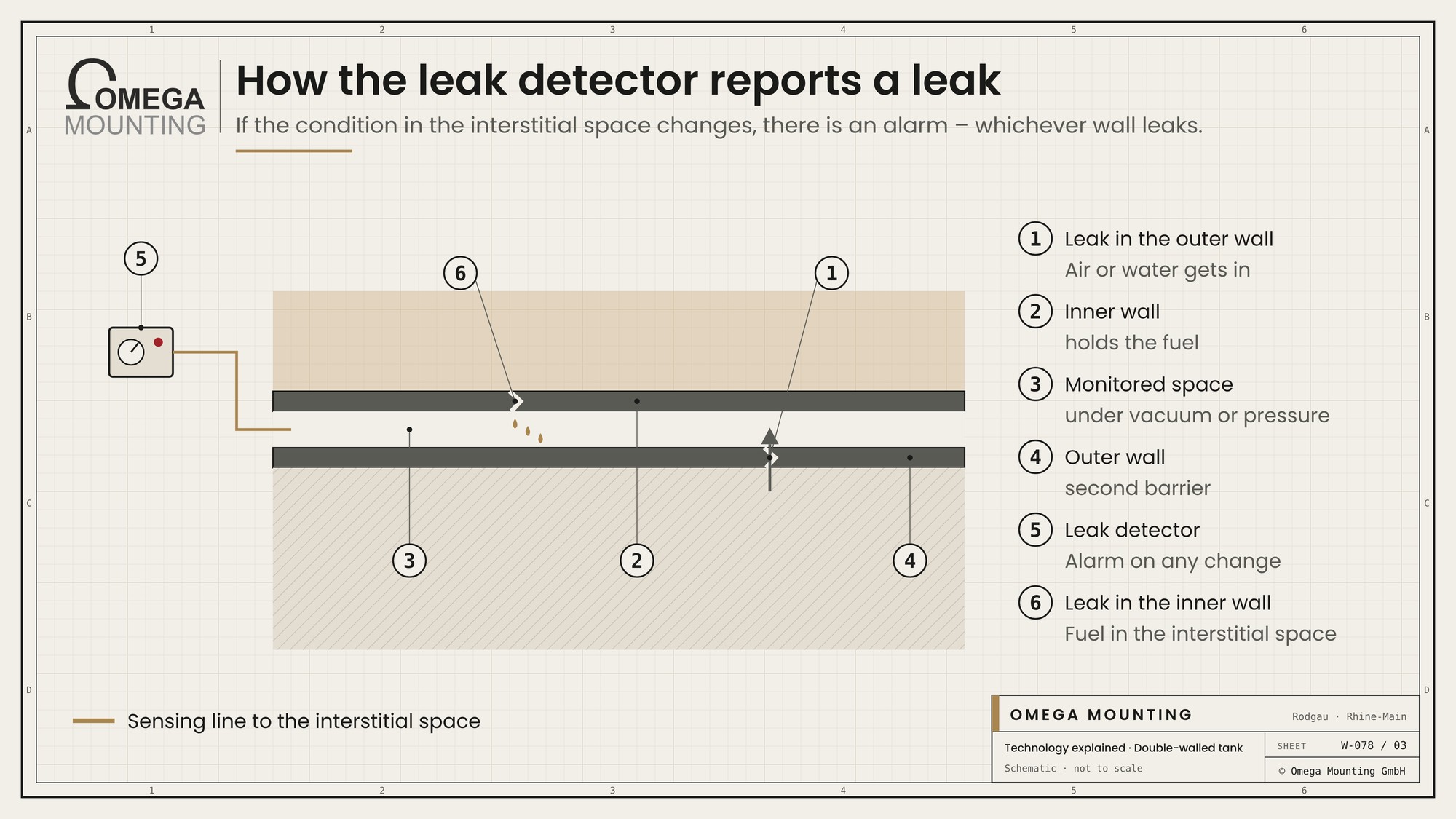
The leak detector keeps the monitored space in a fixed condition and reports when this changes.
- Vacuum: A vacuum is maintained in the interstitial space. If a wall leaks, the pressure rises and the detector raises the alarm.
- Pressure: The interstitial space is under slight overpressure. A leak makes the pressure drop.
- Liquid: The interstitial space is filled with a monitoring liquid. If its level drops, a wall is leaking.
The advantage: the detector notices not only a leak in the inner wall but also one in the outer wall – before any fuel escapes at all. To do this, it must be tested regularly and investigated after every alarm.
Lifting in: lifting points instead of a sling around the shell
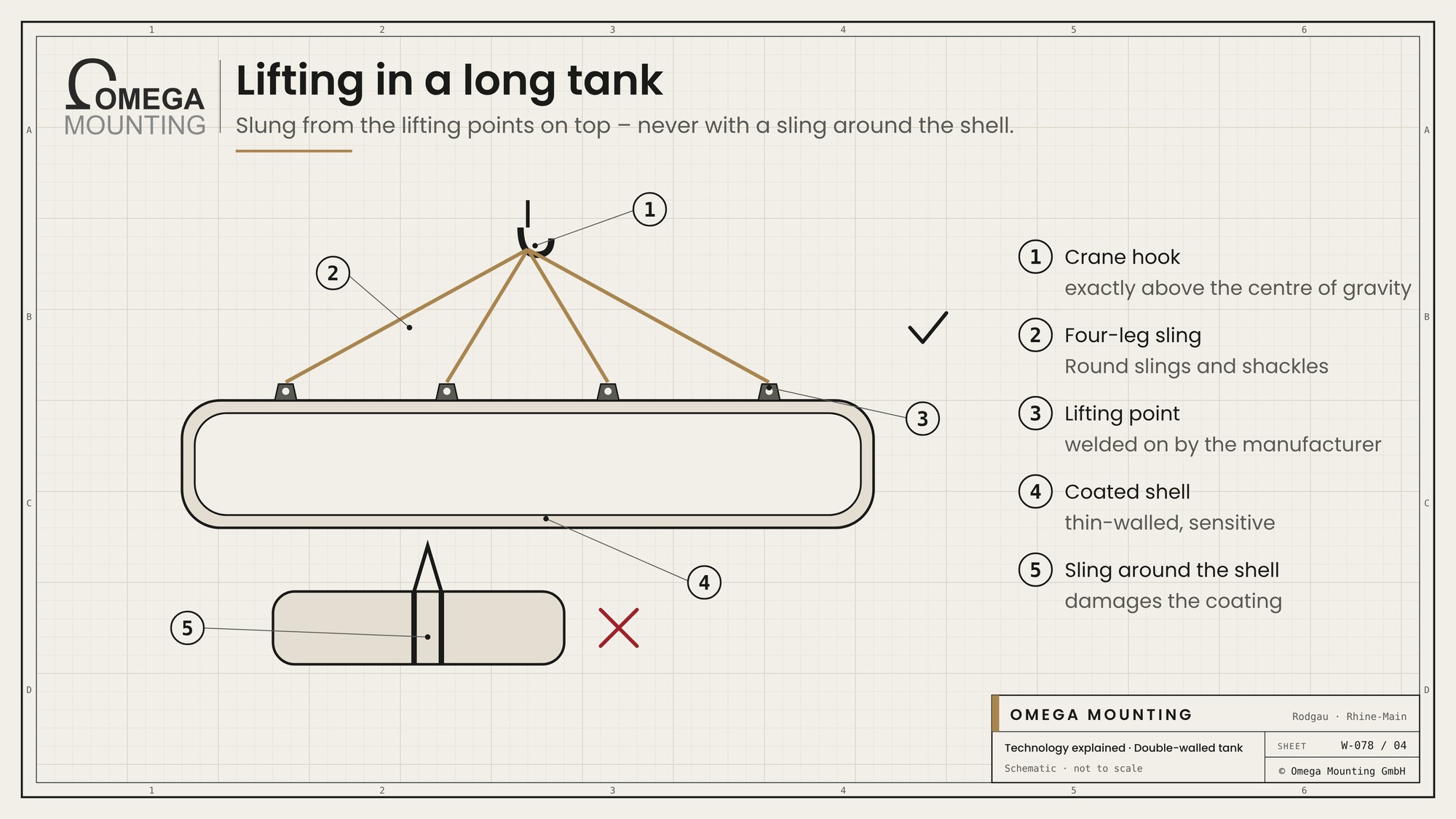
A large horizontal tank is not a compact block but a long, comparatively thin-walled cylinder. The load is spread over the whole length, and the shell is coated.
- No sling around the shell: It damages the coating and puts point loads on the thin wall.
- Manufacturer's lifting points: welded on top and designed for the weight.
- Sling on all points: round slings and shackles, so that every point carries its share.
- Spreader beam for GRP: plastic tanks are often lifted with a purpose-built spreader beam.
- Anchoring: At the destination there are supports or a foundation on which the tank is fixed.
How lifting accessories are selected is explained in our article on round slings, webbing slings and chain slings. Who plans lifts of this kind is described in our guide on the appointed person for lifting operations.
Setting up and connecting
After lifting in, the tank is not yet ready for use. These steps follow:
- Level stand: The tank stands on a level, load-bearing base. Tilting falsifies the level gauge and draw-off.
- Clearances: Space is left to walls and other tanks for inspection and maintenance.
- Leak detection: The interstitial monitoring is connected and checked for function.
- Cables: Filling, draw-off and vent lines are connected free of stress.
- Marking: Contents, volume and warning notices are visible on the tank and at the filling connection.
Depending on size and stored product, the installation needs an inspection by experts before it is filled. The operator clarifies this with the responsible authority – no legal advice. For installation this means: have the tank documents and photos of the installation ready.
What we pay attention to
When lifting in large tanks, the planning before the day decides.
- We check whether transports with the length of the tanks can reach the crane at all.
- We check the manufacturer's lifting points and recalculate the sling.
- We position the crane so that no manhole or sewer lies under the outriggers.
- We lift only at the designated points and protect the coating.
- We set the tanks on their supports or anchor them in the foundation.
Where we use it
At a data center in Raunheim we were the lifting appointed person responsible for five diesel tanks – each 100 cubic metres, 16 metres long and 16 tonnes in weight. The access route led through a residential street, and there were manholes and sewers below ground. They were slung from four welded-on lifting points with a sling of round slings and shackles and set down over the shoring wall into the pit.
In Fulda we set up GRP tanks for a burner conversion: delivered to a tight company site, lifted with a purpose-built lifting beam and fixed with heavy-duty anchors in the concrete foundation.
More technology explained
Technology explained
what the diesel in the tank is for.
Technology explained
what a tank is slung with.
Technology explained
what the crane stands on during the tank lift.
Do you have questions about how this works on your site?
Do you need large tanks lifted in or set up – on a tight site or into a pit? We plan the lift, sling correctly and set the tanks on their foundation. Request a callback.
Our service for this: energy and standby power →
Free, no-obligation callback

About the author
Tobias Schott
Managing director of Omega Mounting GmbH, Rodgau · more than 20 years of hands-on experience in installation and maintenance
A trained mechatronics technician, working in maintenance, servicing and industrial installation since 2004 – first alongside his father, and with Omega Mounting since 2012: from overhead conveyors in Frankfurt to the crane system in a new-build hall. He plans and leads lifting operations as an appointed person (AP) in data centers and on industrial sites in the Rhine-Main region, trains and examines operators of cranes, mobile elevating work platforms and telehandlers, and is a qualified occupational safety specialist. On jobs abroad he is known as the “German Troubleshooter” – the person you call when a site gets stuck. He learned what quality means from his father, not from a manual: Made in Germany as a standard for his own work, not a label. That is why quality comes first at Omega Mounting – ahead of speed and price. The Technology explained articles cover the equipment and techniques his team uses every day: what counts on site is in them – what only appears in the brochure is not.
 English
 German