
- Guide – Lift & Shift
Robot removal: taking out industrial robots in one piece, keeping the line running, converting the cell
By Tobias Schott · 20-minute read · As of November 2026
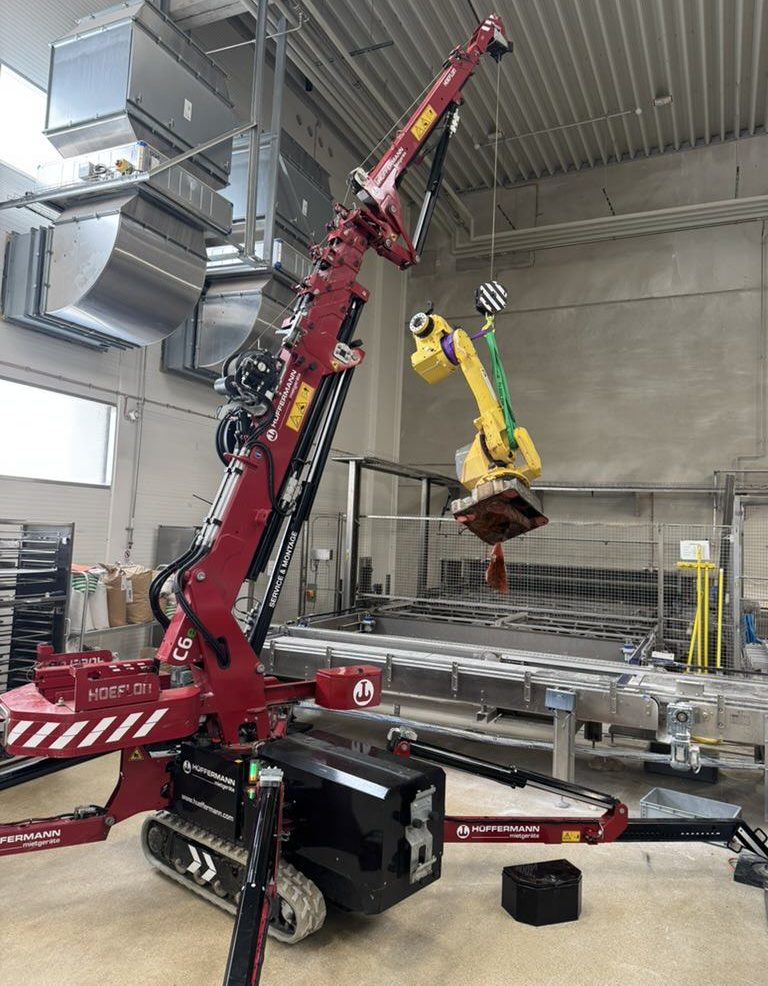
Robot removal means getting a heavy, precise industrial robot out of a tight, running line without damaging it or the line. It includes disconnecting utilities, a solution for controlling the rest of the line, a carefully planned lift and, at the end, a robot cell that is safe again.
An industrial robot rarely stands on its own. It sits in the middle of the line, surrounded by conveyors, safety fences, control cabinets and cables. It is integrated into the control system, receives power, compressed air and sometimes water, and it is heavy. When it has to come out – because it is being replaced, moved or is no longer needed – you face a task that is more than a crane lift.
If you search for robot removal, you find dealers in used robots and manufacturers selling new ones. You find little about how the removal itself works. Can the robot come out in one piece? What happens to the line when the robot is missing? Which crane fits between the conveyors? And who makes sure the cell is safe again afterwards? This guide answers these questions from the point of view of an installation contractor that removes robots and converts cells.
It is written for production and maintenance managers, project managers, plant engineers, buyers and those responsible for occupational safety – anyone who has to get a robot out of a line without stopping production longer than necessary.
Key points at a glance
- Robot removal is a six-step process: plan, disconnect utilities, adapt the control system, lift the robot, remove the base, convert the cell.
- In one piece is usually better. A robot that is to be reused stays in one piece wherever possible. Dismantling costs accuracy and time.
- The line must be able to keep running. If the robot is missing from the control system, a clean adaptation is needed – without disabling safety functions.
- The crane has to fit. Between conveyors and fences, a compact mini crane is often the only solution.
- Hygiene applies to fitters too. In food plants we work to the operator's requirements – with hairnet, face mask and clean tools.
- The cell is different afterwards. Open accesses are closed and safety devices adapted before production restarts.
- Good planning keeps downtime short. Risk assessment, lift plan and sequence are in place before the day of the job.
What does robot removal actually involve?
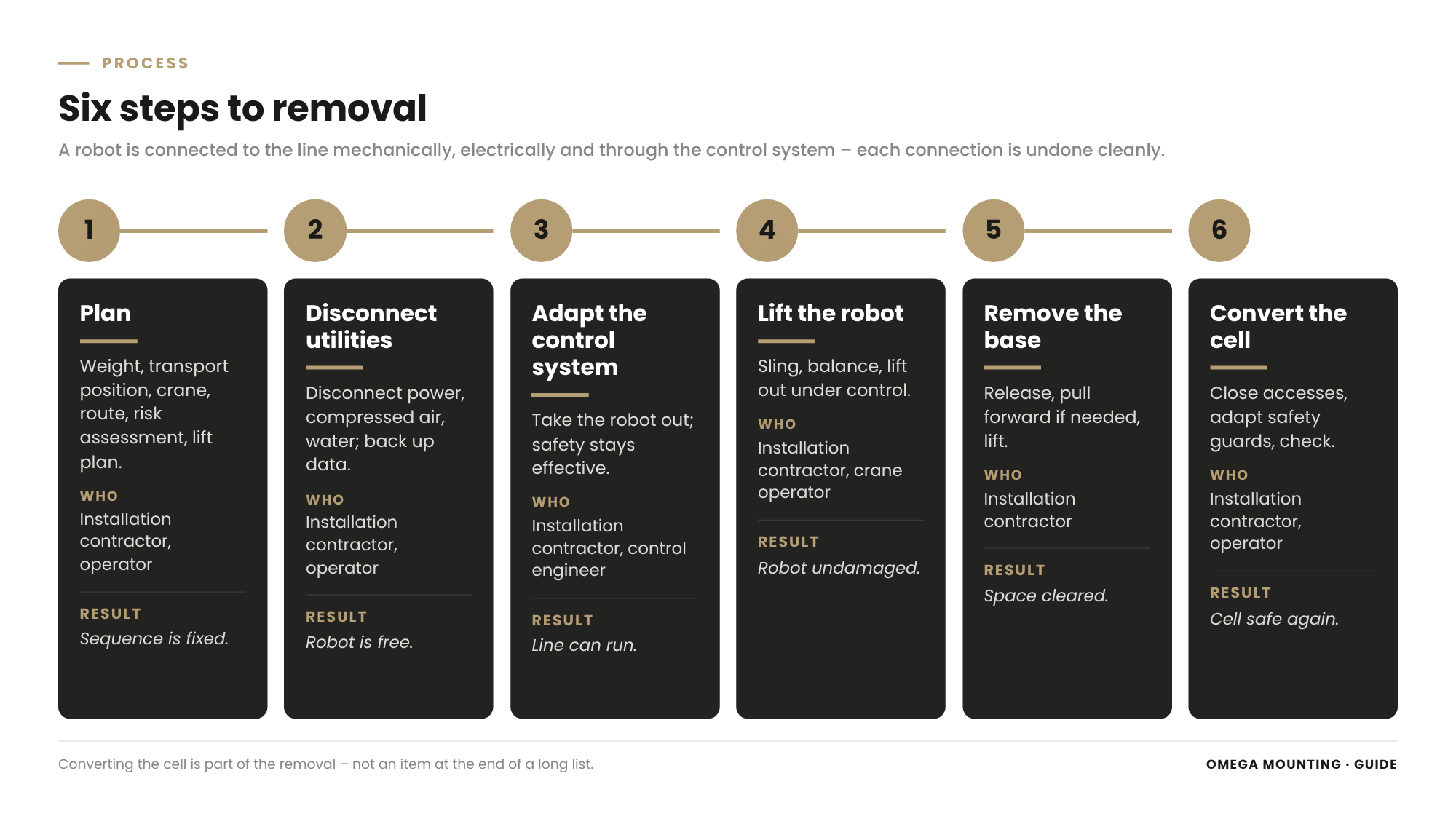
A robot is not simply unbolted. It is connected to the line mechanically, electrically and in the control system, and each of these connections has to be undone cleanly. The removal can be divided into six steps.
First, plan. Weight, centre of gravity, transport position, lifting points, space, crane, route out and the condition of the line afterwards are clarified in advance. From this come the risk assessment and the lift plan.
Second, disconnect utilities. Power, compressed air, water and signal cables are disconnected, secured and labelled.
Third, adapt the control system. So that the rest of the line can run without the robot, it is cleanly taken out of the control system.
Fourth, lift the robot. It is slung, balanced and lifted out of the line under control.
Fifth, remove the base. The pedestal the robot stood on is released and taken out as well.
Sixth, convert the cell. Open accesses are closed, safety devices adapted and the line prepared for continued operation.
Remove, relocate or replace?
The process is similar whether the robot is sold, rebuilt elsewhere or replaced with a new model. The differences lie in the goal: if it is to run elsewhere, transport securing, data backup and documentation are especially important. If it is replaced, the cell has to be prepared for the new robot.
What makes a robot different from a machine
A robot is compact but not symmetrical. Its centre of gravity depends on the position of the axes. It is precisely built, and knocks to arms and gearboxes can cost it accuracy. Cable packages on the arm are sensitive and expensive. That is why it is transported in a defined position and only slung at the points intended for this.
In one piece or dismantled?
The first decision in every robot removal is: does the robot stay in one piece or is it dismantled?
Why in one piece is usually better
A robot that is to be reused stays in one piece wherever possible. Every released axis and every removed gearbox has to be refitted and measured exactly later. That takes time and puts accuracy at risk. Removal in one piece requires more planning for the lift instead.
When dismantling becomes necessary
The robot is dismantled if the route out is too narrow, if no lifting equipment can reach it or if it is going to be scrapped anyway. Then the same applies as for any dismantling: label, photograph, pack carefully. How this works in principle is described in our guide on Industrial dismantling.
The transport position
Most manufacturers specify a transport position: an axis position in which the robot is compact and its centre of gravity is favourable. This position is moved to while the robot still has power. Then the axes are secured against movement.
When the robot is sold
A used robot is worth more if it is handed over undamaged, complete and documented. Photos of the installed condition, the data backup, the rating plate and a list of attachments help buyer and seller. We clarify what belongs to it with you before removal.
Weight and centre of gravity from the documents
The robot's weight and centre of gravity are in the manufacturer's documents, usually for the transport position. We do not take these values on trust but check which attachments are still fitted and whether the base is lifted with it.
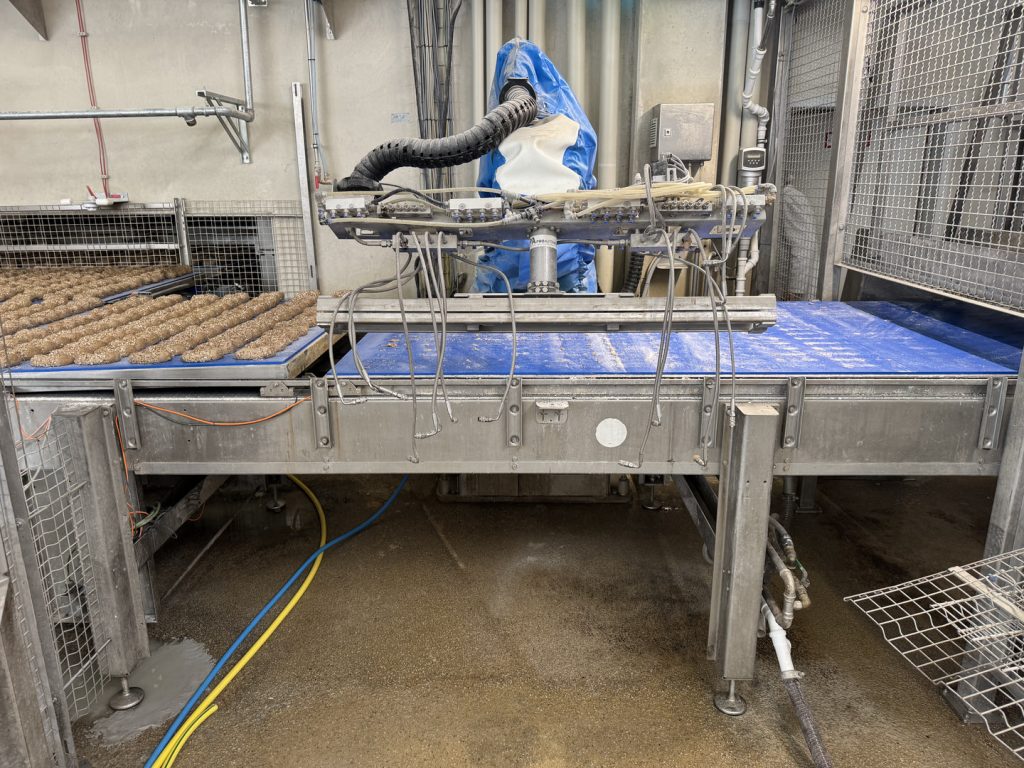
Before removal: disconnect utilities, back up data, transport position
Before the crane arrives, the robot must be separated from the rest of the line.
Backing up data
The robot's programs, parameters and configuration are backed up before it is de-energised. This is done by the operator or its controls contractor. If the robot is to run again later, this backup is worth its weight in gold.
Power, compressed air, water
Our mechatronics technicians disconnect the supply lines: power, compressed air and, where present, water. Every line is labelled and open ends are sealed. The line is secured against switching back on. How isolation and securing work in detail is described in our guide on lockout tagout.
Tools and attachments
Grippers, welding guns, tool changers and energy chains on the robot arm are removed or secured. They change weight and centre of gravity and get in the way of slinging. Cable packages and hoses running along the arm are also released and secured. Loose ends dangling during the lift can snag and throw the robot off balance.
Securing the axes
In the transport position, the axes are secured against movement as the manufacturer specifies. An arm that unexpectedly gives way during the lift shifts the centre of gravity and endangers everyone nearby.
What must keep running: control, safety, utilities

Often the line is to keep running without the robot – at least until a new one arrives. This is the most underestimated part.
The control system without the robot
A robot is usually integrated into the line control via a bus system. If it is missing, the control system reports faults and the line stops. So that the rest of the line keeps running, the robot is cleanly removed from the control system or bridged. Near Fulda, our mechatronics technicians created such a bridge so that the line could keep running without the robot.
Safety functions stay effective
A bridge in the control system must never mean that emergency stops, safety doors or light curtains are disabled. Safety functions stay effective or are replaced by equivalent ones. If anything is changed in the safety technology, the operator assesses with the manufacturer or a specialist whether this is a substantial modification. More on this in our guide on substantial modification of a machine.
Coordination with the control engineer
Where the control system is complex or safety controllers are affected, we agree the adaptation with the control engineer or the line manufacturer. We implement what has been agreed and document it. That keeps it traceable in which condition the line continues to run.
Utilities for the rest of the line
If other consumers hang off the same compressed air or water line, only the branch to the robot is disconnected and sealed. The rest of the line stays supplied.
How long the bridge applies
A bridge is often an interim solution until a new robot arrives or the line is converted. We record what was bridged and why, so that the next step can build on it cleanly.
The lift: mini crane between the conveyors
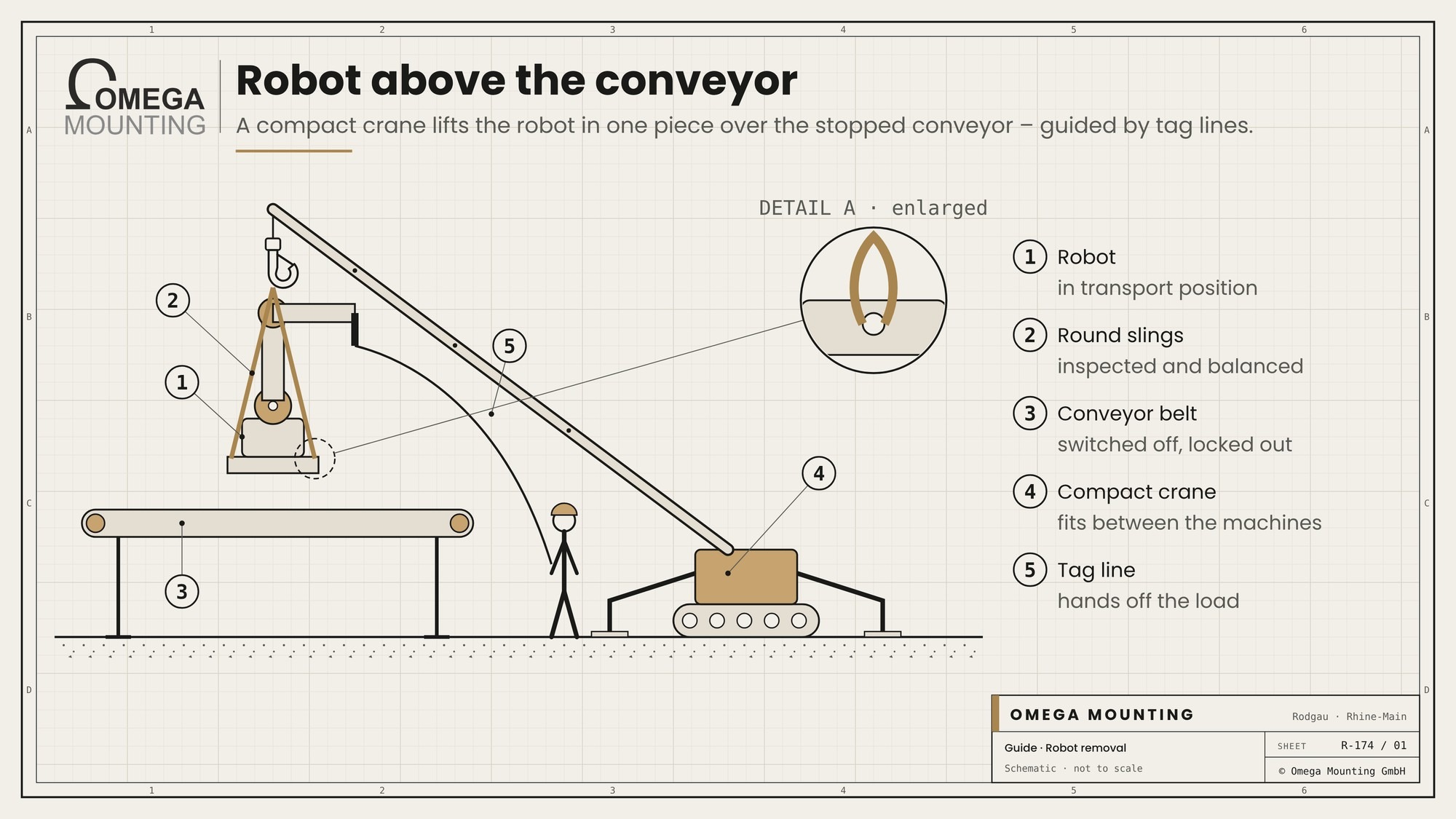
The lift is the visible part of robot removal. It is planned in the lift plan.
Finding the right crane
In many lines, conveyors, fences and machines stand so close together that a large crane cannot get near. An overhead crane is often missing at exactly this spot. Then a compact mini crane is the solution: it fits through small doors and narrow aisles, can turn almost on the spot and needs little space with its outriggers extended. Which crane fits when is described in our guide Spider crane or mobile crane.
Lifting over the conveyor
Often the robot has to be lifted over a conveyor or a machine. Then every centimetre of hook height counts. The robot is lifted until it is safely clear and then guided centimetre by centimetre over the obstacle. The conveyor below is switched off and secured.
Hook height and boom position
How high the robot can be lifted depends on the hall height, on services and cable trays below the ceiling and on the position of the crane boom. We measure these heights beforehand and plan the lift so that there is always clearance between robot, conveyor and ceiling. A trial lift shows whether the calculation is right.
Who does what
During the lift there are clear roles. The person responsible for the lift coordinates and gives permission to lift, the crane operator moves the load, the fitters steady the robot with tag lines and keep an eye on clearances. Nobody stands under the load.
Slinging and balancing
A robot only hangs steadily on the hook if it is slung correctly.
Only at intended points
Many robots have transport eyes or holes for lifting accessories. Where the manufacturer provides none, we sling so that no arms, cables or gearboxes are loaded. We use inspected round slings that are gentle on sensitive surfaces.
Balancing before the lift
Because a robot's centre of gravity is rarely in the middle, it is balanced before the actual lift. The robot is raised just a few centimetres, its attitude checked and the lifting accessories adjusted until it hangs level. Only then does the lift continue.
The test lift
Before the robot goes over the conveyor, we only lift it far enough for it to hang free. In this position we check lifting accessories, crane position, outriggers and clearances once more. Only when everything is right does the person responsible give permission for the actual lift.
Tag lines instead of hands
As long as the robot is suspended, nobody touches it by hand. The fitters guide it with tag lines so that it does not turn or swing against conveyors or fences. Anyone holding a tag line stands outside the area under the load.
Knowing the weight beforehand
The weight is on the rating plate or in the manufacturer's documents. Base, attachments and cables come on top. We calculate the total weight beforehand so that crane and lifting accessories are suitable.
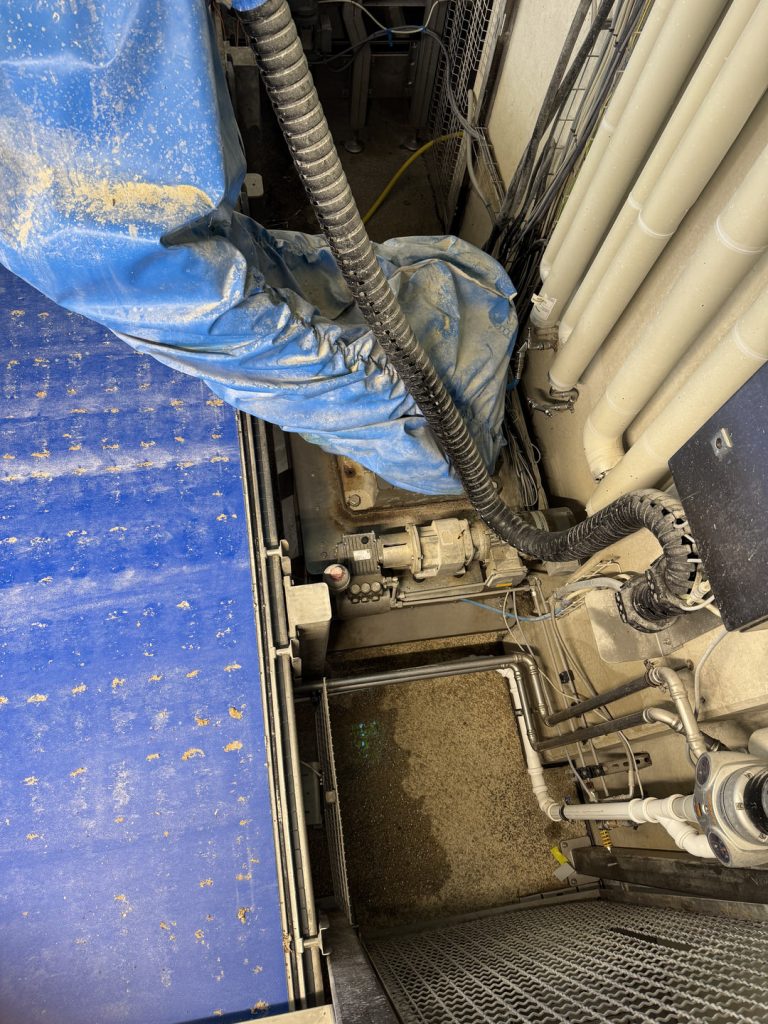
The base: pull out first, then lift
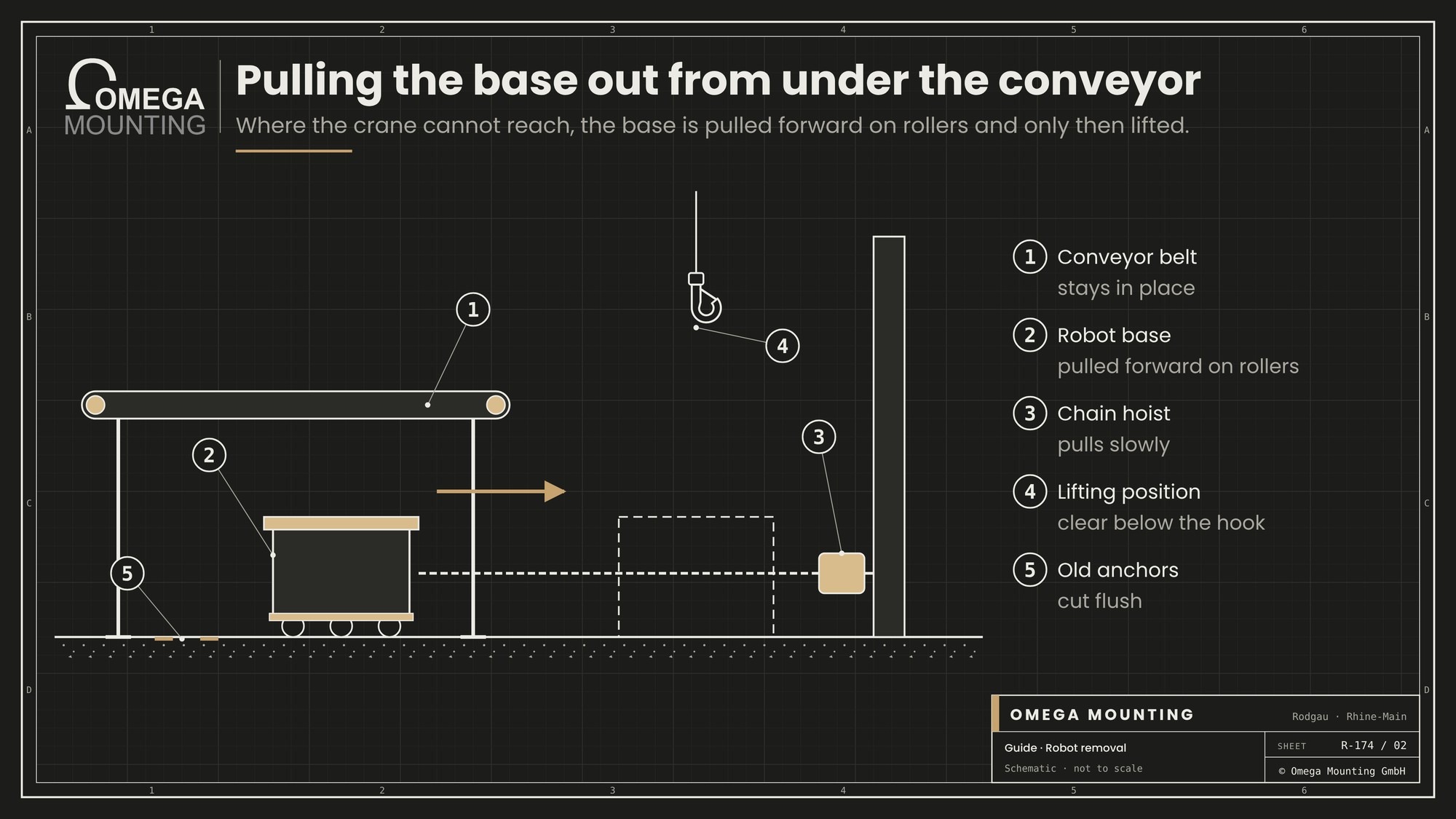
The robot stands on a base, a steel pedestal anchored to the floor. It is often heavier than you think.
When a direct lift is not possible
Sometimes the base stands where the crane cannot lift it directly – under a conveyor, for example. Then it is first released and pulled forward with aids until it stands clear. Only there is it slung and lifted. Near Fulda, we pulled the base out from under the conveyor in exactly this way and then lifted it over the conveyor.
Aids for pulling out
Depending on weight and floor, machine skates, sliding plates, a pallet truck or a chain hoist on a fixed point are suitable for pulling out. What matters is that the base does not tip and does not touch the conveyor above it. We secure it throughout the movement and pull slowly so that everyone can see what is happening.
Releasing the anchorage
The base anchors are released or cut off. If anchor stubs remain in the floor, they are made flush or marked so that nobody trips and cleaning machines do not catch on them.
The floor afterwards
Where the base stood, an area remains that often does not match the rest of the floor. In a food plant it must be cleanable. We discuss beforehand how it should be left.
When a new robot is coming
If a new robot is to stand in the same place, we check whether its base fits the same anchors or whether new holes have to be drilled. We agree bolt pattern, height and position with the supplier of the new robot. That way installation can follow removal directly.
The route out
Once the robot is lifted out of the cell, it still has to leave the hall. This route needs planning too.
Doors, aisles, floors
We check beforehand which door the robot will go through, how wide the aisles are and whether the floor can carry the load of crane, forklift or rollers. Where there is sensitive flooring, we lay protective boards. We never set heavy parts down directly on tiles or coatings. Where a crane has to go through a small door, every centimetre of its width counts.
Transferring to transport equipment
The crane often sets the robot down in the hall on a transport frame, a pallet or machine skates. From there it goes on by forklift or by hand. The robot is secured on its base or its own frame, never loose on the forks.
Crossing running operations
If the rest of the hall keeps running, the transport often crosses forklift traffic and walkways. We cordon off the route, agree the timing with the shift and accompany the transport until the robot is outside.
Transporting and storing the robot
If the robot is to be reused, removal is only half the job.
Transport securing
The robot is fixed in its transport position on a stable frame, with the axes still secured. Connectors and open ports are sealed and sensitive parts padded. For the lorry, the same applies as for any heavy machine: load with positive locking and lash down as well.
Store dry and clean
If the robot has to be stored temporarily, it needs a dry, clean place without large temperature fluctuations. Moisture harms electronics and gearboxes. For longer periods we recommend following the manufacturer's storage instructions and covering the robot.
Handing over documentation
The robot comes with its rating plate, data backup, photos of the installed condition and a list of removed attachments. That way anyone who rebuilds it later knows what they have in front of them.
Hygiene in food plants
Many robots work in food plants – packing, palletising or sorting. Special rules apply there, for fitters too.
Clothing and behaviour
We work to the operator's requirements: with hairnet, face mask, clean clothing and cleaned tools. This also applies to crane work and welding. Which zones exist and what applies in them is described in our guide on high care and low care.
Avoiding contamination
Swarf, lubricants and dust have no place near food. Open products are removed beforehand and conveyors covered. After removal, the area is cleaned before production restarts.
Time window and cleaning
In food plants, the time window for conversions is often tight, because a thorough clean and sometimes approval by quality assurance follow before restart. We plan our work so that there is enough time for this and leave the area so that cleaning can go quickly.
Welding in hygiene areas
If welding is needed during the conversion, additional rules apply: spark protection, extraction and a hot work permit. On stainless steel we use tungsten inert gas (TIG) welding, which gives clean welds without spatter.
Converting the cell: close the access, adapt the guarding
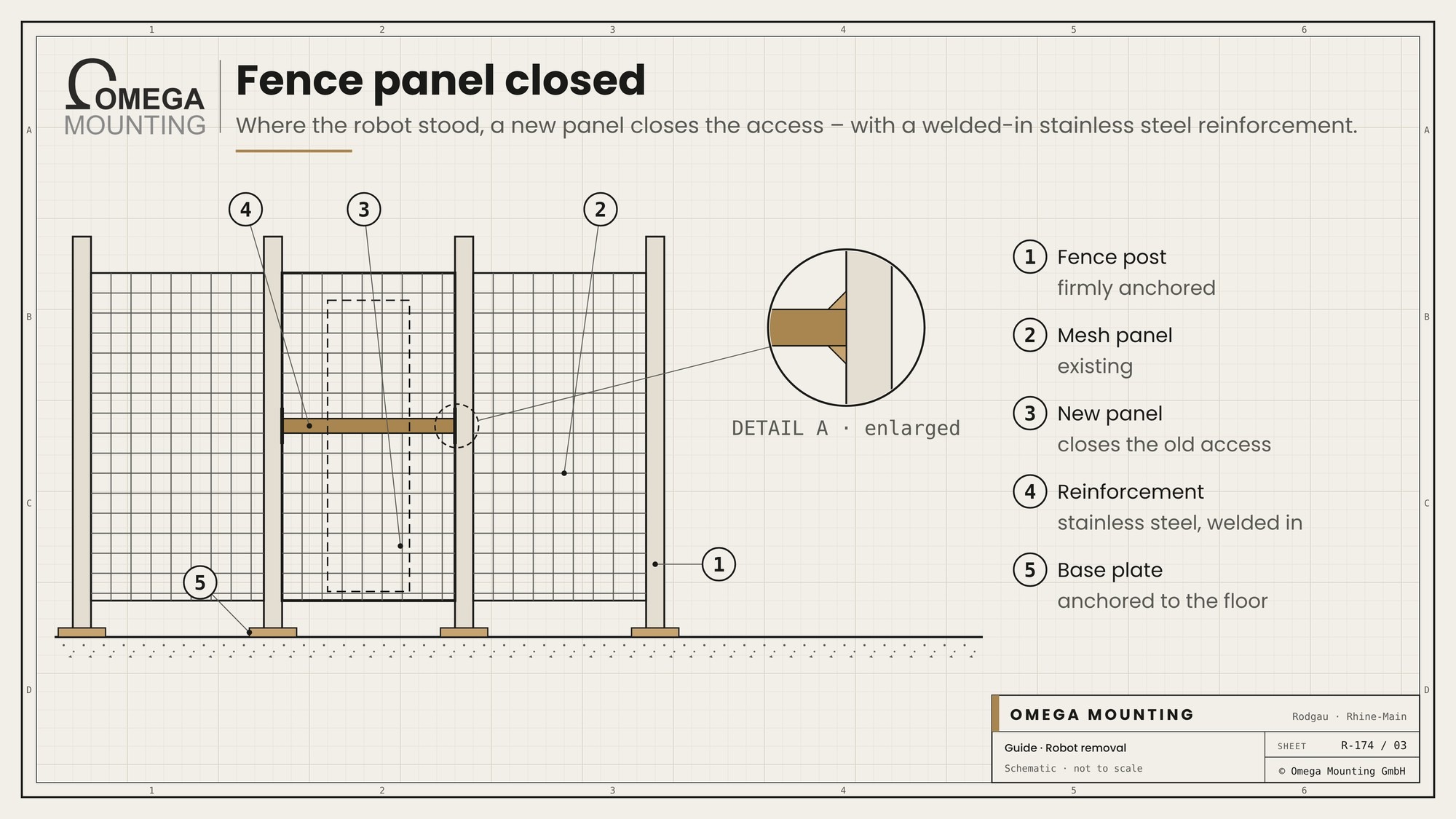
Once the robot is out, the cell is no longer the same. What was safe before may now have a gap. That is why converting the cell is a fixed part of robot removal and not something at the end of a long list.
Closing open accesses
Where the robot stood, there is often an access into the line that was previously blocked by the robot or its cell. These accesses are closed so that nobody can reach into the area of running conveyors or machines.
Adapting safety devices
Safety fences, doors and sensors are adapted to the new situation. Near Fulda, we removed old accesses, adapted the safety devices and welded stainless steel reinforcements into the fence system. How to retrofit safety devices on existing machines is described in our guide Retrofitting safety devices.
Inspection before restart
Before production restarts, the adapted safety devices are inspected. The operator decides who inspects and releases.
Documenting the conversion
We record what was changed in the cell with photos and a short description: which accesses were closed, which fence panels added, which sensors moved. These documents belong to the line and help at every later inspection.
Who does what in robot removal?
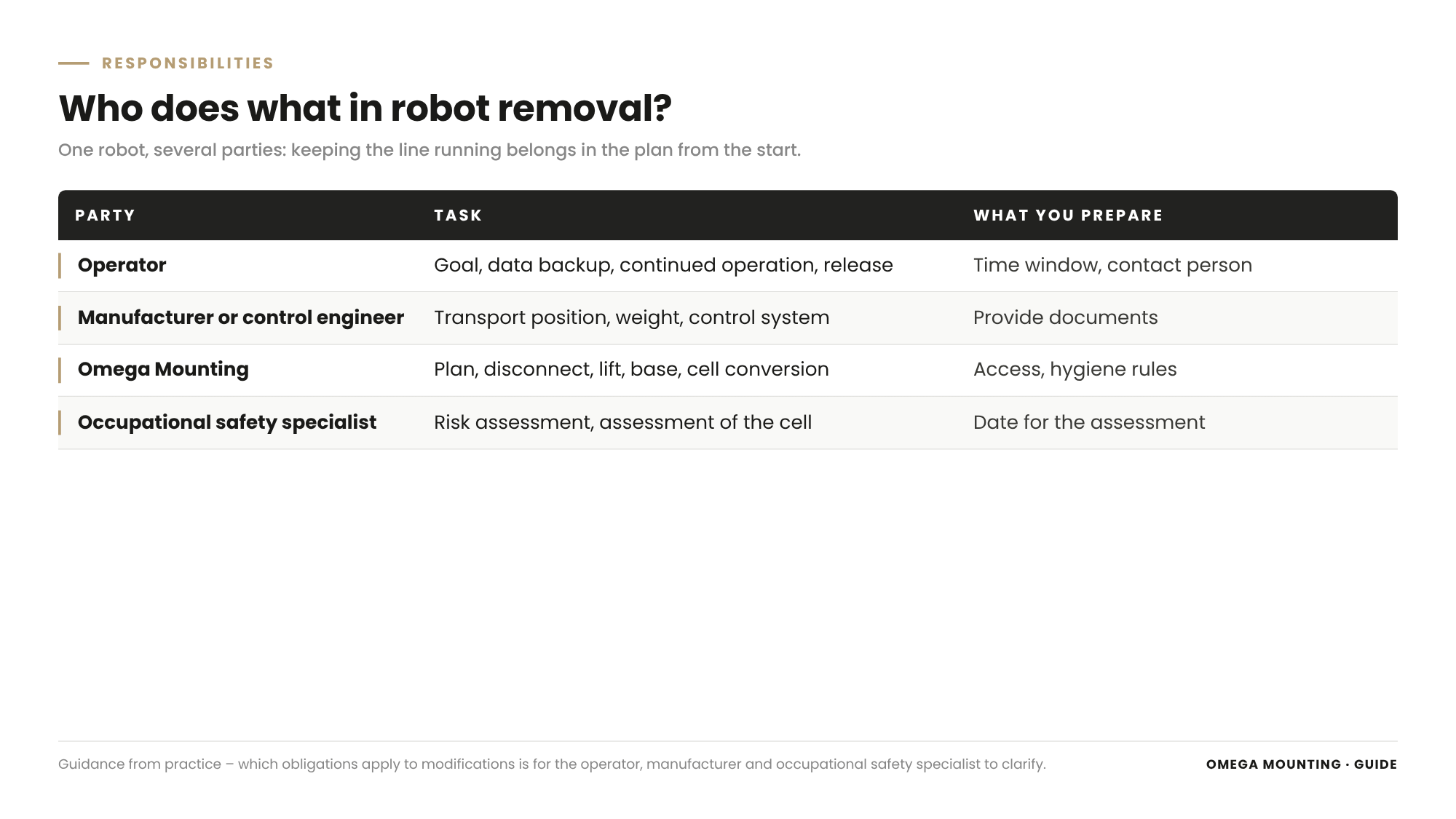
Several parties work together in robot removal. Clear responsibilities avoid gaps.
Operator
You decide what happens to the robot, back up the data or have it backed up, determine what is to keep running and release the line after the conversion.
Manufacturer or controls contractor
Provides transport position, lifting points and weight and supports data backup and changes to the control system where needed.
Omega Mounting
We plan the removal, disconnect utilities, adapt the control system for continued operation, lift out the robot and its base, convert the cell and weld where needed. We provide the crane with operator or coordinate it.
Occupational safety specialist
Supports the risk assessment and the assessment of the converted cell. This guide is not legal advice – which obligations apply to changes to your line you should clarify with your occupational safety specialist and the manufacturer.
Robot removal: what it means for your planning
If you are planning a robot removal, you can decide a lot in advance.
Set the goal
Clarify early whether the robot will be sold, relocated or scrapped. That determines how carefully it has to be secured and documented.
Clarify continued operation
Decide whether and how the line is to keep running without the robot. Plan the adaptation of the control system and safety devices at the same time.
Use the time window
Robots are often removed during short shutdowns. Plan removal and cell conversion so that production can restart on the agreed date.
Think about hygiene
In food plants, hygiene rules, cleaning and approvals should be agreed with the installation contractor before the job.
Typical mistakes in robot removal
- The data is not backed up. The robot is meant to run again later, but programs and parameters are gone.
- The transport position is forgotten. The robot is already de-energised and the axes are in an awkward position.
- Attachments stay on. Grippers and energy chains shift the centre of gravity and get in the way of slinging.
- The crane does not fit. On the day it turns out that it cannot get between the conveyors.
- The control system is not adapted. The line stops because the robot is missing.
- Safety functions are bridged as well. The line runs, but without effective protection.
- The cell stays open. Where the robot stood, there is an unsecured access to running conveyors.
The mistake behind the mistakes
Almost all these mistakes have one cause: robot removal is seen as a crane lift, not as an intervention in a running line. If you plan control, safety and cell at the same time, you get the robot out and the line safely running again.
Robot removal in the Rhine-Main region: how we do it
From Rodgau we quickly reach Frankfurt, Offenbach, Darmstadt, Hanau, Aschaffenburg and Wiesbaden. In the Rhine-Main region, robots work in the automotive industry, food plants, logistics and mechanical engineering – often in lines that have grown over the years and become tight.
Before the job, we look at the robot, its surroundings and the route out, clarify the goal and continued operation with you and draw up the risk assessment and lift plan. On the day, we disconnect utilities, adapt the control system, lift out robot and base and convert the cell. How else we work is on our page on Industrial installation.
Our mechatronics technicians can disconnect utilities, adapt control systems and weld. For you, that means one team for mechanics, electrics and conversion.
Project examples
A job from our project diary shows how robot removal works in a food plant.
Robot from an organic bakery near Fulda
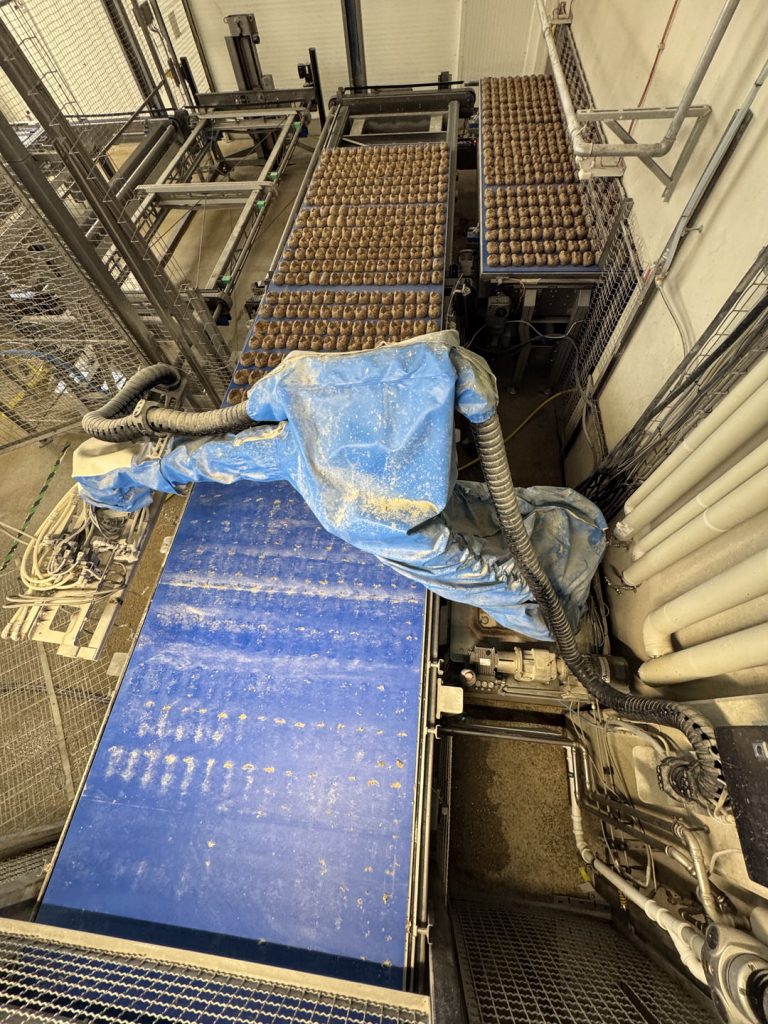
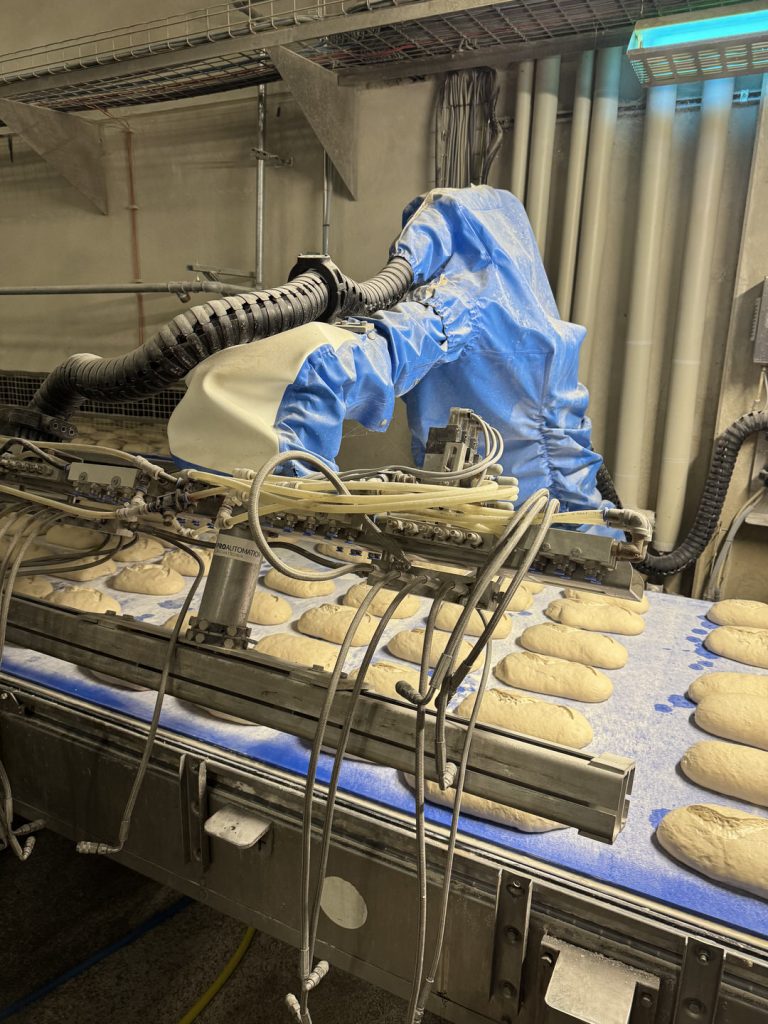
In an industrial organic bakery near Fulda, an industrial robot and its base were to be removed – undamaged and in one piece, within a day, so that production could restart shortly afterwards. Our mechatronics technicians disconnected power, water and compressed air and created a bridge in the bus system so that the line can keep running without the robot. With a risk assessment and lift plan, a compact mini crane and inspected round slings, the robot was balanced and lifted centimetre by centimetre over the production conveyor. We first pulled the base out from under the conveyor and then lifted it out. Over the following days we removed the old accesses, adapted the safety devices and welded stainless steel reinforcements into the fence system. Throughout, the team worked with hairnets and face masks to the plant's hygiene rules. Production restarted on schedule.
Do you have a robot removal coming up?
Send us photos of the robot and its surroundings, the rating plate and your goal – we will tell you what we need for the planning. Get in touch now.
What this means for your role
Production managers: Decide when the line can stop and whether it should keep running without the robot. Plan the restart at the same time.
Maintenance managers: Back up the robot's data and documents. Clarify who adapts the control system and who inspects the safety devices.
Project managers: Bring operator, manufacturer, installation contractor and occupational safety together early. The cell conversion belongs in the programme.
Buyers: Compare quotes not only by the crane. Ask whether disconnecting utilities, adapting the control system, cell conversion and hygiene requirements are included.
Occupational safety specialists: Support the assessment of the converted cell. Make sure no safety function disappears without replacement.
Robot removal plan: template on request
For your next robot removal, we have put together the robot removal plan. On one page it asks about the robot, the surroundings, the line, hygiene and access, and the conversion. You fill it in before the date, and we plan the removal without follow-up questions. Request the template via our contact form – keyword “Robot removal plan”.
Why Omega Mounting?
With over twenty years of experience in installation, move-in and maintenance, we know that a robot only comes out of a line well if mechanics, controls and safety are planned together. That is why we come with mechatronics technicians who can disconnect utilities, adapt control systems and weld, and with a person responsible for the lift who plans it and gives permission to lift. In tight lines we use compact cranes; in food plants we work to the site's hygiene rules. For you, that means one point of contact from the first meeting to a cell that is safe again. Talk to us about your project – get in touch.
Conclusion
Robot removal is more than a lift. Beforehand, data is backed up, utilities disconnected and the control system adapted so that the line can keep running – without sacrificing safety functions. The robot is slung in its transport position, balanced and lifted under control, often with a compact crane between tight conveyors. Afterwards, the cell is converted so that no gap remains.
Whether food plant, automotive industry or logistics: if you plan robot removal as an intervention in a running line, you keep downtime short and the line safe. If a robot has to come out of your line, get in touch with us.
Planning a move-in, installation or maintenance in the Rhine-Main region?
Tell us briefly what you need – we'll come back with an honest assessment.
Free, no-obligation callback
You may also be interested in these guides

About the author
Tobias Schott
Managing director of Omega Mounting GmbH, Rodgau · more than 20 years of hands-on experience in installation and maintenance
A trained mechatronics technician, working in maintenance, servicing and industrial installation since 2004 – first alongside his father, and with Omega Mounting since 2012: from overhead conveyors in Frankfurt to the crane system in a new-build hall. He plans and leads lifting operations as an appointed person (AP) in data centers and on industrial sites in the Rhine-Main region, trains and examines operators of cranes, mobile elevating work platforms and telehandlers, and is a qualified occupational safety specialist. On jobs abroad he is known as the “German Troubleshooter” – the person you call when a site gets stuck. He learned what quality means from his father, not from a manual: Made in Germany as a standard for his own work, not a label. That is why quality comes first at Omega Mounting – ahead of speed and price. He writes these guides from that practice: what works on our sites is in them – what exists only on paper is not.
Frequently asked questions
Usually yes, if a suitable crane can get to it and the route out is wide enough. In one piece, the robot stays more accurate and is ready for use again faster. It is only dismantled when there is no other way.
That depends on the control system. With a clean adaptation or a bridge in the bus system, the rest of the line can keep running. Safety functions always stay effective.
In tight lines, often a compact mini crane that fits through small doors and needs little space. Where there is room, an overhead crane or a forklift with a suitable attachment is sometimes enough.
The robot's programs and parameters, the transport position of the axes and all utilities. The line is secured against switching back on.
Hygiene rules apply to fitters too: hairnet, face mask, clean clothing and cleaned tools. Conveyors are covered, and the area is cleaned after removal.
Usually yes. Where the robot stood, there is often an open access. It is closed, and the safety devices are adapted and inspected before restart.
Yes. Transport securing, data backup and documentation then need particular care. Commissioning of the robot controller is done by the manufacturer or its service provider.
Yes. From Rodgau we quickly reach the whole Rhine-Main region – Frankfurt, Offenbach, Darmstadt, Hanau, Aschaffenburg and Wiesbaden – and further afield on request, as near Fulda.
Send us photos of the robot and its surroundings, the rating plate, your goal and your time window. We will come back with our questions and an assessment. Go to the contact form.
 English
 German