
- Technology explained – terms and documents
The lift plan: what goes into a lifting plan – and why no hook goes up without one
By Tobias Schott · 5-minute read · Updated November 2026
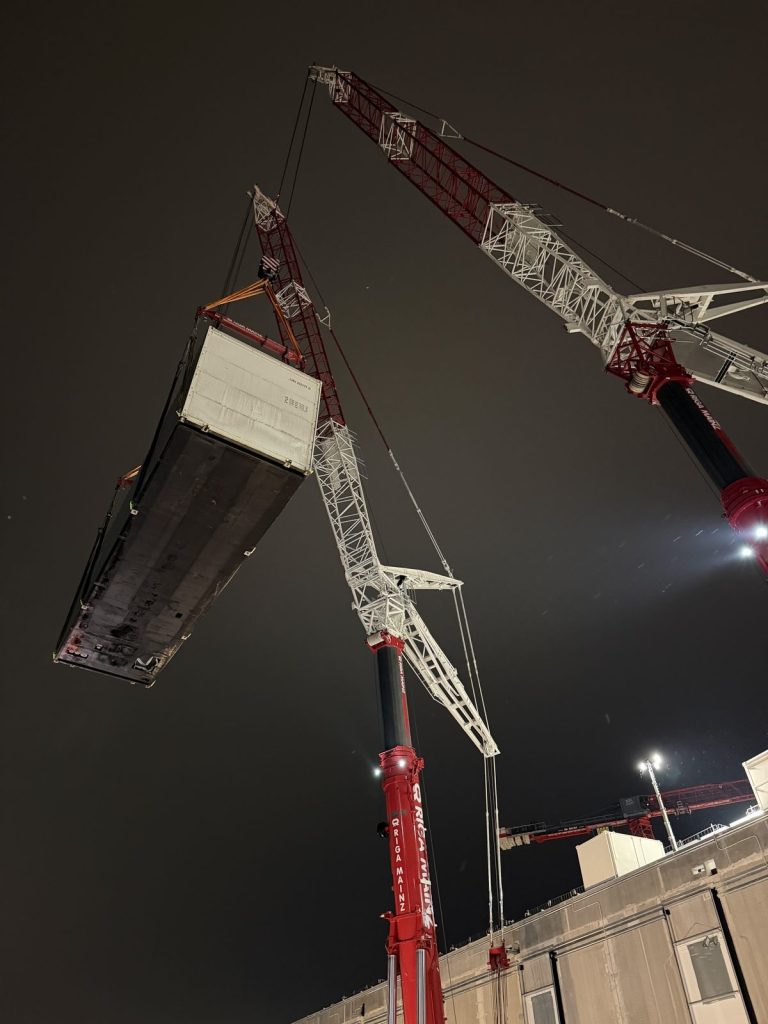
A lift plan – also called a lifting plan – is the document that fully describes a lift before it takes place: which load, which crane, which lifting accessories, which crane position, which sequence and who approves it.
On data center sites and large industrial projects, the phrase comes up again and again: no lifting without an approved lift plan. This is not a formality. In the lift plan, every lift is run through once on paper so that nothing comes as a surprise on the day – not the weight, not the ground and not the neighbouring building.
Here we explain what goes into a lift plan, what the side view and top view show and how the plan goes through to approval. How to plan a crane lift step by step is described in our guide Planning a crane lift.
What is a lift plan?
A lift plan is the written planning of a lift with all the information needed to carry it out safely and have it checked beforehand. Other names are lifting plan, rigging plan or crane plan; in German it is called Liftplan or Hubplan.
Not every lift needs the same effort. A routine lift with a known load and a clear crane position needs only a short plan. A tandem lift, a lift over a building or a lift next to live operations needs a detailed plan with calculations and drawings. The more that can go wrong, the more precisely it is planned.
A lift plan usually consists of a form with the data, a side view and a top view. It is prepared by the person responsible for the lifting operation. On large sites it is checked and approved by the main contractor or operator – often digitally in their management system.
Key facts
- Purpose: Describe every lift completely in advance and make it checkable.
- Contents: Load, crane and configuration, rigging, crane position, surroundings, sequence, people, approval.
- Drawings: Side view with radius and height, top view with crane position and danger zone.
- Prepared by: the person responsible for the lifting operations.
- Approved by: on large sites the main contractor or operator.
- When to revise: whenever load, crane, crane position or sequence change.
What goes into a lift plan?
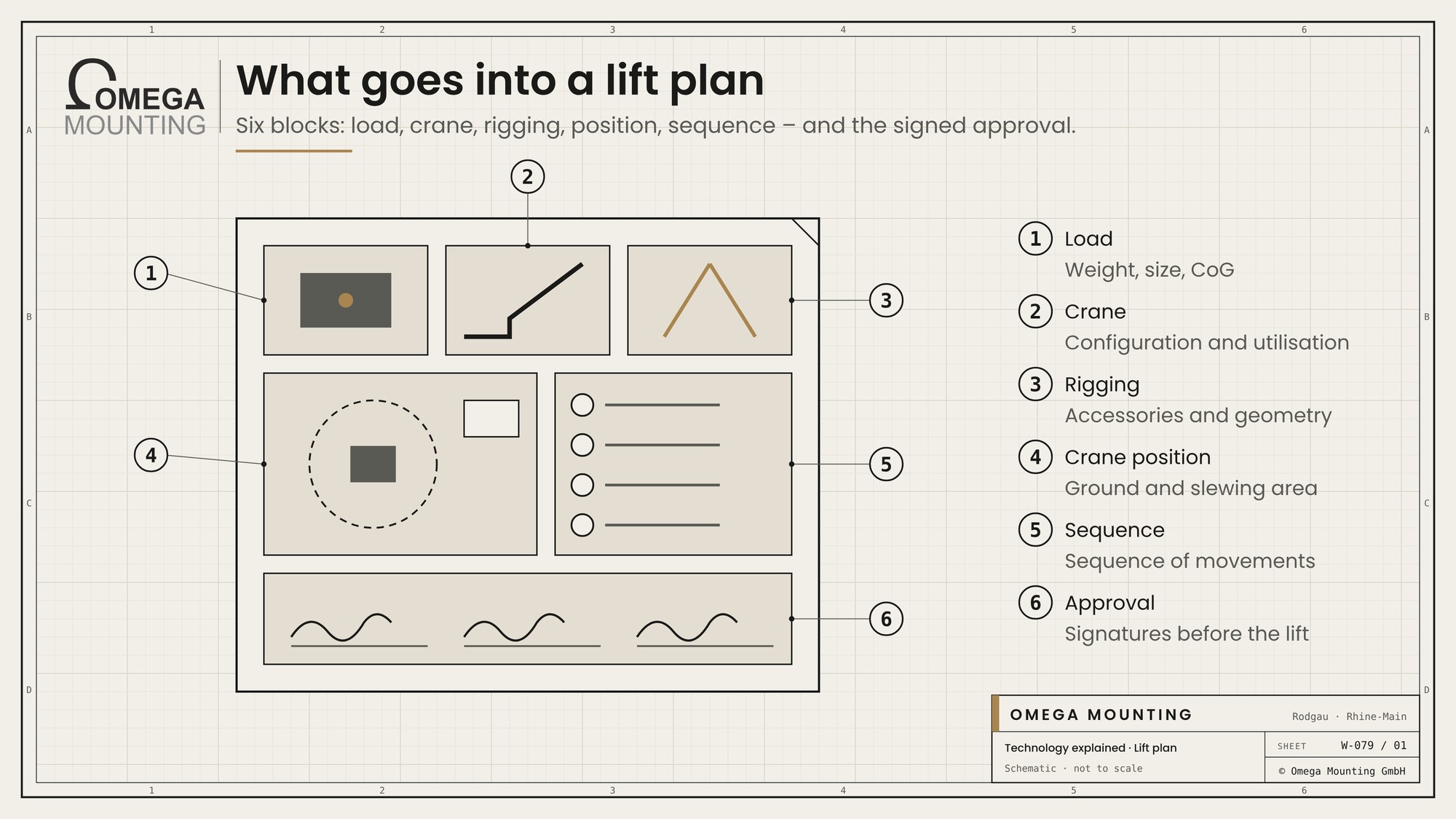
A complete lift plan answers six questions.
| Block | What it contains |
|---|---|
| Load | Weight, dimensions, centre of gravity, lifting points, condition. |
| Crane | Type and configuration, counterweight, boom length, radius, capacity and utilisation at the target point. |
| Rigging | Lifting accessories as specified by the manufacturer, rigging geometry, angle of inclination, spreader beam. |
| Crane position | Outrigger forces, ground pressure, load spreading mats, manholes and services in the ground. |
| Surroundings and sequence | Obstacles, slewing area, barriers, wind limit, sequence of movements. |
| People and approval | Responsible person, crane operator, slinger, banksman, communication, signatures. |
Most of the work goes into the load assumptions and the crane position. The weight must be documented, not estimated. And the forces under the outriggers must be checked against what the ground can carry.
The side view: radius, height, outriggers
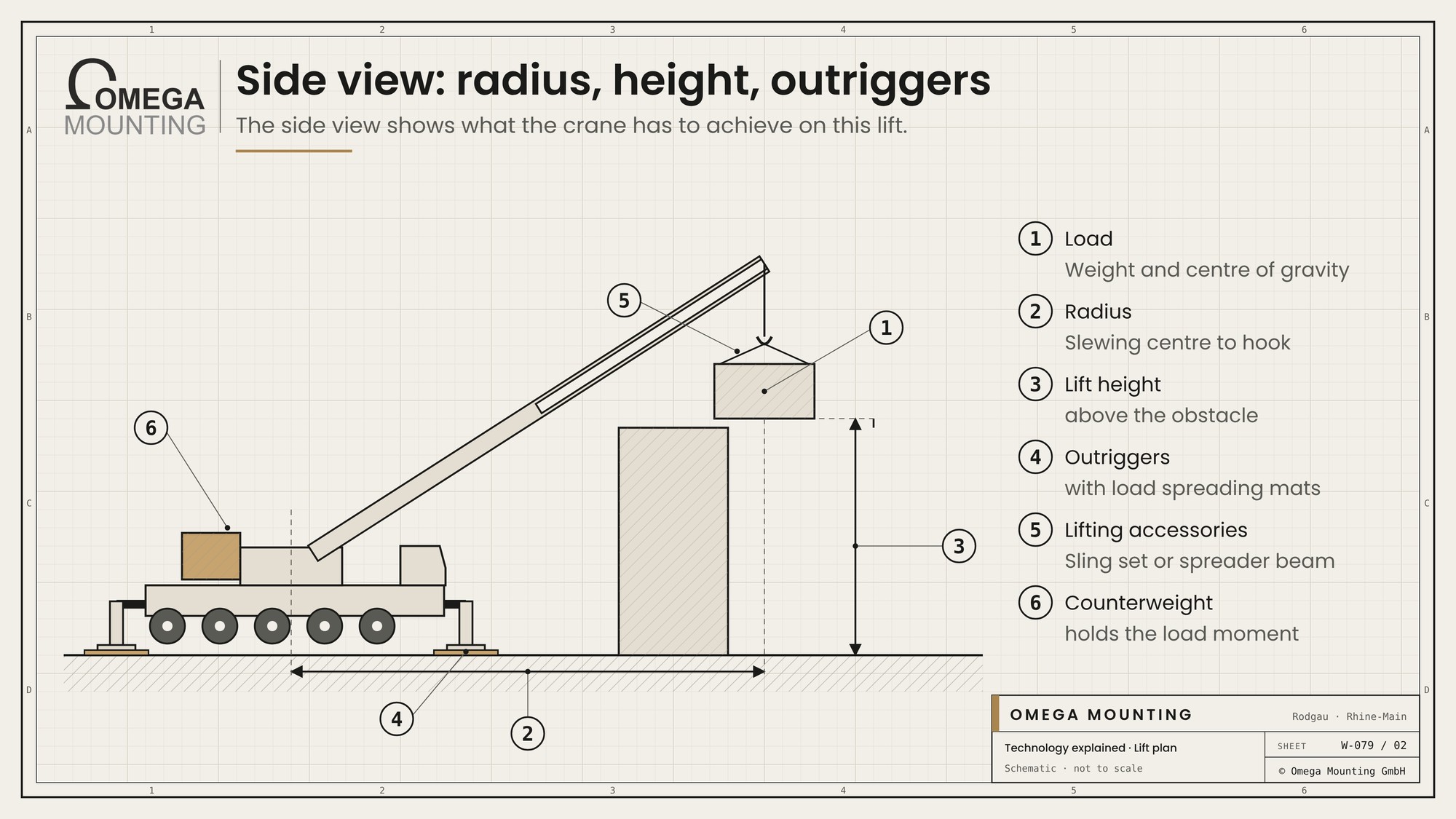
The side view shows the lift as the crane sees it.
- Radius: the horizontal distance from the crane's slewing centre to the hook – at the pick-up and set-down points.
- Lift height: how high the load must go over obstacles such as fence, roof or facade.
- Boom length and angle: these determine the crane's capacity at this radius.
- Outriggers and mats: how far the crane's outriggers are extended and what they stand on.
- Lifting accessories: Sling set or spreader beam between hook and load.
How radius and capacity are related is explained in our article on load moment and radius.
The top view: crane position and danger zone
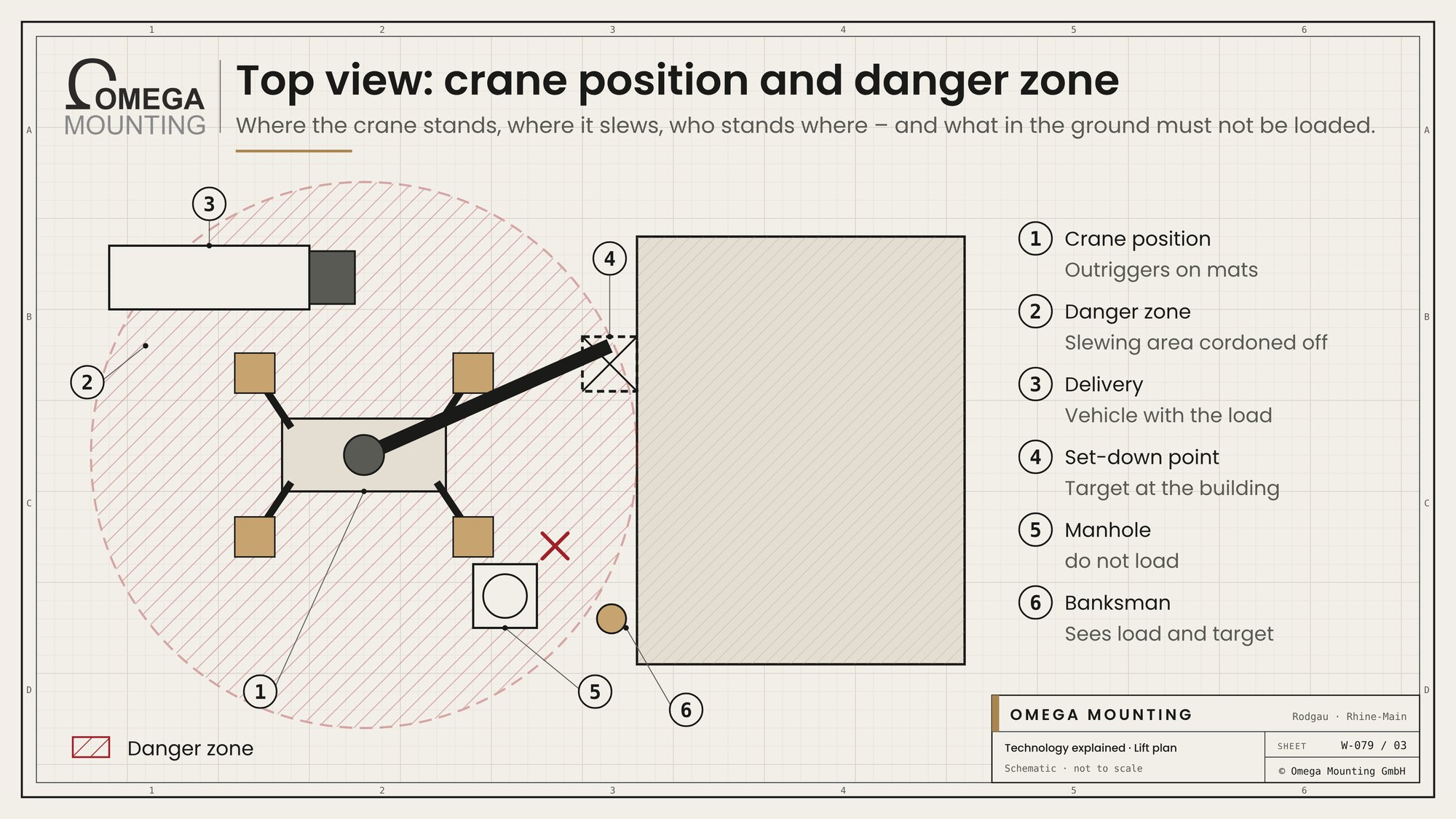
The top view shows where everything stands and where the crane slews.
- Crane position: with outriggers and mats, matched to the ground, manholes and services.
- Slewing area: the circle swept by boom and counterweight when slewing.
- Danger zone: cordoned off, nobody under the suspended load.
- Delivery: where the vehicle with the load stands and how it gets out again.
- Set-down point: where the load is to go – often with a banksman in sight.
What the outriggers stand on and how mats reduce ground pressure is covered in our article on Load spreading mats.
From draft to approval
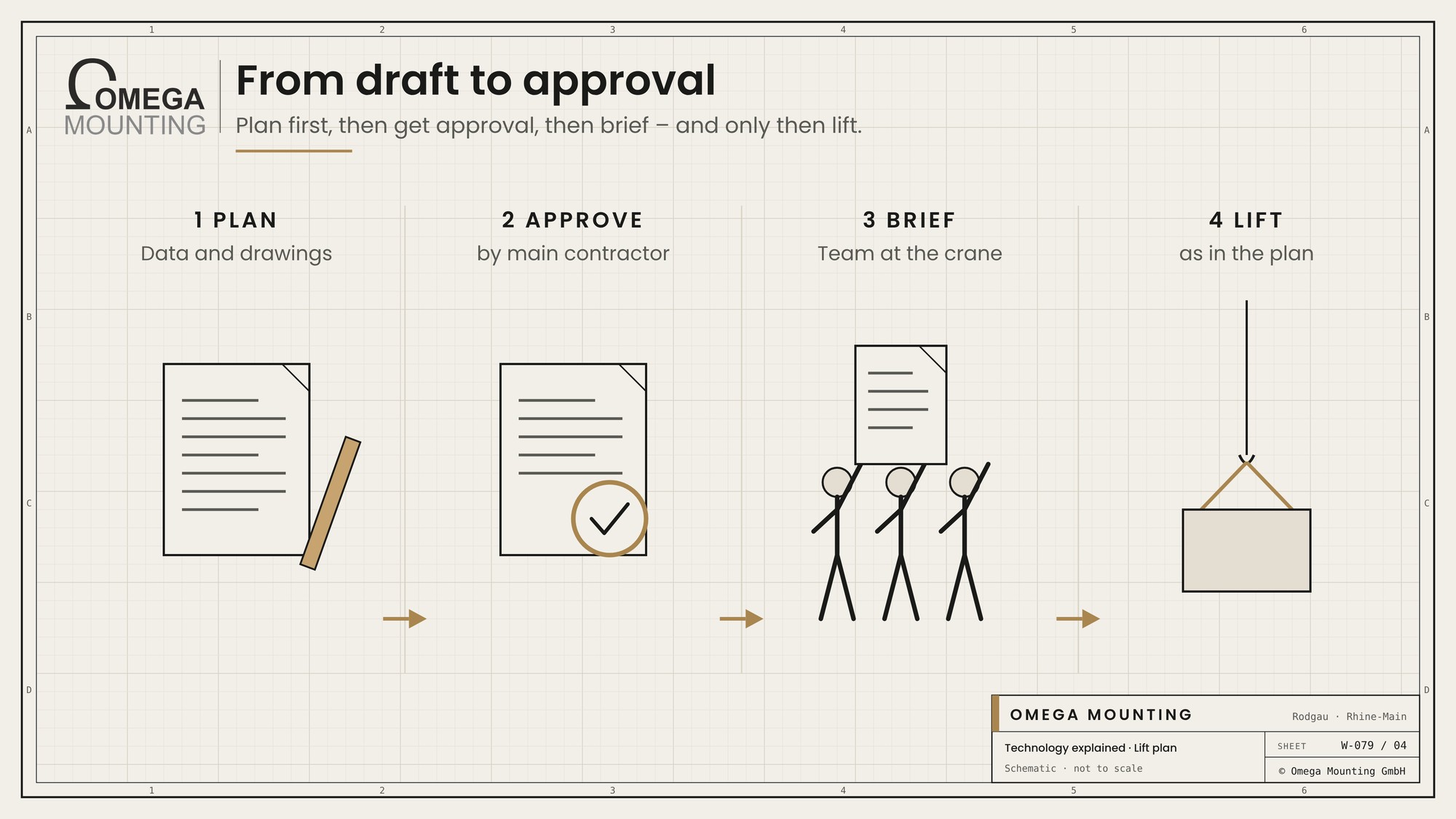
A lift plan is only finished once it has been approved.
- Plan: Collect data, check the crane position, calculate, prepare drawings.
- Approve: Main contractor or operator check and approve, often together with RAMS and the crane's inspection certificates.
- Brief: On the day, the whole team goes through the plan at the crane.
- Lift: Only now does the load go on the hook – and only as set out in the plan.
If anything changes – different weight, different crane position, different crane – the plan is adjusted and approved again. Who bears the responsibility is explained in our guide on the appointed person for lifting operations.
Typical gaps in a lift plan
Most problems in a lift arise not at the crane but in the plan. These gaps keep coming up:
- Estimated weight: The weight comes from memory instead of the rating plate, drawing or weighing. A lift plan calculates with verified values.
- Missing centre of gravity: Without the centre of gravity the load hangs crooked, and one leg carries more than expected.
- Unchecked ground: Outrigger forces go into the ground. Without details of bearing capacity, services and voids, the crane position is an assumption.
- Slings without angles: The capacity of a sling set depends on the angle of inclination. If it is missing, the selection is wrong.
- Wind forgotten: Large-surface loads catch the wind. The plan states up to which wind speed lifting takes place – according to the crane manufacturer’s specifications.
- No communication: Who gives signals, which radio channel is used, who stops the lift? Without this, things get hectic at the decisive moment.
A lift plan applies to exactly the lift described. If the crane position, crane, weight or slinging method changes on site, the plan is adapted and approved again – even if it costs time. A lift carried out to an outdated plan is a lift without a plan.
What we pay attention to
A lift plan is only as good as the data in it.
- We document the load weight with manufacturer data instead of estimating it.
- We check the crane position and ground on site and recalculate the outrigger forces.
- We select lifting accessories as specified by the manufacturer and draw the rigging geometry.
- We define the sequence of movements and, for tandem lifts, the load distribution as well.
- We brief the team on the plan on the day and only lift after approval.
Where we use it
During the installation of standby generators in data centers every lift is pre-planned in the lift plan – load assumptions, rigging geometry, crane set-up, radius, ground pressure and the sequence of movements. For a tandem lift with two mobile cranes, the plan also states how the load is distributed. If one crane lags behind, this distribution is no longer correct.
During the replacement of a CRAH unit in a live data center we prepared the RAMS and lift plans ourselves before a supervisor and three riggers took the unit out and brought the new one in.
More technology explained
Technology explained
the calculation behind the side view.
Technology explained
the calculation under the outriggers.
Technology explained
which crane goes into the plan.
Do you have questions about how this works on your site?
Do you need a lift plan that gets through with the main contractor – or a responsible person for the whole lift? We plan, get approval and lift. Request a callback.
Our service for this: Lift & shift: rigging and lifting →
Free, no-obligation callback

About the author
Tobias Schott
Managing director of Omega Mounting GmbH, Rodgau · more than 20 years of hands-on experience in installation and maintenance
A trained mechatronics technician, working in maintenance, servicing and industrial installation since 2004 – first alongside his father, and with Omega Mounting since 2012: from overhead conveyors in Frankfurt to the crane system in a new-build hall. He plans and leads lifting operations as an appointed person (AP) in data centers and on industrial sites in the Rhine-Main region, trains and examines operators of cranes, mobile elevating work platforms and telehandlers, and is a qualified occupational safety specialist. On jobs abroad he is known as the “German Troubleshooter” – the person you call when a site gets stuck. He learned what quality means from his father, not from a manual: Made in Germany as a standard for his own work, not a label. That is why quality comes first at Omega Mounting – ahead of speed and price. The Technology explained articles cover the equipment and techniques his team uses every day: what counts on site is in them – what only appears in the brochure is not.
 English
 German