
- Guide – Maintenance
High Care and Low Care: Maintenance in Food Hygiene Zones
By Tobias Schott · 21-minute read · Updated October 2026
High care and low care are hygiene zones in the food industry. They separate areas by the risk to the product. For maintenance this means separate rules for access, clothing, tools and materials in each zone – and sign-off by quality assurance before production restarts.
Many food plants do not just have “production”. There are areas for raw materials, areas for the finished, open product and airlocks in between. If you repair a machine there, replace a bearing or fit a bracket, you need to know which zone you are standing in. The high-care/low-care concept decides what you may take in, how you get in and what happens afterwards.
This guide explains what high care, low care and medium care mean and why the boundaries between them are so strict. It shows what the zones mean for maintenance, how jobs are planned, what happens to removed parts and who signs off at the end.
We are an installation and maintenance contractor from Rodgau near Frankfurt. How maintenance in food plants works in general – with lubricants, foreign-body control and screening off – is covered in our guide on Maintenance in food production. Here we look at what the hygiene zones require on top of that.
Key points at a glance
- High care is the area where open product is processed after the last heating or microbial reduction step. Nothing that kills microorganisms comes after it.
- Low care is the area before it: raw materials are received, stored and prepared. A later step still reduces the microorganisms.
- Many plants have a medium-care zone in between. Each plant decides for itself what the zones are called and where the boundaries lie.
- Between the zones there are walls, airlocks and controlled routes for people and materials. Fitters change clothes when they switch zones too.
- High-care tools often stay in the zone, are colour-coded and are counted in and out.
- Spare parts arrive clean and packed at the zone boundary. Outer packaging stays outside.
- After the work the plant cleans and disinfects to its own plan. Only quality assurance may sign off – not maintenance.
What are high care and low care?
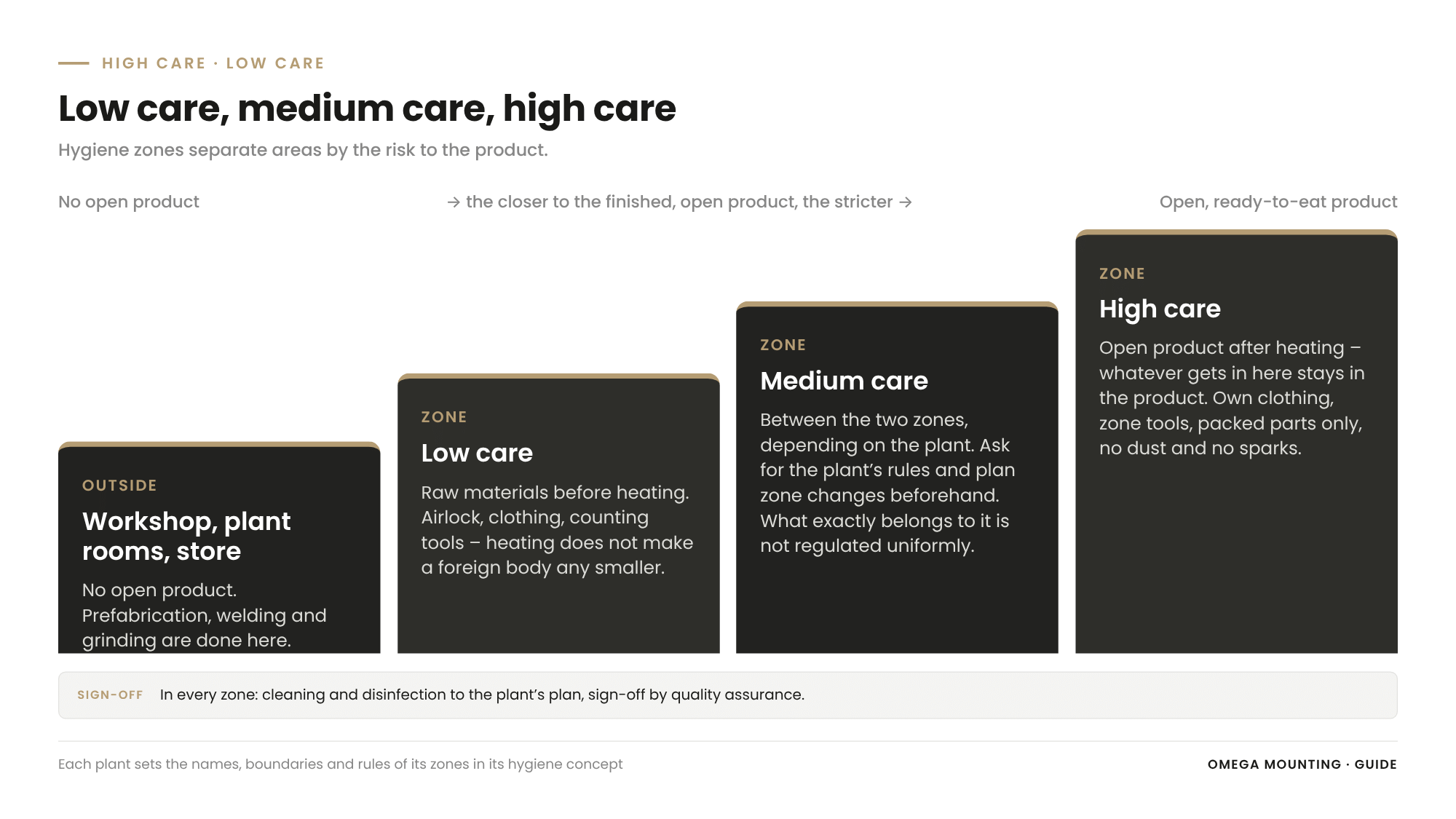
High care and low care are hygiene zones in food plants, separated by the risk to the product. The high-care area holds open, ready-to-eat product after the last heating or microbial reduction step. In the low-care area, raw materials are received, stored and prepared before that step.
The idea behind it is simple. Microorganisms that get into the product in low care are reduced later by cooking, baking, pasteurising or another step. Whatever gets in during high care stays in the product. That is why contamination there is most dangerous for the consumer.
Low care: before the microbial reduction step
In the low-care area, raw materials are delivered, stored, unpacked, cut, mixed or prepared. The hygiene rules are strict, but not as strict as in high care, because the next process step lowers the risk again.
Low care still does not mean “no rules”. Hygiene airlocks, protective clothing, tool control and approved lubricants apply here too. Heating does not make a foreign body any smaller. For foreign bodies, low care is therefore just as sensitive as high care.
High care: after the microbial reduction step
In the high-care area, open product is processed further after heating. Typical examples are sliced meats, cooked dishes, ready meals and salads that are chilled, portioned and packed. The strictest rules apply here: separate clothing, own airlocks, own tools, tightly scheduled cleaning.
Cold, wet and cleaning
High-care areas are often chilled and are frequently wet-cleaned and disinfected. This has consequences for maintenance. Surfaces are damp, tools and parts must withstand cleaning agents, and materials such as stainless steel and plastics as specified by the plant are the norm. The plant clarifies in advance which electrical equipment may be taken in. Work goes more slowly in the cold – allow for it.
Medium care and other areas
Many plants work with more than two zones. Depending on the plant, a medium-care zone lies between low care and high care. Some standards also define an area of particularly high risk. In addition there are areas without open product, such as stores for packed goods, plant rooms, the workshop and offices. There is no single standard for the names. Each plant sets its zones, boundaries and rules in its hygiene concept. A high-care/low-care concept therefore always means the concept of that particular plant.
How the zones are separated
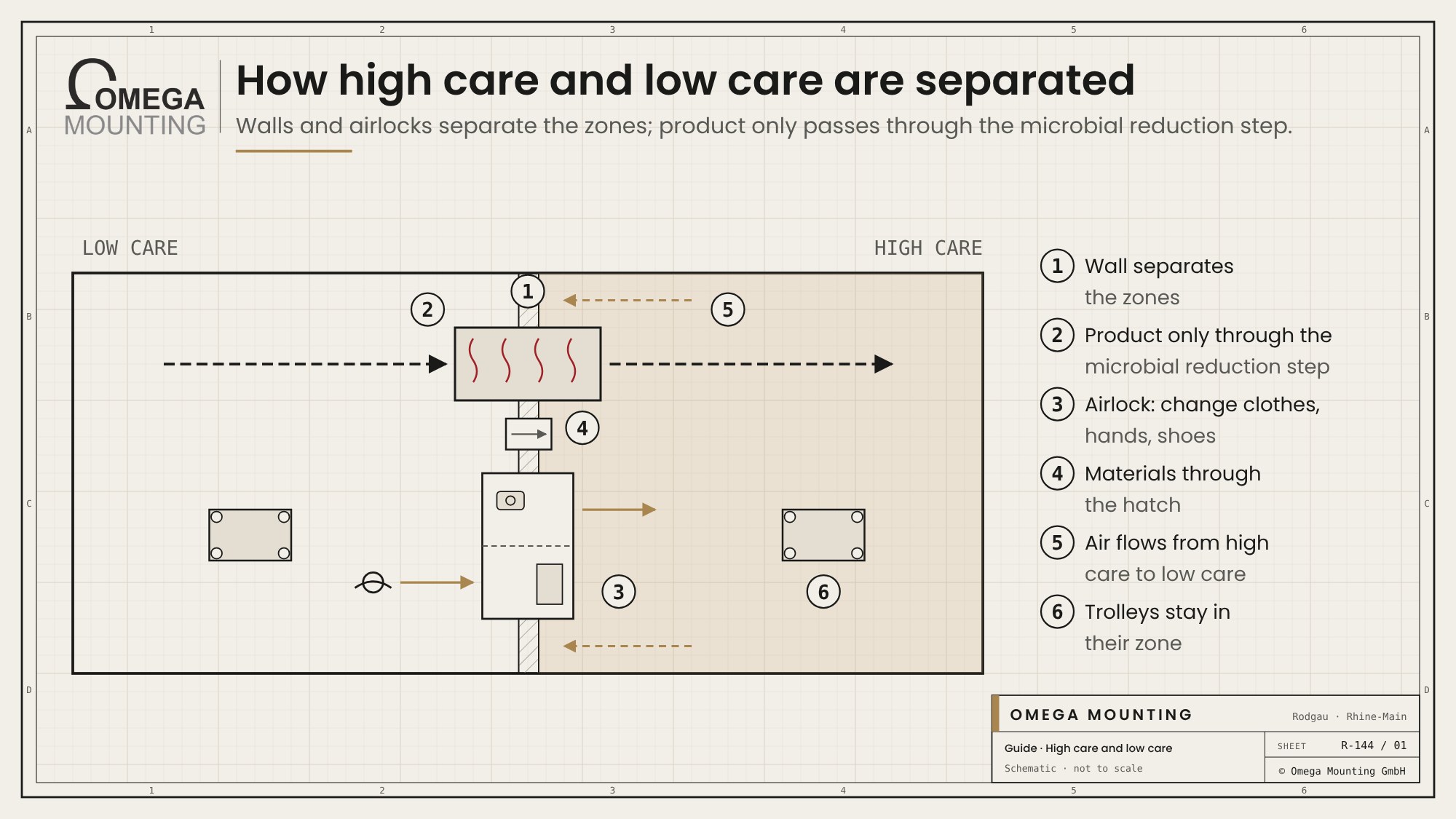
The separation is physical and organisational. Walls and doors separate the zones. Staff change over through hygiene airlocks with changing room, hand washing and shoe change. Materials come in through hatches or material airlocks. Air often flows from high care to low care, not the other way round. Trolleys, pallets and equipment stay in their zone where possible.
Why it matters legally and in practice
Under European food hygiene law, food business operators must identify and control hazards to the product. This includes a concept based on HACCP principles. Many plants are also certified to food safety standards that audit hygiene zones and rules for maintenance. This guide is not legal advice. What applies in your plant is decided by the plant and its quality assurance.
What high care and low care mean for maintenance
For maintenance, high care and low care mean that fitters follow separate rules for access, clothing, tools, spare parts and consumables in each zone, change zones only through the airlocks and, after the work, hand the area over to quality assurance for cleaning and sign-off.
Access and clothing
Fitters follow the same rules as production staff. They change in the airlock, wash and disinfect their hands and change shoes. Hairnet, beard snood and face mask are part of it if the plant requires them. Jewellery, watches and loose items stay outside. High care often has its own clothing in its own colour.
Direction matters. Anyone going from low care into high care changes clothes – and anyone coming from the workshop all the more so. A fitter who walks through high care “just for a moment” in work clothes brings in exactly what the whole zone is meant to keep out.
Tools per zone

Tools are a route for microorganisms and foreign bodies. That is why many plants keep their own tool sets for high care that stay in the zone. They are colour-coded so that everyone can see where a tool belongs. Tools from outside only go in cleaned and once approved.
Counting always happens: before, during and after the work. How tool control works in a food plant in general, and what must never enter production, is described in our guide on maintenance in food plants. The same applies to high care – just without exceptions.
Colour coding
Colours help to keep zones apart: clothing, tool handles, containers, cleaning equipment. Each plant decides which colour stands for what. Ask for the colour key before the first job. A colour that means high care in one plant can mean something else in the next. Colour coding applies to tools just as much as to clothing and containers – it shows at a glance which hygiene zone an item belongs to.
Spare parts and consumables
Spare parts arrive clean and packed at the zone boundary. Cardboard and outer packaging stay outside. In the airlock the packaging is wiped down and removed, depending on the plant’s rules. How materials are brought layer by layer into an even stricter area is shown in our guide on installation in a clean room. Lubricants, sealants and cleaning agents may only enter the zone if they are approved. Which lubricants suit food plants is covered in our guide on the lubrication schedule in maintenance.
Allergens
Many plants work with allergens such as nuts, sesame, milk or gluten. Tools, clothing and parts must not carry traces from one line to the next. Ask which allergens are processed in the zone and whether there are separate rules for them.
Parts that stay in the zone
Whatever is installed must suit the zone. In high care, surfaces are smooth, sealed and cleanable, without gaps, open hollow sections or surfaces where product can collect. Brackets, covers and supports made as replacements follow these principles. At the boundary between two zones, the standard of the stricter zone applies. The plant specifies which materials and surfaces are permitted. Maintenance sticks to this and reports if a spare part does not fit.
Planning maintenance in hygiene zones
Maintenance in hygiene zones is planned with quality assurance: time windows without open product, the order of the zones, tool and parts lists, packaging of spare parts and the question of what can be prepared outside. The more is settled beforehand, the shorter the time in the zone.
Time window and production status
Maintenance is easiest when there is no open product in the room. Weekends, cleaning shifts or a planned shutdown are the usual windows. If work has to be done during live operation, quality assurance decides which line stops, what is covered and who watches the area. How maintenance is planned alongside running production is described in our guide on Maintenance during live operations.
Order of the zones
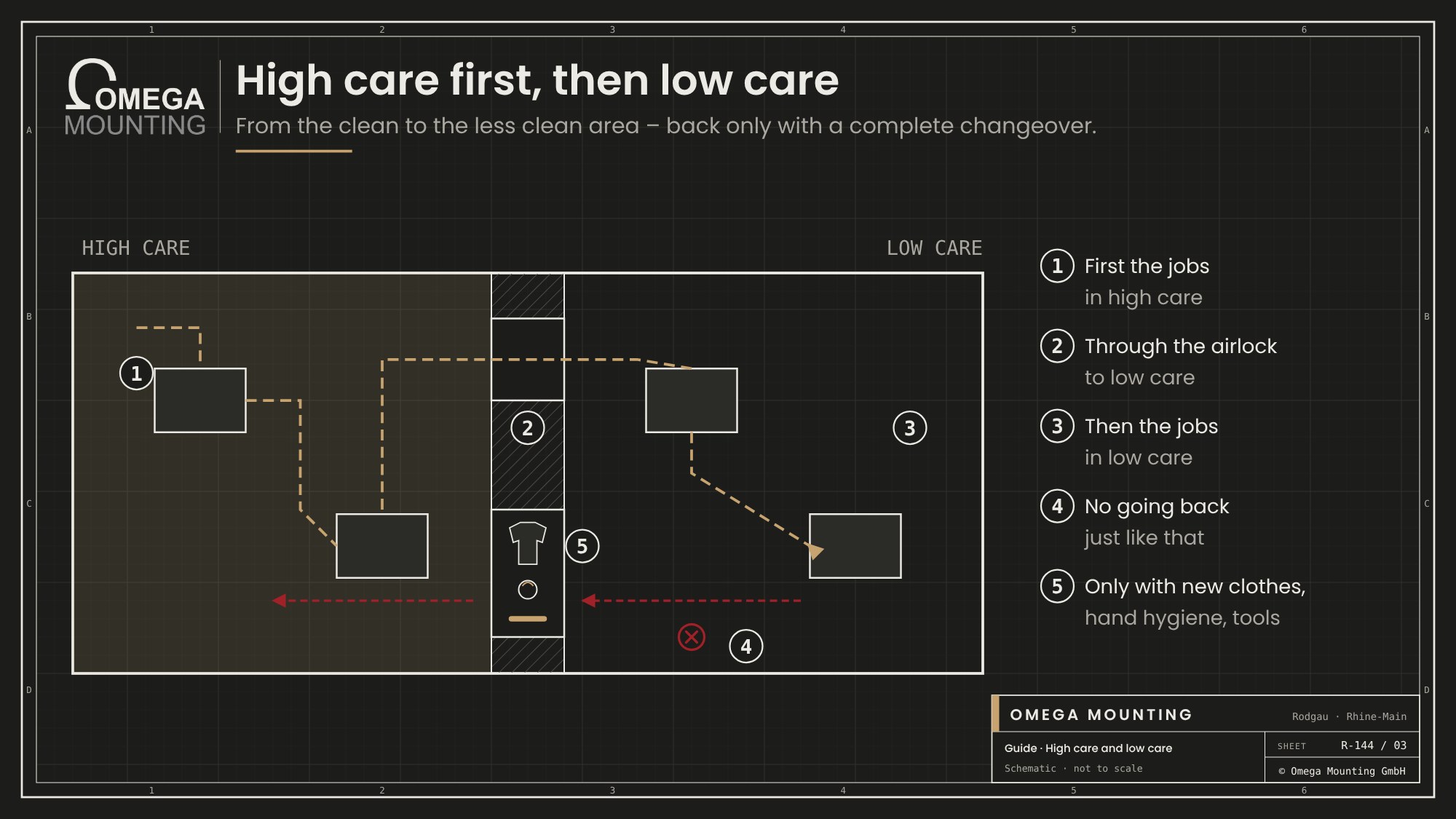
If you work in several zones on one day, plan the order. The rule is usually: from the clean to the less clean area, so high care first, then low care. The other way round needs a complete changeover with changing clothes, hand hygiene and different tools. That costs time and is a typical source of errors.
Reading the zone plan
Ask for the plant’s zone plan before the first job. It shows where each zone is, where the airlocks are and which routes apply to people and materials. For any maintenance in a high-care zone this plan is the most important document. It also answers the question of how a large part gets in and out again.
Working above and next to the zone
Not every job takes place in the zone itself. Pipework, refrigeration, ventilation and conveyors often run above high care or in plant rooms next to it. Hygiene counts there too. Whatever is loosened above can fall into the product below. That is why surfaces underneath are covered, small parts are secured and no work is done above open product.
Lists and induction
The plant wants to know in advance who is coming, what is being brought in and what will be done. A tool and parts list, the names of the fitters and a description of the work belong in the preparation. A hygiene induction comes before the first job. How a plant brings in contractors in general is covered in our guide on contractor management.
Preparing outside the zone
The more is finished outside, the less time the team spends in high care. Brackets are made in the workshop, assemblies pre-assembled, parts cleaned and packed. What remains in the zone is positioning, connecting and checking. Drilling, grinding and welding do not belong in high care wherever this can be avoided. What needs protecting when welding in sensitive areas is described in our guide on Welding during live operations.
Breakdown in high care
Not every job can be planned. If a machine in high care stops, the rules still apply. A prepared emergency procedure helps: who calls quality assurance, which tool set is ready, which line is locked out, how is the area cleaned after the repair? Settling this beforehand saves time when it counts.
Who does what
- Plant and quality assurance: set zones, rules, colour key and time windows, clean, disinfect and sign off.
- In-house maintenance: knows the plant and the routes, keeps tool sets for each zone and accompanies contractors.
- Contractor: follows the rules, prepares materials and tools, works cleanly, checks lists and documents.
- Cleaning team: cleans and disinfects to the plant’s plan.
- Qualified electrician: isolates following your procedure – ours or yours – and carries out electrical work.
If you put these roles in writing before the job, there is no need to argue in the zone.
When parts have to leave the hygiene zone
When parts are removed from a hygiene zone, they leave the area packed by a defined route, are repaired outside and only come back cleaned and approved. That keeps workshop dirt outside and work with dust and sparks out of the zone.
Remove instead of repairing on site
Many repairs are quicker and cleaner in the workshop. A gearbox, a shaft or a bracket is removed, packed and worked on outside. Only removal and refitting stay in the zone. Where an exchange assembly is ready, the time in the zone gets shorter again.
The way out
The way out of the zone is set beforehand. Removed parts are packed in the zone so that oil, wear debris and dirt do not get into the area. Large parts need a route that does not lead through high care, for example via a material airlock or an installation opening. Lifting equipment must be cleanable. How a food plant makes sure nothing is left behind in the area is shown in our guide on maintenance in food plants.
The way back
When the part comes back from the workshop, it is clean and free of swarf, blasting media and workshop lubricants. The surface is as the plant requires. Many plants have their own goods-in check for this: the part is inspected, cleaned and only then let into the zone.
Working in the zone itself
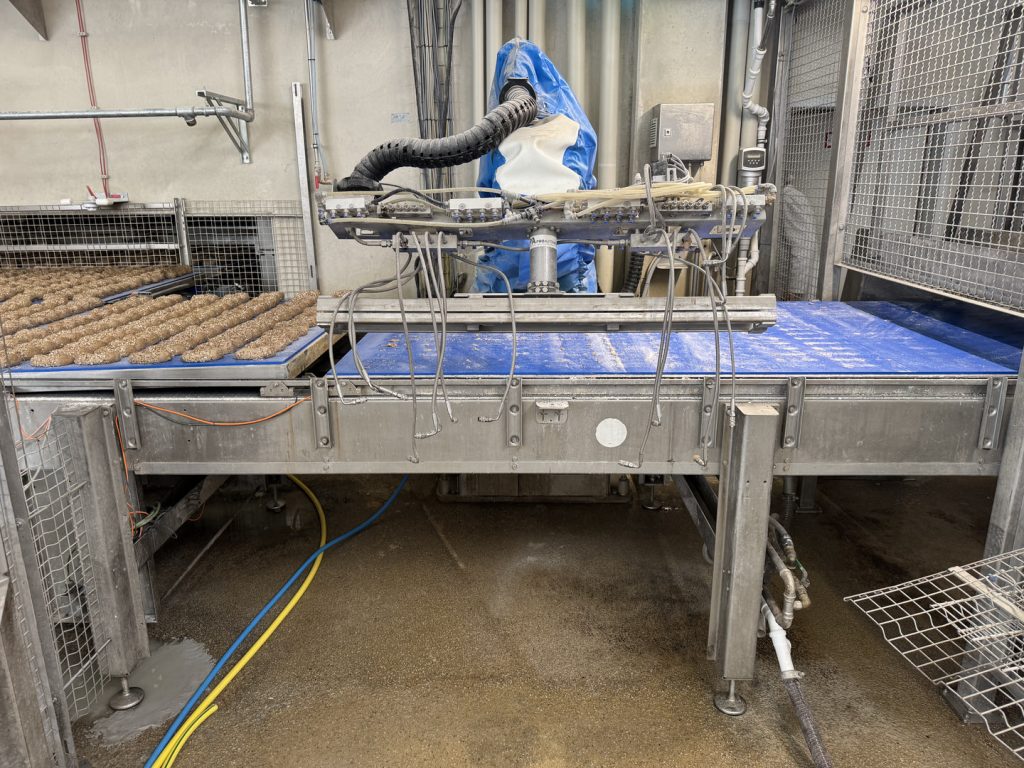
If work has to be done in the zone, the workplace is screened off. Nearby equipment is covered, open product removed, drains protected. Small parts are kept in closed containers. Anything that falls is searched for at once. Swarf is vacuumed, not swept and not blown off.
After the work: cleaning, disinfection, sign-off
After working in a hygiene zone, maintenance does a rough clean-up and checks tools and parts against the list. The plant then cleans and disinfects to its own plan, and quality assurance inspects and signs off. Only then does production restart.
Rough clean-up and check
The fitters remove waste, swarf, covers and removed parts. They check the tool and parts list. If anything is missing, the search continues until it is found. If a part cannot be found, quality assurance decides whether product is held.
Cleaning and disinfection
The actual cleaning and disinfection follow the plant’s plan, with its own agents and method. It is often done by the plant’s cleaning team. Maintenance only agrees when it is finished and the area is handed over.
Sign-off by quality assurance
Sign-off is given by quality assurance or another person named by the plant – not by the fitter. They check the area for foreign bodies, residues and cleanliness and sign. This sign-off is the point at which the plant can prove that maintenance has left no hazard behind. Without hygiene sign-off after maintenance, no line in high care restarts.
Documentation
Maintenance documents what was done: the work, parts fitted, substances used, deviations. If there is a deviation, such as a lost small part or a lubricant leak, it is reported openly. An honest report protects the plant more than a polished one.
Test run and sequence
A machine often has to be checked mechanically after the repair before it produces. Quality assurance decides whether the test run happens before or after cleaning. If the machine runs again with tools or open covers afterwards, cleaning starts from scratch. How a machine is generally handed over after the work is shown in our guide on commissioning and handover.
A job between high care and low care, step by step
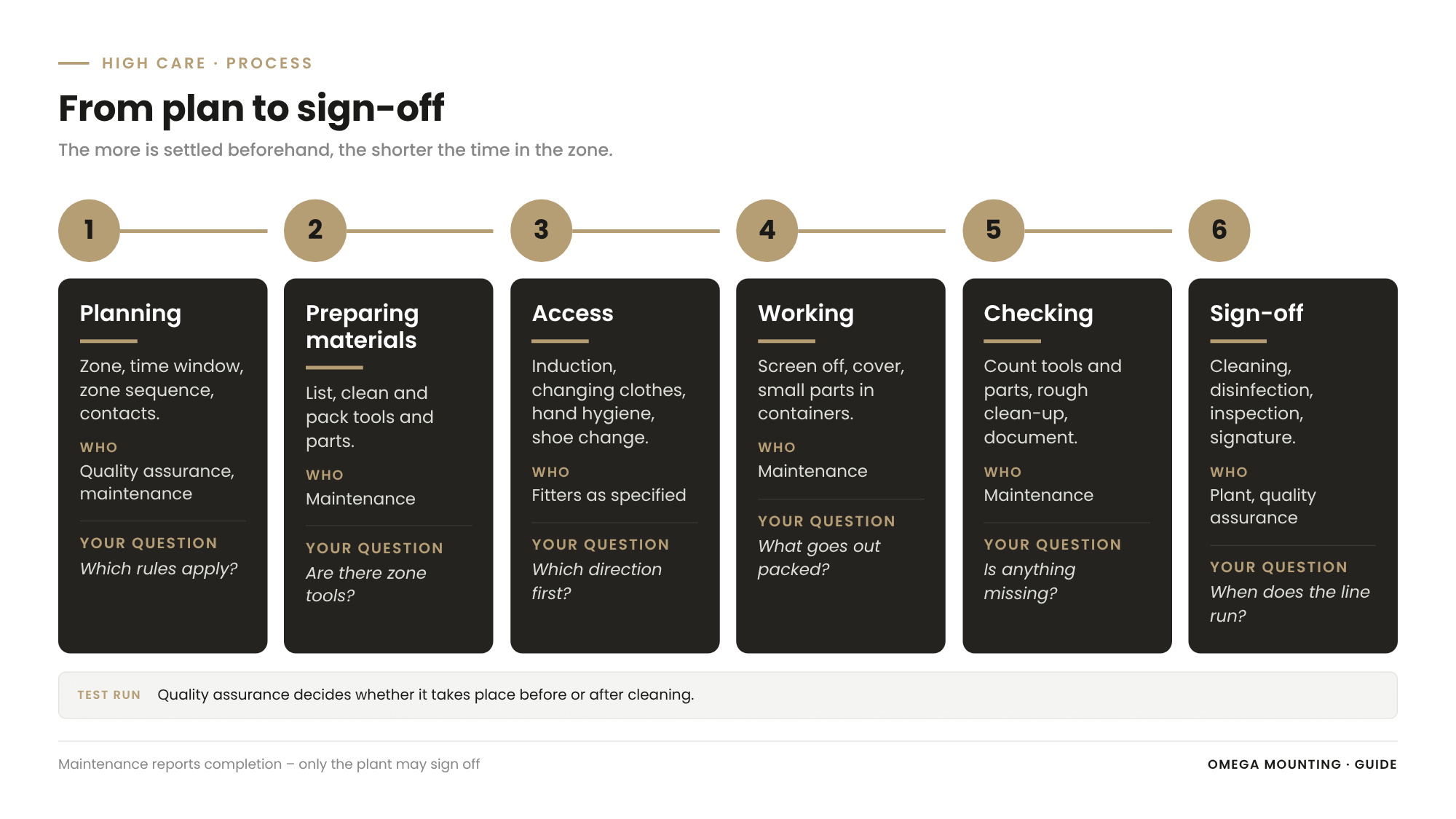
A job in hygiene zones runs in six steps: planning with quality assurance, preparing materials, access through the airlock, working in the zone, checking and rough clean-up, cleaning and sign-off by the plant.
Planning with quality assurance
The work, zone, time window, order of the zones and contacts are agreed. Quality assurance says which rules apply and what is covered.
Preparing material
Tools and parts are listed, cleaned and packed. The plant’s tools are reserved where there are any. Assemblies are pre-assembled outside.
Access through the airlock
Induction, changing clothes, hand hygiene, shoe change. Materials come in through the material airlock; outer packaging stays outside.
Working in the zone
Screen off the workplace, cover equipment, work cleanly. Small parts in closed containers, removed parts packed and taken out.
Checking and rough clean-up
Count tools and parts, remove waste and covers, report deviations, hand over documentation.
Cleaning and sign-off
Cleaning and disinfection to the plant’s plan, inspection and sign-off by quality assurance. Then the line runs again.
Overview: zone, rules, what maintenance must observe

Each zone of a food plant has its own rules – the table shows what this means for maintenance.
| Zone | Typical rules | What maintenance observes |
|---|---|---|
| Workshop, plant rooms | No open product, normal cleanliness | Prefabricate, weld, grind and clean here |
| Store for packed goods | Product protected, hygiene rules for routes | Clothing as specified, leave no small parts behind |
| Low care | Open raw materials, hygiene airlock, clothing | Change clothes, count tools, approved lubricants |
| Medium care | Stricter than low care, depending on the plant | Ask for the plant’s rules, plan zone changes |
| High care | Open, ready-to-eat product, strictest rules | Own clothing, zone tools, packed parts only, no dust |
| Boundary between the zones | Airlocks, hatches, controlled routes | Only through the airlock, mind the direction, packaging stays outside |
| Allergen areas | Separation by allergen | Carry no traces, clean tools as specified |
| After every job | Cleaning, disinfection, inspection | Rough clean-up, checks, documentation – sign-off by quality assurance |
Typical mistakes in high care and low care
The typical mistakes in high care and low care are a zone change in the wrong direction, workshop tools in high care, parts in cardboard at the airlock, unapproved lubricants and a job that ends without quality assurance having signed off.
- Wrong direction. A fitter goes back from low care into high care without changing clothes.
- Workshop tools in high care. Your own toolcase comes along although the plant has a set for the zone.
- Cardboard at the airlock. The spare part arrives in its original packaging, and nobody thought of clean packaging.
- Own lubricants. The usual tin gets used although it is not approved.
- Ground on site. A bracket is adjusted in the zone instead of being finished in the workshop beforehand.
- Part lost. A screw is missing at the check, and nobody reports it.
- Carrying on without sign-off. The line restarts before quality assurance has seen the area.
- Colour key not asked for. A tool with the wrong colour ends up in the wrong zone.
- Test run after cleaning. The machine is opened again after sign-off, and nobody tells quality assurance.
The mistake behind the mistakes
Behind most mistakes lies the assumption that hygiene is production’s job. In high care that is not the case. Everyone who goes in is part of the concept – including the fitter who only replaces a bearing.
What we know from food plants
Our teams work regularly in hygiene areas of food production. Our published project reports talk about hygiene areas and hygiene requirements but do not classify them as high care or low care. Two examples show how we work in such plants.
Overhead conveyor: working outside production time
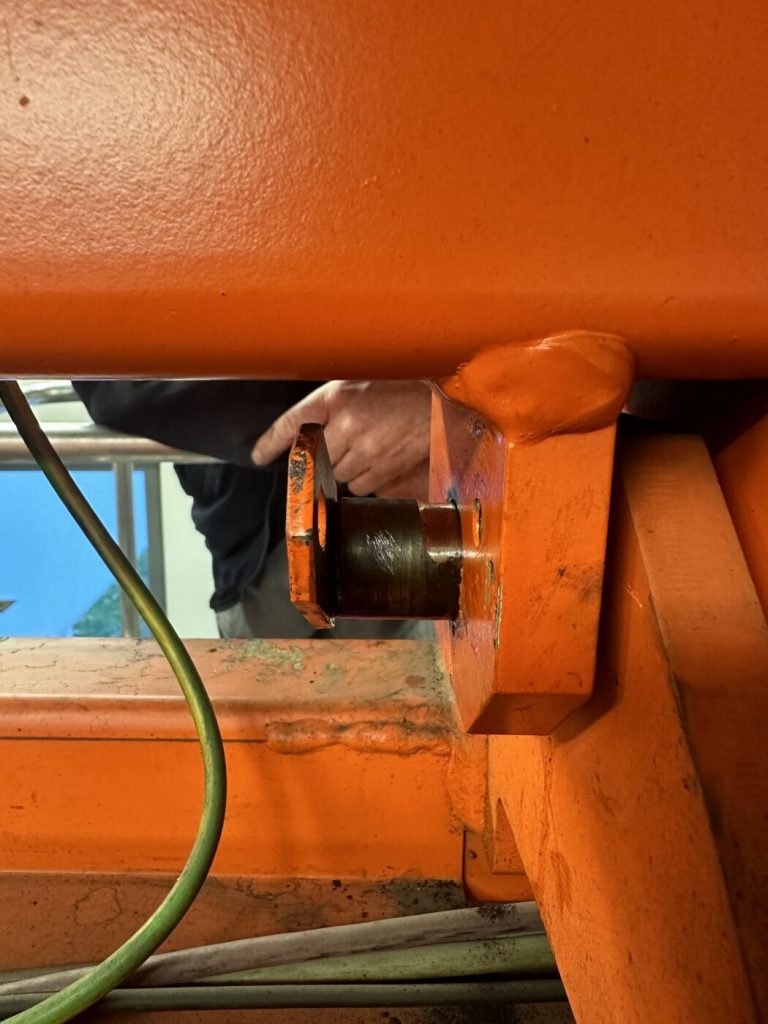
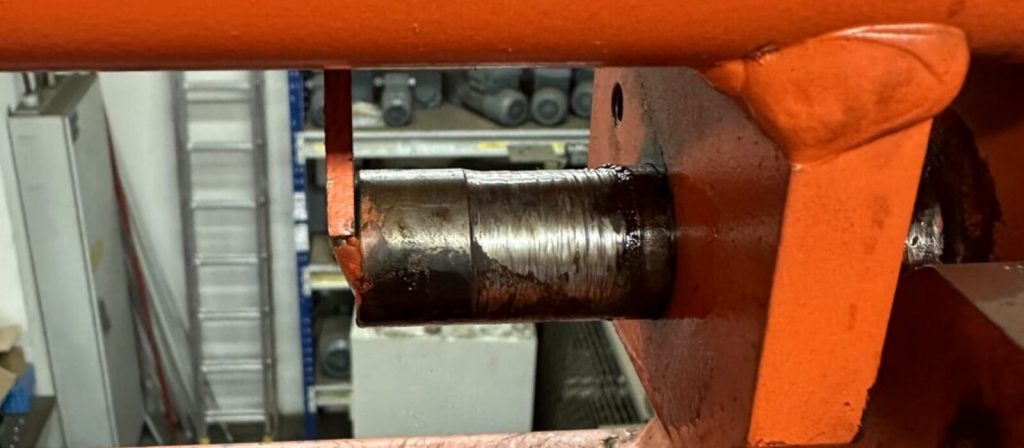
With the repair of the hanger pins on an overhead conveyor in a food plant, all work was carried out in several weekend shifts outside production time. We know the hygiene and access requirements of producing food plants, from conduct on site to clean working. On every carrier the pin was driven out, the bearing point cleaned and a new pin fitted. On Monday production carried on as normal.
Bakery near Fulda: hygiene rules for every move
With the dismantling of a robot from a cell in a bakery near Fulda, strict hygiene rules applied. Our team wore hairnets and face masks throughout and followed all of the operator’s rules. Production stopped only briefly. The supply lines for power, water and compressed air were disconnected before removal. When the cell was converted, reinforcements were TIG-welded onto stainless steel – stainless steel is standard in food production.
What this means for your high care
Both jobs show the basics: know the plant’s rules beforehand, work in the right window, hand over cleanly. How much stricter things get in high care is decided by your quality assurance. We follow it and ask if anything is unclear. How maintenance works in an even stricter environment is described in our guide on Maintenance in the clean room.
Questions about maintenance in your hygiene zones?
Do you have a repair or conversion coming up in a high-care or low-care area? Then get in touch with us. We agree with your quality assurance what is prepared beforehand, what is done outside and what is done in the zone.
High care and low care in the Rhine-Main region: how we work
In the Rhine-Main region we take on the mechanical side of maintenance in food plants: replacing components, renewing bearings and guides, making and fitting brackets, removing and refitting machines. In high-care and low-care areas we work to the rules of your quality assurance.
Bakeries, beverage plants, meat processors and ready-meal producers sit close together in the region. From Rodgau, Frankfurt, Offenbach, Hanau, Darmstadt and Aschaffenburg are short trips. That helps with a site visit beforehand and when a machine stops at the weekend. What we deliver in Maintenance and servicing overall is set out on our service page.
We make and machine parts that do not belong in the zone in our workshop in Rodgau. Only what is cleaned and packed goes into the zone. That is how we combine maintenance in the food industry with the hygiene rules that apply in your plant.
Whether in a bakery in Hanau or at a ready-meal producer in Frankfurt: for high-care and low-care areas in the Rhine-Main region we prepare every job with your quality assurance – lists, zone sequence, tools, handover.
We say beforehand what we do not take on. Zones, hygiene rules, cleaning, disinfection and sign-off are set by your plant. Electrical work is done following your procedure by a qualified electrician – ours or yours – or by an electrical contractor. We do not write hygiene concepts.
What this means for your role
For buyers: State in your enquiry which zone the work is in. Decide who takes care of cleaning and documentation and when sign-off takes place.
For designers: Plan routes for parts and lifting equipment that do not lead through high care. Provide installation openings and cleanable fixings.
For project managers and site managers: As project manager, agree time windows, zone sequence and lists with quality assurance. As site manager, keep an eye on the airlock, tool checks and handover on site.
For maintenance managers: Keep tool sets for each zone and name a contact person. Plan an emergency procedure for breakdowns in high care.
For quality assurance and hygiene managers: Give the contractor your zones, colour key and rules in writing before the job. Plan cleaning and sign-off as a fixed part of the process.
For management and plant management: Give maintenance the windows that clean work in high care needs.
Hygiene zone check for maintenance: template on request
The hygiene zone check for maintenance is a one-page working document for the plant, quality assurance and maintenance. It has four blocks: preparation, access and materials, work and close-out. Each item has a field for the person responsible and the status “settled” or “open”. Zones and rules are deliberately not pre-filled – they come from your plant. Request the template via our contact form – reference “Hygiene zone check”.
Why Omega Mounting?
We are based in Rodgau near Frankfurt and work regularly in food plants. The linked jobs show how we work there: the plant’s rules first, work in the right window, prefabrication in the workshop, clean handover. We say clearly what stays with you – zones, cleaning and sign-off. If you are looking for a partner for a repair in your hygiene zones who sticks to your rules, write to us.
Conclusion
High care and low care separate areas by the risk to the product – every high-care/low-care concept follows this idea. High care holds open product after the last microbial reduction step, low care the raw materials before it. For maintenance this means: access through the airlock, clothing and tools for each zone, parts clean and packed, work with dust and sparks done outside. At the end come the checks, cleaning and disinfection to the plant’s plan and sign-off by quality assurance. If you are preparing a repair in a hygiene zone, send us your enquiry – we will get back to you with an honest assessment.
Planning a move-in, installation or maintenance in the Rhine-Main region?
Tell us briefly what you need – we'll come back with an honest assessment.
Free, no-obligation callback
You may also be interested in these guides
Maintenance & Servicing
Maintenance & Servicing
About the author
Tobias Schott
Managing director of Omega Mounting GmbH, Rodgau · more than 20 years of hands-on experience in installation and maintenance
A trained mechatronics technician, working in maintenance, servicing and industrial installation since 2004 – first alongside his father, and with Omega Mounting since 2012: from overhead conveyors in Frankfurt to the crane system in a new-build hall. He plans and leads lifting operations as an appointed person (AP) in data centers and on industrial sites in the Rhine-Main region, trains and examines operators of cranes, mobile elevating work platforms and telehandlers, and is a qualified occupational safety specialist. On jobs abroad he is known as the “German Troubleshooter” – the person you call when a site gets stuck. He learned what quality means from his father, not from a manual: Made in Germany as a standard for his own work, not a label. That is why quality comes first at Omega Mounting – ahead of speed and price. He writes these guides from that practice: what works on our sites is in them – what exists only on paper is not.
Frequently asked questions
In the high-care area, open product is processed after the last heating or microbial reduction step. Whatever gets into the product there stays in it. In the low-care area, raw materials are received and prepared before this step. That is why the rules in high care are stricter: own clothing, own airlocks, own tools.
A zone between low care and high care that many plants add. What exactly belongs to it is not regulated uniformly. Each plant sets it out in its hygiene concept.
Yes, if they have had an induction and follow the rules of the zone. They change in the airlock, wash their hands, use tools as specified by the plant and only bring in approved materials.
Ideally the tool set the plant keeps for the zone. Tools from outside only go in cleaned, listed and once approved. They are counted before and after the work.
The fitters do a rough clean-up and check tools and parts. Cleaning and disinfection are done by the plant to its own plan, often with its own cleaning team.
Quality assurance or another person named by the plant. They inspect the area and sign. Maintenance reports completion but does not sign anything off.
Usually from the clean to the less clean area, so high care first, then low care. Anyone who has to go the other way changes clothes completely and changes tools.
Only if there is no other way and quality assurance approves it. It is better to remove parts and work on them outside. If work has to be done on site, there must be no open product in the room, and the plant then cleans to its own plan.
Send us a short enquiry with three details: what needs repairing, in which zone and what time window you have. Your hygiene rules and photos help. We agree with your quality assurance what we will prepare. Your contact is Tobias Schott – reachable via our contact form.
 English
 German