
- Guide – Maintenance
Clean room maintenance: servicing and repairing without contamination
By Tobias Schott · 21-minute read · Updated October 2026
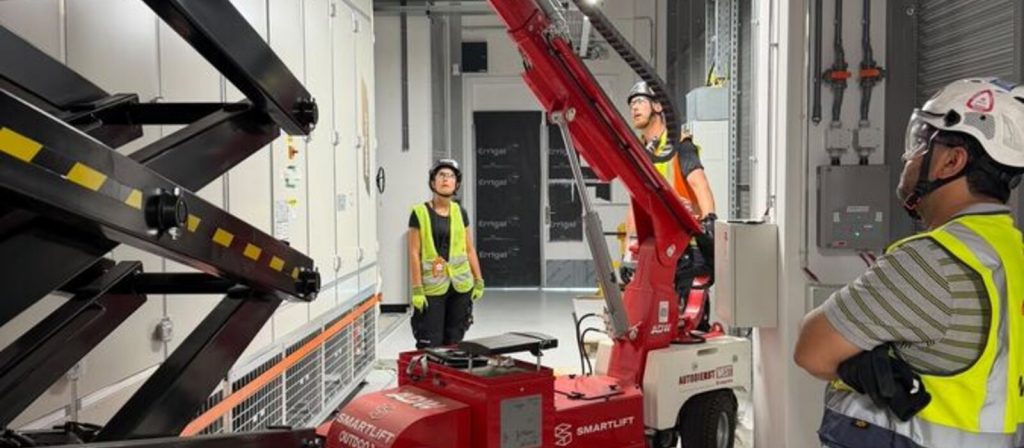
Clean room maintenance means servicing, inspecting or repairing equipment without particles, lubricants or dirt contaminating the room. This only works with an agreed window, prepared parts, cleanly opened equipment and an approval that only the operator gives.
A clean room does not run forever without intervention. Bearings wear, drives fail, filters and seals have to be replaced. Each of these interventions opens equipment that stands in the middle of the clean room. And each one brings people, tools and spare parts into an area that is meant to keep exactly these out.
This guide explains what sets clean room maintenance apart from normal servicing. It shows how an intervention is planned with the operator, how spare parts and consumables get into the room, how equipment is opened with minimal particles and what happens to removed parts. And it describes what to do after the work and in the event of a breakdown.
We are an installation and maintenance contractor from Rodgau near Frankfurt. How people, material and tools get into a clean room in principle is covered in our guide on installation in a clean room. This guide is about what comes on top for servicing and repair.
Key points at a glance
- Clean room maintenance covers inspection, servicing, repair and breakdown response on equipment that stands in a clean room.
- Before every intervention the operator assesses what the work means for the room. The operator sets the window and decides whether the room stays in operation.
- Spare parts, tools and consumables are listed, cleaned and packed for the clean room beforehand. Lubricants are only used with approval.
- Opened equipment is covered, and abrasion and dust are captured right at the source.
- Removed parts are packed, taken out through the airlock and repaired outside.
- After the work come tool reconciliation, cleaning, documentation, measurements and approval by the operator.
- Breakdowns need a procedure that is in place beforehand – with parts, tools and contacts.
What is clean room maintenance?

Clean room maintenance is any work that keeps equipment in a clean room in working order or restores it to that state: inspection, servicing, repair and breakdown response – under the rules of the room and with the operator's approval.
The difference from installation lies in the existing equipment. In an installation something new comes into the room. In maintenance the equipment is already there, often integrated into a running process. It has to be opened, worked on and closed again. This produces abrasion, old lubricant residues and worn parts – exactly what must not be released in a clean room.
Inspection
An inspection establishes the condition of equipment: visual check, noise, play, tightness, function. The equipment usually stays closed. For the clean room this is the lightest intervention. Even so, clothing, airlock and behaviour rules apply without exception.
Maintenance
Servicing maintains the condition: lubricating, adjusting, replacing filters and wear parts, cleaning. Here the equipment is often opened at individual points. The risk for the clean room rises because lubricants and abrasion come into play.
Repair
Repair brings equipment back to its target condition after damage: bearings, guides, drives or entire assemblies are replaced. This is the deepest planned intervention. It needs the most preparation and usually a window of its own.
Breakdown response
A breakdown comes unplanned. Production stops or runs only partially, and the pressure is high. That is exactly when the rules of the room must not be dropped. How to prepare for this is described further down in the chapter on breakdowns.
What clean room maintenance is not
Cleaning the room itself, testing the ventilation and measuring cleanliness are separate tasks. They lie with the operator, its cleaning team and specialist clean room companies. Maintenance of production equipment in the room must fit into these processes but does not replace them.
Planning clean room maintenance: window, status, change, approval
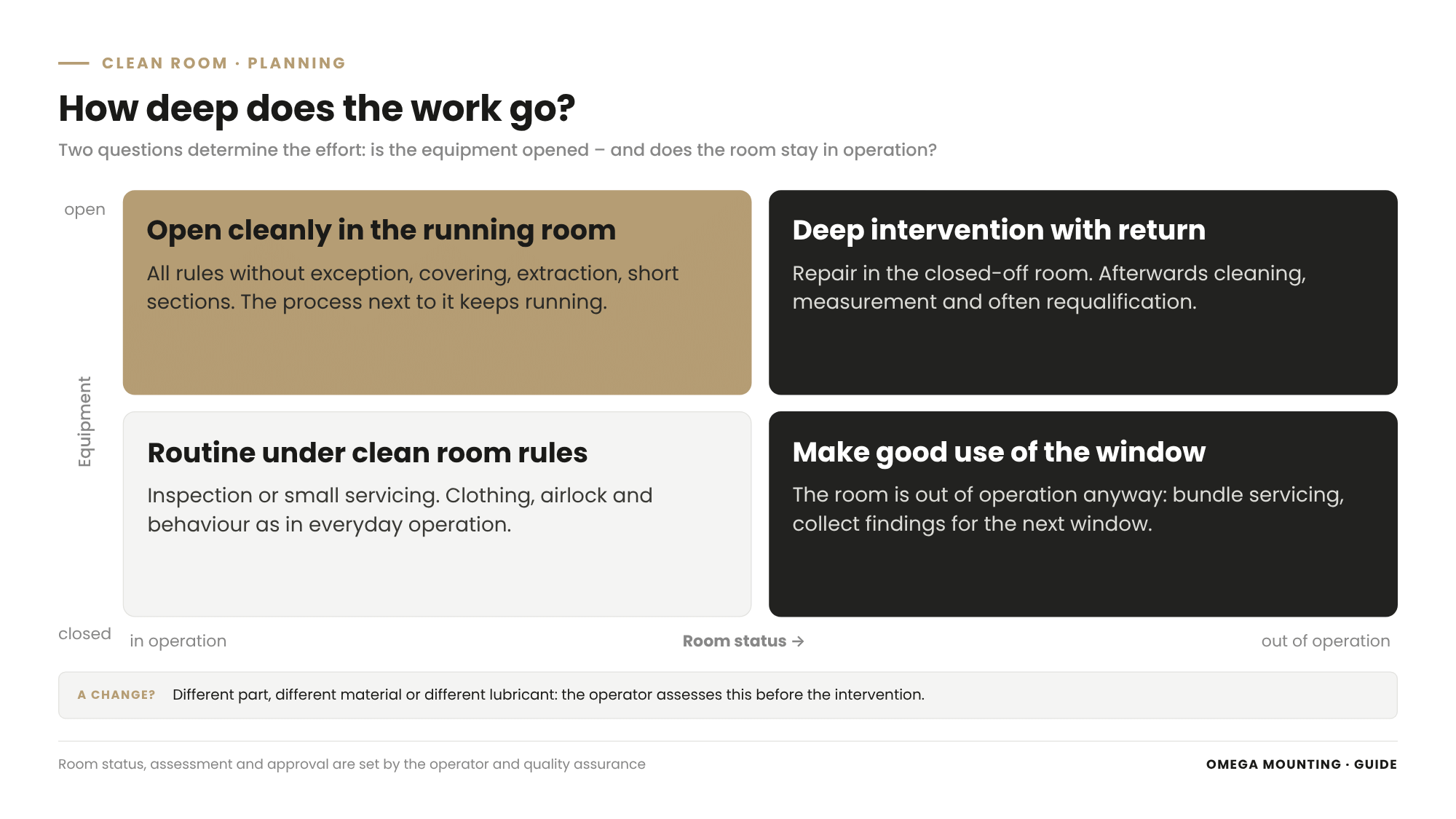
Clean room maintenance starts with the operator. The operator sets the maintenance window, decides whether the room stays in operation during the work, assesses whether the intervention is a change and approves the work. Only then does maintenance plan parts, tools and sequence.
The maintenance window
In a clean room every hour of downtime is expensive, and every return to the clean state takes time. That is why servicing is bundled and placed in fixed windows, often together with other work in the room. How to spread such windows across the year is shown in our guide on the maintenance calendar.
Much can be done before the window while the equipment is still running: reviewing documents, ordering and checking parts, pre-assembling assemblies, preparing checklists. Which levers make a planned window shorter is described in our guide on shortening shutdowns.
The status of the room
The operator decides whether the room stays in operation during the work or loses its status for that time. If it stays in operation, all rules for clothing, airlock and behaviour apply. The work must be clean enough for the process next to it to keep running.
If the room is taken out of operation, deeper interventions are possible. In return it must be cleaned, measured and approved again afterwards. That takes time, which must be in the plan.
Is the intervention a change?
Many operators, especially in pharmaceutical production, work with a change control procedure. Replacing a part with an identical part is usually routine servicing. A different part, a different material, a different lubricant or a changed setting, on the other hand, can be a change. It is then assessed before it happens. In pharmaceutical production the basis for this is the Good Manufacturing Practice (GMP) guidelines and the operator's procedures.
This guide is not legal advice and does not replace qualification. Whether an intervention is a change is decided by the operator and quality assurance according to their procedures.
What maintenance needs to know beforehand
- Type of intervention. Inspection, servicing, repair – and what exactly will be opened.
- Window and status. When the work takes place and whether the room stays in operation.
- Permitted substances. Which lubricants, cleaners, pastes and sealants are approved.
- Parts and tools. What is available, what is brought in, what is kept in the room.
- Isolation. Who shuts down the equipment and secures it against being switched on.
- Contact. Who decides if an unexpected finding turns up when the equipment is opened.
How equipment is isolated and secured before the intervention is shown in our guide on Lockout tagout in maintenance.
Settling findings in advance
Opening equipment often reveals more than expected. A bearing is more worn, a seal hard, a pin worn in. In a clean room it is expensive to look for a new window for this first. So decide beforehand who may approve additional work and which parts are ready for this case.
Spare parts, tools and consumables: what may enter the clean room
Clean room maintenance follows the same rule as every installation: nothing goes in uncleaned. Spare parts, tools and consumables are listed, cleaned and packed for the clean room beforehand, and lubricants are only used after the operator's approval.
Bringing items in, in brief
Cardboard, wood and paper stay outside the airlock. Material arrives in film and is wiped down and unpacked layer by layer. The last wrapping comes off at the workstation. How this works in detail and how staff change is described in our guide on installation in a clean room.
Keeping spare parts in stock
Parts that are needed frequently are best kept cleaned and packed in the clean room or right at the airlock. Others come from a store outside. For parts that are hard to obtain, it pays to have a strategy before the failure happens. How to deal with this is shown in our guide on spare parts that are no longer available.
Order spare parts for the clean room with suitable packaging. A bearing in a cardboard box with paper padding has to be repacked before the airlock. That is an avoidable work step.
Tools for the clean room
Tools in a clean room are clean, free of rust, flaking paint and grease residues. Many operators keep their own tool set in the room, which stays there. This saves trips through the airlock and reduces the risk of bringing in dirt from outside. If you bring your own tools, list them beforehand and clean them before bringing them in.
Lubricants and consumables after approval
Greases and oils can outgas, bind particles or leave residues. In a clean room, therefore, only lubricants approved by the operator are used. This also applies to assembly paste, threadlocker, sealants and cleaners. If the manufacturer's documentation specifies a different grease from the operator's list, this is clarified beforehand – not at the equipment.
How lubricants are selected in principle for hygiene-sensitive areas is covered in our guide on Maintenance in food production. How a lubrication schedule is structured is shown in our guide on the Lubrication schedule.
Documents and notes
Paper and ordinary pens shed fibres. Maintenance instructions, checklists and measurement records are available in the clean room on suitable paper, in film or electronically. Phones and tablets only go in cleaned and often in protective covers, if the operator permits them.
Low-particle servicing: opening, covering, cleaning equipment
Low-particle servicing means opening equipment in such a way that abrasion, old lubricants and dust do not get into the room. Open points are covered, dirt is extracted at the source, and every step ends cleaner than it began.
Defining the work area
Before opening, it is decided where work takes place and where material is put down. Floors and neighbouring surfaces are protected with suitable covers. If work takes place in a room in operation, the operator can additionally partition off the area. How this is done is decided by the operator and the specialist planner.
Covering open equipment
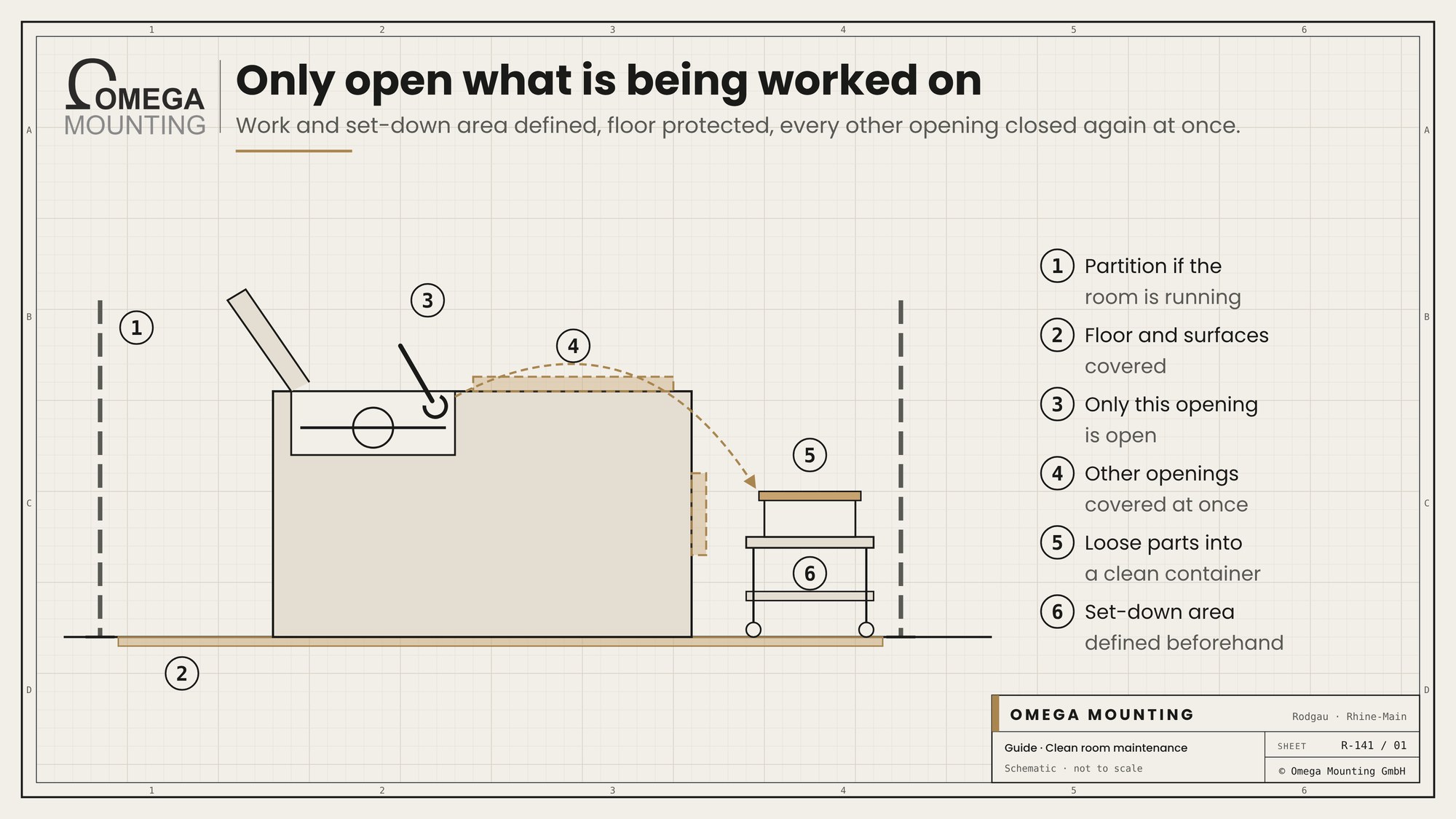
When a hood or housing is open, the inside is exposed. Particles from the air can fall in, and abrasion from the equipment can come out. That is why openings not currently being worked on are covered again immediately. Loose parts go into clean containers, not onto the floor.
Old lubricants and abrasion
When bearings, guides or chains are replaced, old greases and abrasion come to light. They are picked up with suitable wipes, not spread around. Cleaning goes from clean to dirty so that no dirt is carried back. Used wipes go straight into closed containers.
Drilling, grinding, cutting
If drilling is necessary, a suitable vacuum extracts directly at the drilling point. Grinding, cutting and welding produce fine particles and sparks. In a clean room they are avoided wherever possible. Adjustments to parts are made outside, in the workshop.
Fixings and loosening seized parts
Loosening seized parts by force produces abrasion and sometimes chips. If you check outside beforehand which tools and pullers fit, you work more calmly in the room. Where hammering cannot be avoided, the point is covered and vacuumed afterwards.
Vacuum, don't blow
Compressed air stirs up particles and spreads them around the room. Chips, dust and residues are therefore vacuumed, not blown away or swept. The vacuum needs a filter that the operator permits for the room.
Breaks and changeovers
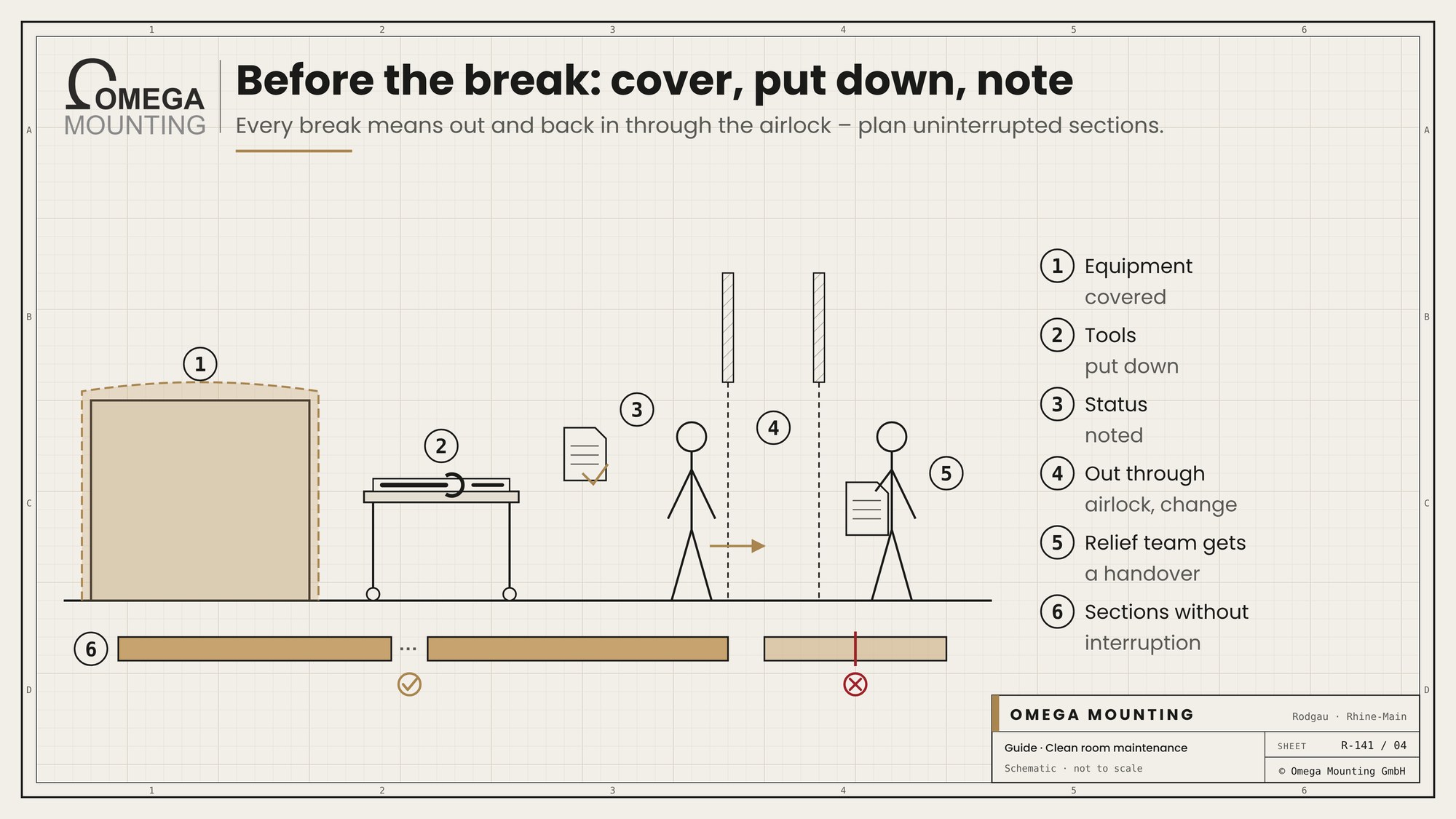
In a clean room every break means: out through the airlock, change, back in through the airlock. So plan the work in sections that are completed without interruption. Before a break the equipment is covered, the tools are put down and the status is noted. Whoever relieves the team gets a short handover at the workstation, not at the airlock.
Check function before closing
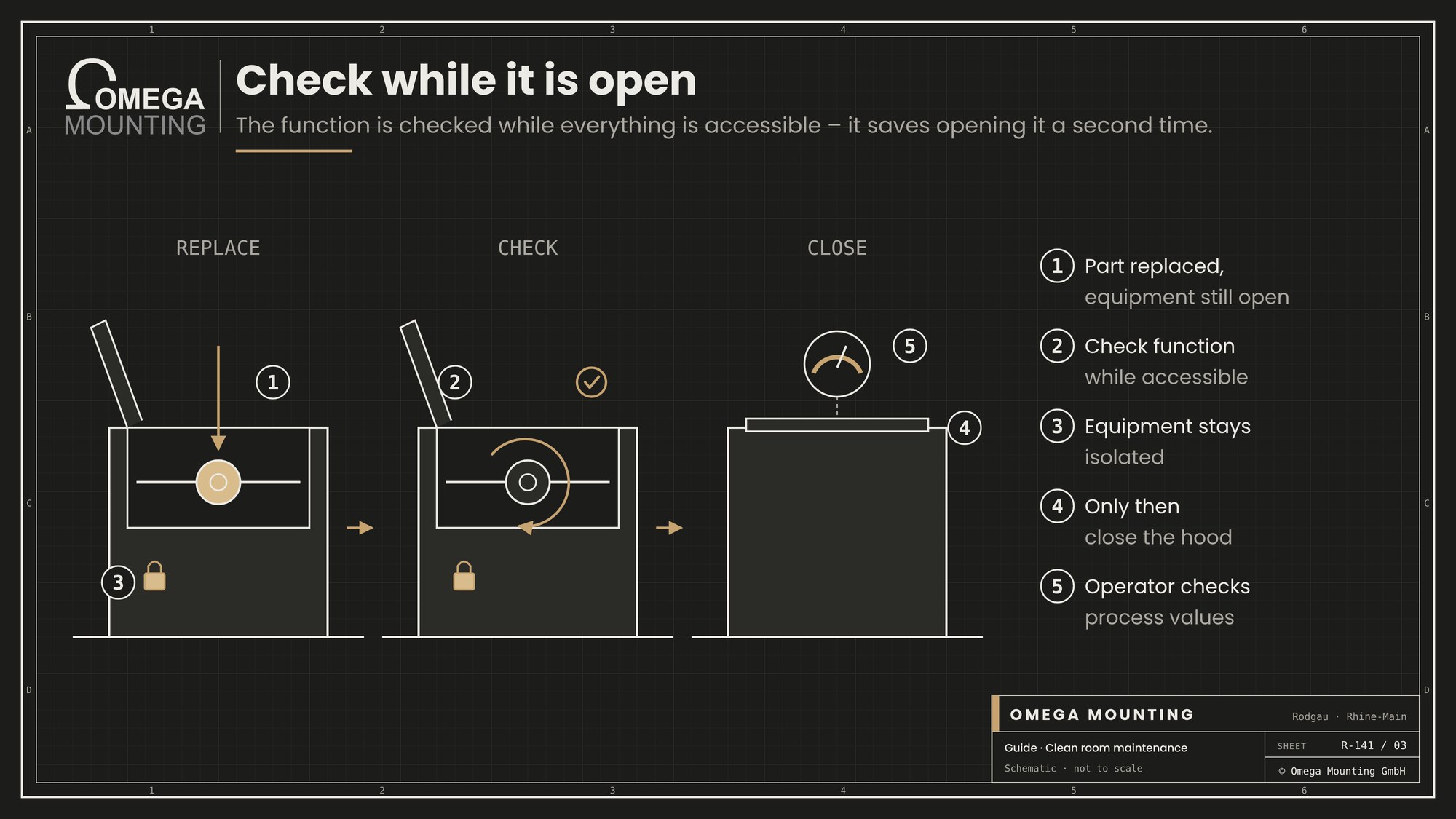
Once the part has been replaced, the function is checked while the equipment is still open and remains accessible. Only then are hoods and housings closed. This saves opening it a second time. Whether the equipment then reaches its values in the process is checked by the operator.
When parts are removed: pack, take out through the airlock, repair outside
Removed parts leave the clean room packed. They are put into film or closed containers right at the equipment, taken through the airlock and examined, cleaned and repaired outside.
Packing right at the equipment
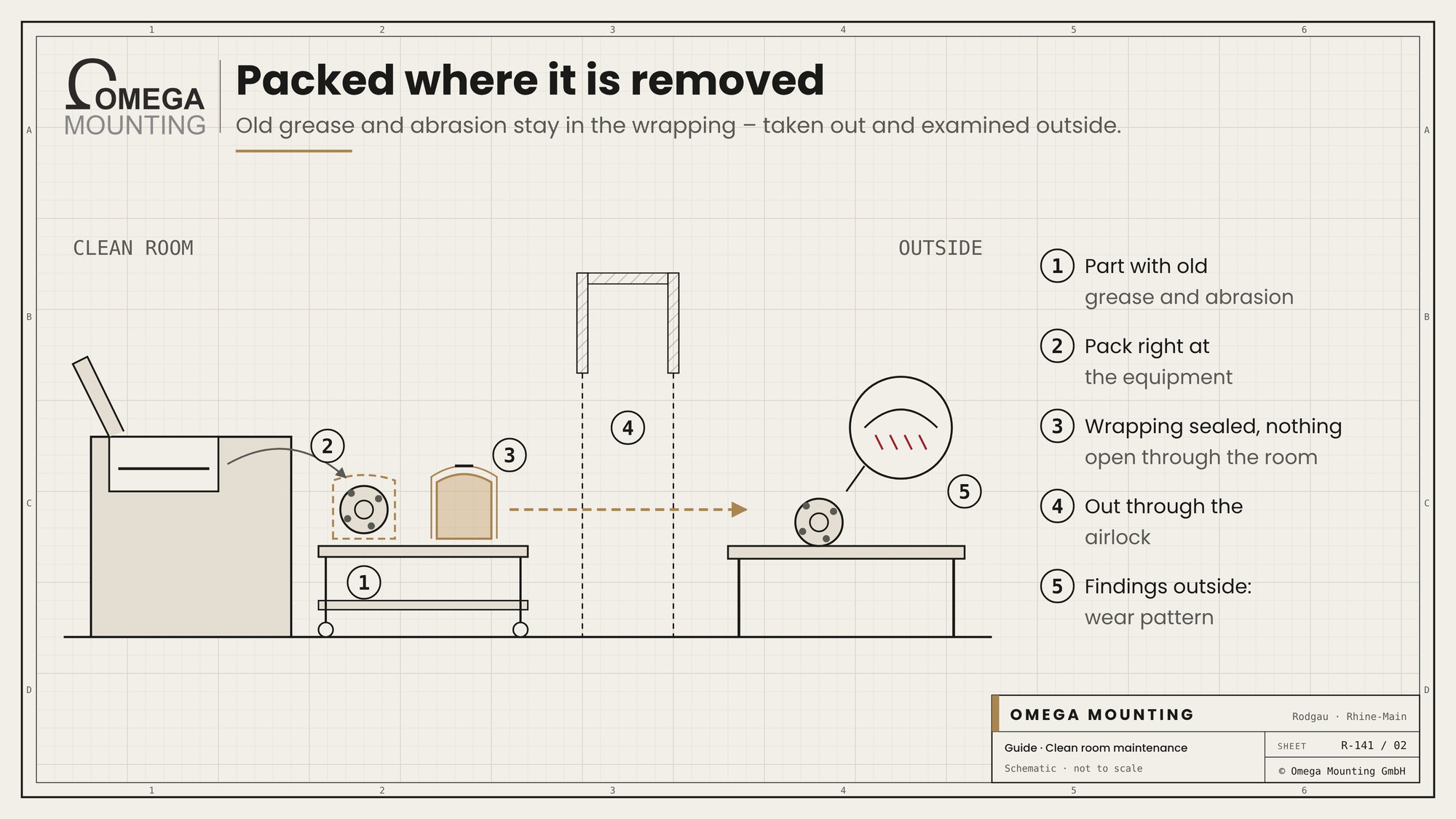
A worn bearing, a chain with old grease or a drive with abrasion does not go through the room unpacked. It is packed where it was removed. This keeps dirt and residues inside the wrapping.
Taking parts out through the airlock
The way out also leads through the airlock. The order is set by the operator. Heavy or large assemblies need a planned route, often the same installation opening through which they once came in.
Findings outside
Outside, the removed part is examined: wear pattern, fractures, condition of the lubricant. The findings help answer the question of whether other equipment in the room is similarly affected. If you want to spot wear early, you will find pointers in our guide on Maintenance during live operations.
Repair in the workshop
Assemblies that can be repaired are repaired outside. They are then cleaned, checked and packed for the clean room. If they are ready as swap assemblies, the next intervention in the room is short: remove, insert, check.
Tool reconciliation
What went in must come out again. Before leaving the room, the tool and material list is reconciled. If something is missing, it is searched for before the equipment runs again. A forgotten tool in equipment is a risk to process and product in a clean room.
After the work: cleaning, documentation, approval by the operator
After clean room maintenance the team clears the workstation and does a rough clean. Then come cleaning according to the operator's plan, documentation of parts and substances, measurements and approval. Only then does the room run again.
Rough cleaning
The fitters remove covers, waste and residues and vacuum the work area. Used wipes and films go out closed.
Cleaning to plan
The actual cleaning follows the operator's plan, often carried out by its own cleaning team with specified agents. In pharmaceutical production this often includes disinfection.
Documentation
Maintenance documents what it has done: work steps, replaced parts, lubricants and consumables used, findings and deviations. In a clean room this documentation is part of the operator's records. What makes maintenance documentation audit-ready is described in our guide on maintenance documentation for audits.
Measurements and requalification
The operator has measurements taken to check whether the room reaches its values again. After a small intervention a check may be enough. After a large intervention or a change, requalification follows. The operator decides which measurements are needed.
Learning from every intervention
Every intervention provides knowledge for the next one. Which parts were missing? Where did bringing items in take a long time? Which finding came as a surprise? Note these points briefly and include them in the preparation of the next window. That way clean room maintenance becomes calmer and more predictable each time.
Approval
Only when cleaning, documentation and measurements are right does the operator approve the equipment and the room. Maintenance approves nothing. How a handover is structured in principle is shown in our guide on commissioning and handover.
Breakdown in a clean room: the emergency procedure
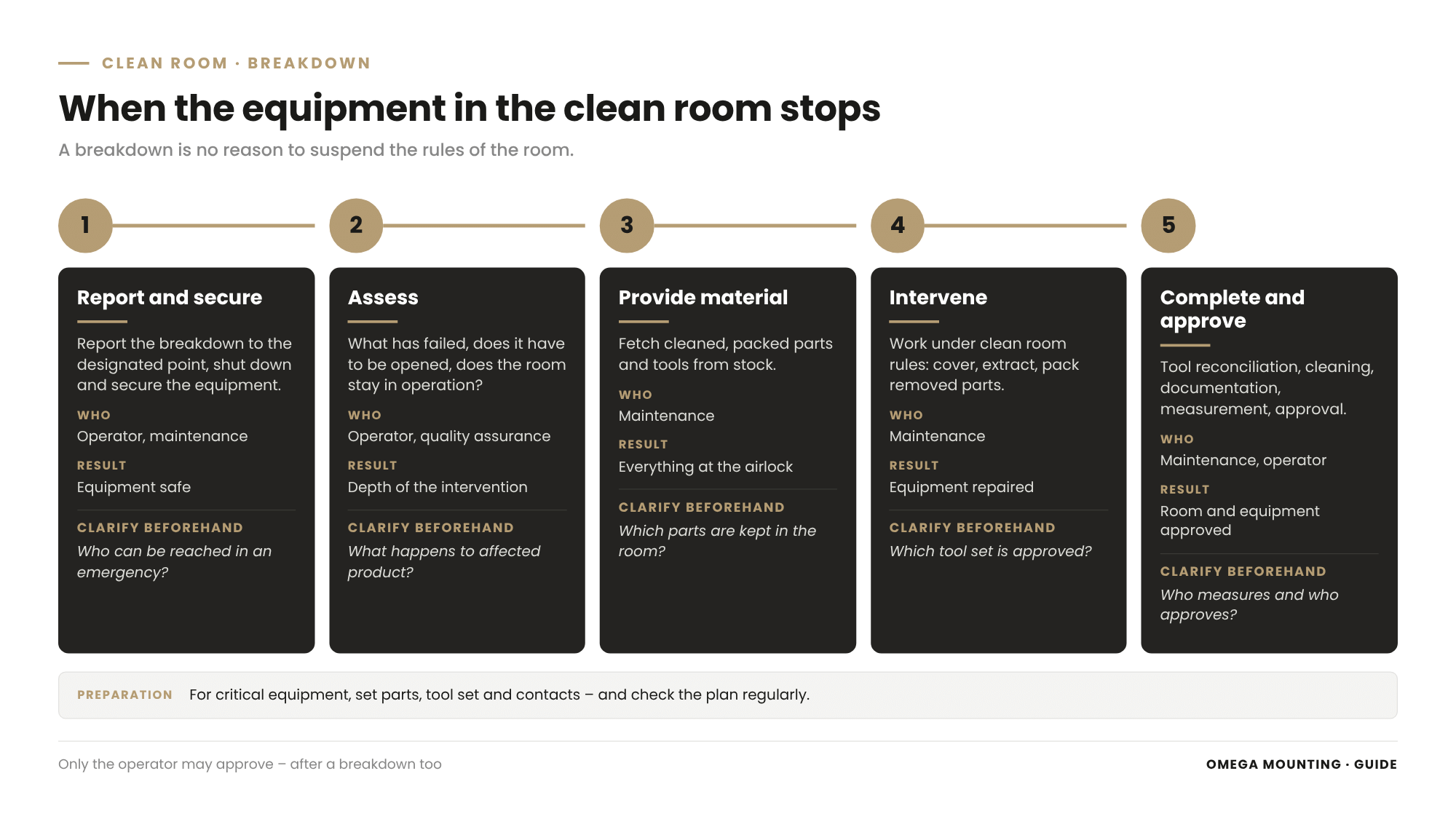
For a breakdown in a clean room: report it, secure the equipment, assess with the operator, provide parts and tools, intervene under the rules of the room and afterwards clean, document and approve as with any servicing. The more of this is settled beforehand, the less time is lost.
Report and secure
Whoever notices the breakdown reports it to the designated point. The equipment is shut down and secured. If product is affected, quality assurance decides what happens to it.
Assess
Operator and maintenance clarify together: what has failed, does the equipment have to be opened, does the room stay in operation? This determines how deep the intervention may be.
Provide material
Now it becomes clear whether provision has been made. If spare parts and tools are ready cleaned and packed, things move fast. If they first have to be obtained, cleaned and repacked, the equipment stands still for longer.
Intervene
Clothing, airlock and low-particle working apply in a breakdown too. The pressure is high, and that is exactly when the typical mistakes happen: tools from the normal trolley, the usual grease, parts in cardboard. A procedure written beforehand helps you stay calm.
Complete and approve
After the breakdown has been dealt with come tool reconciliation, cleaning, documentation and approval by the operator – just as with planned servicing.
Preparing for emergencies
For critical equipment, decide which parts are kept in the room, which tool set is ready and who can be reached in an emergency. Check this plan regularly. A breakdown is no reason to suspend the rules of the room – it is the test of whether the preparation holds.
At a glance: work, risk, measure and who is responsible
Every task in clean room maintenance carries its own risk for the room – the table shows what helps against it and who is responsible.
| Work | Risk to the clean room | Action | Who |
|---|---|---|---|
| Planning the intervention | Work does not fit status and window | Set assessment, window and room status | Operator, quality assurance |
| Bringing in parts and tools | Fibres, dust, grease from outside | List, cleaning, packing layer by layer | Maintenance |
| Lubricating and sealing | Outgassing, residues | Approved substances only. | Operator approves, maintenance applies |
| Opening equipment | Abrasion and old residues get into the room | Cover, parts into clean containers, vacuum | Maintenance |
| Drilling or loosening | Dust, chips, abrasion | Extraction at the source, adjustments outside | Maintenance |
| Removing parts | Dirty parts in the room | Pack right at the equipment, take out through the airlock | Maintenance |
| Closing equipment | Forgotten tools, function faults | Function check, tool reconciliation | Maintenance |
| Cleaning. | Unnoticed contamination. | Rough cleaning, then cleaning to plan | Maintenance, cleaning team |
| Approving | Room runs before it is clean again | Documentation, measurement, requalification as needed | Operator |
| Dealing with a breakdown | Rules are suspended under pressure | Prepared emergency procedure, parts in the room | Operator, maintenance |
Typical mistakes in clean room maintenance
The typical mistakes in clean room maintenance are missing spare parts in the window, the usual grease instead of the approved one, open equipment without covers, removed parts carried through the room unpacked, and an approval that is not in the plan.
- Parts missing in the window. Opening reveals a second fault, and the part is not ready.
- The usual grease. A fitter reaches for the familiar cartridge that the operator never approved.
- Parts in cardboard. The spare part arrives at the airlock in its original packaging.
- Open equipment. A hood is left open during the break.
- Out unpacked. The worn bearing is carried through the room by hand.
- Compressed air for cleaning. Chips are blown away instead of vacuumed.
- Finding without a decision route. Nobody may approve the additional work, and the window runs out.
- Approval forgotten. The equipment runs, but cleaning, measurement and approval are in no plan.
The mistake behind the mistakes
Behind many mistakes is the idea that servicing is routine and needs no preparation. In a clean room even routine is an intervention in a system of air, pressure and rules. If you plan clean room maintenance from the end – from the approval – you forget neither parts nor cleaning.
What we know from sensitive environments
We have not yet documented a job in a clean room. What we know are repairs and equipment replacements in environments where cleanliness, protection and the operator's rules determined the sequence. Three examples from our project diary show this related experience.
Food plant: repair in production-free time
With the pin repair on an electric monorail system in a food plant, all work took place in production-free time at the weekend. On Monday production ran as normal. We know the hygiene and access requirements of operating food plants and the clean way of working they demand.
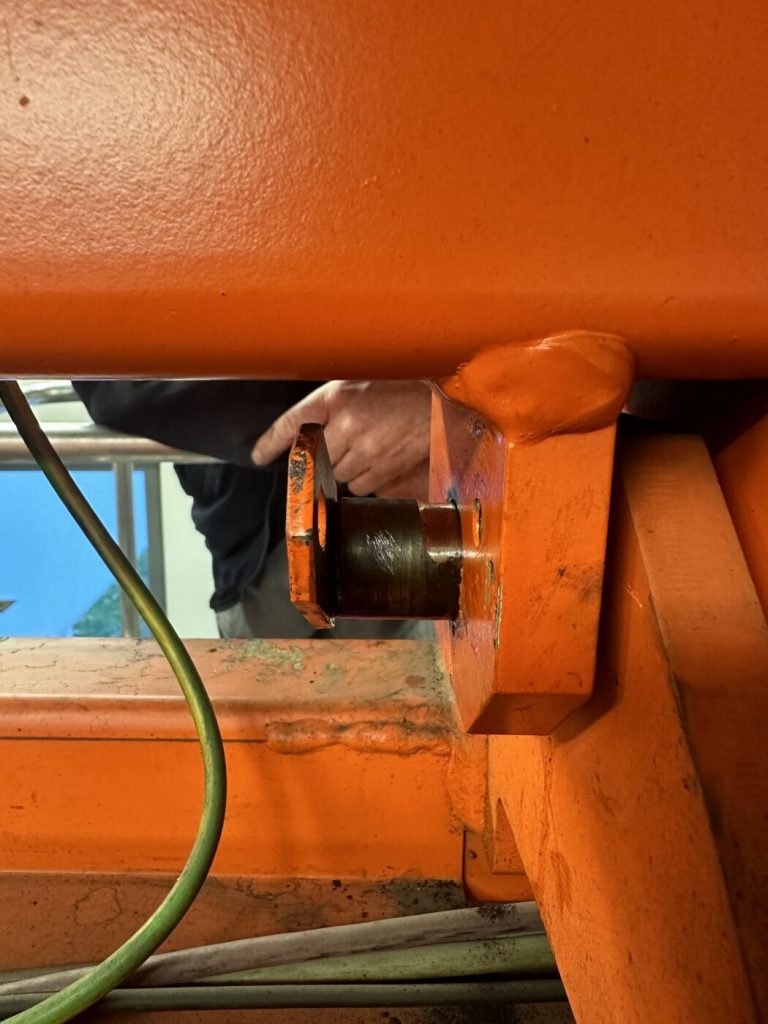
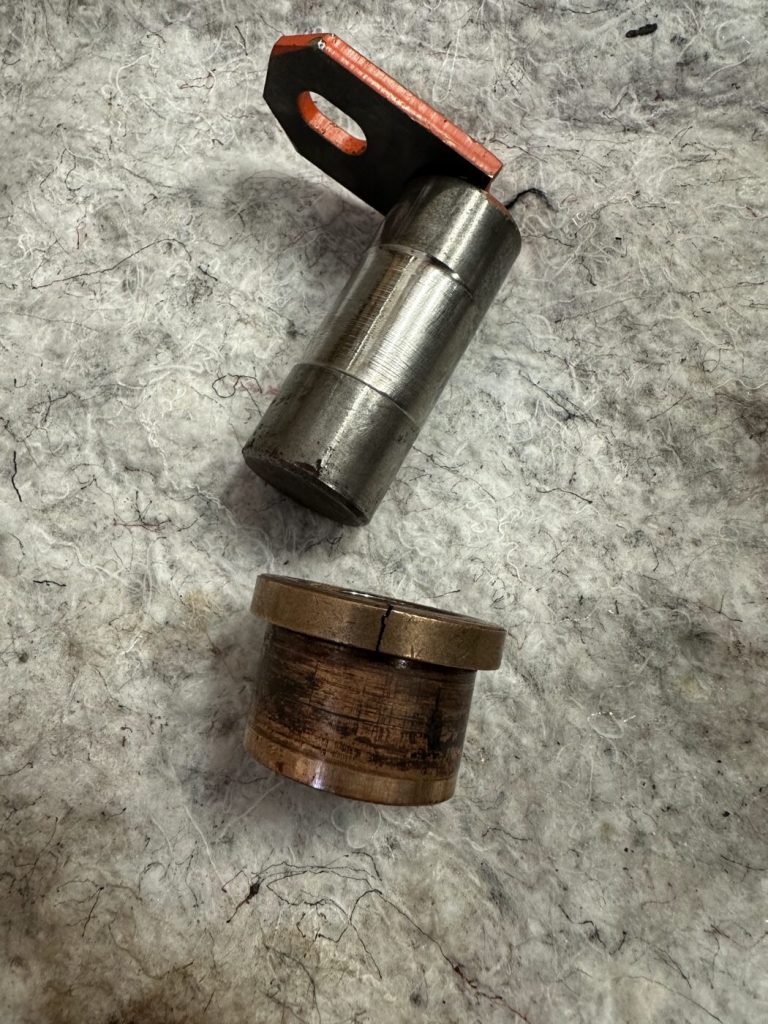
Before the decision, a pin was pulled and examined. The findings were the basis for the repair. On every vehicle the hanger was supported, the pin driven out, the bearing point checked and cleaned, and pin and bearing replaced as a pair. For clean room maintenance this means: findings first, then a window in which everything is ready.
Data center in Frankfurt: airlocks, protection and permits
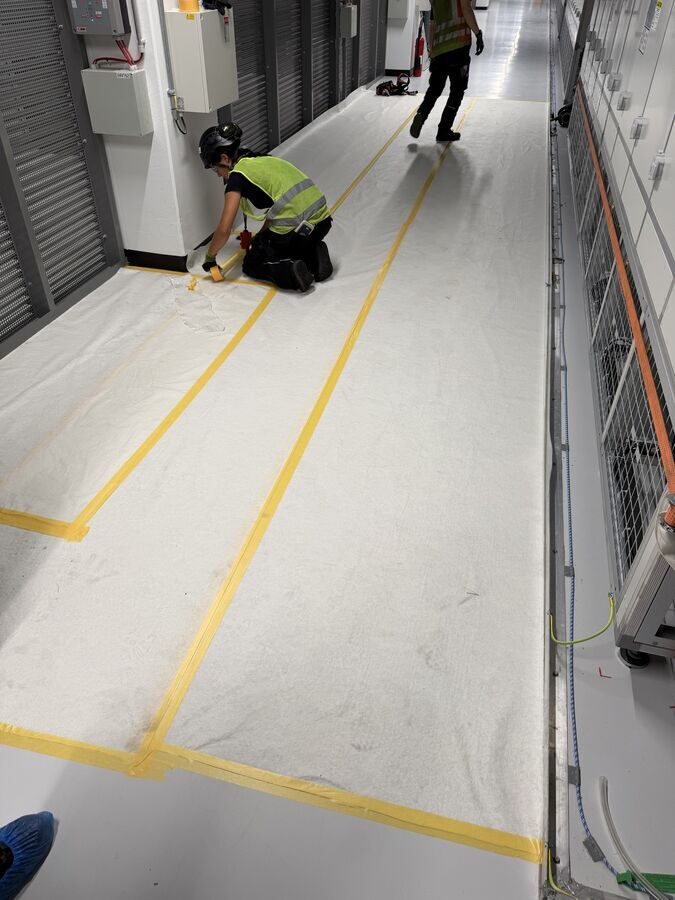
During the replacement of a computer room air handling unit in a live data center in Frankfurt, access led through several secured zones with airlocks and interlocked doors. All walkways and travel routes were covered with protective fleece and taped down, and the tyres of the machines checked. At critical points nothing moved without the supervisor's instruction. Work equipment and lifting accessories were checked and documented before each use, and the work permits agreed with the operator.
For clean room maintenance this means: protection, checks and approval are in place before the first part is moved.
Data center in the Rhine-Main region: finished halls, clean handover
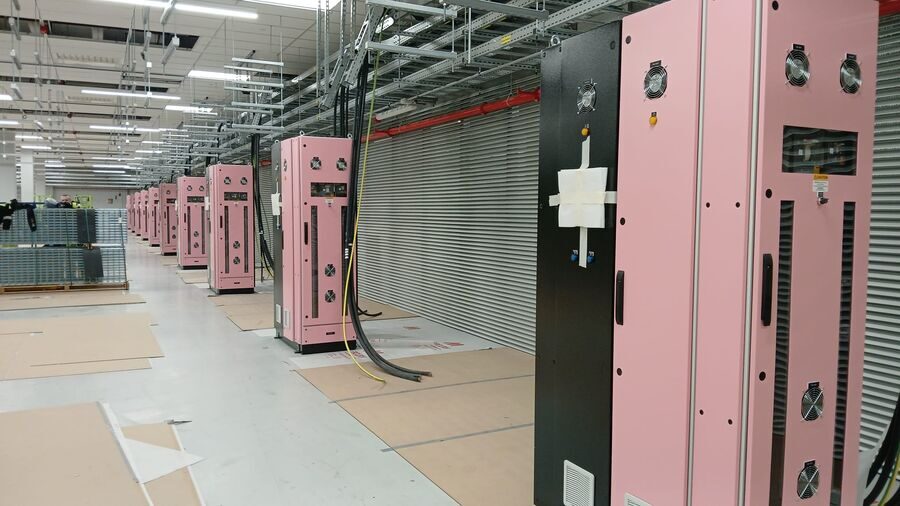
During the installation of power distribution cabinets in a data center in the Rhine-Main area, we worked in finished data halls. Travel and work routes were covered with protective boards and fleece, and the walls protected. All movements ran on protected routes. The handover to the electrical trade went through without rework.
For clean room maintenance this means: if you work in a finished area, you leave it as you found it.
Questions about maintenance in a sensitive environment?
Is servicing or repair due in an area where cleanliness decides the approval? Then get in touch with us. We say openly what we bring and what your operator has to set.
Clean room maintenance in the Rhine-Main region: what we take on
In the Rhine-Main region we take on the mechanical part of clean room maintenance: replacing bearings, guides, drives and assemblies, repairing and pre-assembling parts outside, preparing material and tools to your specifications, working with minimal particles and rough cleaning.
The region has many pharmaceutical, medical technology, electronics and research sites. From Rodgau, Frankfurt, Offenbach, Hanau, Darmstadt and Aschaffenburg are short trips. What we do in Maintenance and servicing overall is set out on our service page.
For an intervention in a clean area we prepare as this guide describes: rules in writing beforehand, parts and tools fully listed, workshop work before the window, deviations reported openly.
We say clearly in advance what we do not take on. Assessment, change control, cleaning to plan, measurements, requalification and approval lie with the operator and its quality assurance. Ventilation and pressure cascades are planned by specialist planners. Electrics and controls are handled by the electrical contractor and the manufacturer. If you want to know what we can prepare for your equipment, write to us.
What this means for your role
For maintenance managers: Bundle servicing into fixed windows. Keep critical spare parts cleaned and packed in the room or at the airlock.
For technical managers: Decide which interventions are routine and which need an assessment. That saves follow-up questions in every window.
For quality assurance: Give maintenance the approved substances and the rules for interventions in writing. Plan cleaning, measurement and approval as a fixed part of every window.
For buyers: Order spare parts with clean room packaging. Clarify in the contract who cleans, who documents and who measures.
For project managers and site managers: Agree windows, lists and contacts beforehand. On the day itself, watch for covers, packing of removed parts and tool reconciliation.
For facility managers: You know the routes, airlocks and installation openings. Clarify early how large assemblies get in and out again.
For management: Give clean room maintenance windows, spare parts and time for approval. Well-prepared servicing in a clean room is almost always cheaper than a rushed repair.
Clean room maintenance approval: template on request
The clean room maintenance approval is a one-page working document for the operator, quality assurance and maintenance. It has four blocks: planning, material, work and completion. Each point has a field for the responsible party and the status “clarified” or “open”. Cleanliness classes and figures are deliberately left blank – they come from the operator. Request the template via our contact form using the keyword “Clean room maintenance approval”.
Conclusion
Clean room maintenance is servicing and repair under the rules of a system of filtered air, pressure cascades and airlocks. It starts with the operator: window, status and assessment. Spare parts, tools and approved substances are ready beforehand. Equipment is opened cleanly and covered, removed parts are taken out packed and repaired outside. At the end come tool reconciliation, cleaning, documentation, measurement and approval by the operator. If you are preparing an intervention in a clean area, send us your enquiry – we will get back to you with an honest assessment.
Planning a move-in, installation or maintenance in the Rhine-Main region?
Tell us briefly what you need – we'll come back with an honest assessment.
Free, no-obligation callback
You may also be interested in these guides
Industrial installation
Maintenance & Servicing
Maintenance & Servicing

About the author
Tobias Schott
Managing director of Omega Mounting GmbH, Rodgau · more than 20 years of hands-on experience in installation and maintenance
A trained mechatronics technician, working in maintenance, servicing and industrial installation since 2004 – first alongside his father, and with Omega Mounting since 2012: from overhead conveyors in Frankfurt to the crane system in a new-build hall. He plans and leads lifting operations as an appointed person (AP) in data centers and on industrial sites in the Rhine-Main region, trains and examines operators of cranes, mobile elevating work platforms and telehandlers, and is a qualified occupational safety specialist. On jobs abroad he is known as the “German Troubleshooter” – the person you call when a site gets stuck. He learned what quality means from his father, not from a manual: Made in Germany as a standard for his own work, not a label. That is why quality comes first at Omega Mounting – ahead of speed and price. He writes these guides from that practice: what works on our sites is in them – what exists only on paper is not.
Frequently asked questions
In five steps: the operator assesses the intervention and sets the window and room status. Parts, tools and approved substances are prepared and brought in through the airlock. The equipment is opened with minimal particles and serviced or repaired. Removed parts go out packed. Then come cleaning, documentation, measurement and approval by the operator.
Not always. Inspections and small servicing jobs often take place in the running room under all the rules. Deep interventions usually take place while the room is out of operation. The operator decides.
Only those approved by the operator. This also applies to pastes, threadlocker, sealants and cleaners. If the manufacturer's specification differs, this is clarified beforehand.
Cleaned, without cardboard and wood, packed in film. In the airlock they are wiped down and unpacked layer by layer. Frequently needed parts are best kept ready in the room.
They are packed right at the equipment, taken through the airlock and examined, cleaned and repaired outside. Repaired assemblies come back cleaned and packed as swap parts.
When the intervention has changed the room or the equipment so much that the operator has to prove the clean state again – for example after a large intervention or a change. The operator decides whether this is the case.
Replacing it with an identical part is usually routine. A different part, a different material or a different lubricant can be a change. The operator and quality assurance assess this before the intervention.
Report it, secure the equipment, assess with the operator, fetch prepared parts and tools and intervene under the rules of the room. Afterwards, clean, document and approve as with any servicing.
Send us a short enquiry with three details: which equipment needs servicing or repair, which area it stands in and which rules your operator specifies. Photos and your specifications help. We clarify with you what we can prepare and what is still missing. Your contact is Tobias Schott – reachable via our contact form.
 English
 German