
- Guide – Maintenance
Welding during operation: repairs in sensitive areas
By Tobias Schott · 22-minute read · Updated October 2026
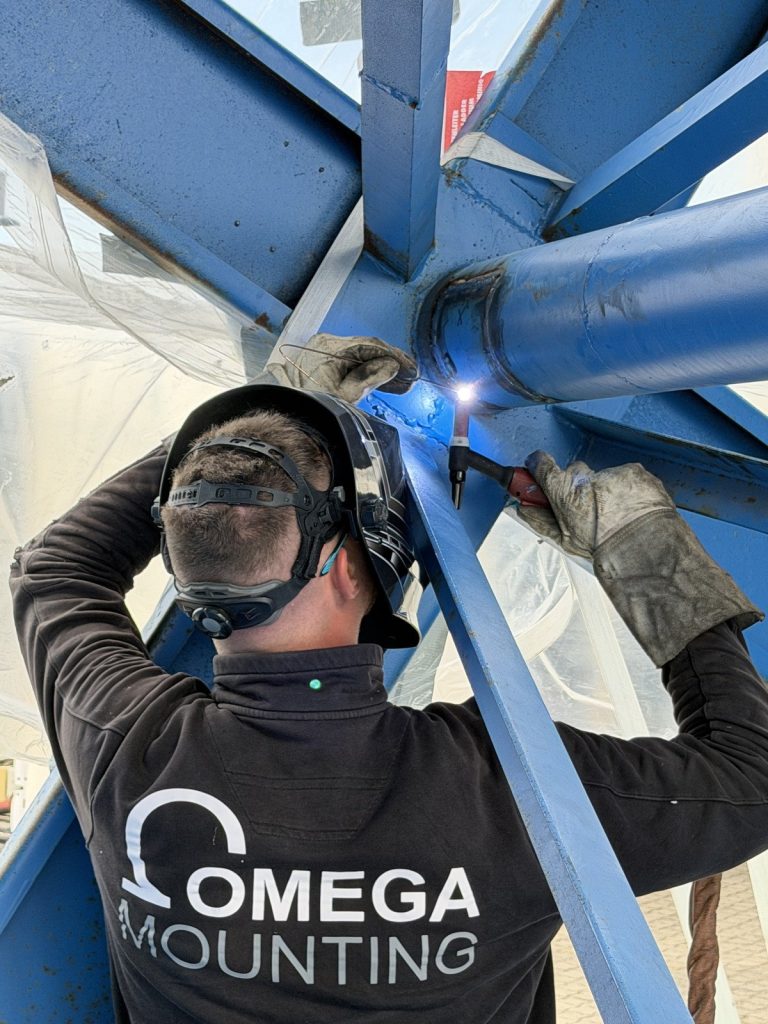
Welding during operation means the weld is made while production, loading or computing continues next door. Good preparation therefore protects not only the welder but also the product, the plant, the surroundings and the operations next door.
A crack in a bracket, a broken holder, a ramp that has to be replaced. Often the repair cannot be put into a shutdown. The hall keeps running, people work nearby, products stand open, controls and smoke detectors hang from the ceiling. Welding during operation is therefore more than a question of welding technique.
This guide explains what is different about welding in sensitive areas compared with the workshop. It shows how sparks, fumes, hygiene, electronics and mechanics are protected, how the sequence is agreed with the operator and which mistakes keep happening.
We are an installation and maintenance contractor from Rodgau near Frankfurt and weld on site and in our own workshop. How a repair weld is made technically – process, material, weld preparation and testing – is covered in our guide on repair welding on industrial plant. This guide is about everything around the weld that has to be protected.
Key points at a glance
- Welding during operation is possible if the risk assessment allows it, the operator authorises the work and the protective measures are in place.
- Four things are protected: the product, the plant, the surroundings and the operations next door.
- Sparks and spatter are caught with screening, covers and welding curtains. A fire watch observes the area during and after the work.
- Fire detectors are only switched off by the operator – and only the operator switches them back on. The contractor requests this; it does not switch them itself.
- Welding fumes are extracted at the source so that they reach neither people next door nor the ventilation, product or smoke detectors.
- In food plants, covering, foreign body control and cleaning also apply. Approval afterwards is given by quality assurance.
- Next to electronics, bearings and drives, the path of the welding current matters. The earth clamp belongs close to the weld, never across bearings or plant components.
- If protection is not feasible, the part is removed and welded in the workshop, or the work is put into a shutdown window.
What is welding during operation?
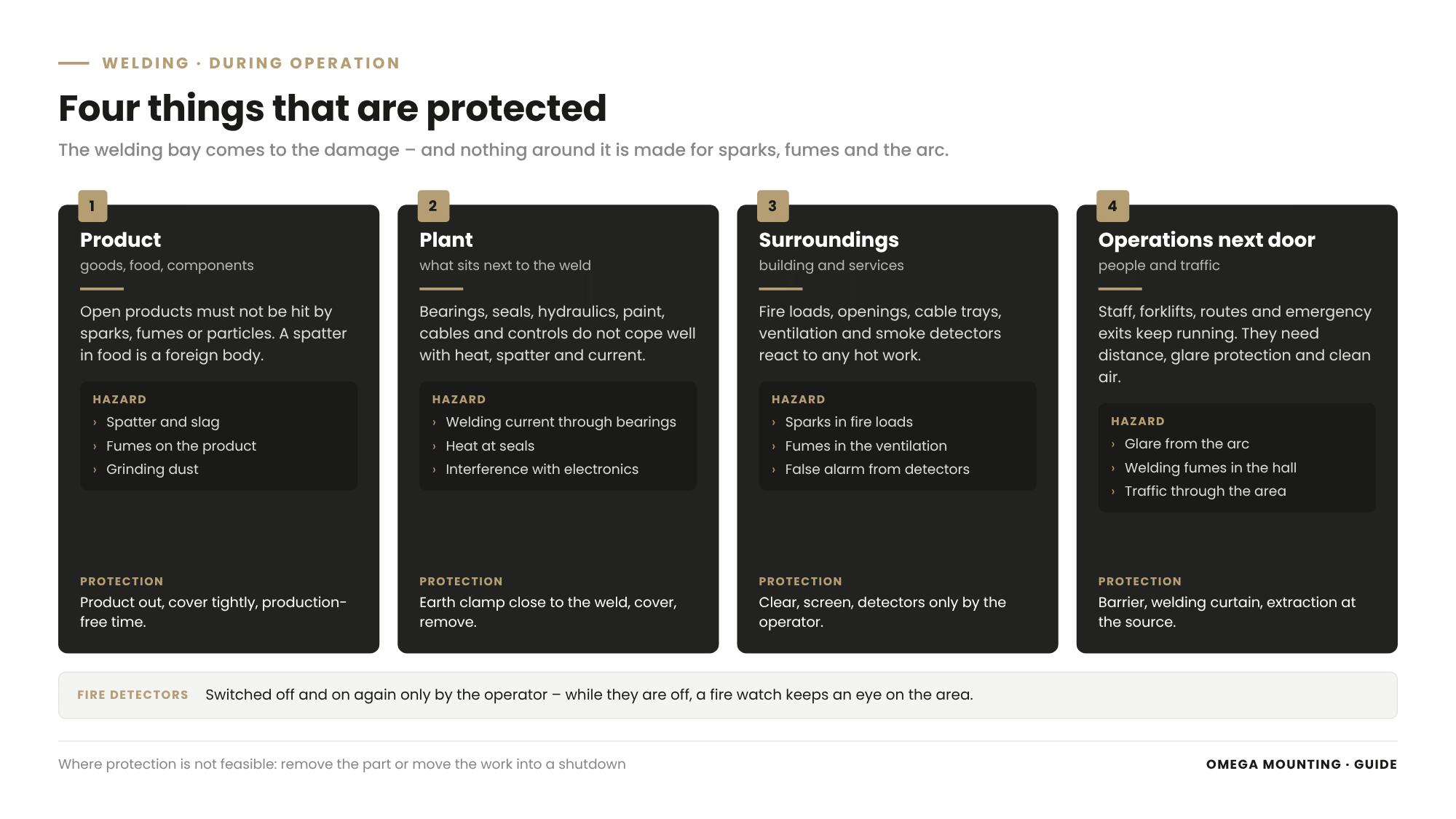
Welding during operation means carrying out welding work on plant or a component while operations around it continue. Next door, production, storage or loading is going on. The work must be secured so that neither people nor products, plant or buildings are harmed.
In the workshop the welding bay is built for this. The floor does not burn, the extraction hangs over the table, nobody stands next to it unprotected. During operation it is the other way round. The welding bay comes to the damage, and nothing around it is made for sparks, fumes and the arc.
Four things that are protected
- The product. Open food, packaging, stored goods or components in production must not be hit by sparks, fumes or particles.
- The plant. Bearings, seals, hydraulics, painted surfaces, cables and controls near the weld are sensitive to heat, spatter and current.
- The surroundings. Fire loads, openings in floor and wall, cable trays, ventilation and smoke detectors belong to the building and react to any hot work.
- The operations next door. Staff, forklift traffic, routes and emergency exits keep running. They need barriers, glare protection and clean air.
What this guide does not repeat
Which welding process suits which material, how a weld is ground out and built up and how it is tested and accepted is explained in our guide on repair welding. It also covers the blocks of a hot work permit and the cases in which it is better not to weld at all. This guide is about how the welding work fits into an operation that does not stop.
When running operations do not fit
Some jobs are not done next to running production. They include welding near open food, in areas with running IT equipment or where an explosive atmosphere can form. Then there are three routes: remove the part and weld it in the workshop, put the work into a shutdown window, or partition the area off so that for the duration of the work it is no longer part of running operations. How work in hazardous areas is authorised is described in our guide on working in hazardous areas.
Sparks and fire: screening, covering, fire watch
When welding during operation, sparks and spatter are stopped by screening, covering and welding curtains, combustible materials are removed and a fire watch observes the area during and after the work. Fire detectors are switched off and on again exclusively by the operator.
Fire load removed or covered
Sparks fly further than you think, and glowing spatter rolls across the floor. Whatever can burn leaves the area: cardboard, film, pallets, rags, oil. Whatever cannot be cleared away is covered with flame-retardant blankets or boards. Joints, floor openings and penetrations are sealed so that nothing falls into neighbouring rooms or cable trays.
During operation this is harder than during a shutdown. Stored goods are where they are because they are needed. That is why clearing up belongs in the coordination with the operator before the welder arrives.
Screening and welding curtain
Welding curtains and screens separate the work area from the operations next door. They hold back spatter and protect the eyes of people walking past. The arc dazzles even from a distance. A barrier ensures that nobody walks into the area by mistake, including forklifts. Where a traffic route runs through the area, the operator sets a diversion.
Fire detectors: only the operator switches
Smoke and heat from welding trigger fire detectors. Depending on the building, alarms, the fire brigade, ventilation dampers or an extinguishing system are linked to them. That is why there is a clear rule: fire detectors are only switched off by the operator, and only the operator switches them back on. The contractor requests the shutdown for a precisely defined area and period and reports when the work is finished.
While detectors are switched off, a fire watch takes over the area. It is then the only fire detection there is. As a contractor, never switch off or cover a detector yourself, not even “just for a moment”.
Fire watch and follow-up check
The fire watch is a named, instructed person with extinguishing equipment within reach. It observes the area, the covers and the neighbouring surfaces during the work. After the last spark it stays and checks whether anything is smouldering. Smouldering fires often only show up later. How long the follow-up check lasts is set by the operator and contractor in the permit to work, depending on fire load and construction.
The permit to work
The basis of any hot work during operation is the written permit to work. How a permit procedure works in principle is explained in our article on Permit to Work. What exactly goes into a hot work permit is described in the guide on repair welding.
Behind this are the risk assessment and the duty to coordinate the work of several companies. This guide is not legal advice. Which rules apply in your operation is something you decide with your occupational safety specialist and your fire safety officer.
Welding fumes and air: extraction, ventilation, smoke detectors
When welding during operation, welding fumes are extracted right where they arise so that they do not drift into the hall, the ventilation, onto the product or to the smoke detectors. In confined spaces fresh air is added, and the operator decides whether its ventilation is adjusted.
Why fumes next door are a problem
Welding fumes are a hazardous substance. The welder has respiratory protection; the people next door do not. Fumes drifting through the hall end up with colleagues who have nothing to do with the work. They settle on surfaces and smell. In a food plant or a plant room they can do more damage than the weld prevents.
Extraction at the source
A mobile extraction unit with a capture arm is placed as close as possible to the weld. It catches the fumes before they spread. The German Technical Rule for Hazardous Substances on welding work (TRGS 528) requires exactly that: capture where the fumes arise. The filtered air must not be blown out where it reaches product or people. Where it goes is clarified beforehand.
Ventilation and air conditioning
Many halls and plant rooms have ventilation that draws in and distributes air. If it keeps running normally during welding, it may carry the fumes into other areas. Whether part of the ventilation is adjusted or an intake point covered is decided by the operator. How ventilation systems in industry are maintained and why filters should be checked afterwards is covered in our guide on ventilation and air-conditioning maintenance.
Smoke detectors and aspirating smoke detection
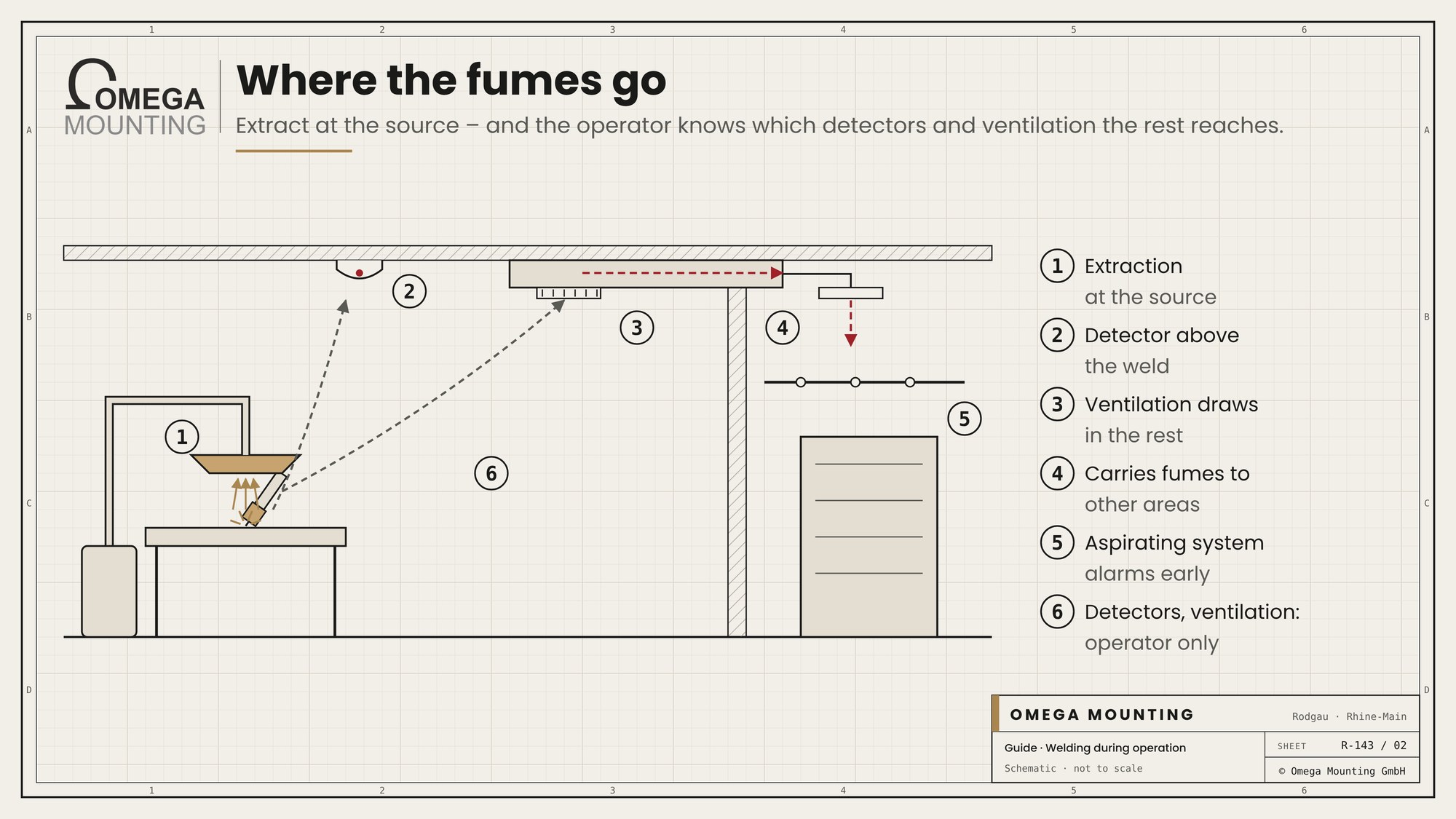
Smoke detectors react not only to fire but also to welding fumes. Sensitive systems that draw in and test air respond particularly early. So it is not enough to know the detector above the weld. The operator must know which detectors the fumes can reach and decides what is switched off. For the contractor this means: extraction at the source is not only occupational safety but also protection against false alarms.
Confined spaces, basements, pits
In basement rooms, pits and cramped plant rooms, fumes and gases build up quickly. There, fresh air supply is added to extraction. A second person stays within calling distance. Clarify in advance where the gas cylinders stand – in a basement, often better upstairs with a longer hose.
Hygiene: welding in a food plant
When welding in a food plant, hygiene and the foreign body risk come on top of fire and fumes. Open products are removed or tightly covered, spatter, slag and grinding dust must not get into the line, and after the work the plant cleans and approves according to its own procedure.
What can fall into the line
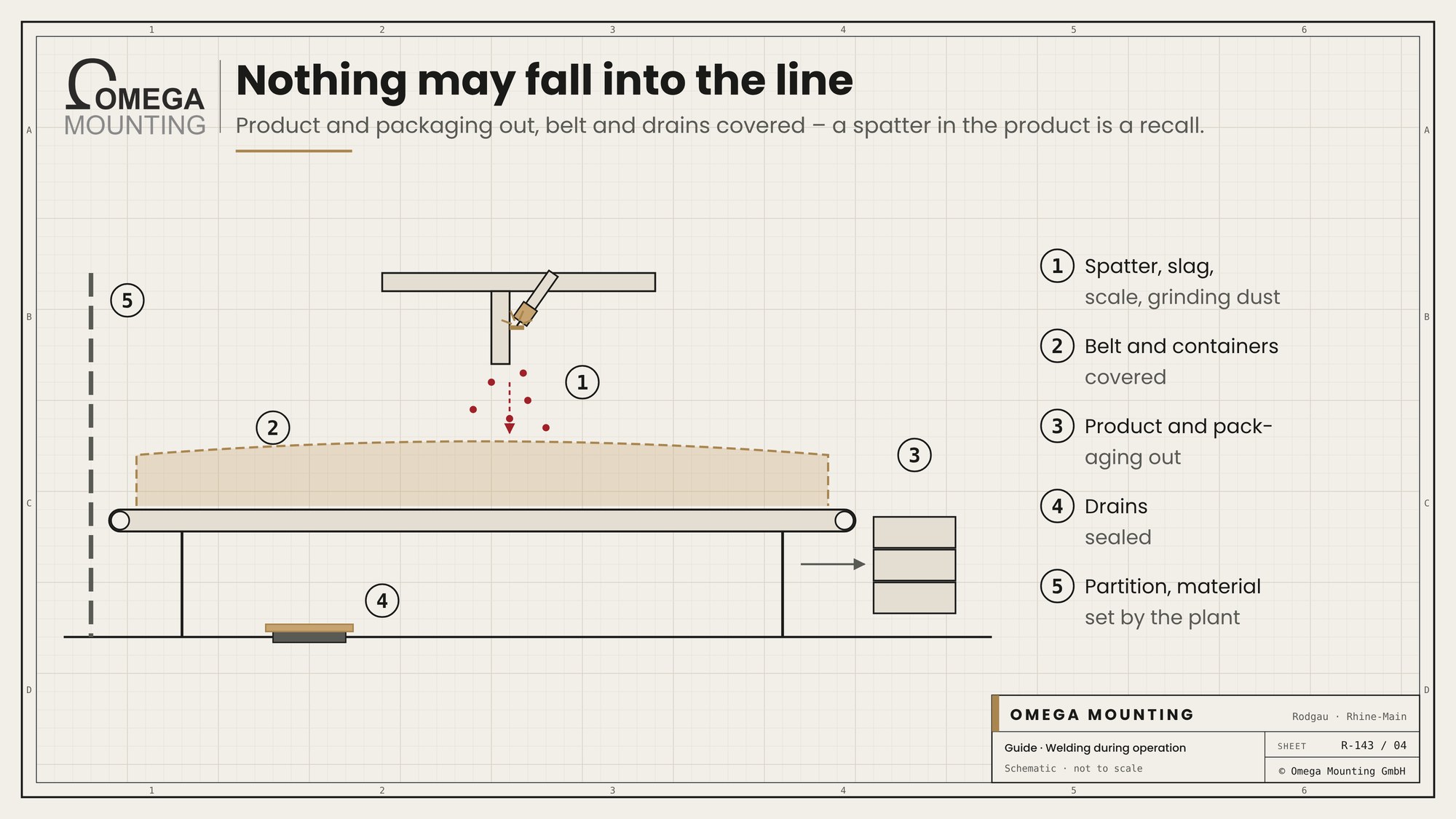
Weld spatter, slag, scale and grinding dust are foreign bodies. A metal spatter in a product is a recall, not a cosmetic flaw. That is why there is no welding above or next to open products. Product and packaging leave the area, belts and containers are covered, drains sealed.
Covering and screening in the hygiene area
Covers here have to do two things: stop sparks and stay clean. What works as a welding blanket in the workshop can shed fibres itself in a hygiene area. The plant specifies which materials may enter the area. Many plants separate the welding area completely from production with a partition.
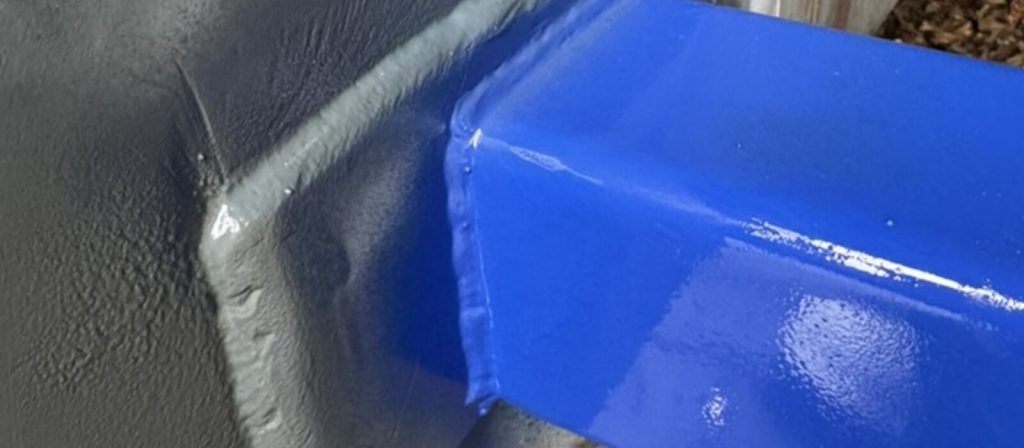
Stainless steel and clean welds
In food plants stainless steel is the usual material. Welds should be smooth, tight and cleanable, without gaps in which product residues can collect. Which processes are suitable and how lubricants and tool control are regulated in such areas is described in our guide on Maintenance in food production. It also covers how a plant systematically excludes foreign bodies during maintenance.
Cleaning and approval by the plant
After welding, the contractor clears away waste, spatter, slag and covers and reconciles its tool list. The actual cleaning and, where required, disinfection follow the plant's plan. At the end, only quality assurance or the plant's hygiene manager may approve. The contractor reports completion; it does not approve anything.
Putting the work into production-free time
Often the best hygiene measure is timing. Weekends, night shifts or cleaning windows are times when no open product is in the room. If you put the welding work there, you need fewer covers and have more time for cleaning afterwards. We cover how hygiene zones in the food industry are structured in a separate guide.
Sensitive equipment: data center, controls, electronics
Next to sensitive equipment, what matters when welding is not only the heat but also the path of the welding current. The earth clamp belongs directly on the workpiece close to the weld so that the current does not flow back through bearings, housings, cable trays or controls. Isolation is decided by the operator's qualified electrician.
The path of the welding current
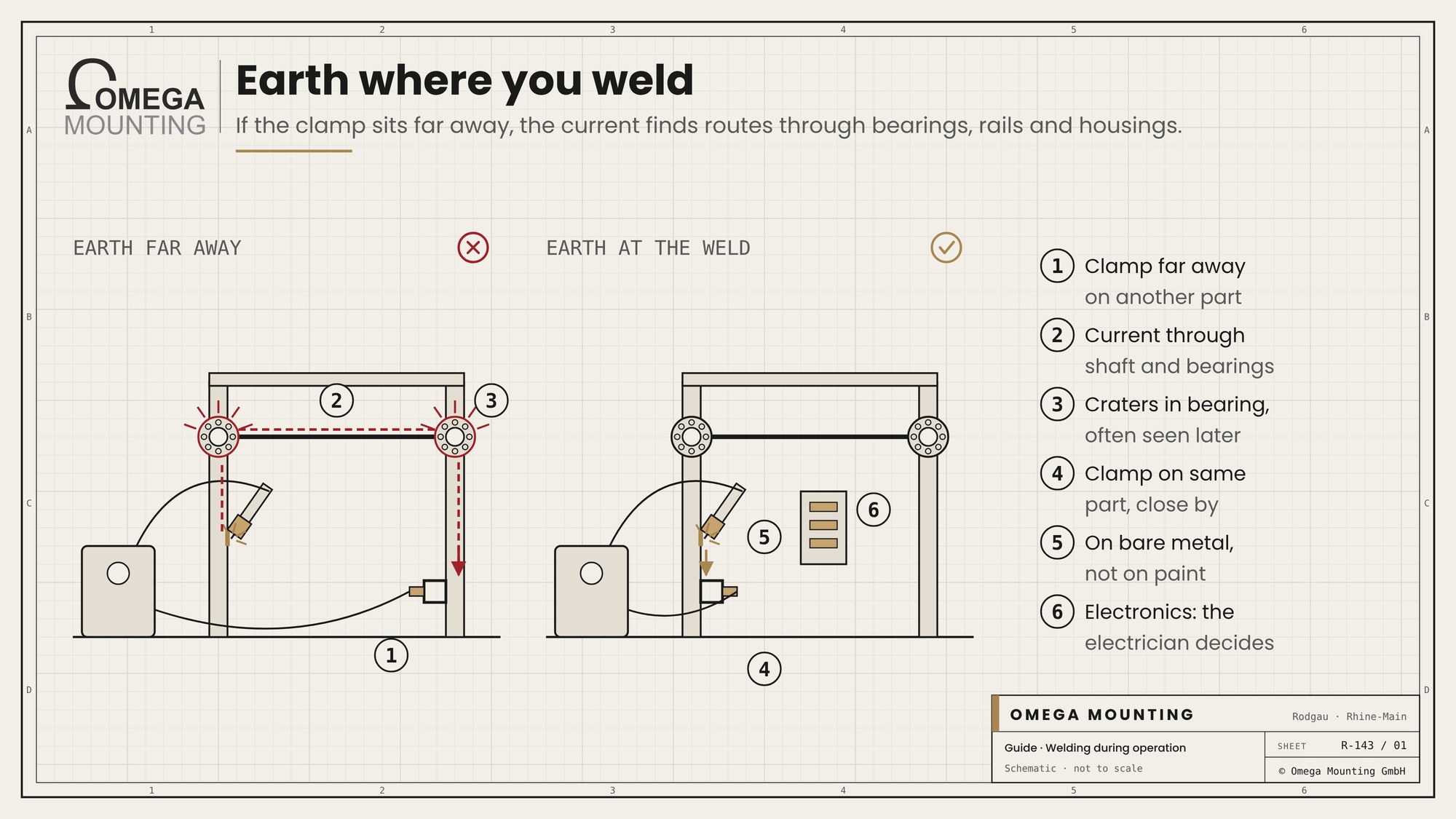
The welding current flows from the machine to the electrode, through the arc into the workpiece and back through the earth lead. If the earth clamp sits far away or on painted metal, the current finds other routes. It then flows through bearings, rails, pipework, protective conductors or housings. There it causes damage that is often only noticed later.
So the rule is: earth clamp on bare metal, on the same component, as close as possible to the weld. Never across a bearing, gearbox, guide or other plant component. Welding and earth leads run close together and away from control and signal cables.
Controls and electronics
Controls, sensors, frequency converters and network equipment are sensitive to return currents and interference from the welding circuit. The ignition of some welding machines can also couple into neighbouring cables. Whether components nearby are disconnected or isolated is not decided by the welder. A qualified electrician – ours or yours – clarifies this with the operator. How isolating and securing against switching back on work is described in our guide on Lockout tagout in maintenance.
Data center: fumes, dust, extinguishing system
In a data center the “product” is availability. As a rule, there is no welding in data halls with running equipment. Parts are removed and worked on outside. In technical areas, for example cooling, standby power or support structures, welding work may become necessary. Then three things matter in particular.
- Fumes. Aspirating smoke detection and extinguishing systems can react to welding fumes. What is switched off is decided by the operator alone.
- Dust. Grinding dust is drawn into cooling units, filters and fans. Grinding is therefore done beforehand in the workshop or with extraction and screening.
- Current. The path of the welding current must be planned particularly carefully, because all around stands equipment with earthing and equipotential bonding.
Which other rules apply to contractors in data centers is described in our guide on installation in data centers.
Protecting the mechanics: bearings, seals, painted surfaces
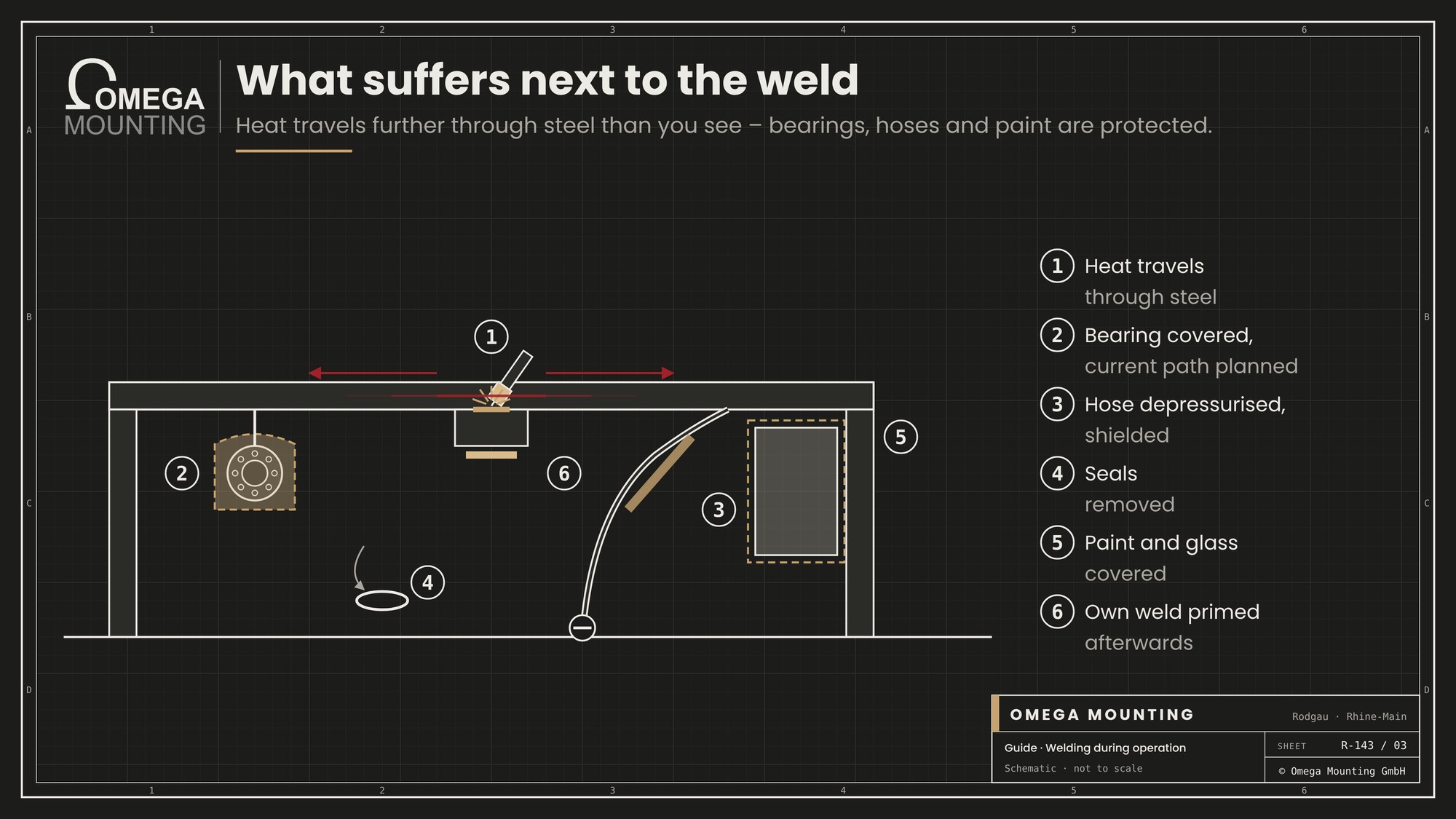
When welding on plant, its own components are protected too. Bearings, seals, hydraulic lines, painted surfaces, sensors and cables near the weld are covered, cooled or removed beforehand so that heat, spatter and current cause no consequential damage.
Bearings and guides
If welding current flows through a bearing, small arcs form on the raceways. This leaves craters and grooves. The bearing keeps running for the time being, but becomes noisier and fails earlier. If you weld next to a bearing, plan the current path and cover the bearing against spatter.
Seals, hoses, plastics
Seals, hydraulic hoses, cable sheaths and plastic parts cannot take heat. Heat travels further through steel than you can see. Whatever sits close to the weld is removed or shielded with heat protection. Hydraulics and compressed air nearby are depressurised before the arc is struck.
Painted surfaces, glass, finishes
Spatter burns into paint, glass and stainless steel surfaces. Covers protect surfaces that will remain visible or have to be cleaned later. After the work our own welds are primed and coated.
Prefabricate instead of welding on site
The less welding on site, the less has to be protected. Holders, brackets, reinforcements and fitting pieces are therefore made in the workshop wherever possible. On site, they are only fitted and joined. How to take work out of a shutdown is shown in our guide on shortening shutdowns.
Welding during operation step by step: sequence and coordination
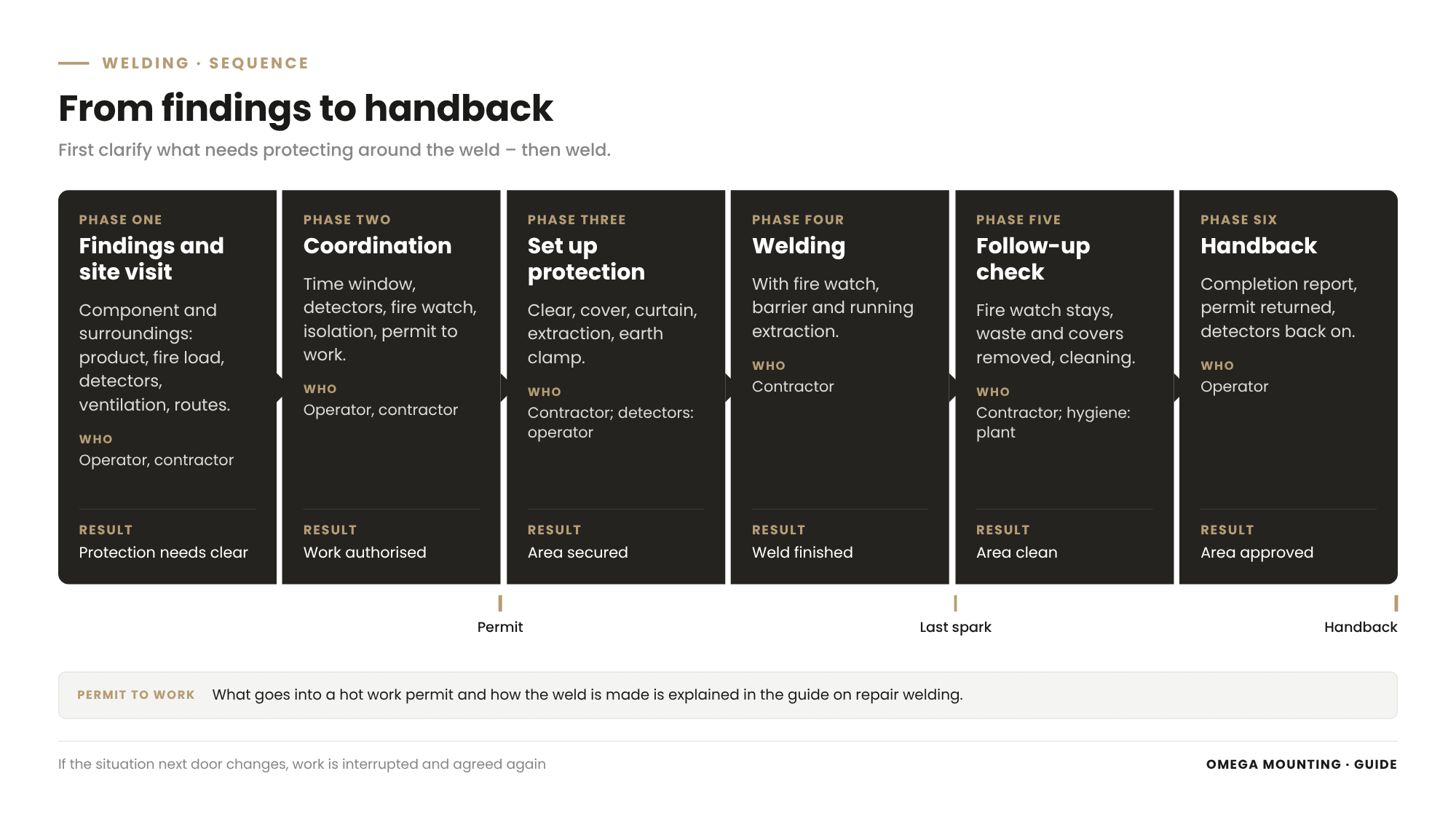
Welding during operation runs in six phases: findings and site visit, coordination and permit to work, setting up protection, welding with fire watch, follow-up check and cleaning, handback to the operator.
Findings and site visit
It starts with the damage and the question of where it is. During a site visit the operator and contractor look not only at the component but at everything around it: product, fire loads, smoke detectors, ventilation, electronics, routes, neighbouring areas. A separate appointment for the damage assessment before the welding machine arrives is often worthwhile.
Coordination and permit to work
Operator and contractor decide when and how welding takes place. They clarify which detectors the operator switches off, who keeps fire watch, who isolates and who decides if there are deviations. Everything is in the permit to work. How operators involve contractors in principle is described in our guide on contractor management.
Setting up protection
Before the arc is struck, the protection is in place: fire loads removed or covered, curtains and barriers, extraction in position, earth clamp set, sensitive parts covered. The operator has switched off the detectors and confirms this.
Welding with fire watch
Welding only continues as long as the conditions are right. The fire watch observes, the barrier stands, the extraction runs. If something changes, for example because product comes close or a detector triggers after all, work is interrupted and agreed again.
Follow-up check and cleaning
After the last spark, the fire watch checks the area. Waste, spatter and covers are removed. In hygiene areas the plant cleans according to its plan.
Handback to the operator
The contractor reports completion and returns the permit to work. The operator switches the detectors back on, checks the area and approves it. How maintenance next to production is planned in principle is covered in our guide on Maintenance during live operations.
At a glance: area, risk, measure
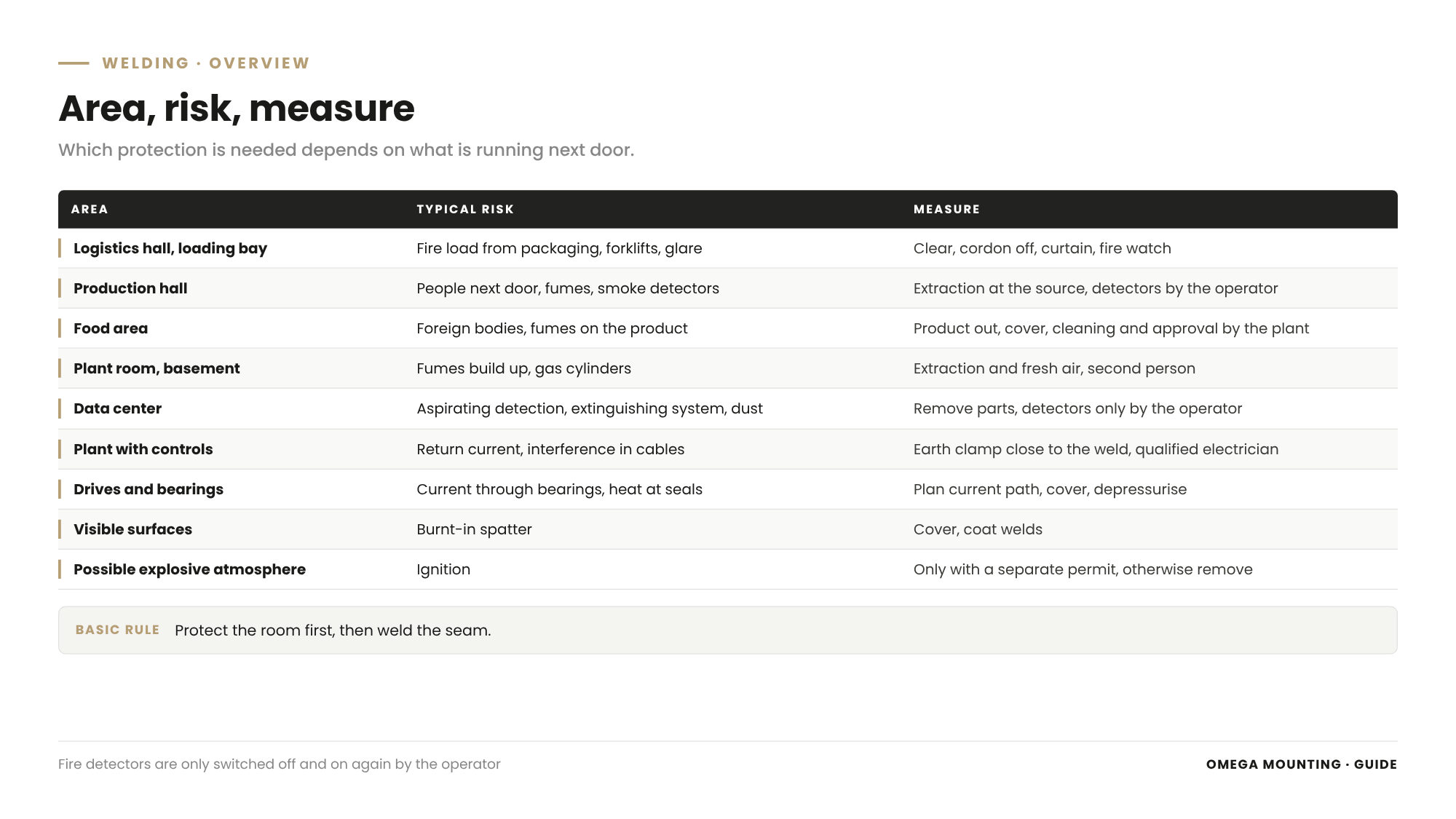
Each area brings its own risk when welding during operation – the table shows typical cases and what helps against them.
| Area | Typical risk | Action |
|---|---|---|
| Logistics hall, loading bay | Fire load from packaging, forklift traffic, glare | Clear, cordon off, welding curtain, fire watch |
| Production hall | People next door, fumes in the hall, smoke detectors | Extraction at the source, detectors by the operator, barrier |
| Food area | Foreign bodies, fumes on the product, hygiene | Product out, cover tightly, production-free time, cleaning and approval by the plant |
| Plant room, basement | Fumes build up, gas cylinders, tight routes | Extraction and fresh air, cylinder upstairs, second person within calling distance |
| Data center | Aspirating smoke detection, extinguishing system, dust, sensitive equipment | Remove parts, detectors and extinguishing system only by the operator, clean current path |
| Plant with controls | Return current through housings, interference in cables | Earth clamp close to the weld, isolation by a qualified electrician |
| Drives and bearings | Current through bearings, spatter, heat at seals | Plan current path, cover, remove, depressurise |
| Painted and visible surfaces | Burnt-in spatter | Cover, coat welds afterwards |
| Area with possible explosive atmosphere | Ignition | Only with a separate permit from the operator, otherwise remove |
Typical mistakes when welding during operation
The typical mistakes when welding during operation are looking only at the component instead of the surroundings, covering smoke detectors yourself, an earth clamp in the wrong place, fumes without extraction and a fire watch that leaves with the last spark.
- Looking only at the weld. The site visit ends at the crack, and nobody sees the cardboard behind it or the detector above it.
- Detector covered by the contractor. A fitter pulls a bag over the smoke detector. Fire protection is then missing without the operator knowing.
- Detector not switched back on. The work is finished, but nobody reports it to the operator. The area remains unprotected.
- Earth anywhere. The earth clamp sits on the nearest free piece of steel, and the current flows through a bearing or a control system.
- Fumes into the hall. There is respiratory protection for the welder but no extraction. The colleagues next door breathe it too.
- Product nearby. In a food plant open goods stand next to the weld because the work only takes “a moment”.
- Fire watch leaves too. After the last spark everyone packs up, and nobody checks afterwards.
- No stop criterion. Nobody has agreed what happens if the situation next door changes.
The mistake behind the mistakes
Almost all mistakes share the same assumption: that welding is work on the component. During operation it is work in the room. If you first ask what has to be protected around it, and only then how to weld, you avoid most mistakes from the outset.
Welding during operation in the Rhine-Main region: how we work
In the Rhine-Main region we weld in logistics centres, production plants and plant rooms, often while the operations next door keep running. We come for a site visit beforehand, agree protection and permits with the operator and propose what is better done in the workshop or in a shutdown window.
From Rodgau, Frankfurt, Offenbach, Hanau, Darmstadt and Aschaffenburg are short trips. That helps when damage needs to be assessed quickly or a part needs to come to our workshop for welding. For us, welding is part of Maintenance and servicing, not a separate trade.
We say in advance what we do not take on. Fire detectors and extinguishing systems are switched by the operator. Isolation follows your procedure – by our qualified electrician or yours. Building electrics remain with your electricians. Cleaning and approval in hygiene areas lie with quality assurance. Whether load-bearing parts may be welded is decided by the structural engineer.

Project examples
Five jobs from our project diary show how we fit welding work into operations that do not stop – and when we deliberately take the hot work out of running operations.
Hinged dock levellers at a logistics centre near Frankfurt
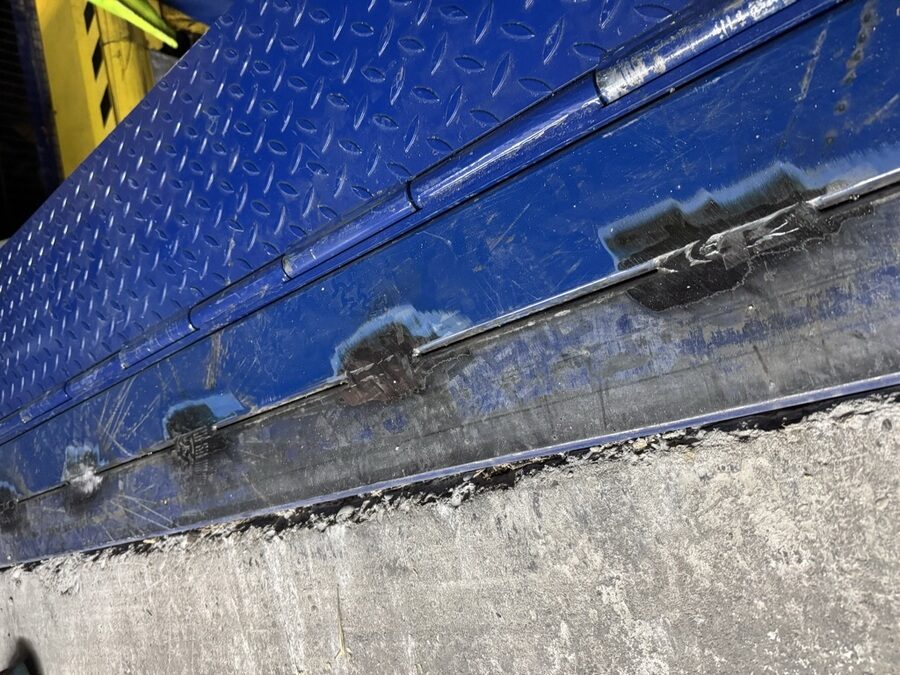
During the replacement of hinged dock levellers at a logistics centre near Frankfurt the principle was: we replace dock levellers in such a way that the logistics centre keeps running. The new levellers were MAG-welded directly on site to the existing steel structure, and the feet aligned and welded in the same way. For a power connection that was still missing, coordination ran with building services. The customer's electrical contractor connected the permanent supply later – without a shutdown for the customer.
Cable drum in the port of Aschaffenburg: covering what stays
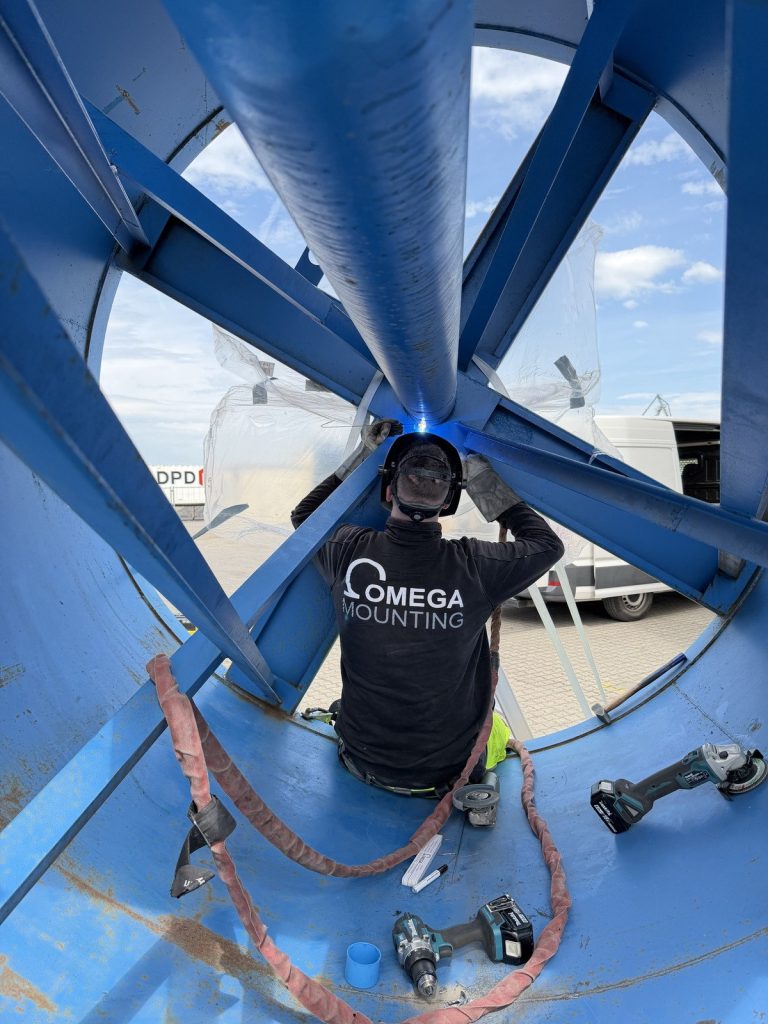
With the repair of a cable drum in the port of Aschaffenburg the heavy high-voltage cable stayed on the drum throughout the work. The adjacent areas were shielded with heat-resistant protective films and covers. This kept weld spatter, grinding dust and sparks away from the sensitive cables. The damage assessment had its own appointment before the welding machine arrived. For us this protection is a matter of course in work preparation.
Loading ramp: closed-off door, heat for the weld
At a loading ramp with defective welds the door was closed off after the inspection. Two fitters ground the welds back to bare metal and rewelded them, in snowfall and with an industrial heater set up specially at the workplace. The report does not say whether loading continued next door. But it shows how much preparation at the workplace goes into a good weld.
Paint shop near Offenbach: hot work brought forward
During the fan bearing replacement in a paint shop near Offenbach the work was timed for the weekend shutdown. Our fitters fabricated and welded the rail system for the removal on site on the preparation day. Control cabinets and cables around it were to remain undamaged. On Monday production ran again as usual. The example shows the other route: where running operations do not fit, the hot work belongs in the window before.
Food plant: production-free time
With the pin repair on an electric monorail system in a food plant, no welding was done. All work took place in production-free time at the weekend. We know the hygiene and access requirements of operating food plants. Exactly this experience determines when and where we propose hot work in such plants.
Is welding work due next to running operations at your site?
Is a bracket cracked, a holder broken or a component to be replaced, and operations are to keep running? Then get in touch with us. We clarify on site what has to be protected and say openly whether welding should be done on site, in the workshop or during a shutdown.
What this means for your role
For buyers: Do not award welding work during operation as a pure hourly service. Describe the site visit, protective measures, fire watch, follow-up check and clearing up as part of the scope.
For designers: Plan for replaceability. Bolted brackets and accessible fixings turn hot work during operation into a simple swap.
For project managers and site managers: As project manager, you agree the time window, permit to work and detector shutdown with the operator. As site manager, on site you watch the barrier, extraction, earth clamp and the report back to the operator.
For maintenance managers and technical managers: You know the room. State what runs next door, where detectors, ventilation and controls are and who decides on site.
For occupational safety specialists and fire safety officers: Set who switches detectors off and back on and how the fire watch is organised during that time. Require a permit to work for every hot work job.
For quality assurance and hygiene managers: Specify in writing beforehand which covers are permitted and how cleaning is done. Approval after the work stays with you.
For facility managers and data center operators: Clarify early which aspirating smoke detection and extinguishing systems may be affected and which parts are better removed.
Welding check during operation: template on request
The welding check during operation is a one-page working document for the operator and the contractor. It has four blocks: preparation, protection, during the work and after the work. Each point has a field for the responsible party and the status “clarified” or “open”. Distances and times are deliberately left blank – you set them in the permit to work. Request the template via our contact form using the keyword “Welding check during operation”.
Why Omega Mounting?
We are based in Rodgau near Frankfurt and weld on site and in our own workshop. The linked jobs show how we approach welding work in existing facilities: look at the damage first, protection before the weld, hot work placed where it disrupts least. We say clearly what stays with the operator – fire detectors, electrics, cleaning and sign-off. If you are looking for a partner for a repair who looks at the whole room with you, write to us.
Conclusion
Welding during operation succeeds when the view does not end at the weld. Product, plant, surroundings and the operations next door each need their own protection: screening and covers against sparks, extraction against fumes, hygiene in the food area, a clean current path next to electronics and bearings. Fire detectors are only switched by the operator, a fire watch stays until the follow-up check, and approval only follows the handback. Where protection is not enough, the work belongs in the workshop or in a shutdown. If a repair is due at your site, send us photos and a short description – we will get back to you with an honest assessment.
Planning a move-in, installation or maintenance in the Rhine-Main region?
Tell us briefly what you need – we'll come back with an honest assessment.
Free, no-obligation callback
You may also be interested in these guides
Maintenance & Servicing

About the author
Tobias Schott
Managing director of Omega Mounting GmbH, Rodgau · more than 20 years of hands-on experience in installation and maintenance
A trained mechatronics technician, working in maintenance, servicing and industrial installation since 2004 – first alongside his father, and with Omega Mounting since 2012: from overhead conveyors in Frankfurt to the crane system in a new-build hall. He plans and leads lifting operations as an appointed person (AP) in data centers and on industrial sites in the Rhine-Main region, trains and examines operators of cranes, mobile elevating work platforms and telehandlers, and is a qualified occupational safety specialist. On jobs abroad he is known as the “German Troubleshooter” – the person you call when a site gets stuck. He learned what quality means from his father, not from a manual: Made in Germany as a standard for his own work, not a label. That is why quality comes first at Omega Mounting – ahead of speed and price. He writes these guides from that practice: what works on our sites is in them – what exists only on paper is not.
Frequently asked questions
Yes, if the risk assessment allows it, the operator authorises the work with a permit to work and the protective measures are in place. These include screening against sparks, extraction at the source, a fire watch and a clear rule for fire detectors. Where this is not feasible, the part is removed or the work is put into a shutdown window.
Only the operator. The contractor requests the shutdown for a precisely defined area and period. While the detectors are off, a fire watch keeps an eye on the area. After the work, it is again the operator who switches the detectors back on.
Throughout the work and for a follow-up check afterwards. How long that lasts is set by the operator and contractor in the permit to work, depending on the fire load and construction of the area. Smouldering fires often only show up later.
With extraction right at the weld. It captures the fumes before they spread. Where the filtered air goes and whether the ventilation is adjusted is clarified by the operator. In confined spaces fresh air is added.
Yes, but not next to open product. Product and packaging leave the area, equipment is tightly covered, and ideally the work is done in production-free time. Afterwards the plant cleans according to its plan, and quality assurance approves.
As a rule, not in data halls with running equipment. Parts are removed and worked on outside. In technical areas welding can be done if the operator has taken aspirating smoke detection and the extinguishing system into account and the path of the welding current is properly planned.
On bare metal on the same component, as close as possible to the weld. That way the current flows back by a short route and not through bearings, housings, pipework or controls.
When open product, running IT equipment, a possible explosive atmosphere or fire load that cannot be removed is nearby. Even when many sensitive parts would have to be protected, the workshop is often the safer and faster route.
Send us a short enquiry with three details: what is to be welded, what runs next door and what time window you have. Photos of the damage and the surroundings help. We come for a site visit and propose the route that disturbs your operation least. Your contact is Tobias Schott – reachable via our contact form.
 English
 German