
- Technology explained – technology and procedures
The crane runway girder: profile, rail, tolerances – what the overhead crane runs on
By Tobias Schott · 5-minute read · Updated November 2026
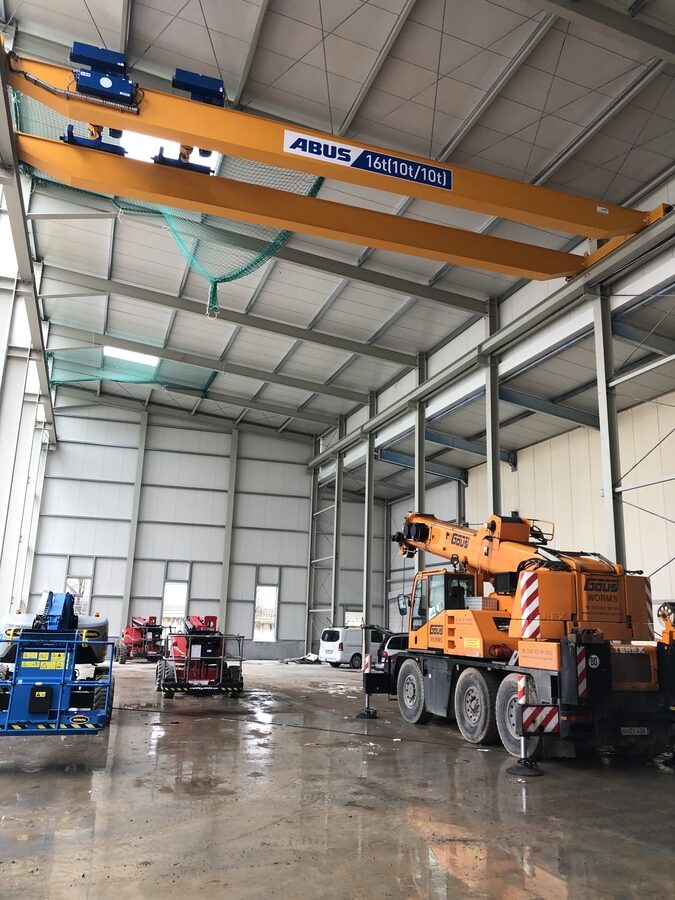
A crane runway girder carries the overhead crane and its load along the whole length of the hall – and just a few millimetres of offset decide whether the crane runs smoothly or eats wheels and rails.
The crane runway girder is the long steel girder on the left and right under the hall roof on which the overhead crane's wheels run. People rarely look at it consciously. It only gets noticed when the crane runs skewed, wheels wear on one side or a new crane is to go onto an old runway.
Here we explain how a crane runway is built, which forces the crane puts on the girder, how the rail is fixed and why the tolerances are so tight.
What is a crane runway girder?
A crane runway girder is the girder that carries the crane rail and transfers the wheel loads of an overhead or suspension crane to columns or brackets. Two parallel runway girders together form the crane runway on which the crane travels along the hall.
The runway girder is usually a wide-flange rolled section or a welded girder. It is designed to DIN EN 1993-6, the part of the Eurocode for crane runways. It is a structure of its own: it hangs from the hall structure or stands on its own columns, but it has to withstand different forces from a roof girder.
Key facts
- Design: Column or bracket, runway girder, crane rail, rail fixing, end stop with buffer, power supply.
- Profile: Wide-flange rolled section or welded girder, depending on span and crane load.
- Rail: Flat bar or crane rail, welded on or clamped.
- Loading: Wheel loads vertically, lateral forces across, braking and starting forces lengthways, plus fatigue from the many runs.
- Tolerances: Gauge, height, lateral position and straightness, set in the design; VDI 3576 gives guidance.
- Inspection: Periodically together with the crane, after alterations and with running problems; surveying by laser or total station.
How is a crane runway built?
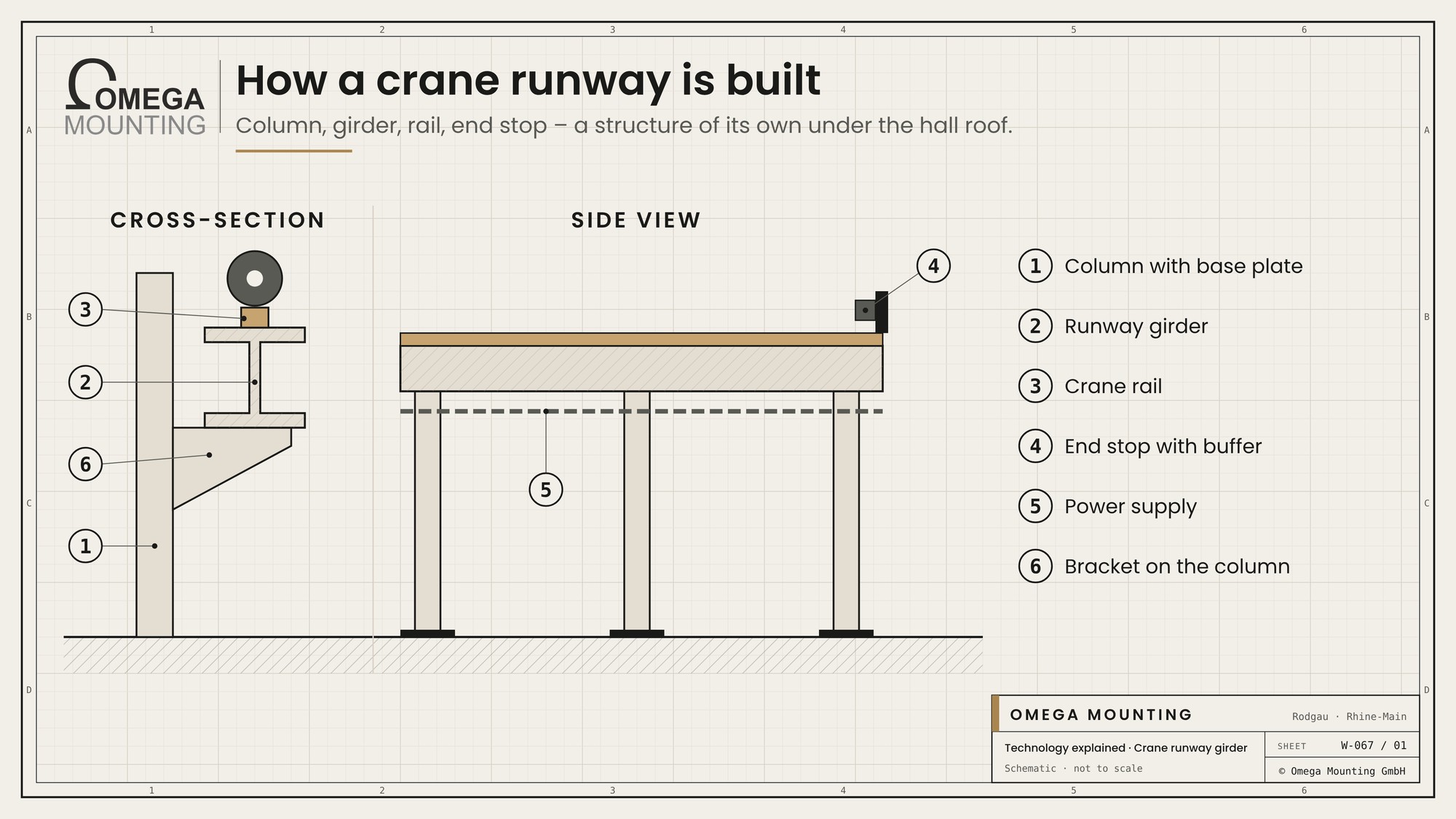
A crane runway consists of columns, two runway girders with rails and the components at the ends.
The Columns stand on base plates anchored in the floor, or are brackets on the hall columns. On them lie the crane runway girders. On top of the girder sits the crane railon which the wheels run. At both ends of each runway, end stops with buffers stop the crane if the end limit switch does not act. Along one runway runs the power supply, usually a conductor rail.
With a suspension crane it is the other way round: the crane hangs with its trolleys from the bottom flange of the runway. The principle stays the same, only the forces act differently.
Which forces act on the crane runway girder?
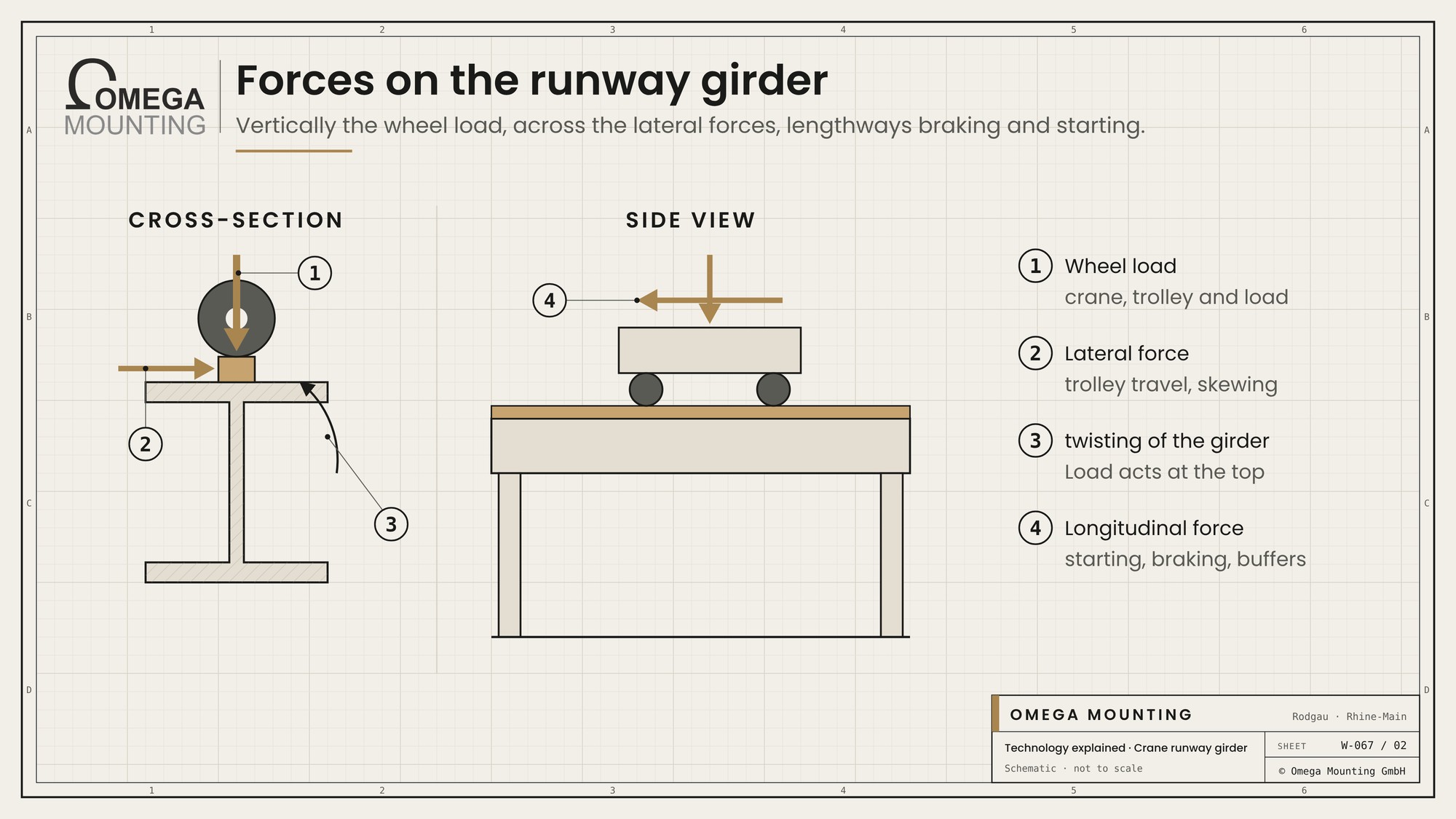
Forces act on the crane runway girder in three directions – vertical, across and lengthways – and they move with every run of the crane.
| Direction | Where it comes from | What it requires |
|---|---|---|
| Vertical | Wheel loads from the crane's own weight and the load, greatest when the trolley is close to this runway. | Bending stiffness and a web that takes the wheel load. |
| Across | Trolley travel, skewing of the bridge, wheel guidance. | Stiffness of the top flange against lateral buckling and twisting. |
| Lengthways | Starting and braking of the crane bridge, impact on the buffer. | Bracing or columns that lead the force into the ground. |
On top of that comes fatigue. An overhead crane passes over the same spots many times a day. Welds on the top flange and on the rail fixing are therefore typical places for cracks if the runway is not properly aligned.
Crane rail and fixing
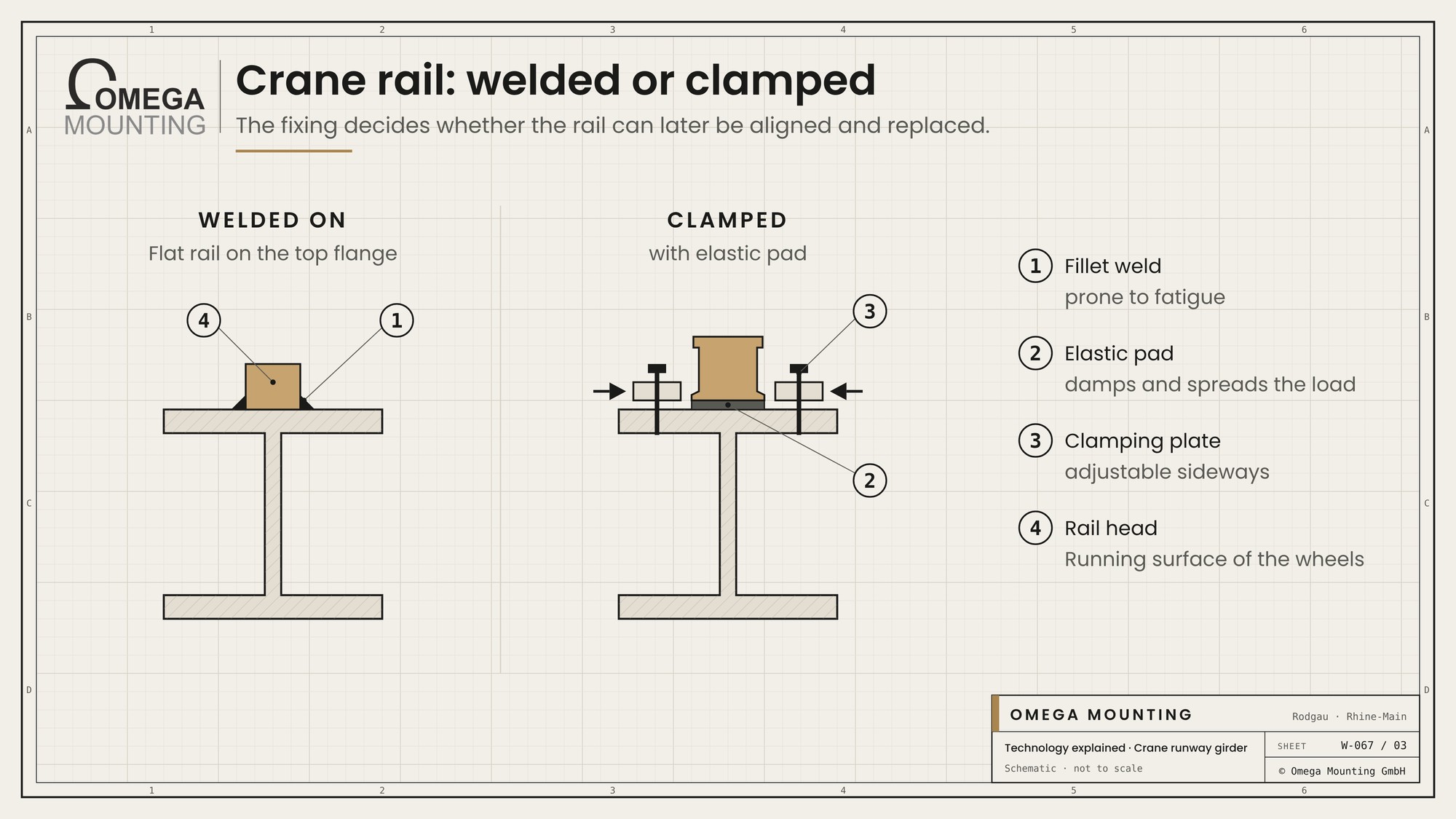
The crane rail is either welded on or fixed with clamping plates – and that choice decides whether it can later be realigned and replaced.
| Fixing | Design | Advantage | Disadvantage |
|---|---|---|---|
| Welded on | Flat or square rail with fillet welds on the top flange. | Simple, compact, no loose parts. | Later alignment and replacement are laborious; welds prone to fatigue. |
| Clamped | Crane rail with clamping plates, often on an elastic pad. | Adjustable sideways, replaceable, pad damps. | More parts, clamps must be checked and retightened. |
There must be no offset at the joints of two rail sections where the wheel would knock. At the end of each runway sit end stops that are as strong as the crane's impact on the buffer.
Tolerances: gauge, height, straightness
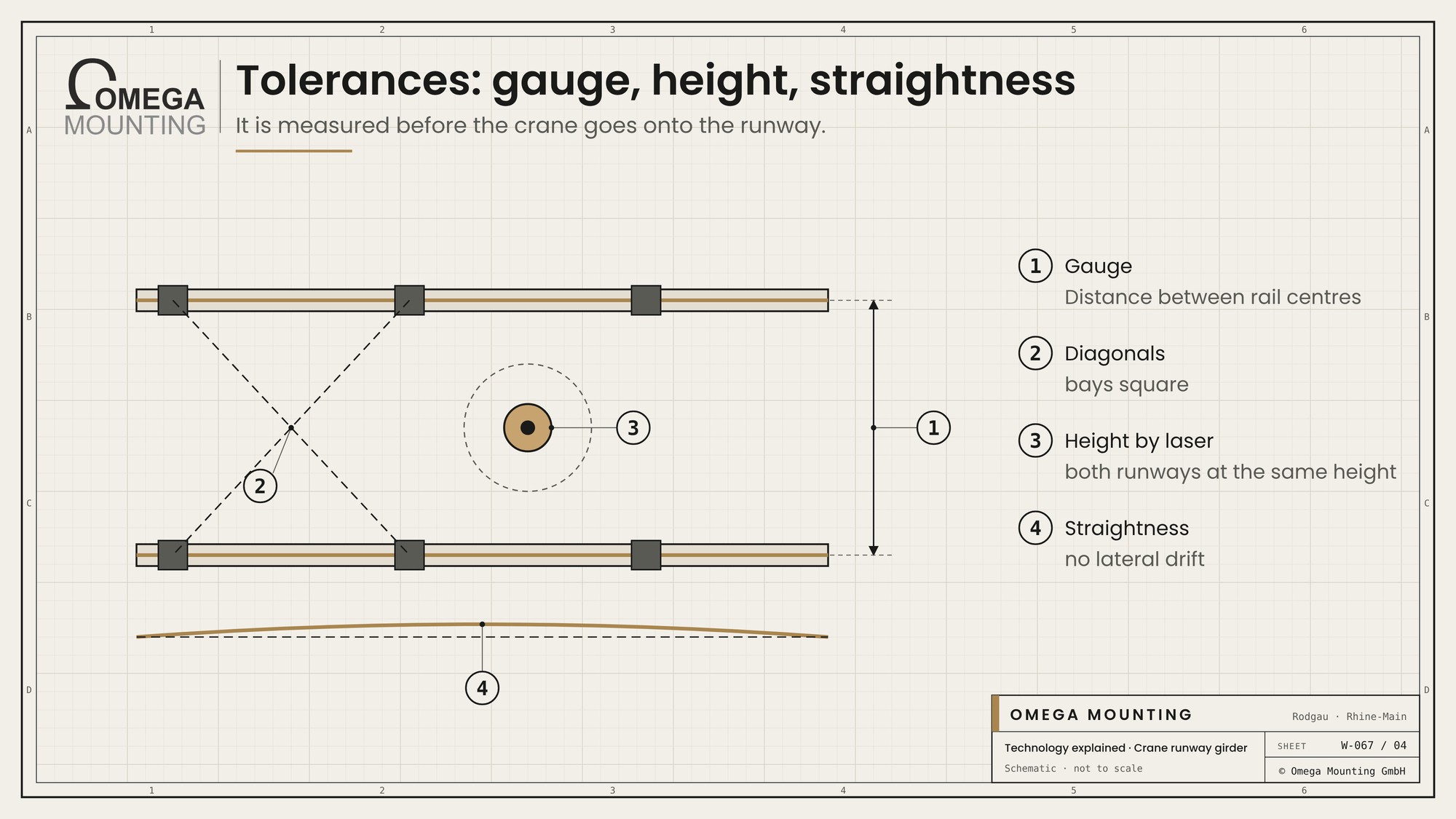
A crane runway must lie within tight limits in gauge, height and straightness, otherwise the wheels run skewed and wear the rail and wheel flanges.
- Gauge: The distance between the two rail centres must match the crane bridge along the whole length.
- Level: Both runways must be at the same height, and each runway on its own must not sag or step.
- Lateral position and straightness: The rail must not drift sideways.
- Diagonals: When the columns are set up, the diagonals show whether the bay is square.
The exact limits are set by the design; guidance values are given in the VDI 3576 guideline. Measurement is done with a rotating laser, levelling instrument or total station. How a survey works is shown in our guide Surveying a crane runway.
Inspection and typical damage
A crane runway girder works with every crane movement. Most damage develops slowly and can be spotted early during an inspection walk:
- Rail wear: The head and flanks of the crane rail wear. One-sided wear points to the crane skewing or a gauge outside tolerance.
- Loose rail fixings: Clamping plates and bolts loosen through the constant impacts. A creeping rail is a clear warning sign.
- Cracks at the top flange: Under the wheel loads, fatigue cracks can develop at welds in the area of the top flange and web. They are inspected specifically.
- Brackets and splices: Bolts at brackets, splices and columns must be tight. A loose splice changes the position of the whole runway.
- End stops and buffers: They stop the crane at the end of the runway. Damaged buffers or loosened stops are repaired immediately.
If the inspection reveals anything unusual, the crane runway is surveyed again: gauge, height and straightness compared with the permissible tolerances. Only the survey record shows whether rails need realigning, clamping plates retightening or sections replacing.
The periodic inspection of the crane and its runway is the job of a competent person. The mechanical repair afterwards – aligning, retightening, replacing rails – is part of our work.
What we pay attention to
When installing a crane runway, we work from the ground upwards.
- We set up the columns to plan and check the diagonals before drilling.
- We set the height with a rotating laser using the levelling screws of the base plates.
- We anchor the base plates with bonded anchors and grout them with non-shrink grout – with tight formwork and the right mixing ratio.
- We place the girders, align them by laser and bring them to gauge before they are firmly connected.
- We only hand the runway over to the crane after the survey.
Where we use it
For an industrial company we worked together with the in-house maintenance team and installed a crane runway for an overhead crane: runway shortened, end stops and bearing blocks welded on new, columns brought to height by laser, anchored and grouted, girders placed with two forklifts and aligned to gauge. In a new hall in the Aschaffenburg area, our two technicians brought a 16-tonne double-girder overhead crane onto its runwayin one day. You will find more on our services under Crane installation.
More technology explained
Technology explained
the crane that runs on the girder.
Guide
how gauge and height are checked.
Technology explained
which crane type suits which runway.
Do you have questions about how this works on your site?
Is your overhead crane running skewed, or is a new crane to go onto an existing runway? We align crane runways, install new ones and bring the crane onto its runway. Request a callback.
Free, no-obligation callback

About the author
Tobias Schott
Managing director of Omega Mounting GmbH, Rodgau · more than 20 years of hands-on experience in installation and maintenance
A trained mechatronics technician, working in maintenance, servicing and industrial installation since 2004 – first alongside his father, and with Omega Mounting since 2012: from overhead conveyors in Frankfurt to the crane system in a new-build hall. He plans and leads lifting operations as an appointed person (AP) in data centers and on industrial sites in the Rhine-Main region, trains and examines operators of cranes, mobile elevating work platforms and telehandlers, and is a qualified occupational safety specialist. On jobs abroad he is known as the “German Troubleshooter” – the person you call when a site gets stuck. He learned what quality means from his father, not from a manual: Made in Germany as a standard for his own work, not a label. That is why quality comes first at Omega Mounting – ahead of speed and price. The Technology explained articles cover the equipment and techniques his team uses every day: what counts on site is in them – what only appears in the brochure is not.
 English
 German