
- Technology explained – machines and equipment
Underslung crane or overhead crane: single girder, double girder and what hangs under the roof
By Tobias Schott · 5-minute read · Updated November 2026
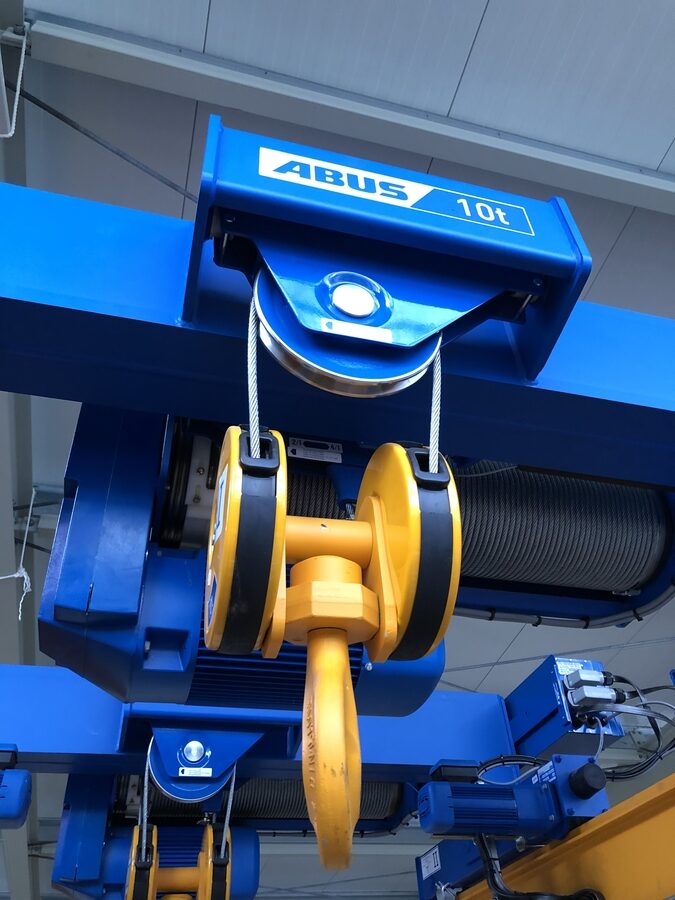
Underslung cranes and overhead cranes are both bridge cranes – one hangs below the crane runway, the other runs on top of it, and almost everything follows from that: hook height, capacity and what the hall has to carry.
Anyone planning or retrofitting a hall crane soon comes across the terms single girder, double girder, underslung crane and underslung trolley. Behind each is a design with its own strengths. The choice decides how high the hook goes, how much the crane can lift and whether the roof or dedicated columns carry the load.
Here we explain the three types, what distinguishes them, where the underslung crane has the advantage and how two trolleys work together on one bridge.
What is an underslung crane?
An underslung crane is a bridge crane whose bridge hangs with its end carriages from the bottom flanges of two crane runways, which are usually fixed to the roof structure. It is also called an underhung or suspension crane; in German it is a Hängekran.
A top-running overhead crane on the other hand runs with its wheels on top of crane rails that lie on runway girders. Both are bridge cranes: a bridge spans the hall and a trolley with the hoist runs along it. Together, long travel and cross travel cover the whole hall floor.
Key facts
- Types: Single-girder overhead crane, double-girder overhead crane, underslung crane with one or two girders.
- Trolley: On the single girder below the girder, on the double girder on top between the girders.
- Load path: Overhead crane via crane runway and columns, underslung crane via runways on the roof structure.
- Control: Pendant control or radio remote control, with two trolleys also tandem operation.
- Inspection: Before first use and periodically, at least once a year under DGUV Regulation 52.
- Installation: Bridge pre-assembled in the hall, lifted in and set onto the runway, power supply and end limit switches connected.
Three types in cross-section
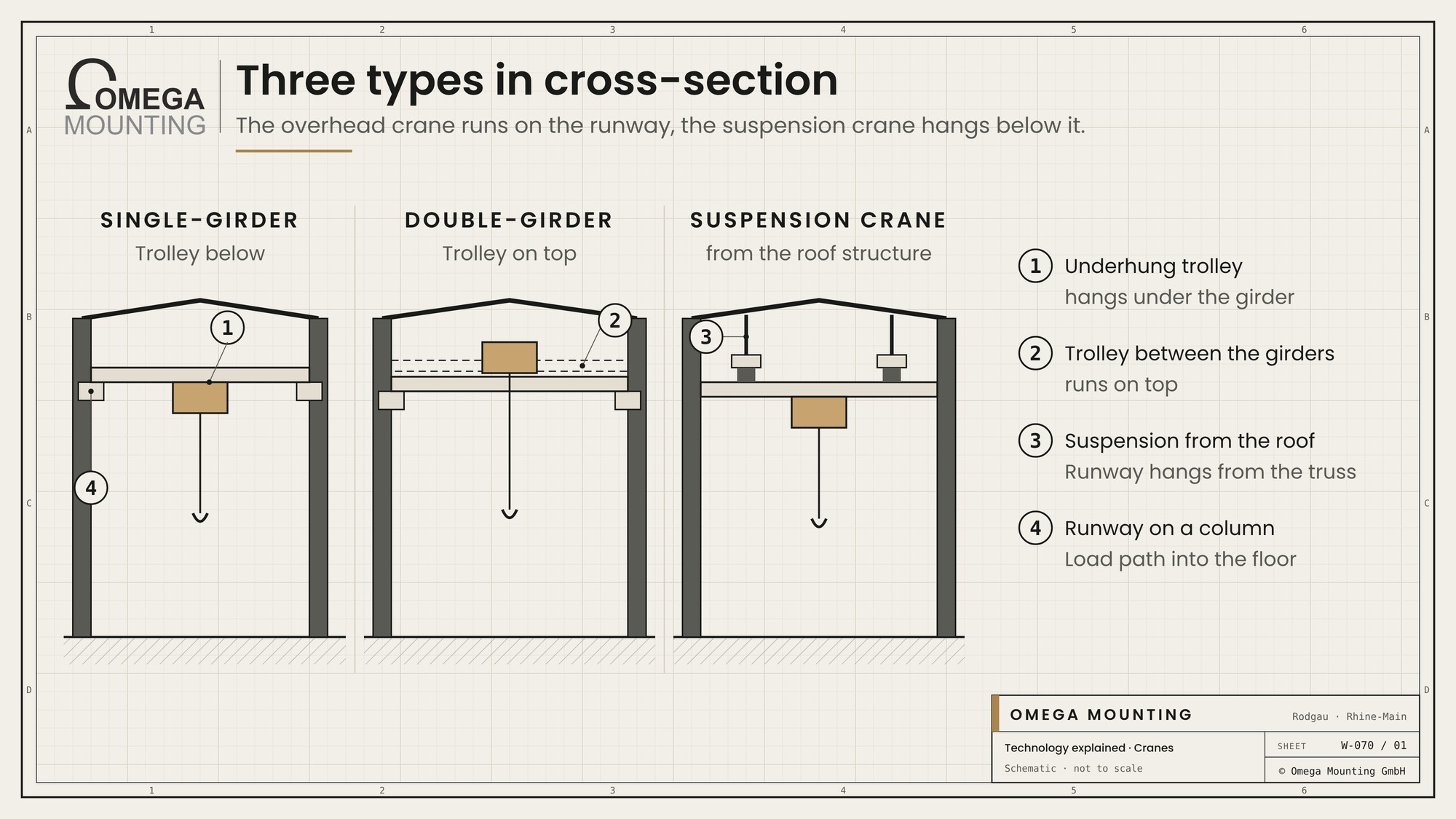
The three types differ in how the bridge sits on the runway and where the trolley travels.
| Type | How it sits | Strengths | Limits |
|---|---|---|---|
| Single-girder overhead crane | One girder, trolley runs on the bottom flange. | Light, simple, for light to medium loads. | Less hook height, limited span. |
| Double-girder overhead crane | Two girders, trolley runs on top between them. | High loads, large spans, full hook height, room for several hoists. | Heavier, needs a strong crane runway. |
| Underslung crane | Bridge hangs from the bottom flanges of the runways under the roof. | No dedicated columns, cantilever possible, transfer between runways. | For lighter loads, the roof must carry the load. |
Which capacity is possible depends on the manufacturer and the hall. As a rule of thumb: the heavier the load and the larger the span, the more likely the double girder.
Then there is the question of what the hall can take. An overhead crane needs a crane runway on columns or brackets that lead wheel loads and lateral forces into the ground. An underslung crane needs a roof that carries the crane load. In existing halls this is often exactly what decides: if there is no room for new columns, the underslung crane remains – if the roof cannot carry enough, the overhead crane on its own runway remains.
Hook height: where the centimetres are lost
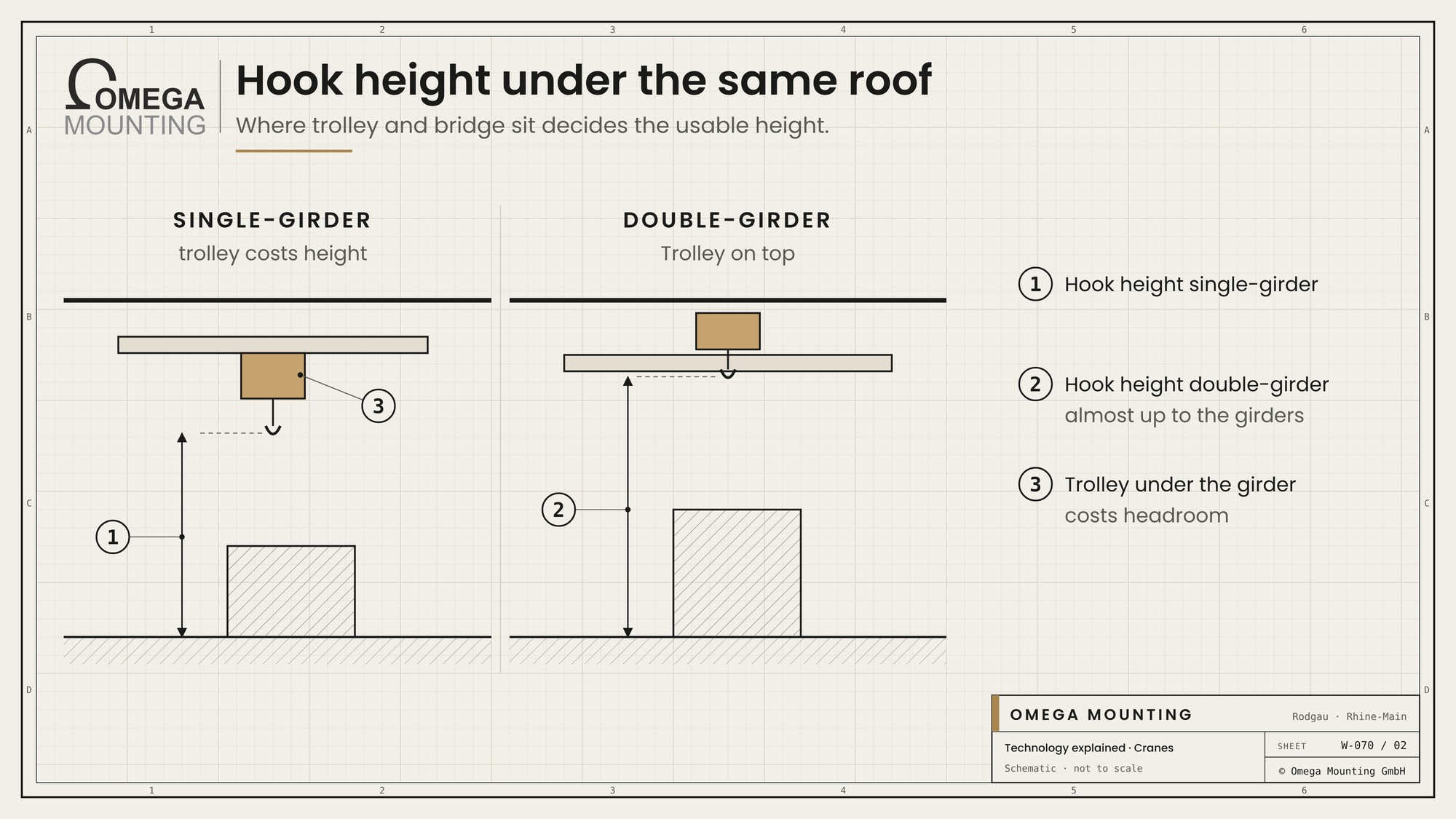
Hook height is the highest point the hook reaches – and the type decides how much of it remains under the roof.
During the operation of a double-girder crane the trolley runs on top between the girders. The hook can be pulled up to just below the girders, so the full hall height remains usable. With a single-girder crane the trolley hangs below the girder and its own construction costs height. With an Underslung crane the overall height of the runway, which itself hangs below the roof, is added.
In halls with limited height, this decides whether one machine can still be lifted over another. Anyone retrofitting therefore first measures the clear height to the underside of the roof.
What the underslung crane does better
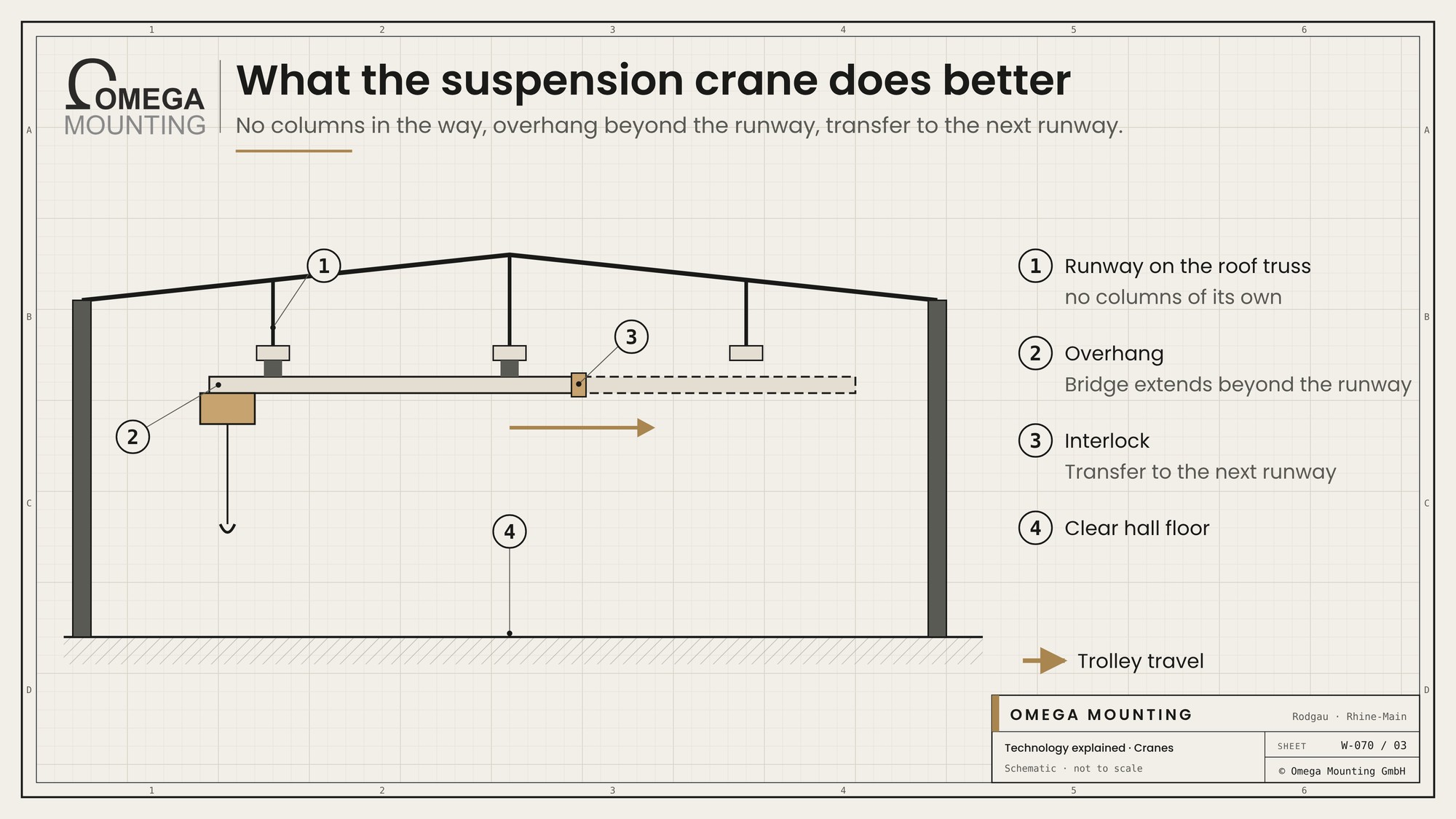
The underslung crane needs no dedicated columns, can cantilever beyond its runways and can transfer its trolley to a neighbouring runway.
- No columns in the way. The runways hang from the roof structure, the hall floor stays clear.
- Cantilever. The bridge can project beyond the outer runway and so reach areas that an overhead crane does not cover.
- Transfer. Via an interlock, the trolley can move from the crane bridge to a fixed runway or a second crane – useful for material flow between hall bays.
The price for this: the roof structure has to take the crane loads. Whether it can is clarified by the structural engineer before planning.
Two trolleys on one bridge: tandem operation
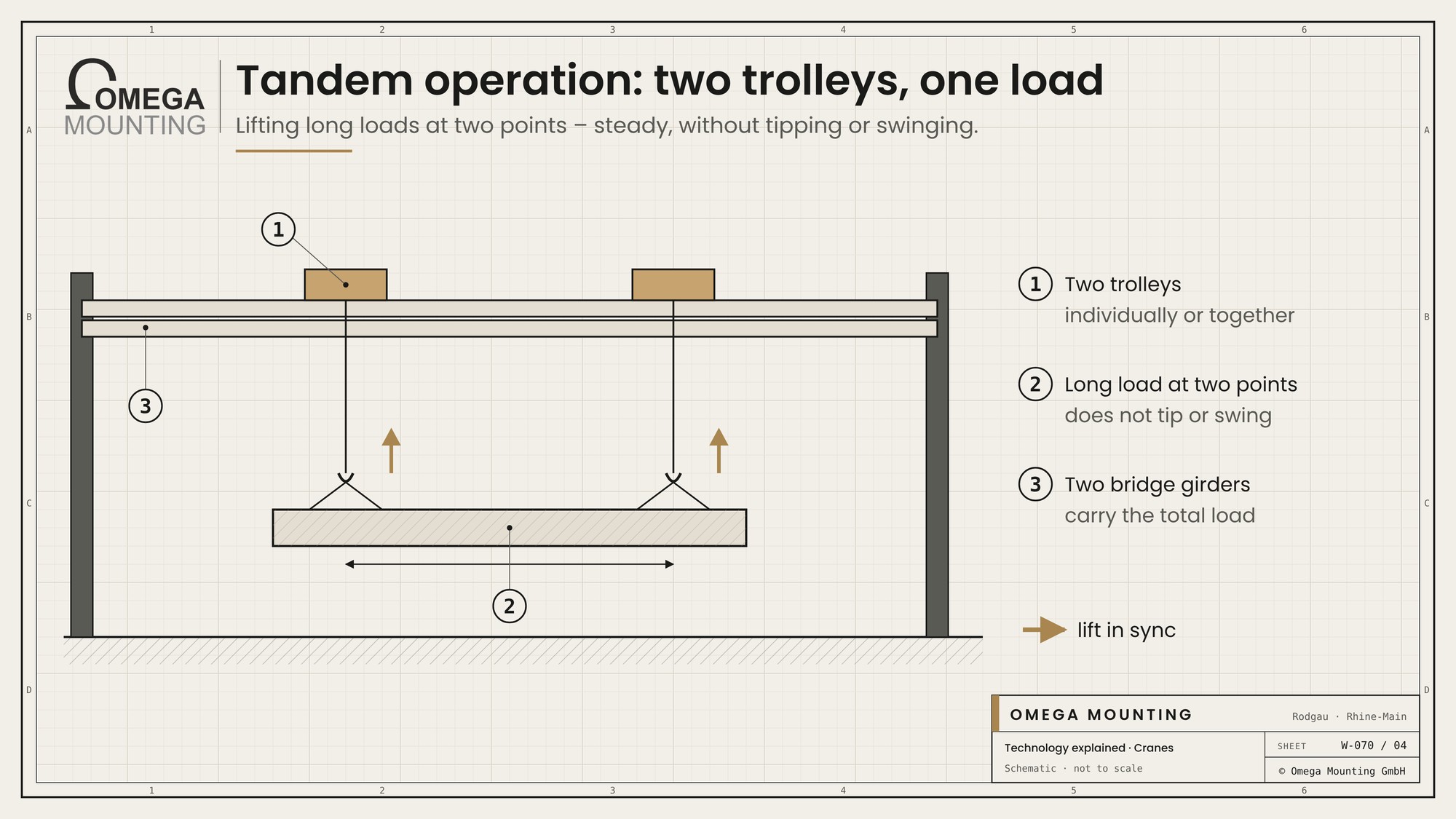
On a double-girder overhead crane, two trolleys can run and work individually or together.
In tandem operation, both trolleys travel and lift in sync. This way a long, bulky load – a machine frame, a girder, a coil – is picked up at two points and rises smoothly without tipping or swinging. The controls make sure both hooks run evenly; the total load must not exceed the capacity of the bridge, even if each trolley on its own could lift more.
Inspecting and servicing
A suspension crane hangs with its runway directly from the roof structure. That is why maintenance covers not just the crane and trolley but also the suspension:
- Suspensions: Threaded rods, clamps and pendulums connect the runway to the roof. They are checked for tightness, deformation and corrosion.
- Runway profiles: The running surfaces of the suspended runway profiles wear under the wheels. Joints between two profiles must remain flush.
- Wheels and end carriages: Wheels wear and bearings develop play. A wheel that no longer runs true makes itself heard.
- Travel drives and brakes: Motors, gearboxes and brakes of the crane and trolley are checked for function, air gap and noise.
- Power supply and end stops: Festoon cables or conductor rails, buffers and end stops are inspected for damage.
The rules for cranes require a periodic inspection by a competent person at least once a year. If the crane is used heavily in multi-shift operation, shorter intervals make sense.
If a suspension crane is extended or hung in a different place, the structural engineer first checks whether the roof can take the new loads. Installation only follows afterwards.
What we pay attention to
When installing bridge cranes, we pre-assemble from the ground.
- We pre-assemble on the ground whatever is faster and safer down there: attachments, hoists, cabling.
- Before lifting in, we check the diagonal dimension of the bridge – it decides whether it can be turned onto the runway inside the hall.
- We use short slinging when there is little room between roof and runway.
- We install the power supply, slow-down and end limit switches and controls up to the main switch.
- We install the electrics up to the main switch ourselves and hand over to the plant electrician and the competent person for the inspection.
Where we use it
In a new hall in the Aschaffenburg area, two of our fitters took one day to install a double-girder overhead crane with a total capacity of 16 tonnes – with two 10-tonne trolleys in tandem operation, pre-assembled on the ground, lifted in and turned onto the crane runway, wired up to the main power switch. Elsewhere, together with the in-house maintenance team, we installed and aligned the runway a crane travels on. More under Crane installation.
More technology explained
Technology explained
the hall crane as a whole.
Technology explained
what the overhead crane runs on.
Guide
inspection, service life and new crane.
Do you need this machine together with a team on site?
Are you planning a hall crane or want to replace an existing one? We install overhead and underslung cranes with crane runway, power supply and controls. Request a callback.
Free, no-obligation callback

About the author
Tobias Schott
Managing director of Omega Mounting GmbH, Rodgau · more than 20 years of hands-on experience in installation and maintenance
A trained mechatronics technician, working in maintenance, servicing and industrial installation since 2004 – first alongside his father, and with Omega Mounting since 2012: from overhead conveyors in Frankfurt to the crane system in a new-build hall. He plans and leads lifting operations as an appointed person (AP) in data centers and on industrial sites in the Rhine-Main region, trains and examines operators of cranes, mobile elevating work platforms and telehandlers, and is a qualified occupational safety specialist. On jobs abroad he is known as the “German Troubleshooter” – the person you call when a site gets stuck. He learned what quality means from his father, not from a manual: Made in Germany as a standard for his own work, not a label. That is why quality comes first at Omega Mounting – ahead of speed and price. The Technology explained articles cover the equipment and techniques his team uses every day: what counts on site is in them – what only appears in the brochure is not.
 English
 German