
- Guide – Occupational safety
RAMS for installation work: what you get – and what you should check
By Tobias Schott · Reading time approx. 24 minutes · Last updated: October 2026
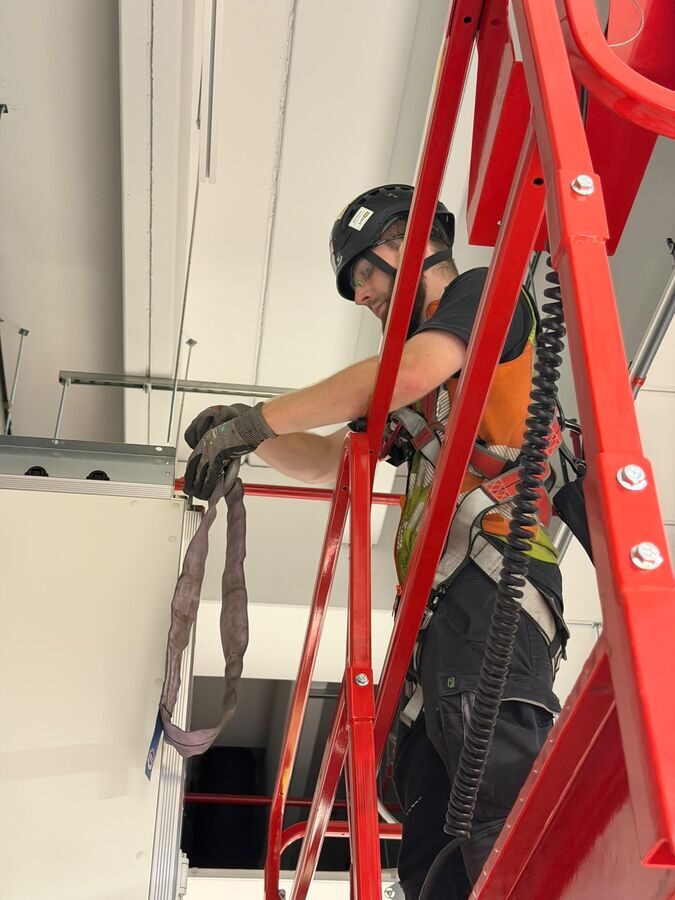
A RAMS for installation work is the project-specific combination of risk assessment and work instruction – it is good when every work step has its own hazards, controls and responsible persons and the document was recognisably written for your site.
Before an installation or a lift, you request safety documents from your subcontractor and receive a document titled RAMS. It is thick, it is in English or bilingual, it contains tables with colours and numbers. The question you have to answer as project manager is: is this a RAMS for installation work that was written for my site – or a template in which only the project name has been swapped?
The answer costs you time if you do not know what to look for. And it costs more than time if you approve an unusable RAMS. On the day of the lift you then discover that the rescue route does not work, the lift plan is missing or nobody in the crew – neither slinger nor banksman – knows the document.
This article explains what a RAMS is and how it relates to the risk assessment under Section 5 ArbSchG (German Occupational Safety Act) and to the work instruction. It also covers how a good RAMS is structured, which gaps are typical and which questions let you check it in ten minutes. It builds on our fundamentals article on qualifying subcontractors for lifting and installation work.
Key points at a glance
- RAMS stands for Risk Assessment Method Statement and combines the risk assessment and the work instruction (method statement) in one project-specific document.
- In Germany, the risk assessment is a statutory duty of the employer – regardless of whether a client requires a RAMS. The RAMS is the contractually agreed form in which it is submitted to the client.
- A good RAMS describes the work sequence step by step and assigns to each step hazards, controls according to the statutory hierarchy of controls, residual risk and responsible persons.
- Lift plan, inspection records for the work equipment, evidence of qualifications, emergency plan with rescue chain and the briefing record belong in it or are clearly referenced.
- Typical gaps are copied templates, blanket hazards with no reference to the work step, PPE as the first instead of the last control, missing authority to stop work and missing rescue plans for work at height.
- As the client, you check site reference, completeness of the steps, logic of the controls, references and briefing – not the colour of the risk matrix.
- We prepare RAMS for data centers and industrial plants in Frankfurt, Offenbach, Hanau and throughout the Rhine-Main region, project-specific after a site visit – and brief our teams on them before the first lift begins.
What is a RAMS for installation work?
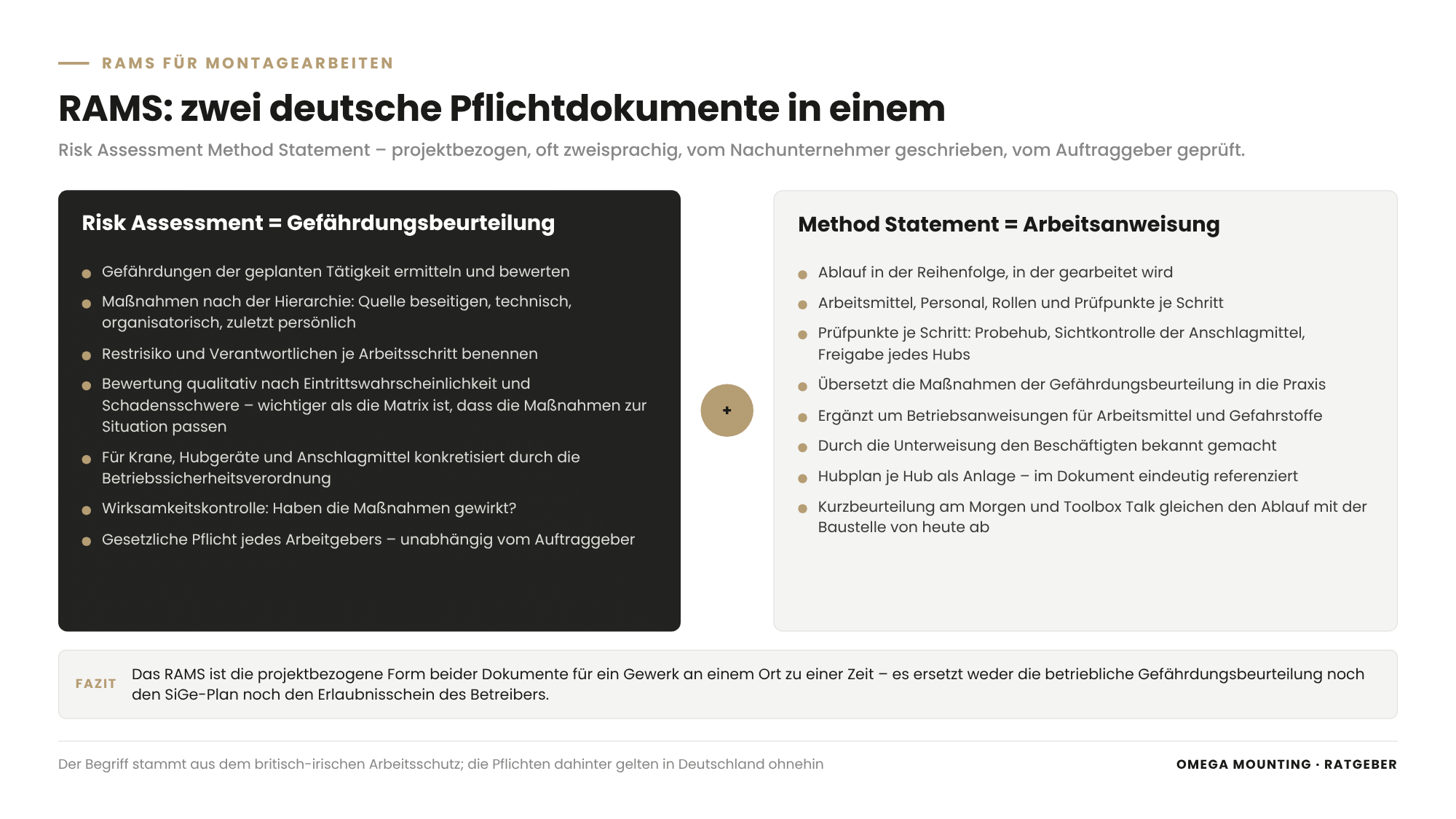
A RAMS (Risk Assessment Method Statement) for installation work is a project-specific safety document that combines the risk assessment for the planned activities and the step-by-step work instruction for carrying them out safely in one document. The term comes from British and Irish occupational safety practice and has spread to Germany via internationally managed construction sites – especially in data center construction.
Risk Assessment: the Gefährdungsbeurteilung
The risk assessment corresponds to the German Gefährdungsbeurteilung. The employer identifies the hazards associated with the work, evaluates them, defines controls and documents the result. For work equipment – cranes, lifting gear, lifting accessories, work platforms – the BetrSichV (Industrial Safety Ordinance) puts this duty into concrete terms.
Method Statement: the work instruction
The method statement corresponds to the work or installation instruction: a description of the sequence in the order in which the work is carried out – with work equipment, personnel, roles and checkpoints. In German law, the work instruction is the instrument by which the controls from the risk assessment are translated into practice. It is supplemented by the operating instructions for the work equipment and hazardous substances used. The statutory briefing makes it known to the employees.
What the RAMS is not
A RAMS replaces neither the subcontractor's company risk assessment nor the SiGe plan under the BaustellV (Construction Site Ordinance), which the building owner or their SiGeKo (health and safety coordinator) draws up for the construction site as a whole. When this SiGe plan must exist is shown in an overview in the BAuA practice brochure on site set-up. As soon as several employers are working on the site – and the use of a subcontractor already means several employers – a coordinator must be appointed. If particularly hazardous work is added or the site exceeds the threshold for prior notification (more than 30 working days and more than 20 employees, or more than 500 person-days), a SiGe plan is also mandatory. The prior notification goes to the authority at least 14 days before the site is set up. For you, this means: for an installation with a crane and a subcontractor, you may ask the building owner about the SiGeKo and SiGe plan. If both are missing, your RAMS is the only document holding the trades together. Nor does it replace the permit to work. That is the operator's day-specific work release for area and period; the RAMS is the basis for it. The RAMS is the slice of the whole that concerns a specific trade at a specific place at a specific time.
Which further evidence you may require from a subcontractor before installation and lifting work is described in our fundamentals article on qualifying subcontractors. Here we focus on the central document beneath it.
How does the RAMS relate to the risk assessment under Section 5 ArbSchG?
The RAMS is the project-specific form of the risk assessment, not its replacement and not its competitor. The duty to carry out a risk assessment applies to every employer by law and independently of the client. The RAMS is the form in which it is worked out for a specific project and submitted to the client.
| Characteristic | Statutory risk assessment | RAMS |
|---|---|---|
| Legal basis. | Statutory duty of the employer. | Contractual requirement of the client. |
| Reference. | Activities and workplaces of the company itself. | A specific project at a specific location. |
| Addressee. | Own employees, supervisory authority, accident insurance institution. | Client, coordinator, own employees. |
| Form. | Free; documentation is mandatory. | Structured document, often bilingual. |
| Contains work sequence? | Not necessarily; implementation via operating and work instructions. | Yes, as a method statement step by step. |
| Effectiveness check. | Statutory duty. | Should be included, often missing. |
Both at once – no duplicated effort
A subcontractor who has properly maintained its risk assessment for lifting work, work at height or handling pressurised gas cylinders builds the RAMS for your project from it. It adds the site-specific hazards, adapts the controls and writes down the sequence in the order of your site. Conversely, a RAMS without a maintained risk assessment can be recognised by the fact that it describes the activity as if it were the first time.
That both may be in one document is not a grey area. The German technical rule TRBS 1111 (Risk Assessment) expressly permits documentation in other records. A RAMS or a lift plan is thus a permissible form of risk assessment as long as the minimum information is included. This minimum information comprises five items: the hazards identified, the protective measures, and the type, scope and intervals of the required inspections. In addition, the justification of how requirements are met in the event of deviations, and the result of the effectiveness check – with date. For you, this means: if one of these five items is missing from the RAMS, it is incomplete as a risk assessment, no matter how thick it is.
A second passage of the same rule protects you from shortcuts. The simplified risk assessment that the ordinance allows for simple cases is not permissible for cranes or for changing site conditions. Anyone who sends you a one-page assessment for a crane move-in has the rule against them.
What German law additionally requires
Two duties under German law often do not appear expressly in RAMS of international origin but belong in them. First, the hierarchy of controls under the ArbSchG: eliminate the hazard at source, then technical, then organisational, finally personal measures. Second, the effectiveness check from the same Act, i.e. checking whether the defined controls actually work. A RAMS that names protective equipment as the first control for every hazard has skipped the hierarchy.
Coordination of several employers
If several companies work at the same place at the same time, the Act requires the employers to cooperate and the accident prevention regulation DGUV Regulation 1 requires coordination on mutual hazards. The RAMS must therefore state which other trades are working in the work area, how slewing range, load area and cordons are communicated and who takes on the coordination of trades. In the data center, the live environment – the ongoing operation of the data hall – is added as a further "neighbour".
How is a good RAMS for installation work structured?
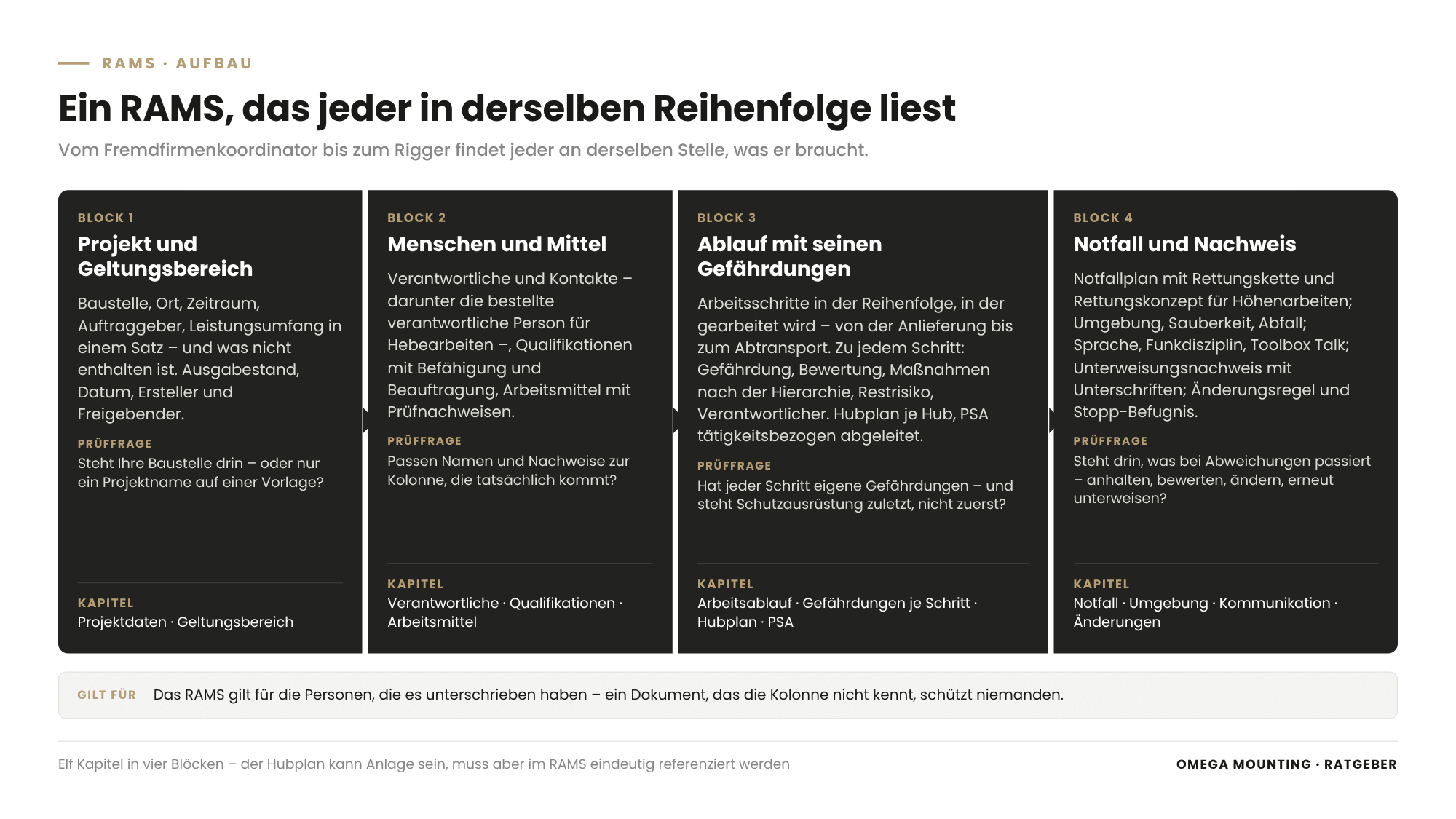
A good RAMS for installation work is structured so that everyone involved – contractor coordinator, project manager, lifting supervisor, rigger – finds what they need in the same order. First project and scope, then people and resources, then the sequence with its hazards, then emergency and evidence.
Project data and scope
Site, location, period, client, scope of services in one sentence, delimitation of what is not included. Revision status and date of the document, name of the author and of the approver.
Responsible persons and contacts
Who is in charge on site, who is deployed as appointed person for lifting operations (lifting supervisor or appointed person), who is first aider, who is the contact at the client. If this person is appointed by written delegation of duties, the reference belongs here; what this role does is described in our article on the appointed person for lifting operations.
Qualifications and evidence
Crane operators, slingers, banksmen, MEWP operators, qualified electricians – with certificate of competence and, where required, written appointment. The evidence is two-tiered: competence and appointment are separate requirements.
Work equipment and inspection records
Cranes, lifting gear, machine skates, lifting accessories (round slings, chain slings, shackles, spreader beams), work platforms, power tools. Each with a reference to the periodic inspection by a competent person – for lifting accessories under DGUV Rule 100-500 with inspection label – as well as the daily visual check against the discard criteria.
Work sequence step by step
The heart of the document: arrival and unloading, moving in, transport route, interim storage, unpacking, slinging, trial lift, lifting, moving, positioning, aligning and fixing, testing, handover, removal. All in the order in which the work is carried out, with personnel, work equipment and checkpoints for each step.
Hazards and controls per step
For each step: hazard, persons affected, risk rating before controls, controls in the order of the hierarchy, residual risk, responsible person. The rating is usually qualitative, based on likelihood and severity; more important than the matrix is that the controls fit the specific situation.
Lift plan
For each lift, a lift plan with load weight and centre of gravity, lifting points, lifting accessories and sling angle. In addition, the lifting equipment and its capacity in the planned configuration – for a crane, radius and load chart –, machine position, load path, safety distances and cordoned-off load area with a ban on standing under suspended loads. The lift plan may be an annex but must be clearly referenced in the RAMS.
Personal protective equipment
Derived from the risk assessment by activity – not as a blanket list. For fall arrest PPE, consisting of full-body harness, lanyard or self-retracting lifeline and a suitable anchor device, a rescue plan is mandatory.
Emergency, rescue, first aid
Emergency plan with escape routes, assembly point, first aiders and rescue chain, rescue plan for work at height in accordance with DGUV Rule 112-199. The rescue plan answers how a person hanging in a harness is rescued within a short time, who does it and with what equipment.
Environment, cleanliness, waste
Floor protection with protective fleece and hardboard, dust control, noise avoidance, return of packaging, handling of operating fluids. In the data center, surface protection on the raised floor is both property protection and a control against slip and trip hazards.
Communication, interfaces, briefing
Language on site, radio discipline during the lift, coordination with other trades, pre-task assessment before work starts. In addition, the toolbox talk at the start of every shift and the briefing record with names and signatures of all involved. The RAMS applies to the persons who have signed it.
Changes and authority to stop work
How to proceed if the situation on site deviates from the document: stop work, assess, amend the document, brief again. Who has the authority to stop work – everyone involved; the re-release lies with the lifting supervisor – is stated expressly in the document, as is the reporting of near misses. A RAMS without a change rule invites people to ignore deviations.
How are RAMS, lift plan and pre-task assessment connected?
RAMS, lift plan and pre-task assessment are three time levels of the same safety concept: the RAMS describes the project before it starts, the lift plan the individual lift, the pre-task assessment the situation on the morning in question. Each level refers to the one above it and adds what has changed since that was prepared.
The RAMS: before the project
The RAMS is prepared after the site visit and before the first day on site. When replacing a CRAH unit – an air recirculation cooling unit for the data hall – in a Frankfurt data center, we recorded all planning parameters in advance. Weight and centre of gravity of the unit, transport dimensions, load capacity of the floors, movement radii of the lifting devices, door clearances and passage dimensions, escape and rescue routes and lifting points. From these came the installation concept – and the RAMS, which assessed every work step individually.
The lift plan: per lift
The lift plan is the detail drawing for the RAMS. Lift plans were available for all lifting operations in the CRAH replacement, with which every lift was thought through before the project started and agreed with the client. On the day of the lift there was no discussion about where the machine stands. The lift release by the site manager presupposes this plan.
The pre-task assessment: in the morning
The pre-task assessment before work starts – internationally often called Safe Plan of Action or Last Minute Risk Assessment – checks whether the site looks today as described in the RAMS. Is the transport route clear? Is the floor protection intact? Is another trade working in the slewing range? Has the weather changed? Is today's permit to work in place? It is short, is carried out and documented by the lifting supervisor with the team in the toolbox talk. Deviations lead back into the RAMS.
What happens if it does not fit
If the situation deviates from the RAMS, work is stopped – that is the authority to stop work. The ArbSchG gives employees the right to leave the workplace in the event of immediate serious danger. Beyond that, the supervisor has the duty not to let anyone work to a plan that is no longer correct. Stopping is never a mistake – even if the concern turns out to be unfounded.
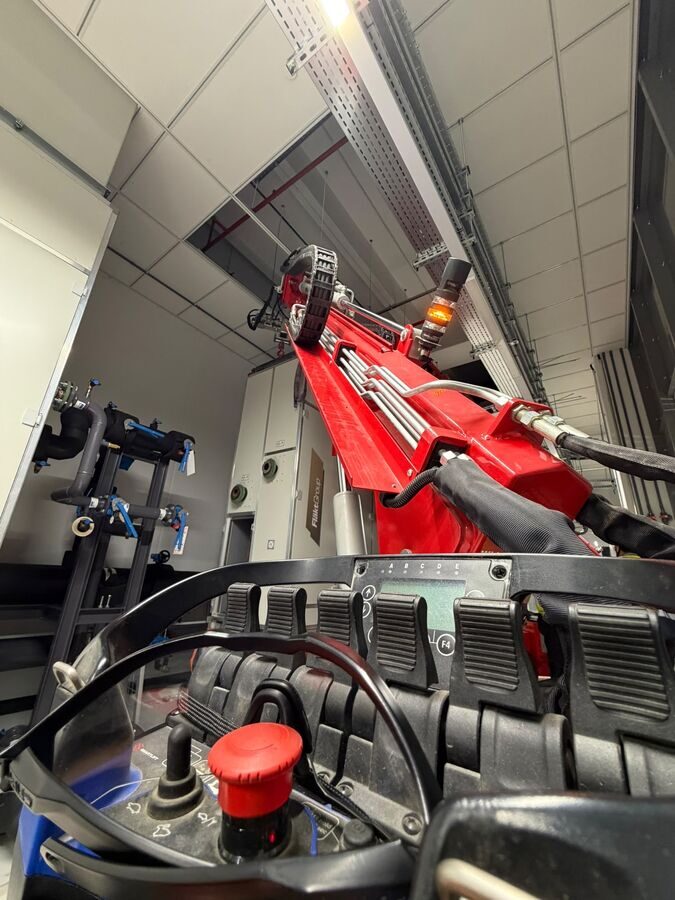
How do you recognise a good RAMS – and a bad one?

You recognise a good RAMS by the fact that it was recognisably written for your site and gives every work step its own hazards and controls. It observes the hierarchy of controls and actually delivers on all references – lift plan, evidence, rescue plan, briefing. Twelve questions are enough for a first check of a RAMS for installation work.
Twelve test questions for clients
- Is your site in it? Location, period, room, level, access – or just a project name on a template?
- Does the sequence match what will really happen? Compare the method statement with the move-in concept, the installation sequence and the construction schedule.
- Does every step have its own hazards? Or is there one hazard list for the whole project that fits every step equally?
- Do technical controls come before organisational before personal ones? PPE as the first answer is a warning sign.
- Is the residual risk credible? "Low" everywhere after one line of controls is not.
- Is there a lift plan for every lift, and is it referenced? Load weight, centre of gravity, lifting points, machine position, load path, load area.
- Are the work equipment items named and their inspections evidenced? Periodic inspection by a competent person, lifting accessories with inspection label.
- Do the qualifications match the crew that is coming? Names and evidence for crane operator, slingers, banksmen, not just functions.
- Is there a rescue plan for work at height? Not just "fall arrest PPE", but who rescues, how and with what.
- Are other trades and ongoing operations taken into account? Coordination between the employers, cordons, communication, interface to the permit to work.
- Is there a briefing record with signatures? A RAMS that the crew does not know protects nobody.
- Does it say what happens in the event of deviations? Stop, assess, amend, brief again – and who has the authority to stop work.
Typical gaps
- The copied template. Recognisable by hazards that do not exist on your site, and by the absence of those that do.
- The blanket hazard list. "Crushing hazard, falls, noise" for the whole project instead of per step.
- PPE first. The statutory hierarchy of controls is skipped.
- The missing lift plan. The RAMS talks about lifts without planning a single one.
- The missing rescue plan. Fall arrest PPE without an answer to the question of how rescue takes place.
- The missing neighbours. Not a word about other trades, ongoing operations, exclusion zones.
- The missing effectiveness check. Nobody checks whether the controls have worked.
- The language gap. Document in English, crew speaks German or vice versa – without a briefing in a language they understand.
- The signatures are missing. Or they come from people who are not on site.
What you do not need to check
The colour of the risk matrix, the number of pages and the question of whether the document is called RAMS, risk assessment or installation instruction. What matters is whether it describes the work that is taking place and whether the people carrying it out know it.
Which hazards typically belong in it for installation and lifting work?
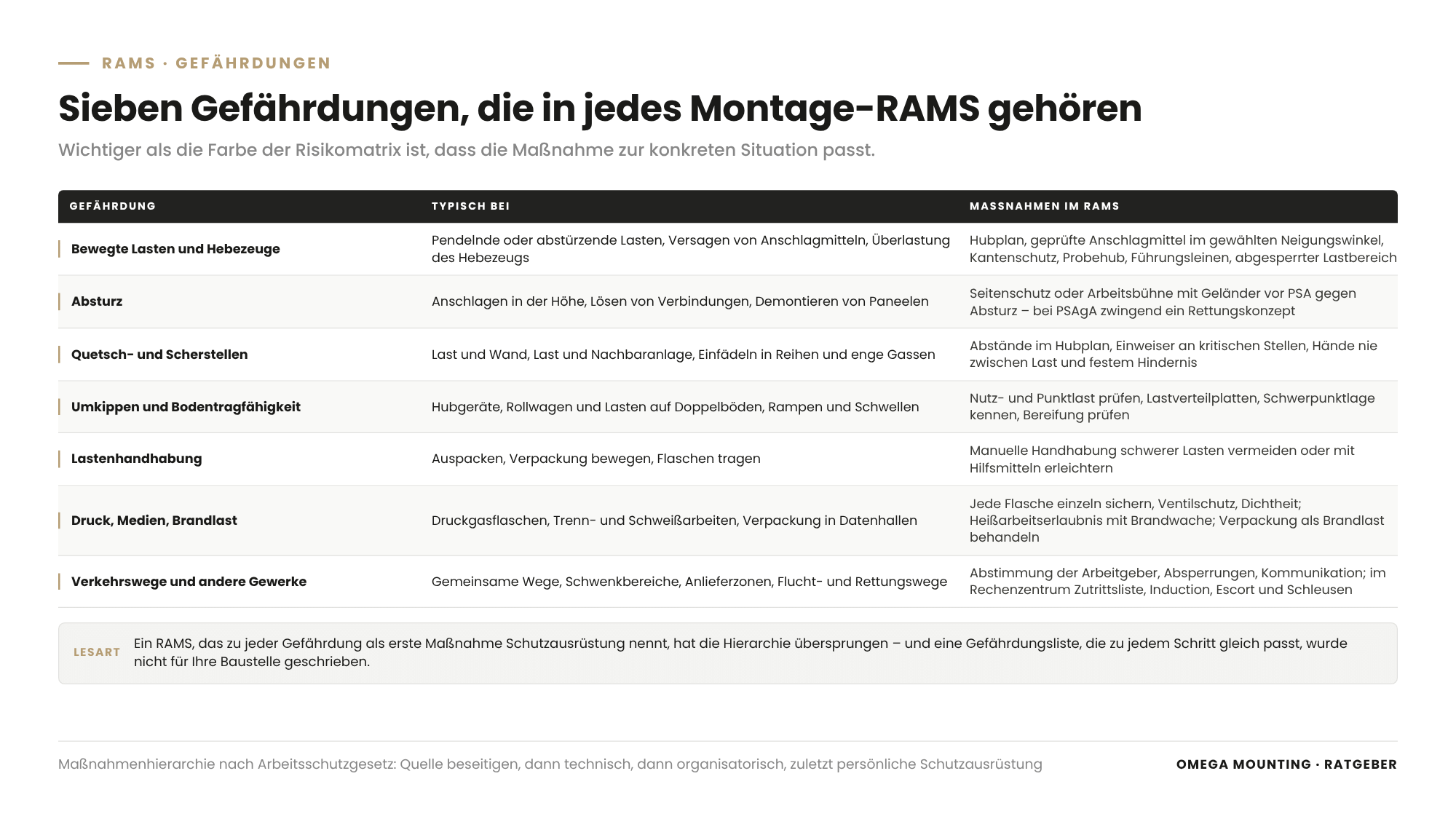
For installation and lifting work, hazards from moving loads, falls, crushing and shearing points, overturning of work equipment, manual handling, traffic routes and electrics typically belong in the RAMS. Depending on the equipment, pressure, utilities or fire load are added. The specific list comes from the site visit, not from the catalogue.
Moving loads and lifting equipment
Swinging or falling loads, failure of lifting accessories, overloading of the lifting equipment, uncontrolled movements when moving. Controls: lift plan, inspected lifting accessories with the correct capacity at the chosen sling angle and edge protection, trial lift, tag lines, cordoned-off load area, communication on the banksman's command. Which lifting accessories suit which load and edge is covered in our guide on lifting accessories for heavy loads.
Falls
Work at height when slinging, releasing connections, dismantling panels. Order of controls: fall protection by guard rails or work platform with railing before fall arrest PPE; with fall arrest PPE, a rescue plan is mandatory. In the CRAH replacement, compact scissor lifts were used to work right up to the ceiling of the gallery – with complete fall arrest PPE.
Crushing and shearing points
Between load and wall, load and neighbouring equipment, load and lifting device – especially in narrow aisles and when threading into rows. Controls: distances in the lift plan, banksman at critical points, hands never between load and fixed obstacle.
Overturning and ground load capacity
Lifting devices, skates and loads on raised floors, ramps and thresholds. Controls: check the floor's live load and point load, reduce ground bearing pressure with load spreading plates, know the centre of gravity, check the tyres.
Manual handling
Unpacking, moving packaging, carrying cylinders. The German Manual Handling Ordinance requires the manual handling of heavy loads to be avoided or eased with aids.
Pressure, utilities, fire load
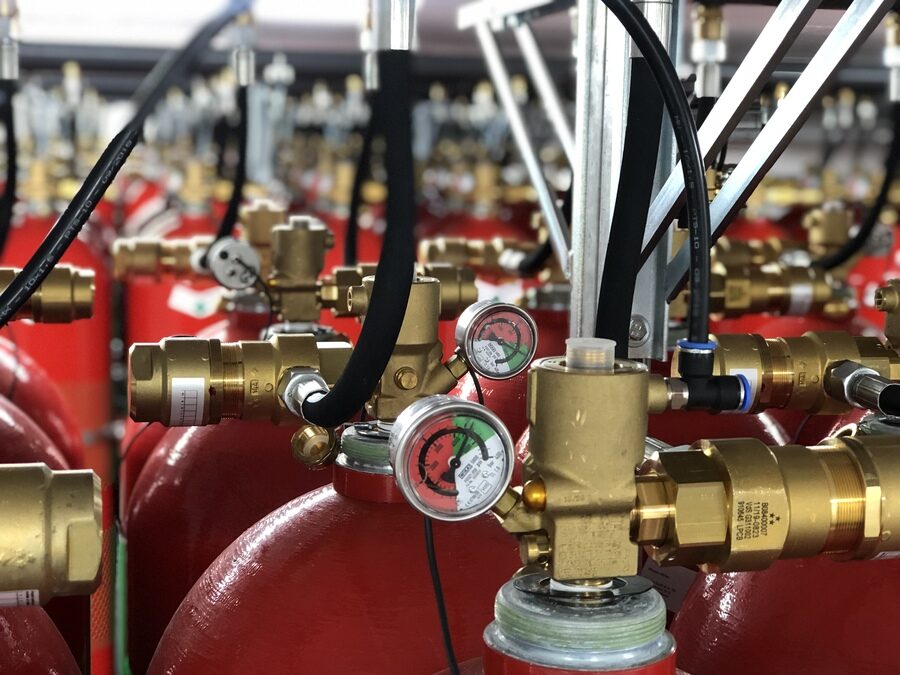
With pressurised gas cylinders at around 300 bar – as in the installation of a suppression cylinder room in the Frankfurt area – further points are added. Transport and securing of each cylinder, valve protection, tightness of the fittings and conduct in the event of unintended gas release. Cutting and welding work needs a hot work permit with fire watch. Packaging in data halls is fire load and is treated as a separate item.
Traffic routes and other trades
Shared routes, slewing ranges, delivery zones, escape and rescue routes that must remain clear. In the data center, additionally the access list, induction, escort requirement, security gates and the live data hall (whitespace) next to the plant areas (greyspace) where most of the work takes place.
How we do it in practice
Three jobs from our project diary show how RAMS, lift plan and execution are connected in our work.
Replacement of a CRAH unit in a live data center
During the replacement of a defective CRAH unit in a Frankfurt data center we prepared all documents – RAMS, pre-task assessment and lift plans – ourselves. The RAMS assessed every work step individually, so that everyone involved knew their controls before work started. A supervisor and three riggers removed the defective unit from the CRAH gallery and moved the new one up to the second floor in two working days. This was done with two synchronously controlled compact lifting devices, because a forklift or overhead crane could not be used in the confined working space. All walkways and travel routes were lined with protective fleece and taped. Before each shift, machines and lifting accessories were inspected and documented; work at height was carried out from scissor lifts with complete fall arrest PPE. Result: no damage to floor or existing equipment.
Series installation of 160 PDCs
During the rollout of 160 PDCs in eight data halls in the Rhine-Main region the risk assessment had to cover a series. Six lift-&-shift mechanics, four levels, a heavy-duty lift as the bottleneck, several weeks of project duration. The controls were correspondingly technical and organisational: a compact lifting device and an aluminium gantry with chain hoist instead of muscle power, round slings for lifting off the pallet. In addition, protective boards and fleece on all travel and work routes, suspended walls and a timed material flow that avoided congestion in the halls. Over several weeks in eight halls there was not a single instance of damage – and zero rework on 160 cabinets.
Installation of a suppression cylinder room with 240 pressurised gas cylinders
With the installation of a suppression cylinder room for a nitrogen gas suppression system in the Frankfurt area three fitters installed cylinder racks and connected pipework to the existing building system in two weeks. 240 nitrogen cylinders in six banks of 40 were moved in, secured and connected individually. At around 300 bar operating pressure, the risk assessment must include the transport and securing of every single cylinder as well as the tightness of every fitting. Valve in correct orientation, pressure gauge readable, hoses without tension or kinks, every connection tightened under control and tested. The system was then commissioned section by section by the specialist fire suppression company – without rework.
Do you have a RAMS on your desk for review – or do you need one for an installation that starts in a few weeks? Then get in touch with us. With a description of the sequence and a site plan, we can usually clarify within an hour what the document is missing or what scope it needs for your site.
What this means for your role
For buyers: Include the RAMS as a separate item in the scope of works – with site visit, lift plan per lift, document language and submission date before installation begins. Require an anonymised sample RAMS from the bidder as evidence of suitability: it shows you whether they work project-specifically or swap templates. Define in the interface list which information is provided by the client, so that missing information does not become grounds for a change order. What belongs to a lifting and installation trade is described on our service page Lift & Shift.
For designers: A RAMS can only be as good as the planning parameters the subcontractor receives. Live and point loads, raised floor class, door clearances and clear heights, lift capacity, escape and rescue routes, location of existing equipment. Provide this information in such a way that it reaches the risk assessment, and in return check whether the method statement matches the move-in concept and installation sequence. One more installation opening often saves a fall arrest PPE measure.
For project managers and site managers: Request the RAMS early enough for a site visit to precede it, and check it with the twelve questions above. Tie the lift release to the reviewed RAMS and the permit to work, and agree that changes on site are documented and briefed again. As site manager, have the briefing record shown to you at the toolbox talk on the first day on site. Deviations and stops belong in the site diary – they are the basis of the effectiveness check. How we organise lifting work in the data center is shown on our page on data center construction.
For maintenance managers: For work on or next to running equipment, you are the source of the hazards that would otherwise be missing from the RAMS. Isolation and lockout (LOTO), residual energies, utilities, operating states, your company's permit-to-work and hot work rules. Read the method statement to see whether it contains your release steps at the right point, and coordinate the morning pre-task assessment with your shift personnel.
For safety officers and HSE coordinators: Compare the RAMS with the SiGe plan and the hazards of other trades. Check whether permit to work, risk assessment and lift plan refer to the same areas and periods. Check the hierarchy of controls, the rescue plan and the delegation of duties to the appointed person for lifting operations. And make sure that the briefing takes place in a language that everyone in the crew understands. Clarify in advance that the authority to stop work applies to everyone and how near misses are reported.
RAMS outline: template to request
The RAMS outline for installation and lifting work is an annotated chapter structure. For each section – from project data through work sequence, hazards per step and lift plan to emergency, briefing and changes – it names the mandatory content, the German legal basis and a test question for the client. A list of typical gaps completes it. It helps project managers with reviewing and subcontractors with preparing. Request the RAMS outline via our Contact form – keyword "RAMS outline".
Why Omega Mounting?
We are an installation contractor from Rodgau near Frankfurt and prepare a RAMS for installation work with lift plans for every job in data centers and industrial plants – project-specific after a site visit, in the language agreed on site. We brief our teams on it before the first lift begins. The linked jobs show the result: a CRAH replacement during ongoing operations without damage, a rollout of 160 cabinets without rework, 240 pressurised gas cylinders tightly connected. From Rodgau we are on site at short notice in Frankfurt, Offenbach, Hanau and the Rhine-Main region, and reachable via the 24-hour hotline outside office hours too. Our workshop manufactures auxiliary structures and lifting fixtures when a lift plan needs them. An overview of our work on site is given on the page on industrial installation in Hanau, and an overview of all services on the page Industrial installation. For you, this means: RAMS, lift plan, appointed person and installation come from a single source and one contact. The document you review was written by the same people who will be standing on your site in Frankfurt, Offenbach or Darmstadt on the day of the lift – get in touch with us, before the next RAMS lands on your desk.
Conclusion
A RAMS for installation work is not an additional instrument alongside German occupational safety law but its project-specific form: risk assessment and work instruction in one document, supplemented by lift plans, evidence, rescue plan and briefing. It is good when it was written for your site, assesses every step individually, observes the hierarchy of controls and is signed by the people carrying out the work. As the client, you check site reference, sequence, references and briefing – not the colour of the matrix. Are you planning an installation or a lift in the Rhine-Main region and want to know what a project-specific RAMS for installation work looks like for it? Send us a description of the sequence, a site plan and the installation date – we will get back to you with an honest assessment of what scope the document needs for your site.
Planning maintenance, moving in or installation in the Rhine-Main region?
Tell us briefly what it is about – we will come back to you with an honest assessment.
100% free and without obligation
You may also be interested in these guides

About the author
Tobias Schott
Managing director of Omega Mounting GmbH, Rodgau · more than 20 years of hands-on experience in installation and maintenance
A trained mechatronics technician, at home in maintenance, servicing and industrial installation since 2004 – first at his father's side, since 2012 with Omega Mounting: from the overhead conveyor in Frankfurt to the crane system in a new-build hall. Plans and leads lifting operations as appointed person in data centers and on industrial sites in the Rhine-Main region, is an instructor and examiner for cranes, mobile elevating work platforms and telehandlers, and a safety officer. On jobs abroad he is known as the “German Troubleshooter” – the one you call when things get stuck on site. He learned what quality means not from a manual but from his father: Made in Germany as a standard for his own work, not as a label. That is why it comes first at Omega Mounting – before speed and before price. He writes these guides from that practice: what works on our sites is in them – what only exists in the standard is not.
Frequently asked questions
RAMS stands for Risk Assessment Method Statement. A RAMS for installation work is a project-specific safety document that combines the risk assessment and the step-by-step work instruction for a specific installation or lifting job. The term comes from British and Irish occupational safety practice and is customary on internationally managed construction sites in Germany.
No. The risk assessment is a statutory duty of every employer and must be documented – regardless of whether a client requires a RAMS. The RAMS is the project-specific elaboration of this risk assessment together with the work instruction, in the form the client requires by contract.
The RAMS describes the entire project with all work steps and hazards; the lift plan is the detailed planning of an individual lift with load weight, centre of gravity, lifting points, lifting equipment, machine position, load path and load area. The permit to work is the operator's day-specific work release for area and period, based on the reviewed RAMS. Both must be clearly referenced in the RAMS.
The subcontractor carrying out the work, because it is the employer of its employees and knows its work equipment and methods. The client provides the site-side information – access, other trades, operating state, floor loads – and reviews the document before granting the lift release.
With twelve questions: site reference, agreement of the sequence with the move-in concept, hazards per step, hierarchy of controls, credible residual risk, lift plan per lift. In addition, inspection records for the work equipment, qualifications of the actual crew, rescue plan, consideration of other trades, briefing record with signatures and a rule for deviations including the authority to stop work. If more than one answer is missing, the document is not ready for approval.
The core is the risk assessment under the ArbSchG (German Occupational Safety Act), put into concrete terms for work equipment by the BetrSichV (Industrial Safety Ordinance). The hierarchy of controls, effectiveness check, briefing and the duty of several employers to cooperate come from the same Act; coordination on mutual hazards is governed by DGUV Regulation 1. For cranes and lifting accessories, DGUV Regulation 52 and DGUV Rule 100-500 are added.
The document may be in the language agreed on site, often bilingual. What matters is the statutory duty to brief: the briefing of employees must take place in a language they understand. An English RAMS for a German-speaking crew – or vice versa – therefore needs a briefing and a toolbox talk in the team's language.
Yes. The system of risk assessment per step, work instruction, lift plan, rescue plan and briefing applies equally to machinery relocations, crane erections, plant installations in logistics or standby power systems. The data center adds the live environment, access rules with induction and escort, and finished surfaces on the raised floor as boundary conditions.
Work is stopped, the deviation is assessed, the RAMS is amended and the team is briefed again – only then does work continue. This rule belongs in the document itself, because a RAMS without a change procedure invites people to pass over deviations. Stopping is never a mistake.
Send us via the Contact form three details: a brief description of the installation or lifting work with load data, a site plan or photos of the installation location and transport route, and the planned period. We arrange the site visit – whether a data center in Frankfurt or Offenbach, an industrial plant in Hanau or a logistics center in the Rhine-Main region. You will then receive a written assessment of the scope and structure of the RAMS, the lift plans required and the site-side information we need for it. Your contact is Tobias Schott.
 English
 German