
- Guide – Maintenance
Replacing a dock leveller: removal, installation and return to service during operation
By Tobias Schott · 20-minute read · As of November 2026
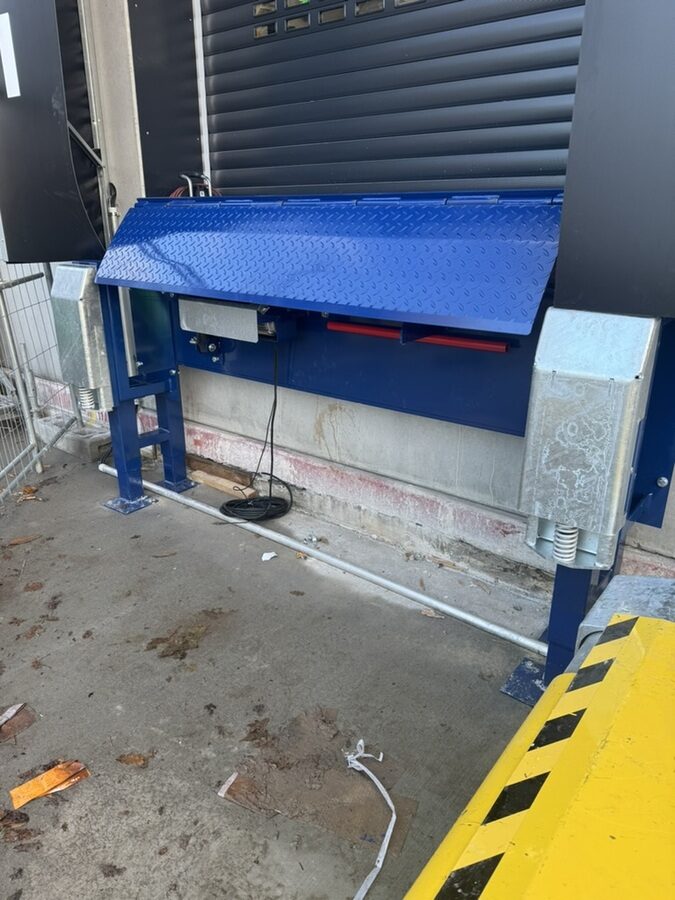
Replacing a dock leveller means cutting out the old leveller, welding the new one in at the dock edge, connecting hydraulics and controls and releasing the loading dock again. Well prepared, this is often done in a day – one door at a time, while the yard keeps running.
The leveller at the loading dock works harder than almost any other component on site. With every lorry, a loaded forklift rolls over it, forwards, backwards, braking. Add the impacts when lorries dock and the constant up and down. At some point repairs are no longer enough: the structure is fatigued, the hydraulics leak, spare parts are unavailable, or the manual lip leveller no longer suits today's throughput.
If you search for replacing a dock leveller, you mainly find manufacturers selling new levellers. It is less clear how the replacement itself works. How does the old leveller come out without damaging the edge? How is the new leveller fixed? Who connects hydraulics and controls? And how does the logistics centre keep running meanwhile? This guide answers these questions from the point of view of an installation contractor that cuts out, welds in and connects levellers.
It is written for logistics managers, site and maintenance managers, project and site managers, buyers and plant engineers – anyone who wants to renew a loading dock without bringing the yard to a standstill.
Key points at a glance
- Replacing a dock leveller is a six-step process: survey, close the dock door, cut out the old leveller, weld in the new one, connect hydraulics and electrics, inspect and release.
- Not every leveller has to go. Cracked welds or individual components can often be repaired. Replacement pays off when the structure is fatigued or the type no longer fits.
- The type decides the effort. A lip leveller at the edge is replaced faster than a pit leveller.
- Welding at the edge is the core of the installation. The weld must withstand every forklift and needs protection against corrosion.
- Hydraulics, controls and signal light are connected at the same time. With us, all of this comes from one contractor.
- In a live building the replacement goes one door at a time. The neighbouring doors keep running, and the closed door is properly cordoned off.
- Before the first loading the new leveller is inspected, adjusted and released. Staff are given a briefing.
What does replacing a dock leveller actually involve?
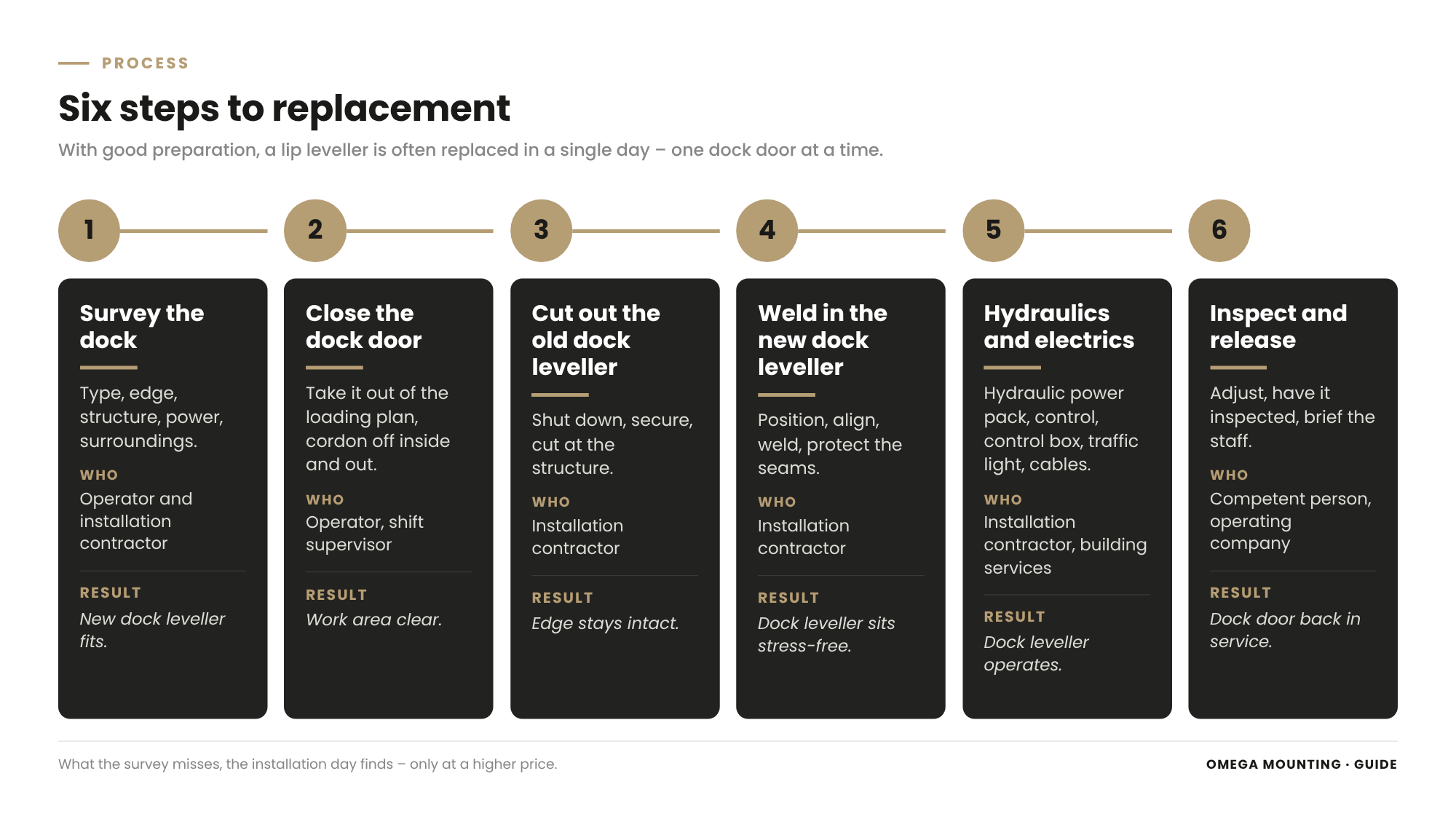
A new leveller arrives finished from the manufacturer. On site it is not built but installed. The replacement can be divided into six steps.
First, survey what is there. Which leveller is installed, how is it fixed, what does the edge look like? Is there power at the door, a door control system, a vehicle restraint?
Second, close the dock door. The door concerned is taken out of loading operations and the area in front of and behind it is cordoned off.
Third, cut out the old leveller. The old leveller is separated from the edge structure, secured and taken away.
Fourth, position and weld in the new leveller. It is positioned, aligned and welded to the existing steel structure.
Fifth, connect hydraulics and electrics. Power unit, controls, control box and signal light are installed, wired and adjusted.
Sixth, inspect and release. The leveller is inspected before the first loading, staff are briefed and the door goes back into service.
Why the replacement is usually quicker than expected
Many operators expect a long construction job. With a lip leveller at the edge, the replacement is often done in a day if the preparation is right. In Frankfurt we replaced two levellers in a single working day – cut out, welded in, connected and handed over.
When it takes longer
It takes longer if the pit of a pit leveller has to be modified, if the edge is damaged or if power, foundation or controls by others are missing. The survey shows this beforehand – not the installation day.
Repair or replace?
Not every leveller with a defect has to go. Cracked welds, a leaking cylinder or a worn lip can often be repaired. How that works and how a closed leveller is returned to service is described in our guide on maintenance of loading ramps.
When replacement is the better choice
Replacement pays off when several defects come together: fatigued structure in many places, recurring cracks, spare parts that no longer exist, or hydraulics that keep failing. Another reason is the type. A manual lip leveller costs muscle power and time with every lorry. A hydraulic leveller moves at the push of a button and settles onto the loading platform under control.
Inspection as the trigger
The annual inspection is often the trigger. If the leveller fails, the door stays closed until the defect is rectified. How to get from the inspection report to return to service is set out in our guide Rectifying UVV defects. If the defect is fundamental, replacement is often the quicker way back into operation.
Spare parts and manufacturers
Many levellers come from manufacturers that no longer exist or no longer support old ranges. Every repair then becomes a one-off. If it is foreseeable that cylinder, power unit or controls will soon be unavailable, a planned replacement is better than a breakdown in the middle of peak season.
Which leveller fits: lip leveller, pit leveller, dock house leveller
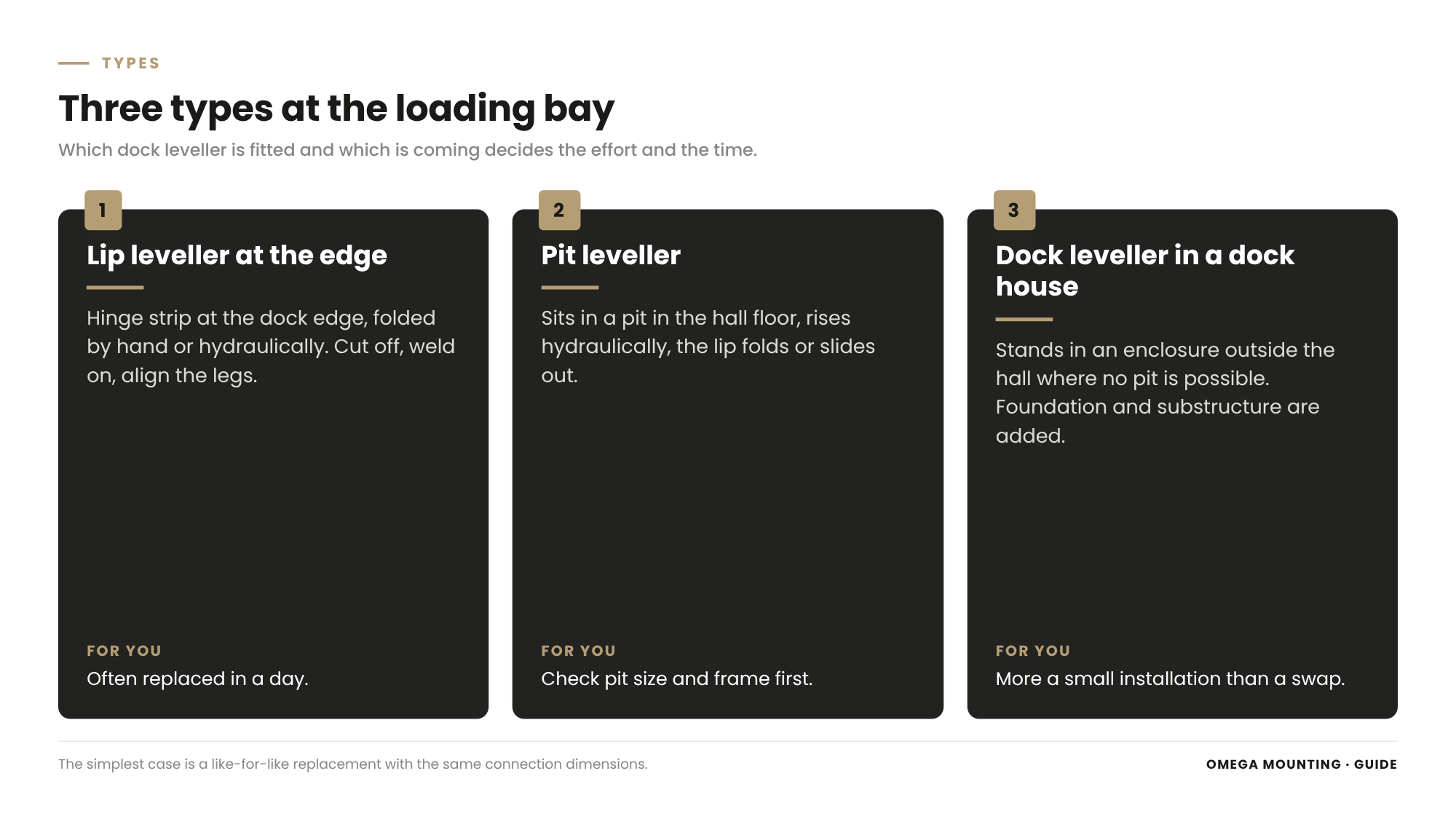
Three types are common at loading docks. Which one is installed and which one is to come decides the effort of the replacement. We explain the types themselves in our article on Dock leveller.
Lip leveller at the edge
A lip leveller sits with its hinge strip directly at the dock edge. For loading it is folded down onto the loading platform and raised again afterwards. Old models are moved by hand, new ones hydraulically. Replacement is comparatively quick: cut off the old leveller, weld on the new one, align the legs.
Pit leveller
A pit leveller lies in a pit in the hall floor at the dock edge. It rises hydraulically, and the lip folds or slides onto the loading platform. For a replacement, what matters is the pit dimensions, the condition of the pit frame and whether the new leveller fits without modification.
Dock house leveller in front of the façade
Where no pit is possible, the leveller stands in a dock house in front of the hall. Foundation, substructure and connection to the façade come on top. The replacement is more a small installation than a simple swap.
Same type or change of type
The simplest replacement is like for like with the same connection dimensions. Changing from a manual to a hydraulic leveller is also quite feasible, but needs power at the door and space for power unit and controls.
Load capacity and use
The new leveller has to suit what rolls over it. A heavy forklift with a full pallet needs a different leveller from a pallet truck. The vehicles count too: if you handle different lorries with different bed heights than twenty years ago, you may need a longer lip or a larger working range. You decide this with the manufacturer before ordering.
Before the replacement: surveying what is there
Most surprises when replacing a dock leveller can be found beforehand. That is why we look at the loading dock before the new leveller is ordered.
Edge and structure
How is the old leveller fixed – welded, bolted, in a pit frame? Is the edge angle still straight and firmly set in the concrete? Are there cracks, rust or old repairs? The new leveller is only as good as the structure it is welded to.
Dimensions and delivery condition
Width, length, edge height and the space next to the door decide which leveller fits. We agree the dimensions with the manufacturer of the new leveller and clarify the condition in which it arrives: pre-assembled, with power unit, with controls.
Power and controls
Is there a connection at the door for a hydraulic leveller? Where is the door control? Should leveller and door be interlocked? If the permanent supply is missing, we plan a temporary solution and agree it with building services.
What is worn around the leveller
Buffers, door seal, signal light, vehicle restraint and impact protection are often as old as the leveller. Worn buffers, for example, make every lorry hit harder and damage the new leveller. Renewing them at the same time saves a second visit.
Pit and drainage
With pit levellers, we also look at the pit floor. If water stands there, leaves collect or the drainage is blocked, the hydraulics and substructure of the new leveller suffer just as much as those of the old one. A dirty pit is cleaned before installation, a blocked drain cleared.
Removing the old leveller: cut, secure, dispose
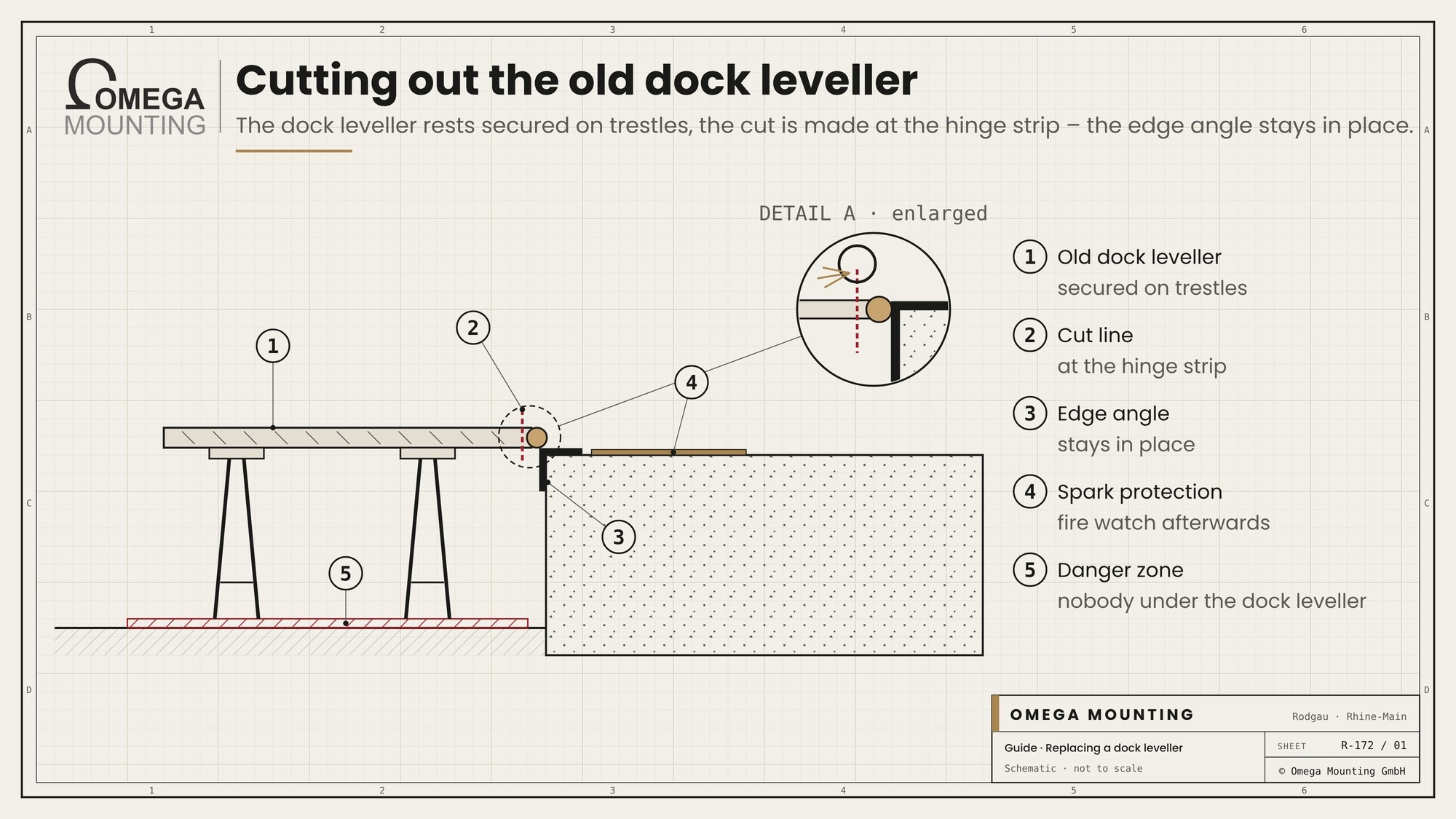
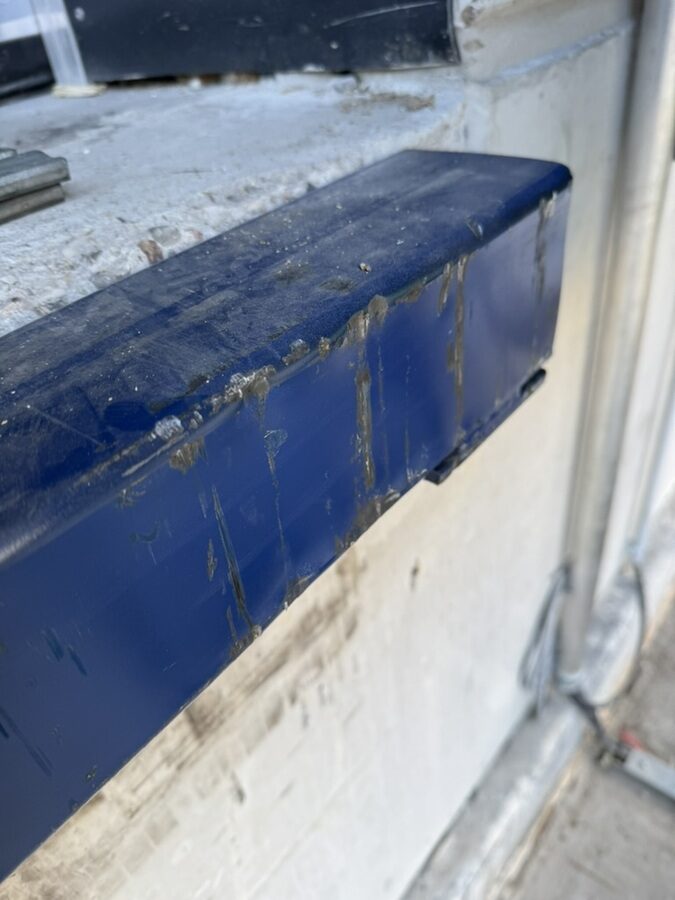
Removal is the part that needs the most care. The old leveller has to come out, the edge should stay.
Cutting in the right place
The old leveller is separated from the structure where it is welded. Depending on the position we use an angle grinder or a cutting torch. The cut is made so that enough of the edge angle remains to weld the new leveller on cleanly.
Securing the leveller
A leveller is heavy. Before the last cut, it is secured – on the forklift, on trestles or on lifting equipment. Nothing falls uncontrolled, and nobody stands under a loose load.
Hot work with a permit
Cutting and welding are hot work. Sparks fly far, and loading docks often have packaging, film and pallets lying around. Before starting, we clear the area, lay out spark protection, provide extinguishers and, where the operator requires it, work with a Permit to work. After finishing, a fire watch remains.
Removal and disposal
The old leveller is dismantled or taken away in one piece. Hydraulic oil is drained and disposed of separately. Who takes the old leveller is clarified beforehand so that it does not sit in the yard for days.
Lines and connections of the old leveller
If the old leveller already has hydraulics or controls, these are shut down, secured against switching back on and disconnected before cutting. Hydraulic lines are depressurised and sealed. Only then is it cut – otherwise the grinder hits a pressurised line or a live cable.
Positioning and welding in the new leveller
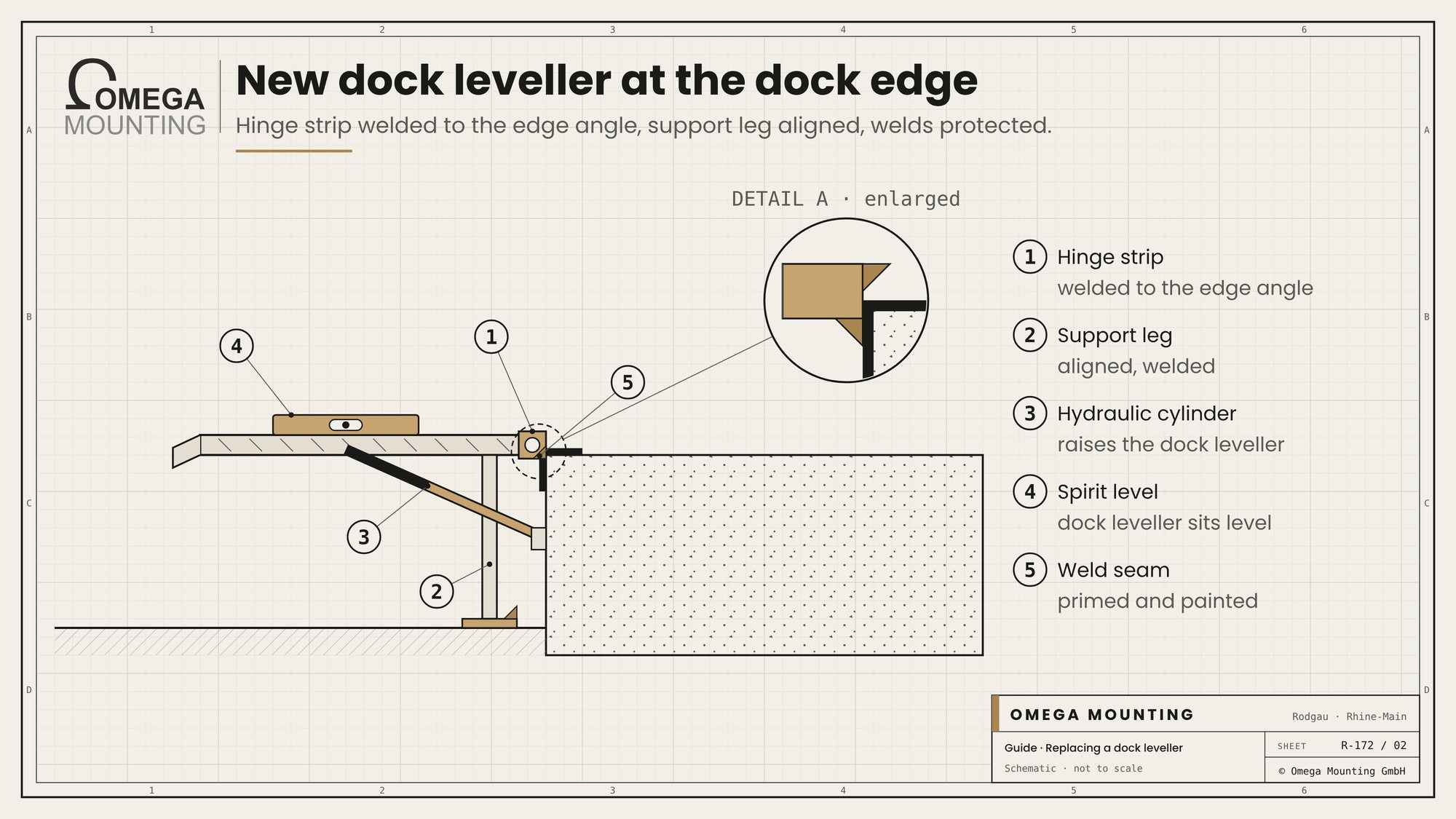
Installation creates the joint that has to carry every forklift for years to come.
Positioning
The new leveller is brought into position with the forklift or a lifting device. It must sit flush at the edge, centred on the door and at the right height for the edge.
Aligning
Before welding, we align the leveller: level, flush with the edge, with free-running hinges. The support legs are aligned so that the leveller stands free of stress. A leveller welded in crooked distorts under load and cracks at the welds. Where the edge itself is no longer straight, we compensate with shims and fitting pieces instead of forcing the leveller into a crooked position. We record the deviation in the report.
Welding in
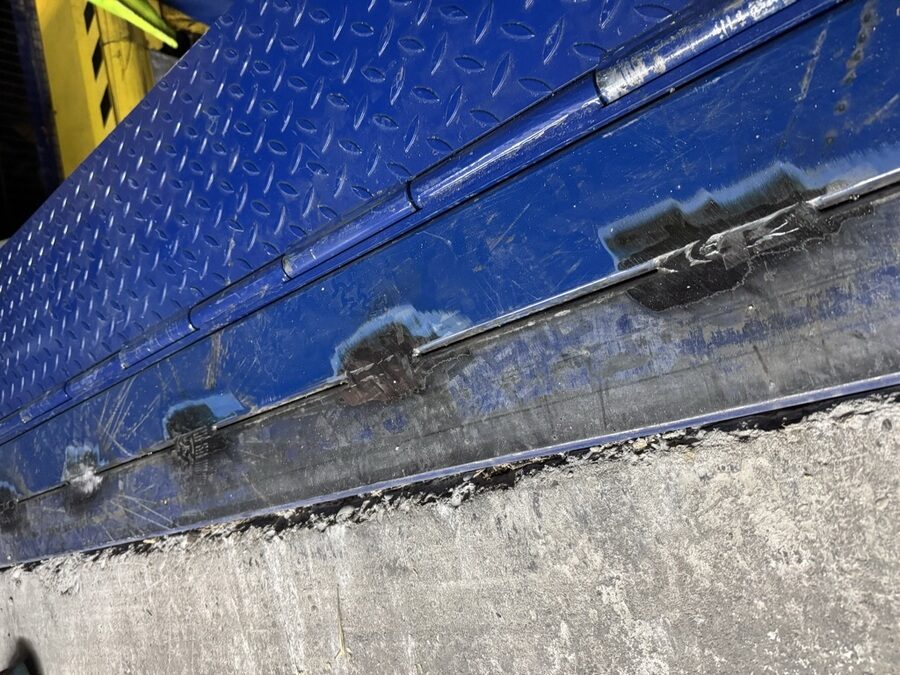
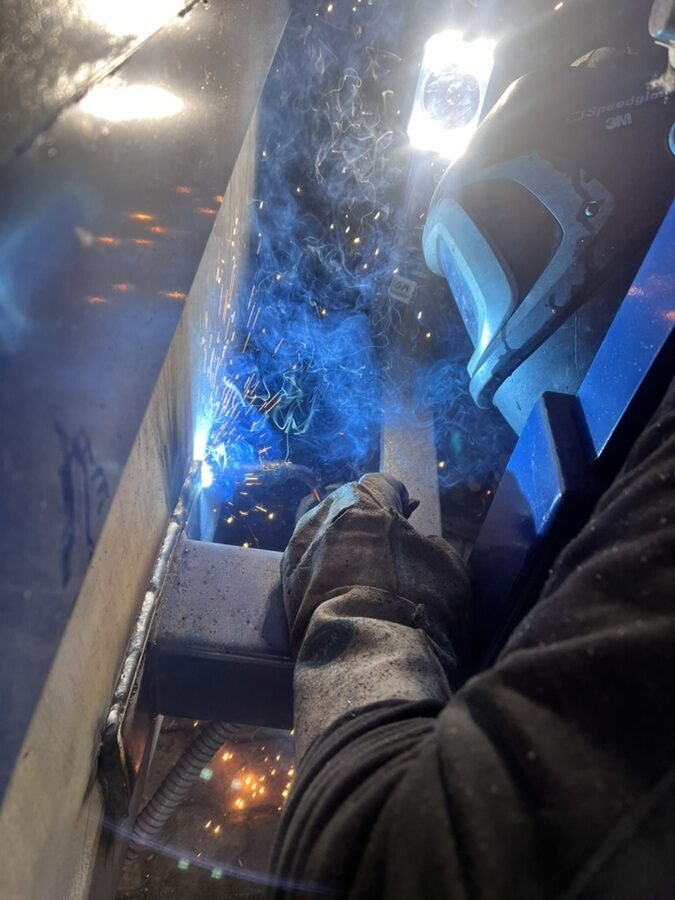
The hinge strip and the legs are welded to the existing steel structure. We weld using metal active gas (MAG) welding, which suits this kind of structural steel on site. A deep penetration on clean, bare parent metal is essential. A weld on rust or old paint does not hold.
Welding in cold and wet conditions
Loading docks are outdoors, and levellers are replaced in winter too. In cold and wet conditions the steel cools the weld too quickly and moisture gets into the weld pool. That is why, if needed, we work with weather protection and an industrial heater that keeps steel, people and equipment warm. On a winter job at a leveller we worked exactly like that – in snowfall, with a heater brought in specially.
Corrosion protection
A bare weld on the weather side of a door rusts quickly. That is why all welds are cleaned, primed and painted. Warning markings on the leveller are renewed where they suffered during welding.
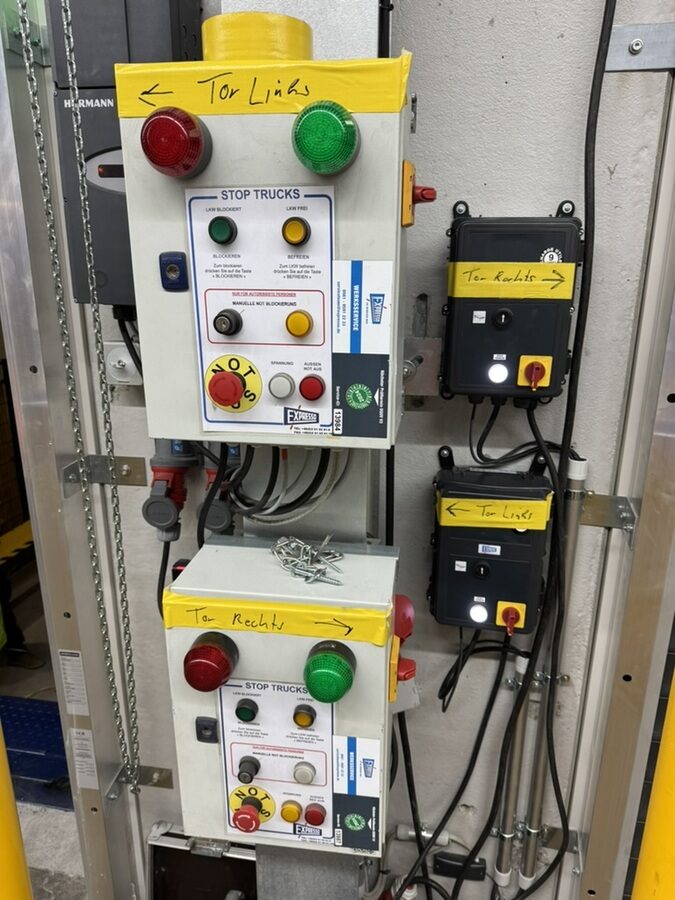
Hydraulics and electrics: connecting and adjusting
A hydraulic leveller needs a power unit, controls and cables between them. With us, mechanics, hydraulics and electrics come from one contractor.
Hydraulics
The power unit is installed, the lines connected and bled. We check tightness, end positions and the speed at which the leveller rises and lowers.
Controls, control box and signal light
Inside the building we set up the control cabinet, place the control box next to the door and run the cables to the leveller. Where required, the leveller is linked to the door control and the signal light so that loading only starts when door and leveller are ready.
When the supply is still missing
Sometimes there is no permanent power connection at the door yet. Instead of waiting, we work with a power distribution unit and hand over the leveller fully functional. Building services later switch over to the permanent supply. That way the door runs, and nobody waits for the last connection.
Replacing during running loading operations
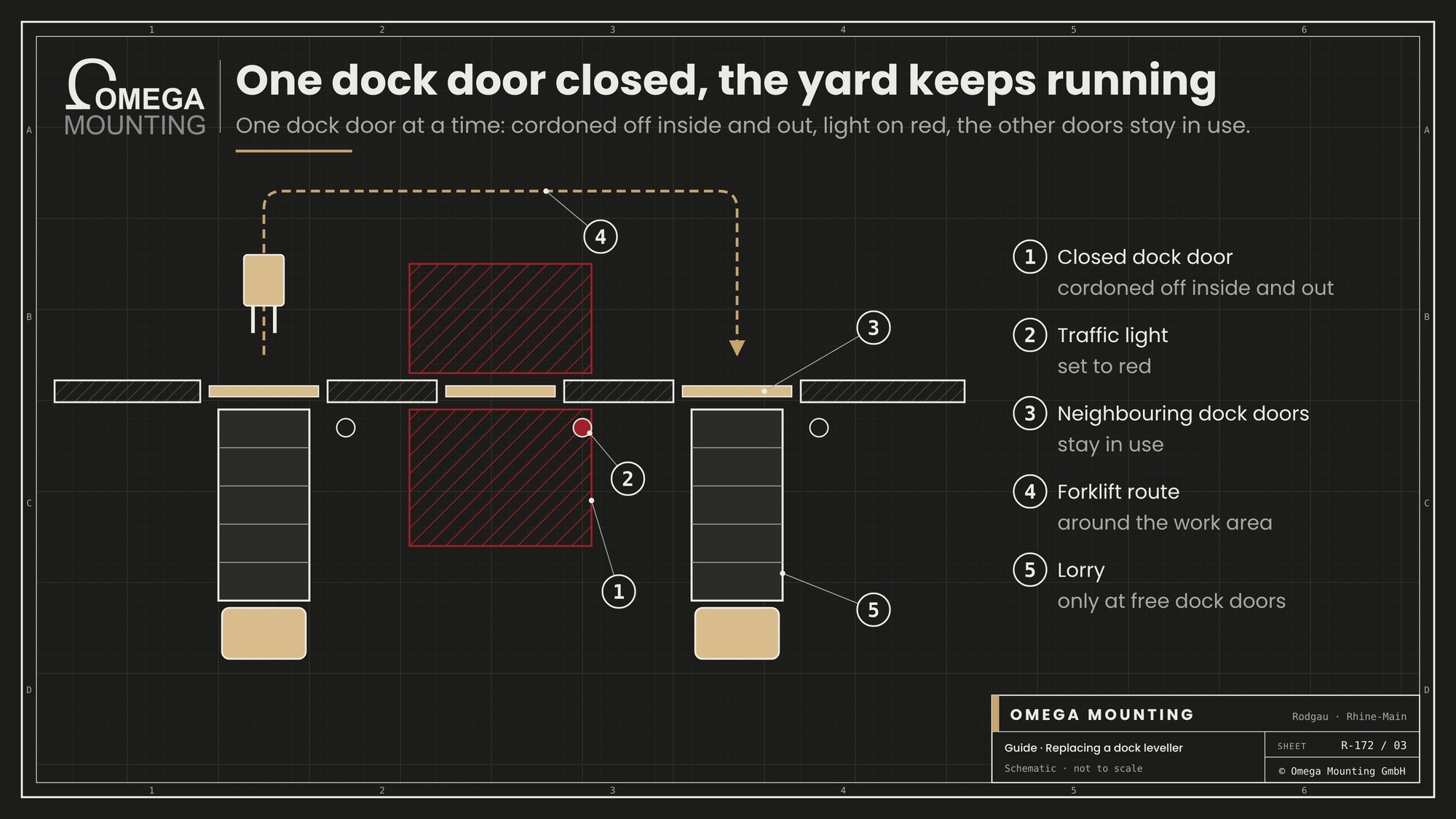
A logistics centre can rarely spare all its doors at once. That is why we replace one door at a time.
One door closed, the others running
The door being worked on is taken out of the loading plan. It is cordoned off inside and out, the signal light is on red and nobody docks. The neighbouring doors keep running. Forklift traffic inside is routed so that it does not cross the work area.
Coordination with the shift
Before starting, we agree with the shift manager when which door will be free. Lorries planned for this door are routed to other doors. When it gets tight, we replace at quieter times, at weekends or at night.
When several doors are due
If several levellers are due for replacement, we plan them as a series. The first leveller shows what the edge, structure and connections really look like. At the following doors every step is familiar, and the pace picks up. It is important that enough doors always stay free for ongoing operations.
Working safely next to yard traffic
Outside, lorries reverse while manoeuvring; inside, forklifts carry loads. Our work area is cordoned off and marked on both sides. On our sites nobody works alone: one welds, one secures and keeps an eye on the traffic.
Inspection and release
The new leveller is inspected before the first loading. Only then does the door go back into service.
Function and adjustment
We cycle the leveller several times and check end positions, lip, emergency lowering and operation. Controls and signal light are set to work together with the door.
Inspection before first use
Dock levellers and hydraulic levellers are power-operated work equipment. Under the German Industrial Safety Ordinance (BetrSichV) and the accident prevention regulations, they are inspected before first use and regularly afterwards by a competent person – the operator decides who does this. Which inspections apply to your installation is described in our guide on Operator's inspection obligations.
Bringing staff along
Anyone who has operated a manual leveller for years has to get used to a hydraulic one. That is why we brief not just one responsible person but, where possible, the staff who work at the door. We show operation, signal light, emergency lowering and how to place the lip correctly. It takes a few minutes and prevents the new leveller from being misused in its first week.
Briefing and handover
We brief staff on operation and hand over documents, photos and the installation report. The new leveller goes into the inspection log with its manufacturer's documents.
What we document
Handover includes photos of the removal, of the welds before and after corrosion protection and of the finished leveller. Add the set end positions, special features at the edge and open points, if there are any. The inspector then has a basis, and at the next service everyone knows what is installed.
What should be renewed at the same time
The leveller is rarely the only old part at the loading dock. If you are closing a door anyway, look at the surroundings too.
Buffers
Dock buffers absorb the impact when the lorry reverses in. If they are worn or torn, the impact hits edge, leveller and façade. New buffers are quickly fitted and protect the new leveller from the start.
Door seal and door
A worn door seal lets wind, rain and cold into the hall. On the Sectional door itself, it is worth checking springs, tracks and drive while the door is out of service anyway.
Vehicle restraint and signal light
A vehicle restraint holds the lorry at the dock until loading is finished. Where it is missing or old, it can be linked to the controls of the new leveller and the signal light during the replacement. Loading then only starts when the lorry is secured and the leveller is in place.
Impact protection
Bollards and impact protection at door and control box protect against forklifts and manoeuvring lorries. Which type fits is described in our guide Impact protection: plastic or steel. During the replacement, we position it so that the new control box is protected.
Who does what when replacing a dock leveller?
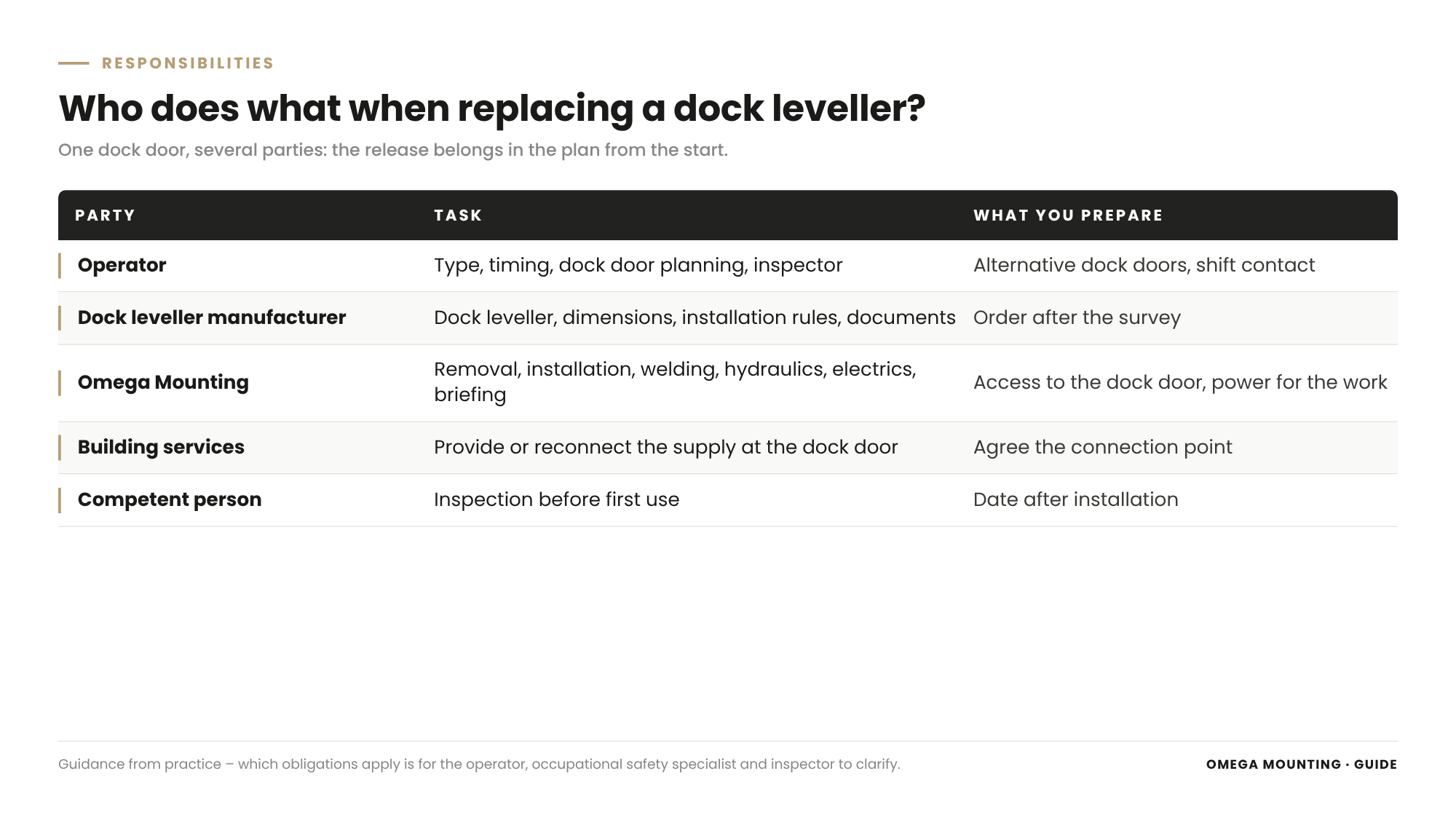
Several parties work together when replacing a dock leveller. Clear responsibilities avoid gaps.
Operator
You decide on type and timing, take the door out of the loading plan and name a contact person on the shift. You decide who inspects and releases.
Manufacturer of the new leveller
Supplies the leveller with dimensions, installation requirements and documents. If there are deviations on site, they are the first point of contact.
Omega Mounting
We survey what is there, cut out the old leveller, position and weld in the new one, connect hydraulics and electrics, adjust and brief. On request we also renew buffers, impact protection and vehicle restraint.
Building services and competent person
Building services provide the supply at the door or switch it over later. The competent person inspects the leveller before first use. This guide is not legal advice – which obligations apply to your loading dock you should clarify with your occupational safety specialist and your inspector.
Replacing a dock leveller: what it means for your planning
If you have a dock leveller replaced, you can decide a lot in advance. Four points make installation day easier.
Plan doors one after the other
Plan the replacement one door at a time and decide early which door is free when. That keeps throughput going.
Clarify power at the door
Changing from a manual to a hydraulic leveller needs power at the door. Clarify beforehand whether the connection is there or comes later.
Think about the surroundings
Buffers, door seal, signal light, vehicle restraint and impact protection are often as old as the leveller. Have them looked at during the survey.
Plan the release
Plan the inspection before first use at the same time. A fully installed door waiting for the inspector helps nobody.
Typical mistakes when replacing a dock leveller
- The new leveller is ordered without a survey. Then it does not fit the pit or the edge.
- The edge is damaged during removal. Then the structure has to be repaired before installation.
- The leveller is welded in crooked. It distorts under load, and the welds crack.
- Welds are left bare. They rust on the weather side and become the next inspection defect.
- There is no power at the door. The hydraulic leveller is installed but does not move.
- Buffers and vehicle restraint stay old. The new leveller takes the impacts the buffers should absorb.
- The inspection before first use is missing from the plan. The door stays closed although the installation is finished.
The mistake behind the mistakes
Almost all these mistakes have one cause: the replacement is planned as a delivery, not as an installation with lead time. If you clarify survey, power, surroundings and release beforehand, installation day holds no surprises.
Replacing a dock leveller in the Rhine-Main region: how we do it
From Rodgau we quickly reach Frankfurt, Offenbach, Darmstadt, Hanau, Aschaffenburg and Wiesbaden. The Rhine-Main region has many logistics centres, warehouses and production sites with loading docks that have been in use for decades.
Before the date, we survey the dock with you and agree the new leveller with the manufacturer. On installation day we close the door, cut out the old leveller, weld in the new one, connect hydraulics and electrics and hand over. How else we install and maintain loading technology is on our page on Logistics.
Our mechatronics technicians can weld, connect hydraulics and build control cabinets. For you that means one team, one date, one handover – instead of three trades with three dates.
Project examples
Three jobs from our project diary show how varied work at loading docks can be.
Two lip levellers in one day in Frankfurt
In a large logistics centre in Frankfurt, we replaced two old manual lip levellers with hydraulic ones. Two mechatronics technicians cut the old levellers off the steel structure with an angle grinder, brought the new levellers into position with a forklift and welded them to the existing structure. Then the legs were aligned and welded, hydraulics and control cabinets connected and the cables pulled. Because the permanent supply was still missing, we worked with a power distribution unit – building services switched over later. By the evening both doors were running again.
Cracked welds: repair instead of replacement
At a logistics service provider, a leveller had failed its inspection and the door was closed. Here a repair was enough: we ground out the defective welds completely, rewelded them with deep penetration, primed and painted – on a winter day with an industrial heater so that steel and weld were warm enough. It shows that not every leveller with a defect has to be replaced.
Loading docks in series near Leipzig
In a logistics centre near Leipzig, we fitted vehicle restraint systems to a large series of loading docks. In a series, what counts is that every loading dock is built the same way – and the same applies when several levellers are replaced one after the other.
Do you have a leveller replacement coming up?
Send us photos of the loading dock and tell us which leveller is to be fitted – we will tell you what we need for the survey. Get in touch now.
What this means for your role
Logistics managers: Take the doors out of the loading plan one after the other and set alternative doors. Name a contact person on the shift.
Maintenance managers: Use inspection reports and the damage pattern to decide whether repair or replacement is the better route. Keep documents and photos of the new leveller in the inspection log.
Project and site managers: Clarify power at the door, controls and release before installation day. Make sure the inspection before first use is scheduled.
Buyers: Compare quotes not only by the price of the leveller. Ask whether removal, disposal, welding in, corrosion protection, hydraulics, electrics and briefing are included.
Plant engineers: Report old repairs, services and special features at the loading dock that are not on any drawing. Your knowledge of the existing installation saves time during installation.
Loading dock replacement plan: template on request
For your next leveller replacement, we have put together the loading dock replacement plan. On one page it asks about what is there, the new leveller, door planning, connections and completion with inspection and briefing. You fill it in before the date, and we plan the replacement without follow-up questions. Request the template via our contact form – keyword “Loading dock replacement plan”.
Why Omega Mounting?
With over twenty years of experience in installation, move-in and maintenance, we know that at the loading dock every hour a door stands idle counts. That is why we survey beforehand, replace one door at a time and come with mechatronics technicians who can weld, connect hydraulics and build control cabinets. On request we also renew buffers, impact protection and vehicle restraint. For you, that means one point of contact from removal to handover. Talk to us about your loading dock – get in touch.
Conclusion
Replacing a dock leveller is easy to plan. If you survey beforehand, clarify power and controls and plan the doors one after the other, you often get a new leveller in a day – without the yard standing still. What matters is a clean removal, a leveller welded in straight with protected welds and an inspection before the first loading.
Whether a lip leveller at the edge, a pit leveller or a dock house leveller in front of the façade: if you plan the replacement as an installation with lead time, you save the second visit. If one of your levellers is getting on in years, get in touch with us.
Further reading: Wie Sie eine Klapprampe im Betrieb halten, steht in Servicing a folding dock leveller. Worauf es ankommt, wenn die neue Rampe an einen feuerverzinkten Rahmen geschweißt wird, lesen Sie in Welding a folding dock leveller.
Planning a move-in, installation or maintenance in the Rhine-Main region?
Tell us briefly what you need – we'll come back with an honest assessment.
Free, no-obligation callback
You may also be interested in these guides
Maintenance & Servicing
Maintenance & Servicing

About the author
Tobias Schott
Managing director of Omega Mounting GmbH, Rodgau · more than 20 years of hands-on experience in installation and maintenance
A trained mechatronics technician, working in maintenance, servicing and industrial installation since 2004 – first alongside his father, and with Omega Mounting since 2012: from overhead conveyors in Frankfurt to the crane system in a new-build hall. He plans and leads lifting operations as an appointed person (AP) in data centers and on industrial sites in the Rhine-Main region, trains and examines operators of cranes, mobile elevating work platforms and telehandlers, and is a qualified occupational safety specialist. On jobs abroad he is known as the “German Troubleshooter” – the person you call when a site gets stuck. He learned what quality means from his father, not from a manual: Made in Germany as a standard for his own work, not a label. That is why quality comes first at Omega Mounting – ahead of speed and price. He writes these guides from that practice: what works on our sites is in them – what exists only on paper is not.
Frequently asked questions
With good preparation, a lip leveller at the edge is often replaced in a day. A pit leveller or dock house leveller takes longer, especially if pit, foundation or power have to be adapted.
Yes. The new hydraulic leveller is welded in at the edge, together with power unit, controls and control box. A power connection at the door is required.
No. We replace one door at a time. The door concerned is closed and cordoned off, the neighbouring doors keep running.
Often, yes. Defective welds can be ground out and rewelded. Replacement pays off when the structure is fatigued in many places or the type no longer fits.
With us, the same mechatronics technicians who weld in the leveller. Mechanics, hydraulics and electrics come from one contractor.
Yes. Power-operated levellers are inspected before first use and regularly afterwards by a competent person. The operator decides who inspects.
It is dismantled or taken away in one piece, and the hydraulic oil is disposed of separately. Who takes it is clarified in advance.
Yes. From Rodgau we quickly reach the whole Rhine-Main region – Frankfurt, Offenbach, Darmstadt, Hanau, Aschaffenburg and Wiesbaden – and further afield on request.
Send us photos of the loading dock, the type of the old leveller and of the planned new one, and the number of doors. We will come back with our questions for the survey and an assessment. Go to the contact form.
 English
 German