
- Technology explained – terms and documents
The punch list: how “almost finished” turns into acceptance
By Tobias Schott · 5-minute read · Updated November 2026
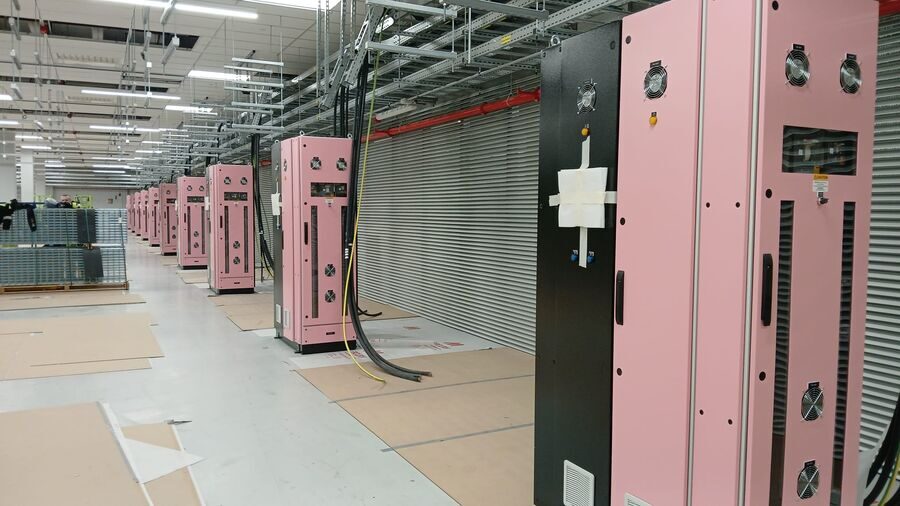
A punch list collects all defects and outstanding work that still have to be completed before acceptance, with location, responsible person, deadline and status, until every item has been checked and closed.
At the end of every large installation comes the moment when almost everything is finished. A cover is missing, a bolt is not tightened, a sign hangs crooked, a test is still outstanding. Individually these are minor things. Together they decide whether a project is accepted. The punch list makes sure none of them gets lost.
Here we explain what belongs in an entry, how items are grouped by urgency, how a punch list item runs from recording to closing and how it is marked on the component.
What is a punch list?
A punch list is the shared register of all open items of a project between completion and acceptance. Other names are snag list, defects list or list of open items; in German it is called Restpunkteliste.
It is created during walk-throughs, functional tests and pre-acceptance inspections. Anyone who finds something enters it. What matters is that there is exactly one list: if each trade keeps its own, in the end nobody knows what is really still open. On large sites the list therefore sits on a shared platform accessible to site management, trades and client. In data center construction it is part of commissioning: before the systems are tested together, the items affecting safety or function must be closed. How commissioning is structured is explained in our article on Commissioning.
Key facts
- Purpose: Keep all open items visible and work through them until acceptance.
- Content per entry: Location, description, photo, trade, responsible person, deadline, status.
- Grouping: by urgency – before commissioning, before handover, afterwards with a deadline.
- Process: record, assign, fix, report done, check, close.
- Format: spreadsheet, platform or app – what matters is one list for everyone.
- End: list empty or the remaining items agreed with a deadline.
What belongs in an entry?
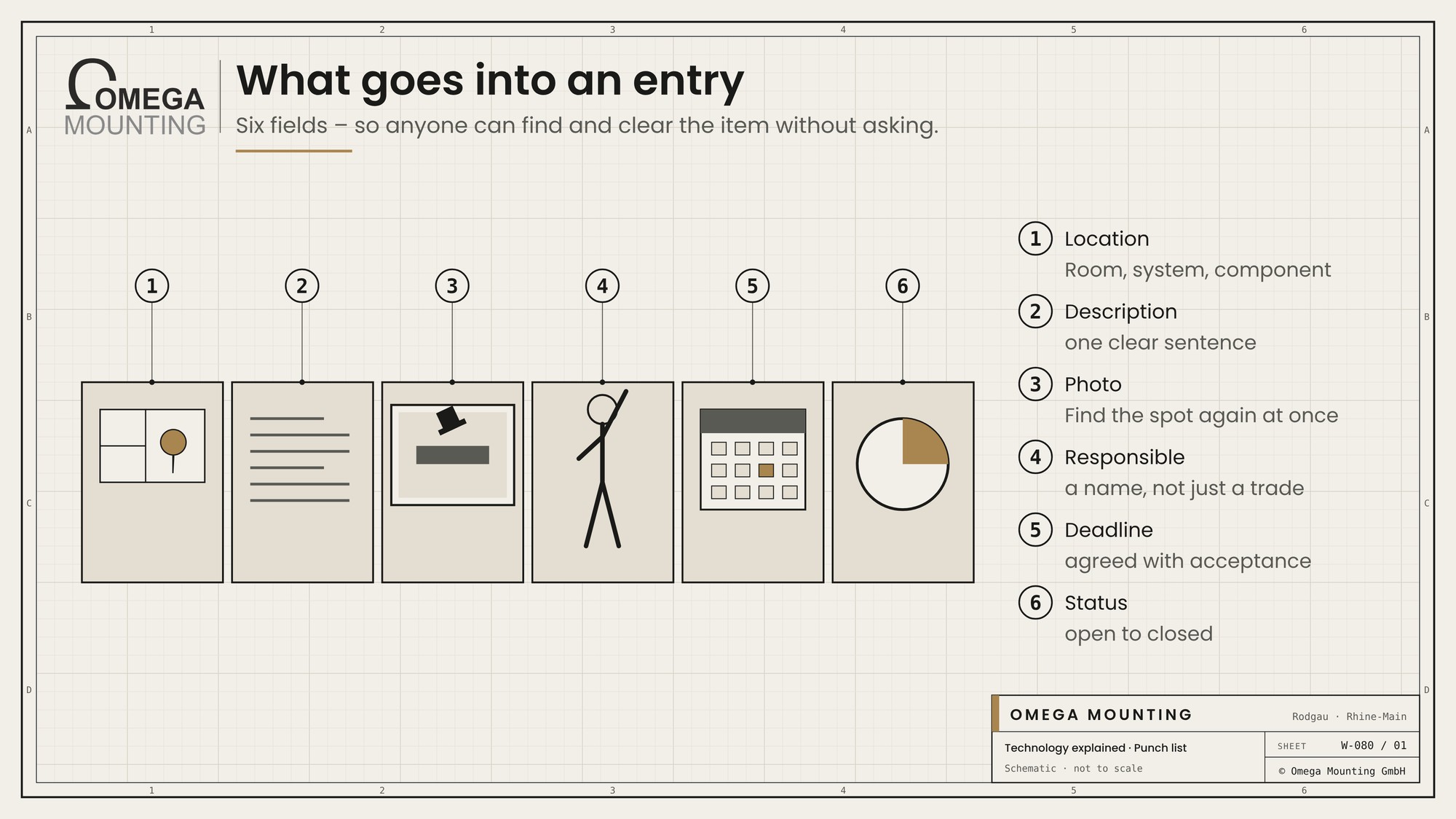
A good entry can be worked through without asking.
| Field | What it contains |
|---|---|
| Location | Building, level, room, system, ideally with the component tag. |
| Description | What exactly is missing or wrong – in one sentence, without cryptic abbreviations. |
| Photo | A picture in which you can find the spot again immediately. |
| Trade and responsible person | Who fixes the item – a name, not just a company. |
| Deadline | By when, agreed with commissioning and handover. |
| Status | Open, in progress, reported done, checked, closed. |
If one of these fields is missing, the back-and-forth begins. “Cable loose” without location and photo costs more time than the cable itself.
Urgent or not: the grouping
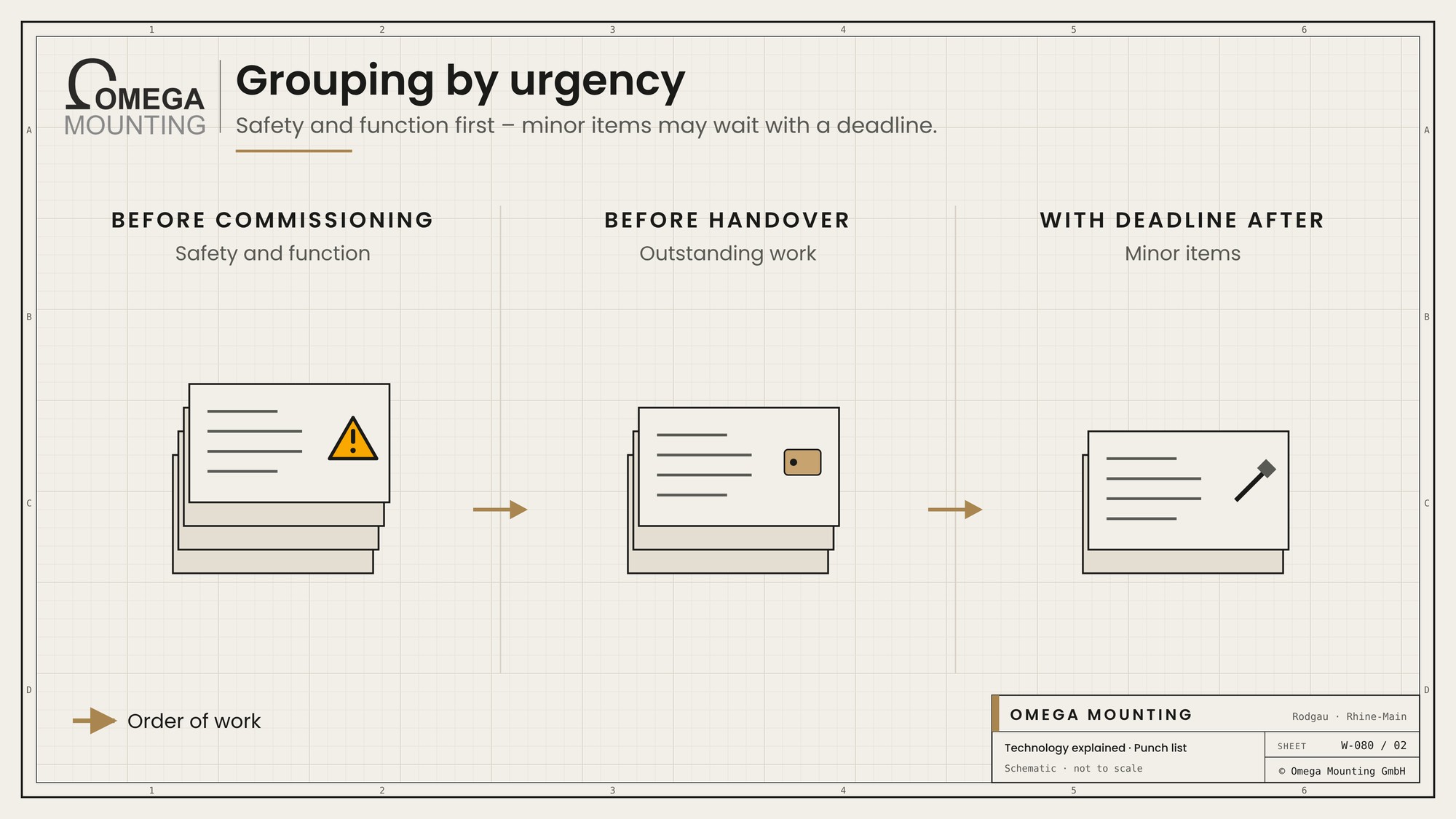
Not every punch list item is equally important. That is why items are grouped by urgency.
- Safety and function: Anything that endangers people or stops the system working properly is closed before commissioning.
- Outstanding work: Anything that is part of the contract but does not affect function – labelling, covers, documentation – is completed by handover.
- Minor items: Cosmetic defects or touch-up work that do not affect operation may follow after handover with an agreed deadline.
What the levels are called is set by the client or operator. Whether a defect prevents acceptance is also a contractual question – this is not legal advice, just an orientation for the site.
The life of a punch list item
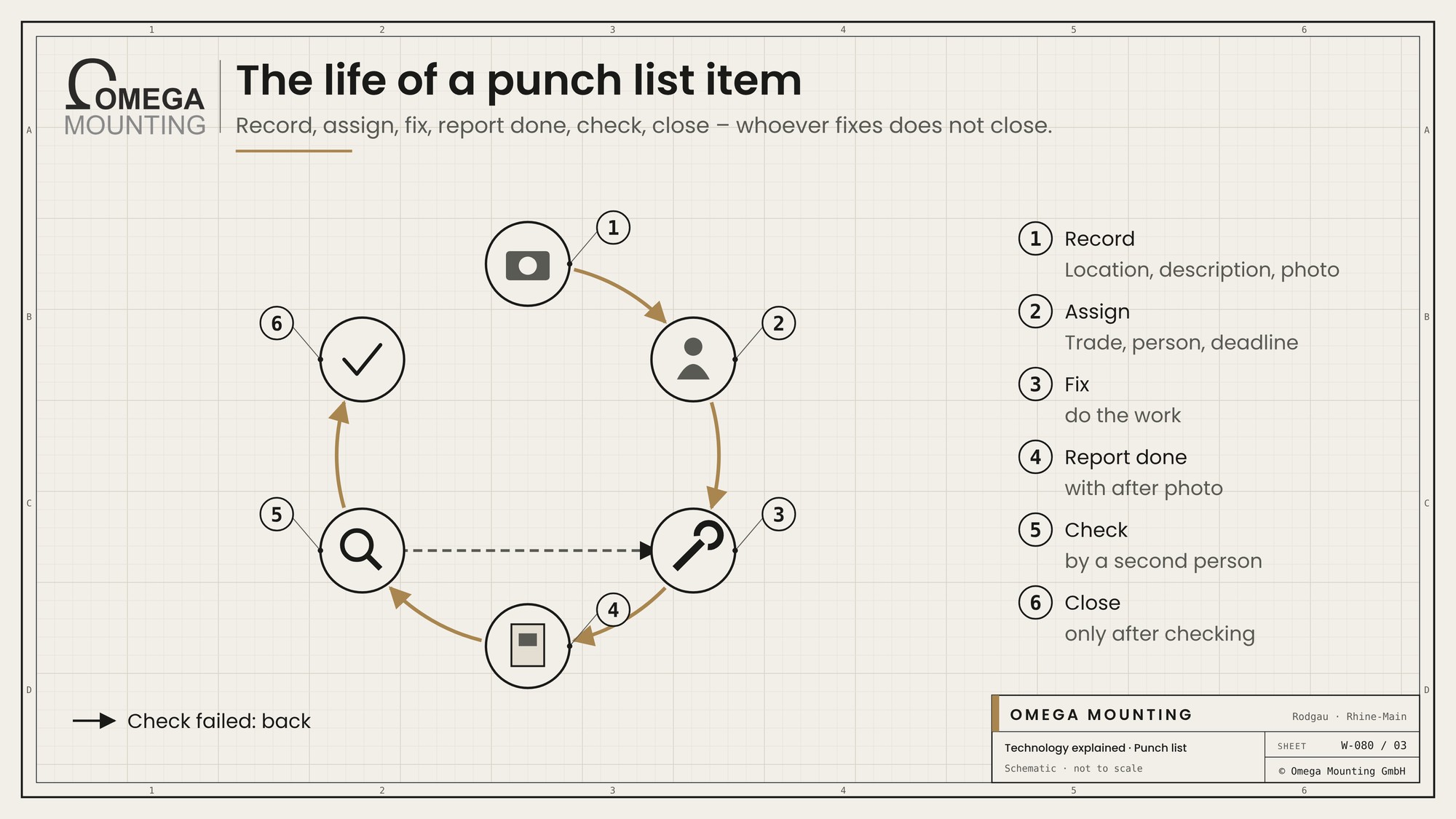
A punch list item always goes through the same steps.
- Record: during a walk-through or test, with location, description and photo.
- Assign: to a trade and a person, with a deadline.
- Fix: the work is done.
- Report done: the trade reports the item as completed – with a photo.
- Check: whoever recorded the item or site management checks on site.
- Close: only after a passed check. Otherwise it goes back to the trade.
The most important principle: whoever fixes does not close. Only the check by a second person turns “done” into “closed”.
Punch list item on the component: marking and documenting
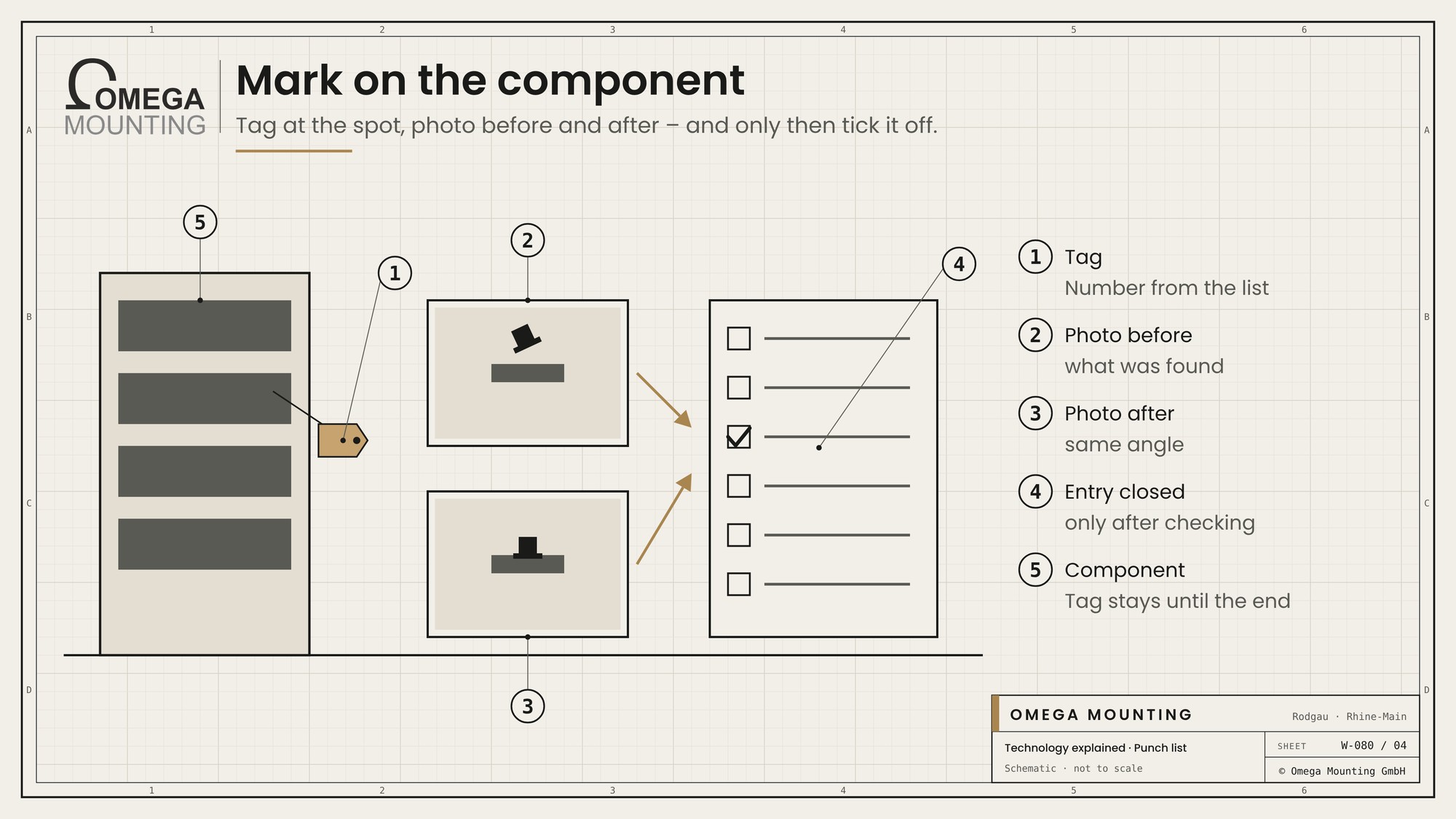
On large sites with many identical systems, a punch list item only helps if you can find it again on the component.
- Tag on the component: with the number from the list, clearly visible at the defect.
- Photo before: shows what was found.
- Photo after: shows that the item has been fixed – from the same angle.
- Remove the tag only after closing: otherwise the checker looks for a spot nobody can find any more.
Where several trades work on the same system, this also includes agreeing who may work on the component and when. How work is released is explained in our article on the Permit to Work.
Typical mistakes in a punch list
A punch list only helps if it is maintained. These mistakes turn it into a list that nobody reads any more:
- Unclear description: “Check” or “rework” is not enough. An entry names the location, the component and exactly what is missing.
- No one responsible: An item without a trade or a name stays open because nobody feels responsible.
- No deadline: Without a date every item slips. Even small items get a date.
- Duplicate entries: The same thing is on the list several times, recorded by different people. That inflates the list and causes confusion when ticking off.
- Missing photos: A before and after photo saves discussions about what was meant and whether it has been done.
- Ticking off without confirmation: Whoever completes an item reports it. It is only closed once the person who raised it has checked it.
A single list for everyone involved, kept by one person, works best. Several lists in parallel – one from site management, one from the client, one of your own – almost always lead to items getting lost.
Whether the list is kept on paper, in a spreadsheet or in an app is secondary. What matters is that it is on the table at every site meeting.
What we pay attention to
Punch list items arise even with the best installation. What matters is how quickly they disappear.
- We go through our own work before handover, before others do.
- We enter punch list items with location, photo and name – no shouting across the site.
- We only report items as done with an after photo.
- We hand over every system so that the next trade can carry on without asking.
- We keep staff available to close punch list items immediately during tests.
Where we use it
During the installation of 160 PDCs in a data center in the Rhine-Main region every cabinet was passed on to the electrical trade surveyed, aligned and prepared. With so many identical systems over four levels, what counts is that every handover is complete – otherwise an open item travels from hall to hall. More under installation in data centers, and how a system moves from construction into operation is described in our guide commissioning and handover.
More technology explained
Technology explained
where the punch list fits into the process.
Technology explained
the systems the items relate to.
Technology explained
who may work on a system and when.
Do you have questions about how this works on your site?
Is your installation close to acceptance and the list is not getting shorter? We take on mechanical punch list items and close them with evidence. Request a callback.
Our service for this: Industrial installation →
Free, no-obligation callback

About the author
Tobias Schott
Managing director of Omega Mounting GmbH, Rodgau · more than 20 years of hands-on experience in installation and maintenance
A trained mechatronics technician, working in maintenance, servicing and industrial installation since 2004 – first alongside his father, and with Omega Mounting since 2012: from overhead conveyors in Frankfurt to the crane system in a new-build hall. He plans and leads lifting operations as an appointed person (AP) in data centers and on industrial sites in the Rhine-Main region, trains and examines operators of cranes, mobile elevating work platforms and telehandlers, and is a qualified occupational safety specialist. On jobs abroad he is known as the “German Troubleshooter” – the person you call when a site gets stuck. He learned what quality means from his father, not from a manual: Made in Germany as a standard for his own work, not a label. That is why quality comes first at Omega Mounting – ahead of speed and price. The Technology explained articles cover the equipment and techniques his team uses every day: what counts on site is in them – what only appears in the brochure is not.
 English
 German