
- Guide – Maintenance
Systematic troubleshooting: narrowing down faults in plant, finding causes and eliminating them permanently
By Tobias Schott · Reading time approx. 22 minutes · As of: November 2026
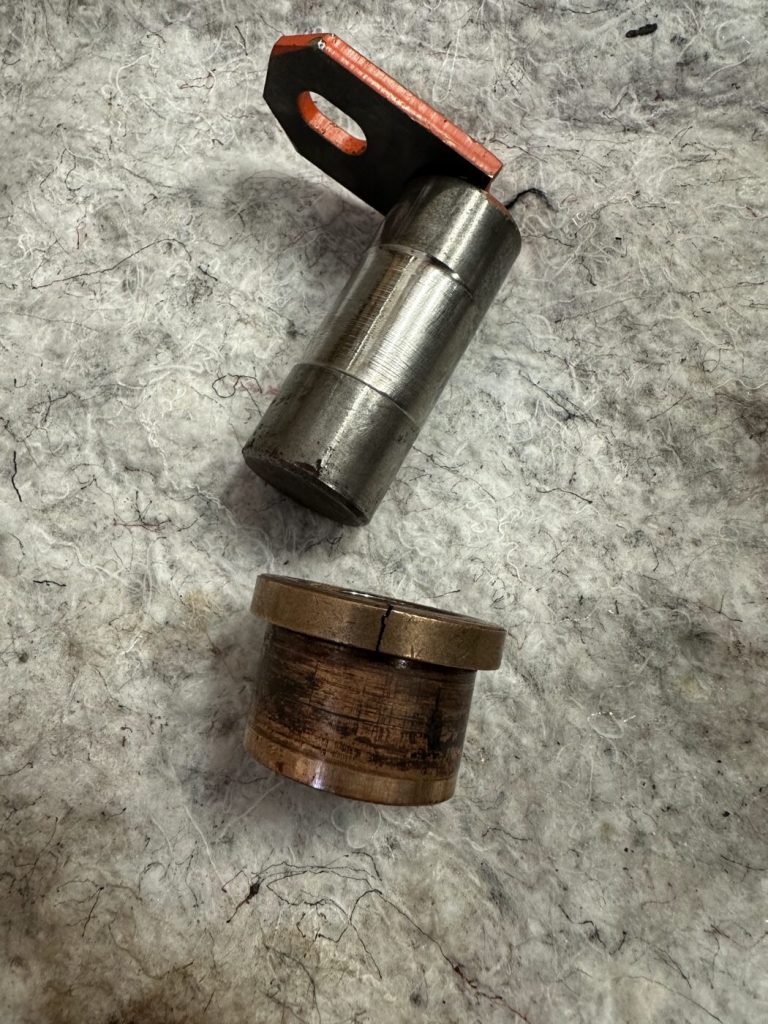
Systematic troubleshooting means describing the fault precisely, securing the plant, gathering information, narrowing the fault down step by step, testing assumptions in a targeted way and only repairing once the cause has been found – not just the symptom. Anyone who works this way finds faults faster, swaps fewer parts on suspicion and prevents the same fault from coming back.
A plant is at a standstill. The shift is waiting, production is pushing, and everyone has a theory. Was it the sensor? The motor? The controls? Often whatever is to hand gets swapped. Sometimes the plant runs again afterwards. Sometimes not. And sometimes it runs for a week until the same fault occurs again.
This is exactly what systematic troubleshooting prevents. It replaces guesswork with a fixed sequence: first describe, then secure, then gather, then narrow down, then test. Anyone searching for “plant troubleshooting”, “fault finding” or “root cause analysis” usually wants to know exactly this sequence.
This guide shows how to narrow down faults in machines and plant methodically, distinguish cause from symptom and eliminate faults permanently. It is written for maintenance managers, shift supervisors and machine operators, operations and technical managers, planners, buyers and occupational safety specialists. How to proceed specifically with conveyor systems is described in the guide Fixing a conveyor system fault.
Key points at a glance
- Systematic troubleshooting means: describe, secure, gather, narrow down, test, eliminate.
- Erst sichern. No troubleshooting on a plant that can start up unexpectedly.
- Genau beschreiben. What, where, when, how often and under what conditions?
- Eingrenzen statt raten. First the subsystem, then the assembly, then the component.
- From simple to complex. Check simple and likely causes first.
- Ursache statt Symptom. Anyone who only repairs the symptom will see the fault again.
- Write it down. Every fault and every cause belongs in the log.
- Know the responsibilities. Controls and software with the manufacturer, electrics beyond the main switch with the electrical contractor.
What is systematic troubleshooting actually?
Systematic troubleshooting is an orderly approach to finding the actual cause of a fault. Instead of swapping individual components on suspicion, the possible fault area is made smaller step by step until only one explanation remains.
The term sounds theoretical. In practice it is very down-to-earth. It means: look closely, ask the right people, test one assumption after another and only ever change one thing at a time.
Troubleshooting is not the same as repair
Troubleshooting ends with a diagnosis. Only then does the repair begin. Anyone who mixes the two often repairs in the wrong place. A clear separation also helps with planning: the diagnosis needs experience and measuring equipment, the repair needs spare parts, tools and a time window.
Fault, malfunction, damage
A malfunction is what operations notice: the plant stops, runs roughly or reports an error. A fault is the deviation behind it. Damage is the consequence, such as a broken part. This distinction helps you not to stop at the first visible damage when narrowing down.
Why method pays off
Without a method, troubleshooting depends on one person's experience. With a method, even a colleague who knows the plant less well can proceed in a structured way. And the result is traceable, because every step is documented.
Systematic troubleshooting in six steps: the process
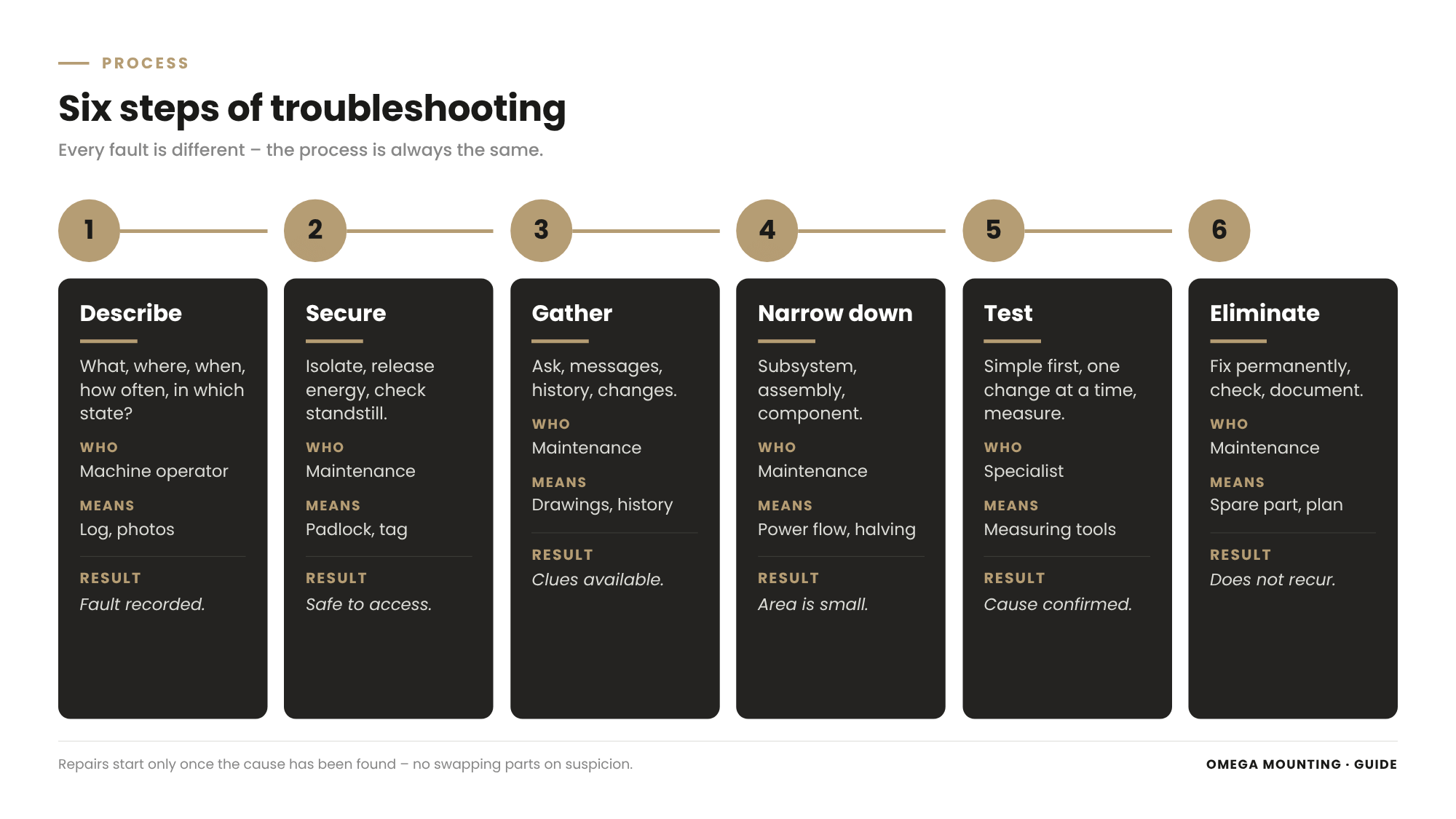
Every fault is different. The process is always the same.
Step one: describe the fault
What exactly happened? A precise description is half the diagnosis.
Step two: secure and isolate
Before anyone reaches into the plant, it is secured against unexpected start-up and stored energy is released.
Schritt drei: Informationen sammeln
Ask the machine operator, read the messages, look at the maintenance history, clarify recent changes.
Schritt vier: eingrenzen
Which subsystem is affected? Mechanical, electrical, hydraulic, pneumatic or controls? Then the assembly and the component.
Step five: test hypotheses
Assumptions are tested one after another, the simple and likely ones first.
Step six: eliminate and document
The cause is eliminated permanently, the plant is checked and the fault is recorded with its cause and the measure taken.
Describing the fault: what exactly happened?
“The plant isn't working” is not a description. It is the start of a question.
The key questions
What exactly happens? Where on the plant? Since when? How often? In what operating state – on start-up, under load, after a long running time, in the cold? What is different from usual? These questions take a few minutes and often save hours.
Beobachten, bevor man eingreift
If it is safe to do so, the fault is observed while it is still present. A noise, a smell, an unusual movement or a message on the operator panel often disappear as soon as someone restarts.
Do not acknowledge too quickly
Anyone who acknowledges a fault message and restarts the plant sometimes deletes exactly the information that would have helped with troubleshooting. That is why the rule is: photograph or write it down first, then acknowledge.
Intermittent faults
The most difficult faults are those that only occur now and then. A fault log helps here, recording each occurrence with time, operating state and surroundings. Often a pattern only emerges in comparison.
Secure first: isolating and releasing stored energy

Troubleshooting is one of the most dangerous activities in maintenance. The plant is not behaving normally, guards are sometimes open, and under time pressure people quickly improvise.
Securing against restart
The plant is switched off and secured against unexpected switching on, for example with a personal padlock on the main switch and a tag. How this works in detail is described in the guide lockout tagout in maintenance.
Stored energy
Even a switched-off plant can still contain energy: pressure in hydraulic accumulators and lines, compressed air in vessels, tensioned springs, suspended loads, flywheels running down, heat. This energy is released or safely blocked before anyone intervenes.
Checking standstill
After securing, a check is made that the plant really is at a standstill and does not start. A start attempt at the control panel and a look at the pressure gauges are part of this.
Testing while live
Some faults can only be found on a running or switched-on plant. Such tests on electrical parts are a matter for qualified electricians with suitable equipment and authorisation. For mechanical observations on running plant: only at a distance, only with guards closed, never with your hand near moving parts.
Nobody alone
Nobody troubleshoots dangerous plant alone. What applies here is described in the guide lone working in maintenance.
Gathering information: machine operator, messages, history
The best clues are often already there before anyone picks up a tool.
Asking the machine operator
Whoever stands at the plant every day notices changes first. Did it already sound different yesterday? Did something happen beforehand, such as a jam, a knock or a product changeover? These questions are asked without blame. Anyone who is afraid of being blamed says less.
Messages and fault memory
The operator panel and controls often show where the fault occurred. The message is a clue, not a diagnosis. “End position not reached” can mean that the sensor is faulty – or that the cylinder is sticking because the guide is worn. How a control system basically works is explained in the article SPS-Grundlagen.
Maintenance history
What was done last? When was it lubricated, replaced, adjusted? Has the same fault occurred before? Good maintenance documentation is worth its weight in gold here.
Recent changes
Many faults begin shortly after a change: new product, new spare part, new setting, conversion, different lubricant. The question “What has changed?” often leads straight to the cause.
Documents
Circuit diagrams, hydraulic and pneumatic diagrams, operating instructions, spare parts list. Anyone who follows how the plant works on paper can narrow down in a more targeted way.
Narrowing down the fault: which subsystem is affected?
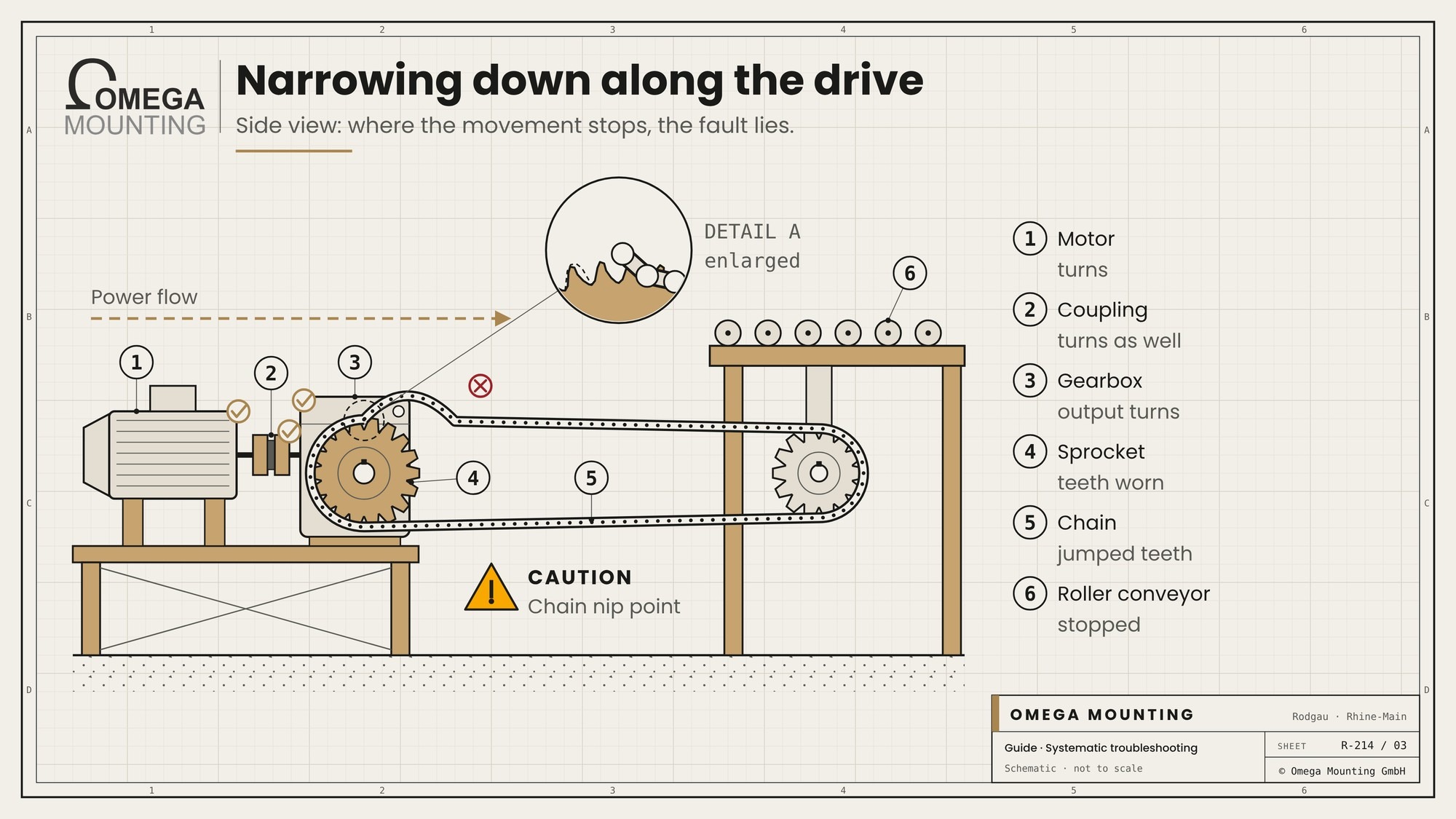
Narrowing down means reducing the possible fault area until only a few components remain in question.
Distinguishing subsystems
Almost every plant consists of the same subsystems: mechanical, electrical, hydraulic, pneumatic and controls. The first question is: in which of these subsystems is the fault?
Mechanical
Wear, play, missing lubrication, foreign bodies, breakage, misalignment. Mechanical faults often announce themselves: through noises, vibration, heat, play or abrasion. How to recognise wear early is described in the guide Recognising wear on machines.
Electric
Failed drives, tripped protective devices, faulty cables, loose terminals. Electrical faults are traced by qualified electricians. Our own electricians make the plant-side connections up to the main switch, for example after a motor replacement. Faults in the power supply, building electrics or medium voltage lie with the electrical contractor, the operator or the network operator.
Hydraulic
Lack of pressure, slow movements, leaks, hot or contaminated oil, clogged filters. How hydraulics are maintained is described in the guide hydraulic maintenance on presses.
Pneumatic
Too little compressed air, leaks, a dirty service unit, sticking valves or cylinders. Often the cause is trivial: a kinked hose or a closed shut-off valve.
Controls
Missing signals, wrong sequences, inexplicable shutdowns. Here the work often begins at the sensor: dirty, misadjusted, bracket bent. That can be solved mechanically. Faults in the program, parameters or software are clarified by the manufacturer or control system builder.
Along the power flow
Within a subsystem, narrowing down follows the path of the energy: from the motor via the coupling and gearbox to the sprocket and the chain. At each station a check is made as to whether the movement still arrives. Where it stops, that is where the fault lies. How drives, gearboxes and pumps are maintained is described in the guide Maintaining drives, gearboxes and pumps.
Halving
With long chains of components, it helps to check in the middle. If the signal or movement still arrives there, the fault lies beyond it, otherwise before it. This way the area gets smaller with every test.
Testing hypotheses: from simple to complex
After narrowing down, several possible causes usually remain. Now they are tested.
The simple things first
Is the emergency stop pressed? Is a guard door open? Is the compressed air there? Is the sensor dirty? Is a foreign body in the way? Simple causes are more common than you think, and they can be ruled out quickly.
Then the likely things
What has failed more often on this plant? Which component is under the greatest load? Experience and history tell you where to look first.
The complex things last
Dismantling, removing, replacing: that only comes once simple tests have produced no result. Anyone who dismantles straight away loses time and sometimes creates new faults.
One change at a time
Anyone who changes three things at once does not know afterwards which one helped. That is why only one thing is ever changed and then tested.
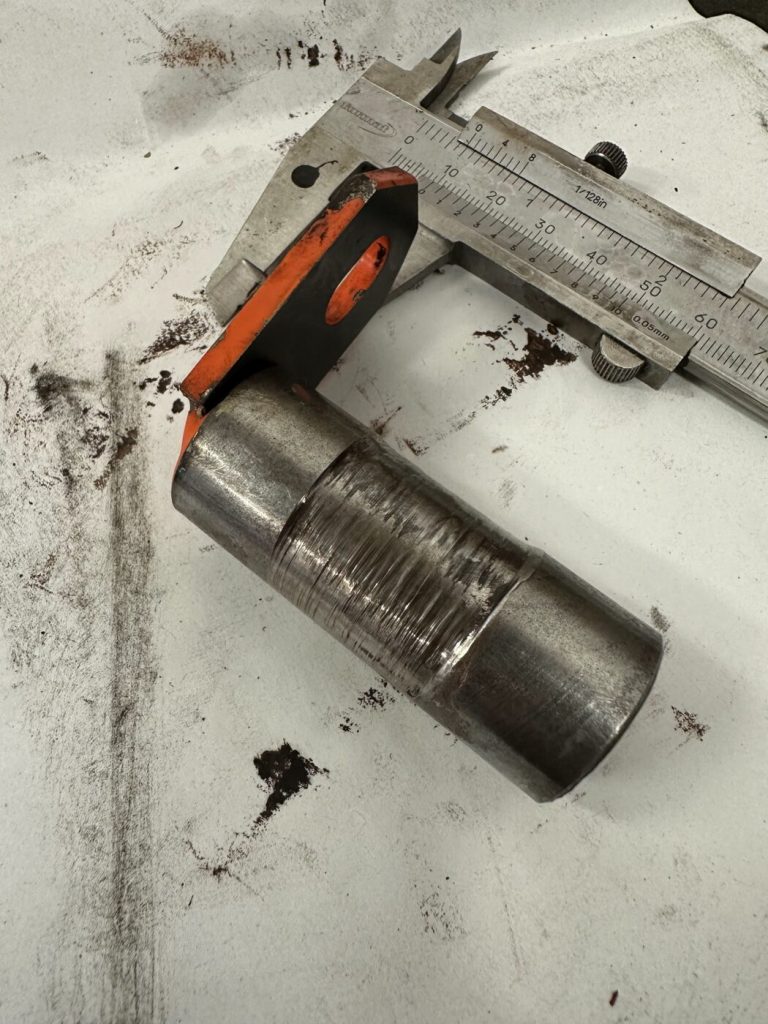
Measuring instead of guessing
Assumptions are confirmed or rejected with measurements: temperature, play, diameter, pressure, vibration. A calliper, feeler gauge and pressure gauge belong in every toolbox. For deeper diagnoses, these help: Thermography and Vibration analysis.
A look inside
A removed part reveals a lot. Scoring, grooves, discolouration, chipping or one-sided wear show what has happened. How to read damage patterns on bearings is explained in the article Bearing damage.
No swapping parts on suspicion
Fitting a new part to see whether it helps is expensive and obscures the cause. If the plant runs afterwards, nobody knows whether the old part was really faulty. If it does not, money has been spent and nothing gained.
Cause or symptom: where does the repair start?
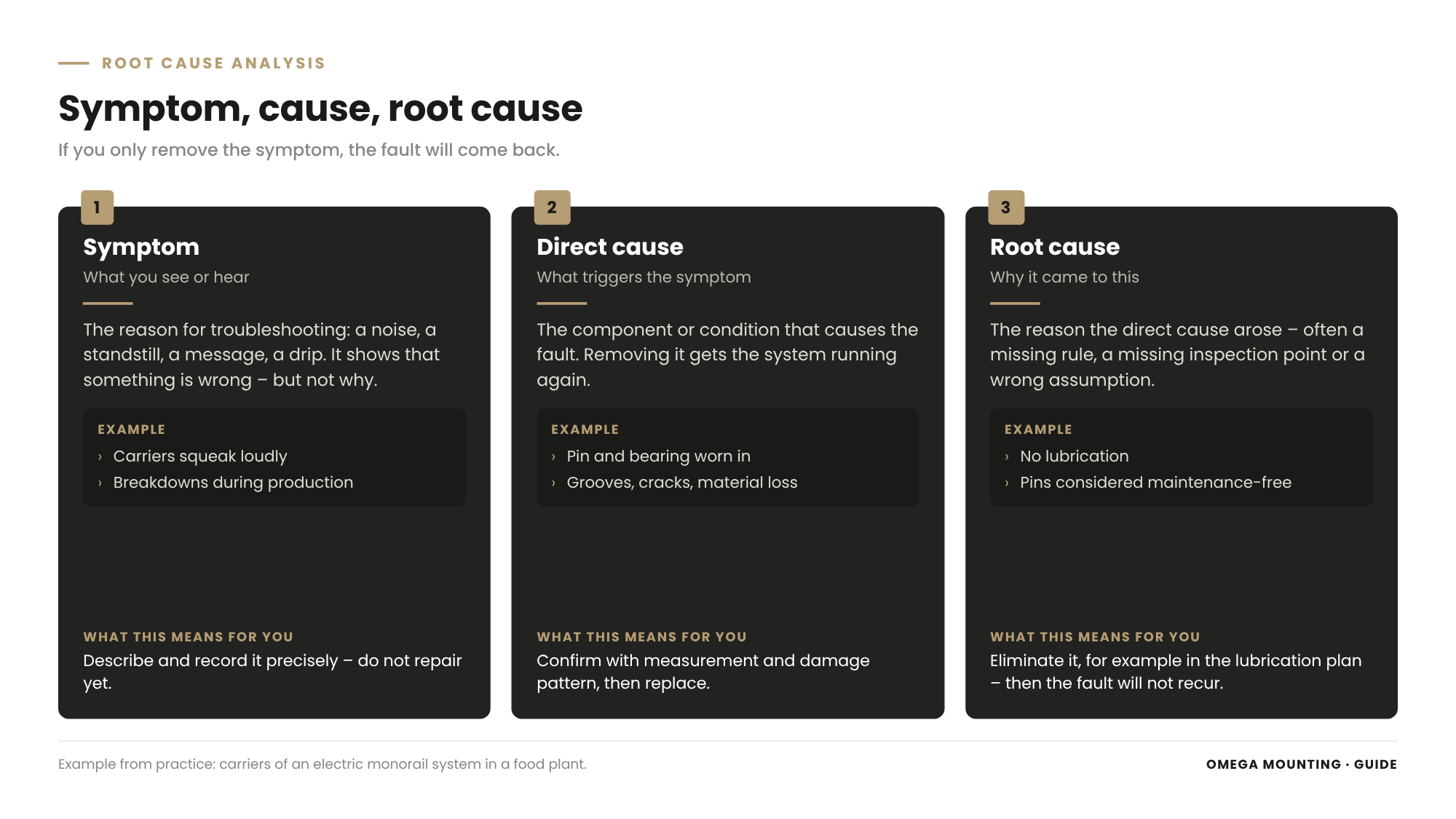
This is the most important question in the whole troubleshooting process.
The symptom
The symptom is what you see or hear: the squeak, the stationary roller conveyor, the dripping line. It is the reason for troubleshooting, but rarely its goal.
The direct cause
The direct cause is the component or condition that triggers the symptom: the worn pin, the worn sprocket, the leaking fitting. Anyone who eliminates it gets the plant running again.
The root cause
The root cause explains why the direct cause arose: there was no lubrication because the component was considered maintenance-free. The chain ran crooked because the alignment was never checked. Anyone who only eliminates the direct cause will soon be repairing the same spot again.
Recognising consequential damage
Sometimes the visibly defective part is itself only a victim. A broken pin can be the result of a worn bearing, a hot motor the result of a stiff gearbox. That is why, after a find, the question is always asked: is this really the start of the chain?
When the direct cause is enough
Not every fault needs an in-depth root cause analysis. A one-off foreign body is quickly removed. But if the same fault comes back, it is time to dig deeper.
Fault tree and five-why method: tools for root cause analysis
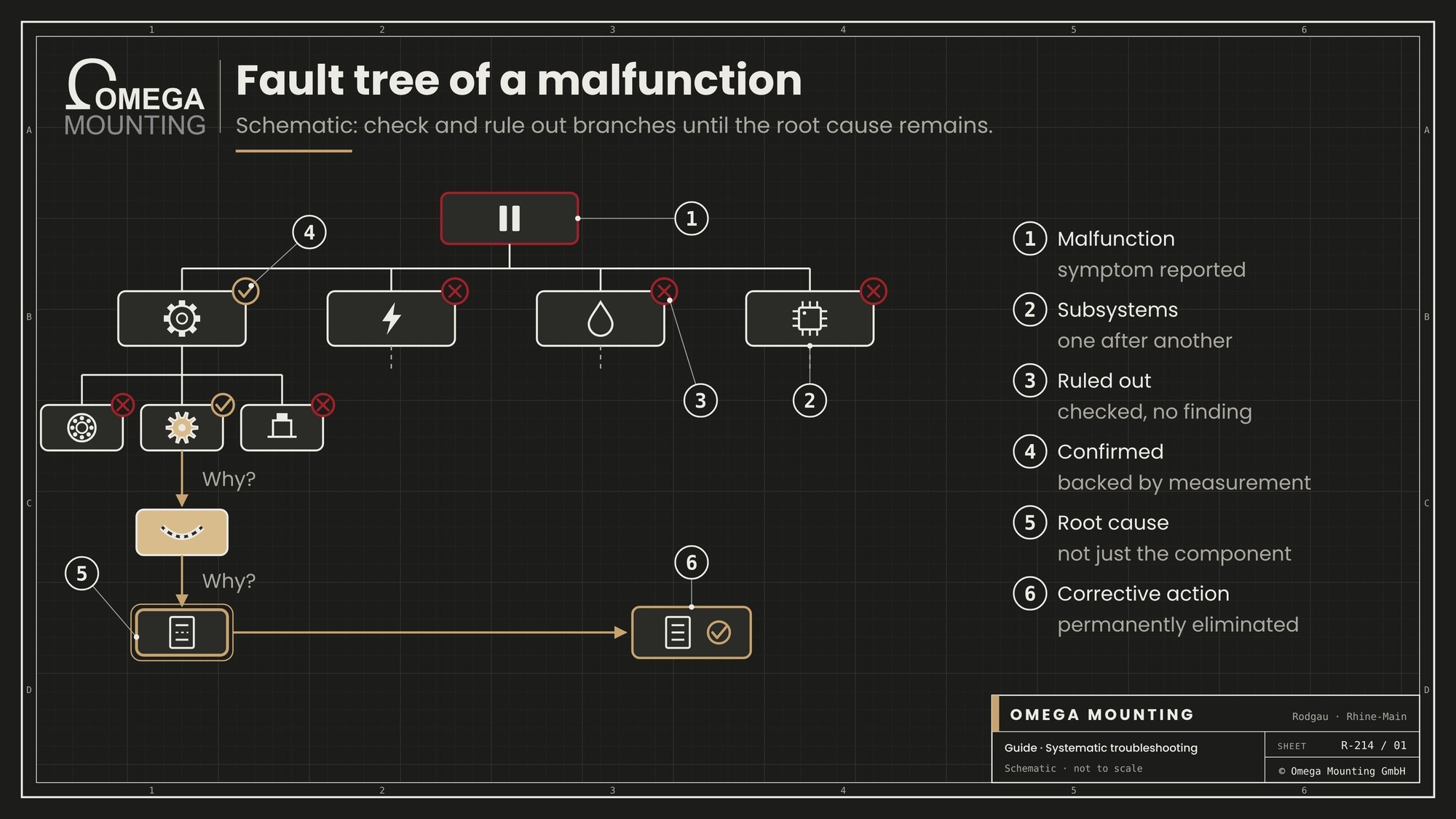
Two simple tools help you to get to the root cause systematically.
The five-why method
With the five-why method you keep asking “Why?” until you arrive at a cause that can be eliminated. Why is the plant at a standstill? Because the chain jumped. Why did it jump? Because the sprocket was worn. Why was it worn? Because the chain was running too slack. Why was it running too slack? Because retensioning was not in any plan. The number of questions is not a rule but a reminder not to stop too early.
The fault tree
A fault tree puts the fault at the top and branches downwards into all possible causes: first by subsystem, then by assembly and component. Each branch is checked and either ruled out or followed up. This way everyone in the team can see what has already been done and what is still open.
Cause-and-effect diagram
For complex or recurring faults, a cause-and-effect diagram, also known as a fishbone diagram, helps. It collects possible causes in groups such as people, machine, material, method and environment.
Working as a team
Root cause analysis works best as a team: machine operator, maintenance and, where necessary, the manufacturer and electricians. Everyone sees a different part of the problem.
Facts instead of opinions
Every branch and every answer to a “Why?” is backed up by an observation or measurement. An assumption that has not been tested is not a cause.
Immediate measure or permanent elimination?
The cause cannot always be eliminated permanently straight away. Then a clear distinction is needed.
The immediate measure
It quickly returns the plant to safe operation: a provisionally sealed leak, a straightened plate, a part from stock that does not quite fit. An immediate measure is permitted if it is safe and marked as such.
Permanent elimination
It eliminates the cause so that the fault does not come back: the right spare part, the corrected alignment, the supplemented lubrication schedule. It is planned and fixed with a date.
The risk of the temporary fix
Many temporary fixes stay because the plant is running again. That is dangerous. That is why every immediate measure is linked to an open item for the permanent solution.
Checking effectiveness
After elimination, a check is made as to whether it has worked: in a trial run, by measurement and after some time in operation. Only when the fault does not return is troubleshooting complete.
Where systematic troubleshooting reaches its limits: controls, software, electrics
Good troubleshooting also knows its limits.
Controls and software
Faults in the program, wrong parameters or disrupted communication between control systems belong in the hands of the manufacturer or control system builder. Anyone who intervenes here without knowledge risks new faults and may lose the warranty.
Electrics beyond the main switch
Power supply, building electrics, medium voltage and grid connection lie with the electrical contractor, the operator or the network operator. Our own electricians work on the plant side up to the main switch.
Safety functions
Emergency stop circuits, light curtains and guard door switches are not bypassed in order to keep searching. Changes to the safety chain are only made with the operator's approval and with a test afterwards.
What we take on
We take on mechanical troubleshooting, the replacement and repair of components and coordination with the manufacturer and electrical contractor. This way the operator does not have to manage every company themselves.
Documentation: what is recorded after troubleshooting
Troubleshooting that is not written down has to start from scratch next time.
What belongs in the record
Plant and assembly, time, description of the fault, messages, measured values, hypotheses tested with result, cause found, root cause, measure taken, spare parts used and open items.
Photos
Photos of the damage pattern, the removed part and the condition after the repair help with queries, warranty questions and the next job.
For the audit
Many operators have to prove that faults have been dealt with and causes eliminated. What audit-proof documentation looks like is described in the guide maintenance documentation for audits.
Passing on knowledge
Whatever was learned from a fault belongs in the plant's maintenance documents: as a note in the maintenance plan, as a new inspection item, as an entry in the spare parts list.
Recognising and avoiding repeat faults
Repeat faults are the clearest sign that so far only symptoms have been treated.
Recognising patterns
Anyone who documents faults sees patterns: the same assembly, the same time of day, the same product changeover. A quick look at the fault list once a month is often enough to find repeat faults.
Lubrication and care
Many repeat faults have a simple root cause: missing or wrong lubrication, connections not retightened, dirty filters. How a lubrication schedule is structured is described in the guide lubrication schedule in maintenance.
Maintenance-free does not mean for ever
Some components are considered maintenance-free and are therefore never looked at. This is often only true under ideal conditions. In practice it is worth taking a regular look at these parts too.
Design causes
If a fault keeps coming back despite correct maintenance, the cause sometimes lies in the design: an undersized component, an unfavourable installation. Then a change is discussed with the manufacturer or planner. Whether such a change substantially modifies the machine is described in the guide Substantial modification of a machine.
From fault to prevention
Every fault that is solved is a pointer for preventive maintenance. Whatever has failed once gets an inspection item in the maintenance plan.
Spare parts: what should be ready for troubleshooting
The best diagnosis is of little use if the spare part first has to be ordered.
Keeping critical parts in stock
For plant that must not stand still for long, the parts that fail most often or have long delivery times are kept in stock: chains, sprockets, bearings, belts, sensors, seals, valves. What belongs in such a store is described in the guide spare parts store in maintenance.
Replacing parts in pairs
Some parts wear together: chain and sprocket, pin and bushing, belt and pulley. Anyone who replaces only one wears out the new part faster.
The right part
The spare part must fit: dimensions, material, version. A similar part is often only an immediate measure. For older plant, the guide helps: Spare parts no longer available.
Keeping the old part
The removed part is not disposed of straight away. It shows what has happened and helps with root cause analysis and warranty questions.
Safety rules for troubleshooting
- No troubleshooting without securing against restart.
- Stored energy is released or safely blocked.
- Standstill is checked before anyone intervenes.
- Work on electrical parts only by qualified electricians.
- Safety functions are never bypassed in order to keep searching.
- Nobody works alone on dangerous plant.
Typical mistakes in troubleshooting
Guessing instead of describing: The fault is not recorded precisely, and the search starts in the wrong place.
Acknowledged too quickly: The message is deleted, the information lost.
Swapping parts on suspicion: Viel Geld, wenig Erkenntnis.
Several changes at once: Nobody knows what helped.
Symptom repaired: The plant runs, the fault comes back.
Temporary fix forgotten: The immediate measure becomes a permanent state.
Nothing written down: Next time the search starts from scratch.
The mistake behind the mistakes
Most mistakes happen under time pressure. Especially when the plant urgently needs to run, it is worth pausing briefly and sticking to the sequence. That is almost always faster than hectic trial and error.
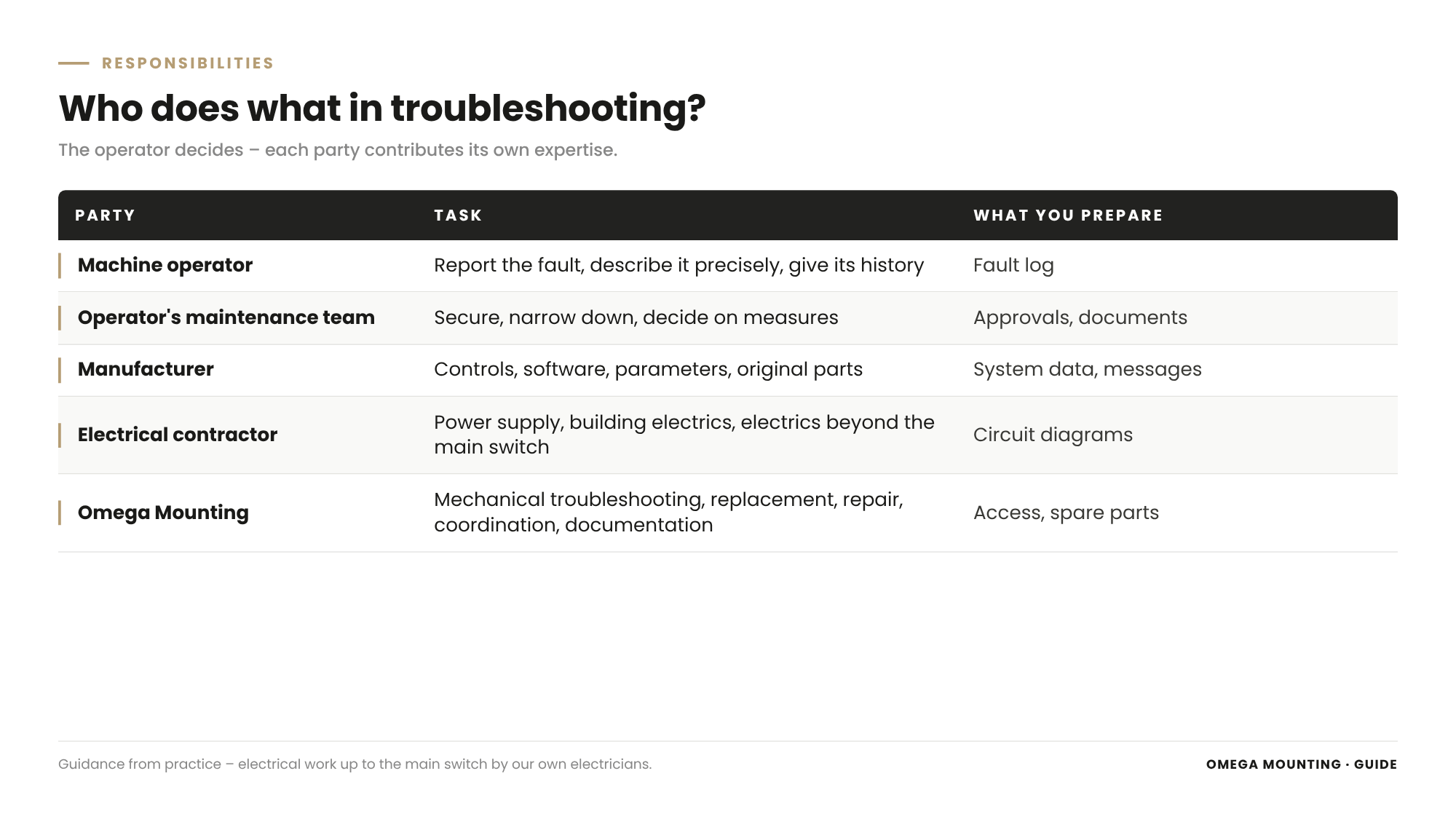
Who does what in systematic troubleshooting?
Machine operator
They report the fault, describe it precisely and provide information on the operating state and history.
Operator's maintenance team
They secure the plant, gather information, narrow down and decide on the immediate measure and permanent elimination.
Manufacturer
They support with controls, software and parameters, supply documents and original parts and clarify design questions.
Electrical contractor
They trace faults in the power supply and building electrics and take on electrical work outside our scope.
Omega Mounting
We take on mechanical troubleshooting, replacement and repair, make the plant-side connections up to the main switch, coordinate the manufacturer and electrical contractor and document the cause and the measure taken.
Systematic troubleshooting: what it means for your planning
Is there a procedure for faults?
Define who is informed in the event of a fault, who secures the plant and who decides.
Are the documents to hand?
Keep plans, instructions and spare parts lists ready at the plant or digitally.
Is documentation kept?
Keep a fault log and evaluate it regularly.
Who helps when things get tight?
Agree in advance who provides support with major faults. What on-site plant support looks like is described in the guide On-site plant support.
What belongs in the order for troubleshooting
Service
Troubleshooting, diagnosis, immediate measure, permanent repair, trial run, documentation.
The frame
Availability, access, isolation by the operator, interfaces with the manufacturer and electrical contractor, procurement of spare parts.
Record
Fault log with cause and measure, photos, list of parts used, open items.
Legal framework
Troubleshooting and repair work on plant is governed, among other things, by the German Ordinance on Industrial Safety and Health with its requirements for safe maintenance work, the technical rule for industrial safety on maintenance, the Occupational Safety and Health Act with its obligation to carry out a risk assessment and to coordinate between several employers, and the accident prevention regulation for electrical installations and equipment. In addition there is the manufacturer's information. This guide is not legal advice – clarify which obligations apply in your case with your occupational safety specialist.
Systematic troubleshooting in the Rhine-Main region: how we do it
From Rodgau we quickly reach Frankfurt, Offenbach, Hanau, Darmstadt, Aschaffenburg and the industrial and logistics areas of the region – and our own teams work throughout Germany. Anyone in the Rhine-Main region who needs support with troubleshooting gets experience from many types of plant with us.
We troubleshoot and repair conveyor systems, overhead conveyors, storage technology, fans, drives and standby generators. How we otherwise work in servicing and maintenance is shown on the page on Maintenance and servicing.
For you this means: a diagnosis that finds the cause, and a repair that lasts.
Project examples
Three jobs show what systematic troubleshooting looks like in everyday work.
Squeaking carriers in a food plant
In a food plant an overhead conveyor was squeaking loudly, and there were repeated breakdowns during production. We pulled a pin: pin, bearing seat and bearing were worn, with grooves, cracks and material loss. The root cause was missing lubrication, because the pins were considered maintenance-free. Over several weekends we refurbished all the carriers. The job is described in the report EHB-Bolzen-Reparatur in einem Lebensmittelbetrieb.
Standstill in the high-bay warehouse at Frankfurt Airport
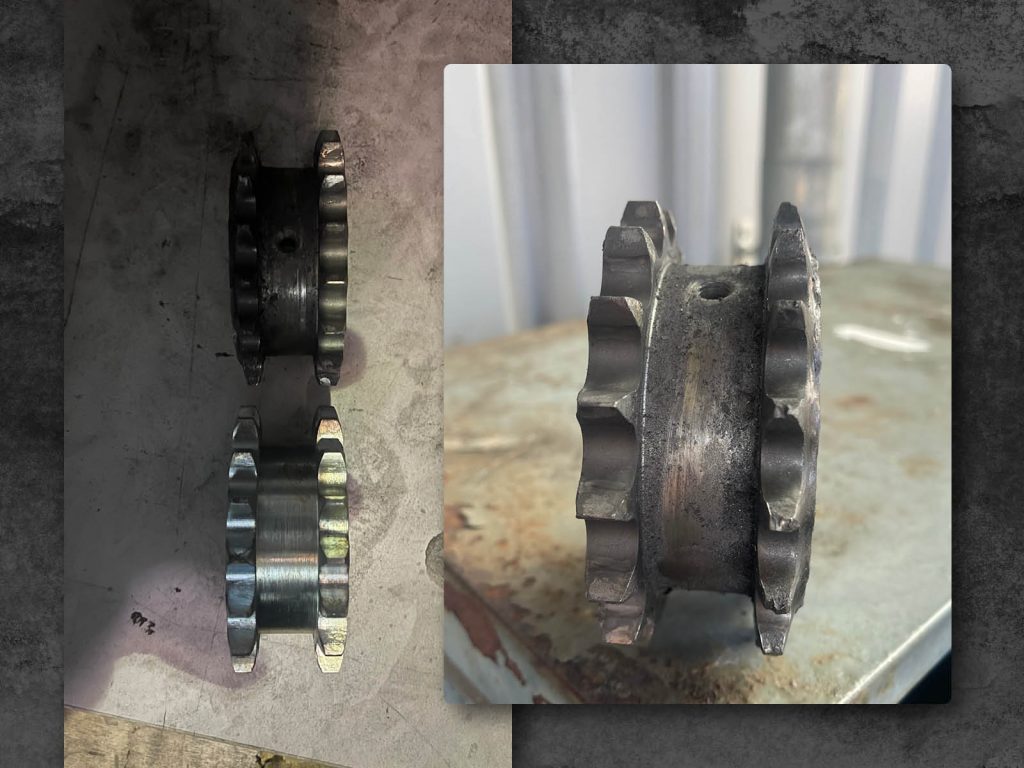
At Frankfurt Airport a high-bay warehouse was at a standstill, and nobody knew which component had failed. We narrowed it down on site: the roller conveyor was no longer conveying. In the drive unit a gear was worn, and the drive chain was blocking and partly jumping. Because the spare parts were on site, we replaced chains and gears immediately and readjusted them. The job is described in the report High-bay warehouse repaired at the airport.
Leak on the generator radiator in Offenbach
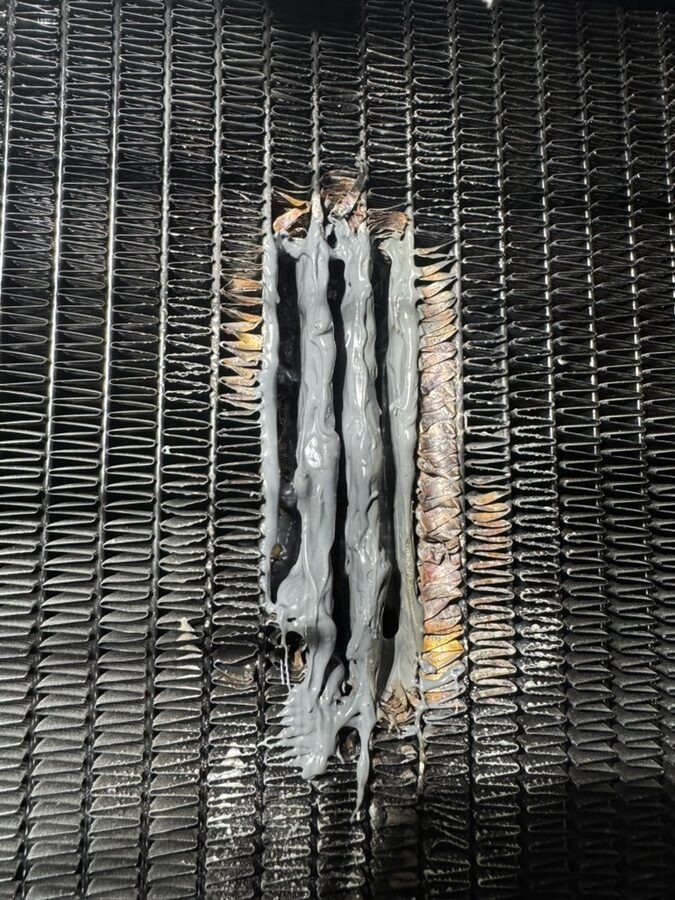
In a data center in Offenbach, the radiator of a standby generator had a leak shortly before commissioning. Together with the master craftsman of a partner company, we exposed the cooling fins, brazed and sealed the leak and tested it with a pressure test. This was deliberately a temporary solution: the permanent repair follows with the silencer removed. The job is described in the report Radiator repair on the generator in the Offenbach data center.
Is one of your plants at a standstill, and the cause unclear?
Describe the fault to us, the plant and what has been checked so far – we will tell you how we would approach the troubleshooting. Get in touch now.
What this means for your role
Maintenance managers: Introduce a fixed procedure for faults and regularly evaluate the fault log for repeat faults.
Shift supervisors and machine operators: Describe faults precisely, only acknowledge messages after writing them down and say what was different beforehand.
Operations and technical managers: Give root cause analysis time, even when the plant is already running again.
Planners: Ensure accessibility, measuring points and complete documents – that makes any later troubleshooting easier.
Buyers: Ask whether diagnosis, documentation and coordination are included in the quotation.
Occupational safety specialists: Check whether securing, isolation and the handling of stored energy are covered in the risk assessment.
Fault log template: on request
For your plant we have put together a template for a fault log. It covers description, operating state, securing, narrowing down, hypotheses tested, cause, root cause, immediate measure, permanent elimination and effectiveness check. Request the template via our contact form – keyword “Fault log template”.
Why Omega Mounting?
From more than twenty years of practice in installation and maintenance we know: the fastest repair is the one you only have to do once. That is why we narrow down faults systematically, test assumptions before we swap anything and ask about the root cause. Mechanical troubleshooting, replacement and repair come from a single source, our own electricians make the plant-side connections up to the main switch, and we coordinate with the manufacturer and electrical contractor. For you this means: less downtime and no fault that keeps coming back. Talk to us about your plant – we will get back to you promptly.
Conclusion
Systematic troubleshooting means: describe, secure, gather information, narrow down, test hypotheses and eliminate permanently. Anyone who distinguishes cause from symptom, gets to the root cause with a fault tree or the five-why method and documents every fault avoids repeat faults and unnecessary parts swapping.
A method is not a detour but the shortest route to a running plant. If you need support with a fault or with setting up systematic troubleshooting, get in touch with us.
Planning a move-in, installation or maintenance in the Rhine-Main region?
Tell us briefly what you need – we'll come back with an honest assessment.
Free, no-obligation callback
You may also be interested in these guides
Maintenance & Servicing
About the author
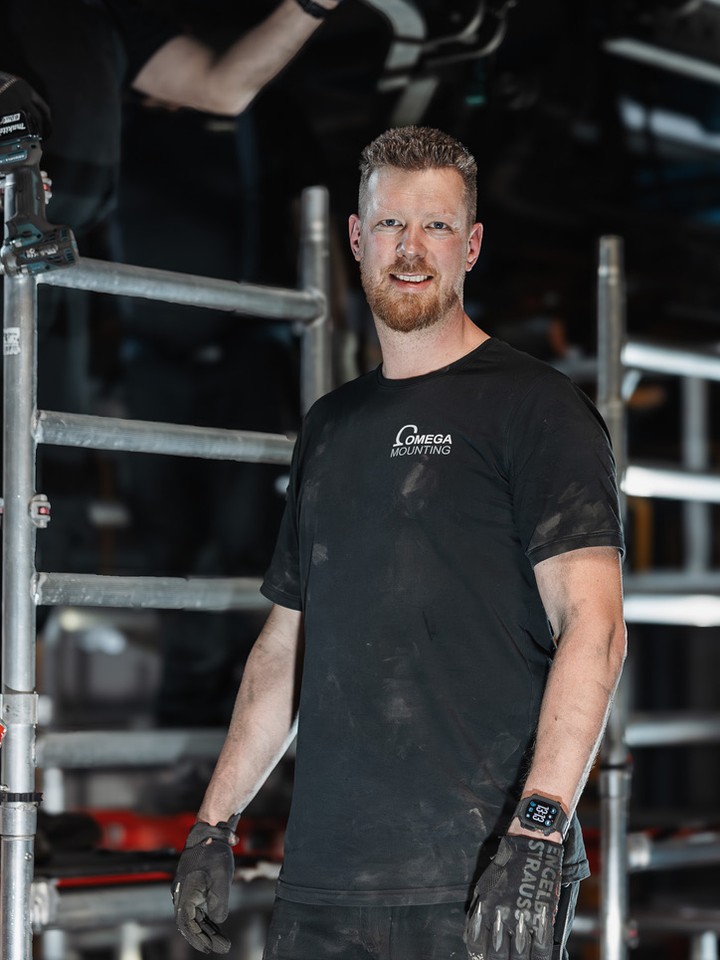
Tobias Schott
Managing director of Omega Mounting GmbH, Rodgau · more than 20 years of hands-on experience in installation and maintenance
A trained mechatronics technician, working in maintenance, servicing and industrial installation since 2004 – first alongside his father, and with Omega Mounting since 2012: from overhead conveyors in Frankfurt to the crane system in a new-build hall. He plans and leads lifting operations as an appointed person (AP) in data centers and on industrial sites in the Rhine-Main region, trains and examines operators of cranes, mobile elevating work platforms and telehandlers, and is a qualified occupational safety specialist. On jobs abroad he is known as the “German Troubleshooter” – the person you call when a site gets stuck. He learned what quality means from his father, not from a manual: Made in Germany as a standard for his own work, not a label. That is why quality comes first at Omega Mounting – ahead of speed and price. He writes these guides from that practice: what works on our sites is in them – what exists only on paper is not.
Frequently asked questions
An orderly approach in fixed steps: describe the fault, secure the plant, gather information, narrow down, test hypotheses and eliminate the cause permanently.
The symptom is what you notice, such as a noise or a standstill. The cause is the reason for it. Anyone who only eliminates the symptom will see the fault again.
You keep asking “Why?” until you arrive at a cause that can be eliminated permanently – usually a missing rule, a missing inspection point or a wrong design assumption.
A diagram that, starting from the fault, branches into all possible causes by subsystem and component. Branches that have been checked are ruled out until the cause remains.
With a precise description and securing the plant. After that, the simple and likely causes are checked first.
Because it is expensive and obscures the cause. If the plant runs afterwards, nobody knows whether the old part was faulty.
The manufacturer or control system builder. Electrics beyond the main switch lie with the electrical contractor or the operator.
By looking for the root cause, documenting every fault, evaluating the log regularly and transferring the findings into the maintenance plan and spare parts list.
Describe the fault to us, the plant and what has already been checked. We will come back to you with a proposal. Go to the contact page.
 English
 German