
- Guide – Maintenance
Terminating a maintenance contract: switching provider without losing knowledge
By Tobias Schott · 21-minute read · Updated October 2026

If you hand servicing to a new service provider, you risk the knowledge about your plants: a clean switch clarifies the open points before you terminate, gets all documents back before the contract ends and starts with the new partner with a condition survey as the baseline.
The decision is made: you want to terminate the maintenance contract and give the servicing to another service provider. Perhaps the response in a breakdown came too late too often. Perhaps the contract no longer suits your machine fleet. Or the plant has moved, and the previous partner is now too far away. The reason is usually quickly found – the handover is the difficult part.
Because knowledge leaves with the old service provider. Which switch has caused trouble twice already? Where is the last inspection report? Which spare parts are in their store and not in yours? If you do not clarify this before the contract ends, you start from scratch with the new partner.
This guide shows what to clarify before you terminate, which documents have to be handed over, how the new partner makes a clean start and how to get through the transition period without a gap. What belongs in a maintenance contract and which contract models exist is explained in our basic article on the maintenance contract in industrial maintenance. This one is about the end of a contract – and the start of the next.
We write from the point of view of an installation and maintenance contractor from Rodgau near Frankfurt that often takes over plants at exactly this point. We pass no judgement on your previous service provider.
Key points at a glance
- Term, notice period and form of termination are in your own contract – also check there what it says about handing over documents and parts.
- Before you terminate, open findings, upcoming inspection dates, parts in the service provider's store, keys and access belong on a list.
- Nine documents and stocks are handed over: equipment file, inspection records, service reports, findings list, spare parts list, drawings, parameters, contacts and open orders – complete before the contract ends.
- The new partner starts with a condition survey as the baseline and compares it with the handover documents.
- Inspection dates continue, no matter who services; they belong in the new partner's calendar from day one.
- During the transition period it must be clear for every plant who is responsible and who comes in a breakdown – a gap and double responsibility are both risky.
What is a change of service provider in maintenance?
A change of service provider in maintenance is the planned transfer of the servicing of a plant from one service provider to another – with termination of the old contract, handover of all documents and stocks and a documented start with the new partner.
The switch has three phases. Before terminating, you clarify what is open. Until the contract ends, the handover runs. After that, the new partner starts with a condition survey. If you only plan the first phase, you end up with a terminated contract and an incomplete file.
Anyone who wants to switch service provider in maintenance usually thinks first of the new contract and the new quotation. That is understandable, but it is the wrong order. What comes first is what lies with the previous partner: documents, parts, access and the knowledge of its fitters. Only once it is clear what of this comes back can you say what the new partner has to deliver at the start.
Switch completely or only partly?
Changing your maintenance company does not always mean re-awarding everything. Often only part changes: the mechanics go to an independent contractor, controls and software stay with the manufacturer. Our guide Manufacturer's service or independent maintenance contractor weighs up which model fits when. That one is about the decision, this one about the handover.
Check first, then terminate
Not every annoyance with the contract is a reason to switch. Sometimes all that is missing is an up-to-date asset list or a rule for findings. Before you end the maintenance contract, an honest look at the content is therefore worthwhile. How to recognise a good contract and what is often missing is shown in our guide on maintenance contract for machinery. If the result is clear, switching is a decision on the facts – not a reaction to the last annoyance.
Why companies terminate their maintenance contract
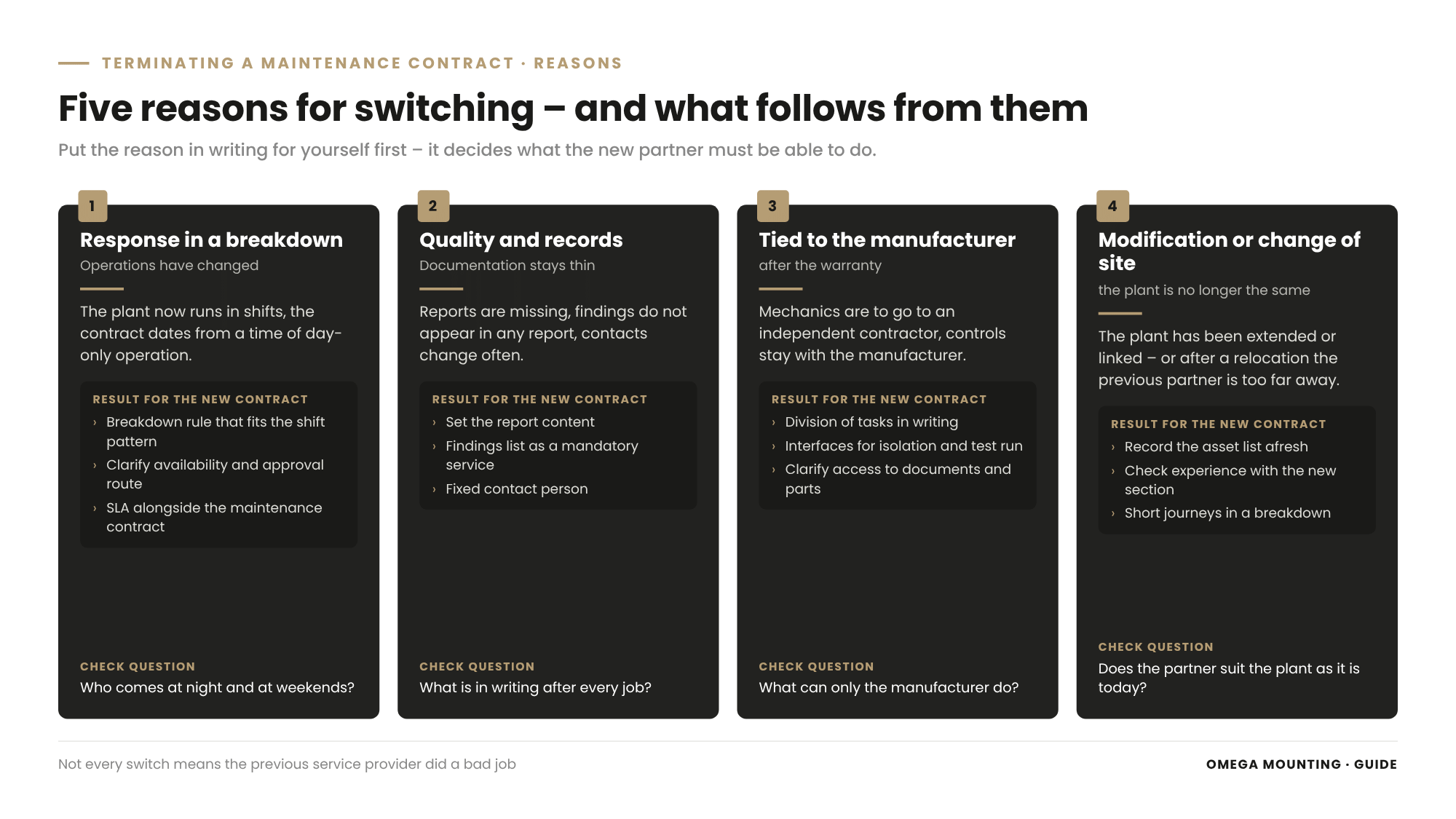
Companies usually terminate a maintenance contract for one of five reasons: the response no longer fits, quality varies, the tie to the manufacturer is too close, the plant has been modified, or the location has changed.
Not every switch means that the previous service provider did a bad job. Often the company has changed, not the partner.
- Response in a breakdown. The plant now runs in shifts, the contract dates from a time of day-only operation. What a breakdown rule has to deliver is set out in our guide on SLA in maintenance.
- Quality and records. Reports stay thin, findings do not appear in any report, contacts change often.
- Ties to the manufacturer. After the warranty, the mechanics are to go to an independent contractor, the controls stay with the manufacturer.
- Modifications. The plant has been extended or linked, and the previous partner lacks experience with the new section.
- Change of site. After a relocation, the previous service provider is too far away for short journeys in a breakdown.
Name the reason for yourself
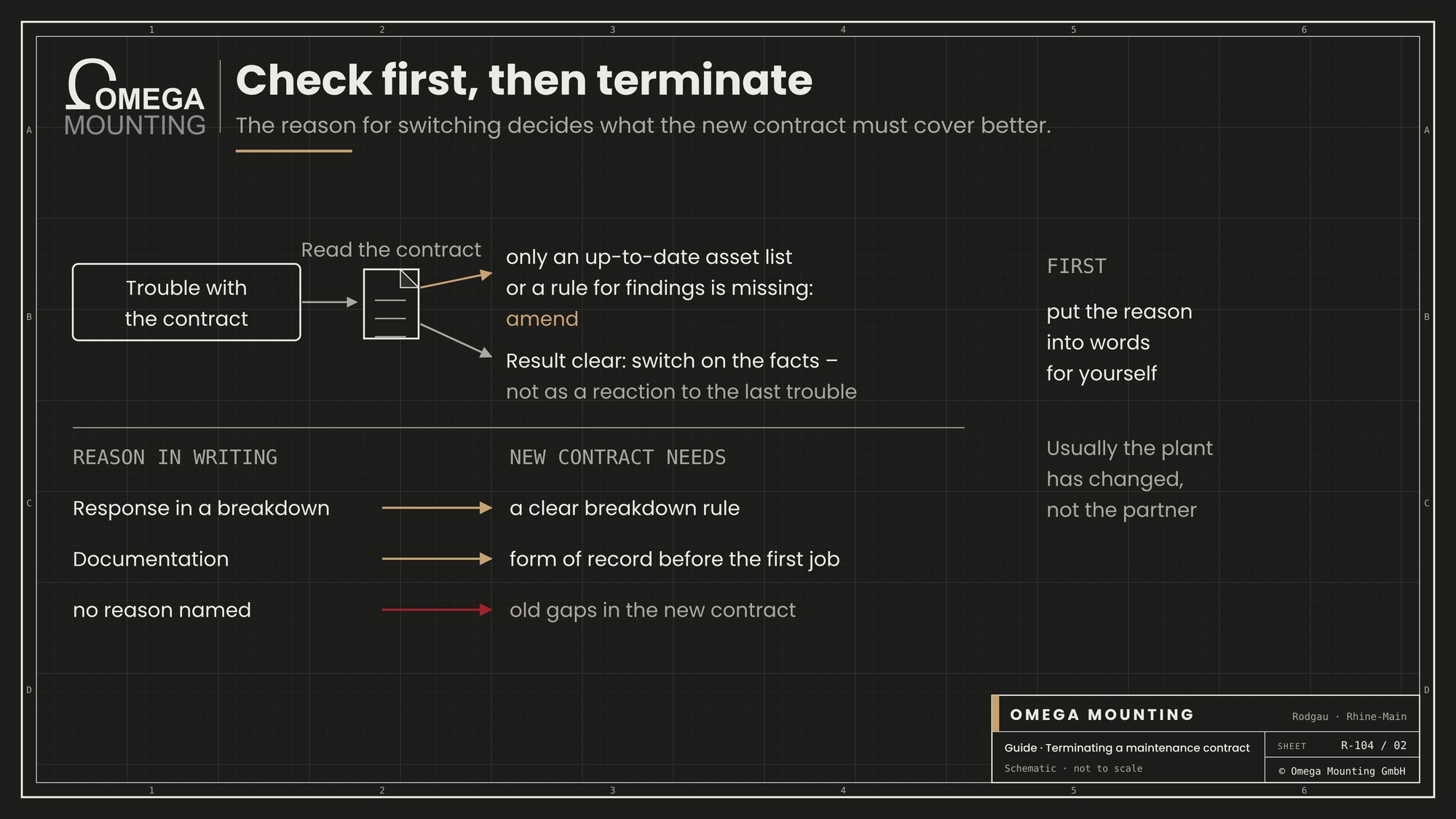
Put the reason for switching in writing – first for yourself. It decides what the new contract must cover better. If you switch because of the response, you need a clear breakdown rule. If you switch because of the documentation, you need a form of record that is fixed before the first job. If you do not know the reason, you write the old gaps into the new contract.
Before terminating: what to clarify before you terminate your maintenance contract
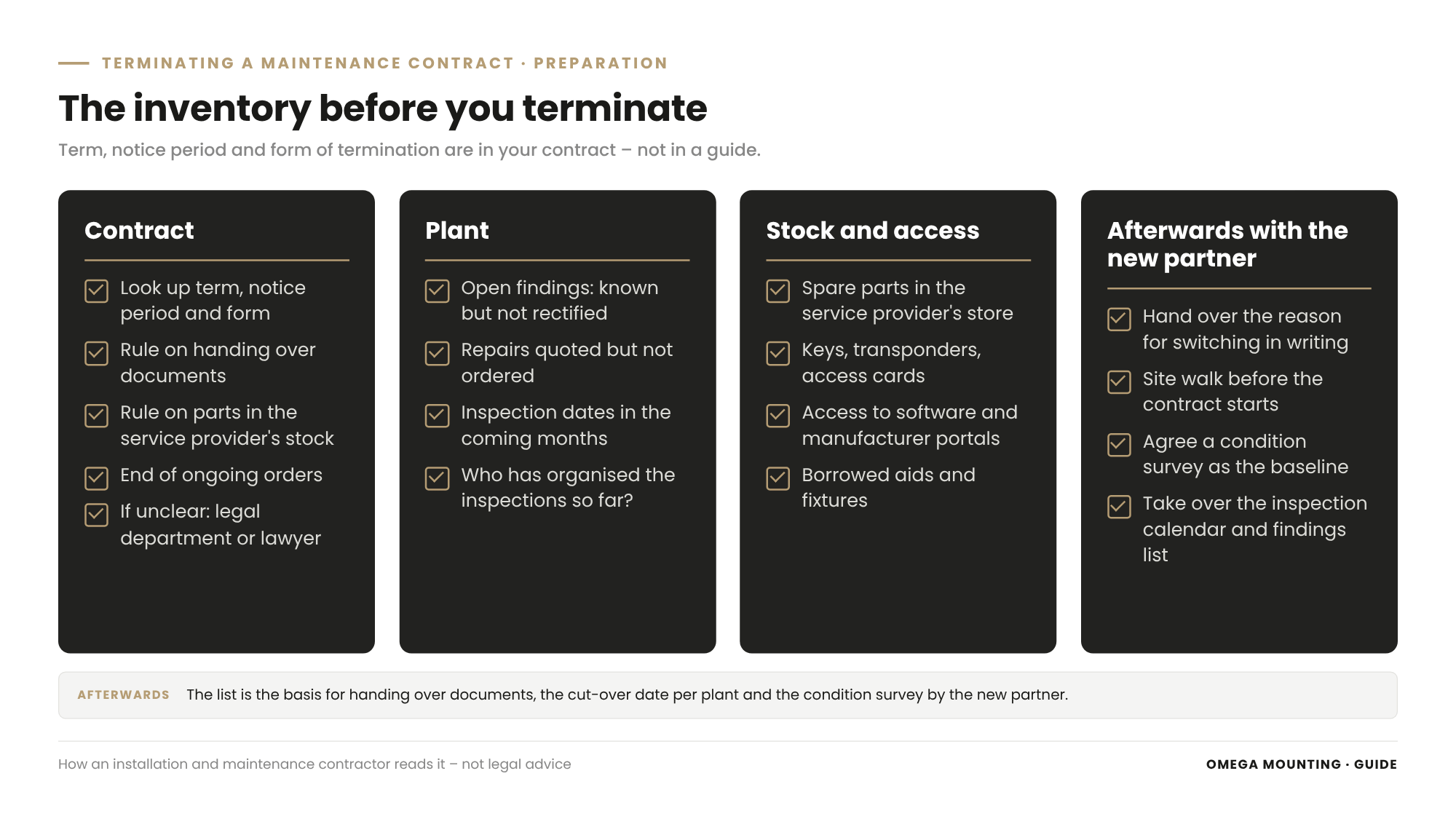
Before terminating, you clarify five things: what your contract says about term, notice period and documents, which findings are open, which inspection dates are coming up, which parts are with the service provider and which keys and access have to come back.
Read your own contract
Term, notice period and form of termination are in your contract – not in a guide. Also check there what it says about handing over documents, parts in the service provider's stock and the end of ongoing orders. This guide is not legal advice. If anything is unclear, clarify the termination with your legal department or your lawyer. The same applies to terminating the manufacturer's service contract: the terms are in your documents.
The inventory before you terminate
Before the termination letter goes out, five points belong on a list. It is the basis for everything that follows.
- Open findings. Which defects are known but not rectified? Which repair has been quoted but not ordered?
- Upcoming inspection dates. Which recurring statutory inspection is due in the coming months, and who has organised it so far?
- Parts in the service provider's store. Are spare parts that were procured for your plant lying with the service provider? Clarify how they get to you before the contract ends.
- Keys, cards and codes. Keys to control cabinets and plant rooms, access cards, codes for gates and airlocks.
- Software access at the manufacturer. Who has access to the controls, to parameters, to a service portal or a remote connection? If it runs via the service provider, it has to be switched over to you.
Clarify the manufacturer's terms in writing
If part of the servicing moves away from the manufacturer, there is one more question. Whether the manufacturer's terms require specific servicing is in your documents; ask in writing before you switch. Warranty and guarantee are two different things – what applies is set out in your purchase contract and the manufacturer's terms. File the answer in the equipment file.
Choosing the timing
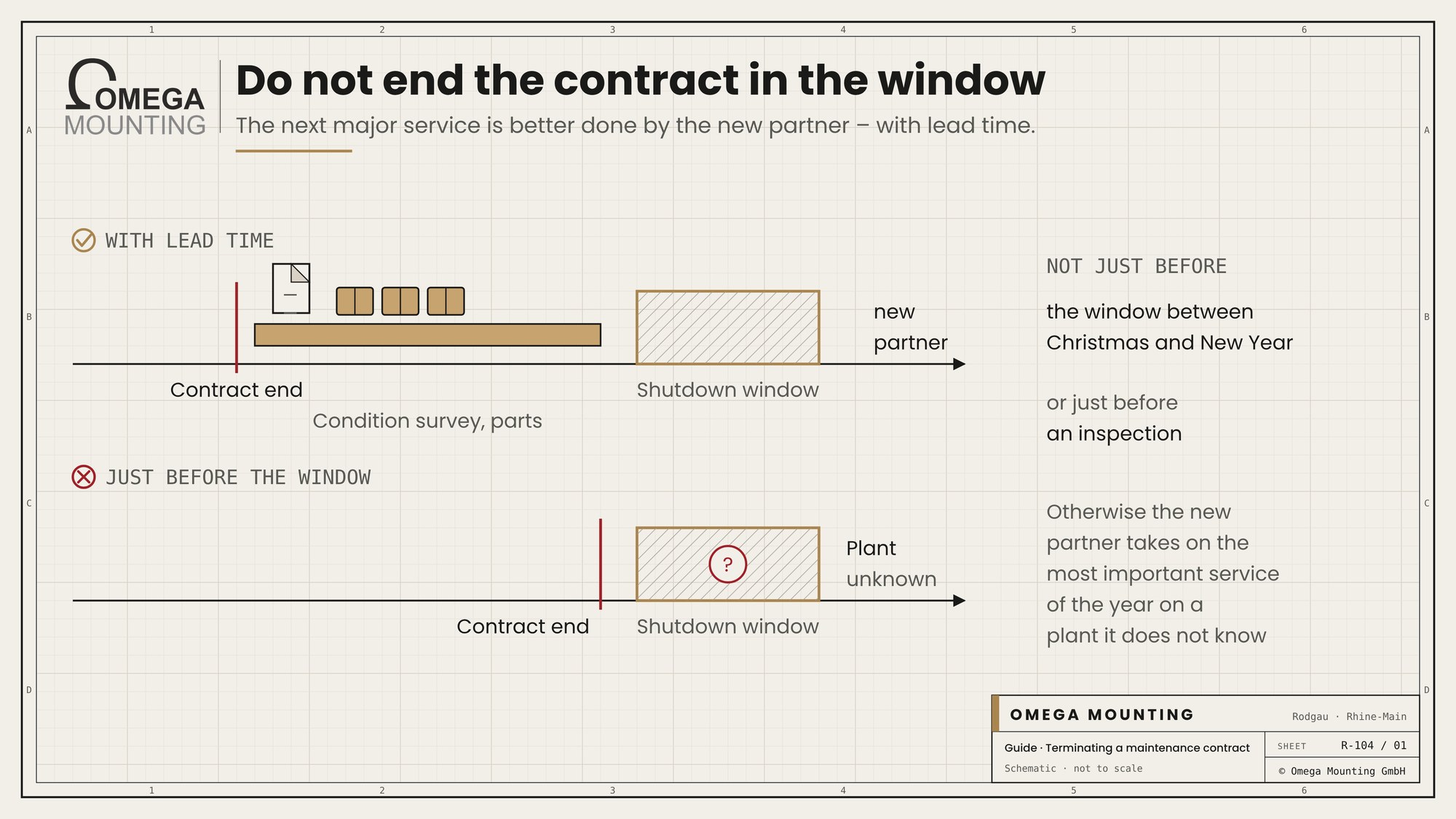
Do not terminate into a shutdown window. A good contract end lies so that the next major service is already with the new partner – with lead time for the condition survey and parts. A contract end just before the window between Christmas and New Year or just before an inspection is the opposite. Then a partner takes on the most important service of the year on a plant it does not know.
What has to be handed over
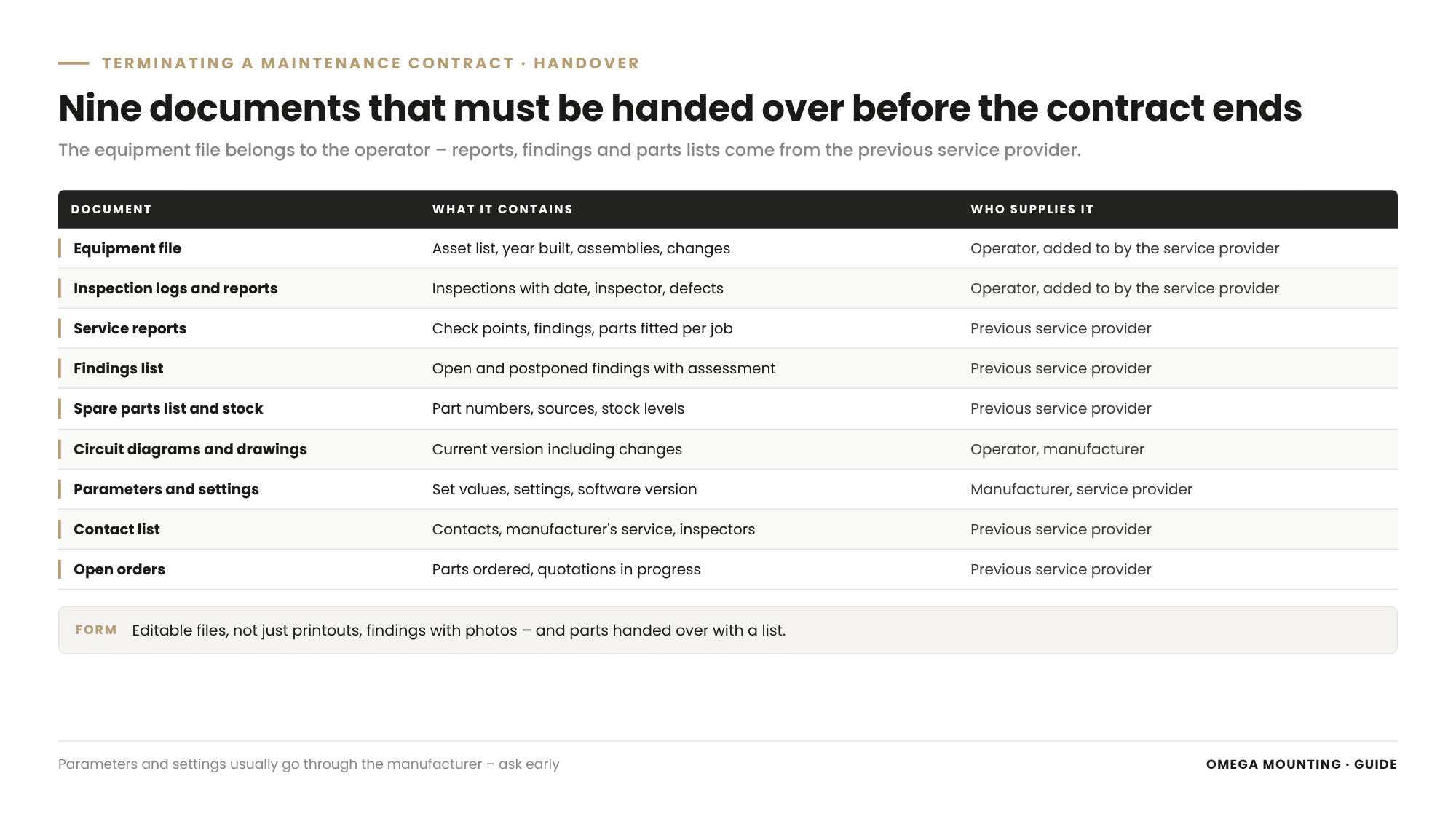
Nine documents and stocks have to be handed over: equipment file, inspection records, service reports, findings list, spare parts list with stock, circuit diagrams and drawings, parameters and settings, contact list and open orders.
The table shows what they contain, who supplies them and in what form. The deadline is the same for all: before the contract ends. Whatever is still missing after the last day on site is often hard to get.
| Document | What it contains | Who provides it | Design |
|---|---|---|---|
| Equipment file | Asset list with location, year built, assemblies and changes | Operator, added to by the service provider | Folder or file with a table of contents |
| Inspection logs and inspection reports | Recurring inspections with date, inspector and defects | Operator, added to by the service provider | Complete collection kept by the operator |
| Service reports | Date, plant, check points, findings and parts fitted per job | Previous service provider | Editable file, not just a printout |
| Findings list | Open and postponed findings with assessment | Previous service provider | List with photos |
| Spare parts list and stock | Part numbers, sources, stock on site and with the service provider | Previous service provider | List plus handover of the parts |
| Circuit diagrams and drawings | Mechanics, electrics and changes since commissioning | Operator, manufacturer, service provider | Current version with date |
| Parameters and settings | Control parameters, end positions, software version | Via the manufacturer | Data backup and list |
| Contact list | Contacts at the manufacturer, inspectors, electricians and suppliers | Previous service provider | List with responsibilities |
| Open orders | Services ordered, quoted and in progress | Both sides | List with status and completion |
The equipment file is the heart of the handover
Much of the table should be with you anyway. An operator who only has inspection records and service reports at the service provider's notices at the latest when switching – or in an audit. With the equipment file, the handover decides whether the new partner builds on knowledge or starts from scratch. What a file that survives both looks like is shown in our guide on maintenance documentation for audits.
Parameters only via the manufacturer
Parameters, software versions and control settings come via the manufacturer, not the maintenance contractor. Ask early whether it will supply a data backup or a parameter list and who will have access in future. Without these values, every replacement on the controls after the switch becomes a search.
Keeping an eye on spare parts
The spare parts list often shows more than stock levels. It shows which parts the previous partner obtained from which sources – and which were already hard to get. The usual routes for parts the market no longer supplies are shown in our guide on spare parts that are no longer available.
A handover meeting instead of a parcel
Ideally, both sides hand over at the plant. The previous service provider shows the special features, the new one asks questions. A record notes what was handed over and what is missing. Not every previous partner goes along with this – ask anyway. Many are willing if the switch was announced fairly. Sending the maintenance documents by post does not replace this conversation.
The baseline with the new partner
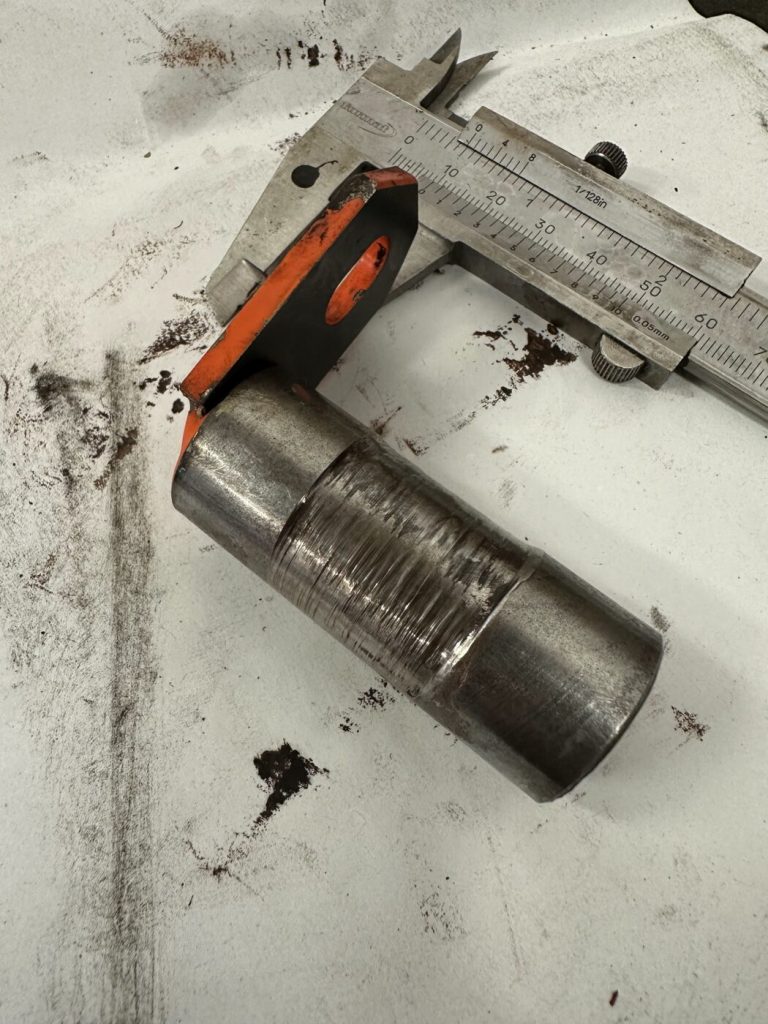
The baseline with the new partner is a condition survey of all plants taken over at the start: it records the condition in which the plant was handed over and separates existing defects from everything that arises afterwards.
Without this baseline, after a year nobody knows whether a worn bearing was already worn at takeover. With it, the question is answered in a minute. The start runs in five steps.
- Condition survey. The new partner assesses every plant down to the assembly, measures wear, takes photos and evaluates.
- Comparison with the handover documents. Do the asset list, findings list and reports match what can be seen on the plant?
- Create a new findings list. Old and new findings come together in one list, with assessment and proposal.
- Take over the inspection calendar. All inspection dates go into the new partner's planning with their date.
- Sharpen the scope of services. What the condition survey shows feeds into the new contract.
Why the comparison matters
The handover documents show the situation on paper, the condition survey the situation on the plant. Where the two diverge is often where the real knowledge lies: a finding that was never written down, a change without a drawing, a part fitted differently from the list. These are exactly the points that belong in the takeover record.
Existing defects in a separate package
Repairs revealed by the condition survey do not belong in ongoing servicing but in a separate package. Otherwise the new contract carries the old one's existing defects. So only compare quotations from new partners if the condition survey is included. How to recognise complete quotations is shown in our guide on comparing maintenance quotations.
Inspection dates continue
Recurring statutory inspections know no change of service provider. As the operator, you set the type, scope and frequency in your risk assessment, and they continue to apply no matter who services. So enter all inspection dates in the annual plan on day one, with inspector and a window for rectifying defects. How such a plan is drawn up is shown in our guide on the maintenance calendar.
The transition period: no gap and no double responsibility
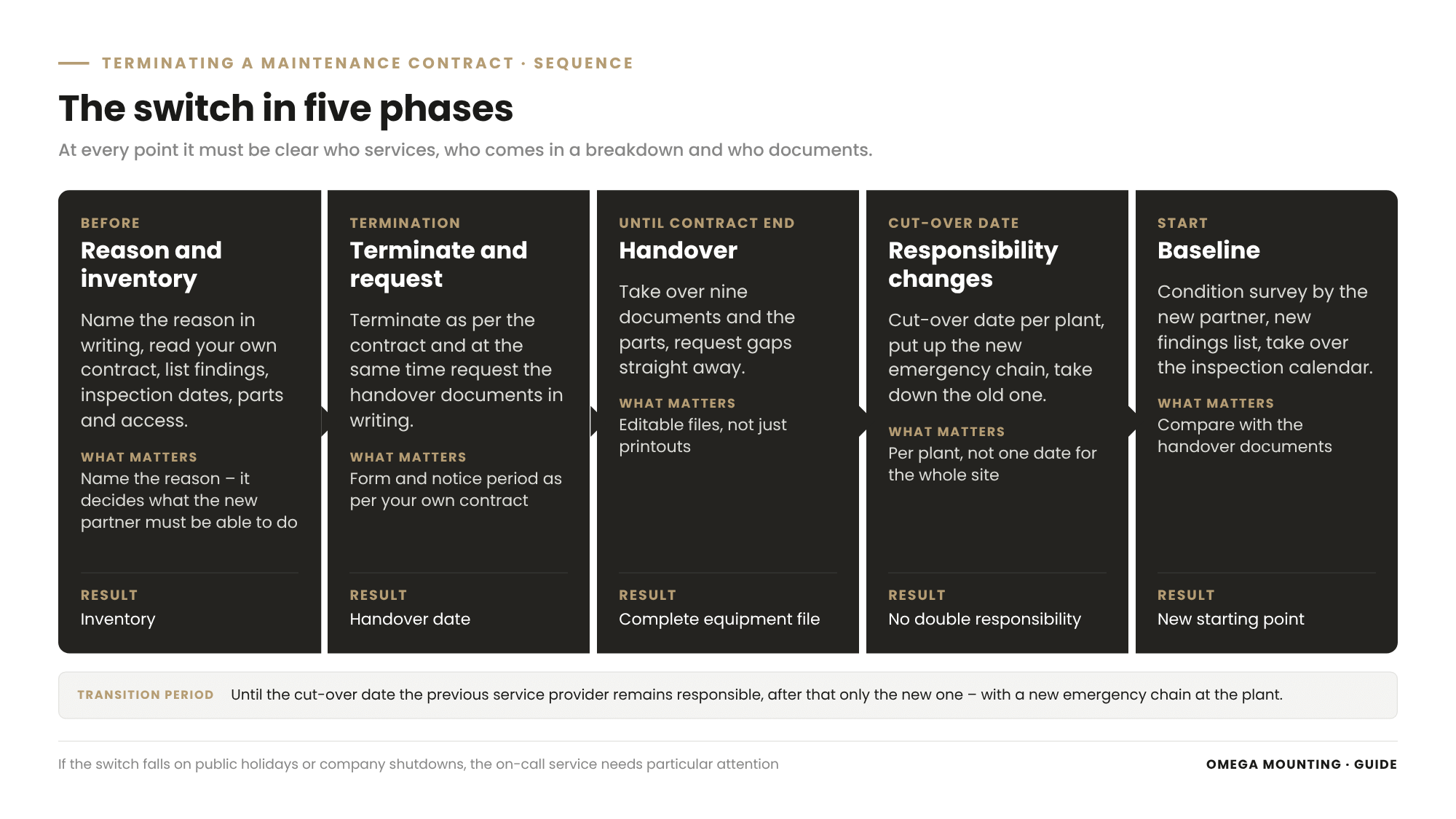
The transition period is the phase between termination and the new partner's full start; throughout it, it must be clear at all times who services, who comes in a breakdown and who documents.
Avoid double responsibility
Two service providers on the same plant without a clear boundary are risky. Each relies on the other, and findings fall between the reports. So set a cut-over date from which the new partner is responsible – per plant, not one date for the whole site. Until then, the previous service provider remains responsible, after that only the new one.
Clarify the emergency chain
Who comes if the plant stops in the week of the switch? The answer must be fixed before the cut-over date: phone number, responsibility, approval. Put up the new emergency chain where the shift will look for it, and take down the old one. An outdated notice on the plant is worse than none at all in a breakdown.
On-call cover across the switch
If the switch falls at a time of thin staffing, the on-call service needs particular attention. That applies to public holidays, company shutdowns and the turn of the year. How to organise on-call and emergency service over such days is shown in our guide on maintenance on public holidays.
Set up the contractor rules afresh
The new partner needs induction, access, permits and a place in your contractor coordination. That is effort before the first job – not an obstacle if it is planned in. What it involves is described in our guide on contractor management.
Typical mistakes when changing service provider
The typical mistakes when changing service provider are documents requested too late, forgotten inspection dates, parts in the wrong store, forgotten access and a start without a condition survey.
- Documents requested too late. If you only ask after the last job, you get whatever happens to be to hand.
- Inspection date overlooked. The old partner organised the inspection, the new one knows nothing about it. The deadline runs out anyway.
- Parts in the wrong store. The rollers for the next service are still with the old service provider – or can no longer be found.
- Access forgotten. The remote connection to the controls still runs via the old partner, the control cabinet key is gone.
- No baseline. Without a condition survey, months later everyone argues about whether damage is old or new.
- Switch in the window. The contract ends just before the big shutdown, and the new partner does not know the plant.
- No reason put into words. The new contract covers the same points as vaguely as the old one.
The invisible knowledge
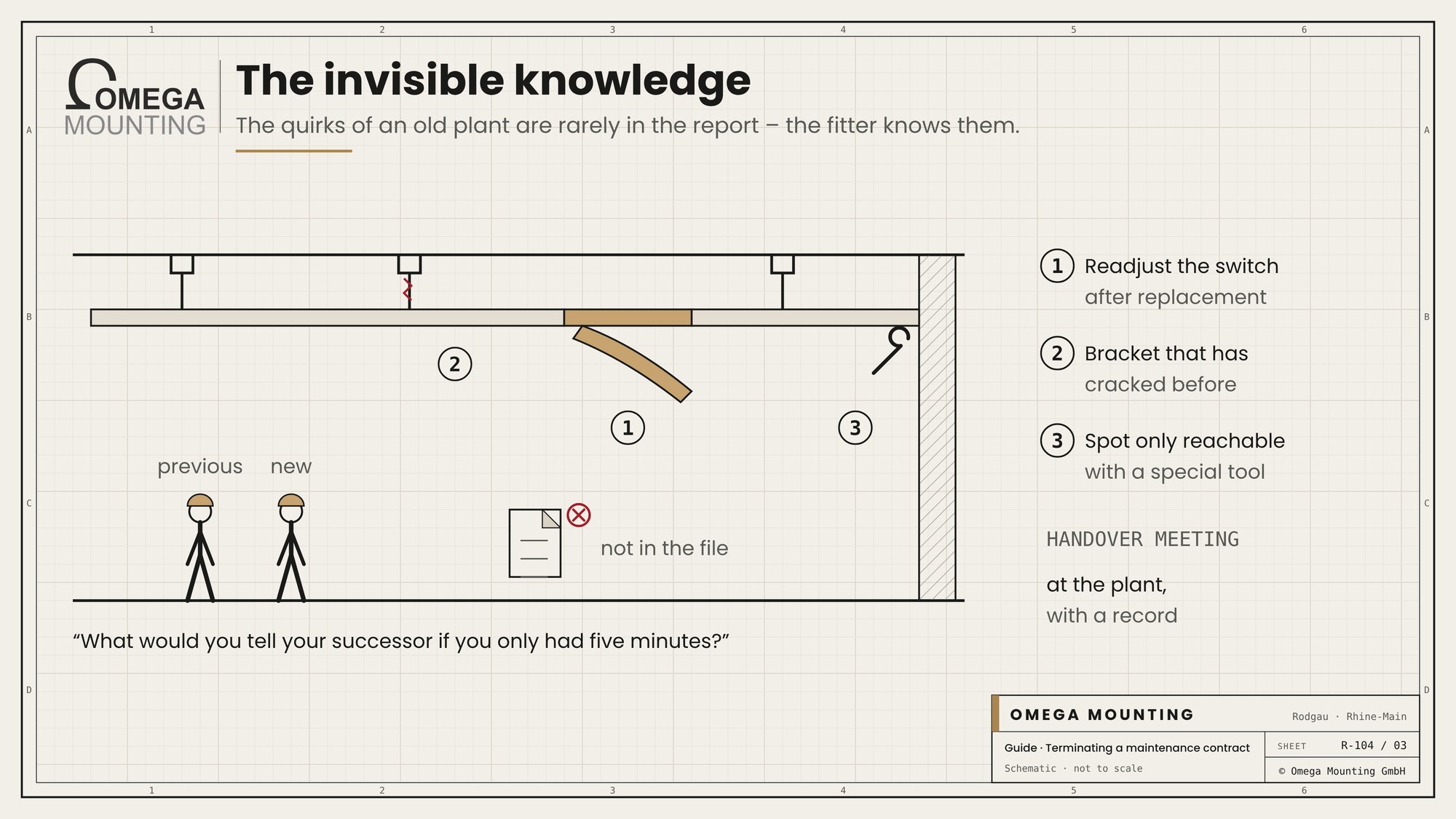
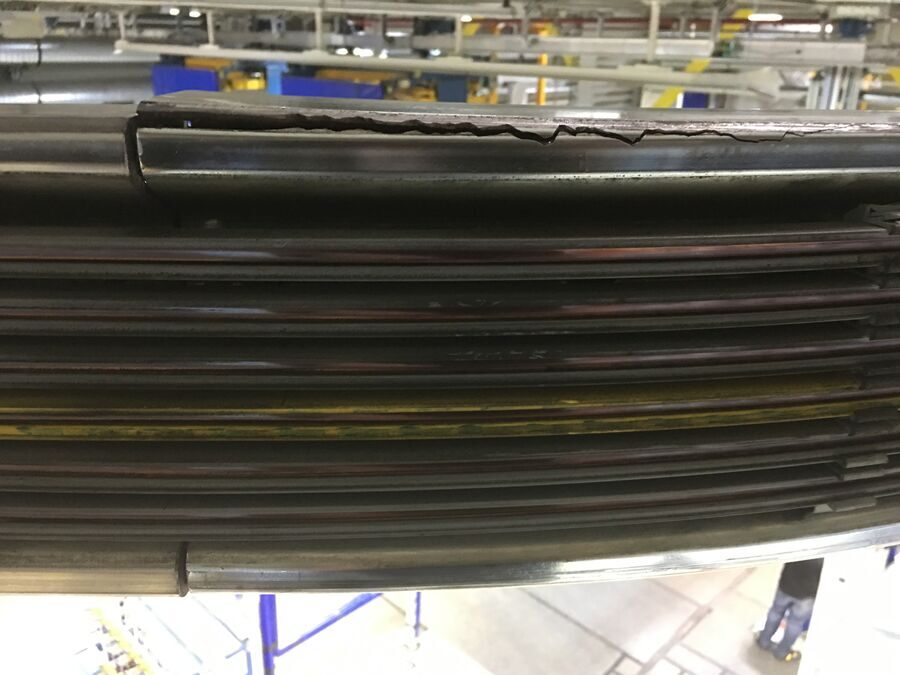
One mistake often weighs heaviest because you cannot see it: knowledge that was never written down. The quirks of an old plant are rarely in a report. Which switch has to be readjusted after replacement, which bracket has cracked before, where you can only reach with a particular tool – the fitter knows that, not the file. That is why the joint handover meeting at the plant is worthwhile. Ask specifically: what would you tell your successor if you only had five minutes?
Terminating a maintenance contract in the Rhine-Main area: how we work
In the Rhine-Main area, we take on the mechanical part of servicing after a switch: conveyor systems, overhead conveyors, cranes, fans, drives and standby generator sets, plus lifting, welding and remanufacturing of parts.
From Rodgau, Frankfurt, Offenbach, Hanau, Darmstadt and Aschaffenburg are short journeys. With us, the starting point is a site walk. We look at the plant and the existing handover documents and say what is missing. Then comes the condition survey as the baseline – with findings list, photos and a proposal for scope of services and intervals.
We say beforehand where our work ends. The plant electrics up to the main switch are handled by our own qualified electricians; the supply cable and building electrics stay with your electricians or building services, controls and software with the manufacturer. The recurring statutory inspection is carried out by the competent person, meaning someone with training, professional experience and recent work on this type of equipment. We coordinate with these partners and bring dates and documentation together. The scope of our Maintenance and servicing for industrial plants is set out on our service page.
For a change of service provider in the Rhine-Main area, this means: short journeys in a breakdown, one contact for mechanics and lifting, and a workshop in Rodgau that makes brackets, consoles and plates from measurements. Whether your plant is in Dietzenbach, Rüsselsheim or Seligenstadt makes no difference to this process.
Project examples
Three examples from our project diary and our guides show what counts in a takeover. To be honest up front: none of them was a change of service provider, and none had a contract link. They show ways of working that help with a switch – the survey as the baseline, preparation before the first spanner is turned and the checklist as a handover document.
Overhead conveyor in Frankfurt: survey before the first package
With the maintenance of an overhead monorail system in Frankfurt – an overhead conveyor system whose carriers run on a rail under the hall ceiling – the plant was around thirty years old, with about a hundred switches in two operating areas. Before the repairs began, all switches were checked. The condition of every switch was recorded and assessed by damage. Spare parts, scope of work and sequence were agreed with the customer: badly damaged switches and those critical to operations first. Running wheels, guide rollers and switch shoes were ready in advance and assigned to the work areas. The work ran during weekend shutdowns, at times with only around 36 hours between the end of production on Saturday and restart on Monday.
For your switch, this means: this is exactly what a baseline looks like. Every assembly is recorded, every finding assessed, and the assessment produces a sequence. Anyone who takes over a plant is best off starting with this work – not with the first routine service.
Standby generator set in the Rhine-Main area: preparation before the first spanner is turned
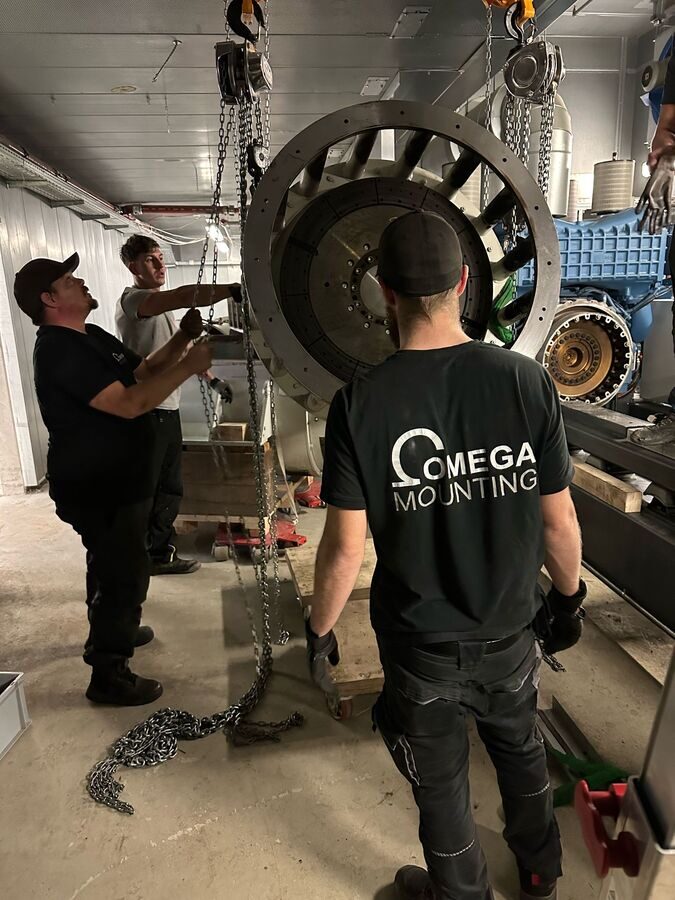
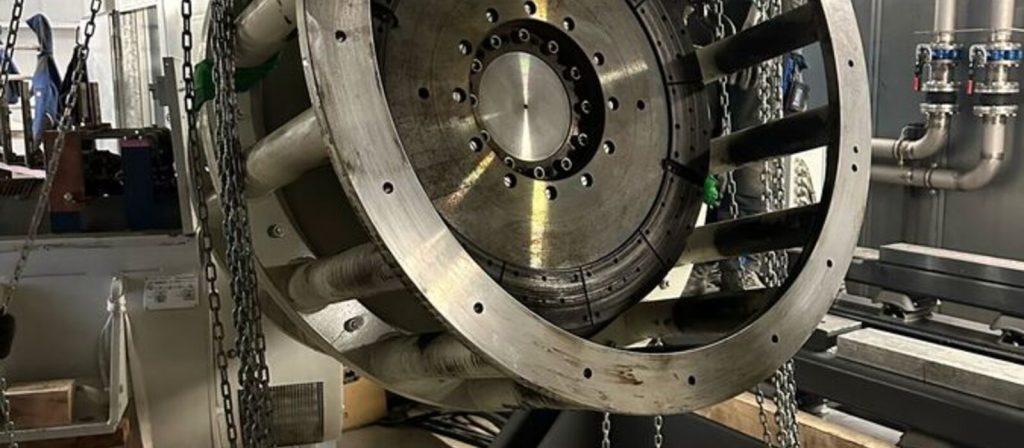
With the maintenance of the generator of a standby power system in a larger building complex in the Rhine-Main area, the lift plans were ready before installation began. Passage widths, space for lifting out, slings, lifting gear and the load capacity of the suspension points had been checked. The enclosure was dismantled and transport frames were built on site. Chain hoists on a support structure lifted the generator, heavy-duty skates moved it to the access shaft, and a mobile crane lifted it out of the basement. One lifting coordinator was in charge, three mechanics carried out the work. The overhauled parts went back the same way and were positioned, connected to the engine, aligned and secured.
For your switch, this means: anyone taking over such a plant needs routes, suspension points and weights before lifting for the first time. If lift plans and drawings from earlier jobs exist, they belong in the handover package. If they are missing, they are created afresh during the condition survey – and then sit in your file.
Overhead conveyor maintenance checklist: the inspection grid as a handover document
Our guide to overhead conveyor maintenance with a checklist breaks an overhead conveyor down into five assemblies with specific check points. The checklist has space for finding and action as well as a header and signature field. The guide recommends documenting all findings after every maintenance window, including those not rectified – as the basis for the next window.
For your switch, this means: a completed checklist per plant is the best handover document there is. It shows the new partner not only what was done, but also what is open. Request such lists from the previous service provider, and have the new partner continue working to the same grid.
Want to switch service provider – without losing anything?
Then get in touch with us. Send us your asset list, the existing contract and the documents you already have. During a site walk in the Rhine-Main area, we compare both with the plant and show what is still missing from the handover package.
What this means for your role
For buyers: Plan the switch backwards from the end of the contract: termination, handover, the new partner's quotation, condition survey. Only compare quotations if the condition survey is included and the form of record is fixed. How the contract models differ is explained in the basic article on maintenance contracts.
For designers: Every plant you plan will change service provider at some point. Hand over drawings, parts lists and servicing tables so that they lie with the operator and not only with the installer or maintenance contractor. Record changes with their date – they are often the biggest gap when switching.
For project managers and site managers: As a project manager, you make sure that a switch does not fall in the middle of an ongoing project without responsibilities being clarified. As a site manager, you induct the new partner on site, hand over access and the emergency chain and take down the old notices.
For maintenance managers: You lead the switch. Keep the inventory before terminating, request the documents early and attend the handover meeting yourself. Set the cut-over date per plant and enter the inspection dates in the new plan from day one.
For facility managers and operators: A switch shows whether your file belongs to you or to the service provider. Keep inspection records, reports and findings list so that any successor can work with them. Then the next switch is a formality.
Handover checklist for a change of service provider: template on request
The handover checklist for a change of service provider is a one-page working document. It lists the nine documents and stocks from this article, each with the fields “available”, “requested” and “missing”. On top of that come fields for keys and access, the cut-over date and the new emergency chain. It deliberately contains no contract wording or deadlines – it helps you see the status of the handover in a meeting. Request the template via our contact form – subject line “handover checklist”.
Why Omega Mounting?
We are based in Rodgau near Frankfurt, can be reached by phone (Mon–Fri 9 am–3 pm) and on WhatsApp, and have our own workshop. The linked jobs show how we approach a plant. On the overhead conveyor in Frankfurt, checking every switch came before the first repair. On the standby generator set, the lift plans were fixed before the first spanner was turned. And our overhead conveyor checklist turns servicing into an inspection grid that any successor can read. For you, this means: a single point of contact for condition surveys, servicing, repair and lifting – with a documented start and short journeys in the Rhine-Main area.
Conclusion
Terminating a maintenance contract is the easy part; the handover decides whether the knowledge about your plants stays. Before terminating, clarify the contract, open findings, inspection dates, parts and access. Request all documents before the contract ends, and start with the new partner with a condition survey as the baseline. During the transition period, it must be clear for every plant who is responsible and who comes in a breakdown. If you are planning a switch, send us your asset list and the documents you have – we'll come back with a site visit date and an honest assessment.
Planning a move-in, installation or maintenance in the Rhine-Main region?
Tell us briefly what you need – we'll come back with an honest assessment.
Free, no-obligation callback
You may also be interested in these guides
Maintenance & Servicing
Maintenance & Servicing
Maintenance & Servicing

About the author
Tobias Schott
Managing director of Omega Mounting GmbH, Rodgau · more than 20 years of hands-on experience in installation and maintenance
A trained mechatronics technician, working in maintenance, servicing and industrial installation since 2004 – first alongside his father, and with Omega Mounting since 2012: from overhead conveyors in Frankfurt to the crane system in a new-build hall. He plans and leads lifting operations as an appointed person (AP) in data centers and on industrial sites in the Rhine-Main region, trains and examines operators of cranes, mobile elevating work platforms and telehandlers, and is a qualified occupational safety specialist. On jobs abroad he is known as the “German Troubleshooter” – the person you call when a site gets stuck. He learned what quality means from his father, not from a manual: Made in Germany as a standard for his own work, not a label. That is why quality comes first at Omega Mounting – ahead of speed and price. He writes these guides from that practice: what works on our sites is in them – what exists only on paper is not.
Frequently asked questions
Three things: first, look up the term, notice period and form of termination in your own contract. Then clarify open findings, upcoming inspection dates, parts with the service provider, and keys and access. Finally, request all documents before the contract ends, and start with the new partner with a condition survey as the baseline. For the transition period, set a cut-over date and an emergency chain per plant.
What applies to handing over documents is set out in your contract – check there before you terminate. Request reports, findings list and spare parts list early, not only after the last job. As the operator, you need inspection records and an equipment file yourself anyway. Ideally, keep this file so that it lies with you and not only with the service provider.
They continue, no matter who services. The German Industrial Safety Ordinance (BetrSichV) requires you as the operator to set the type, scope and frequency of inspections in your risk assessment. Enter all upcoming inspections in the new partner's plan on day one. Which work equipment is subject to inspection is shown in our guide on inspection obligations for operators.
That depends on the number of plants, the state of the file and the cooperation of the previous service provider. There is no universally valid duration. Plan the handover backwards from the end of the contract: request documents, handover meeting, condition survey, cut-over date. If you start early, you do not have to chase anything under time pressure at the end.
Whether the manufacturer supplies original parts without a service contract is set out in its terms. Ask in writing before terminating and file the answer in the equipment file. In the same letter, clarify who will supply parameters and software versions in future. In the mixed model, the manufacturer often stays responsible for the controls anyway.
That is your decision, but a factual reason makes the handover easier. A partner who learns of the switch fairly is more likely to agree to a joint handover meeting. Stick to facts – shift operation, modification, location – and avoid accusations. You need their knowledge until the last day.
Yes, the process is the same for all plants; the emphasis shifts. For cranes, inspection logs and inspection dates come first, for conveyor systems the findings list and wear parts. For standby generator sets, overhaul documents, lift plans for removal and moving in, and the interface with the electrical contractor count. In data centers and logistics, access rules and maintenance windows are added.
For the mechanical part, installation and maintenance contractors from the region are the shortest route. From Rodgau, we take on conveyor systems, cranes, overhead conveyors, drives and standby generator sets in Frankfurt, Offenbach, Hanau, Darmstadt and Aschaffenburg – with a site walk, condition survey and findings list. On request, our own qualified electricians take care of the plant electrics. Controls and inspection stay with the responsible partners, with whom we coordinate dates and documentation.
With a short enquiry containing three details: the plants concerned with age and location, the planned end of the contract and the documents you already have. We arrange a site walk, look at the plant and the file and send a written assessment with the gaps in the handover package and a proposal for the condition survey. Your contact is Tobias Schott – reachable via our contact form.
 English
 German