
- Guide – Maintenance
Reviewing a maintenance contract: the annual review in seven questions
By Tobias Schott · 21-minute read · Updated October 2026

A maintenance contract ages faster than the machines it covers: if you hold it up once a year with seven questions against service records, breakdowns, variations and the current machine fleet, you will know whether to continue, adjust, renegotiate or switch.
The contract has been running for years, the invoices arrive on time, and nobody has read it since it was signed. New plants have been added in the hall, an old one has been scrapped, and every major repair came as a variation. Anyone who wants to review their maintenance contract now quickly notices: the paper describes the operation as it was then, not as it is today.
This guide shows why maintenance contracts become outdated and which seven questions to use for the annual contract review. It also shows which data you need and which decisions can come at the end. What belongs in a contract in the first place is set out in our guide on maintenance contract for machinery. We do not repeat the ten contents from there – this one is about keeping a running contract up to date.
We write from the point of view of an installation and maintenance contractor from Rodgau near Frankfurt. We know such meetings from the service provider's side – and know which questions help both sides.
Key points at a glance
- A contract review is a fixed annual meeting at which operator and service provider compare the maintenance contract with the actual machine fleet and the past year.
- Contracts become outdated because plants are added, modified or decommissioned and because findings, inspection duties and budget shift.
- Seven questions carry the review: asset list, called off against agreed, recurring variations, breakdowns and response, inspection dates, documentation and the right contract model.
- The basis is service records, breakdown list, findings list, variations list and budget spend – evaluated qualitatively, without rigid targets.
- At the end comes one of four decisions: continue, adjust, renegotiate or switch service provider.
- The best time is before the budget round, so that adjustments go into next year's budget and calendar.
What is a contract review for a maintenance contract?
A contract review is a planned, usually annual meeting at which operator and service provider check whether the maintenance contract still fits the company's plants, services and risks.
In everyday practice the meeting is also called the annual meeting or service meeting. For a maintenance contract, the annual meeting is more than a look back at invoices. It is the moment when contract and reality are compared. How a contract is drawn up and which models exist is described in our basic article on the maintenance contract in industrial maintenance. The review makes sure that it is still right in its third or fifth year.
How it differs from supplier rating
Many purchasing departments carry out a supplier rating for maintenance and service – with marks for punctuality, quality and communication. This service provider rating in maintenance answers the question of how well the partner worked. The contract review also asks whether the contract orders the right things. A service provider can be rated very well and still work under a contract that covers the wrong machines.
How it differs from an audit
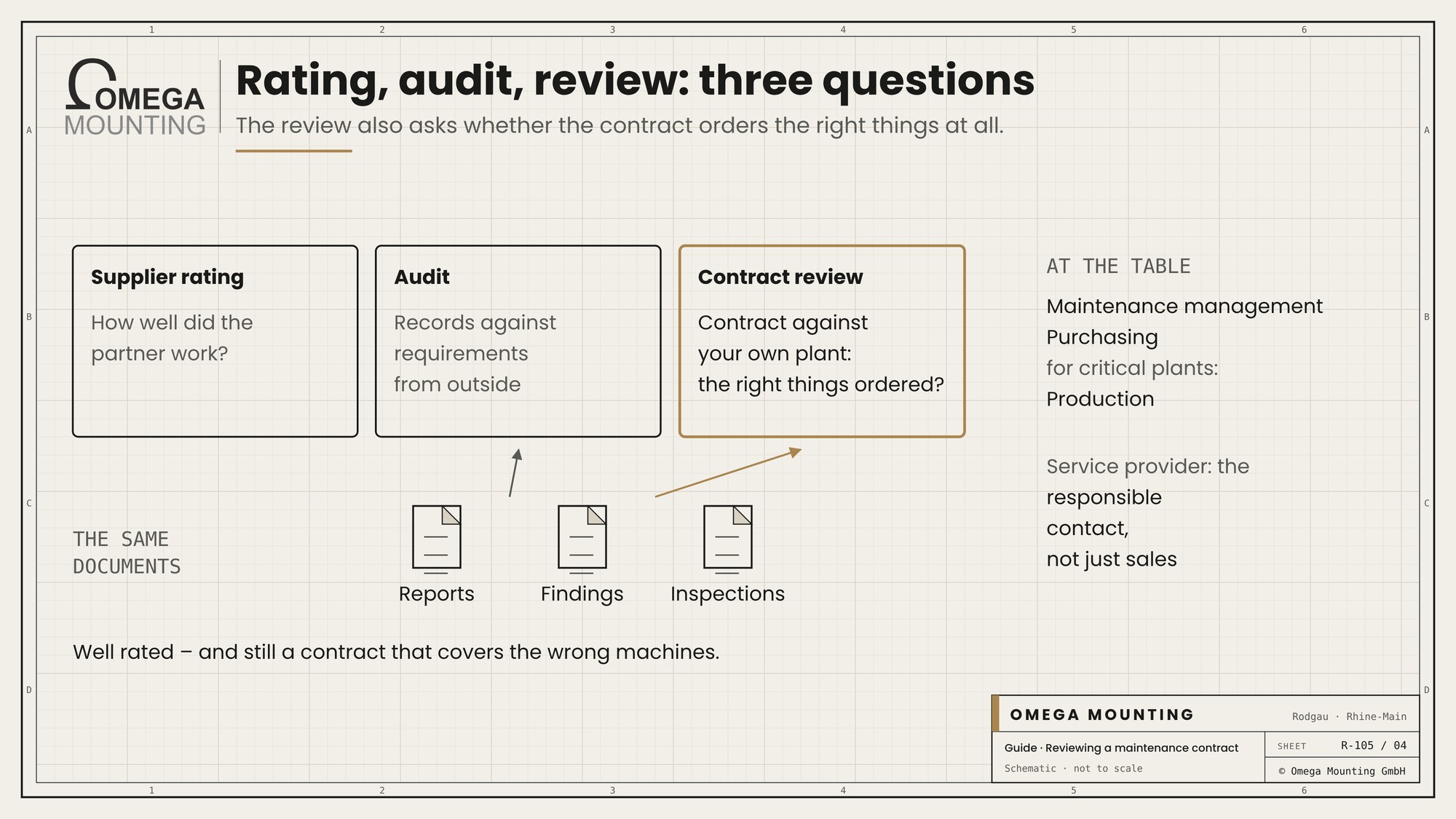
An audit checks records against requirements from outside. The review checks the contract against your own operation. Both use the same documents – reports, findings list, inspection reports. That is why it pays to keep these documents properly once and use them for both purposes.
Who sits at the table
On the operator's side, maintenance management and purchasing belong at the table, for critical plants production too. On the other side sits the service provider's responsible contact, not just sales. Whoever knows the plants has to be there. Otherwise the contract review in maintenance turns into a mere price round.
Why a maintenance contract becomes outdated
A maintenance contract becomes outdated because the operation moves on and the contract does not: plants come and go, machines are modified, findings shift the focus, inspection duties change and the budget no longer matches the effort.
- Plants come and go. New machines run without a contract, decommissioned ones are still on the asset list. Both are often only noticed when something goes wrong.
- Machines are modified. They are linked, extended or get a new safeguard. The contract then describes the old state. Whether a modification is more than a repair is clarified in our guide on substantial modification of a machine.
- The findings shift. An assembly that was inconspicuous when the contract was signed now causes the most work. The contract only knows it as one line among many.
- Inspection duties change. New work equipment, a revised risk assessment or a changed use shift inspection dates and responsibilities.
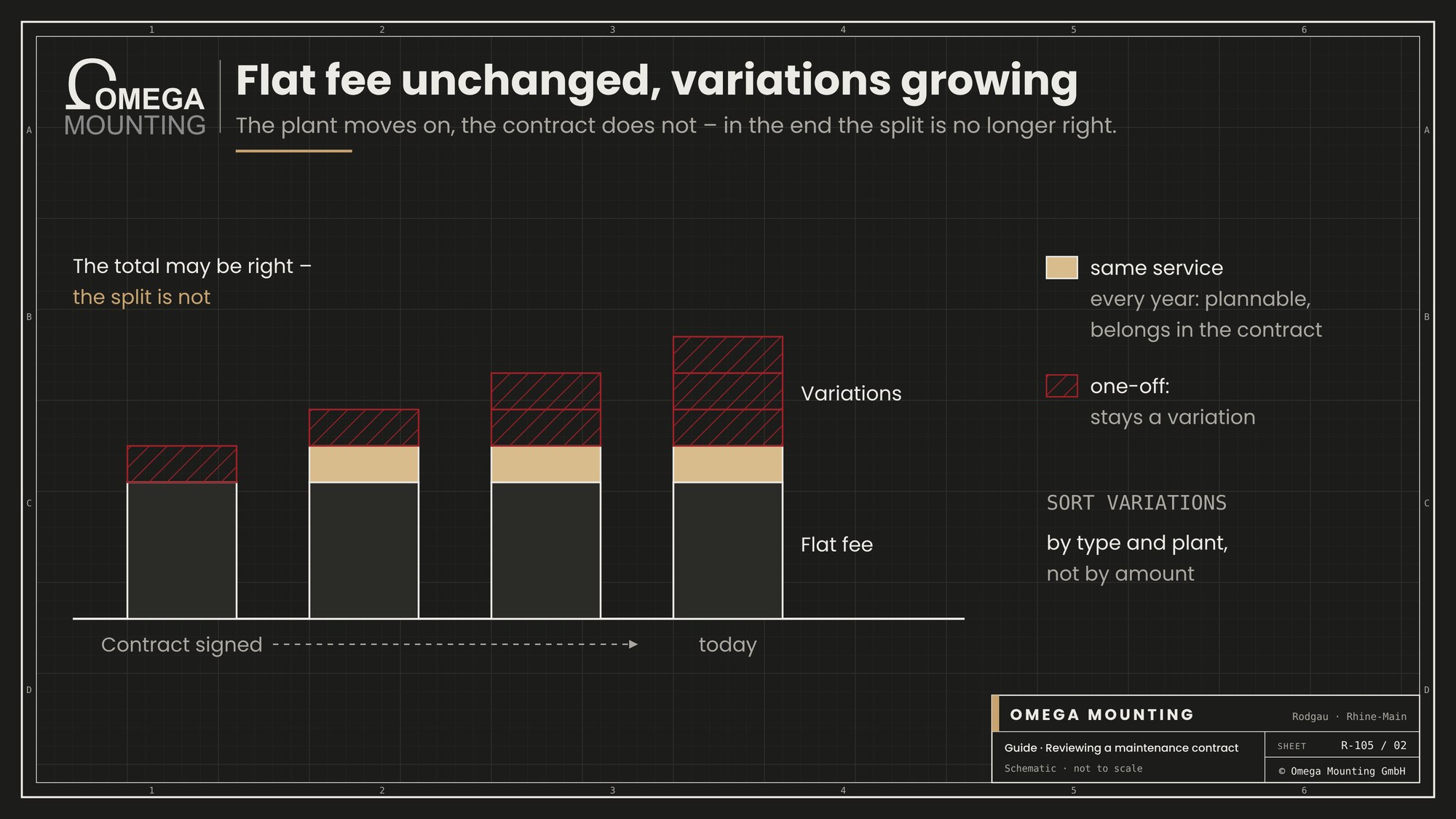
- The budget no longer fits. The flat fee stays the same, the variations grow. At the end of the year the total may be right, but not the split.
On top of that come changes on both sides of the contract. Contacts change, shift patterns change, shutdown windows get shorter. Each individual change is small. Together they turn a good contract into one that helps nobody in a breakdown.
Do not wait for the renewal
Many companies only look at the contract when the renewal is due. Then there is little time left, and the decision is made under pressure. An annual review, by contrast, keeps the contract up to date in small steps. The renewal then becomes a formality – or a decision you have prepared for a long time.

Reviewing a maintenance contract: the seven review questions
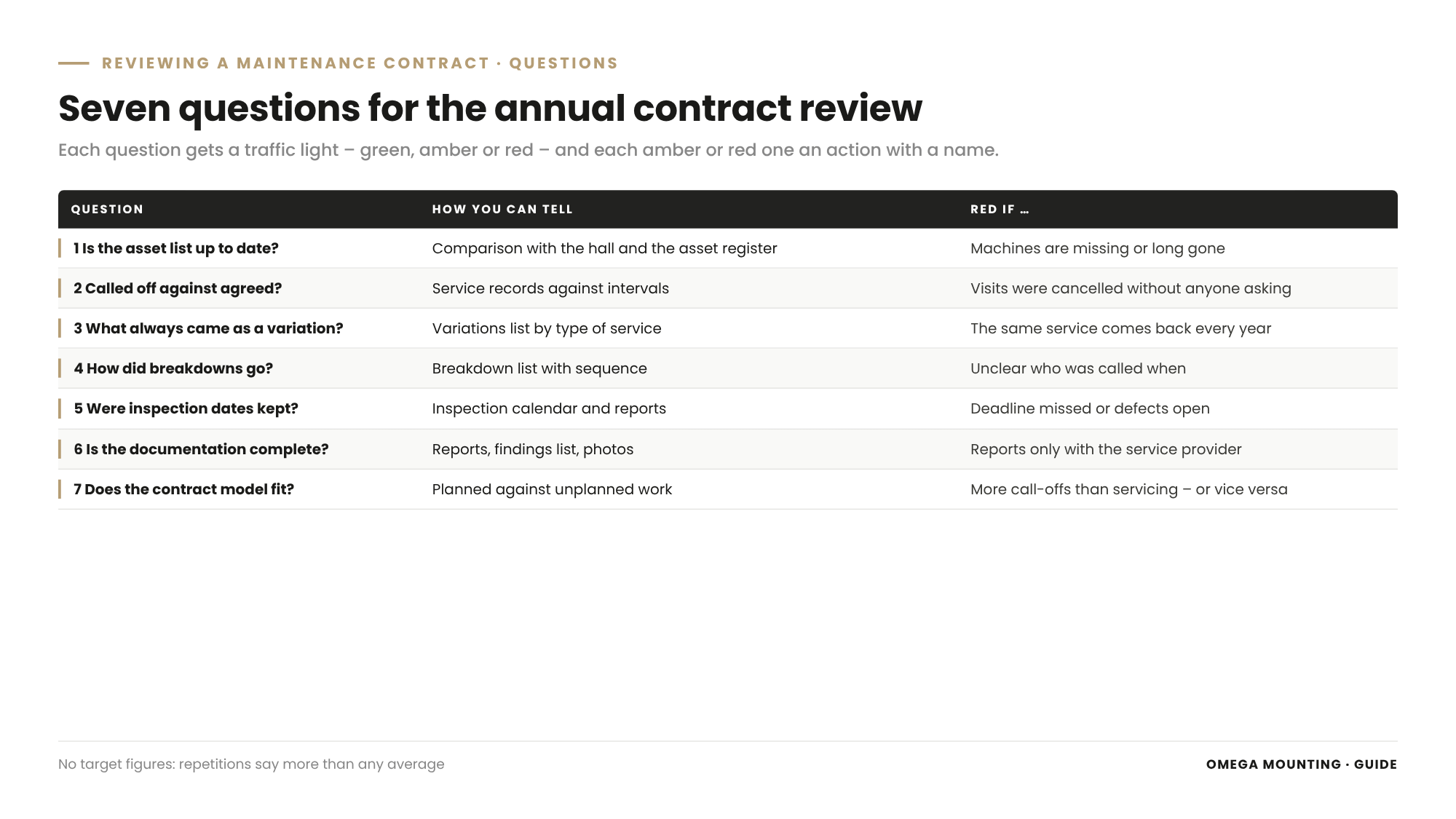
Seven questions carry the annual review: is the asset list right, what was called off, what came as a variation, how did breakdowns go, were inspection dates kept, is the documentation complete and does the contract model still fit?
Our guide on the maintenance contract for machinery sums up the review in four questions. Here we break it into seven so that each question has its own result. The table gives an overview. The right-hand column names the signal at which the traffic light turns red.
| Question | How you can tell | Red if … |
|---|---|---|
| 1 Is the asset list up to date? | Comparison with the hall and the asset register | Machines are missing or long gone |
| 2 Called off against agreed? | Service records against intervals | Visits were cancelled without anyone asking |
| 3 What always came as a variation? | Variations list by type of service | The same service comes back every year |
| 4 How did breakdowns go? | Breakdown list with sequence | Unclear who was called when |
| 5 Were inspection dates kept? | Inspection calendar and inspection reports | Deadline missed or defects open |
| 6 Is the documentation complete? | Reports, findings list, photos | Reports missing or only with the service provider |
| 7 Does the contract model fit? | Ratio of planned to unplanned work | More call-offs than servicing – or vice versa |
Question 1: Is the asset list still up to date?
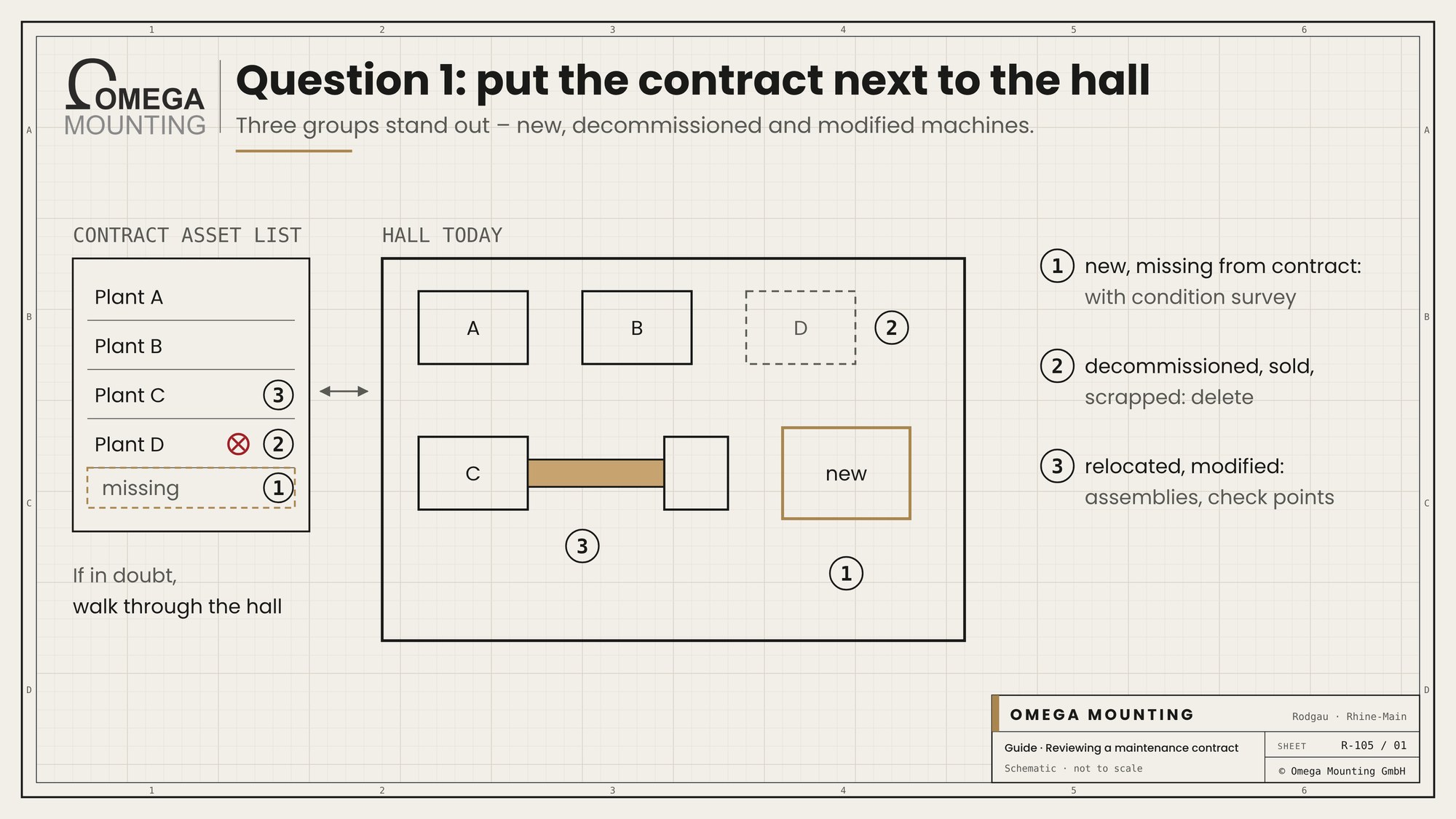
The first question is the most important because all the others build on it. Put the asset list from the contract next to the current asset register. If in doubt, walk through the hall. Three groups stand out: new machines missing from the contract; decommissioned, sold or scrapped machines; relocated or modified machines. Every new machine goes into the contract with a condition survey. For modified machines, check whether assemblies and check points are still right.
Question 2: What was called off – and what was agreed?
Compare the year's service records with the agreed intervals. Evaluating the service records shows which visits took place, which were postponed and why. A cancelled visit is not automatically the service provider's fault. Often production did not release the window. What matters is that the cancellation was noticed and made up. And the other way round: if services were provided that the contract does not include at all, that belongs on the table too.
Question 3: Which services always came as a variation?
Variations in maintenance are normal, because findings cannot be predicted. It becomes conspicuous when the same service comes as a variation every year. Typical examples are the bearing replacement on the same conveyor, readjusting the same switches or the lifting for the same overhaul. Then the variation is in truth a plannable service that belongs in the contract.
So do not sort the variations list by amount, but by type of service and by plant. What recurs becomes part of the contract. What was a one-off stays a variation. At the same time, check the approval rule: did the fitter get a quick decision on a finding – or did they wait in front of the machine for a phone call?
Question 4: Which breakdowns were there – and how did the response go?

Go through the year's breakdowns one by one. When was it reported, when was someone on site, when did the plant run again? This is not an accusation but a sequence check. It often turns out that it was not the service provider that was slow, but the reporting chain. Nobody knew whom to call at night, or access to the site was not arranged.
Which times should be in the contract and how they are measured is described in our guide on SLA in maintenance. For the review, a second question also counts: which breakdown could servicing have prevented? That becomes an additional check point in the contract – or a recommendation for spare parts and redundancy.
Question 5: Were the inspection dates kept?
Recurring statutory inspections on cranes, doors, racking or hoists have deadlines that you have set in your risk assessment. The review checks whether every inspection took place and who carried it out. It also checks whether the defects from the inspection report have been rectified. An open defect must not wait until the next review. If the contract does not clearly say who organises the inspection and who rectifies the defects, now is the moment to change that.
Question 6: Is the documentation complete?
Every service visit needs a report with date, plant, check points, findings and parts fitted. The review checks by sampling whether these reports exist and whether the findings list has been kept up to date. And it checks whether the file is kept by you – not only by the service provider. If documents are missing, you will notice at the latest at the next audit or when you change partner. What an auditor wants to see is set out in our guide on maintenance documentation for audits.
Question 7: Does the contract model still fit?
The last question takes a step back: is a contract with fixed intervals still the right form at all? If most services came as call-offs after findings, a framework agreement with items may fit better. If a plant caused hardly any work, individual call-offs may be enough. And if a new plant has a high share of controls, it may be better placed with the manufacturer's service. How framework and call-off work is explained in our guide on the framework agreement in maintenance.
Which data do you need for the review?
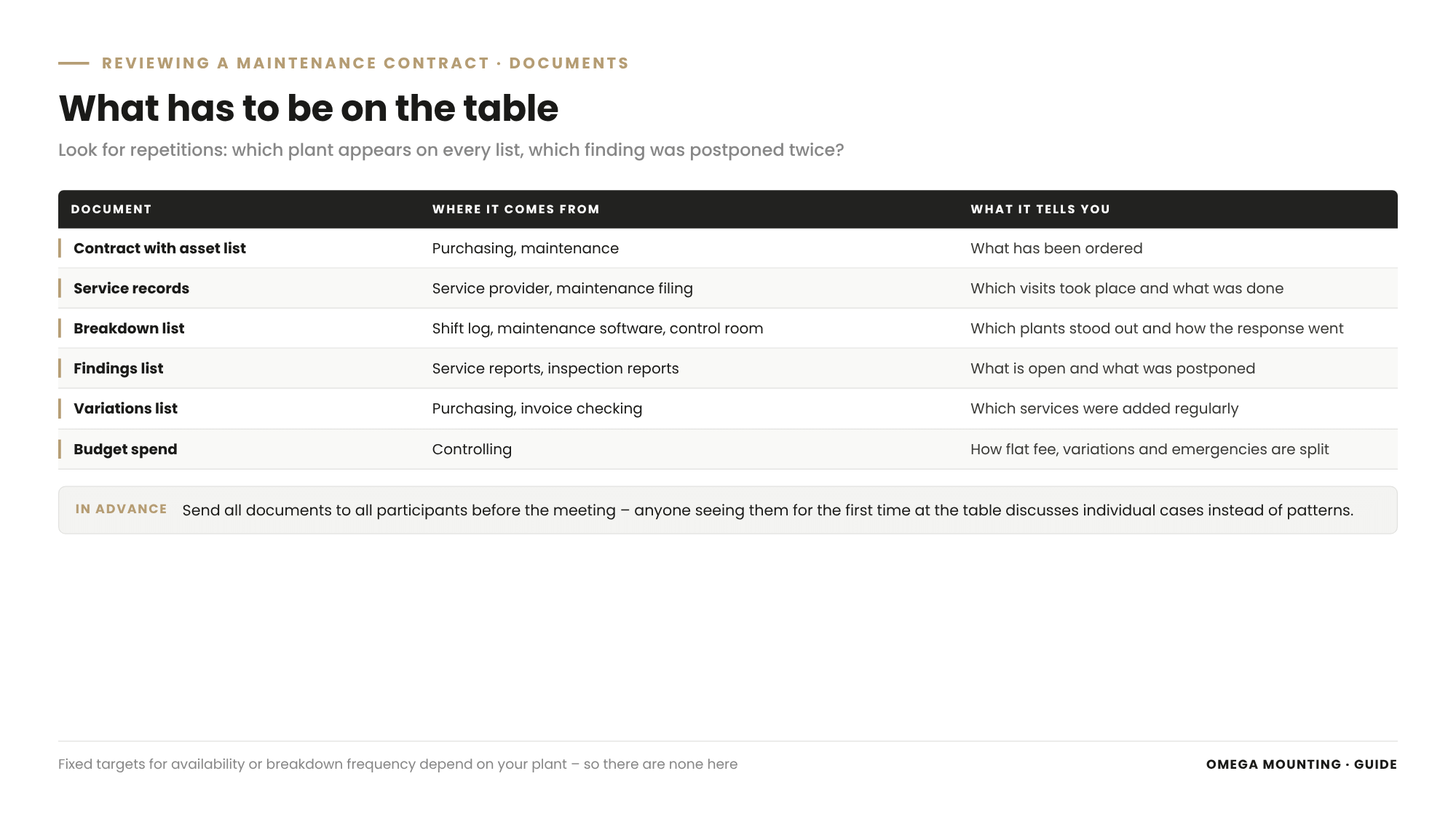
For the review, besides the contract with asset list, you need five documents: the year's service records, the breakdown list, the findings list, the variations list and the budget spend.
| Document | Where it comes from | What it tells you |
|---|---|---|
| Contract with asset list | Purchasing, maintenance | What has been ordered |
| Service records | Service provider, maintenance filing | Which visits took place and what was done |
| Breakdown list | Shift log, maintenance software, control room | Which plants stood out and how the response went |
| Findings list | Service reports, inspection reports | What is open and what was postponed |
| Variations list | Purchasing, invoice checking | Which services were added regularly |
| Budget spend | Controlling | How flat fee, variations and emergencies are split |
Send the documents to all participants before the meeting. Anyone seeing them for the first time at the table discusses individual cases instead of patterns.
Patterns instead of key figures
For a good review you do not need a collection of key figures. We deliberately give no fixed targets for availability or breakdown frequency here. They depend on your plant, your shift pattern and your risk. Repetitions matter more. Which plant appears on every list? Which assembly generates the most variations? Which finding was postponed twice? Such a repetition says more than any average.
If the data is missing
Not every company has clean lists. Then the first review is also an inventory of your own documents. Ask the service provider well before the meeting for a list of its jobs, findings and variations. If something is missing, exactly that becomes the first action: a findings list that is kept up to date from now on.
Result: continue, adjust, renegotiate or switch
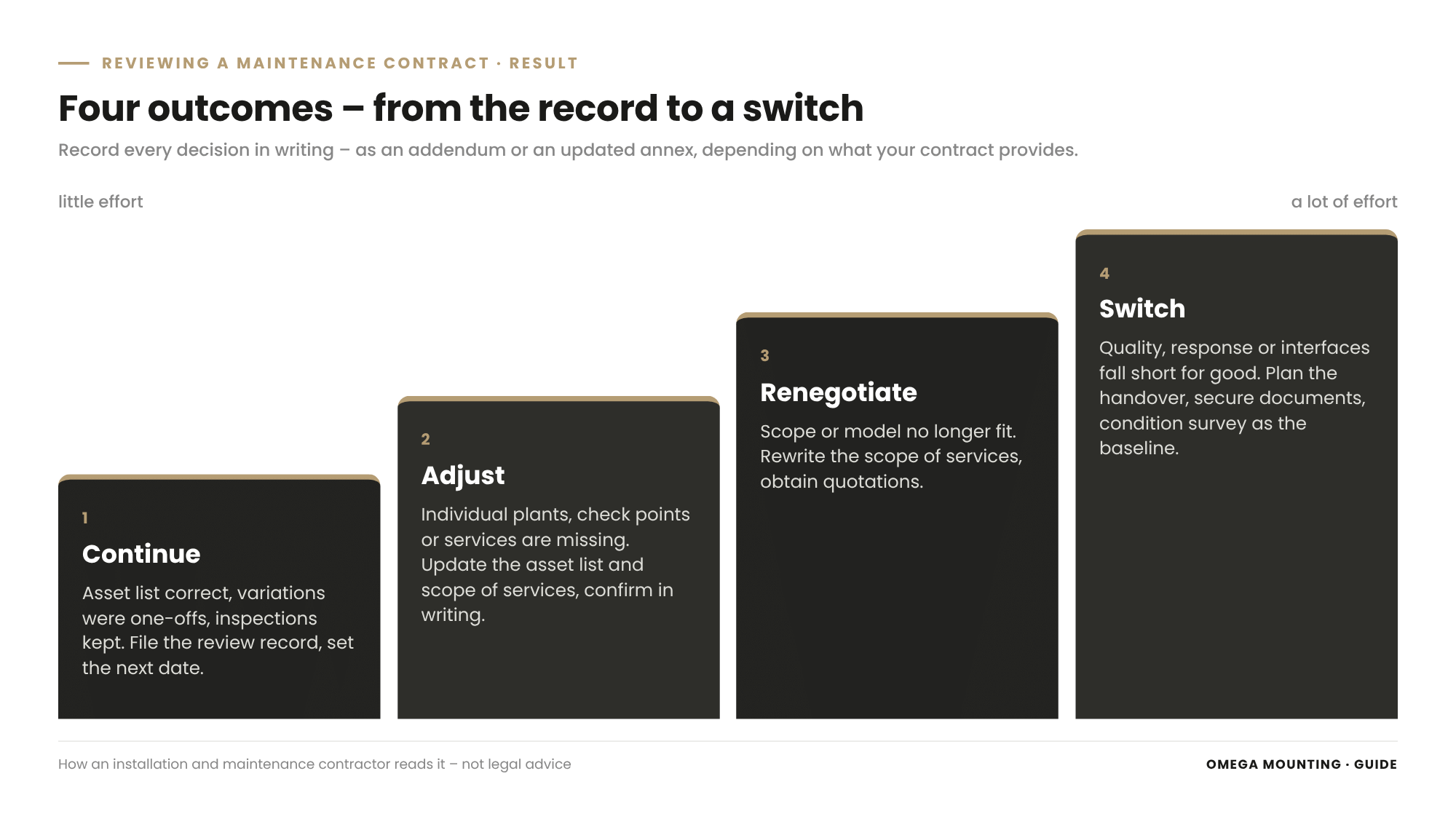
At the end of a review comes one of four decisions: continue the contract unchanged, adjust it within the existing framework, renegotiate it or switch service provider.
| Decision | When it fits | Next step |
|---|---|---|
| Continue | Asset list correct, variations were one-offs, inspections kept | File the review record, set the next date |
| Adjust | Individual plants, check points or services are missing | Update the asset list and scope of services, confirm in writing |
| Renegotiate | Scope or model no longer fit | Rewrite the scope of services, obtain quotations |
| Switch | Quality, response or interfaces fall short for good | Plan the handover, secure documents, start the new partner with a condition survey |
Adapting
Most reviews end with an adjustment. Adjusting the maintenance contract means in practice: adding new machines with a condition survey, deleting decommissioned ones, taking recurring variations on as a fixed service and clarifying responsibility for inspections. Record every adjustment in writing. Whether as an addendum to the contract or as an updated annex depends on what your contract provides for.
Renegotiate
You should renegotiate the maintenance contract if the scope has shifted considerably or another model fits better. Then a new scope of services belongs on the table that brings both sides to the same picture. Feel free to obtain comparison quotations as well. How to put quotations on a common basis is shown in our guide on comparing maintenance quotations.
Switch
A switch is the rarest outcome and the one with the longest lead time. Term, renewal and deadlines are in your contract – check there before announcing anything. This guide is not legal advice; clarify the contractual side with your legal department or your lawyer. How a handover without loss of knowledge works is described in our guide Terminating a maintenance contract and switching provider. Whether a plant goes to the manufacturer or to an independent contractor is shown in our guide Manufacturer's service or independent maintenance contractor.
When is the best time for the review?
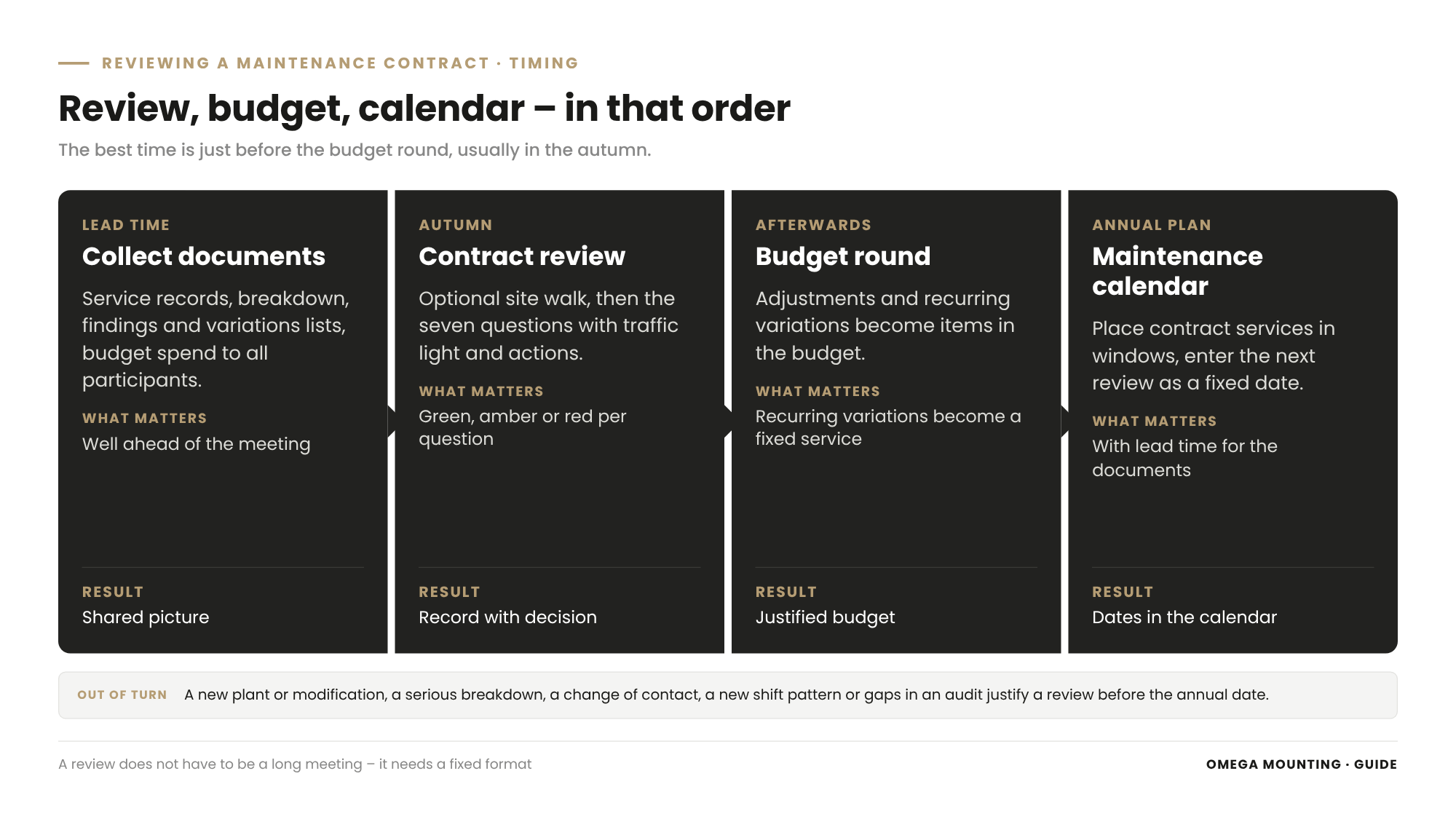
The best time for the contract review is just before the budget round, usually in the autumn – then adjustments flow straight into next year's budget and calendar.
The order is simple: first the review, then the budget, then the calendar. How findings and variations become a justified budget is shown in our guide on planning a maintenance budget. The maintenance calendar sets out the windows the contract services fall into next year. Enter the review itself in this calendar as a fixed date – with lead time for the documents.
Occasions out of turn
Some events justify a review before the annual date:
- A new plant goes into operation or an existing one is modified.
- A serious breakdown has stopped production.
- The contact on one side changes.
- The shift pattern or use of a plant changes.
- An audit or inspection has shown gaps in the documentation.
How the meeting runs
A review does not have to be a long meeting. It needs a fixed format:
- Send documents in advance. All participants know the lists before they sit down at the table.
- Optionally a site walk. Critical plants are looked at together beforehand.
- The seven questions in order. A traffic light per question: green, amber or red.
- Record actions. Every amber or red light gets an action, a person responsible and a date.
- Make the decision. Continue, adjust, renegotiate or switch.
- Sign the record. Both sides confirm the result and the next date.
Reviewing a maintenance contract in the Rhine-Main area: how we work
In the Rhine-Main area, we support the review for the mechanical part of your maintenance contract: we bring our jobs, findings and variations of the year and, on request, walk through the hall with you beforehand.
From Rodgau, Frankfurt, Offenbach, Hanau, Darmstadt and Aschaffenburg are short journeys. Before the meeting, we assess the critical assemblies and compare the asset list with what is actually there. That way you come to the table with an up-to-date picture instead of a list from when the contract was signed. If the contract is with another service provider, feel free to show us the technical scope of services – we will tell you which mechanical services are missing or appear twice. The contractual side stays with your legal department.
We say openly where our work ends. The plant electrics up to the main switch are handled by our own qualified electricians; the supply cable and building electrics stay with your electricians or building services, controls and software with the manufacturer, and the recurring statutory inspection with the competent person. We coordinate with these partners and keep dates, isolation and documentation together. The scope of our Maintenance and servicing for industrial plants is set out on our service page.
For a contract review in the Rhine-Main area, this means: you do not negotiate about flat fees but about plants, findings and packages – in Dreieich just as in Hanau.
Project examples
Three jobs from our project diary show what belongs in a review. None of the jobs describes a maintenance contract or an annual meeting. They show situations that a review has to make visible: findings that add up, a breakdown with a follow-up recommendation and a plannable repair.
Overhead conveyor in Frankfurt: findings that add up over years
With the maintenance of an overhead monorail system in Frankfurt – the plant was around thirty years old, with about a hundred switches in two operating areas. An overhead conveyor is a suspended conveyor system whose carriers run on a rail. The in-house maintenance team had kept the plant running for years. In production operation, however, there was usually only time for acute repairs; larger dismantling work was hardly possible.
So the wear damage added up: worn running surfaces, damaged or torn-off running and guide rollers, misaligned rail joints, switches that were mechanically out of service. Every switch was checked and its condition documented. Spare parts, scope and sequence were agreed with the customer – badly damaged switches and those critical to production first. The work ran during weekend shutdowns with windows of around 36 hours at times.
For your review, this means: if a year consists only of acute repairs, the findings list grows in the background. Questions two and three make this visible. An inventory like this is then the basis for adjusting the contract.
Sunday evening at a logistics operation: a breakdown that becomes a contract question
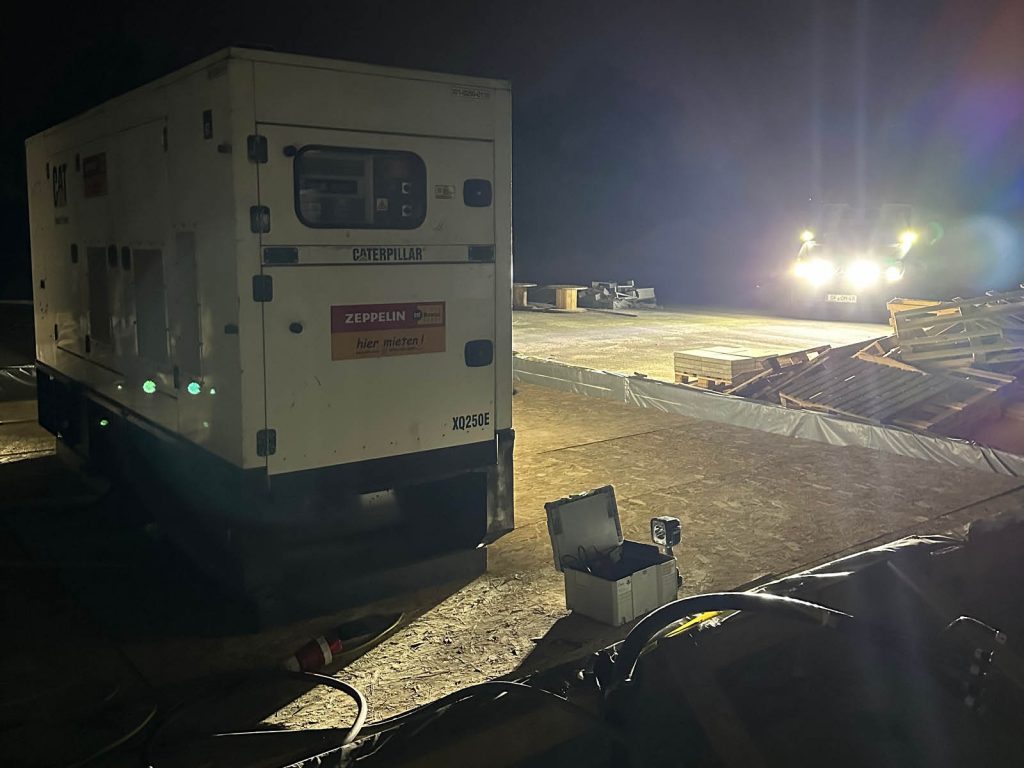
During the emergency call-out on a Sunday evening – the power supply of a logistics operation whose building was still under construction depended on a standby generator set. Problems occurred on start-up, and the generator set was no longer operational. Production was due to start at four o'clock on Monday morning. After troubleshooting it was clear: the generator set had to be replaced.
The new generator set came from a different manufacturer and had a different connection panel. A temporary solution was set up overnight, and suitable cable lugs and heat-shrink sleeves were obtained. By Monday lunchtime, the new generator set was in operation. Afterwards, we proposed a second generator set for redundancy – the customer implemented it.
For your review, this means: question four does not only ask about the response time. It asks what the breakdown reveals about the plant – here the missing second unit and an interface that did not fit at the replacement. Such insights turn into contract topics: redundancy, spare parts stock, settled connections.
Paint shop system near Offenbach: plannable repair instead of a variation
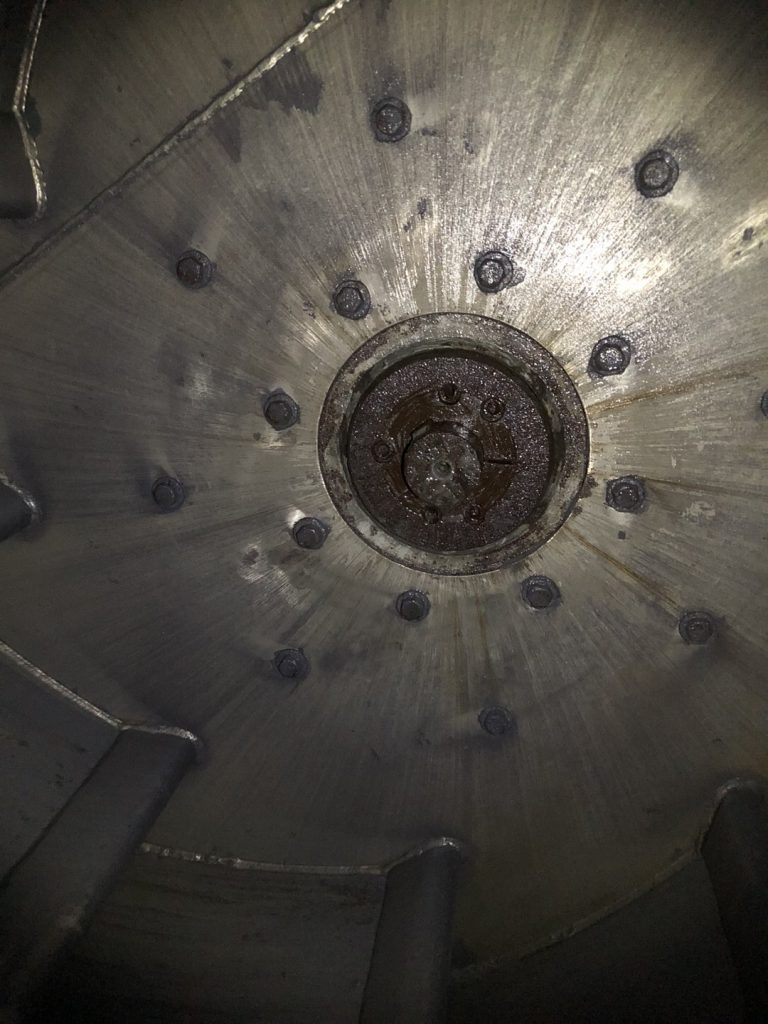
During the fan bearing replacement on a paint shop system near Offenbach – the planned replacement of a wearing bearing was due. The fan impeller, around 1.40 m in diameter, sits directly on the motor of a large process air fan. On the preparation day, our fitters welded a rail system made of square steel tubes on site. On the day of the job, during the weekend shutdown, the unit was moved out, lifted with the gantry crane, overhauled and refitted. The site's electricians disconnected and reconnected the motor. On Monday, production ran without restriction.
For your review, this means: a repair with a preparation day and lifting is a service in its own right. If it recurs, it belongs in the contract as a package – with a clear interface to the electrics.
Your maintenance contract has been running for years – and nobody has read it lately?
Then get in touch with us. Send us the contract, the asset list and last year's variations. We go through the seven questions with you and show where the contract should be updated.
What this means for your role
For buyers: Bring the variations list to the review sorted by type of service – not by amount. Link your supplier rating to the question of whether the contract orders the right things. And before every renewal, clarify what the review has shown.
For designers: Every plant you commission or modify changes the maintenance contract. Hand over new plants and modifications to maintenance together with the servicing documents. Then they will be on the asset list at the next review instead of running for months without servicing.
For project managers and site managers: As a project manager, you report new plants with their documentation package to maintenance before the trades leave site. As a site manager, you make sure that changes during modification or relocation are recorded with photos and dates. Both end up on the table at the review.
For maintenance managers: You host the review. Keep the breakdown list and findings list over the year, set the meeting before the budget round and send the documents in advance. Insist that every red light gets an action with a name and a date.
For operations and plant managers: After the review, do not ask about the total first, but about the red lights. Which critical plants are not properly covered, which findings are open? A contract that is checked every year is a tool against shutdowns – one that sits in a folder is not.
Maintenance contract review sheet: template on request
The maintenance contract review sheet is a one-page working document. It contains the seven questions from this article, each with a traffic light field green, amber or red and a line for action, person responsible and date. At the top are the contract, service provider and date of the review, at the bottom the next date. It deliberately contains no contract wording, amounts or targets. Request the sheet via our contact form – keyword “Maintenance contract review sheet”.
Why Omega Mounting?
We are based in Rodgau near Frankfurt, can be reached by phone (Mon–Fri 9 am–3 pm) and on WhatsApp, and have our own workshop. The linked jobs show how we work. On the overhead conveyor in Frankfurt, the survey of every switch came before the first package. On the Sunday evening emergency call-out, it did not end with the repair – a recommendation for redundancy followed. On the paint shop system near Offenbach, a preparation day made the weekend shutdown plannable. For you, this means: a single point of contact for condition surveys, servicing, repair and lifting that puts findings and variations openly on the table – with short journeys in the Rhine-Main area.
Conclusion
Reviewing a maintenance contract means holding it up against the actual operation once a year. Seven questions are enough: asset list, called off against agreed, recurring variations, breakdowns, inspection dates, documentation and contract model. The basis is your lists for the year, evaluated for repetitions rather than averages. The result is a conscious decision – continue, adjust, renegotiate or switch – and a date before the budget round makes it effective. If you want to know whether your contract still fits your machine fleet, send us your contract, asset list and variations list – we will come back with a date and an honest assessment.
Planning a move-in, installation or maintenance in the Rhine-Main region?
Tell us briefly what you need – we'll come back with an honest assessment.
Free, no-obligation callback
You may also be interested in these guides
Maintenance & Servicing
Maintenance & Servicing
Maintenance & Servicing

About the author
Tobias Schott
Managing director of Omega Mounting GmbH, Rodgau · more than 20 years of hands-on experience in installation and maintenance
A trained mechatronics technician, working in maintenance, servicing and industrial installation since 2004 – first alongside his father, and with Omega Mounting since 2012: from overhead conveyors in Frankfurt to the crane system in a new-build hall. He plans and leads lifting operations as an appointed person (AP) in data centers and on industrial sites in the Rhine-Main region, trains and examines operators of cranes, mobile elevating work platforms and telehandlers, and is a qualified occupational safety specialist. On jobs abroad he is known as the “German Troubleshooter” – the person you call when a site gets stuck. He learned what quality means from his father, not from a manual: Made in Germany as a standard for his own work, not a label. That is why quality comes first at Omega Mounting – ahead of speed and price. He writes these guides from that practice: what works on our sites is in them – what exists only on paper is not.
Frequently asked questions
At least once a year, ideally just before the budget round, and additionally after modifications, new plants or serious breakdowns. Seven questions matter: is the asset list up to date, what was called off, what came as a variation, how did breakdowns go, were inspection dates kept, is the documentation complete and does the contract model still fit? At the end comes a decision with actions, people responsible and dates.
On the operator's side, maintenance management and purchasing, for critical plants production too. On the service provider's side, the responsible contact who knows the plants – not just sales. For plants with inspection duties, the safety specialist can join. What matters is that someone at the table can make decisions, so that the review does not end in a follow-up meeting.
The contract with asset list, the year's service records, the breakdown list, the findings list, the variations list and the budget spend. Plus the current asset register so that new, modified and decommissioned machines stand out. If lists are missing, ask the service provider in advance for a list of its jobs and findings. What matters is that all participants know the documents before the meeting.
Sort the variations by type of service and by plant, not by amount. What comes back every year is not a surprise but a plannable service – it belongs in the contract as a fixed item. At the same time, check the approval rule for findings: who approves, up to what scope at once, from when with a quotation? Without this rule, variations arise under time pressure.
When the work no longer fits the form of contract. If most services come as call-offs after findings, a framework agreement with items often fits better than a contract with fixed intervals. If individual plants cause hardly any work, individual call-offs may be enough. If the focus is on controls and software, a plant belongs rather with the manufacturer's service. Usually a mixed model of several forms emerges.
Yes, because a missed inspection weighs more heavily than a missed service. Under the German Industrial Safety Ordinance (BetrSichV), you set the type, scope and frequency of inspections in your risk assessment. The review checks whether all inspections took place, who carried them out and whether the defects have been rectified. Which work equipment is subject to inspection is shown in our guide on inspection obligations for operators.
Yes, the seven questions fit every form of contract; the emphasis shifts. With a framework agreement, items called off against items never used come to the fore. With a manufacturer contract, interfaces with the mechanics and the reachability of the service count. In the data center, maintenance windows, redundancy and the change process are added – the logic of the review stays the same.
For the mechanical part of a maintenance contract, installation and maintenance contractors from the region are the shortest route. From Rodgau, we support reviews in Frankfurt, Offenbach, Hanau, Darmstadt and Aschaffenburg – with a site walk, comparison of the asset list and a findings list. On request, our own qualified electricians take care of the plant electrics. Controls and inspection stay with the responsible partners, with whom we coordinate dates and documentation.
With a short enquiry containing three details: your existing contract with asset list, last year's variations and breakdowns and the shutdown windows your production can release. We arrange a site walk, go through the seven questions with you and send a written assessment with traffic lights and a proposal. Your contact is Tobias Schott – reachable via our contact form.
 English
 German