
- Guide – Maintenance
Framework agreement in maintenance: award, call-off, legal duties
By Tobias Schott · 22-minute read · Updated October 2026
A framework agreement for maintenance sets out once what applies to every job – schedule of rates, certificates, call-off route, documentation – and leaves only the equipment, the finding and the date to the individual call-off. What the law requires is not specific servicing, but the safe condition and the inspections of your equipment.
One question comes up in searches again and again, almost always in the same words: “Which maintenance is required by law, and what belongs in a framework agreement for maintenance?” It comes from buyers, maintenance managers and facility managers who have to set up or renew a framework agreement for maintenance. Usually there is an old contract on the table that only knows hourly rates and a term. And every call-off still turns into a separate quotation.
The question has two parts, and both deserve an honest answer. The first part is a question of duty: what must an operator do, and what is merely customary? The second is a question of organisation: how does a framework become a tool for calling off services quickly, comparably and with proper records?
This guide answers both. It builds on our basic article on the maintenance contract in industrial maintenance, which sorts out the contract models, response times and operator responsibility. This one is about the framework itself: content, award, everyday call-offs and typical mistakes. It is written from the point of view of an installation and maintenance contractor from Rodgau near Frankfurt – not from a lawyer's point of view.
Key points at a glance
- A framework agreement in maintenance sets the catalogue of services, terms, certificates, call-off procedure and documentation for a period; a service only arises with the individual call-off.
- There is no general list of servicing required by law: what is required is the safe condition of work equipment and its inspections; servicing follows from the risk assessment and the manufacturer's data.
- At its core is a schedule of rates with groups of items instead of flat fees – inspection, servicing, repair, lifting, welding, emergency, documentation.
- The call-off route decides how useful it is: who may call off, in what form, with what description and with what record at the end?
- A framework is awarded like any maintenance service: demand from the asset list and findings history, check suitability, make quotations comparable, bidder meeting, ideally a trial order.
- Framework, maintenance contract and one-off order do not exclude each other – the predictability and impact of failure of each piece of equipment decide which form fits where.
- A framework without an annual review becomes a habit: called off against agreed, findings, asset list and certificates belong on the table once a year.
What is a framework agreement in maintenance?
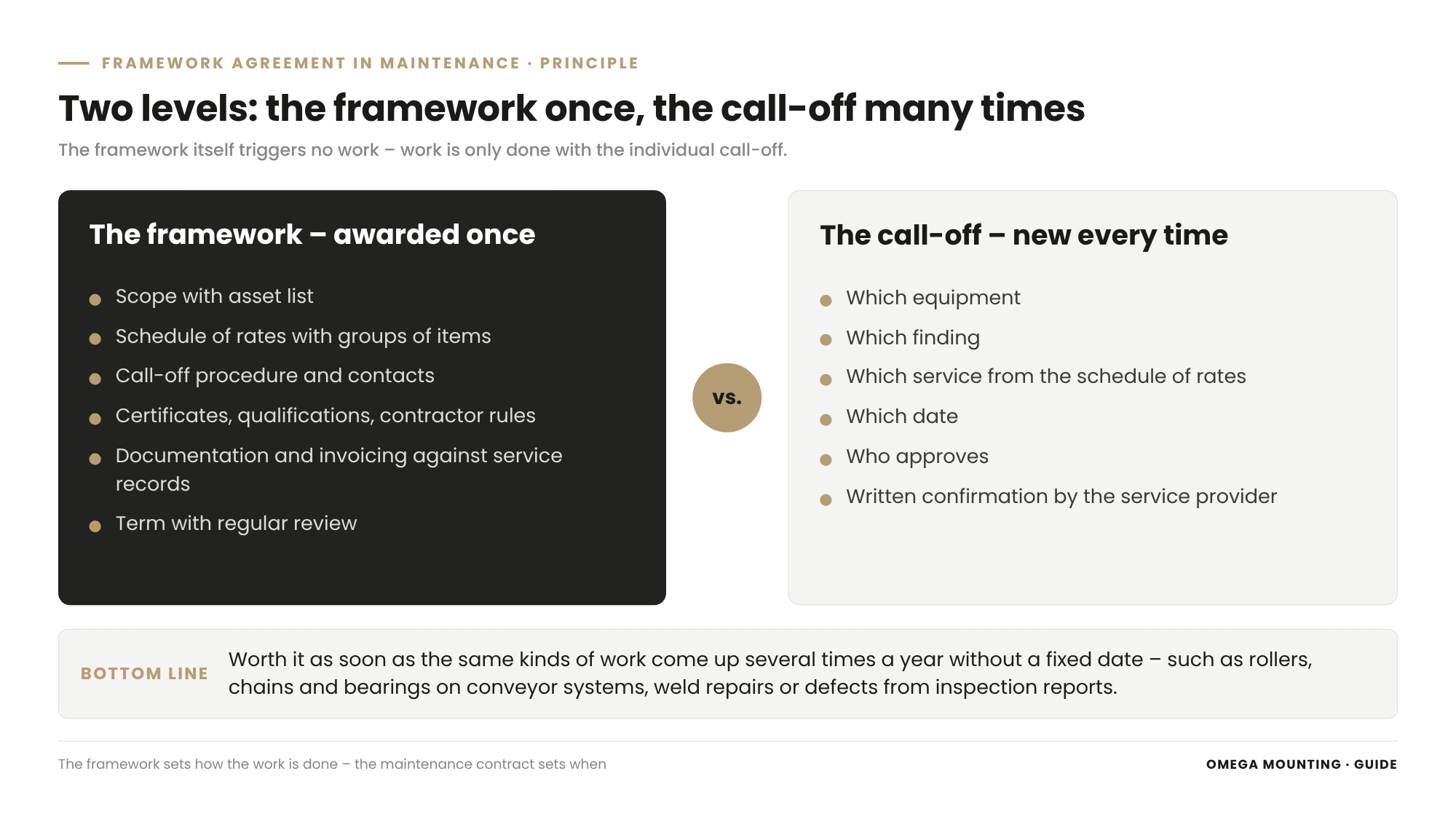
A framework agreement in maintenance is an agreement between operator and service provider that sets the catalogue of services, terms, certificates, call-off procedure and documentation for a fixed period without triggering any work itself. Work is only done when the operator places an individual call-off.
The contract therefore has two levels. The framework contains everything that is the same for every job. The call-off contains only what changes: equipment, finding, service required, date and approval. Some companies speak of a maintenance framework agreement, others of a maintenance contract with call-off items. The principle is the same: award it properly once, then call off quickly many times.
How it differs from a maintenance contract
The maintenance contract sets fixed dates and intervals – the service is agreed before a finding exists. The framework sets how the work is done, but not when. For machines with clear manufacturer intervals, the maintenance contract for machinery is therefore the right form. For equipment whose work arises from findings, it is often the framework. The parent article compares both models in an overview.
How it differs from a one-off order
A one-off order starts from scratch every time: enquiry, quotation, comparison, order, certificates, access. That is right for one-off projects such as a machinery relocation or moving in with a mobile crane. For recurring work it costs time that nobody has in a breakdown. The framework saves exactly these steps – apart from the description of the individual call-off.
When a framework pays off
A framework pays off as soon as the same kinds of work come up several times a year without their date being fixed in advance. Typical examples are rollers, chains and bearings on conveyor systems, weld repairs on ramps and steel components, defect rectification after inspection reports and lifting work when replacing heavy assemblies. Companies with several sites benefit too: a framework makes sure that certificates, documentation and invoicing run the same everywhere. It does little, on the other hand, for a single piece of equipment that is only worked on once a year.
Whether an individual call-off is contractually closer to a contract for work or a contract for services depends on what is owed. The forms are classified in our guide on external industrial fitters.
Which maintenance is required by law?
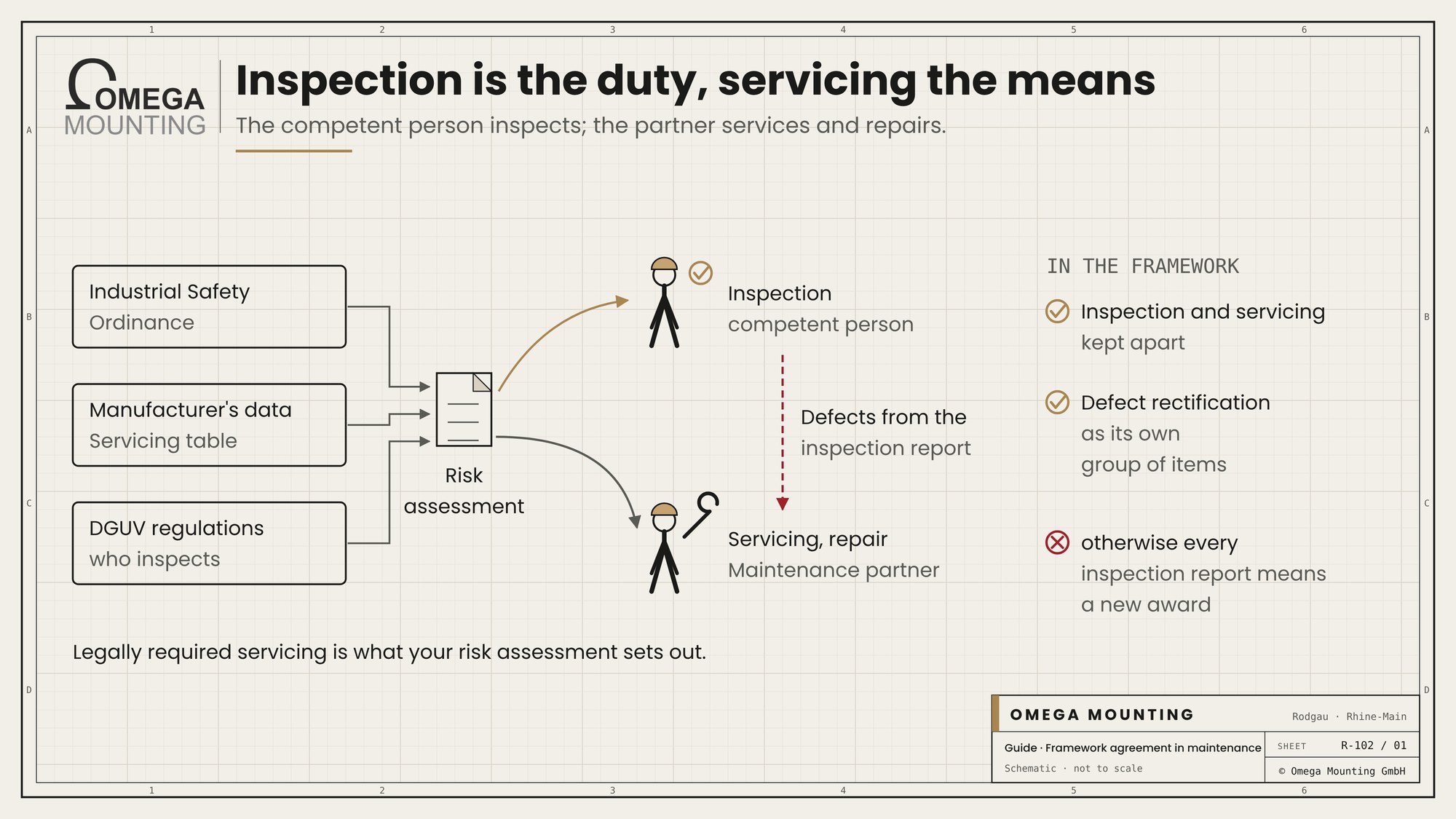
There is no general list of “servicing required by law” for all companies. What is required is the safe condition of work equipment and its inspections. Which servicing is needed for that follows from your risk assessment and the manufacturer's data.
That sounds like dodging the question, but it is the legal position in three steps:
- The BetrSichV (Industrial Safety Ordinance) obliges the employer to provide work equipment in a safe condition and to maintain it. The employer sets the type, scope and frequency of inspections in the risk assessment.
- The manufacturer's data in the operating manual and servicing table say which servicing the equipment needs to stay safe. They feed into the risk assessment.
- The DGUV regulations of the German statutory accident insurance additionally set, for certain work equipment, who inspects – for example for cranes, industrial trucks and electrical installations.
For your framework, this means: inspections are the duty, servicing is the means by which you pass the inspection and keep the safe condition. Servicing required by law in the narrow sense is therefore the servicing that your risk assessment sets as a measure. This guide is not legal advice. Which work equipment is subject to inspection at your site is set out in your risk assessment.
Typical work equipment subject to inspection – and what it means for the framework
The table deliberately gives no deadlines. They are in your risk assessment and in our guide on inspection obligations for operators.
| Work equipment | What is required | Where servicing comes from | In the framework as |
|---|---|---|---|
| Cranes, crane runways, hoists | Periodic inspection by a competent person or an expert examiner | Manufacturer's data, findings, loading | Servicing, repair, defect rectification after inspection |
| Lifting accessories and load-handling attachments | Check before use, periodic inspection | Wear, discard criteria | Replacement after a finding, inspection separate |
| MEWPs, industrial trucks | Periodic inspection | Manufacturer's data, operating conditions | Usually with the hire company or manufacturer |
| Racking | Inspection by a qualified racking inspector, visual checks | Impact damage, damage category | Repair according to the inspection report |
| Loading ramps, power-operated doors | Periodic inspection | Hydraulics, welds, wear | Servicing, weld repair, replacement |
| Conveyor and sorting systems | Inspection according to the risk assessment, safety devices | Manufacturer's data, running hours | Mechanics, wear parts, retrofitting |
| Electrical installations | Periodic inspection by a qualified electrician | Regulations and operating conditions | Separate partner: electrical contractor |
| Standby generator sets, cooling, hydraulic power units | No uniform deadline, inspections according to the risk assessment | Manufacturer's data, test run | Overhaul, lifting, moving in |
Take two things away from the table. First, a good framework keeps inspection apart from servicing: the competent person inspects, the maintenance partner services and repairs. Second, defect rectification after an inspection belongs in the framework as its own group of items – otherwise every inspection report starts a new award.
Framework agreement in maintenance: what goes in it
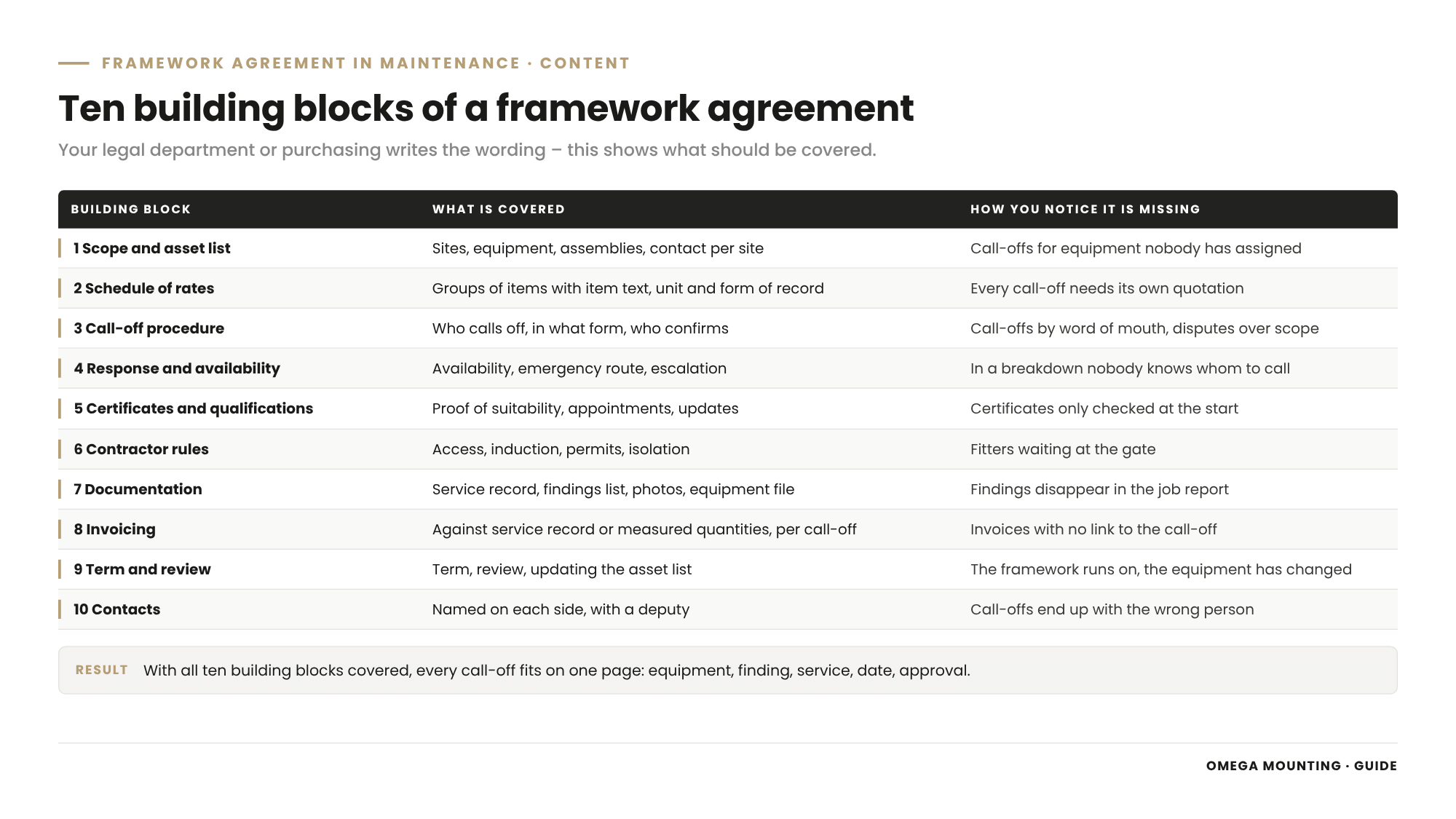
A framework agreement for maintenance needs ten building blocks: scope with asset list, schedule of rates with groups of items, call-off procedure, response and availability, certificates and qualifications, contractor rules, documentation, invoicing against service records, term with review, and named contacts.
Your legal department or purchasing writes the wording. This shows what should be covered – not what it is called legally.
| Building block | What is covered | How you can tell it is missing |
|---|---|---|
| 1 Scope and asset list | Sites, equipment, assemblies, contact per site | Call-offs for equipment nobody has assigned |
| 2 Schedule of rates | Groups of items with item descriptions, unit and form of record | Every call-off needs its own quotation |
| 3 Call-off procedure | Who calls off, in what form, with what description, who confirms | Call-offs by word of mouth, disputes over scope |
| 4 Response and availability | Availability, emergency route, escalation | In a breakdown nobody knows whom to call |
| 5 Certificates and qualifications | Proof of suitability, appointments, updates | Certificates only checked at the start |
| 6 Contractor rules | Access, induction, permits, isolation | Fitters waiting at the gate |
| 7 Documentation | Service record, findings list, photos, handover into the equipment file | Findings disappear in the job report |
| 8 Invoicing | Against service record or measured quantities, assigned to the call-off | Invoices with no link to the call-off |
| 9 Term and review | Term, review, updating the asset list | The framework runs on, the equipment has changed |
| 10 Contacts | Named on each side, with a deputy | Call-offs end up with the wrong person |
If you build a framework agreement for maintenance like this, every call-off fits on one page. Three building blocks deserve a closer look.
Items instead of flat fees
The schedule of rates for maintenance sorts services into groups of items based on the basic measures of the German standard DIN 31051: inspection, servicing, repair and improvement. For an installation and maintenance contractor, three groups are added that many schedules lack: lifting, welding and emergency call-outs. The seventh group is documentation – as a service in its own right, not as an extra. Every item has an item description, a unit and a form of record. Provisional items cover what only comes up occasionally; daywork remains the exception for what cannot be described.
The call-off procedure
A call-off under a framework agreement only works if it is clear who may call off and in what form. A call-off form with equipment, finding, service required, date and approver is common. The service provider confirms the call-off in writing – either with the items from the schedule of rates or with a short quotation per call-off if a site walk is needed. How response and availability in a breakdown are defined is set out in the parent article and our guide on SLA in maintenance; this guide does not repeat it.
Certificates, contractor rules, documentation
You check the certificates once at the start and regularly after that: qualifications, appointments, insurance, certificate of good standing. Which ones you may ask for is shown in our guide on subcontractor credentials in installation. Induction, permits and isolation are governed by your contractor management – the framework refers to it instead of reinventing it. And documentation does not end with the service provider: how service records and findings pass an audit is described in our guide on maintenance documentation for audits.
Award: how to tender a framework agreement
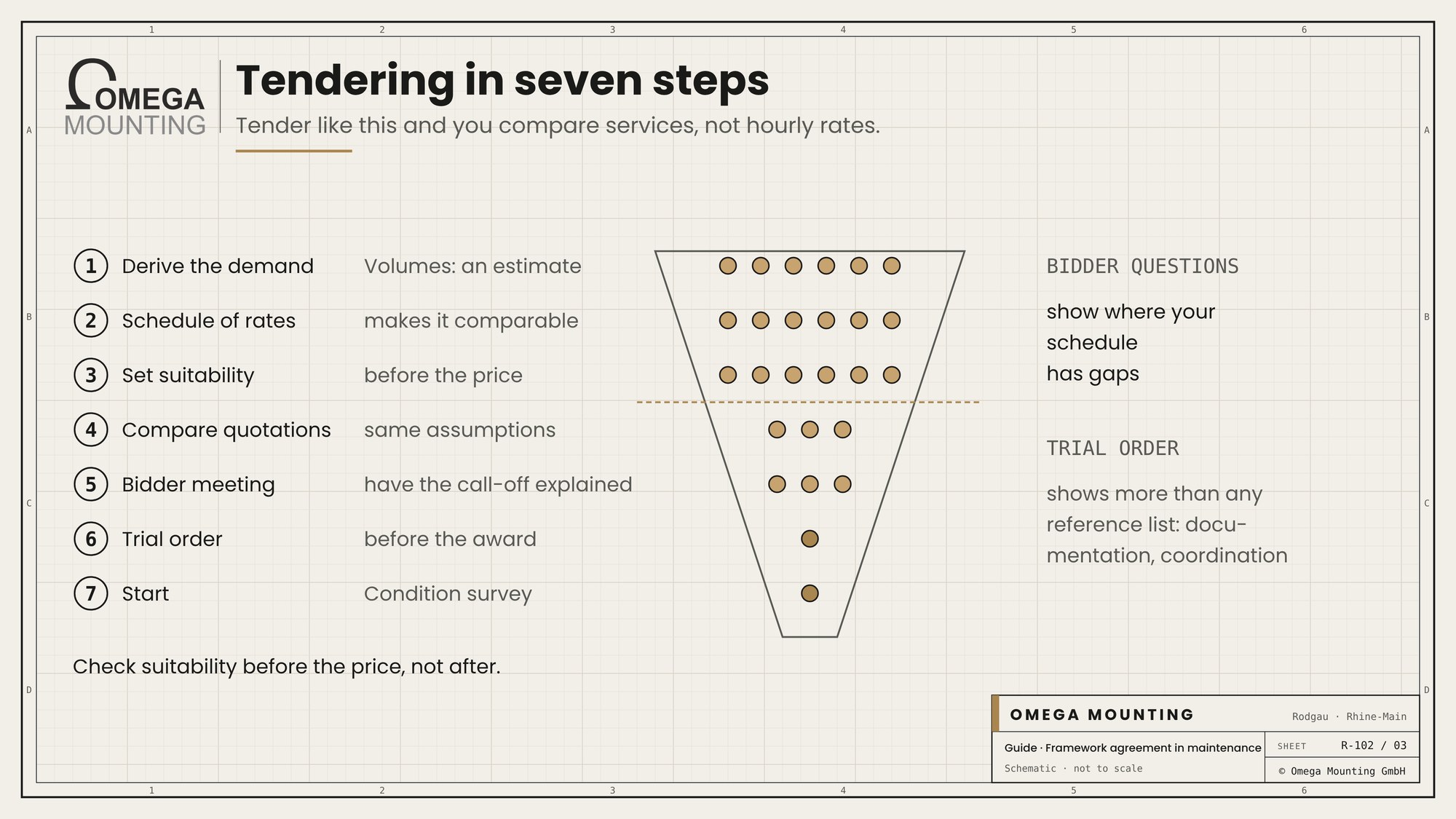
You tender a framework agreement for maintenance in seven steps: derive the demand from the asset list and findings history, draw up the schedule of rates, set suitability, make quotations comparable, hold a bidder meeting, place a trial order and prepare the start with a condition survey.
- Derive the demand. Asset list, inspection calendar, findings list and the breakdowns of recent years show which services recur. This produces a volume estimate – an estimate, not a promise.
- Draw up the schedule of rates. Groups of items, item descriptions, units and forms of record. This is where it is decided whether quotations will be comparable later.
- Set suitability. Qualifications, references on comparable equipment, workshop, availability, insurance. Check suitability before the price, not after.
- Make quotations comparable. Same schedule of rates, same assumptions, same ancillary services. What matters here is shown in our guide on comparing maintenance quotations.
- Hold a bidder meeting. Have the bidder explain how a call-off runs on their side – from the phone call to the service record. Bidder questions show where your schedule has gaps.
- Place a trial order. A manageable job before the award shows more than any reference list: how is it documented, how does coordination work?
- Prepare the start. The first appointment after the award is a site walk with a condition survey. It is the baseline against which later findings are measured.
If you build your maintenance tender like this, you compare services, not hourly rates. How enquiry, site walk and order fit together for installation work is described in our guide on commissioning an industrial installation.
Public-sector clients
For public-sector clients, public procurement law also applies when awarding a maintenance contract or framework. Your procurement office clarifies procedures, thresholds and deadlines – this guide deliberately does not go into them. The technical building blocks of the framework stay the same.
One service provider or several?
Many companies split the framework by trade: mechanics, lifting and plant electrics with an installation and maintenance contractor, building electrics with their own electricians, inspections with the competent person, controls and software with the manufacturer. More partners mean more interfaces, but also less dependence. Which services should stay with the manufacturer and which an independent contractor can take on is shown in our guide on manufacturer's service or an independent maintenance contractor.
The call-off day to day: from the call-off form to acceptance
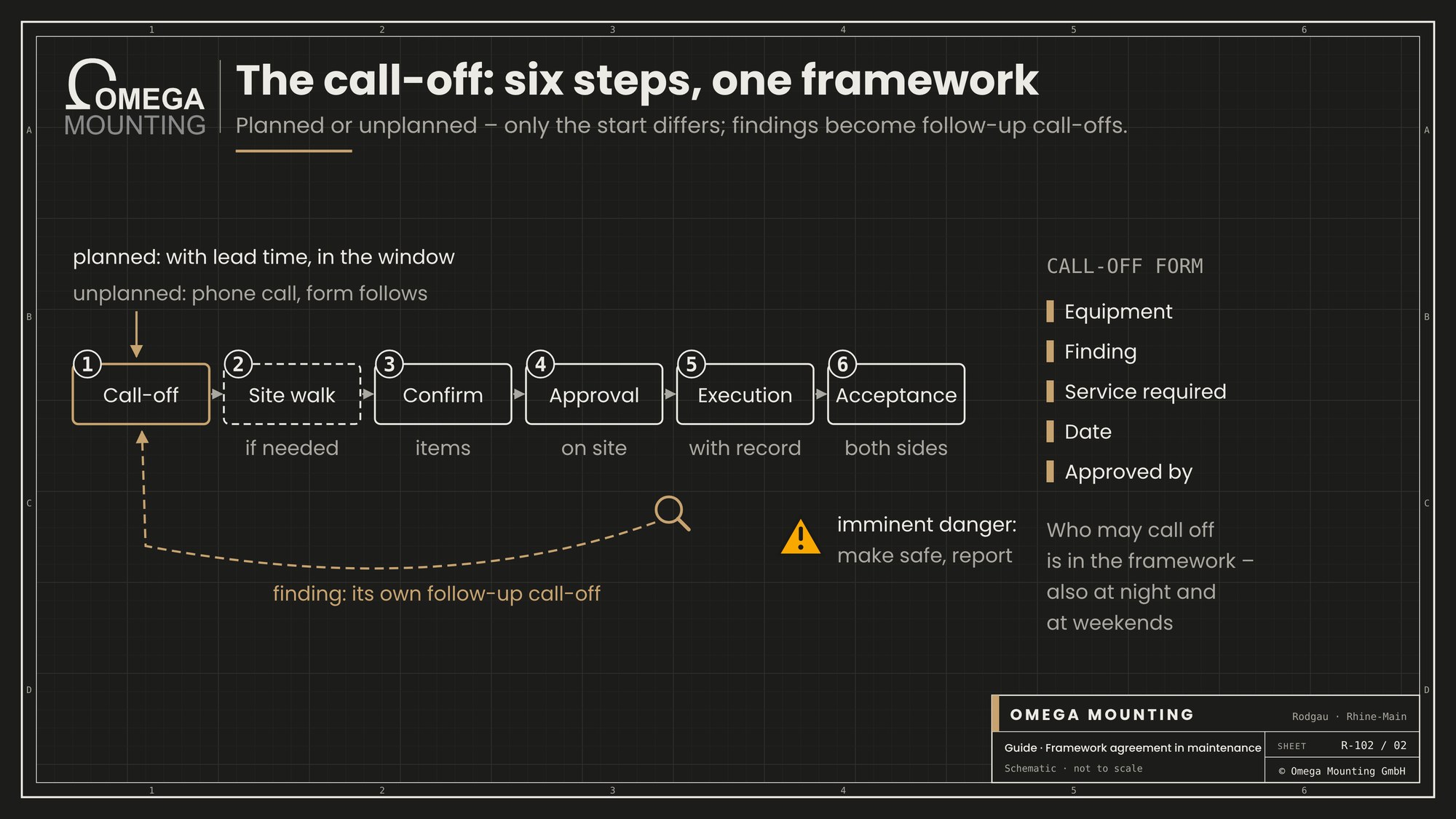
A call-off runs in six steps: call-off form, site walk if needed, confirmation with items or quotation, approval on site, execution with service record and acceptance – and every finding that comes up along the way becomes a follow-up call-off instead of an extra job by word of mouth.
| Step | Who | What it produces |
|---|---|---|
| 1 Call-off form | Person authorised to call off at the operator | Equipment, finding, service required, date, approver |
| 2 Site walk if needed | Operator and service provider | Clear scope, lifting, interfaces |
| 3 Confirmation | Service provider | Items from the schedule or quotation per call-off |
| 4 Approval on site | Operator | Induction, permit, isolation |
| 5 Execution and service record | Service provider | Record with date, findings and photos |
| 6 Acceptance | Both sides | Signature, handover into the equipment file |
Planned and unplanned
The planned call-off has lead time: it can be walked, prepared and placed in a shutdown window. The unplanned call-off starts with a phone call. For it, the framework sets out who may call off at night or at weekends too and how the call-off form is submitted afterwards. Both run through the same framework – only the start is different.
Findings become follow-up call-offs
If the team finds another defect during the work, it is documented and approved as a separate call-off. That way every call-off stays invoiceable and traceable. The exception is imminent danger: anything that directly endangers safety is made safe and reported before anyone talks about items.
Framework agreement, maintenance contract or one-off order?

Which form fits is decided by two properties of each piece of equipment: how predictable is the work, and how heavily does a failure weigh? Most companies therefore need not one form but two or three side by side.
| Predictability | Impact of failure | Suitable form |
|---|---|---|
| High | High | Maintenance contract with fixed dates, repair through the framework |
| High | Low | Framework with call-offs per maintenance plan, or your own maintenance team |
| Low | High | Framework with a set emergency route, spare parts on site and availability |
| Low | Low | Framework with call-off after a finding, or a one-off order |
| One-off | Any | One-off order with a site walk and its own quotation |
A maintenance framework agreement alone does not replace a fixed maintenance plan for critical equipment. A maintenance contract alone does not cover repair after a finding. And a one-off order is right for relocating a machine, but not for the fifth roller replacement of the year. If you want to outsource maintenance, sort the equipment first and then the contracts. Whether and how much to outsource at all is shown in our guide on outsourcing maintenance.
Typical mistakes with framework agreements
The most common mistakes with framework agreements are a schedule of rates that is too coarse, an unclear call-off route, certificates checked only once, a framework without a volume estimate, inspection and servicing mixed up, and the forgotten review.
- Schedule of rates too coarse. “Maintenance work as incurred” is not an item. Result: every call-off becomes a separate quotation and the framework saves nothing.
- Call-off route unclear. Nobody knows who may call off. Result: call-offs by word of mouth, disputes over scope, invoices with no reference.
- Certificates only checked at the start Qualifications and appointments expire, staff change. Result: the certificate is missing at the gate and the window passes.
- Framework without a volume estimate. Without an estimate of demand, every bidder calculates differently. Result: quotations cannot be compared.
- Inspection and servicing mixed up. The framework says “servicing including inspection”, but nobody is named as the competent person. Result: at the end of the year the inspection record is missing.
- Review forgotten. Equipment is added, other equipment is decommissioned or modified. Result: the framework no longer fits the plant.
The annual review
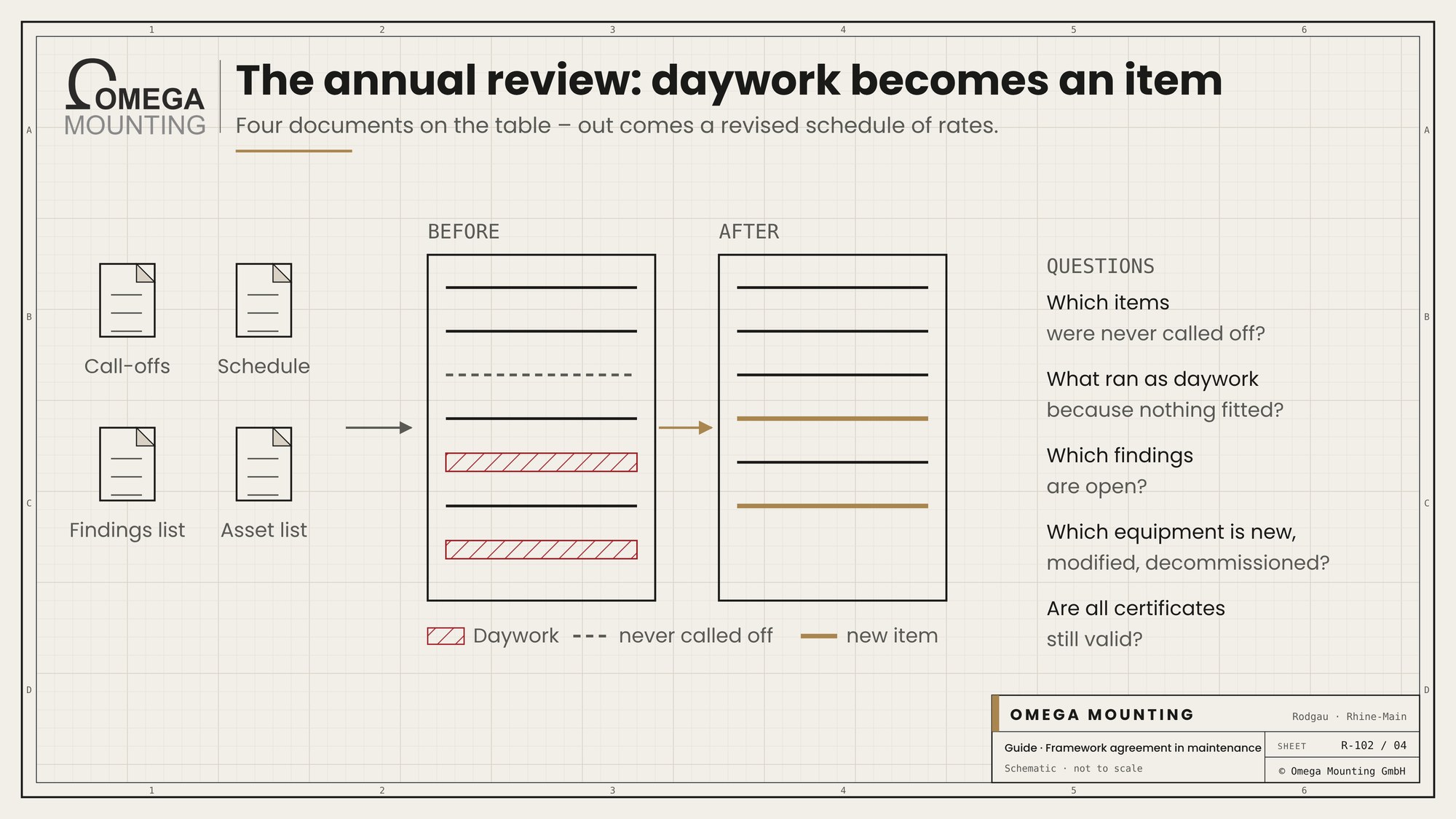
Once a year, operator and service provider sit down with four documents: the list of call-offs, the schedule of rates, the findings list and the asset list. The questions are simple. Which items were called off, which never? Which services came as daywork because no item fitted? Which findings are open, which equipment is new, modified or decommissioned? And are all certificates still valid? The answers produce a revised schedule – with new items for what kept running as daywork, and without items nobody needs.
The countermeasure is the same in every case: a schedule with items, a written call-off route and a fixed date each year when the framework comes onto the table. The budget belongs there too – how call-offs and a reserve get into the annual plan is shown in our guide on planning a maintenance budget.
Framework agreement in maintenance in the Rhine-Main area: how we work
In the Rhine-Main area, we work under frameworks with individual call-offs as well as on one-off orders – and before the award we say which form suits which equipment. From Rodgau, Frankfurt, Offenbach, Hanau, Darmstadt and Aschaffenburg are short journeys.
With us, a new framework starts with a site walk. We go through the asset list with you, assess the critical equipment and write down which groups of items you need. Lifting, welding and emergency call-outs are always in there as separate groups. Parts that the market no longer supplies are remanufactured by our workshop in Rodgau from measurements. For the unplanned call-off, phone and WhatsApp are the way in; what applies behind them we agree with you per piece of equipment.
The scope of our Maintenance and servicing for industrial plants is set out on our service page. Where we are not responsible, the schedule says so: statutory inspections with the competent person, the power feed and building electrics with your electricians, controls with the manufacturer. For a framework agreement in maintenance in the Rhine-Main area, this means: one partner for mechanics, plant electrics, lifting and workshop – in Dietzenbach just as in Rüsselsheim or Mainz.
Project examples
Four jobs from our project diary show what call-offs look like – none of them ran under a framework agreement that we report on here. They are ways of working: an unplanned call-off at night, a planned call-off in a data center, a small call-off with a big effect and a replacement with a clear interface. The link to the contract comes from the classification, not from the jobs.
Sunday evening at a logistics operation: the unplanned call-off
During the emergency call-out on a Sunday evening – a logistics operation whose building was still under construction was getting its power from a standby generator set. It failed when it was started on Sunday evening, and production was due to start at four o'clock on Monday morning. The new generator set came from a different manufacturer, and its connection panel had different dimensions. Cable lugs and heat-shrink sleeves were not to be had anywhere. The team set up a battery-based emergency supply, got the material overnight and connected in the morning – with diesel lines to the additional tank, earthing and measurements. By Monday lunchtime, production was running fully. Afterwards, the customer installed a second generator set for redundancy.
For your framework, this means: the emergency route must set out who may call off on a Sunday evening. And the recommendation afterwards is a typical follow-up call-off.
Data center in Frankfurt: the planned call-off
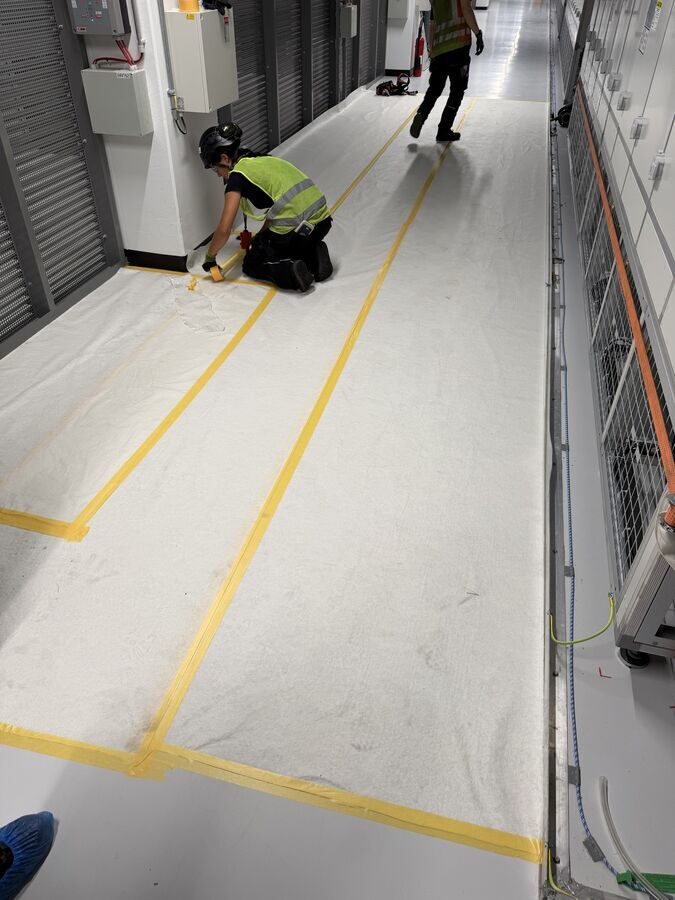
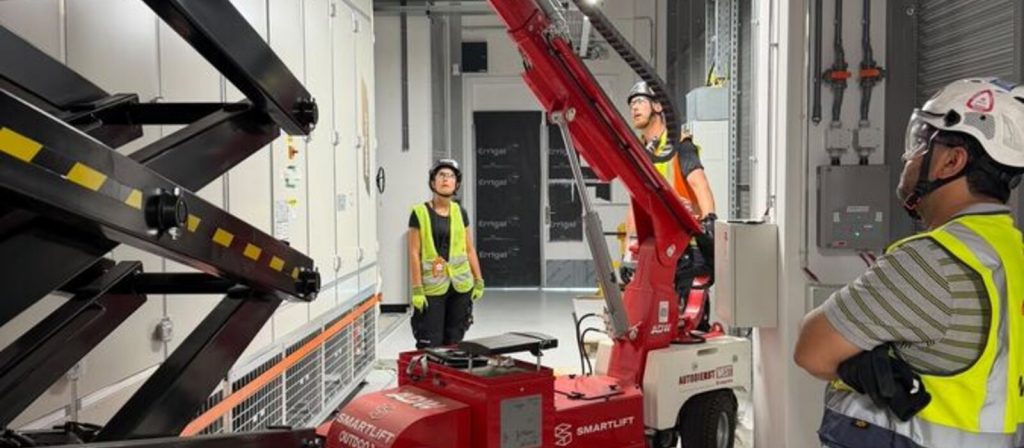
During the replacement of a CRAH unit in a data center in Frankfurt – the heat exchanger of one unit was so badly damaged that a repair on site was not worthwhile. Lift plans were ready in advance, and the transport routes were protected with protective fleece and taping. One supervisor and three riggers brought the new unit up to the second floor and removed the faulty one – in two working days, with hydraulic trolleys, scissor lifts and radio remote control. The result: no damage to the floor or existing equipment, no rework, and the work areas were released again straight away.
For your framework, this means: lifting, floor protection and the lift plan belong in the schedule as items. Then a replacement like this is a call-off with a site walk, not a new award procedure.
Frankfurt Airport: small call-off, big effect
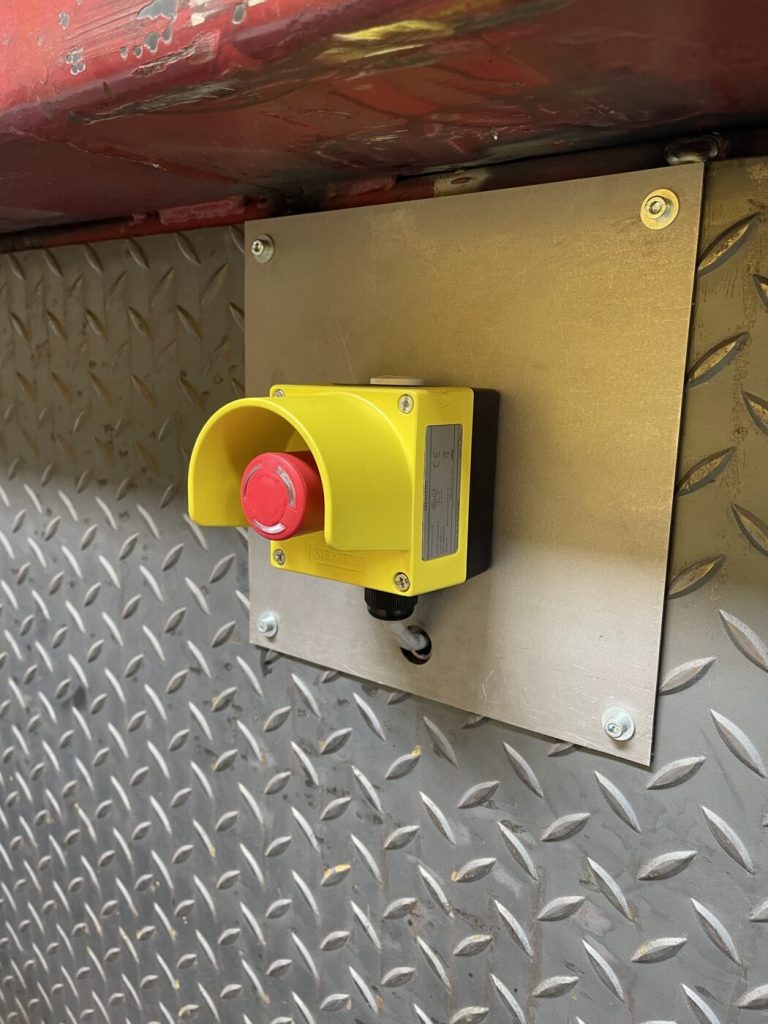
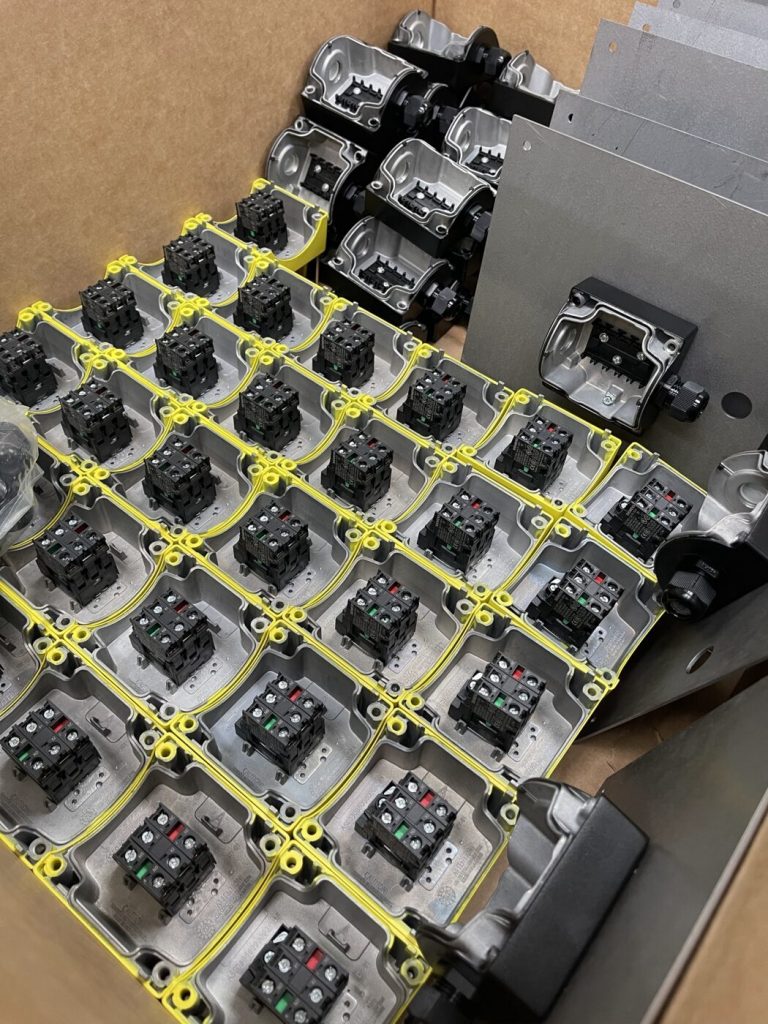
With the installation of emergency stop buttons on a sorting system at Frankfurt Airport – an existing parcel sorting system was extended by 32 emergency stop buttons and several sensors. Two fitters worked for two days during the day in the system's downtime: pre-assembly of the mounting plates, mechanical installation, integration into the existing safety chain with testing – the electrical side in coordination with the operator's qualified electrician. The fitters had their background checks and aviation security training. The system was only allowed back into regular operation once all elements had been installed, connected and tested.
For your framework, this means: access certificates lodged once in the framework are what make small call-offs in security areas possible in the first place.
Logistics centre in Frankfurt: replacement with a clear interface
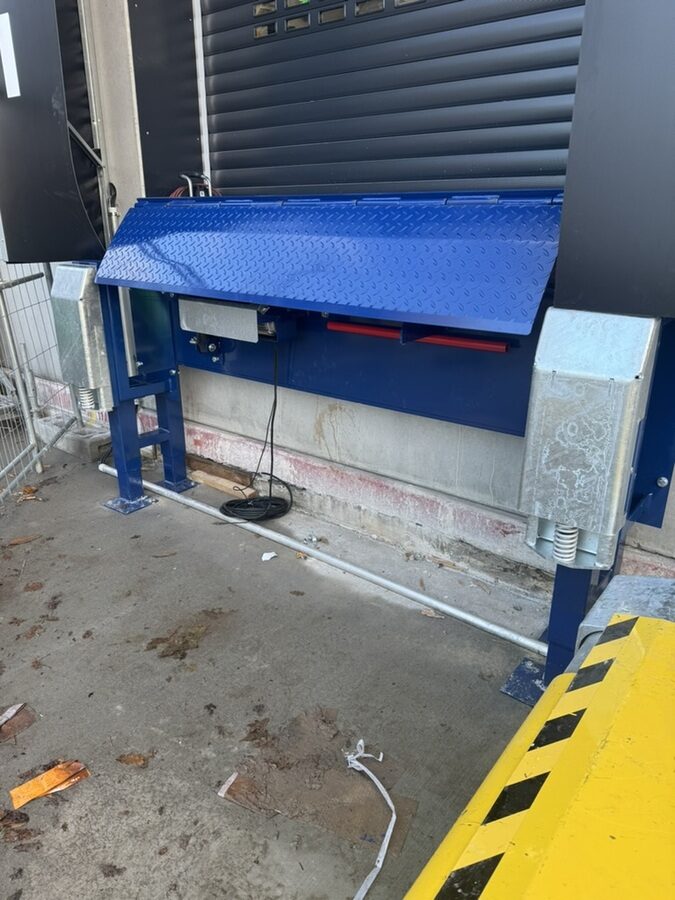
During the replacement of two folding ramps at a logistics centre in Frankfurt – two mechatronics technicians replaced two manually operated ramps with fully hydraulic ones in one day on site. They cut off the old ones with an angle grinder, positioned the new ones with a forklift and MAG-welded them to the existing steel structure. On top of that came support legs, hydraulics, a hydraulic control cabinet, two control cabinets in the building and the connecting cables. The final power connection was still missing – the work ran from a power distribution board, and the in-house electrical contractor reconnected later. By the end of the day, both doors were ready for use.
For your framework, this means: the boundary with the electrics belongs on the call-off form. Then nobody waits for anybody.
Is a framework coming up – or is one running that does not work?
Then get in touch with us. Bring your asset list, the existing contract and last year's call-offs. During a site walk in the Rhine-Main area, we look together at which groups of items are missing and which equipment needs a different form.
What this means for your role
For buyers: Award the framework on the basis of a schedule of rates with groups of items and a volume estimate, not by comparing hourly rates. Check suitability before the price and plan in a trial order. Set the call-off route in writing before the first call-off comes in.
For designers: Every new piece of equipment you plan will later be part of a framework. Pass on the servicing table, inspection duties, lifting points and moving-in routes so that they can become items. If you plan access openings and access routes as well, later call-offs will be shorter.
For project managers and site managers: As a project manager, you make sure that the handover of a plant provides the documents for the schedule of rates. As a site manager, you induct the framework partner's fitters, issue permits and countersign the service record. Without your signature, a call-off is not complete.
For maintenance managers: You are the most important person authorised to call off and the author of the volume estimate. Keep the asset list and findings list up to date, keep inspection and servicing cleanly apart and set the annual review as a fixed date. Findings from every job belong in your list, not just in the partner's report.
For facility managers and operators: For standby generator sets, cooling and building services, the framework is also your evidence towards users and insurers. Check whether the emergency route, access and documentation match your operator duties. The responsibility stays with you – the framework organises how it is met.
Framework agreement schedule of rates outline: template on request
The framework agreement schedule of rates outline is a two-page working document. Page 1 contains the seven groups of items – inspection, servicing, repair, lifting, welding, emergency, documentation – with empty fields for item description, unit and form of record. Page 2 is a call-off form with the fields equipment, finding, service, date, approval and record. It deliberately contains no quantities, prices or contract wording. Request the template via our contact form – keyword “Framework schedule of rates outline”.
Why Omega Mounting?
We are based in Rodgau near Frankfurt, can be reached by phone (Mon–Fri 9 am–3 pm) and on WhatsApp, and have our own workshop that remanufactures parts from measurements. The linked jobs show how we handle call-offs: at night with an improvised emergency supply at a logistics operation, with a lift plan and floor protection in a data center in Frankfurt, with security clearances at Frankfurt Airport, with a settled electrical interface at the loading dock. For you, this means: a single point of contact for mechanics, repair, welding and lifting – with short journeys in the Rhine-Main area and a schedule that says what we do and what we do not.
Conclusion
A framework agreement for maintenance pays off when it covers more than hourly rates: asset list, schedule of rates with groups of items, call-off route, certificates, contractor rules, documentation and an annual review. What the law requires is the safe condition and the inspections of your equipment – servicing follows from the risk assessment and the manufacturer's data. The framework is awarded on suitability and comparable services, and it is lived through call-off forms and service records. If you want to set up or review your framework, send us your asset list, existing contract and last year's call-offs – we'll come back with a site visit date and an honest assessment.
Planning a move-in, installation or maintenance in the Rhine-Main region?
Tell us briefly what you need – we'll come back with an honest assessment.
Free, no-obligation callback
You may also be interested in these guides
Maintenance & Servicing
Maintenance & Servicing
Maintenance & Servicing

About the author
Tobias Schott
Managing director of Omega Mounting GmbH, Rodgau · more than 20 years of hands-on experience in installation and maintenance
A trained mechatronics technician, working in maintenance, servicing and industrial installation since 2004 – first alongside his father, and with Omega Mounting since 2012: from overhead conveyors in Frankfurt to the crane system in a new-build hall. He plans and leads lifting operations as an appointed person (AP) in data centers and on industrial sites in the Rhine-Main region, trains and examines operators of cranes, mobile elevating work platforms and telehandlers, and is a qualified occupational safety specialist. On jobs abroad he is known as the “German Troubleshooter” – the person you call when a site gets stuck. He learned what quality means from his father, not from a manual: Made in Germany as a standard for his own work, not a label. That is why quality comes first at Omega Mounting – ahead of speed and price. He writes these guides from that practice: what works on our sites is in them – what exists only on paper is not.
Frequently asked questions
There is no general list of servicing required by law. What is required is the safe condition of your work equipment and its inspections; the servicing needed follows from the risk assessment and the manufacturer's data. A framework agreement for maintenance needs an asset list, a schedule of rates with groups of items, a call-off procedure, an emergency route, certificates, contractor rules, documentation, invoicing against service records, a term with review and contacts.
The maintenance contract sets when work is done: fixed dates and intervals, agreed before any finding. The framework agreement sets how work is done: items, certificates, call-off route and documentation – the service only arises with the call-off. Many companies combine both: a fixed maintenance contract for critical equipment, a framework for repairs and findings.
Asset list with sites, schedule of rates with item descriptions and volume estimate, suitability criteria, call-off procedure, requirements for availability, certificates and qualifications, contractor rules, form of documentation and type of invoicing. Plus the term and a date for the review. The wording is decided by your purchasing department with the legal department. Technically, what counts is that all bidders offer the same thing.
After the award comes a site walk with a condition survey of the critical equipment – the baseline for all later findings. Then contacts, people authorised to call off, access and induction are set. Ideally, the first call-off is a manageable, planned job. After a few months, both sides check together whether the schedule and call-off route work.
No, that is a commercial decision, not a duty. Some frameworks name a purchase quantity, many only a volume estimate. An honest volume estimate helps both sides: the service provider can plan staff and material, and you get comparable quotations. How to set this out in the contract is for your legal department.
Against the service record: every call-off has a number, every service record refers to it, and so does every invoice. Invoicing is either by the items from the schedule of rates or by the confirmed quotation per call-off. Daywork remains the exception and needs a countersigned record. That way every invoice can be assigned to a call-off, a piece of equipment and a budget.
As many as there are trades that need to be clearly separated: typically mechanics and lifting, electrics, inspections and, where applicable, the manufacturer for controls and software. Several partners for the same trade create alternatives, but also coordination effort. More important than the number is an interface list that says who is responsible up to where.
Yes, the building blocks are the same in all industries; the emphasis shifts. In data centers, lifting, floor protection, access and maintenance windows come first, as with the replacement of a cooling unit in Frankfurt. In logistics, it is doors, ramps, conveyor systems and sorting systems in live operation. At the airport, background checks and aviation security training are added as certificates.
With a short enquiry containing three details: your asset list with sites, the existing contract or your draft, and last year's call-offs or breakdowns. We arrange a site walk in Frankfurt, Offenbach, Hanau or wherever your equipment is, and send a written assessment with missing groups of items and the suitable contract form per piece of equipment. Your contact is Tobias Schott – reachable via our contact form.
 English
 German