
- Guide – Maintenance
Resilience plan for critical facilities: standby power, redundancy and maintenance under Germany’s KRITIS Umbrella Act
By Tobias Schott · 22-minute read · Updated October 2026
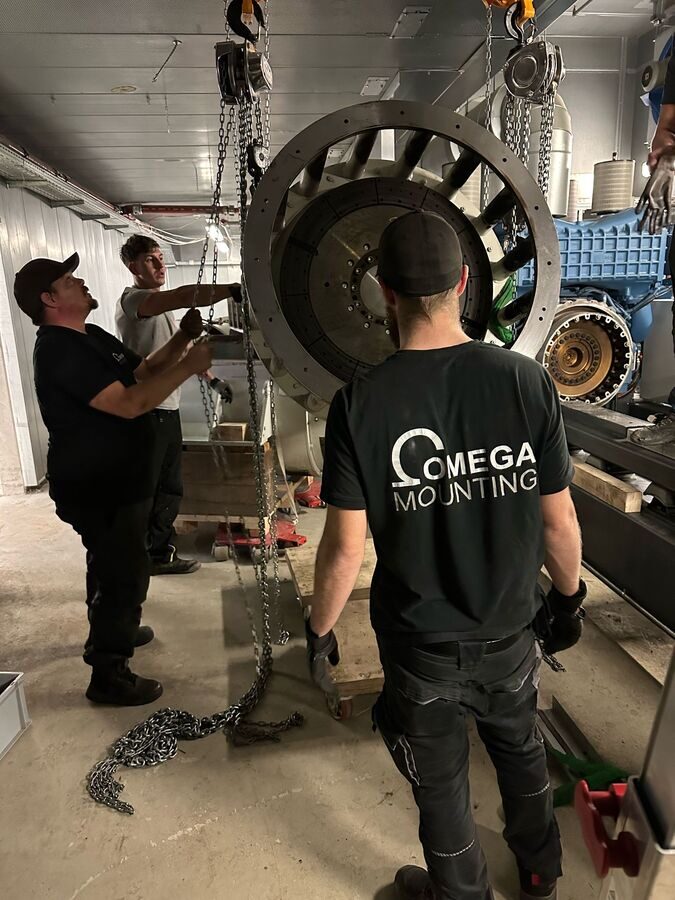
A resilience plan under Germany’s KRITIS Umbrella Act is not a document for the drawer. It describes how a critical facility prevents, withstands and recovers from disruption – and so sooner or later it lands with maintenance.
If you have to draw up a resilience plan for a critical facility, you usually start with law and organisation: registration, risk assessment, reporting lines. By the time you reach the measures, it gets technical. What happens if the grid fails and the standby generator does not start? Where is the spare radiator if the installed one leaks? Who gets a heavy assembly out if the crane first has to be ordered?
This guide covers the technical part. It briefly explains what the law requires and translates its goals into maintenance: maintaining and testing standby power, keeping redundancy in working order, holding spare parts and exchange assemblies, planning recovery, keeping records and managing contractors.
We write from the perspective of a mechanical installation, move-in and maintenance contractor from Rodgau near Frankfurt. The operator writes the resilience plan. We make sure the mechanical measures in it actually work.
Key points at a glance
- The KRITIS Umbrella Act governs the physical resilience of critical facilities – protection against failures caused by natural hazards, technical failure, accidents or sabotage.
- Operators of critical facilities must assess risks, take measures based on that assessment and set them out in a resilience plan.
- Many of these measures are maintenance: servicing and testing standby power, well-kept redundancy, spare parts, planned lifting routes and recovery.
- Redundancy only protects if the redundant plant is also maintained, tested and ready for use.
- Spare parts and exchange assemblies for critical components belong in the plan, together with the route by which they are installed.
- Every measure needs evidence: maintenance record, inspection report, lift plan, service report.
- Service providers belong in the plan – with availability, access rules, qualifications and evidence.
What is the KRITIS Umbrella Act?
The KRITIS Umbrella Act (KRITIS-Dachgesetz) is Germany’s law to strengthen the physical resilience of critical facilities. It transposes the EU Critical Entities Resilience Directive (CER Directive, (EU) 2022/2557) into German law. Other EU member states implement the same directive through their own national laws.
“Umbrella” means the law applies across sectors. Until now, physical security of critical infrastructure was mainly covered by separate rules for each sector. Now there is a common framework. It has applied since 17 March 2026.
Physical resilience, not IT security
The law covers the physical side: buildings, plant, supplies, staff and processes. IT security is governed by another law – the German BSI Act as amended to implement the EU NIS Directive. Many operators fall under both. For maintenance, the KRITIS Umbrella Act is the decisive one, because it is about things you can touch: generators, radiators, pumps, pipes, doors, fences.
Physical resilience describes the ability of a facility to prevent an incident, withstand it, limit its consequences and recover from it.
Who is affected
Operators of critical facilities in sectors that are important for supplying the population are affected. These include energy, water, food, health, transport, IT and telecommunications, finance and municipal waste disposal. Which facility is covered in detail is set out in a statutory ordinance. Check whether your site is covered against the law and the ordinance, or ask the competent authority.
Even if you are not covered yourself, you will often feel the law. Operators pass their requirements on to suppliers and service providers. A maintenance partner for a data center, a waterworks or a logistics centre will increasingly be asked for evidence, availability and reliability.
What operators must do
In simplified terms, the law requires a chain of steps:
- Register. Operators register their critical facilities with the competent body and name a point of contact.
- Assess risks. Based on national risk assessments, operators assess the risks to their own facilities.
- Take measures. The risk assessment leads to appropriate and proportionate technical, security and organisational measures.
- Draw up a resilience plan. The measures are set out in a resilience plan.
- Report incidents. Significant disruptions are reported to the competent body.
Deadlines: staggered
The deadlines are staggered. They depend on registration and on the statutory ordinance, which determine when what is due for your facility. The law and ordinance in their current versions are authoritative. We deliberately do not give fixed dates here.
What this guide does and does not do
Whether your business falls under the law and what applies legally should be clarified with your legal department, a specialist lawyer or the competent authority. This guide is not legal advice. It describes what the law’s goals mean for engineering and maintenance.
What the resilience plan means technically
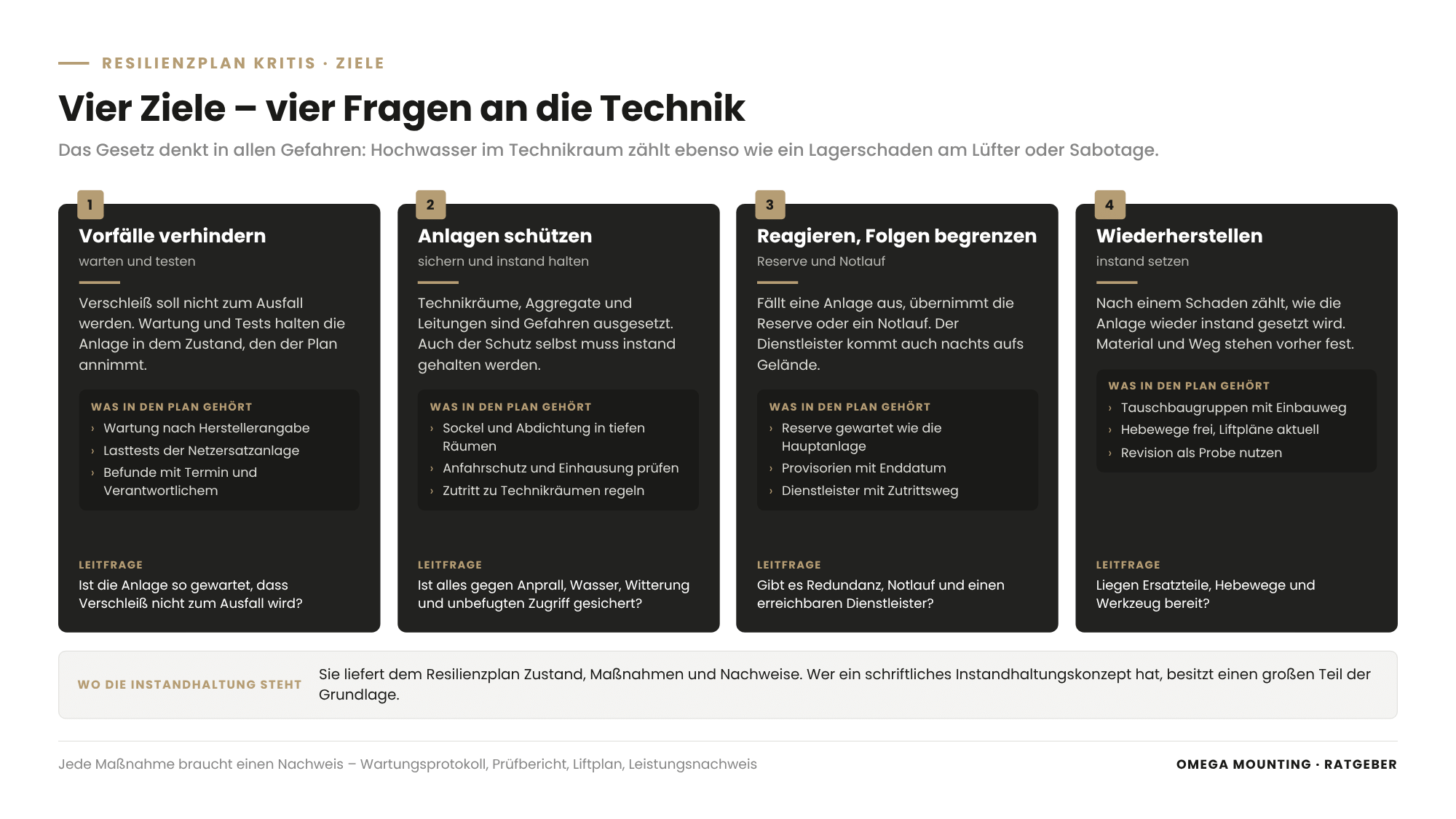
Technically, the resilience plan means that every plant whose failure affects supply is maintained, protected, stocked and documented so that it withstands disruption and returns to service.
The all-hazards approach
The law considers all hazards, not just attacks – the all-hazards approach. For engineering, this means: flooding in the plant room counts as much as a bearing failure in a fan, heat on the roof as much as a cable fire, an excavator hitting the supply cable as much as sabotage. Maintenance has known many of these hazards for years. What is new is that they are assessed systematically and the measures are evidenced.
The goals and their questions for engineering
The law names goals that resilience measures should achieve. In essence they are these – each with a question for maintenance:
- Prevent incidents. Is the plant maintained so that wear does not turn into failure?
- Protect facilities. Are plant rooms, generators and pipework protected against impact, water, weather and unauthorised access?
- Respond and limit consequences. Is there redundancy, an emergency mode and a service provider who can be reached?
- Recover. Are spare parts, lifting routes and tools ready to repair the plant?
There are also requirements for staff and security management, including for external service providers. More on this in the chapter on contractors.
Where maintenance fits into the plan
Maintenance supplies the resilience plan with the condition of the plant, the measures and the evidence. If you already have a written maintenance concept, you have a large part of the basis. How to build one is shown in our guide Creating a maintenance concept. For resilience, one more question comes in: what happens if the plant fails anyway?
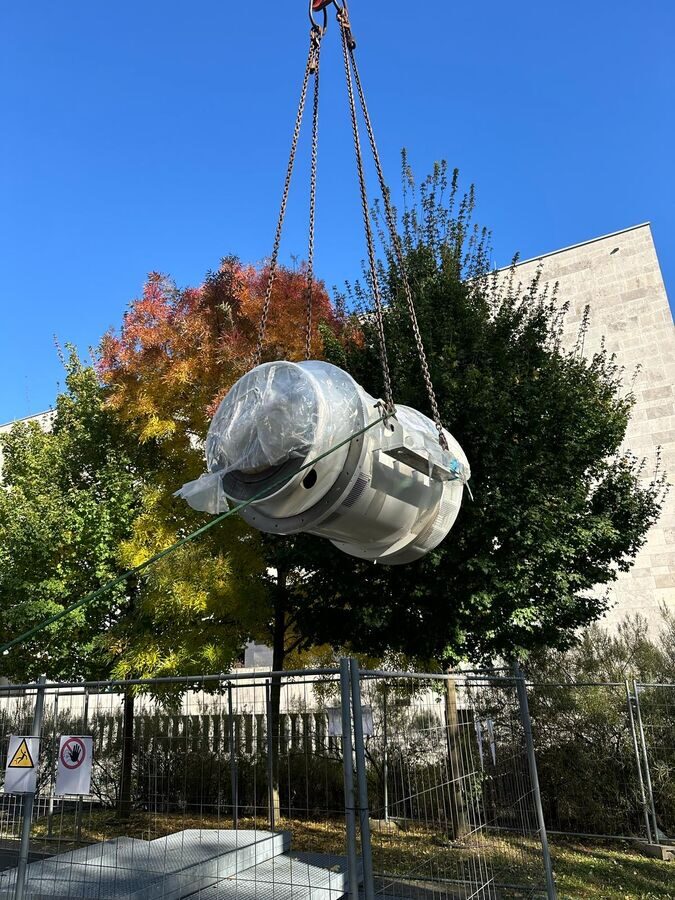
Standby power: maintain, test, evidence
Standby power is usually the central technical measure against grid failure in a resilience plan – but it only counts if the system is regularly maintained, load-tested and documented.
A standby power system stands idle most of the time. That is exactly why it fails when it matters if nobody looks after it: coolant is lost, batteries age, fuel ages, seals go brittle. How generator maintenance works and how a test run differs from a load test is described in our overview guide on maintenance of standby generators. Here we look at which of it belongs in the resilience plan.
What belongs in the plan
- The whole chain. Not only the generator but also radiator, exhaust system, fuel supply, tank, ventilation and enclosure.
- Maintenance as specified by the manufacturer. Intervals and scope follow the manufacturer and the risk assessment, not gut feeling.
- Tests under realistic conditions. Load tests with a load bank show whether the system delivers what it should in an emergency.
- Overhauls with a lift plan. Major overhauls often require removal – so lifting routes and lift plans belong in the documents.
- Findings and follow-up. Anything noticed during the test is fixed, with a date and a person responsible.
Changeover, grid connection and all electrical testing lie with the electrical contractor. We take on the mechanical part: removal, transport, move-in, alignment and reassembly of assemblies.
Why the lifting route is part of resilience
An overhaul shows how hard it would be to repair a plant after damage. Does the enclosure have to be dismantled? Is there an installation shaft? Can the suspension points take the load? If you answer these questions during a planned overhaul, you have already answered them for an emergency. A lift plan from the last overhaul is worth more to the resilience plan than any general statement of intent.
Keeping redundancy in working order
Redundancy means that another unit or assembly takes over the function if the first one fails – it only counts in the resilience plan if the reserve is also maintained, tested and genuinely ready for use.
Many operators of critical facilities rely on duplicated generators, pumps, cooling units or supply feeds. Our standby power guide explains how redundancy levels are named. For maintenance, the following counts.
The reserve ages too
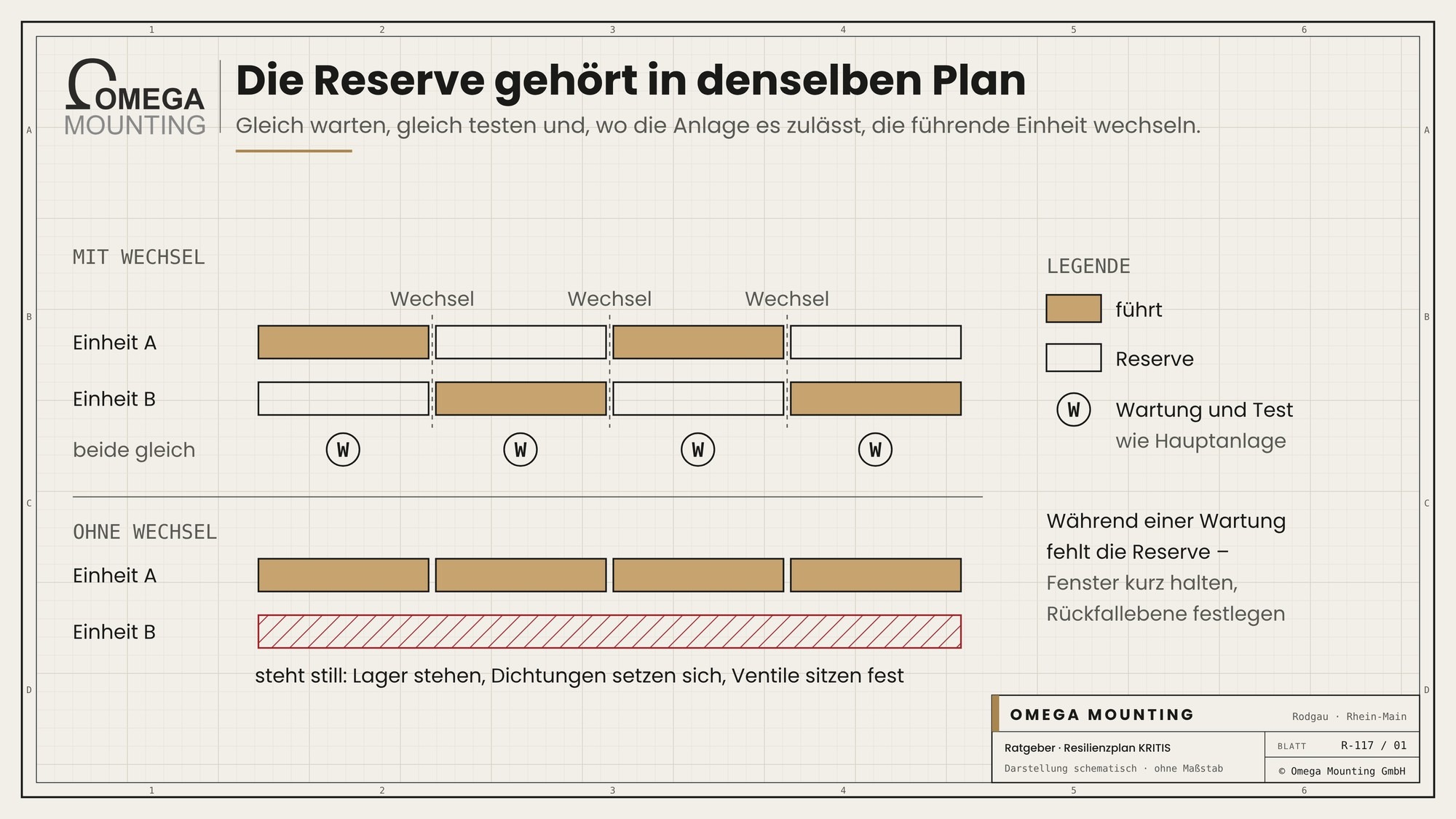
A reserve that never runs wears differently from one that works. Bearings stand still, seals set, valves seize. Plan the redundant plant into maintenance and testing just like the main plant. Where the system allows it, rotate the lead unit regularly.
Maintenance weakens redundancy
While one unit is being serviced, the reserve is missing. In this window the facility is more vulnerable than usual. Maintenance windows for redundant plant therefore belong in the plan: when is maintenance done, how long is the reserve missing, what is the fallback? The better the work is prepared, the shorter the window without a reserve.
Temporary fixes are not redundancy
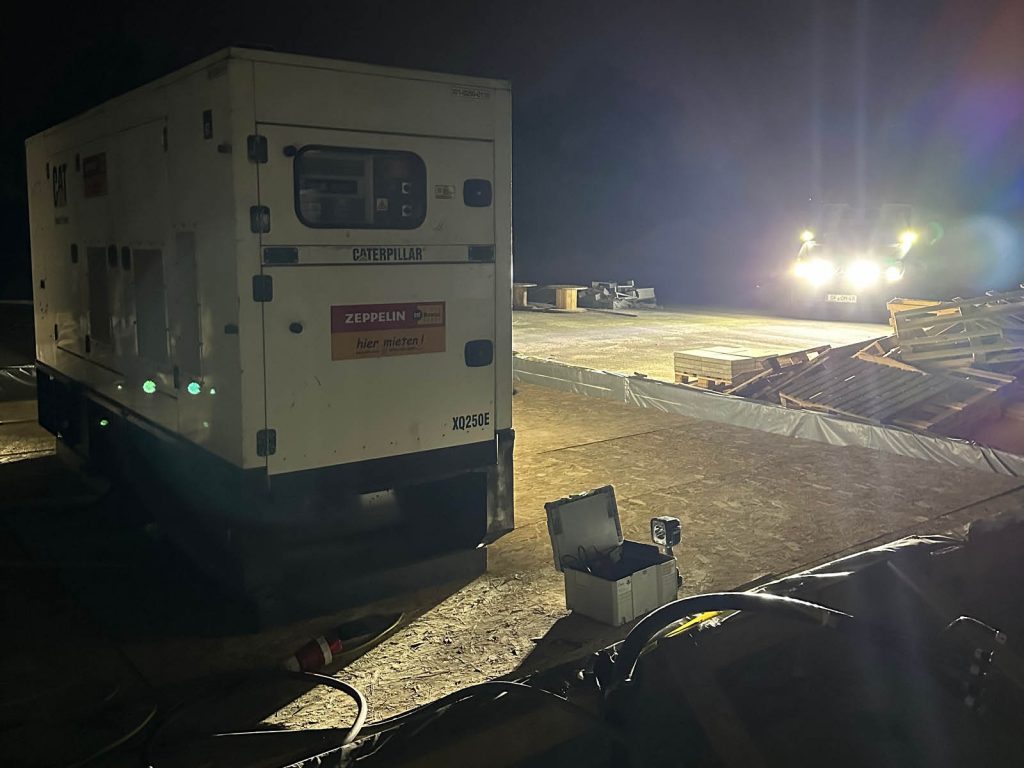
An emergency mode, a hired generator or a stopgap can bridge a gap. But they belong in the plan with an end date and a person responsible. Otherwise the temporary fix quietly becomes permanent. An example from our work: after a generator replacement at night, a logistics business asked for a proposal for an additional standby power system for redundancy and then had it installed.
Spare parts and exchange assemblies
Spare parts and exchange assemblies are the resilience measure for when a critical assembly fails despite maintenance – they belong in the plan with storage location, supply route and installation route.
A spare parts strategy for critical facilities starts with a simple question: which single component brings the whole function to a halt? Often it is not a large generator but a radiator, a coupling, a bearing, a valve or a control board.
Grouping the parts
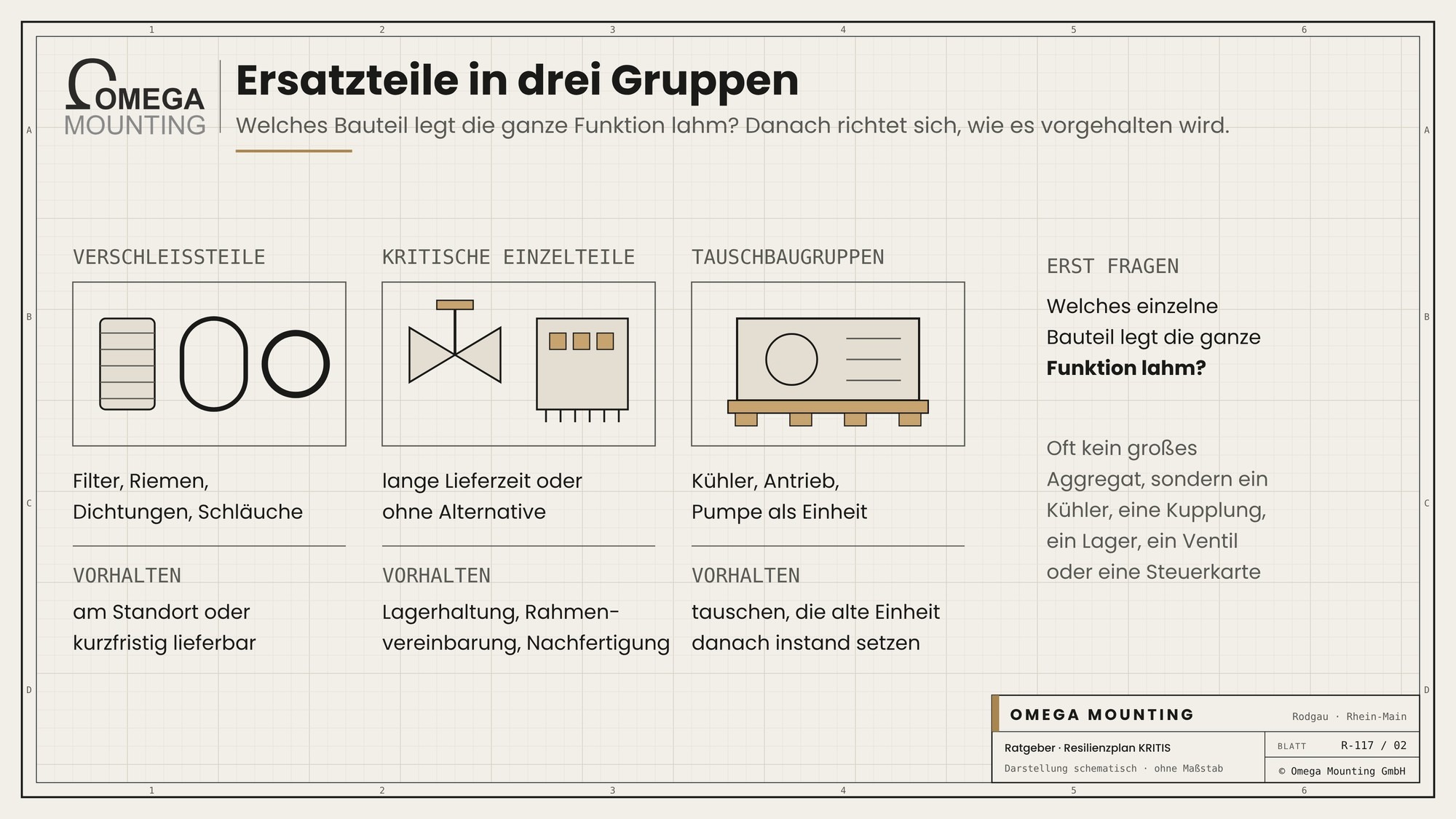
- Wear parts. Filters, belts, seals, hoses. They are stocked on site or available at short notice.
- Critical single parts. Parts with long lead times or no alternative. For these, clarify stockholding, a framework agreement with the supplier or re-manufacture.
- Exchange assemblies. Whole units such as a radiator, a drive or a pump. In the event of damage, the unit is swapped and the old one is then repaired without time pressure.
For parts the market no longer supplies, the usual routes up to re-manufacture are shown in our guide to spare parts that are no longer available.
The installation route is part of it
A spare radiator in the store is little help if nobody knows how it gets to its place. For every exchange assembly, record: weight and dimensions according to the manufacturer, lifting points, transport route, crane standing area, required lifting equipment. Check whether doors, shafts and floors allow the route. Where needed, the structural engineer assesses the load capacity of floors and beams.
When there is no exchange part
Sometimes you have to improvise. Then what counts is that the stopgap is professional, safe and honestly named as such – and that the permanent repair is in the plan with a date. The practice chapter shows an example.
Recovery and restoration
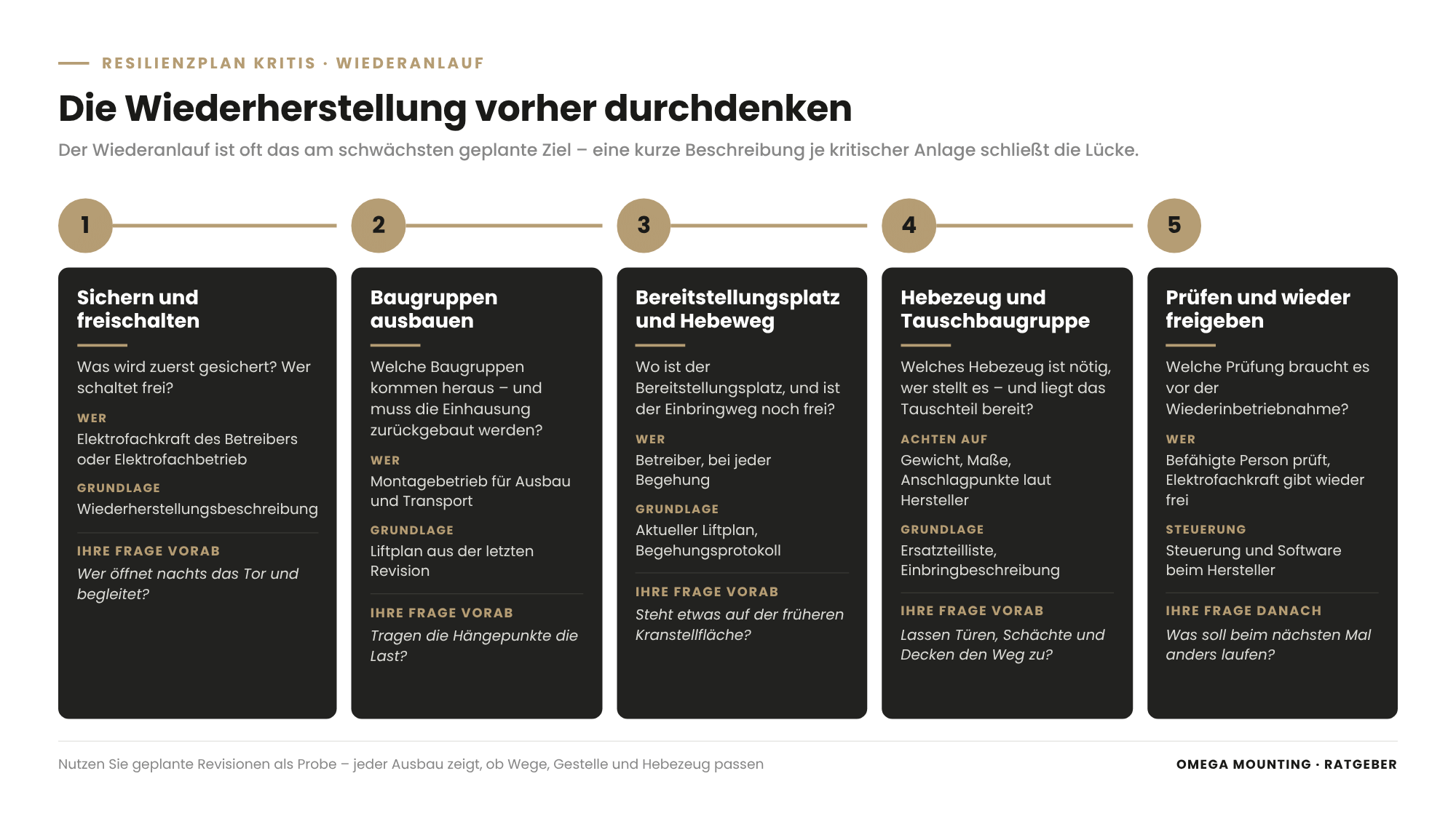
Recovery is the last goal of the law and in practice often the least planned: who repairs the plant after damage, with which material, by which route and in which order?
Think restoration through in advance
A short restoration description is worth having for every critical plant. It answers: what is made safe first? Who isolates? Which assemblies come out? Where is the laydown area? Which lifting equipment is needed, and who provides it? Which inspection is needed before return to service?
Elektrische Freischaltung und Wiederfreigabe laufen nach Ihrem Verfahren – durch unsere oder Ihre Elektrofachkraft. Steuerung und Software bleiben beim Hersteller. Die Prüfung nach einer Instandsetzung übernimmt die befähigte Person.
Keep lifting routes clear
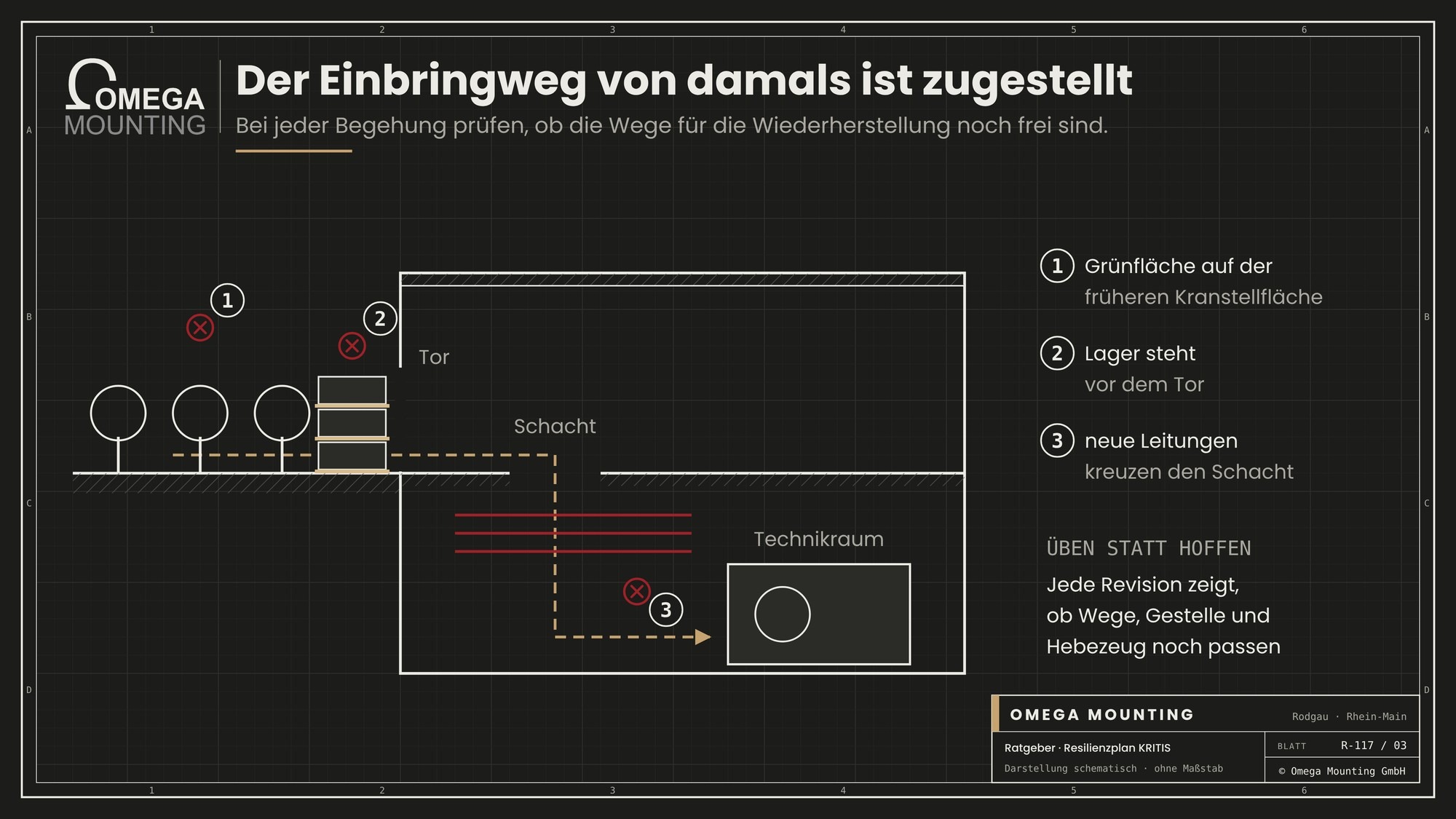
A common blind spot: the installation route by which a plant once came in has since been blocked. New pipes cross the shaft, a store stands in front of the gate, a green space now covers the former crane standing area. Check on every site walk whether the routes for restoration are still clear.
Practise instead of hoping
A plan that has never been practised has gaps. Use planned overhauls as rehearsals: every removal shows whether routes, frames and lifting equipment fit. Record what should go differently next time.
Documentation and evidence
Documentation turns a measure into evidence – for the resilience plan, what counts are maintenance records, inspection reports, lift plans, findings lists and service reports that show the measure has actually been implemented.
The competent authorities can request evidence of the resilience measures. For engineering, this means: what is not documented is, if in doubt, considered not done.
What good evidence contains
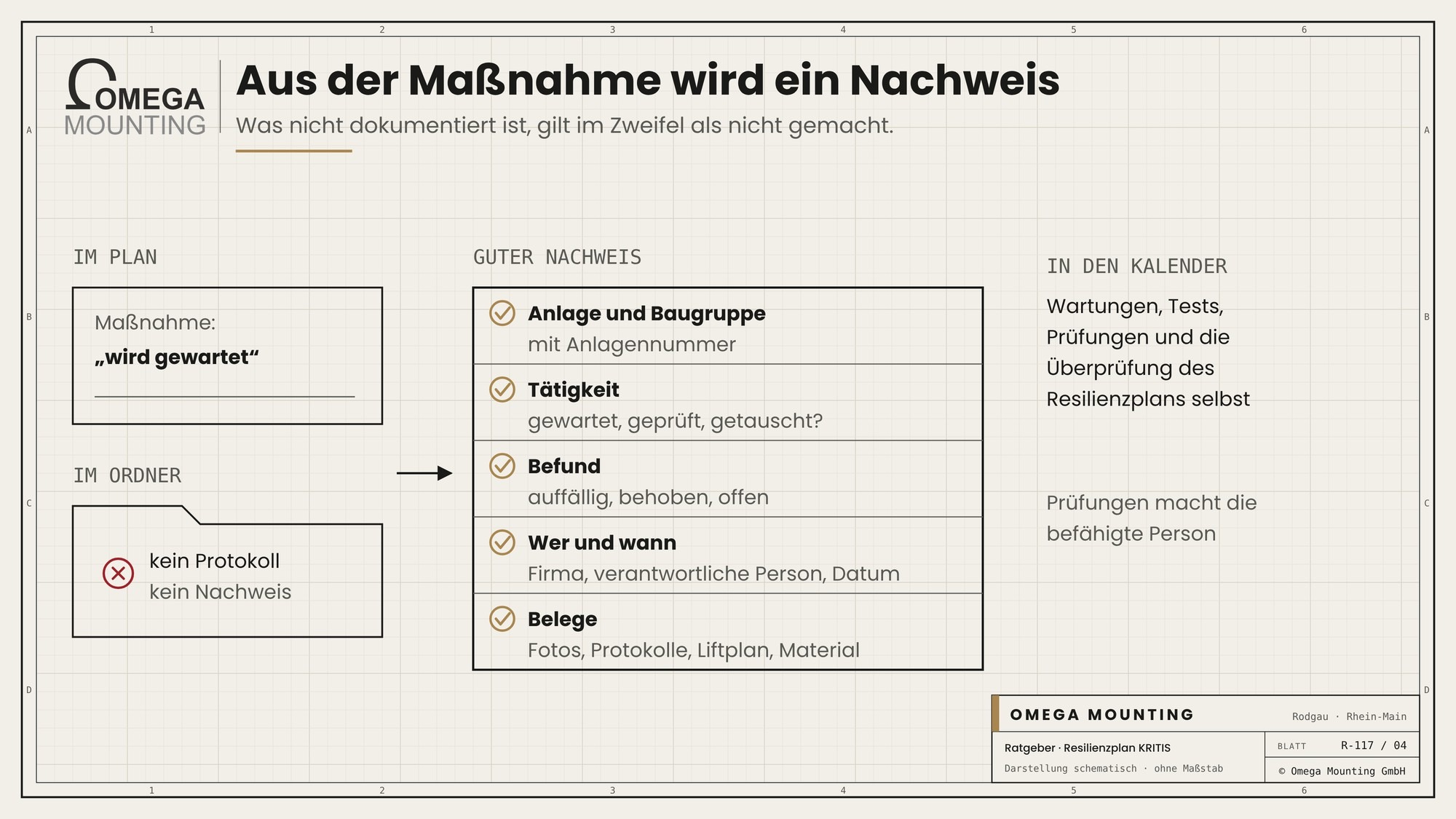
- Plant and assembly. Clearly identified, ideally with the asset number from your asset register.
- Activity. What was serviced, inspected, replaced or repaired?
- Findings. What was noticed, what was fixed, what is still open?
- Who and when. Company, responsible person, date.
- Supporting documents. Photos, inspection records, lift plan, material certificates.
How to keep maintenance records that stand up in an audit is shown in our guide to maintenance documentation for audits.
Make dates visible
Servicing, tests, inspections and the review of the resilience plan itself belong in one shared calendar. How to spread windows and inspection dates over the year is shown in our guide to the maintenance calendar.
Contractors, access and reliability
For resilience, contractors are both an opportunity and a risk: they bring expertise and capacity in an emergency but need controlled access, inducted staff and clear responsibilities.
The law requires appropriate security management, including with regard to the staff of external service providers. In practice this means several things.
Who may go where, and when?
Decide which companies have access to which areas, who escorts them and how tools and materials come in and go out. For sensitive areas, the operator can require a background check of the staff. What that looks like in detail is decided by the operator according to its security concept.
Access in an emergency
Emergencies rarely happen during office hours. Clarify beforehand how a service provider gets onto the site at night or at the weekend: who opens up, who gives the induction, who escorts? A fitter waiting at the gate for a pass is not at the plant.
Coordinating several contractors
In a failure, several trades often work at the same time: mechanical, electrical, refrigeration, manufacturer’s service. Each company needs a contact who can make decisions. How to coordinate several contractors safely is described in our guide to contractor management.
From risk to measure
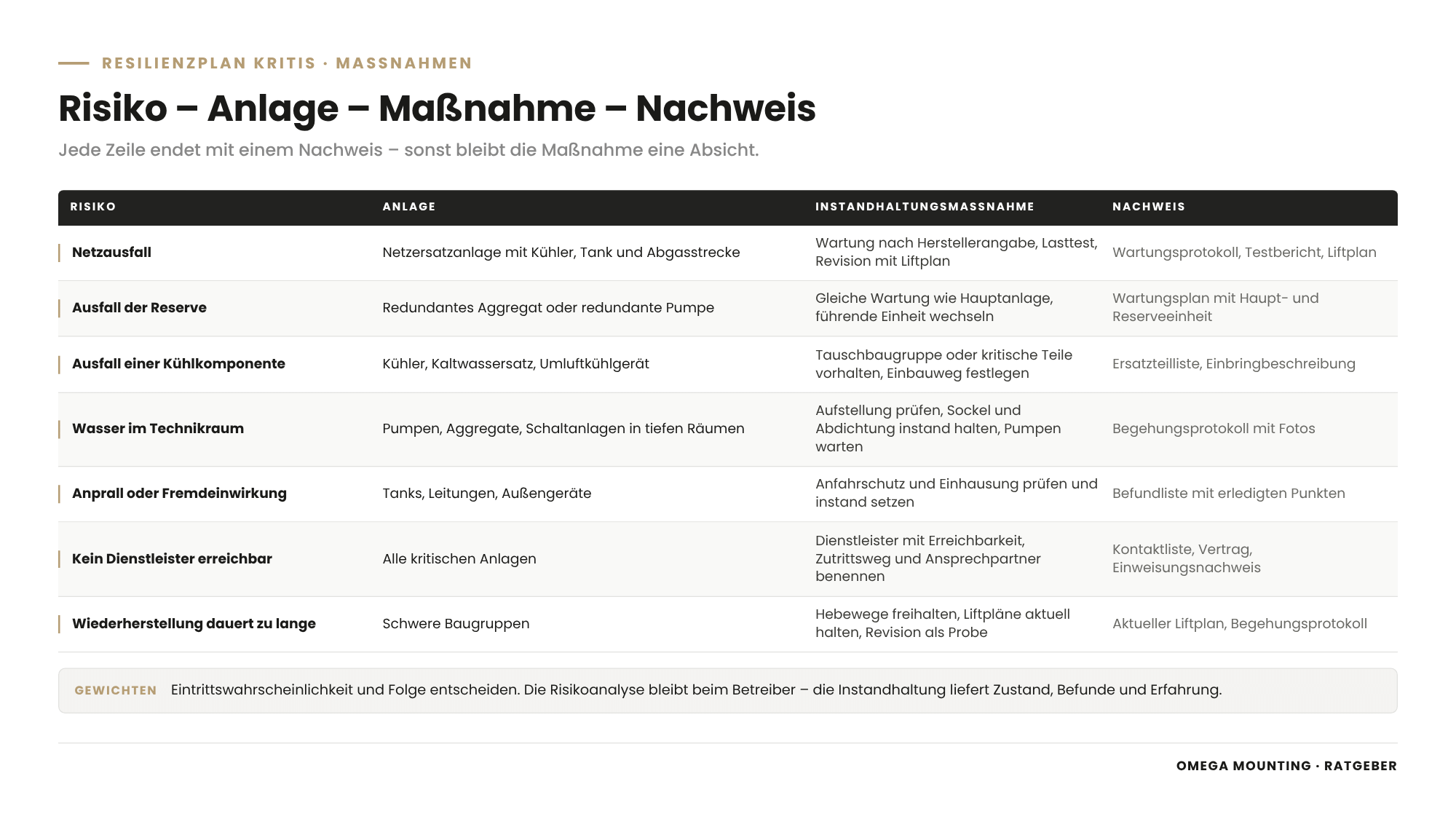
You get from risk to measure by naming the risk for each critical plant, assigning the affected assembly, defining a maintenance measure and specifying the evidence.
The table shows typical rows from the technical part of a resilience plan. It does not replace a risk assessment but shows how a risk becomes a verifiable measure.
| Risk | Plant | Maintenance measure | Record |
|---|---|---|---|
| Grid failure. | Standby power system with radiator, tank and exhaust system. | Maintenance as specified by the manufacturer, load test, overhaul with lift plan. | Maintenance record, test report, lift plan. |
| Failure of the reserve. | Redundant generator or redundant pump. | Same maintenance as main plant, rotation of the lead unit. | Maintenance plan covering main and reserve unit. |
| Failure of a cooling component. | Radiator, chiller, CRAH unit. | Hold exchange assembly or critical parts, define installation route. | Spare parts list, move-in description. |
| Water in the plant room. | Pumps, generators, switchgear in low-lying rooms. | Check installation, maintain plinths and sealing, service pumps. | Site walk record with photos. |
| Impact or third-party damage. | Tanks, pipes, outdoor units. | Check and repair impact protection and enclosure. | Findings list with completed items. |
| No service provider available. | All critical plant. | Name service providers with availability, access route and contact. | Contact list, contract, induction record. |
| Restoration takes too long. | Heavy assemblies. | Keep lifting routes clear, keep lift plans up to date, use overhauls as rehearsals. | Current lift plan, site walk record. |
How to weight the rows
Not every row is equally important. What counts is probability and consequence. How to rank plant by criticality and align maintenance accordingly is shown in our guide to risk-based maintenance. The KRITIS risk assessment itself stays with the operator – maintenance supplies condition, findings and experience.
What operators should require from service providers
Operators should require service providers to be reachable in an emergency, to present their qualifications and evidence, to follow access rules and to document every job so that it fits into the resilience plan.
Availability and response routes
Do not just ask whether a service provider can be reached, but how. Is there a hotline? Who answers? Who decides on the call-out? A response route is more than a phone number. It describes who calls, who authorises and who coordinates on site. How this can be set out in a contract for data centers is shown in our guide to maintenance contracts in data centers.
Evidence and qualifications
Ask for the evidence your plan needs: training records, qualifications for lifting operations, inspection certificates for lifting accessories and lifting equipment, insurance. Ask to see what service reports look like before the first job.
Reliability and access
Ask whether the staff know access procedures for sensitive areas. Ask how tool and material lists are kept. A company used to such procedures loses no time at the gate in an emergency.
Honest limits
Ein guter Dienstleister sagt, was er nicht macht. Ein Montagebetrieb wie wir übernimmt die Anlagenelektrik bis zum Hauptschalter, aber keine Gebäudeelektrik, kein Brandschutzkonzept und keine Rechtsberatung. Er sollte Ihnen aber sagen können, wer diese Teile übernimmt und wie die Schnittstellen laufen.
Typical mistakes in the technical part of the resilience plan
The typical mistakes are looking only at the main generator, forgetting the reserve, planning spare parts without an installation route, leaving temporary fixes in place and writing down measures without evidence.
- Only the generator in view. Radiator, tank, exhaust system and ventilation are missing from the plan.
- Reserve without maintenance. The redundant unit has stood idle for years and was never load-tested.
- Spare part without a route. The exchange assembly is in the store, but nobody knows the lifting points and transport route.
- Temporary fix without end date. The stopgap keeps running because the follow-up job was never planned.
- Blocked installation routes. The shaft or crane standing area has been blocked since the last conversion.
- Service provider without an access route. In an emergency, nobody gets onto the site.
- Measure without evidence. The plan says “is maintained”, but the record is missing from the file.
The mistake behind the mistakes
Behind most mistakes lies a gap between plan and plant. The resilience plan is written in the office; the plant stands in the basement or on the roof. Bring maintenance to the table early. A site walk with the people who know the plant reveals more gaps than any template.
Resilience plans in the Rhine-Main region: how we support you
In the Rhine-Main region, we support operators with the technical part of their resilience plan: site walk, condition survey, mechanical maintenance and overhaul, lifting equipment, move-in and documented jobs.
It starts with a site walk. We look at the critical plant, check installation routes, suspension points and crane standing areas and record what would have to come out after damage, and how. The result is a list of mechanical measures you can take into your plan – your plan stays your plan.
From Rodgau, Frankfurt, Offenbach, Hanau, Darmstadt and Aschaffenburg are short trips. That matters for planned overhauls and even more when something fails. What we deliver in Maintenance and servicing for industrial plants is set out on our service page.
We say up front what we do not take on. The resilience plan, risk assessment and registration stay with the operator. Electrics, changeover and grid connection are done by the electrical contractor. The fire safety concept is prepared by the specialist designer; the fire protection contractor designs and commissions suppression systems. The structural engineer assesses load capacities, the competent person carries out inspections. IT security is not our field.
Project examples
Jobs from our project diary show building blocks that belong in a resilience plan. To be clear up front: none of these reports was commissioned for a resilience plan. They show ways of working that deliver exactly what the plan needs – maintenance, redundancy, restoration and evidence.
Standby power system in the Rhine-Main region: overhaul with a lift plan
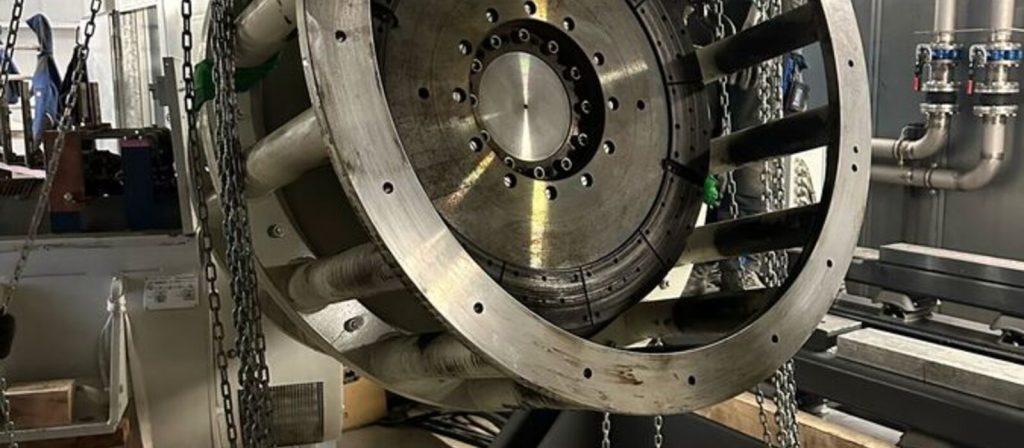
With the maintenance of the generator of a standby power system in a large building complex in the Rhine-Main region, the overhaul was only possible with the generator removed. Before the job, lift plans were prepared, transport routes and openings checked, lifting accessories selected and the load capacity of the suspension points clarified. The enclosure was dismantled, and custom-made frames were ready. Chain hoists on a support structure separated the generator from the engine, machine skates took it to the installation shaft, and a mobile crane lifted it out. The overhauled parts came back the same way and were positioned, connected and aligned.
For your plan, this means: the lift plan of an overhaul is also the restoration description for an emergency.
Data center in Offenbach: stopgap with a follow-up date
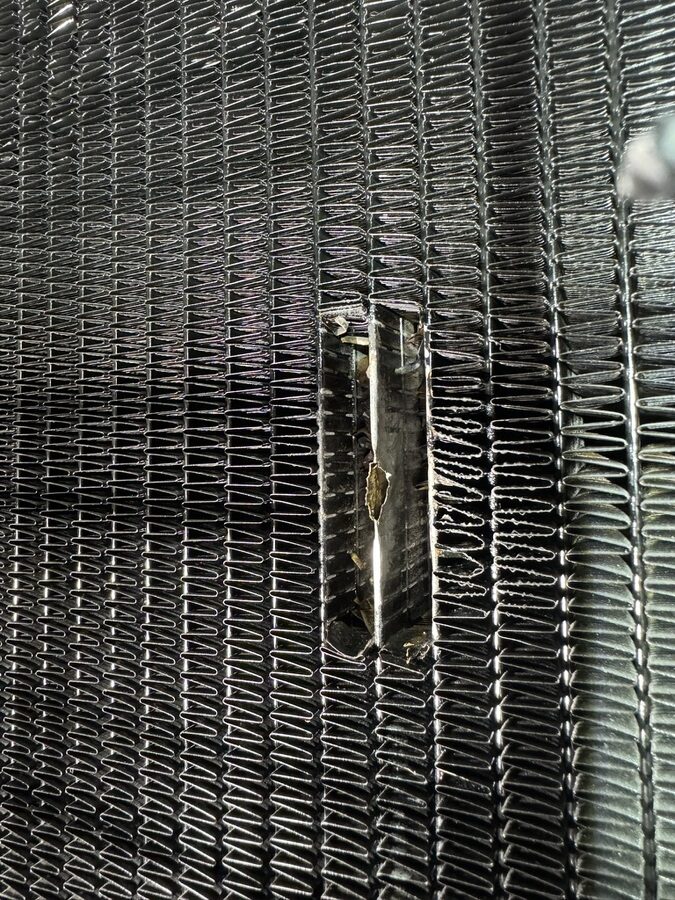
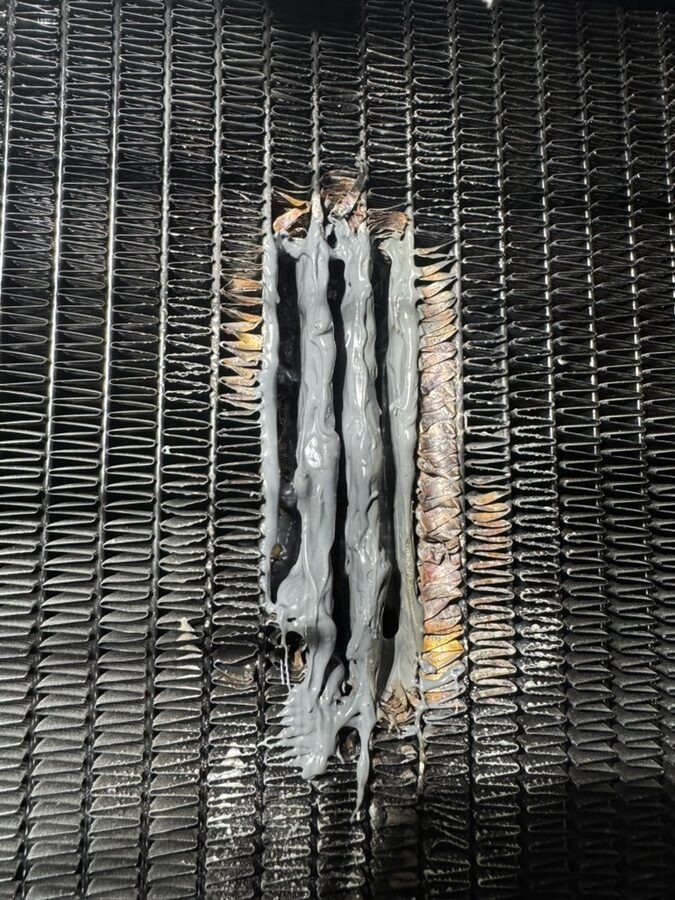
During the radiator repair on a standby generator in a data center in Offenbach a leak had appeared shortly before the system went live. Without working cooling the generator must not run, and acceptance of the standby power supply depended on this component. Removal was not possible at short notice. Together with an HVAC partner, the leak in the narrow gap between radiator and silencer was brazed and additionally sealed. The hot work was registered and safeguarded, and a pressure test confirmed leak tightness. The report explicitly calls the repair a stopgap. The permanent repair was planned as a follow-up job.
For your plan, this means: a temporary fix is acceptable if it is done properly and the follow-up date is fixed.
Logistics business: from failure to redundancy
During the emergency call-out on a Sunday evening the situation was this: a standby generator was supplying a logistics site that was still under construction. Faults occurred on start-up, and the generator was no longer operational. Our team disconnected the lines, drained the fluids and lifted the old generator out. The new one had a different connection panel, so an emergency mode ran at first. Material was sourced overnight, and the next day the new generator was finally connected. Afterwards the client asked for a proposal for an additional standby power system for redundancy and had it installed.
For your plan, this means: once you have lived through a failure, you plan redundancy differently. It is better to do that beforehand.
Data center in Frankfurt: installation under access rules
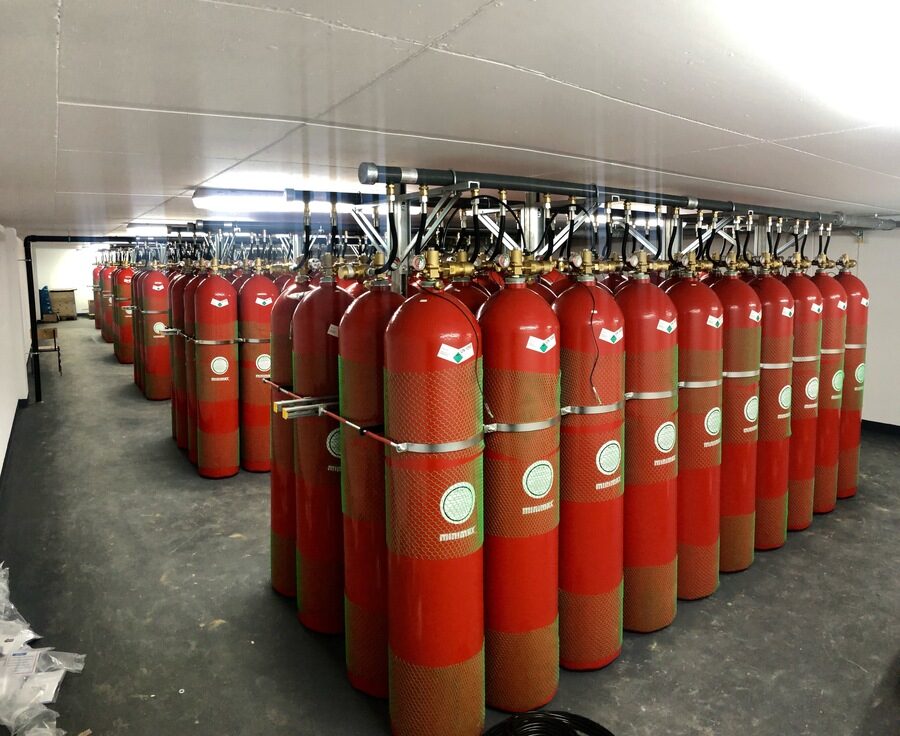
With the installation of a suppression cylinder room for a nitrogen gas suppression system in a data center in the Frankfurt area, we worked as installation partner of a fire protection contractor, who designed and commissioned the system. We installed cylinder racks, pipework and the high-pressure cylinders. Every connection was checked for position, tightening and leak tightness. Access rules and secure areas applied in the data center and were taken into account in the work. The client commissioned the system section by section.
For your plan, this means: protection systems are built by several parties – design and commissioning by the specialist contractor, installation by the installation partner, both documented.
Want to check the technical part of your resilience plan?
Then get in touch with us. Send us the list of your critical plant. On a site walk we show which mechanical measures, lifting routes and spare parts questions belong in your plan.
What this means for your role
For buyers: Ask service providers about availability, access procedures, qualifications and the format of their service reports. Buy critical spare parts and exchange assemblies with storage location and installation route in mind.
For designers: Design new plant so that it can be repaired after damage. Installation routes, lifting points, access hatches and crane standing areas later decide how easily a plant can be restored.
For project managers and site managers: As project manager, you make sure lift plans, move-in descriptions and inspection reports from construction and conversion end up in the operating documents. As site manager, you make sure new installations do not block installation routes.
For maintenance managers: You supply the resilience plan with condition, measures and evidence. Include the reserve in the maintenance plan, keep lifting routes up to date and keep a short restoration description for every critical plant.
For management and resilience officers: Bring maintenance into the work on the plan early. Give it the task of naming gaps – and the budget to close them.
Resilience measures list: request the template
The resilience measures list for the technical part is a one-page working document. For each plant there is a row with the columns “risk”, “plant or assembly”, “maintenance measure”, “evidence”, “responsible” and “status”, plus the fields “exchange assembly available”, “lifting route planned” and “service provider reachable and named”. It deliberately contains no deadlines or legal statements – it helps you sort the technical part together with maintenance. Request the template via our contact form – quoting “Resilience measures list”.
Why Omega Mounting?
Wir sitzen in Rodgau bei Frankfurt, sind telefonisch (Mo–Fr 9–15 Uhr) und per WhatsApp erreichbar und arbeiten regelmäßig in Rechenzentren, Logistikzentren und Industrieanlagen mit Zutrittsregeln. Die verlinkten Einsätze zeigen, wie wir an kritische Technik herangehen: Revision mit Liftplan, ehrlich benannte Übergangslösung mit Folgetermin, Aggregattausch in der Nacht, Montage unter Zutrittsregeln. Für Sie heißt das: a single point of contact for mechanical work, lifting equipment, move-in and restoration – with short journeys in the Rhine-Main region.
Conclusion
A resilience plan under the KRITIS Umbrella Act requires critical facilities to prevent, withstand and recover from disruption. For engineering this means: maintain and test standby power, look after the reserve as well as the main plant, hold spare parts with an installation route, keep lifting routes clear, give temporary fixes an end date and evidence every measure. The operator writes the plan; maintenance makes it robust. If you want to check the technical part of your plan, send us the list of your critical plant – we'll come back with a site visit date and an honest assessment.
Planning a move-in, installation or maintenance in the Rhine-Main region?
Tell us briefly what you need – we'll come back with an honest assessment.
Free, no-obligation callback
You may also be interested in these guides
Maintenance & Servicing

About the author
Tobias Schott
Managing director of Omega Mounting GmbH, Rodgau · more than 20 years of hands-on experience in installation and maintenance
A trained mechatronics technician, working in maintenance, servicing and industrial installation since 2004 – first alongside his father, and with Omega Mounting since 2012: from overhead conveyors in Frankfurt to the crane system in a new-build hall. He plans and leads lifting operations as an appointed person (AP) in data centers and on industrial sites in the Rhine-Main region, trains and examines operators of cranes, mobile elevating work platforms and telehandlers, and is a qualified occupational safety specialist. On jobs abroad he is known as the “German Troubleshooter” – the person you call when a site gets stuck. He learned what quality means from his father, not from a manual: Made in Germany as a standard for his own work, not a label. That is why quality comes first at Omega Mounting – ahead of speed and price. He writes these guides from that practice: what works on our sites is in them – what exists only on paper is not.
Frequently asked questions
The law requires measures based on the operator’s risk assessment. They should prevent incidents, protect the facility, limit consequences and secure recovery, also with regard to staff and service providers. This article covers the technical part: maintenance, redundancy, spare parts, recovery and evidence. Clarify the legal classification with a specialist lawyer or the competent authority.
The KRITIS Umbrella Act has applied since 17 March 2026. The obligations take effect in stages. They depend on registration and on the statutory ordinance that defines which facilities are covered. The law and ordinance in their current versions are authoritative.
The KRITIS Umbrella Act governs physical resilience: buildings, plant, supplies, staff and processes. IT security is governed by the German BSI Act. Many operators fall under both. For maintenance, the physical side matters most.
In most cases yes, if the facility has to keep running during a grid failure. What matters is the whole chain: generator, radiator, fuel, exhaust system, ventilation and changeover. Maintenance, load tests, findings and overhauls are evidenced. Changeover and electrical testing lie with the electrical contractor.
Only if the reserve is maintained, tested and ready for use. A reserve that never runs ages unnoticed. Plan it into maintenance and load testing, and decide how the facility is protected while one unit is being serviced.
That follows from the question of which single component would bring the function to a halt. Typical are wear parts on site, critical single parts with long lead times and exchange assemblies such as radiators, pumps or drives. Each part needs a storage location, supply route and installation route.
Availability with a clear response route, proof of qualifications, inspection certificates for lifting equipment and lifting accessories, experience with access procedures and service reports that fit into the plan. A good service provider also says what it does not take on and names the interfaces.
Für den mechanischen Teil sind Montage- und Instandhaltungsbetriebe aus der Region der kürzeste Weg. Von Rodgau aus unterstützen wir Betreiber in Frankfurt, Offenbach, Hanau, Darmstadt und Aschaffenburg mit Begehung, Wartung und Revision der Mechanik, Hebetechnik und Einbringung. Gebäudeelektrik, Brandschutz und Rechtsfragen bleiben bei den zuständigen Partnern.
A short enquiry with these details: your critical plant, the status of your risk assessment and the existing maintenance documents. We arrange a site walk, look at plant, lifting routes and spare parts and send a written assessment of the mechanical measures. Your contact is Tobias Schott – via our contact form.
 English
 German